

Ski Safety is a Full-Time Thing
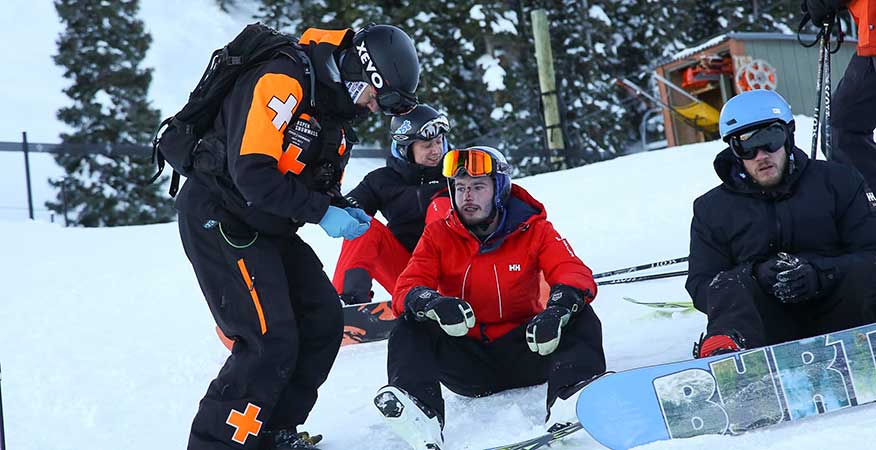
AspenSnowmass Ski Patrol injury
January is promoted as Ski Safety Month, but our attention to safe skiing and riding, and avoiding accidents, should not be limited to one month. It’s a season-long thing.
These common sense tips from the Aspen-Snowmass Ski Patrol – and from me – will help keep all of us safer on the slopes.
Check Your Equipment
Be sure your equipment functions properly. Don’t let malfunctioning bindings or edges ruin your day. Have a local shop do a function test on your bindings.
· When was the last time you had your skis or board waxed and/or sharpened? They should turn like steak knives, not butter knives.
Stay warm and comfortable out on the slopes with goggles, helmet, hat, neck gator, gloves and layers.
· Use the pockets in your parka with sunscreen, lip balm, water and snacks.
Know The Rules Of The Slopes
The Responsibility Code is printed on every trail map and reads:
Always stay in control and be able to stop or avoid other people or objects. People ahead of you have the right of way (it is your responsibility to avoid them; you must not stop where you obstruct a trail or are not visible from above ‚ whenever starting downhill or merging into a trail, look uphill and yield to others; always use devices to help prevent runaway equipment; observe all posted signs and warnings (keep off closed trails and out of closed areas); and, finally, prior to using any lift, you must have the knowledge and ability to load, ride and unload safely.
Be Aware Of Seasonal Conditions
Patrollers keep areas closed until they are safe for everyone. There are hidden obstacles and holes in terrain during any part of the season; hazards exist that are not marked. Large snow storms and/or wind present potential avalanche hazards.
· Skiing or riding closed trails could cost you your lift pass – or worse.
Know What To Do When An Accident Happens
Cross skis or place the snowboard above the injured; make note of potential injury type and location of the incident (look for landmarks).
If possible, stay on the scene until patrol arrives. Patrollers are highly trained— most have at least EMT certification at most resorts — and some are paramedics, so you can trust that the care following an accident on the hill is very professional.
Don’t let an injured person ski or ride down.
· It’s a good idea to load the number of the Ski Patrol on your phone before you get on the first chairlift, gondola or tram of the day. Just in case, and especially if you are skiing along.
Know Your Limits
One of the most essential safety tips is to stay within your skill and fitness levels. Ski and ride only where you are comfortable and don’t let friends talk you into places that will get you into trouble.
· Remember, if you’re caught skiing or riding too fast, you could lose your pass, so stay in control and avoid accidents.
Venture Into The Backcountry At Your Own Risk
If you venture beyond ski area boundaries, be educated on backcountry conditions and special equipment for necessary precautions, and some offer classes to prepare you for the special conditions and safety requirements.
Larger resorts offer backcountry guides and equipment including avalanche beacons.
· Don’t go into the backcountry without the proper gear – or alone
Be safe out there, so we can see you on the slopes the rest of this season and seasons to come.

- Tips and Tactics for Spring Skiing - March 19, 2026
- Short Swings: Timely Tidbits of Snowy News - March 5, 2026
- Indy Pass Adds 16 Resorts for Next Season - March 5, 2026


Thank you for the Responsibility Code…. Important.
The “Standard of Care” of the National Ski Patrol is the Outdoor Care Technician. A few areas want EMTs rather than OEC Technicians. The OEC course is similar to the EMT course with less emphasis on illness and more on trauma and does not include the hospital internship that is required for EMT. OEC Technicians have national standard final examinations and annual refreshers.
Alaska Back Country and Resort ski facts.
2025 is vastly different from 2024.
Way less snow 700 vs 500 inches.
Alyeska Resort makes and professionally grooms a combination of man made and natural snow.
The NOAA Wx Forecasts are accurate. Visibility at sea level is harder to predict/forecast.
That “unknown” fact infers/adds an element of truth. “Is it time to ski”?
Heli Ski Guides Resort reports rely on NOAA Forecasts which are carefully monitored.
The Guides are on the snow with the Clients.
Sea level Wx near a 20+ foot Tidally active Inlet is a known VARIABLE.
IT CHANGES FAST.
The Guides are PRO’s.
When they ski with us at Alyeska and have “OFF the chart skills”,it is reassuring to know
that Both Alyeska Patrollers with their trained Canines coupled with the Guides technical machines/beepers/knowledge Alyeska benefits.
We know the terrain we asses the challenges and we ski together knowing we benefit WITH their company.
Personally having benefitted from Alyeska Patrollers skills am wanting to add my appreciation
to both the Guides and Alyeska Resort.
ALSO THE LIFT CREW AT ALYESKA
It takes a TEAM .
Thanks for the great list!
My one comment is that the Responsibility Code leaves a large gray area when two people are about side-by-side, when it’s not at all clear who is downhill of whom; particularly where two trails merge. Because of that, I would just add, try to ski/ride predictably, ie. if you’re making a repetitive series of GS turns, don’t suddenly cross the slope to stop, without looking, as the person skiing/riding next to you, may not be prepared for that.
The related point, is I often read people’s interpretation of downhill person having right of way, as implying that person has carte blanche to do just about anything, just because they are downhill. I would strongly disagree, but the Responsibility Code leaves a large gray area.
In my opinion, the requirement to look uphill when merging, should also apply to downhill skiers/riders. I mean, if you are making erratic zig-zags down the slope, or changing one’s turn-shape, you should also look uphill before zigging or zagging. How is zigging across a trail merge, any different than zagging on a single trail? It isn’t. People need to ski/ride predictably and look uphill, when changing direction unpredictably. Just my 2cents.