

Skiing Your Dreams At Sugarbush
 When I first started skiing way back in the late sixties, I had no instruction to introduce me into the sport. I had heard many stories from friends who would take their buddies to the top of the mountain and take off, leaving the beginner skier struggling to get down and probably scared to death.
So my approach would be more structured. I would not go to the top until I was able to stop, slow down and turn. After a trial and error, I was able to negotiate the beginner runs at small areas near me in the Northeast, and eventually felt confident enough to join some buddies at Killington, a big step from small to large area.
They left me alone on a beginner area until I felt confident that I was parallel skiing, or, at least, close to it. That afternoon, I talked them into taking me to the top of Ramshead, which turned out to be a disaster.
It took me an hour to make it down, by which time I had lost all the confidence built up that morning. But this was the learning method of trial and error then, and probably still is. I joined some learn-to-ski programs at local areas and progressed to considering myself an advanced intermediate skier.
Then disaster struck again, in moguls. Skiing then was sitting back and skidding the tails of the ski around to help make the turn. It turned out to be a lot of work, and by the day’s end you were exhausted from fighting the hill on every descent.
In the mid 90’s, I went to Sugarbush. The weekend started with a meeting where we discussed how to take deep breaths and other breathing techniques to help relax your body and feel the internal energy. It was really an informal introduction to Tai Chi.
So, what did this have to do with skiing? It turned out to be skiing with your mind and body, being aware and a method of helping you to relax and you as ski down a slope.
Many of us, especially seniors who ski, are in a state of rigor mortis and limited flexibility on skis. You can see that with skiers clutching the poles as tight as they can, moving down the slope in a rigid manner. If you were inside their boots their toes are scrunched together until they hurt, as if they were what was going to stop them as they picked up speed on the trail.
In the afternoon, we practiced feeling the turns, lunging downhill to help you get out over your tips and the skis will miraculously follow you. We also learned to totally relax, the hands, feet, and entire body with deep breathing. I found that helped in feeling my skis turn and for the first time. I was not fighting the hill but being part of the hill.
A very quick course on what was called” Centered Skiing” or” Inner Skiing” skiing within yourself. What a wonderful awakening! That weekend improved my skiing 200% to a stress-free sport that I love to do.
To this day, I continually ski taking deep breaths and feeling every turn as I gracefully descend the slope. Feeling the ski turn in my mind as I watch the tips carve a turn on or through the snow. With today’s the improved equipment it is more and more effortless to ski, and it helps to make the sport more and more enjoyable as the years have progressed.
All this now is a state of mind, I practice breathing and focusing on the slopes, on the golf course and when I play racquetball. All because of that weekend at Sugarbush, many years ago.
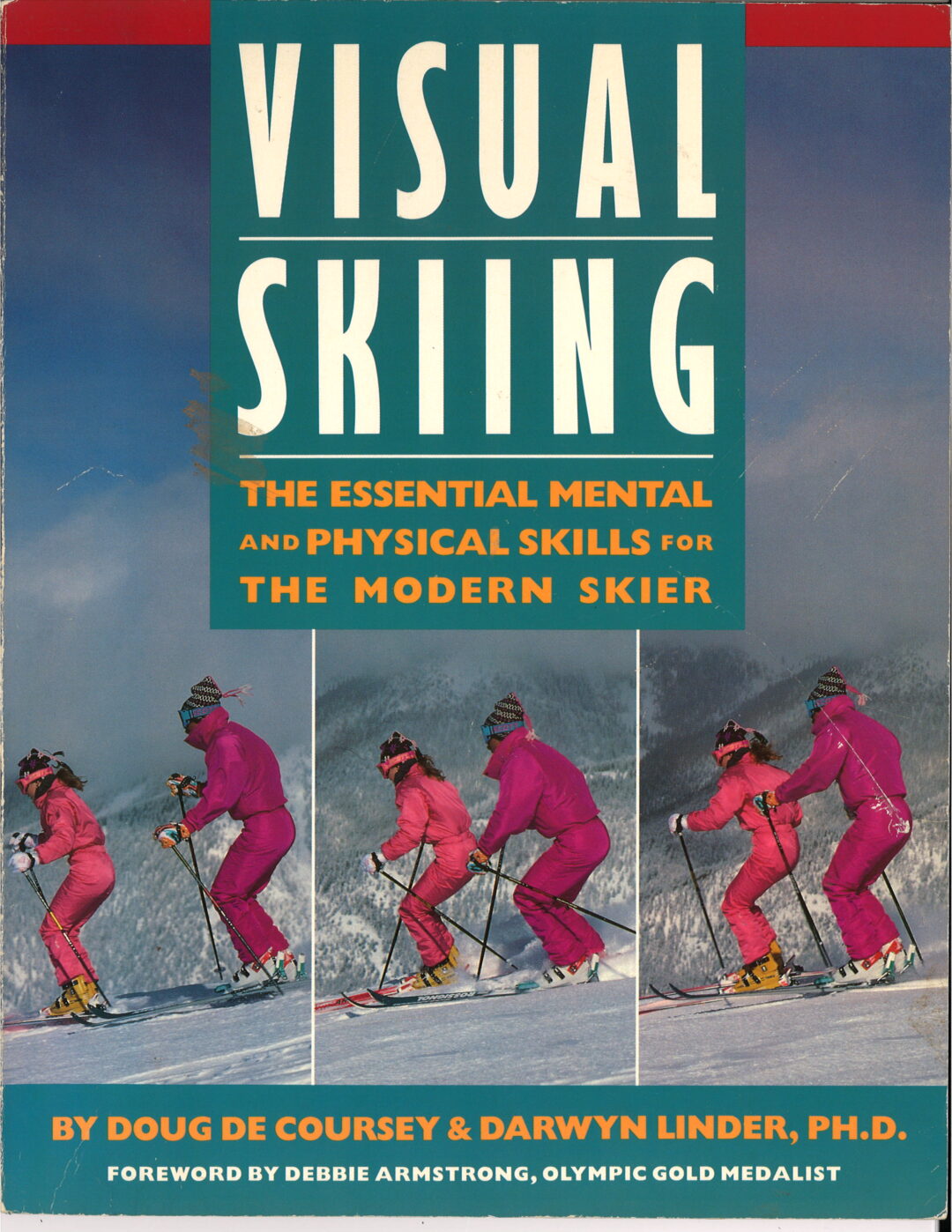
I did purchase two books great books on the subject, and have read them both “The Centered Skier” by Denise McCluggage and “Visual Skiing” by Doug De Coursey and Darwin Linder, PH.D.
On the back cover of McCluggage’s book, the centered skiing book, it states, “you can ski like you ski in your dreams“. Believe it.

- My 80 Plus Patch and Its Potential - March 19, 2026
- Optimism vs. Pessimism: Update on Skiing Private-Public Powder Mountain - March 5, 2026
- Skiing is Less Expensive Than Other Activities - January 8, 2026
Those are both excellent books that have had a big influence on my 53 year ski teaching career. These thoughts used to be the exception in many snowsport schools, but PSIA-AASI have incorporated this kind of coaching into their Learning Connection model for teaching. We can all use good coaching, even at our ages, if only to get more efficient at what we do. If you haven’t used snowsport school products for a while, give it a try.
Sherm White, PSIA level 3, still teaching at Smugglers Notch in Vt
Sherm thanks for the comment
Thanks for your article, Mike. It brought back memory of my experience with “Inner Skiing.” I was an instructor at a VT. ski area in the 70’s. I remember reading or hearing about “Inner Tennis,” followed up by “Inner Skiing.” One day, I met with a client for a private lesson. She was a competent skier, but had never skied any black diamond trail, believing (or perhaps having been told) they would be too hard for her. Bingo! – Inner Skiing popped into my mind. I suggested that rather than spend an hour doing drills to improve her level of skiing we go explore a black diamond trail. We talked about the things you mentioned: being relaxed, feeling your feet/boots/skis as you turned, etc. as you skied down a slope. The hour flew by and she noticeably relaxed as we skied. Later in the day after the lifts had closed she came up to me and proudly proclaimed that she had skied every black diamond trail on the mountain! I could not have been happier for her and learned about a valuable tool to use in future lessons, regardless of the shape/color of the trail sign.
thanks for your comment, well taken. my instructor for the weekend was Paul McKinney if I remember correctly who went on to teach at Alta. He was a pharmacist from Montreal. Anyone no him? I would love to thank him.
It pained me to read the above paragraph, “Many of us, especially seniors who ski, are in a state of rigor mortis and limited flexibility on skis. You can see that with skiers clutching the poles as tight as they can, moving down the slope in a rigid manner. If you were inside their boots their toes are scrunched together until they hurt, as if they were what was going to stop them as they picked up speed on the trail.” That paragraph is excruciating to read! Like the author, I learned to ski on the east coast in the early-to-late-1960s (including at Sugarbush), and at age 73 I’m still at it, having more fun than ever. If that paragraph rings true to any reader, please, please, please do yourself a favor and take a private ski lesson. Skiing on modern equipment should not be “gripping”, and it is an easy fix. My retirement gig is as a ski instructor at Breckenridge, now going on 13 years, with PSIA “Senior Specialist” certification, focusing on the goals and needs of senior skiers. Being gripped on the slopes is no fun, and as seniors our goals should be to maximize fun, be safe, and Spend the Kids’ Inheritance (emphasis on S-K-I).
maybe when I stop working, I should become an instructor
Love the article. I am 91 and still going to ski this winter at Stratton. Will take your advice I am going to get read the books
so glad to hear.
Thanks for a great article.
Fortunately, I did not experience “friends who would take their buddies to the top of the mountain and take off”. My friends took me to the bunny slope and taught me snowplow turns and stop. And then they left me alone so I was never embarrassed when I grabbed the rope tow too tightly or fell over. That was when I was 12. I’m still skiing and love it so much, particularly skiing with my 8 and 10 year old granddaughters. They’re really lucky. They’re in Colorado. I had to learn on the icy snow of western New York.
Bryan
Bryan. If you can ski new England surfaces you can ski anywhere. I was at snowbird a while back, springtime conditions That froze up overnight, it was firm but very skiabke and there were no locals on the slope because it was too icy!