Northstar

Short Swings!

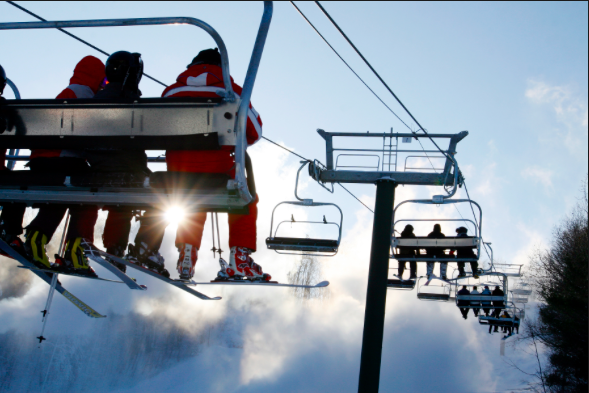
Unless you’re riding with people you know, ski lifts are public places, and conversational topics should reflect that.

Courtesy of Northstar

At least, that’s how I view the 8 – 12 minute ride with people who, if nothing else, have the sport in common. But experience shows that others may not share that sensitivity. How else to explain the ride on a triple where the night manager of a local hotel explained in detail how the owner was a drug dealer who used the property to launder money? Personal discretion must not have been a requirement for his job. That was a long time ago. More recently, on another triple, the man in the middle went on a racist rant for most of the ride. I told him he was using inappropriate language for a public place. He paused for a few breaths and resumed in a more obnoxious manner. I told him that based on what he said he was a racist. “No I’m not!” he yelled as we left the lift and he skied away. Regardless of age or status, lift conversation is our opportunity to bridge gaps and preserve the spirit of skiing.  Please make the effort.

IKON Pass Introduced. M.A.X. and Rocky Mtn Super Pass to be Retired 

Ikon is from Alterra Mountain Company and includes 23 resorts in the U.S. and Canada, many of which are part of the M.A.X. Pass, the Rocky Mountain Super Pass and the Mountain Collective. M.A.X. and Rocky Mountain passes will no longer be available and Mountain Collective will continue through 2018-19. The resorts include Mammoth, Squaw/Alpine, Deer Valley, Alta, Snowbird, Copper, Eldora, Aspen/Snowmass, Steamboat, Jackson Hole, Big Sky, Killington, Sunday River, Sugarloaf , Loon, Tremblant and CMH. Ikon will announce costs at a later date.

Epic Pass adds Telluride

Telluride Ski Resort will be available on Epic Pass starting next season.

Winter Olympics

Courtesy, IOC

The South Korean games run Feb 9-25 in Pyeongchang, the name of a county about 40 miles from the DMZ. Opening and closing ceremonies will be held in a roofless five-sided stadium seating 35,000. South Korea is the second Asian nation to host the games. Korea’s Yongpyong resort has been the site for World Cup ski races four times since 1998. It has 14 lifts servicing up to 2,500′ vertical.

Warren Miller

Ski Utah posted this five minute edit of the1984 Warren Miller’s Ski Country. Hearing his voice narrate the film brings me back to another time.

Patagonia Environmental and Social Responsibility Report

This three minute video presents what Patagonia has done to improve the environment, preserve outdoor recreational areas, and contribute to improved lives in 2017. It’s an eye-opener.


Lovin’ Snowshoes

‘Shoes Have Come A Long Way.  Have You Looked Lately?

Old: Good for decorating rustic cabins.

Back in 1971, when I transferred winter affections from downhill to Nordic skiing (due to a spectacular fall in Austria that racked up one knee and stripped off my ski suit—but that’s another story), I also tried snowshoeing. After all, cross-country skis and snowshoes were both made of wood and quite beautiful; they’re both ways to travel over snow rather than wade through it; they’re both very low-impact sports.

But cross-country evolved into my lifelong true love, while snowshoeing became merely the affably boring cousin you contact every few years. Too much work; bindings were crappy (now you’re in, now you’re not—and your fingers are gonna freeze putting the damn things back on); ‘shoes didn’t slide like skis, except sideways downhill on crust; wood frames cracked; rodents enjoyed chewing the rawhide webbing in summer storage.

Modern snowshoes confirm the theory of evolution. They’re clearly descendants of the woodies but virtually a new species in design, materials, flotation, and fun.

I found this out one January about a dozen years ago, laying out ski trails at a resort in Montana. (Sadly, I hadn’t visited that cousin in almost 30 years.) The snow was too deep, buried underbrush and deadfall too catchy to use Nordic skis. So since slogging through waist-deep powder on foot was out of the question, what to do? Happily, intuition had suggested bring my new aluminum snowshoes along to test the frozen waters. They behaved magnificently, though I dumped a couple of times trying to back up, sinking the tails of the ‘shoes. (My style of absorbing knowledge always seems to be “education through error.”)

Modern: Light, durable, inexpensive. Credit: Tubbs

So what’s new about this next generation (or two – more on that shortly) of snowshoes? It may seem minor at first, but bindings have improved incredibly; they’re easy to use, they stay on, and they don’t stretch. The ‘shoes themselves are durable and have no food value to rodents, since they’re generally made with aluminum frames and synthetic decking that’s durable and gives great flotation.  That combination is light weight, so there’s less effort. The addition of bottom cleats gives you much better grip on crust and even side-hills, though it’s still smart to avoid those when possible.

What else? Modern models definitely aren’t as pretty, but it’s a trade off of aesthetics for dependability, longevity, and convenience.

Snowshoes are nowhere near as pricey as Alpine or even Nordic gear, but it’s still smart to rent before you buy to see if you like the sport. You can use hiking or snow boots with today’s adjustable bindings, or even sneakers with neoprene booties.

There’s a new kind of ‘shoe that came on the market this fall ago from Crescent Moon Snowshoes, a Colorado company. They’re made of foam (!) but from my destructive testing are not just light but also sturdy, incredibly maneuverable.  I backed up in them, did a 180 degree jump-turn for no good reason.  They have great binding and are setting the snowshoe industry on its butt.

There are a thousand more subtleties to fun snowshoeing—using poles, running vs. walking, clothing, etiquette, and the like. They’re mostly unimportant. Snowshoeing has become easy, and easy on your bones and joints. And even if you don’t glide, just repeat too yourself, “600+ calories per hour!”, enjoy the burn, and head for the dessert tray.

Most Modern: Foam ‘shoes from Crescent Moon.

Inferno 1969

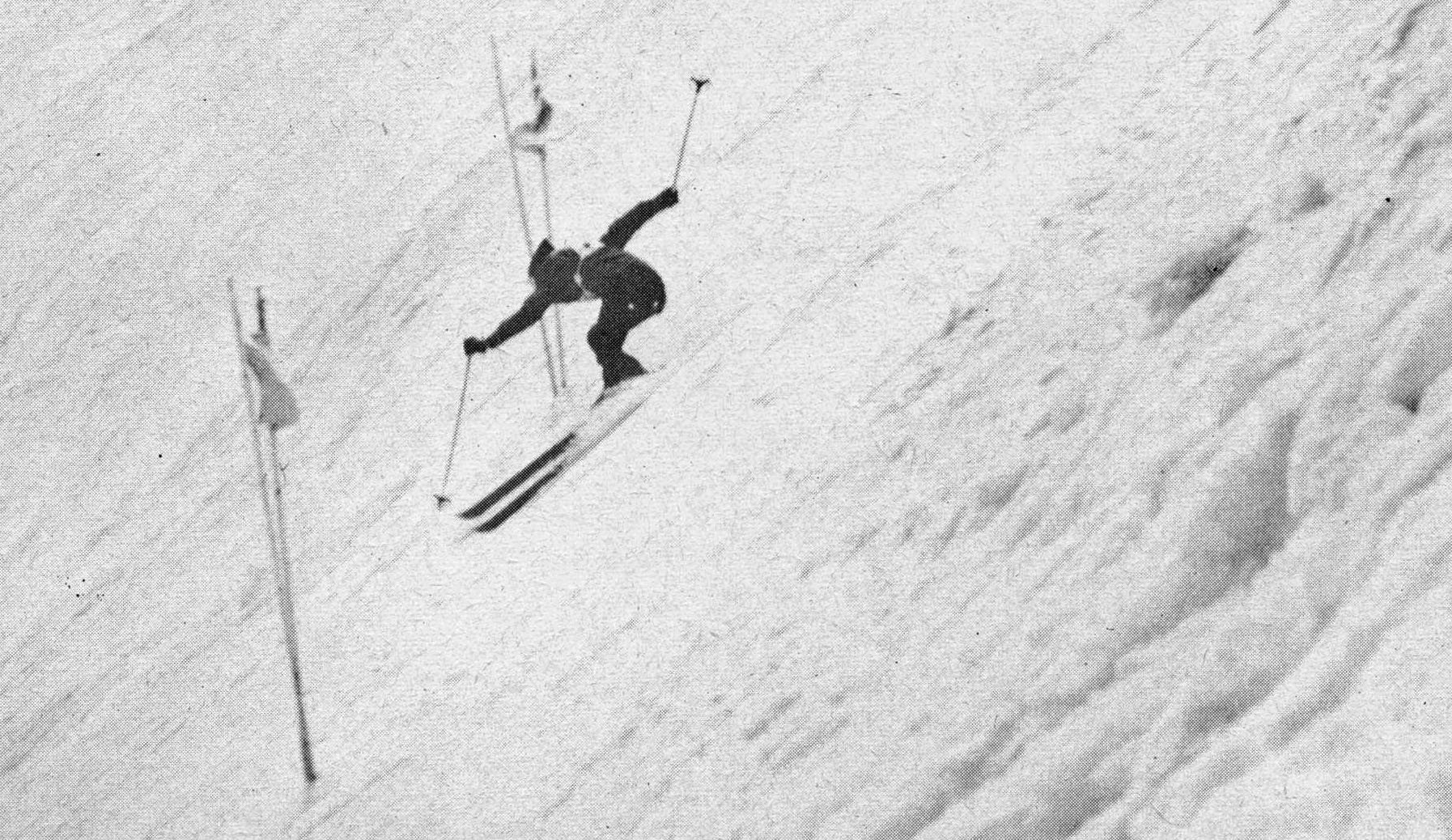
Mystery Glimpse: A Hot Time On This Hill

See If You Can Name The Race In This Old Picture.

Hint: circa 1969.  Perhaps you know the name of the race this fellow is in and what makes it special. Put your best guess in the COMMENTS section below. Extra credit for naming an unusual chap who won the same race in earlier years and what the circumstances were.

Last Week

Credit: US Ski & Snowboard Hall of Fame

This is Seattle-born and raised Deb Armstrong with a tennis racquet. Deb won the giant slalom at the 1984 Winter Olympics in Sarajevo, the first won to win a gold since Barbara Corcoran’s 1972 victory in Sapporo.

After her retirement from ski racing, Debbie Armstrong led various humanitarian causes, including the Debbie Armstrong Say No to Alcohol and Drugs campaign; the SKIFORALL Foundation, which opens skiing events to the disabled; and Global ReLeaf Sarajevo, which seeks to reforest Sarajevo after the Bosnian war. According to Wikipedia, Deb is an executive at Steamboat Springs. Here’s Debbie (right) waving the flag in 1984.

Below is a short video of Deb Armstrong giving powder skiing lessons at Steamboat Springs. Two very lucky kids get a very clear and effective lesson from a gold medal Olympian.  Perhaps you can learn something, too.