
Senior Skier Tries Monoskiing

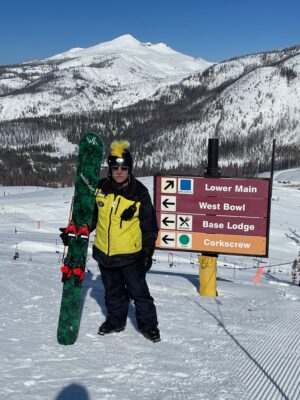
Rob Scharf at Sierra At Tahoe

Editors Note: This article comes from SeniorsSkiing subscriber Rob Scharf

I have been on two skis 55+ years, including as a patroller and volunteer mountain host.  So trying a monoski was a challenge that became exhilaration  – and just plain fun.

I learned to ski at Mt Lassen Ski Area in northern California, where there were two rope tows and one Poma lift and a season pass for my parents and four kids was $100 total. As a high schooler in the 1970s I was intrigued by monoskiing, but didn’t know anyone who did it, or how to find out about it. I had seen it on TV, in magazines, and probably in Warren Miller films. I tried snowboarding in the 1990s and hated it.  So I stayed on my two skis.

I learned to ski when it was a status symbol to keep them close enough so the inside of the boots rubbed against one another, and it was a real status symbol if the duct tape you applied to your scraped boots was also scraped up. I have had ski instructors tell me I ski with my skis too close together, but when I ski patrolled and had to pull a toboggan, my skis automatically separated for a more stable base.

In the spring of 2021, I was a volunteer mountain host at Sierra At Tahoe Ski Resort, working at the bottom of one of the lifts reminding guests to put on their COVID mask, when I saw someone approaching the lift line on a monoski. It turned out to be an enthusiast loved to talk about skiing while your feet were locked side-by-side on one board. Towards the end of our conversation, he offered me to loan me the spare SnowShark monoski in his car.

After so many years on two skis, the monoski was a struggle. On two skis, much of your weight is on your downhill foot pressing on your uphill edge. On a monoski, that shifts to your uphill foot to get the uphill edge weighted.  Clearly, this old dog would have to learn a new trick or several.  It was a struggle, but eventually I felt more comfortable.

In March 2022 I went to Monopalooza, an annual event that attracts about 100 monoskiers from all over the US and beyond. The first day was a demo day. I found strong contenders from each manufacturer, but chose to go with a WhiteKnuckle All Mountain ski, and ordered one that summer.

Most monoski manufacturers are small operations, so they can provide almost unlimited customizations. They suggested a website to order fabric. I found one I liked and that green malachite fabric became the topcoat of my new ski. We agreed on the graphics “WK” on the shovel and “WhiteKnuckle” at an angle just in front of the bindings, which were mounted to fit the boot sole length I provided.  Now, I had my own monoski with custom graphics, for less than most pairs of skis cost.

At the start of the 22/23 season, I was probably more excited than I had been in many years. I was also nervous. Am I doing the right thing? What if I don’t like it and I have this very nice custom monoski? What will I tell my wife about the money I had spent just to have a wall decoration?

That first day on the slopes on my new ski was wonderful, exciting, scary, uncomfortable and just plain weird. For the first time in a very long time, I felt like a beginner, and I suddenly had a whole new appreciation for all beginners on a ski hill. I couldn’t control where I might slide to or whom I might slide in to. Stopping under control was iffy at best. I also got a better appreciation for snowboarders who only have one edge to hold them on a slope and for use when turning.

I am getting better on my monoski. Groomed runs are no longer an issue – as long as it’s not too icy. I tried some powder and the ski floated so well I quickly found myself sitting in the powder. Just imagine trying to get up in powder when both feet are securely fastened to one ski and your side-to-side balance is next to zero. As we all know, pushing a pole down in those conditions is not much help as it sinks down to the handle. I was able to struggle to sit on the back of my ski then stand up. Small moguls are fun but large ones are something I need to work my way into. Steep slopes with moguls will require more experience than I have right now, but hopefully one day.

One day recently, I was skiing at Alyeska, Alaska. I reached the bottom of a run when I heard someone just getting on the lift yelling in my direction. It was another monoskier “in the wild” waving at me. He waited at the top for me. 

He was a ski instructor at Alyeska. He taught on two skis, but was having fun on his monoski between teaching. He skied with me and my buddy for a couple of runs, giving us a quick tour. We would have never met that local if it weren’t for me monoskiing at the right place at the right time.

Standing on a monoski in a lift line is always interesting. “What is that?”, “Is that a training tool to keep your skis together?” “Cool board dude.” “Wow, a monoboard. I haven’t seen one of those in a long time. That thing must be ancient.” “Mommy, look at that funny  ski.” “Did they forget to cut your skis apart?”

My responses: “It’s called a monoski.” “They mounted my snowboard bindings incorrectly.” “I have yet to cross my tips.” “I snow plow one side at a time.” “I do have trouble skating on this.” It’s quite the conversation piece.

If you ever have the opportunity to try a monoski, do it. They are fun, scary, exhilarating and just plain fun. Did I mention they are fun? Will I try the monoski where the feet are one in front of the other like a slalom water ski? No, because I would automatically lean back and grab for a rope out of habit.

If you see a group of monoskiers in late February or early March this season or a future one, you’ll know there is likely a Monopalooza nearby. And, if you see just one or two monoskiers you can now refer to it as a monoski, not a monoboard.

 MONO, MONO!
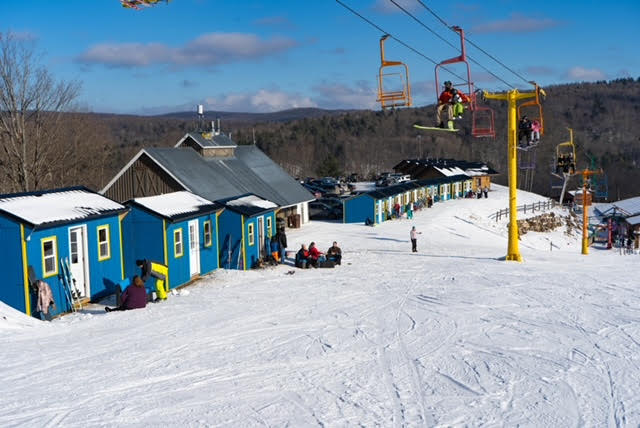
And then there is Titus

Titus Skibana

High speed detachable quads, gondolas, six-packs and eight-packs, bubble chairs and heated cushions are all part of the growing race to get us uphill faster, even warmer. And then, there is Titus, an independent family-operated, family-friendly destination near the Canadian border in upstate New York.

Titus Mountain Family Ski Center is a 1,200 vertical ski area tucked an hour’s drive north of Lake Placid and about 50 miles south of Montreal. There are 52 trails and glades, 38 with snowmaking. It is a mellow, well groomed layout. Ski it end-to-end and you’ll go through two tunnels and cross over a bridge.

What about the lifts?

There are six fixed-grip doubles and two triple chair lifts, all manufactured by Hall, the Watertown, NY, company that went out of business in 1982. So don’t expect a quick ride up the hill at Titus. And don’t expect that to change.

According to area operations and marketing manager Bruce Monette III, whose family has owned the former Moon Valley area since 2011,  “We believe these lifts are just fine for us. It gives people time to talk on the trip uphill. We don’t see that changing.”

The Monette family is no seat-of-the-pants operator. In addition to the ski area, their business interests range from large scale maple syrup production to gravel mining operations that support infrastructure and road development in the area, to fuel distribution services throughout the region.

Need a place to stay while skiing at Titus?

They own the Holiday Inn Express in nearby Malone as well as several Airbnb slopeside chalets.

What does it cost to ski at Titus

It is a bargain in today’s ski world. A ticket purchased on line is $59 on weekends, $49 on weekdays – add $5 if buying at the ticket window. The day tab for seniors 65+ is just $39 on weekdays, $49 on weekends. And that includes evening skiing on Fridays and Saturdays. A season’s pass for 70+ is $199.

And Titus is now part of the INDY pass network.   https://seniorsskiing.com/indy-pass-adds-54-new-resorts/

Want to make it a weekend at Titus

The Monette’s Holiday Inn Express in Malone offers a one-night ski-and-stay package for two for $249 total that includes breakfast, preferred parking at the hill and lift tickets. Compare that to a single day walk-up lift ticket on a weekend elsewhere these days.

 Treat yourself to a heated Skibana

While the lifts may date back to an earlier time, Titus has one area feature that is cutting edge: Skibanas.

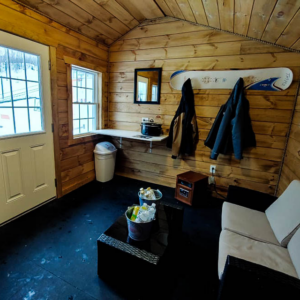
These are eleven regular and three larger Amish-built wooden enclosed cabanas near the main base lodge that can be rented by the day. They are heated, outfitted with comfortable seating, and can easily accommodate a family of four carting their own food and beverages.  Another perk is they come with reserved parking.

Titus Skibana

Need to rent equipment?

Arrange in advance and it will be there in your skibana when you arrive. The cost to reserve: $99 on weekdays and $149 on weekends, which usually sell out days in advance.

If you are planning a road trip and want speedy lifts and fancy facilities, Titus is not your place. But if you want a family friendly area with an appealing ski layout at a modest price, this one is worth a try.

https://www.titusmountain.com/

Out Of Control

Better Quality Skiing – Tribute to Contributor Bob Trueman

Editors Note:

It is with great sadness that we learned of the recent passing of one of our very popular contributors, Bob Trueman, a retired ski instructor and coach based in Europe.  Every one of his many articles about how to ski better and enjoy it more struck a chord with SeniorsSkiing readers, always eliciting a spirited conversation in the comments section.  We are republishing one of his last ones, about the simple pleasures of just enjoying skiing without worrying about improving or not.  Richard Lambert

Jean Claude Killy, one of the greatest ski racers of all time, reminded us that “skiing is always a trip to the edge of what is possible. But it is not an obligation – we don’t have to improve if we don’t want to; skiing should always be a pleasure.

It’s in our nature that only a small percentage really want to improve the quality of our skiing, and for those who do, that’s one of the ways we enhance our pleasure. For others it can more beer in the mountain restaurant. Both are valid.

What IS better quality skiing? Put at its most concise, it’s best described as “more skillful skiing”.

Skill is a much misused word. “Carving” a ski, or pitching a baseball are often referred to as “skills”. They aren’t; they are techniques, which can either be executed skillfully or not. Watch me pitch a baseball and you’ll know what I mean.

So the next questions in this cascade of questions are – what is skill, and how is skill improved?

The most concise definition of skill I know is this – “Skill is the learned ability to bring about pre-determined outcomes with maximum certainty; often minimum effort”. (Emphases added).

My job over the last 35 years or so has been to assist skiers to enhance their ability to do this. Not to “show” them what to do. Not to “demonstrate” perfect skiing (which I can’t do anyway). Skill cannot be enhanced by watching someone else, particularly if they are especially proficient – super skillful skiers do things so subtly that you can’t see what’s going on anyway.

Our personal make-up guides our beliefs, which give birth to our thoughts, which drive our actions – what we actually do – and what we do brings about our outcomes.

To achieve better skiing outcomes we need to change what we do. I’ll repeat that – it’s what you DO that matters.

“Doing” in skiing, involves a lot.

As a skier, you already know full well that we have to exercise control over every part of our bodies – our heads, torsos, arms, hips, legs, feet, even toes!

Because the only person who can improve your skiing is you, you are the one who needs information coming to you in real time letting you know how close to your desired outcome your performance is. Once, that is, you have defined your desired outcome of course – which is where fellows like me come in.

Since we have only a limited number of senses acting as pathways for this information, we must ask which is best. As a longtime instructor and coach, I can tell you that it’s what you feel , it’s not what you smell, taste, or hear though once already highly skilled, hearing may well be useful, but it’s not the number one.

Importantly, it’s not what you see, though that can help you avoid a tree. One reason for this (there are many) is that you cannot see yourself as you ski.

You need to develop a high level of skill is assessing what you feel. As a simple example of this – imagine you’re my pupil. We decide a specific desired outcome and what you’ll attempt to be aware of. You ski, I watch. At the end of your very short run I ask “What did you feel?” If you’re like 99% of skiers you will say something like “It felt good”. Or “Yeah, I felt ok”,or “I didn’t really feel confident”, or whatever.

At which point you will hear me say “I didn’t ask you that – I asked you what you felt (as you skied) I wasn’t asking you for a value judgement, just what you felt.

We are likely to have agreed that you would seek to feel, say, some pressure under a toe, or feel your shin pressing against your boot, or to feel if any pressure came under your heel, etc etc. Just one thing, never two.

I will tell you that I don’t want you to think or anticipate or even make anything up (you’re not being judged). All we are doing is working together to help develop your awareness. Very few skiers have it, and watching other skiers will not develop it.

You can do it on your own though when you know how. Until you know how, it provides a living for good ski coaches like me!

I wrote a paper somewhere in which I made up two new English words that help us here – the paper was called “The Kneed to Knowtice”. To enhance our skill at pretty much anything we need to be focused, and more importantly to notice a chosen specific that will enable us to know what is happening concurrent with its happening.

The simplest example is my most frequent exhortation when starting with any skier, however good already, which is “Let’s agree before you set off that you will do your best to be aware at all times of nothing other than feeling the amount and quality of the pressure under your big toes – if you like just under one big toe”.

And I promise in return that after your practice run, that I will refer to nothing other than that about your skiing on that run.

Wooden Ski Day Held At Carter’s XC Ski Center

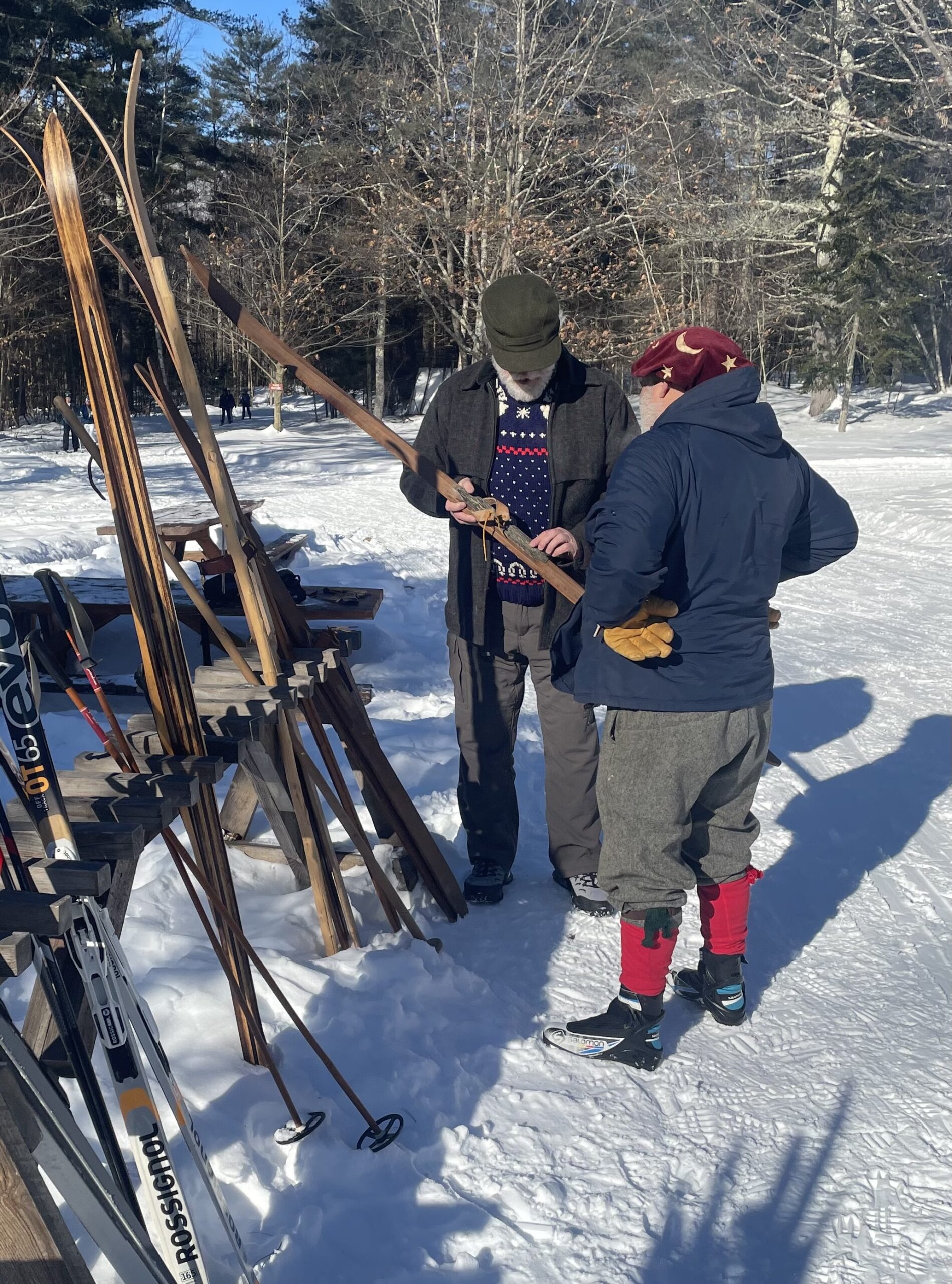
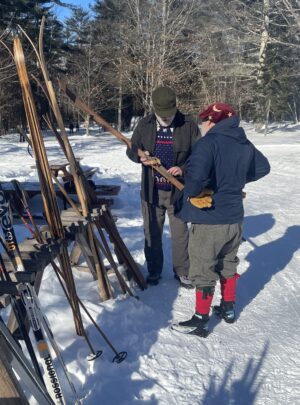
Maine Ski Museum’s Glenn Parkinson shared his knowledge about vintage gear with folks at the Wooden Ski Day

The traditional way of skiing (from the 1920’s on) was celebrated at the annual Wooden Ski Day at Carter’s XC Ski Center in Bethel, Maine. The event has been run for about 40 years at Carter’s, which began operating in 1984. In the early days of skiing everyone used wooden skis because synthetics had not begun to be used in ski manufacturing. Soon after the Carters started the family XC ski business, they acquired a pair of 12-foot long wooden skis, which they believe is the longest pair of wooden skis in New England! And there are stories about Dave Carter, who has since passed away, joining some relay team members to race on those 12-foot skis.

Nowadays, wooden skis are often used as wall decorations but there are still a few skiers who love the feel of wood under their ski boots. Many people refer to wooden skis as vintage or retro but while it may be fun on any type of XC skis, when compared to most modern skis, their performance is not in the same league. Keep in mind as we aggrandize the past ski equipment, that new equipment including skis, boots, bindings, and poles will significantly outperform wooden skis, light leather boots, 3-pin bindings, and so on. For example, the pair of Bonna 1800 skis that I borrowed for the Wooden Ski Day parade were terribly warped in the ski tail, which is common for many pairs of the wooden skis that still exist.

Carter’s XC Ski Center owners Anne and Jess Carter celebrate Wooden Ski Day. Jess is on the 12 foot skis, the longest skis in New England!

Ski historian, Glenn Parkinson, currently the president of the Maine Ski & Snowboard Museum, shared his knowledge of ski history at the event and he is one that knows about it. In 1995, Parkinson published the book called “First Tracks” that traced skiing in Maine back to the 1870’s. The book covers Maine’s skiing heritage from the time when Swedes immigrated to the state and brought what they called “skees” to clear snow-covered forests for settlers. In those days ski wax was known as “dope.” Parkinson’s book covers all of Maine’s ski history with photographs, skiing characters, ski trains and winter carnivals, lost ski areas, and a chronological chart of the historical highlights between 1870 and 1938.

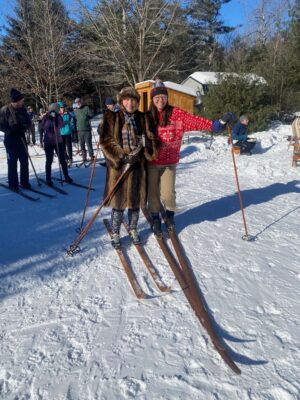
Carter’s XC Ski Center complimented folks who participated on wooden skis with free trail passes. All the people who donned wooden skis held a short parade and prizes were given based on most “old-timey” or traditional Nordic ski wear, retro 70’s/80’s ski wear, and finally, most overall creative. There was live music with a local jazzy folk band, a bonfire, and Norway Brewing Co. served beer. A portion of the day’s profits at Carter’s benefited the Maine Ski & Snowboard Museum.

ICYMI for February

In case you missed it, here are bits and pieces from here and there about several of our favorite winter resorts East and West, to help you plan your downhill or XC time and your time before, during or after. See you on the slopes! 

Birding on Skis at Alta

This is a unique winter adventure. Alta’s Birding on Skis program let you glide through  breathtaking snowy landscapes while expert guides birding from Tracy Aviary lead you to discover the diverse avian species that thrive in the Wasatch Mountains in winter.  Immerse yourself in the tranquility of nature, learn about the fascinating behaviors of winter birds, and create lasting memories against Alta’s beautiful snow-covered terrain. Registration required.

Birding tours are 9am-Noon on the 2nd and 4th Thursday of each month. Meet at the bottom of Collins lift by 8:50am with a lift tiket or season pass, all your gear and ready to ski. Participants must be at least 12 years old and able to ski intermediate, groomed runs.

  • February 8th and 22nd
  • March 14th and 28th
  • April 11th and Alta Earth Day (TBA)

Jackson Hole Kings & Queens of Corbet’s Competition – Cancelled

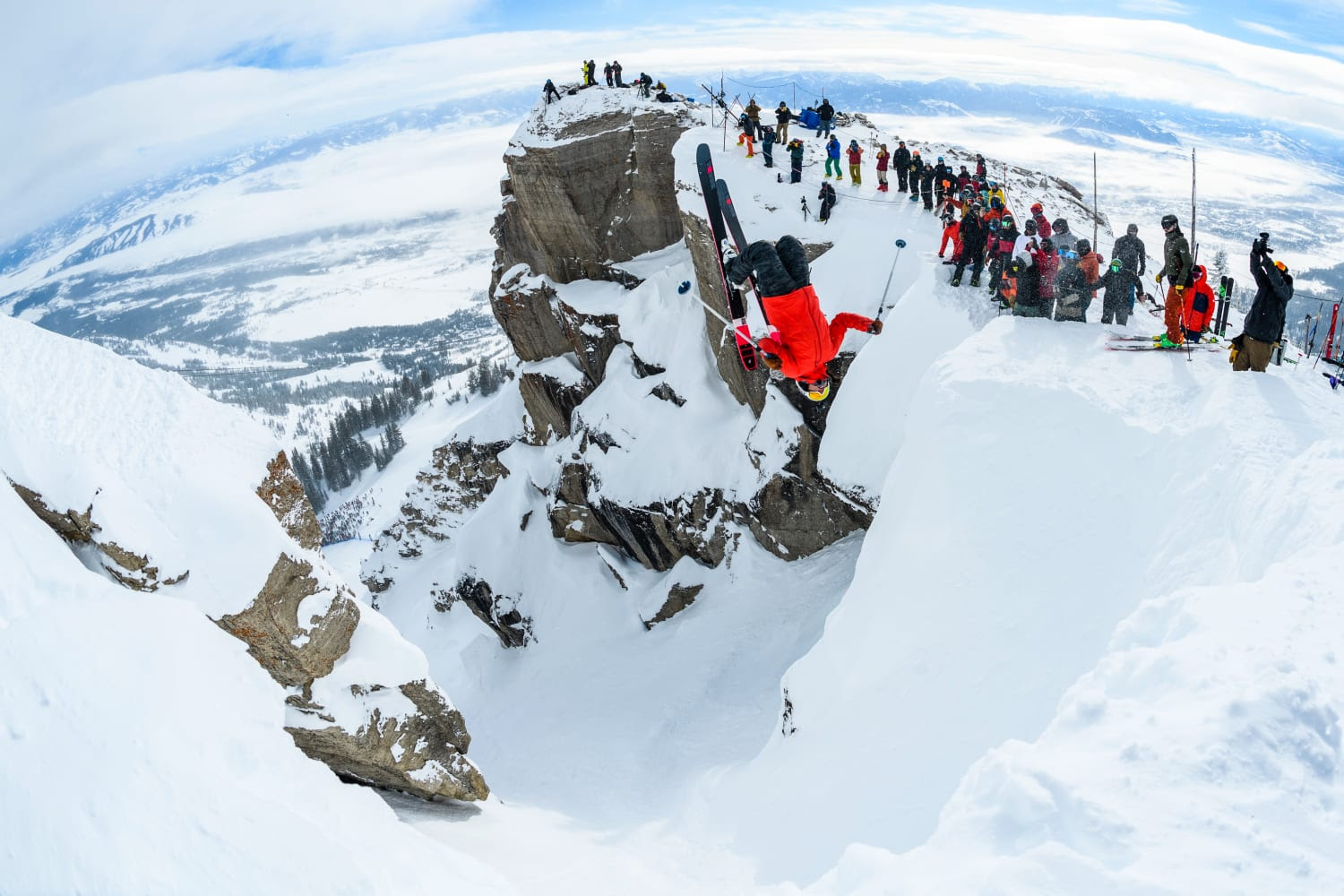
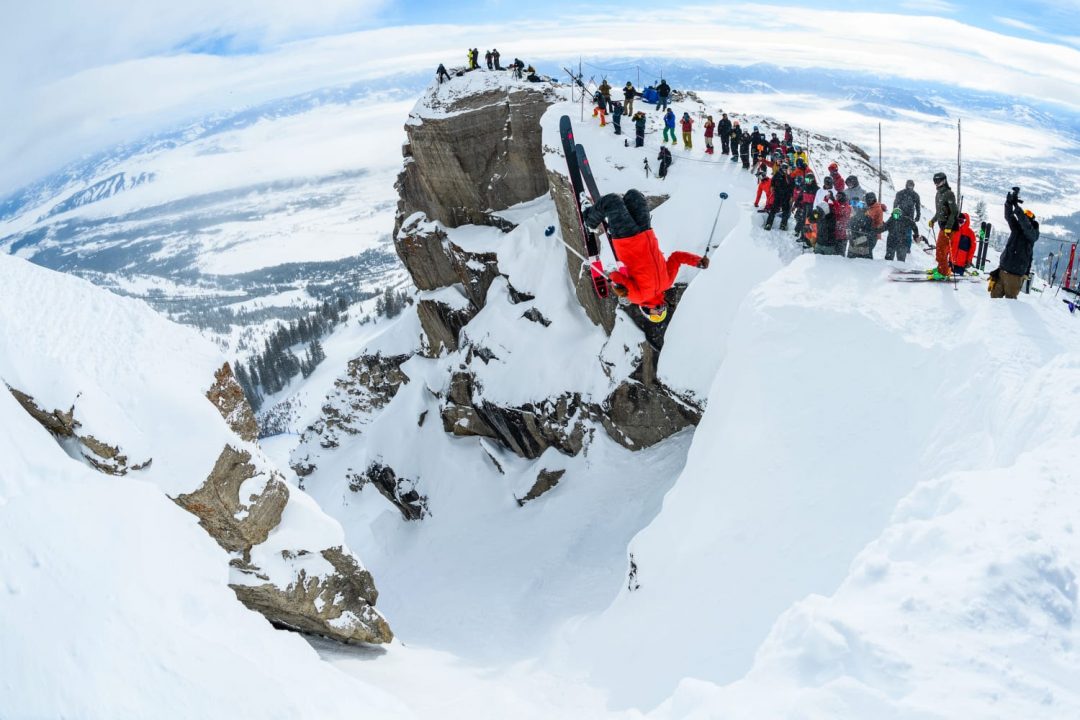
JH Kings and Queens of Corbets Veronica Paulson first womans backflip

Jackson Hole is saddened to announce that Kings & Queens of Corbet’s 2024 is cancelled.

The Jackson Hole Ski Patrol, Mountain Operations, Event Leadership, and current/former competitors have been working together to assess conditions in the Couloir for the competition scheduled for Feb. 3-10. 80” of snow has blanketed the Resort in the past two weeks and the mountain is open wall-to-wall.

However, Corbet’s Couloir requires specific weather factors to fill in properly and create a competition-worthy environment that supports landing mind-blowing tricks and carrying high speed through it. Unfortunately, this last storm didn’t deliver what we needed. Upon first-hand inspection of the snowpack within the Couloir, the competitors agreed that conditions are not at the level needed to run an elite competition. However, they all agreed that it is skiable for those with expert abilities. We are working to open Corbet’s to our guests very soon and will update you when it’s ready.

Kings & Queens veteran Veronica Belle says, “Corbet’s is skiing great, but conditions are not there to do what we want to do. As athletes, we all want to show off our best skiing, and right now the conditions are not safe enough for us to put on the show we usually do. I’ve trained all year for this and now I have another year to keep training and dreaming about my run.

Also see our recent article on where to ski and what to do in Jackson Hole. 

https://seniorsskiing.com/seniorsskiing-guide-jackson-hole-not-for-experts-only/

Skier/Snowboarder Responsibility Code

January is National Safety Awareness Month, a good time to be reminded about safety on the slopes we all love, to keep us, the kids and the grandkids all safe and smiling on the slopes we all love.
 We invite you to add your comments about experiences with downhillers who have violated the safety code. Even more, we invite you to contribute a full article on your opinion of the current state of safety and courtesy on the slopes today.  Add your comment directly to the article, or send us your full article to info@seniorsskiingmedia.com

This list of ten “must do” safety tips is from the National Ski Areas Assn. (NSAA), which represents more than 300 alpine resorts that account for more than 90% of the skier/snowboarder visits nationwide. Additionally, it has several hundred supplier members that provide equipment, goods and services to the mountain resort industry.

  1.  Always stay in control. You must be able to stop or avoid people or objects.
  2.  People ahead or downhill of you have the right-of-way. You must avoid them.
  3.  Stop only where you are visible from above and do not restrict traffic.
  4.  Look uphill and avoid others before starting downhill or entering a trail.
  5.  You must prevent runaway equipment.
  6.  Read and obey all signs, warnings, and hazard markings.
  7.  Keep off closed trails and out of closed areas.
  8.  You must know how and be able to load, ride and unload lifts safely. If you need assistance, ask the lift attendant.
  9.  Do not use lifts or terrain when impaired by alcohol or drugs.
  10.  If you are involved in a collision or incident, share your contact information with each other and a ski area employee.

Ski and snowboard safely – in January and in all months of the ski, snowboard and XC season.

Fit to Be Tied

Lord willing, this is my 66th straight year of skiing. But this is about one special memory with the Blizzard Ski Club of Minnesota in 1964, when I was nine.  It is also about my dad, a PSIA Chief Examiner who skied well into his 70s, as I am doing now.

My parents were early flatland skiers in the Twin Cities just after WWII, after he had returned from active combat in Western Europe.  He had enlisted in the 10th Mountain Division but became impatient for assignment and transferred to the 71st Infantry.  As a kid he competed at a respectful level in jumping, which was really the only skiing done back then in our neck of the country.  He decided to join the Minneapolis jumping club after visiting Sun Valley when he was just 12 years old, in 1936, and then fell in love with downhill skiing, too. 

We had many family ski trips when I was a kid –  the old single chair adjacent to Ruthy’s Run at Aspen was my first experience on a chair lift, at the age of seven.  This is one of many stories I have written about the Adzick Family Alpine Skiing adventures, about a spring skiing excursion to Montana.

The Blizzard Ski Club had assembled 100 kids from in and around Minneapolis to take the train to Billings and ski Red Lodge Mountain, for a full week of corn snow, clear blue skies, new friends, goggle eyes and – for my family – my mother’s 40th birthday.  The freedom we kids enjoyed was a celebration of life at its very best. I skied alone, not by choice, mostly by will and reckless abandon. By mid-week, the entire flatlander club was well equipped with mountain legs, including me.

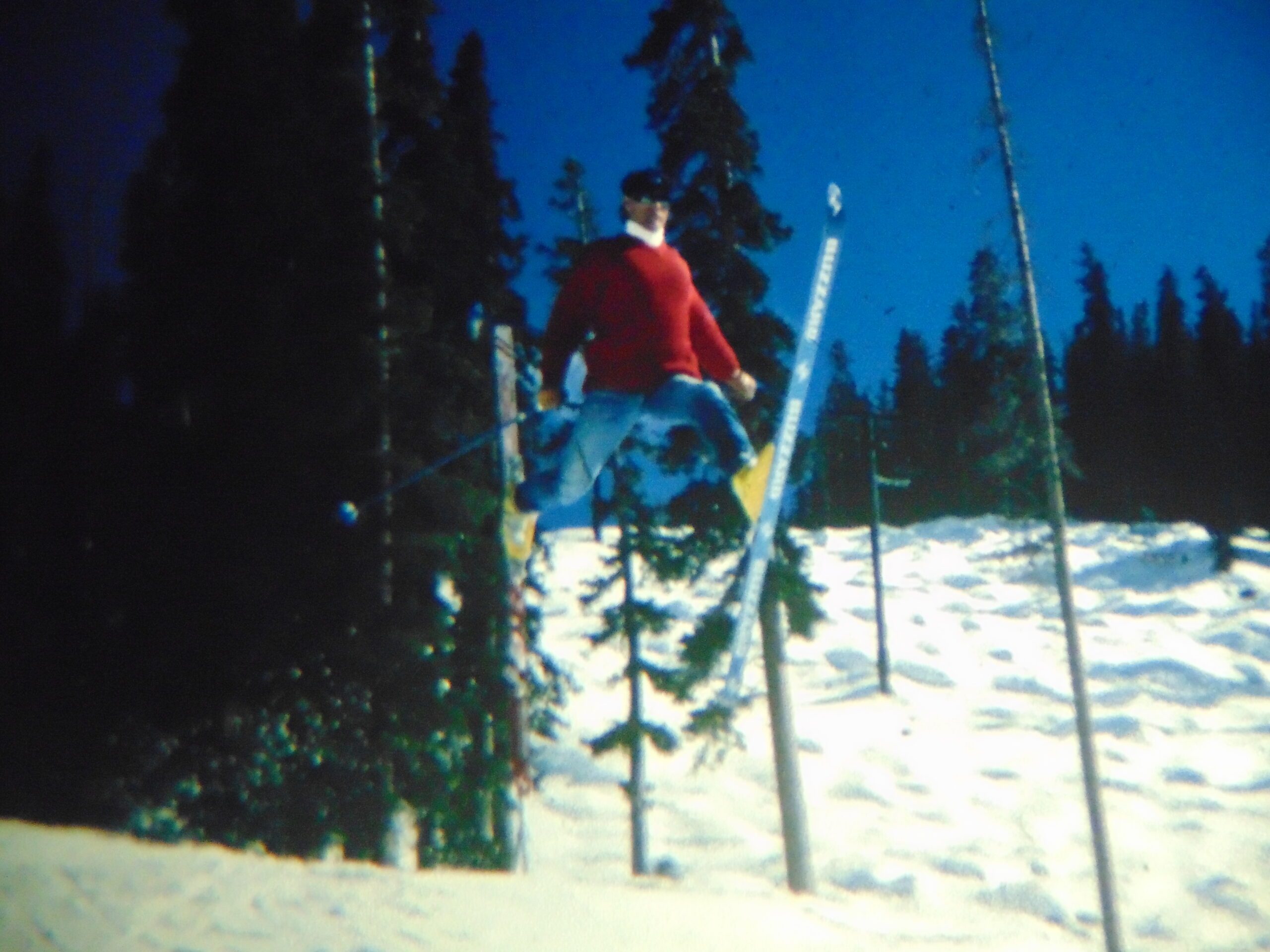
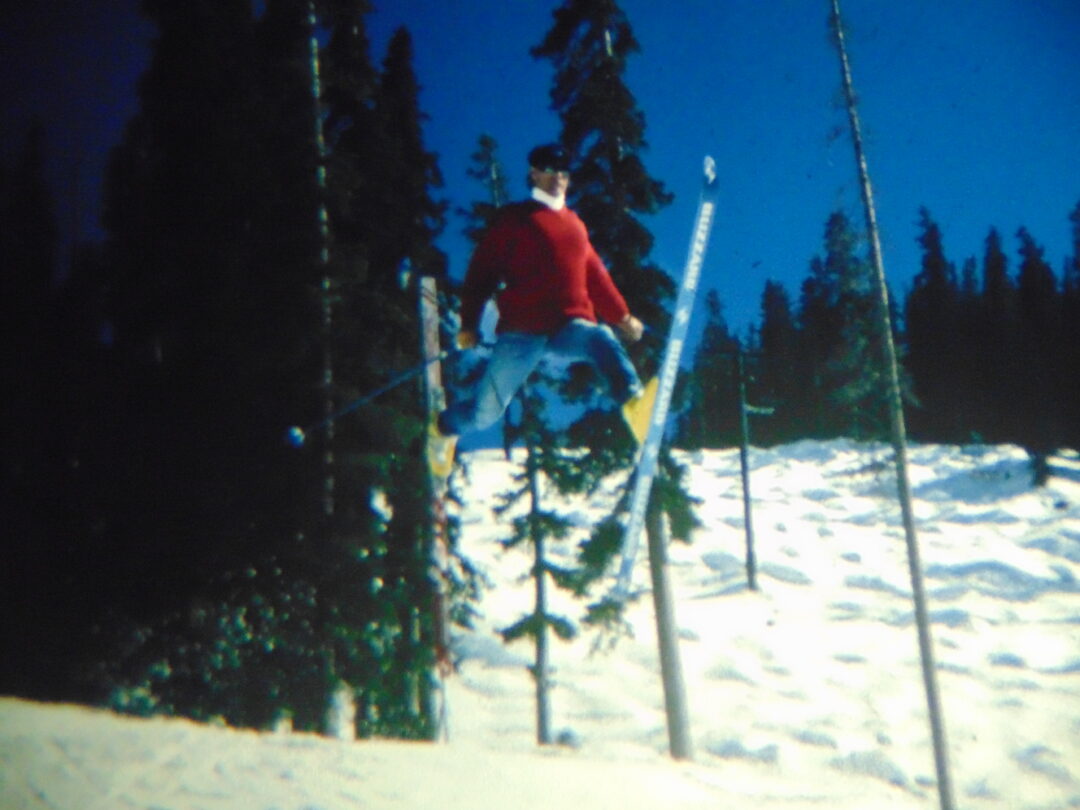
George Adzick at A-Basin 1982 in Daphne style, a Bernard Altman sweater, jeans, Nordica Astro Bananas, and 210 Blizzards.

One afternoon, from a chairlift, I spotted a group of skiers making their way down the highest and most difficult terrain on the mountain, romping from one mogul to another.  My privileged view triggered a deliberate pre-teen unraveling of my inner self.

As the tiny figures below expressed their joy of dancing with gravity, they braided past one another and through the trees, leaped the knolls and carved the fall line.  Random movements separated their individual styles, but they would remain in formation, as if a squadron.

These men were the finest skiers I had ever seen, an eight-year-old watching a regiment of heroes rapidly moving downhill as I slowly ascended past them.  The sounds of their skis on the snow added to this wave of splendor, brilliance and grandeur.  I was overwhelmed.

“Dad!”, I shouted as they skied beneath my chair.  I was the only rider on what may have been halfway to a never-ending ascent.  “Wait!” I yelled down as I moved uphill away from them. Our paths had crossed.  “Wait!”  They all stopped, in an instant.

My dad looked up. I was in agony.  Would he wait for me to join him?  Would they all wait?  Any of them? I twisted around to keep them in sight as the chair moved further away. Then, the unspeakable.  The squadron of men I so desperately wanted to join, to romp with and braid with, to show my stuff, to keep up with, in a blink turned in unison down the fall line in real time.  It was a portrait of magnificence, the rare beauty of elite christie in unison, for my eyes only.

They didn’t wait, and I had but one choice to take command of my destiny, to experience inclusion in this squadron of alpine masters, so I did it.

I worked my way to the edge of the moving chair and jumped 40 feet off. I hit the ground hard, luckily everything intact, and quickly pulled myself together to catch them. I pointed my skis down the mountain and thought of nothing but the coming glory of my gallantry.

I caught up to them and stopped with a hockey stop swagger. They stood motionless, seething, not a variation of expression on any face.  And while by week’s end I would become a fixture in Blizzard Ski Club folklore, I was until then a shocking image, a paradox on skis, an undeniable liability.

They were fit to be tied.

George Adzick

Blizzard Ski Club

Winter in the Time of Global Warming

Planning in late summer for an early December ski trip in Europe you have to think about glaciers. There are a number of possibilities: Zermatt in Switzerland, Cervinia in Italy, and Hintertux, Kitzsteinhorn, and Stubai in Austria. Glacier skiing used to be confined to summer and pre-season skiing, but with global warming, the situation is changing and if you want to be sure of snow in early December, it has to be on a glacier.

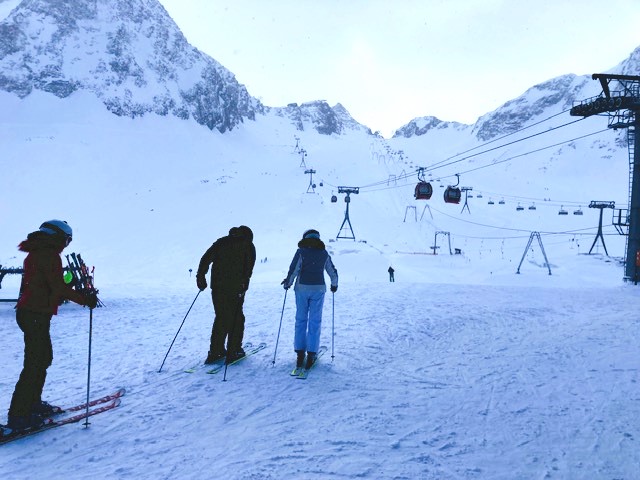
We chose to go to the Stubai glacier in Austria because it’s the glacier with the most ski runs and it’s just a short ride up the hill from the Innsbruck airport. There are 35 downhill ski runs between the top stations at over 3,100 meters all the way down to the mid-station at 2,300 meters. The lifts are of a mix of gondolas and covered chair lifts with a few T-bars for shorter runs. We bought our lift tickets on line and took advantage of the 20% discount offered for advanced purchases.

Glacier skiing is usually not ski-in-ski out. We stayed in the town of Neustift, which is 25 minutes from the Innsbruck airport. The lift station for the glacier is a further 20 minutes up the road, and is serviced by a free ski bus every fifteen minutes or so. For convenience we chose to drive. Neustift is a typical Austrian ski town complete with ski shops, restaurants and shops selling all the local handicrafts. We stayed in an apartment at Sportpension Elisabeth which was more than comfortable, with a small kitchen to prepare dinner on the nights we stayed in, and with the option for breakfast in the pension’s breakfast room

Everything at the Austrian ski areas is tip-top: moderately priced self-service restaurants, full-service restaurants, inside areas reserved for those who bring their own food, cubby-hole storage to store your pack while you’re out skiing, escalators to avoid climbing stairs, charging stations for your phone, and snow, real snow. Oh, and don’t worry if you’ve forgotten something down in the valley gloves, goggles, a helmet, skis, poles, whatever, there are Intersport shops at every lift station.\

The weather in December is not always accommodating. We had four snowy days and three days of bright sunshine. The skiing was great, even on the days we couldn’t see much past the next turn. The new snow made up for what we couldn’t see. Temperatures were -2 to -8 Centigrade, depending on the altitude, but with new materials for ski outfits these days, such temperatures are not uncomfortable. The sun did come out for us during our last days, and the skiing was super. While skiing on a glacier may seem fraught with black diamond rated trails, the reality is just the opposite. For the most part the trails are rated blue with a few reds. We encountered no ice and enjoyed cruising along on the runs which were meticulously groomed after the snow stopped falling.

This was a multi-generational adventure with my son, some grandchildren and spouses. All in all, we greatly enjoyed our early December glacier skiing. Snow covered pine trees, snowy white landscapes, skiing in the new snow, all reminded me of Winter’s Past.

Different Way to Buy a Pair of Skis – Part II

Before I left Dallas, knowing I now had a new pair of Dynastar skis, I needed a new ski bag. The ones I had were designed to protect the skis on a car roof rack but weren’t suitable for riding in the baggage compartment of an airliner.

On visits to the local Dallas shops, what the shops had left was either really expensive or didn’t fit my needs.

So, I called the ski shop holding my new Dynastars, and sure enough, they had ski bags. But when I arrived, they had only bags for two skis or more. Again, not what I wanted.

That first night at Whistler, my lovely bride of 53+ years went to work. As a “master” Amazon Prime shopper, she found the perfect ski bag on Amazon Canada in minutes. The single ski bag listed for CDN$98, which equals ~US$69 plus taxes. On Amazon U.S., the bag listed for $149!

Then she asked “Do you want a new boot bag?” Sure, why not. CDN$69 (US $48) later, and the boot bag and ski bag were on the way to Whistler/Blackcomb. Skis, bindings, ski and boot bags all for less than US$500. Not bad.

The lesson learned is that currency arbitrage can be a wonderful thing. During our ski trip, the Canadian dollar was worth about 70 cents. So, everything we bought was at a ~30% discount.

Oh, and the skiing? Fantastic. Whistler/Blackcomb is one of my favorite ski areas in the world. I hadn’t been there since before Covid, but it is a place I love to ski. What Whistler/Blackcomb calls an intermediate trail, most ski areas would call expert. Most of the runs are well-groomed and the trails are well marked.

For the brave, you can take the gondola between the peaks, but if heights make you uncomfortable, I suggest skiing down to the bottom. There are runs that are great for all levels of skier and quickly enable you to switch areas.

The only negative was that we were there during the Canadian spring break (the first two weeks of March), and the trails were not crowded. Lift lines, if one knew where to go, were non-existent. The on-mountain restaurants were packed with very long lines for food and the fare limited.

We stayed in a condo complex within a short walk of the Whistler Creekside live. The area didn’t have as much snow as it normally did during the first two weeks of March, but there was plenty. Every day, we had periods of snow that dropped 2 – 4 inches and days when it was cloudy but no snow.

There were also parts of the mountain where the light was so flat, it was akin to skiing inside a milk bottle. I never liked skiing in flat light, and as I get older, I like it less and less.

However, the sun came out on the last two days and the skiing was glorious. Whistler/Blackcomb, I will be back!