Out Of Control

Better Quality Skiing – Tribute to Contributor Bob Trueman

Editors Note:

It is with great sadness that we learned of the recent passing of one of our very popular contributors, Bob Trueman, a retired ski instructor and coach based in Europe.  Every one of his many articles about how to ski better and enjoy it more struck a chord with SeniorsSkiing readers, always eliciting a spirited conversation in the comments section.  We are republishing one of his last ones, about the simple pleasures of just enjoying skiing without worrying about improving or not.  Richard Lambert

Jean Claude Killy, one of the greatest ski racers of all time, reminded us that “skiing is always a trip to the edge of what is possible. But it is not an obligation – we don’t have to improve if we don’t want to; skiing should always be a pleasure.

It’s in our nature that only a small percentage really want to improve the quality of our skiing, and for those who do, that’s one of the ways we enhance our pleasure. For others it can more beer in the mountain restaurant. Both are valid.

What IS better quality skiing? Put at its most concise, it’s best described as “more skillful skiing”.

Skill is a much misused word. “Carving” a ski, or pitching a baseball are often referred to as “skills”. They aren’t; they are techniques, which can either be executed skillfully or not. Watch me pitch a baseball and you’ll know what I mean.

So the next questions in this cascade of questions are – what is skill, and how is skill improved?

The most concise definition of skill I know is this – “Skill is the learned ability to bring about pre-determined outcomes with maximum certainty; often minimum effort”. (Emphases added).

My job over the last 35 years or so has been to assist skiers to enhance their ability to do this. Not to “show” them what to do. Not to “demonstrate” perfect skiing (which I can’t do anyway). Skill cannot be enhanced by watching someone else, particularly if they are especially proficient – super skillful skiers do things so subtly that you can’t see what’s going on anyway.

Our personal make-up guides our beliefs, which give birth to our thoughts, which drive our actions – what we actually do – and what we do brings about our outcomes.

To achieve better skiing outcomes we need to change what we do. I’ll repeat that – it’s what you DO that matters.

“Doing” in skiing, involves a lot.

As a skier, you already know full well that we have to exercise control over every part of our bodies – our heads, torsos, arms, hips, legs, feet, even toes!

Because the only person who can improve your skiing is you, you are the one who needs information coming to you in real time letting you know how close to your desired outcome your performance is. Once, that is, you have defined your desired outcome of course – which is where fellows like me come in.

Since we have only a limited number of senses acting as pathways for this information, we must ask which is best. As a longtime instructor and coach, I can tell you that it’s what you feel , it’s not what you smell, taste, or hear though once already highly skilled, hearing may well be useful, but it’s not the number one.

Importantly, it’s not what you see, though that can help you avoid a tree. One reason for this (there are many) is that you cannot see yourself as you ski.

You need to develop a high level of skill is assessing what you feel. As a simple example of this – imagine you’re my pupil. We decide a specific desired outcome and what you’ll attempt to be aware of. You ski, I watch. At the end of your very short run I ask “What did you feel?” If you’re like 99% of skiers you will say something like “It felt good”. Or “Yeah, I felt ok”,or “I didn’t really feel confident”, or whatever.

At which point you will hear me say “I didn’t ask you that – I asked you what you felt (as you skied) I wasn’t asking you for a value judgement, just what you felt.

We are likely to have agreed that you would seek to feel, say, some pressure under a toe, or feel your shin pressing against your boot, or to feel if any pressure came under your heel, etc etc. Just one thing, never two.

I will tell you that I don’t want you to think or anticipate or even make anything up (you’re not being judged). All we are doing is working together to help develop your awareness. Very few skiers have it, and watching other skiers will not develop it.

You can do it on your own though when you know how. Until you know how, it provides a living for good ski coaches like me!

I wrote a paper somewhere in which I made up two new English words that help us here – the paper was called “The Kneed to Knowtice”. To enhance our skill at pretty much anything we need to be focused, and more importantly to notice a chosen specific that will enable us to know what is happening concurrent with its happening.

The simplest example is my most frequent exhortation when starting with any skier, however good already, which is “Let’s agree before you set off that you will do your best to be aware at all times of nothing other than feeling the amount and quality of the pressure under your big toes – if you like just under one big toe”.

And I promise in return that after your practice run, that I will refer to nothing other than that about your skiing on that run.

An Old Pro Shares Thoughts on Staying Safe on the Hill

The way skiers and boarders enter the sport determines their behavior on the hill. Years ago, many were introduced to skiing by their parents; skiers who knew the commonsense safety rules and made sure their children knew them, as well. For decades, those entering the sport through ski school have been exposed to the Skier’s Responsibility Code during lessons, their instructors citing examples in real time:

  • Looking up the hill when entering a trail is pointed out each time an instructor takes his or her class onto a new run.
  • Stopping at the edge of a trail and not obstructing traffic is taught by example as instructors always pull to the side when talking to the class.

Unlike driving there’s no requirement for beginning skiers to pass a test before taking to the trail. They simply show up, usually with a friend who attempts to teach them; a friend who may not know the safety basics himself.

Riding the rope. Harriet’s daughter Alison, 5, in leather boots and wooden skis on Jiminy Peak’s rope tow. Credit: Harriet Wallis

There can be serious consequences. Eight years ago at Cranmore Mountain I was struck and seriously injured by a boarder who was uphill from me. As the uphill rider, it was her responsibility to avoid anyone below. She knowingly entered a populated slow-skiing area without slowing down. Had we been in Colorado, she would have been held liable for my injury.

Over my years patrolling at Sunday River, I always pointed out, “If you’re good enough to overtake another skier, you had better be good enough to avoid them.” Skiers have don’t have rearview mirrors or turn signals.  If one turns into your path, it’s up to you to change your path to avoid her. The responsibility code calls this skiing under control.

Source: The New York Times

Another frequent safety violation is skiing closed trails and out-of-bounds terrain. Trails are closed for a reason, and that reason could be hazardous conditions. Years ago, a skier at Loon Mountain fell on an intermediate cross trail and slid under a rope onto a closed steep and icy run. His companions had to work their way through the trees to reach their injured friend. It even was difficult for patrol to reach the injured skier, who eventually died.  The double lesson here: 1.Stay off closed trails. 2.If terrain and conditions between you and the injured skier are beyond your ability, wait for patrol.

Know how to report an accident. The key is to know where you are on the mountain. You can always go to the bottom of a lift, where the accident will be called in. Most areas have a number to call for ski patrol. Make sure it’s in your cell.

Out of bounds is another issue. There is no grooming, and unless your skills are up to handling all conditions, stick to the groomed runs. These areas are not patrolled and not swept at the end of the day. Never ski these areas alone. Three or more is preferred. If someone is in trouble, one can stay with the injured party while the other goes for help.  If you choose to ski out-of-bounds, think of the sign at the top of Killington: The mountains will be just as cold and lonely tonight as they were 200 years ago.

Branching Out: Skiing the Trees

Your Support Helps!

Help us keep SeniorsSkiing.com free. Please support SeniorsSkiing.com with a donation.

DONATE

For many of us, skiing through the aging process means no longer going places we once skied without thinking twice. Now, approaching my 80’s, my mantra is never to overstep my capabilities and always watch out for the other guy!

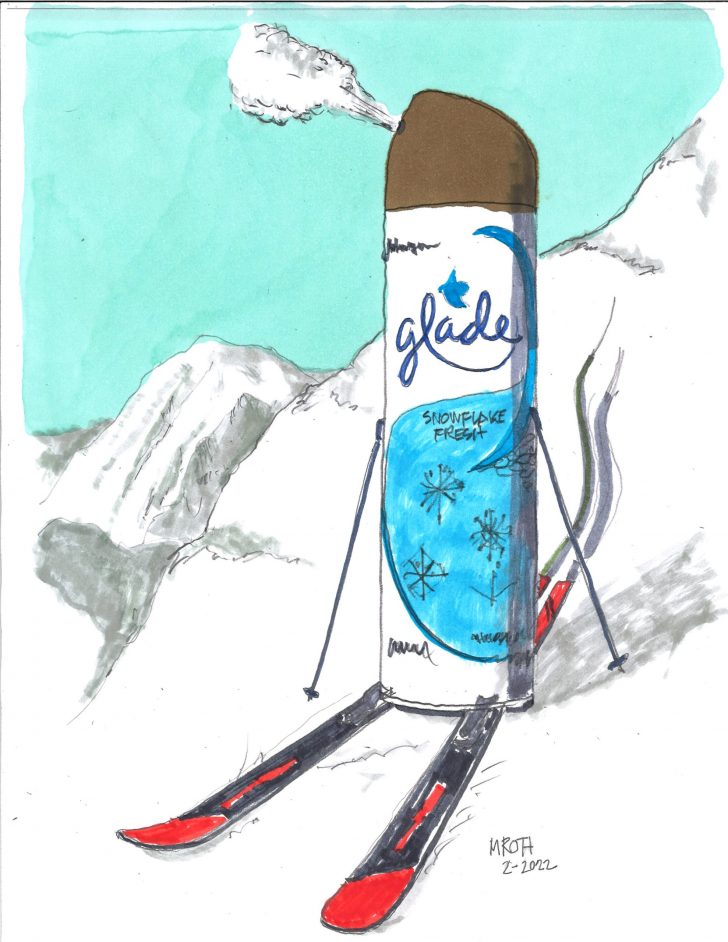
Anticipate turns when skiing the trees!                                             Illustration: Mike Roth


I’ve always loved skiing in the trees and still do on occasions when conditions are right, and I’m feeling up to the task. I enjoy the silence, the natural snow, and the general absence of other skiers. But I’m always on guard avoiding the trees and their branches.

My Favorite Eastern Glades

Some of my memorable tree runs have been in the East, where I do most of my skiing.

Mount Snow’s North Face tree runs are challenging. However, the tree run on the main face to the left of “One More Time“ is a delightful intermediate. Also, at Carinthia, the trees between Mineshaft and Nitro are fun.

Killington offers plenty of tree runs, for skiers of all ages and abilities. A favorite of mine is Squeeze Play, to the right of Ramshead’s Timberline trail. It is easily handled.

My favorite at Gore Mountain is Twister Glade. Like many other gladed runs, it needs a certain amount of natural snow.

Bromley’s Avalanche Glades are fun. The area’s Everglade to the Glade is a bit easier.

The south face of Okemo is where you’ll find Forrest Bump (cute name), Double Diamond, Outrage, and Loose Spruce. It’s on the latter that a snow snake twisted my leg.

A different take on Glade Skiing.                  Illustration: Mike Roth

Glade Skiing Rules

Here are rules I follow when skiing glades:

  • Never Ski Alone. It’s best to ski with 3 others. If one person is hurt, another can remain, while the third gets ski patrol.
  • Don’t Use Pole Straps. Catching a pole on a branch can damage arm and/or shoulder. The release mechanism on some Leki poles helps avoid the potential problem.
  • Wear Goggles and Helmet. They are essential protection when skiing trees
  • Carry a Loud Whistle. It’s advisable wherever you ski. If you get hurt or lost, a series of loud blasts will attract help.
  • Ski Within Your Ability

And a few pointers for tree-skiing:

  • Anticipate turns: Look to where you want to go between the trees and try to anticipate your next two turns
  • Make smooth rounded turns: In the woods, bumps tend to be soft, with plenty of places to set an edge

We skiers may be getting older, but, with the right attitude and a good dose of caution, we can still enjoy skiing in the trees.