
KOSSAK

Living My Dream – Joining the Ski Patrol After Decades of Skiing

By Robert Kossak
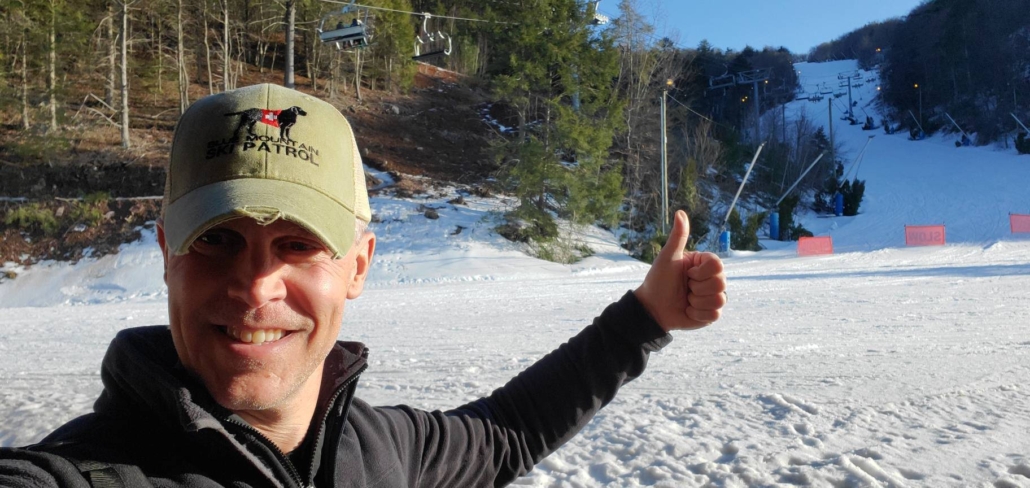
Robert Kossak

I’ve wanted to be a Ski Patroller since I was a kid, and finally got to do it as an adult. It’s a dream come true.

Growing up in New Jersey, my first time skiing was an elementary school class day trip to Holly Mountain, more hill than mountain, which no longer exists. I remember speeding downhill while my buddies cheered me on as they passed overhead on the ski lift. It was great.

Unfortunately, I didn’t know how to stop.  Luckily, a chain link fence at the bottom of the run stopped me. Later that day I learned something called the “hockey stop”, which I still use when necessary.

The years passed and I continued to ski. Whenever, wherever and with whoever wanted to tag along with me. These days, my favorite tagalongs are my wife and kids.

In 2023, I decided to join the Ski Patrol at Blue Mountain, close to home.  After surviving the ski off, I was given a huge book, “Outdoor Emergency Care: A Patroller’s Guide to Medical Care, Sixth Edition” and told, simply,  to learn it, report every Tuesday night at 6pm starting from April to August. That’s when I would be tested on the material and must pass to continue on as a Ski Patrol candidate.

I have no medical background. I thought I just had to ski around looking cool in that Ski Patrol jacket. It was a surprise that I would have to learn medical stuff.

Okay, I’ll study, I’ll train and do whatever is needed to be listed among the ranks of the National Ski Patrol! Let’s rock! I passed with a 90% grade, only to learn that was just a start.  Next would be OET (Outdoor Emergency Transport) as soon as there was snow.

On the first night of OET I was told by the Patrol Director that it’s a shame I paid full price for my skis because I’m only using the back third. But  I press on. Two nights per week plus Saturday mornings meant a two hour drive each way with about $23 dollars in tolls each trip. Never mind the cost. I’ve been wanting to do this since I was a kid.

I failed that first OET test but encouraged to try again next season.  The instructors also advised me to get new boots and learn to get out of the back seat. My parting words were, “I’ll be back.” One instructor said, “I like your attitude.” That meant the world to me.

Spring, summer and fall came and went and I couldn’t wait to get back to the mountain. I was literally the first one in line on opening day, remembering the parting advice from my OET instructors: “Never let good snow go to waste.”

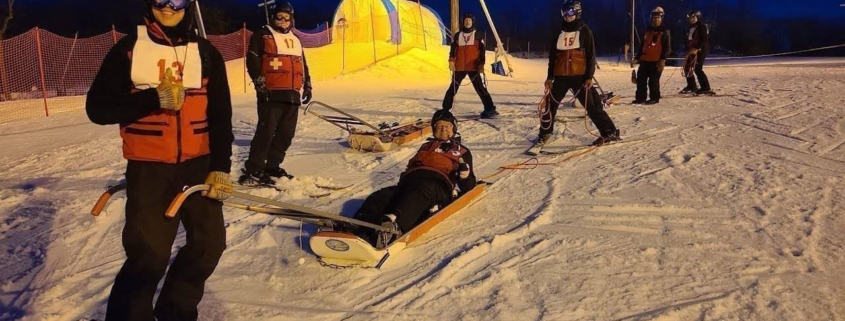
I would train solo. I would attend every OET training session. I would ask anyone better than me (which was pretty much everyone on Ski Patrol) for tips and advice, and before I knew it, it was OET test night, when 26 OET candidates gathered at Patrol Base. There was a stack of numbered beanies and we were told to grab a number. I chose 13. Nobody ever grabs number 13. I don’t believe in luck and always felt that number 13 has gotten a bad rap.
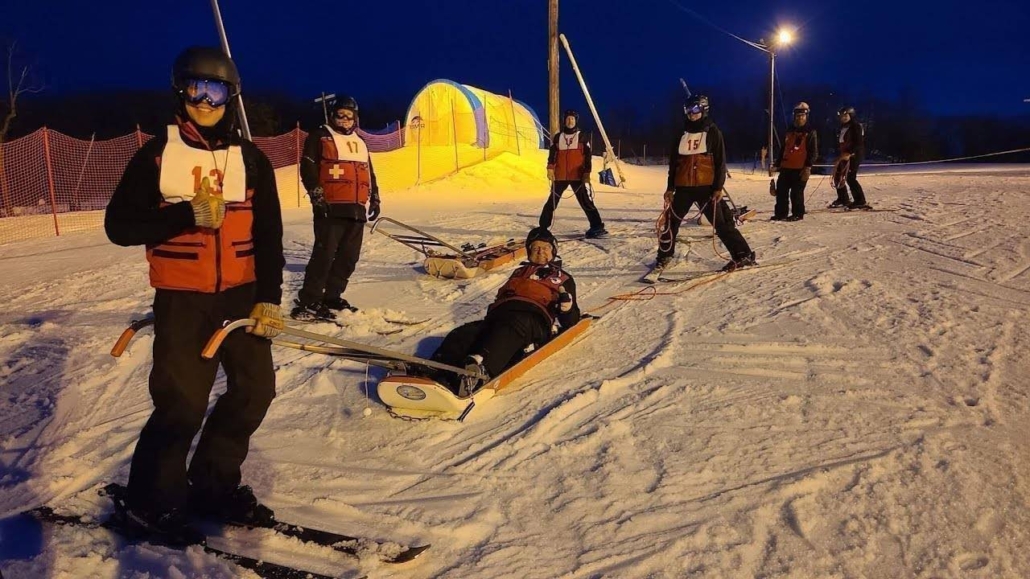
KOSSAK

OET Test Night

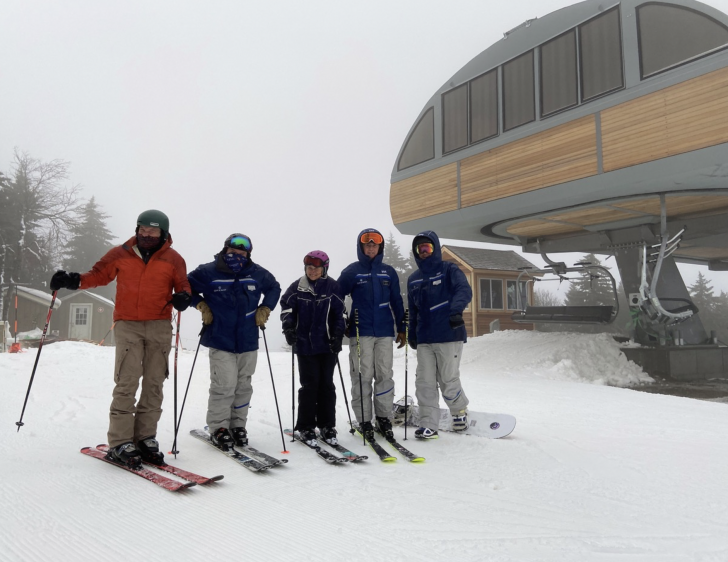
We headed to the hill. Test night was on the double black diamond “Challenge.” Appropriate. Then, back to Patrol Base to wait while the OET Instructors rated us.  When my name is called, our lead instructor says they all wanted to recognize my hard work and perseverance and that … I passed!

I will never be able to fully articulate my thanks, appreciation, admiration and love for my Blue Mountain Ski Patrol family, and the joy and purpose it has given me to help and protect skiers and snowboarders.

Recently, I visited another local mountain. I called their Ski Patrol for a courtesy pass for the day. When I got there, I met some of the Patrollers, who asked where my home mountain was.  When I said Blue Mountain, one replied with, “Blue Mountain Ski Patrol is intense. It is known for making Patrollers.”

I can testify first hand that the Blue Mountain Ski Patrol is known for making Patrollers, because they made one out of me. Within two seasons, I went from Tag Along to Sled Hauler. And for that, I’ll forever be grateful and proud to wear the red jacket.


Virginia’s First Ski Area Restores the Nation’s Oldest Spa

Omni Homestead Snowman

The Homestead in Hot Springs, Virginia, is not the biggest ski area in the South, but it’s the oldest. When snowmaking was installed on new slopes in 1959, the historic hotel appended the words “ski” and “spa” to its self-description.

The hotel has been hosting guests “taking the waters” at local hot springs since 1766, a decade before the American Revolution. Today, its upscale offerings continue to make it a posh, even exclusive destination – one with its own ski hill.

It’s the perfect place where not-so-crowded slopes and not-too-difficult terrain for senior skiers to introduce the family, including the grandkids, to skiing and a rarefied escape to a newly refurbished hotel and spa facilities.

https://www.omnihotels.com/hotels/homestead-virginia/things-to-do/resort-activities/winter-activities

The Homestead’s Ski Area

Omni Homestead Ski Slope

A free shuttle links the hotel and the modest slope layout, which is open Sunday to Thursday this season.

Back in 1959 when Austrian immigrant and southern ski legend Sepp Kober designed and built the ski area, it included a “skimobile” trestle lift similar to one then in use at Mount Canmore in New Hampshire.  Also, it was the first are anywhere to rely solely on snowmaking, setting an example for the region and world.

His ski school was staffed by young Europeans whose accents became the norm at southern slopes, as well as in ski areas in the North and West. Sepp and his Austrian instructors are no longer with us, but his ski school still offers a family-friendly setting that makes skiers and boarders out of beginners from 4 years up. A Little Penguins Program focuses on children ages 5 to 11.

The Homestead’s 10 slopes, up from 5 in the 1980s, drop 700 vertical feet. The main double chairlift tops out at 3,200 feet. Two blue runs leave the top of the chair, Escape and Upper Main, and merge with Upper Main continuing along the chair to mid-station. There’s also a short, steep black run, Nose Dive, from the top of Upper Main, and a pair of blues, Upper and Lower Glades.

At mid-station, green Yonder-Weigh leads beginners off the lift back down to the lodge on a longer green run, Lower Main. Another green, Briar Patch, slips by the resort’s tubing park, Penguin Slides. Also from mid-station, a terrain park comes back to the main slope above the tubing runs. Absolute beginners have a learning area served by three surface lifts, and kids can ride mini-snowmobiles.

The base lodge has large picture windows and an outdoor deck backed by plexiglass to break the wind. On a spring ski weekends, white-coated chefs from the hotel flip gourmet burgers. An upstairs grill, Kober’s, serves lunch and dinner amid extensive memorabilia of the life and legend of Sepp Kober.

Alternatives to skiing and riding include The Homestead’s Allegheny Springs, an ice skating facility with rentals, and a spring-fed, two-acre water park where a steaming outdoor pool and hot tub are perfect for soothing sore legs.

Homestead Re-Opens After Major Makeover

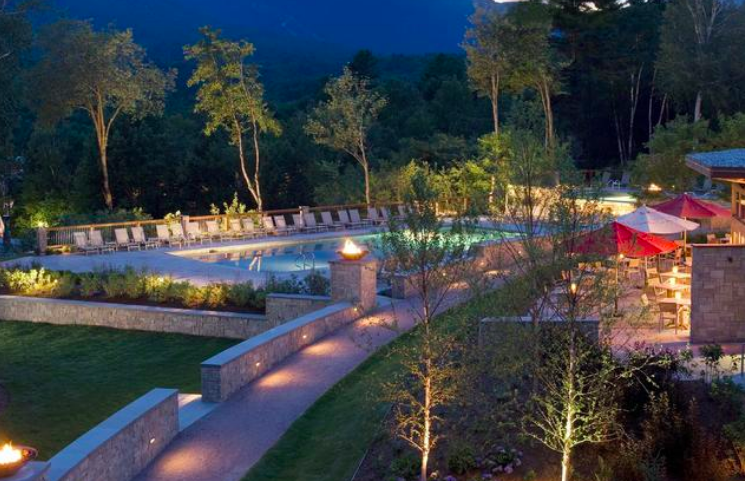
Omni Homestead Outdoor Pool

The grande dame hotel reopened for lodging on Feb. 2, 2023, after a massive

$121+ million makeover, the most significant investment in the resort in more than a century. The resort is a member of the Historic Hotels of America, a nationwide collection of legendary lodging spots organized by the National Trust for Historic Preservation.

www.historichotels.org

The impressive Great Hall, five hundred guest rooms and suites, and numerous dining destinations were fully refurbished and ready to carry the venerable resort’s luxurious reputation well into the 21st century. Given The Homestead’s singular historical status, the work involved a painstaking preservation process that included restoring 978 original wood windows and hundreds of doors and repair of interior and exterior stucco, terracotta, limestone and brick masonry.

For many, the real “wow” is the complete restoration and reopening of the nation’s oldest historic spa structures.  Once called “the Jefferson Pools,” after Thomas Jefferson’s early 1800s visits, the restored Warm Springs Pools include buildings that always reminded me of what a nuclear power plant might look like if they’d been in use in the 19th century, including the plume of steam emerging from the top of the dome-shaped roofs. Restoration included preserving and/or replacing the historic wood structure, windows, doors, siding and roofing.

The restoration effort involved the Virginia Department of Historic Resources and

notable preservationists to be sure the project adhered to The Secretary of the Interior’s Standards for the Treatment of Historic Properties.

Head Back in Time

At the newly restored spring buildings, there are adult and family times for spa visits, and sex-segregated clothing optional sessions. But unlike back in Jefferson’s day, guests no longer hang from ropes in the warm mineral waters. Today foam noodle floats do the job without the upper body workout.

The Homestead’s slopes and snowmaking gave birth to the now bullish Southern ski market, but back in 1761, when the stone basin of the 1820s Gentlemen’s Bathhouse was first constructed, it became the oldest spa resort structure in the country. No wonder The Homestead’s 2,300 acres are today surrounded by aptly named “Bath” County.

With its impressive recent improvements, the entire Homestead experience is a fitting tribute to Kober, often called the “Father of Southern Skiing” for his decades-long efforts to nurture the active Southern ski market. Kober was inducted into the U.S. National Ski and Snowboard Hall of Fame in 2009.
What’s New for the 2022-23 Season—Southeastern Edition 

Massanutten Resort

Terrain expansions and technology upgrades are routine at the seventeen ski resorts south of the Mason-Dixon Line. This year, that trend continues.

Here’s what’s new for the 2022/2023 season in Virginia, West Virginia, North Carolina and Tennessee.

Virginia –

Massanutten – 2022-23 marks the 50th year of skiing inside the “Kettle” bowl of Shenandoah Valley landmark Massanutten Mountain. In 1990, the resort joined the regional “big list” jumping to its present 1,110 feet of vertical by opening two major slopes and a summit quad.

This year, Mueller’s Mile adds a third run from the summit, along with two other new slopes, a black connector to Muellers Mile called Slot, and Ridgecrest, a blue from the upper mountain along the craggy crest of the Kettle. The expansion finishes up next winter, replacing the old fixed quad with a detachable, and turning the lift line into the resort’s only double black diamond run.

The requisite snowmaking expansion started five years ago with a two and a half-mile pipeline tapping a new water supply, and finishes this year with 21,000 feet of new snowmaking pipe on the mountain. Director of Skiing Kenny Hess, says “this expansion will be a game changer for Massanutten, especially next year. With a double black lift line trail, Mass will ski much bigger than in the past.”

Bryce Resort, near Basye, Virginia, has converted its legacy double chair to a fixed grip quad. And Wintergreen Resort, near Charlottesville, makes a big snowmaking upgrade to its Upper Dobie and Lower Diamond beginner slopes and The Plunge snow tubing park.

West Virginia –

Timberline Mountain – After being closed for two pre-pandemic seasons, Timberline Mountain in Canaan Valley (pronounced kuh-NANE) was purchased in 2019 by Indiana’s Perfect North Slopes. The reinvention of a great southern ski area is picking up speed as COVID issues ebb.

The new owners have made “a complete do over on the snowmaking, quadrupling capacity,” says Paige Perfect. Two new lifts went in, West Virginia’s first six-pack detachable, to the summit, and a fixed grip quad to mid-station with a loading conveyor. New lighting to mid-station brings back night skiing this winter.

The summit, where two-mile Salamander starts, the South’s longest run, stays dark for now to protect the Cheat Mountain salamander. Flanking the alpine-like Dolly Sods Wilderness Area, the slope is the only one in the region on US Forest Service land. In fact, Perfect says, “we saw Salamander and knew Timberline was it.” The slope’s beginner pitch, few intersecting runs, and expansive width make it a regional favorite.

Snowshoe Mountain – Even with nearly 200 inches of annual southern snowfall covering its 1,500-foot vertical, this Alterra Mountain Company resort added 15 automatic fan guns on the revamped Skidder beginner slope beside the summit village, creating a longer, wider learning slope with consistent pitch. There’s also additional snowmaking at Progression Park and at the Silver Creek area, the ridge top run and adjacent easy routes get the same snow gun expansion as Skidder.

To reduce traffic on the Ballhooter lift, the usual route back up to the village from The Boat House eatery on a lake below, Skidder’s carpet lift has been realigned to access the village from the top of the Grabhammer lift.

Winterplace – The only southern ski area located five minutes from an interstate highway celebrates its 40th anniversary this season. The resort has redesigned its rental process and expects a 75% decrease in the time required to rent from a ski and snowboard inventory that this year is all new. There’s also a new Progression Terrain Park with a double chair located beside one of the area’s favorite easier slopes, Highland Run.

North Carolina –

Appalachian Ski Mountain – This area, in Blowing Rock, becomes the latest of the South’s slopes to embrace the RFID ticketing system based on an easy, radio verified lift ticket purchase that’s reloadable online.

Beech Mountain – In the northwestern High Country corner of the state near Boone, this is the East’s highest ski area at 5,506 feet, one of two major ski areas flanking Banner Elk (town license plates read “Ski Capital of the South”). This season, Beech’s far left legacy double chair has been upgraded to a fixed grip quad with a loading conveyor. he mountain’s former terrain park becomes a new beginner trail, Carolina Caribbean, named after the resort’s original development corporation back in the late ‘60s that paired the ski area with a resort in the US Virgin Islands. That new green gets an enclosed conveyor lift.

New terrain parks are being built, for advanced riders on the former Powder Bowl slope, and for beginners on the Meadows run, both with new LED lights and fixed SMI tower Polecats (among Beech’s ten new guns for this year). An interesting new Latitude L60 All Weather Snowmaker is being installed in the tubing area.

On the “back side” of the mountain, the Oz slope’s new name is West Bowl, and its Lift 7 has gotten an electrical upgrade.

Sugar Mountain – The other ski area near Banner Elk, Sugar Mountain adds its second new high speed detachable quad chairlift in three years, on intermediate cruiser Oma’s Meadow. The first opened on the Easy Street beginner run in 2019, and a new fixed grip quad went in on intermediate Big Birch in 2021.  There’s also a six-person Summit Express servicing the rousing Gunthers Way advanced run.

With all the new high-speed lifts since 2014, and lift configurations since the mountain has literally reinvented its slope system, dramatically improving the ski experience at one of the region’s top ski areas. Snowmaking improvements will help cover the expanded base of the Oma’s slope and on adjacent upper mountain runs from the mile-high summit. The resort’s conveyor lift gets an enclosure to shelter skiers and new electronic lockers make ski storage easier in the lodge.

Cataloochee – The snowmaking system has been fully automated at North Carolinas first ski area (1961) and an additional twenty-seven guns added. The lodge has a new menu with gluten free and vegetarian options, along with authentic, on-site smoked North Carolina pulled pork barbecue. Hand-crafted ski racks have been installed on many walls and railings.

 Tennessee –

Ober Gatlinburg – The state’s oldest (1962) and only ski area has changed hands, with original owners the Anders family selling to local investors led by Joe and Jessi Baker, founders of Ole Smoky Distillery and Yee-Haw Brewing. The name means “over Gatlinburg” in German, and Eastern America’s largest tram lifts skiers to the slopes from the streets of the Great Smoky Mountain tourist town. The area’s new name will be Ober Mountain.

What’s New For the 2022/23 Season – Eastern Edition

Photo Credit: Stratton Mountain Resort

It’s time to check your goggles and helmet for wear and tear, shake your packed-up down jackets back to life and try on your ski or snowboard pants to make sure they still fit well enough to let you bend down and fasten your boots.

Here’s a short swing through what’s new at resorts in the Northeast.

New York State

Windham Mountain invested more than $9 Million for improvements, including replacing the old triple-chair from the base area with a Dopplemayr high-speed quad.  That will speed up-load times and shorten lift lines.  The Catskills mountain resort also increased snowmaking, and renovated an old mountain hotel as employee housing.

Vermont

Killington Resort opens its long-awaited new base lodge this season. The K1 Lodge offers indoor and outdoor seating for over 900 guests, multiple bars and food stations, retail and rental shops, and—by popular guest demand—45 restroom options.  Killington also has expanded its Woodward Mountain terrain parks.

 Mad River Glen replaced outdated snowmaking over the summer.  The new system can put more snow on the lower mountain/high traffic areas faster than before while using less water.

 Magic Mountain doubles its uphill capacity with the new Black Line Quad and its lunch and apres ski capacity with a new, larger base lodge deck. The locals fav area will maintain its 1500-per-day ticket limit. Also new is lights on the terrain mark, making Magic the only night terrain park in southern Vermont (open Friday and Saturday nights, including holidays).

 Stratton Mountain Resort launches Next Step Lessons, a beginner and lessons package, aimed at helping second- or third-time skiers and riders expand their footprint in the sport. Also expanding is Stratton’s number of terrain parks, with a new one on Beeline.

Snow tube fans will find an expansion to 6 tubing from the previous 4 at the Tuber Park, along two-for-one tubing for the last hour the park is open, for all Ikon Pass holders.

Sugarbush improved snowmaking on Easy Rider/Pushover to improve the beginner experience and also on the upper half of Mt. Ellen to provide more snowmaking reliability. The resort also replaced Reverse Traverse with an improved pitch that could change the way Lincoln Peak’s terrain opens up early winter.

Suicide Six is gone – in name only.  The 86-year-old Vermont resort has chosen the new name Saskadena Six.  The new name means “standing mountain” and honors the area’s connection to the native western Abenaki people.  Resort owners collaborated with Chief Don Stevens of the Nulhegan Band of the Coosuk-Abenaki Nation for his counsel and insights on the land, its heritage, and current use. 

Maine & New Hampshire

Sunday River Resort has replaced the old Jordan Express lift with the Jordan 8 chair, a Doppelmayr D-Line 8-person chairlift – one of the most advanced lift designs in the world. It is designed to be wind resistant and weatherproof, with heated seats and bubble covers in signature Sunday River Red. 

New for this season is a three-resort pass, for Sunday River and Sugarloaf, both in Maine, and Loon in New Hampshire.  The new N.E. Day pass is valid any day at all three resorts, available in increments of 2-5 days.

Where are you skiing or riding in the Northeast this season?

History Awaits Your Next Ski Trip (Part 1)

Your Support Helps!

Help us keep SeniorsSkiing.com free. Please support SeniorsSkiing.com with a donation.

DONATE

As serious skiers gain years and experience, many become interested in the history of their sport. And a lot of us are also better positioned economically to savor that heritage by checking into some of the country’s more historic ski settings. A budget bunker motel beside the access road might be OK, but it’s surprisingly easy and affordable to set your sights higher.

No article can list all the options, but the choices are many and range from historically significant ski lodging at specific resorts (think the 1936 Sun Valley Lodge) to atmospheric hotels and lodges that represent the enduring appeal of many ski country locations.

Since 1989, the National Trust for Historic Preservation has rounded up a classic lodging collection called the Historic Hotels of America (HHA), many of which are located in ski country. Ski destinations in New England and the South make perfect examples of places where these distinguished accommodations raise the bar on a ski vacation, especially with available senior discounts.

New England


The Presidentials are awesome from Bretton Woods Ski Area.                           Photo courtesy Omni Hotels and Resorts


A one-time Appalachian Mountain Club backcountry researcher, I enjoy New Hampshire’s Presidential Range. Last time, I overdosed on Nordic and downhill on both sides of the range, with stays in Jackson, south of Pinkham Notch, and Bretton Woods, north of Crawford Notch.

I remember the area’s rambling grande dame Crawford House Hotel before it burned in 1977, so I’ve occasionally chosen the Omni Mount Washington Resort as a substitute. The original 1902 hotel is massive and immaculately restored, with spectacular views of the Presidential Range. There are even better views from Bretton Woods ski area, New Hampshire’s largest. I took my first Nordic ski instructor’s training here in the ‘80s so I lean Nordic. Bretton Woods has 100 km of great valley touring that also includes a lift-served cross country trail network near the slopes.

The historic Mount Washington Hotel makes a riveting backdrop from the resort’s cross country ski trails.            Photo courtesy Omni Hotels and Resorts

If the big historic hotel experience is a no go, nearby Bretton Arms Inn is part of the same HHA Omni resort as the Mount Washington Resort, but it’s an 1896 former private residence on a more intimate scale.

While in Bretton Woods, don’t miss the New England Ski Museum, a short drive away in nearby Franconia.

The Historic Hotel of America option in Jackson is the Eagle Mountain House, literally on the village’s intensively groomed, 150 km Jackson Ski Touring Foundation trail system. The 1879 hotel’s Eagle Landing Tavern is a cozy setting, but skiers also have Highfields at the hotel, literally steps off the track.

Randy Johnson (right) and friends pose in the early 1980s at Hall’s Ledge on the way to Jackson after skiing down from the summit of Wildcat Mountain. Mount Washington towers above.                               Photo: Randy Johnson

Many nearby options are available, and I never seem to miss a stay or meal or two at the trailside Wildcat Inn and Tavern, not far from the foundation’s center. What a relaxed, quirky, full-of-character place. No wonder my best ski buds and I still talk about the times we’d base at Wildcat Inn and telemark the Wildcat Valley Trail down to town from the summit of Wildcat Mountain. Speaking of higher up, Pinkham Notch’s Joe Dodge Lodge accommodations still appeal to me long after I used to weigh my alpine hut-bound pack on the porch. This is old-school ski lodging but I’m not too special to call this rarefied throwback experience something I still savor.

Next Week, Part 2 / The Rest of the Country

Branching Out: Skiing the Trees

Your Support Helps!

Help us keep SeniorsSkiing.com free. Please support SeniorsSkiing.com with a donation.

DONATE

For many of us, skiing through the aging process means no longer going places we once skied without thinking twice. Now, approaching my 80’s, my mantra is never to overstep my capabilities and always watch out for the other guy!

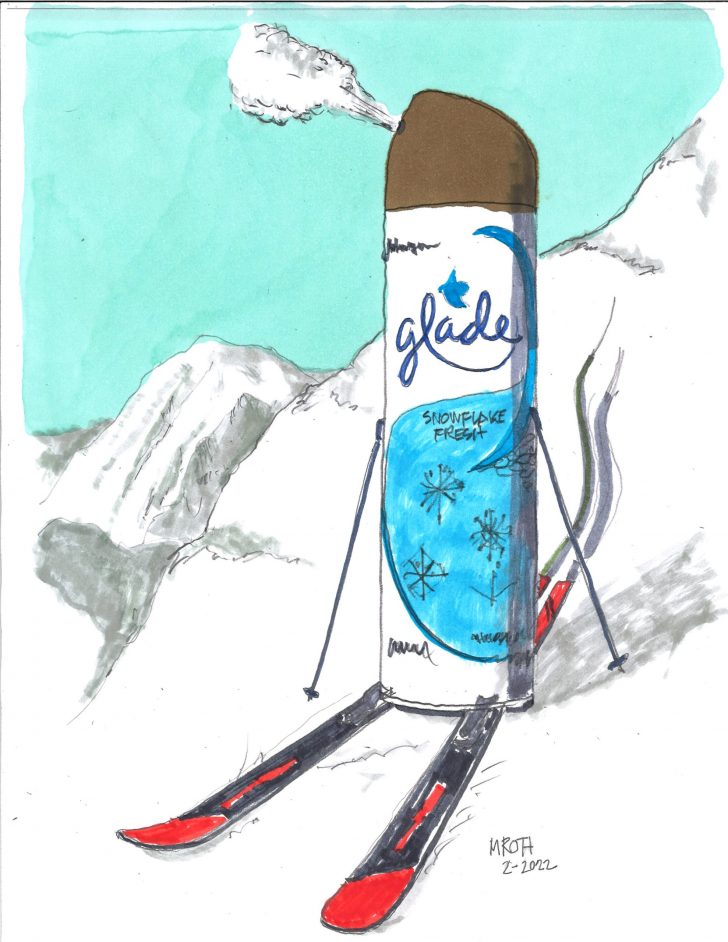
Anticipate turns when skiing the trees!                                             Illustration: Mike Roth


I’ve always loved skiing in the trees and still do on occasions when conditions are right, and I’m feeling up to the task. I enjoy the silence, the natural snow, and the general absence of other skiers. But I’m always on guard avoiding the trees and their branches.

My Favorite Eastern Glades

Some of my memorable tree runs have been in the East, where I do most of my skiing.

Mount Snow’s North Face tree runs are challenging. However, the tree run on the main face to the left of “One More Time“ is a delightful intermediate. Also, at Carinthia, the trees between Mineshaft and Nitro are fun.

Killington offers plenty of tree runs, for skiers of all ages and abilities. A favorite of mine is Squeeze Play, to the right of Ramshead’s Timberline trail. It is easily handled.

My favorite at Gore Mountain is Twister Glade. Like many other gladed runs, it needs a certain amount of natural snow.

Bromley’s Avalanche Glades are fun. The area’s Everglade to the Glade is a bit easier.

The south face of Okemo is where you’ll find Forrest Bump (cute name), Double Diamond, Outrage, and Loose Spruce. It’s on the latter that a snow snake twisted my leg.

A different take on Glade Skiing.                  Illustration: Mike Roth

Glade Skiing Rules

Here are rules I follow when skiing glades:

  • Never Ski Alone. It’s best to ski with 3 others. If one person is hurt, another can remain, while the third gets ski patrol.
  • Don’t Use Pole Straps. Catching a pole on a branch can damage arm and/or shoulder. The release mechanism on some Leki poles helps avoid the potential problem.
  • Wear Goggles and Helmet. They are essential protection when skiing trees
  • Carry a Loud Whistle. It’s advisable wherever you ski. If you get hurt or lost, a series of loud blasts will attract help.
  • Ski Within Your Ability

And a few pointers for tree-skiing:

  • Anticipate turns: Look to where you want to go between the trees and try to anticipate your next two turns
  • Make smooth rounded turns: In the woods, bumps tend to be soft, with plenty of places to set an edge

We skiers may be getting older, but, with the right attitude and a good dose of caution, we can still enjoy skiing in the trees.

Don Burch’s Fun Times (at Mount Snow, Okemo & Stratton)

It has been decades since I’ve skied the East. Once I discovered Western skiing, I traded the long flight for the long drive, eventually moving to Utah to shorten the time to the slopes. But Don Burch is giving me second thoughts. He’s developed an appealing alternative ski video genre (shot largely at Eastern areas). His most recent, “Fun Times at Mount Snow, Okemo & Stratton,” makes me long for those long-gone New England ski days.
Click on the image to screen this 60-second gem.

Quantum Six

Okemo Debuts New Express Lifts

Now in its 66th winter season, Okemo is one of the most technologically advanced ski areas in the East.

The first -chair passengers of the new Quantum Six at the top terminal: (l to r) Resort Guest James Kraft, Okemo GM Bruce Schmidt, Journalist and Ski Historian Karen Lorentz, Okemo Director of Resort Operations John Neal and Director Of Skier Services Steve Clark. Photo:Bonnie MacPherson

This year’s installation of two express lifts maintains that tradition with the debut of an express replacement for the Green Ridge Triple and the new Quantum Six Express lift at Jackson Gore, providing greater and quicker access to upper Jackson Gore, home of several expert trails and Tuckered Out, a classic winding New England run.

This is great news for seniors like me who enjoy skiing from Jackson Gore to South Face and getting lots of runs in less time. It has the added bonus of comfort of quick rides on really cold days. Fifty years ago, I might have gotten eight runs all day. Now, thanks to these new, fast lifts, I can get 12 to 20 runs in four hours. The Evergreen lift will put the frosting on my exercise cake by making possible upper mountain laps on blue favorites.

Quantum Six will disperse people more quickly from Jackson Gore to Okemo’s main summit when they’re skiing to the Evergreen Summit Express. Okemo recycled its Quantum Four Express bubble lift to replace the fixed-grip Green Ridge Triple and named it Evergreen Summit Express. The renamed lift increases rider capacity, cuts ride-time in half, and adds a bubble, providing greater comfort on cold, windy days.

A new, short connector trail with snowmaking re-routes skiers from the Mountain Road trail to the Evergreen’s loading station. For those coming from Jackson Gore, the new trail and lifts not only reduce the time it takes to access the main Summit, it cuts the time to access the summit of South Face from Jackson Gore’s base from approximately 40 to 25 minutes.

Senior Director of Mountain Operations Eb Kinney noted the Evergreen lift offers a good alternative to the Sunburst Six for skiing a host of upper mountain trails — like Timberline, Sapphire, Tomahawk, and Jolly Green Giant, several tree runs, and some easy greens. Greater usage of this underutilized lift/skiing area will reduce lift waits at the popular Sunburst Six, he said.

Installations of the new lifts followed existing lift footprints and skier loading areas.

Part of Vail Resorts’ multimillion-dollar capital improvements plan for Okemo this year are upgraded snowmaking infrastructure, addition of a new grooming machine, improvements to the Clock Tower base area, and new shuttle service between Okemo’s main parking lot to the Clock Tower base.


Four Bucket List New England Cross Country Ski Towns

XCSkiResorts.com recommends these classic New England towns and areas for a cross country  ski vacation:

Stowe, VT, is quintessential New England with its white steepled church and main street lined with stores.

Source: Trapp Family Lodge

  • It’s also the home of the Trapp Family Lodge of Sound of Music fame. Trapp Family Lodge has a 110 km trail network with 60 km of groomed and machine-tracked trails. Stowe has a full range of dining and shopping options. Other nearby XC resorts include Bolton Valley, Stowe Cross Country Center, and Edson Hill.

Woodstock, VT is another winter mecca with inns, restaurants, unique shops, and a national historical park.

  • The Woodstock Nordic Center operated by The Woodstock Inn & Resortoffers two trail systems right in town covering more than 45 km. The Mount Peg trails begin on the golf course at and climb to the summit overlooking the village below. On nearby Mt. Tom, the Center grooms more than 20 km of trails on old carriage roads in the midst of Vermont’s first tree farm and Marsh-Billings-Rockefeller National Historical Park.

The Mt. Washington Valley in the White Mountains of New Hampshire has some of the best cross-country skiing in the East.

  • “Enchanting” is the best word to describe Jackson, the paragon of New England towns and home to Jackson Ski Touring Foundation, a non-profit organization chartered to provide and maintain XC trails on more than 80 private properties and national forest. Country inns are scattered throughout the region. The base lodge is accessed through a scenic covered bridge.

Covered bridge at Jackson Ski Touring Center, New Hampshire Photo: Roger Lohr

  • Great Glen Outdoors at the base of Mount Washington is a magnificent setting with 45 kilometers of XC skiing, snowshoeing, and an ol’ fashioned tubing hill. Great Glen’s scenic trail system offers an enjoyable combination of well-protected spruce and fir-lined trails plus wide-open areas with breathtaking views of Mt. Washington and surrounding peaks. On the trails is the classic New England Glen House Hotel, with 68 rooms, a pub and restaurant. For even more adventure, enjoy a comfortable winter tour on the 9-passenger Mt. Washington SnowCoach, which transports guests to an unforgettable journey to a sub-Artic world on Mt. Washington.

Skiing at Bretton Woods, NH Photo: Roger Lohr

  • Bretton Woods Nordic Center is a thriving cross country ski center on the grounds of the Omni Mt. Washington Hotel. It. The grand Bretton Woods hotel has 100 km of XC ski laced throughout 1,700 acres of spectacular scenery. The Mountain Road, accessed via a lift at the Bretton Woods alpine ski area, offers spectacular vistas of Mt. Washington from a 7 km groomed trail down to Route 302.

Bethel, Maine is home to the Bethel Inn and Carter’s XC Ski Center, and Sunday River Resort’s alpine ski trails. The town settled in 1774, retains its small-town lifestyle.

Bethel Inn Resort , Bethel, ME

  • The XC ski trails, which meander through forest to a picturesque, covered bridge are canine friendly. Several inns along the trails are operated by the nonprofit Bethel Inland Woods and Trails organization. The Carter’s XC Ski Center has beautiful views of the Mahoosuc and Presidential mountain ranges. Alpine skiing, dogsledding trips, and snowmobile rentals are available nearby.

Many businesses in each of these New England ski towns organize special events on winter weekends and vacation weeks to encourage people to get out and enjoy the snow.

If you’re into XC skiing and keep a bucket list, Stowe and Woodstock, VT, the Mt. Washington Valley, and Bethel, Maine are classic New England destinations not to be missed.

Around Walden Pond

There are two trips around Walden Pond near Concord, MA. The first is a ski tour through a picturesque New England landscape, with sharp and steeply wooded hillsides surrounding an ice-covered, lambchop-shaped lake.

Around the same pond is a second trip, a pilgrimage that passes the cabin site of Henry David Thoreau, “self-appointed inspector of snowstorms”, conjuring the spirit of a special place and inspiring the thoughts of the pilgrim visitor.

Henry David Thoreau in 1856. Source: Wikipedia

If you choose the first trip, you‘ll find a pleasant ski tour: maples, birch, and oaks, rubbing branches in the wind, a frozen-solid pond to ski across, varying widths of trails in and out of sunlight, all free of charge, all well-tended, all convenient to the Walden Pond State Reservation parking lot on the Concord Road.

But, if you choose the second, be prepared to confront a man who discovered himself in those very woods and hills of Walden Pond, giving us a model of independence and renewal. One thing is for sure; if you take this trip around Walden, you won’t come out the way you went in.

What is it about Thoreau that initiates such pilgrimages? Why are visitors on foot and on skis so drawn to this singular place, the site of a small cabin gone long ago?

The answer is in the subtle message Thoreau left in those winter woods. To know the message, you have to know why Thoreau went to the woods to live alone by Walden Pond and what changes the woods made to his life.

Born in Concord in 1817, Thoreau went to Harvard College where he was homesick for the fields and forests where he once had played. Upon graduation, he and his brother, John, started a school in Concord. John became ill, the school closed, and Henry went to live with Ralph Waldo Emerson, serving as the philosopher’s gardener and handyman. Shortly after moving in, John Thoreau died, and Emerson’s five-year-old son passed away; their mutual grief bonding the two.

Now, Thoreau turned his attention to the community of thinkers surrounding Emerson, splitting his time between handyman and writing philosophical essays.

He was 28, an unsuccessful writer and poet living among the most dynamic American literary and philosophical giants of the time.  Frustrated by the complexities of society, Thoreau returned to the woods, to think, write, learn and sort out his life.

Replica of Thoreau’s cabin. Source: The Walden Woods Project

On July 4, 1845, he moved into the cabin he had built on the northwest shore of Walden Pond on land owned by Emerson.

You can ski up to the site of Thoreau’s cabin by following the shoreline trail on the north side of the pond or by a ridge trail also to the north of the pond but in more rugged terrain. If conditions are right, you can ski right across the frozen surface.

All of these trails are short, about a quarter-mile from the parking lot. A circumnavigation of the pond is less than three miles. If you want more skiing,  cross Concord Road and link into the web of well-tended trails that spread around Sandy Pond and into the town of Lincoln.

But this is a pilgrimage.

Thoreau’s house site and cairn. Source: The Walden Woods Project

The cabin site is in a clearing of pine and hickories “on a pleasant hillside.” A cairn nearby has been building since the site was discovered  in 1947. Stone markers indicate a small cabin, about 11 by 15 feet, the door facing the pond.

Much has been written about Thoreau’s two-year residence in the woods as a practical experiment and a naturalist’s odyssey. However, as you stand in that clearing by the cabin site, imagine Thoreau writing  on his little desk, remembering his brother and struggling to express his thoughts about life, values, and simplicity. Surely, the time spent at Walden was a time of renewal.

“I went to the woods because I wished to live deliberately, to front only the essential facts of life, and see if I could not learn with it had to teach and not, when I came to die, discover that I had not lived,” he wrote later.

In September 1847, Thoreau left Walden and moved back to his father’s house in Concord. He left knowing he could live the life he wanted. For the rest of his life until he died in 1862 at 43, Thoreau wrote, lectured, travelled, and continued to wander the woods.

Walden had been a turning point; the woods were a catalyst that helped him recognize who he was and where he was going, a man marching to a different drummer.

If you make this pilgrimage in winter, go early. You’ll find yourself alone in the woods next to Walden Pond. Stop skiing and stand quietly. The wind will crackle the branches, and you’ll hear your heart pounding.

Like Thoreau, let the woods give you respite. Recall what these woods have done, what any woods can do to vexed souls. Reflect on the simple beauty around you, read aloud from Walden, go back to the parking lot, different than when you went in.

Enjoy Don Burch’s Newest Creation

Don Burch creates short, artistic ski videos that capture the small moments showing people of all ages and abilities having fun together on the mountain.

Skiing The East” features scenes from Stowe, Okemo, Otis Ridge, Sunday River, Killington, Sugarbush, Mount Snow, Stratton, Wildcat, Magic, Waterville Valley and Maple Valley (long closed). Enjoy this two-minute ride.

Sunday River

Look Back: Sunday River

Smooth sailing on Risky Business. Photo by Tamsin Venn.

For the record, early morning skiing was just the best at Sunday River, Maine.

We skied this reliable, late-season spot over Easter weekend with two gorgeous sunny days, happy the travel restrictions into Maine had eased for us at last. Better late than never.

Everyone wore masks. Photo by Tamsin Venn.

Count SR’s season-long commitment to snowmaking (90 percent coverage) as the insurance that makes the late season possible, especially with paltry late-season snowfall. Also, a three-mile-long ridge of eight peaks gives skiers and boarders varied snow conditions at different exposures. You can always find something holding up well. Big vert lets you stay on upper slopes in afternoon to avoid lower-elevation slush. Good grooming helps put things right the next day in New England’s freeze and thaw cycle: 8 a.m. crispy corduroy.

All good.

The crowds were the biggest challenge. At the popular Barker Chair, social distancing was a little ragged, but everyone was wearing masks. People in the lift line were polite, waiting their turn, and no grumbling heard for riding alone. Slopes were busy, but most people knew what they were doing, including the rug rats, probably mostly passholders. (Note to senior self – the later in the season, the safer you are.) The one exception was the young, helmetless dude on the snowboard straight-lining White Heat.

There were a few surprises. We agreed to meet for Easter lunch at the sunny deck at North Peak Lodge, but only the bar was open. So we drank instead and ate chocolate bunnies. One closed trail we wanted to ski suddenly opened. The top of White Heat is nothing but a granite ledge with snow on top of it (you don’t realize that mid-winter). The schlep across a dry parking lot is not so bad.

I checked in with the millennials with me on what they liked at Sunday River and what they hope will be carried over into next year.

On the way over to the next peak. Photo by Tamsin Venn

Increased RFID use and access? Already there. Food trucks? Already had them. Outdoor dining? Great, unless it’s a blizzard. They can’t wait to get back to booting up in the lodge and more places to eat. They plan to renew their Ikon passes.

As for changes going forward, Sunday River says while plans for next year aren’t finalized, it will likely continue to encourage online advanced ticket sales, offer online food ordering at certain eateries, and hopes to expand takeout options.

Kelly Pawlak, President of the National Ski Areas Assn., noted successes that will likely be carried over into next year at most ski areas. Those include advanced ticket sales (ski areas like to know how many skiers will show up); reconfigured indoor spaces that open up space within lodges; increased use of ticket kiosks; outdoor living fixtures like fire pits, chairs, food trucks, outside food windows; and for employees, daily wellness checks, staying home if sick, plus sick pay for seasonal workers.

Summary of the 20-21 ski season? Like many, with the skis now hung up, I was very grateful there was one to begin with, and Sunday River made for a very rewarding finale.

Spring Skiing At Killington

Here’s Another Don Burch Video Capturing A Blue Bird Day At The Big K.

Snapshot of perfect conditions on a beautiful day.

Beech Mtn

Top To Bottom: Beech Mountain

North Carolina Has The Highest Ski Resort In Eastern North America. Have You Been?

Beech Mountain has 17 slopes and 8 lifts. The longest run is one mile. It might be short but it is indeed sweet.

The next stop in our Vicarious Vacation series is a hop down to North Carolina’s Beech Mountain. Located in the western mountains of the state, Beech Mountain has a summit elevation of 5,506 feet, making it the highest ski resort on the East Coast. The mountain is a mecca for mid-Atlantic skiers.

Here’s a run from top to bottom. We found the sound track a bit irritating, so we muted our sound while we watched.  We love cruising blues, and this run does it. Easy-peasy. See what southern skiing is like. No, it’s not the Rockies or the Alps, but it is fun for all.  It’s from pre-COVID times, so no masks, etc.


Spring Comes to Wildcat

Long And Winding Runs. Great Views.

Getting ready for spring skiing at Tuckerman. Credit: Tamsin Venn

It was serendipity to arrive at Wildcat in the northern Presidential Mountains of New Hampshire the first week in March and find spring skiing. Many of us missed that part of the ski season last year in the pandemic shut-downs.

Due to its north facing slopes and deep snowpack, Wildcat usually is the last ski area to close in New Hampshire. This year it’s April 18.

While there, temps shot up to 66 degrees. Wildcat is not always so hospitable. It sits across the street from weather magnet Mt. Washington, tallest peak in the Northeast at 6,288 feet, and highest recorded wind speed 231 mph.

Away we go down Upper Catapult. Credit: Tamsin Venn

This year we were on the lookout for non-crowded midweek slopes, a friendly local atmosphere, and no state travel restrictions for us. Wildcat fit the bill.

The L-shaped parking area minimizes the schlep to the main lodge. Boot up from your tail gate, tiptoe across the icy parking lot, hike past four new, neon-colored porta-potties, get your RFID card zapped, and hop onto the Wildcat Express Quad. Seven minutes later, in one of the swiftest trips in skidom, you have reached the summit.

For several hours I lapped the Express Quad, zipping up-down-up, alternating from the left to the right flank on long, winding trails of 2,100 vertical feet. The trails draw you down as the head and shoulders of Mt. Washington rise. It’s like being in a movie… with good lighting.

Snow was corn, sweet, smooth. My left-foot steering was working as well as my right, always a good sign. Around 11, soft conditions required maneuvering into skied-off slots to save on thigh burn. Clearly early-morning skiing is best for spring skiing, even at a north facing mountain. But when I left early afternoonish, the parking lot was jammed. Spring fever had hit.

Although it has a reputation as an expert’s mountain, Wildcat has beginner terrain (20 percent)—Pole Cat is a 2.5 mile beginner trail, longest in New Hampshire—(see video article in this issue)— intermediate terrain (47 percent)—Lynx is a sweet roller with fun intermediate pitches—and expert terrain (33 percent)— famed black bump runs under the lift line. Midweek, you’ve got your turns to yourself and stress-free trail junctions.

The “cans” are display only. Credit: Tamsin Venn

Looking across to the top of Mt. Washington and thinking of spring skiing Tuckerman Ravine, you will always be grateful for the Express Quad that whips you to the area top at 4,028 feet. No hiking required. On wind holds, the Tomcat Triple gives you the bottom three-quarters.

When Vail Resorts bought Wildcat two years ago to add to its Epic mix, it took many by surprise. Wildcat is loved for its no-frills amenities and boot-scarred lodge, not exactly a Vail kind of place.

But a modern mega-resort corporation can’t erase the memories. My neighbor asked me:

“Does Wildcat still have those cold gondolas? When skiing there circa 1950s, the cable jammed [and] we near froze in the can in the hour it took to get them moving.  When people did emerge at the top, all the men ran for the bushes!  Anyway, it was exciting to ski there.”

It still is.


Click here for Wildcat Trail Map

Click Here for Wildcat Tickets

Click Here for Uphill Access

Click Here for Mountain Cams


The Big K’s Ambassador Program

Ambassadors Help Create A Congenial Climate At Killington.

Here are the 2019-20 Killington Ambassadors saying hello. Volunteers commit to 21 days of service during the season. Credit: Killington Mountain Resort

As a huge ski area with several base areas and mountain peaks, finding one’s way around Killington can be a challenge. That’s where the green-jacketed Ambassadors come in, often saving the day by showing guests how to get where they want to go—or in some cases—avoid a too difficult or too flat a trail.

This year the COVID-19 pandemic has made the Ambassadors duties extra special as so much has changed—from getting a lift ticket to the necessity of wearing masks.

Ambassadors are dedicated volunteers who enjoy skiing or snowboarding so much that they commit to 21 days wearing the green to help guests have fun. Ambassador Program Manager Pete Duffy notes, “They are passionate about the mountain, the sport, and they want to help people.”

Hard to miss the Ambassadors in the green jackets. Credit: Karen Lorentz

To do that, Ambassadors attend morning briefings before the lifts open so they are up to date on conditions, lifts operating, and anything else pertinent to that day. They answer questions as they greet people mornings at the base areas and later help them find their way back to starting points at the end of the day.

Throughout the day, they ski around assigned mountain areas and answer questions just as their bright green jackets invite.

They also help reunite parties that get separated. Seeing a small boy reunited with his parents was “priceless,” Roger Halye said of a best memory.

Another joy Ambassadors cite is assisting with marriage proposals—whether it’s writing a “will you marry me” on the snow under a lift or taking a photo of a proposal at the peak.

They also assist other departments as needed. The sweet perk is skiing until it’s time to help the ski patrol with the end-of-the-day sweep or man various end-of-day stations. Duffy notes, they do all these tasks in all kinds of weather, including extreme cold, wind, snow, and rain.

In a normal season, Ambassadors also give free Meet the Mountains Tours, offer tips on events, take photos of people, greet bus groups, and staff the hotel and events, all of which went by the boards due to state COVID-19 related guidelines this year.

They ARE smiling. Green jacket Ambassadors Mike Cahill, Pete Duffy, Susan Cummins, Keith Murphy guard new ticket booth. Credit: Karen Lorentz

Recently I had the great fun of being shown around by Ambassadors Susan Cummins and Mike “Mickey” Cahill. Cummins prides herself on being “a friendly face willing to help and guide.” Like others, she also praises the social aspects of being an Ambassador, noting, “Through the program, I have generated some wonderful friendships; some so close they have come to my family events like weddings and holidays.”

Retired State Trooper Mike Cahill briefly dips his mask at the new automated ticket kiosk. Credit: Karen Lorentz

Noting he loves skiing Killington and helping people enjoy the mountain. Cahill said becoming an Ambassador helped him fill a void in his life after he retired from being a New York state trooper at the mandatory age of 60. “I enjoy the camaraderie within the group of outstanding people who share the same goals,” he added.

Bobby G has given tours for 20-plus years and counts many special moments, including people who return year after year for another tour, which leads to great friendships. One friendship has taken him to England several times. Another repeat guest is a clinical psychologist, causing Giordano to “sometimes wonder if it’s just the friendship or if I’m a ‘research subject’ that needs to be carefully watched.”

When fierce winds were buffeting a petite beginner who kept falling, Noreen McGill used her own body to shield her from the gusts, and together they managed to slip and side step to the shelter of trees. There McGill applauded the woman’s tenacity and thanked her for “sharing her struggle and strength” with her.

Riding a lift, Ambassador Louise Young met a guest from Toms River, NJ.  “I mentioned Toms River made the news years ago (1998) by winning the Little League World Series. Turns out he was one of the coaches!!”

Joe Schorle had a guest ask him “what he could do about boots causing his feet to hurt. I started to recommend a shop for adjustment but then looked down and realized his boots were on the wrong feet!”

Marc Pileggi recalled a “most unusual thing that happened was having to call a transport for a group of 12 who decided to go to the top of Ramshead at 3:45 with no ability to ski down.”

Questions People Ask

“How do you get to the main lodge? They usually mean the lodge where they started from,” notes Louise Young.

“What’s the easiest black diamond trail?”

When he’s stationed at the top of Killington Peak on a cloud-free day, people ask Robert Ide to identify the other visible ski areas.  The mountain they wish to have identified most is Mt. Washington, he said.

Questions Anthony Russo hears include: “Can you take our photo (asked prior to COVID)?” “Where’s the restrooms?” “What time does the lift close (usually asked at 4 p.m.)?  Where are the beginner slopes? Where is a good place to eat? Can you recommend other things to do besides skiing? Is there an easier way down from here?”

In late March and April, Phil Lipari is often asked, “Why does the mountain close at 4:00 when there is still a lot of day light? In January and February, why there is no night skiing?”

“What do you do with all the man-made snow in the summer?” Noreen McGill overheard a woman ask an Ambassador. “We store it in all the silos on the farms,” elicited an “Oh” as she contentedly walked away.

Pete Duffy said he was greeting people when a woman holding a glass bowl asked where she could leave her pet turtle while she skied. Since pets were not allowed inside a lodge, he never did find out what she did with it.


Women Played Integral Role at One of Nation’s Oldest Ski Areas

[Please consider supporting SeniorsSkiing.com with a donation. We appreciate your help. Click here.]

Janet Davis Mead, June Aker, Verlene Belden All Kept Pico Going And Growing, Despite Obstacles and Challenges.

Janet and Brad Mead started Pico in 1937.

Vermont’s Pico Mountain survived a war, two owners’ deaths, and a neighbor called Killington to become one of the 30 oldest continually operating ski areas in the country.

It’s a feat that was largely driven by women in its first 30 years, a time when the ski industry was known to be “a man’s world.”

Women also played major roles in Pico operations since that time, continuing the strong family influence that began with co-founder Janet Davis Mead.

A feisty woman given to exaggeration, Janet Davis told Brad Mead she had skied at the Lake Placid Club, so he invited her to go skiing.

“I had to follow him down what looked to me then like Mount Everest. I made it, but without poles,” she would write years later, explaining she had thrown them in the bushes, not knowing what they were for.

Her bravado paid off; they married and researched building a ski area.

Envisioning a year-round resort with mountainside homes, aerial tram, swimming pools, ice rinks, and tennis courts, the Meads leased Pico Mountain and opened Thanksgiving Day 1937 on Little Pico with a 1,200-foot rope tow and a rough-cut, 2.5-mile Sunset Schuss skiers could ‘skin up’ to the summit.

The Meads hired Swiss racer Karl Acker to run the ski school, added two tows, widened Sunset Schuss — renowned for downhill racing and the Pico Derby — and installed the first U.S. Constam T-Bar to the top of Little Pico.

After Brad died in a boating accident in 1942, Janet carried on with support from skiers, the Otter Ski Club, and Otter Patrol. When workers including Acker left for World War II, she kept Pico open despite hardships of rationing and shortages that caused many areas to close. Using her marketing skills, charisma, and tenacity, she gave special rates to schoolchildren and servicemen who visited on furlough weekends.

Karl and June Acker took over from Janet and continued to expand the resort.

Having survived wartime, Janet bought the mountain (1947) as Acker returned to teach and help operate Pico. (He coached daughter Andrea Mead, first American to win two Golds in the 1952 Olympics, bringing acclaim to Pico’s strong racing tradition.) As the first woman to own and run a U.S. ski area still operating, Janet survived four lean snow years, weak finances, and growing competition by lowering ticket rates and offering summer rides on chairs hung on the T- Bar (1950). With the ski boom on and her children not interested in running Pico, she sold to Karl and June Acker in 1954.

Karl added trails, a T-Bar, and a J-Bar. “The lack of access to funding caused him to do too much of the work himself; the long hours and the stress of the new J-Bar which he couldn’t get to work quite right contributed to his fatal heart attack” in May 1958, June told me in 2007.

“The three banks that had lent us money to purchase Pico had insisted on a life insurance policy on Karl. Because I was a woman they needed to know I could repay the loan if he died,” June said of becoming Pico’s owner at age 30.

She added trails, replaced a lift, and obtained financing for Pico’s first chairlift, a Stadeli double that went halfway to the top ($110,000 in 1962).

“Pico needed lift service to the summit to compete and survive.  Being a woman contributed to the banks’ reluctance to provide more loans,” June said, of her decision to sell to Bruce and Verlene Belden (1964) in hopes they would carry on a family-oriented mountain.

Bruce had helped build Mount Snow (1955-1964), while Verlene ran their 30-guest ski lodge and raised four children. With former guests investing, they became majority owners with Verlene as office manager. Her business acumen coupled with their strong family orientation and expansion of the mountain enabled Pico to survive the trying 1970s when all but five major Vermont ski areas changed owners, and most surface lift areas closed. Vermont had 81 areas in 1966 but just 39 by 1988.

When they retired in 1987, Pico had a reputation as the “friendly mountain” with strong racing and instruction programs and new base village engendering a loyal following.

Women played significant roles in achieving that reputation. “They taught youngsters to ski and race and were instrumental in the Pico Ski Club. They also ran various departments from ski shop to ski school, tickets to childcare. They contributed to the skier loyalty that saw kids who grew up at Pico return as instructors or coaches and bring their own families to the mountain,” noted former GM Frank Heald.

Current Pico Director of Operations Rich McCoy added, “Pico staff make people feel at home and welcome. That’s a legacy that women through their leadership roles have contributed to throughout Pico’s long history and still do today.”

Sunset Schuss: Had to skin up in the old days.

Loon Mountain Resort Update

Lodges Closed. Back To Basics.

[Please consider supporting SeniorsSkiing.com with a donation. We appreciate your help. Click here.]

Sunny day at Tote Road Quad.

Kudos to Loon Mountain Resort, N.H., for managing COVID restrictions so well.

Our family bubble all agreed the best thing Loon had done was shut down all the lodges to indoor food service. That simplified one’s strategizing. Grab ‘n Go food windows and indoor order options provided al fresco sustenance with outdoor seating. Canvas tents were pop-up dining halls. Quick stop locations on the mountain provided places to duck in with little ones to get out of the wind. Space heaters are placed in certain areas when weather permits. Rest rooms were available at all lodges even if closed (outdoor access) and one fancy trailer near the gondola.

We parked our rolling base lodge in the Main Lot with an easy-ish schlep to either the Gondola or Kancamagus Express Quad, booted and masked up. Lunch break was pleasant with hot soup, the heater run sparingly, and radio dial set to NH public radio. Loon does not allow open-fire grills in the parking lot.

Contactless pickup boxes, PUBs, are where you can pick up a RFID card bought online or scan a QR code to reload. Ikon pass holders need to reserve, but because of popularity can cancel, even day of (blizzard anyone?).

Ghost lines leave plenty of room. Credit: Tamsin Venn

Loon set up intervening ghost lift lines for social distancing (a few jerks zoomed down these). One employee did mask patrol. A lift attendant kept necessary order. Social distancing worked less well in the gondola line without the natural six-foot ski separation. Plexiglass barriers inside the gondola building separated the snaking queue. Some in our pod refused to ride the gondola. Nowhere was there pushback on riding a lift alone.


PUBs replace ticket windows.

Masks are required in the parking lot, lift lines, when loading and unloading. This routine broke down in the parking lots.

Nearby Plymouth State College is on a hybrid schedule so you get many college skiers all the time, not just January break, which lends a convivial air. Everyone seemed grateful to be outside skiing and letting off steam.

We deferred our Ikon passes because of New England travel restrictions. Loon is the only New Hampshire Ikon resort. Massachusetts residents, as are we, are allowed into New Hampshire but have to ten-day quarantine or produce a negative COVID test on return.


Snowy day in the Lincoln Woods. Credit: Tamsin Venn

Loon’s senior 65-79 pass averages $65 midweek, non-holiday through mid-March, free passes for those ages 80 and up and as a courtesy you don’t need to reserve. (Bretton Woods senior midweek pass is $39, FYI).

On the last day, we went XC skiing in the popular Lincoln Woods owned by the U.S. Forest Service The snow had newly fallen, the woods quiet. You follow a trail on either the east or west side of the snow-clad Pemigewasset River with snowshoers and dog walkers. 

In all, the experience felt pared down. You got out of your car, went to lifts, skied and rode, went big-ish then went home. That is a good thing. What will we do with the many usual options when we return to normal? And the snow conditions were outstanding.

Loon Trail Map

Loon Web Cam 

Uphill Access Policy 

Gratitude

Half-Way Through The Season, Pat McCloskey Takes Stock.

[Please consider supporting SeniorsSkiing.com with a donation. We appreciate your help. Click here.]

My Ski Lodge. Credit: Pat McCloskey

We are halfway through winter, and the groundhog has come out to let us know what he thinks about the rest of the winter. I wonder if he will be masked? In any event, this has been a different ski year with booting up in the parking lot and eating lunch in the car or at a tailgate. The good news is that, for the most part, snow has been really good this winter, and lots of folks are getting out to enjoy the slopes nationwide.

Here in Western Pa, the snow has been plentiful, and all of our ski areas have been operating well. There have been a few glitches along the way but for the most part, I am grateful that the lifts are spinning. The outside fireplaces are roaring, and, when there are only a few people in the lodge, I sneak in early to sit by the fire, one of my favorite things to do.

There’s been snow in western PA. Gratitude. Credit: Pat McCloskey

There have been a lot of changes this year in the operation of skiing. We don’t really know the half of it, but I am sure that operating a ski resort in Western PA is challenging enough let alone in a year with a pandemic. In the fall, there were questions about whether there would be skiing this season.  However, the resorts have made it possible even though their bottom lines are probably not as robust with the lack of bar and restaurant business. Tough to survive on take out and limited indoor seating. But they are doing it, and, for that, I am grateful. When I ride up that old chairlift and look out over the Laurels, I am so thankful that I have the health and the skill to enjoy skiing. And an hour and a half from where I live, I will take it.

Janet and I are headed west in February and I will be going again in March. From what I am hearing from friends out there, the resorts are doing a good job in general. Sure there has been the issues with long lines due to social distancing on the chair lifts, but it seems to have sorted itself out as the season has progressed.  This past week, most of the west has seen a significant snowfall which will hold them in good stead for the rest of the season. Outdoor recreation is essential to all of us if we want to get through this pandemic and nothing better than enjoying the snow in the winter.

As I sit in my folding chair at the beginning of the day and boot up, I look around and think we are much better off than we thought we might be. The weather has been cooperative, and it has led to good times outside for a lot of us. So the next time you see a snowmaker at the resort, any resort, thank them. They work hard in really adverse conditions. When you see the patrol, the ski school, a groomer , restaurant employee, ticket booth personnel, or management at an area, take a moment to thank them all and tell them how much we appreciate their efforts to keep us all going strong this winter. The good news is that no matter what that ground hog says, we have a lot of winter left.


Call Of The Mountains

A Lyrical Look At Classic Eastern Ski Trails.

Killington, Okemo, Mt. Snow. See what you’re missing, Western Skiers?

Thanks to SeniorsSkiing.com correspondent Don Burch for another great, feels-like-you’re-there video.

Early Season Skiing: Okemo, VT

Shaking Off Summer Dust: First Runs Of The Season

Snow finally came to New England last week whether through machines or from the sky. It finally got consistently cold enough to make the stuff or for real snow to stick. 

SeniorsSkiing.com correspondent Don Burch ventured out to see what was going on at Okemo, VT. Here’s his video report from the slopes.  If you haven’t been out yet this year, perhaps this short video will rev up your enthusiasm.


SeniorsSkiing Guide: Holiday Valley

Are there powder days in Western New York? Can Pete Widger yodel?


Yes, to both. In fact, septuagenarian Widger, the voice of Holiday Valley’s Snow Phone, will lace his conditions report with his trademark vocals every powder day of the season.

Holiday Valley’s powder comes compliments of Lake Erie’s snow machine, the same lake-effect system that gives Buffalo its arctic reputation.

Holiday Valley, in Ellicottville, Cattaraugus County, averages about 180 inches of snow per season. In addition, the resort’s snowmaking staff is able to cover 95 percent of the resort’s terrain with its 611 snow guns.

Holiday Valley’s peak elevation is 2,250 feet, a rise of 750 feet from its 1,500-foot base elevation.

It boasts 60 trails, served by 13 lifts (including three high-speed quads) over 290 acres. Green trails make up 37 percent of those runs, blue, 25 percent, black, 37 percent and double-black, 2 percent.

For a good warmup, take the Mardi Gras lift for a slide down Candy Cane, a green trail, with options for a blue Crystal Bottom. Or start blue with Independence or even black with Yodeler or Champagne. North Wind upper and lower trails are also accessible from this lift as are a variety of other lift-and-trail combos.

On the facing hillside, Cindy’s Run, accessible by Cindy’s Quad, is a challenging blue. Cindy’s can lead to black options such as Foxfire, Wall Top and the double-black Wall.

It is easy to spend a day at Holiday Valley mixing your trail colors and lifts. Most every skier will find challenges and satisfaction.

Comfy lodge at the bottom. Trails for all abilities at HV. Credit: Craig Melvin

The resort’s beginnings can be traced to the late 1930s when enterprising enthusiasts built a tow from an old truck and built a little warming hut. The operation has moved from slope to slope in the Ellicottville area. The current lodge site was established in the 1960s and the resort has grown from there.

The club atmosphere of those days has endured, said Jane Eshbaugh, director of marketing at Holiday Valley, “Especially in this part of the country, skiing is very social, we see many senior groups skiing together or having coffee or dining.”

“We have so many generations at Holiday Valley. We really market to families, but that includes parents, grandparents and great-grand parents,” Eshbaugh said.

One perk for senior pass holders is the ability to add a grandchild at an additional family rate.  At Holiday Valley, loyalty pays. Skiers 65 to 69 can receive 5 percent of a Classic Pass. But if a senior skier has purchased a Season Pass or Ultimate Pass for the past five years, the discount goes to 25 percent. For those 70-plus, the initial discount is 10 percent and 50 percent for those with pass purchases the past five years.

Holiday Valley gets regular snow dumps from lake-effect storms. Nice coating on trees. Credit: Craig Scott

Holiday Valley’s employment rolls are well-populated with seniors. From office and maintenance to on-slope duties such as Ski Patrol, Ski School Instructors and Safety Patrollers.

Because Holiday Valley lies close to Canada (about an hour from the Canadian border), there are often as many Ontario plates in the parking lot as those from New York. The resort features, Canadian Friendship Week, during which lift tickets and rentals are at par with Canadian cash. It’s hard to ride the lifts on a busy day that week without meeting fellow skiers from, say, Toronto or Niagara Falls.

Lift lines, however, are rather rare at Holiday Valley. The lifts are efficient and only on the busiest days are there people waiting to ride.

Holiday Valley offers a number of lodging and dining options, and nearby Ellicottville is a friendly and hip little Eastern ski town.

The nearest large airport is Buffalo International, about 60 minutes away. Cleveland, Pittsburgh and Rochester are about two to three hours away by car.

CLICK HERE FOR HOLIDAY VALLEY TRAIL MAP

CLICK HERE FOR HOLIDAY VALLEY WEBSITE


SeniorsSkiingGuide: Seniors Love Sugarloaf

For Many Many Reasons.

Sugarloaf is a big mountain with lots of choices for all levels.

Located in Maine’s western mountains, Sugarloaf is farther away than other New England resorts, with underpopulated weekdays, giving you more room to roam.

It is rugged and unpretentious which draws one of the most loyal following of skiers in New England.

The setting is a lone behemoth, third highest peak in Maine at 4,249 feet.

It is challenging with seriously steep runs, above-treeline snowfields, glades. Experienced skiers make it less likely they will run into you.

It’s a little wild and wooly. Getting here, you are just as apt to pass logging trucks as SUVs.

Temperature inversion is a springtime phenomenon. Credit: Tamsin Venn

As one of the biggest ski areas in New England with a 2,820 foot vertical and 57 miles of trails with minimal traversing, the mountain is vastly entertaining, suiting any mood or ambition, as you wander from one lift to another.

We used to take the kids up there. Sugarloaf also has many easier ways down, but it had been years since we had been been there.

It all came back. You can lap the blacks on the Superquad like Upper Narrow Gauge and Hayburner, or stick to blue King’s Landing. Enjoy the views to the west at the top of Timberline chair then meander down the green Upper Timberline. Stop in at Bullwinkle’s for a hot chocolate. Tote Road is a 3.5-mile green run from summit to base, longest trail on the mountain.

Pole your way over to Spillway with its sweet consistent pitch. Take the Skyline quad. Hike up to Sugarloaf’s famed snowfields, front or back side, double blacks all. In spring corn snow with a good snowpack, they are the best.

Follow Spillway XC cut and pick your challenge. The truly adventurous plunge down Upper Winter’s Way, gnarly, bumped, and ungroomed just like the good old days. Gondi Line, Upper Bubblecuffer, White Nitro, or lower angle Ramdown lead back to the base when too windy up top.

Mountain east, served by the King Pine chair, you access the snowcat-serviced hand-cut Brackett Basin Burnt Mountain glades.

Relax on mostly blue runs off Whiffletree. Take the grandkids under the wood arch to Moose Alley to see Amos the Moose and pals Blueberry the Bear and Pierre the Lumberjack.

Schlep alert: Take the short Skidway chair to the Sugarloaf Superquad.

Sugarloaf can get wind-scoured. Think top of Mt. Katahdin, almost the same height. But when you hit it right, there is no finer place to ski in New England. In mid-March, I dove down the middle of an empty Gondi Line, non-stop, gripping corn snow. The sky was blue. It was an experience I hope to repeat when we all can make a safe return to the mountains.

Check Out

Former French team racer Lionel Hering mans Happy Tunes ski shop. Credit: Tamsin Venn

  •  Expert boot fitting by former French racer Lionel Hering at Happy Tunes!, Valley Crossing.
  • Friendly, daily grooming intel in the snow conditions report.
  • Sugarloaf Inn’s Shipyard Brew Haus’ twofer dinners Tuesdays.
  • Venison, fiddleheads, and fine local dining at One Stanley Avenue, Kingfield.
  • Free same-day Nordic trail access with Alpine ticket at Sugarloaf Outdoor Center, 90 km. 
  • Free Sugarloaf Explorer Shuttle. Wave it down. They’ll stop.
  • Don’t miss the Hotel Herbert, Kingfield, for rooms with antiques and charm

The Tickets

Seniors 65-79, $85,  80-plus free.

For Sugarloaf webcams, click here.

For Sugarloaf trail map, click here. 

For Sugarloaf uphill access policy, click here. 

Topnotch

Topnotch At Stowe: Ski, Relax, Recharge

A Great Spot Close To The Big Mountain.

View the stars from the outdoor heated pool at Topnotch.

As one person said, Stowe, VT, takes its wellness seriously and nowhere is that more apparent than at Topnotch Resort. The 120-acre wooded getaway is a place to recharge and refuel in a calm and soothing environment.

The attractive, minimalist hotel has just 68 rooms, plus two restaurants. From the minute you swing open the large wood front doors, you are swarmed by friendly staff ready to help.

Floor to ceiling windows overlook Mt. Mansfield, which beckons, ski me, ski me, which is easily done. Take the resort’s free shuttle up to the Spruce Peak parking area without the hassle of parking.

Alternative snow activities abound, including sleigh rides. Think grandkids.

Topnotch caters to both rabid outdoor types and those who are on a different pace. If you need a chillax day or have someone in your group who does not ski, Topnotch offers a schedule of daily fitness activities—some are free, some have fees. They range from Pilates to Vinyasa Yoga, from Qui Gong to Chakra Balancing; plus a morning stretch at 8:25 a.m.

You can do as much or as little as you like. No one is judging you.

The five-mile Stowe Recreation Path runs along the river across the road. You can fat bike, Nordic ski, hike, snowshoe, walk your dog (Topnotch has several pet friendly rooms). Rent gear from MountainOps, a high-end retail and rental shop that works with Topnotch and where you can pick up local intel.

SeniorsSkiing readers are also tennis players. Check the courts at Topnotch.

Tennis anyone? You can take daily adult clinics at Topnotch Tennis, with four indoor courts, recently resurfaced and relit, consistently is ranked as one of the top tennis resorts in the U.S.

The piece de resistance, however, is the 35,000-foot spa. You have absolutely no excuse to not be on the slopes the next day due to sore muscles.  A cascading waterfall indoor hot tub hydro-massages aching shoulders, while an indoor pool with a dedicated lap lane lets you stretch out the whole body. A steam room, sauna, and shower will also help melt away any tight spots.    

An outdoor heated pool and hot tub let you swim or soak under the stars.

You may not be interested in the fitness center, after beating yourself to a pulp on Stowe’s Front Four, but if you do, it has a wide selection of cardio and weight equipment and attractive studio. The spa also has 30 treatment rooms. I highly recommend the signature hops massage with Scott, which left me feeling as bendy as the Mom in The Incredibles.  

After the day outdoors, the ravenous will appreciate The Flannel which uses local, seasonal, fresh ingredients from local farmers, Vermont cheesemakers, and culinary artisans, supervised by chef Ryan Lajoie. The Roost, an informal lobby bar, is a popular locals’ après-ski spot with live music weekends and offers more casual fare and a kids’ menu. Topnotch is a place all generations can enjoy.

In spring, rates go down at this four-diamond luxury resort, just in time for Vermont maple sugaring season. Both are sweet deals. Plus Stowe just got three feet of snow.

Alpine Backcountry Touring Primer In Bolton Valley

Three Things to Do And Not To Do While Alpine Backcountry Touring.

Backcountry skiing is different, requires planning and gear. Credit: Bolton Valley

For those who have never tried Alpine Touring, Bolton Valley near Burlington, Vt., offers an intro to backcountry skiing every Saturday morning out of the spacious Sports Center near the main lifts.

That is due to a recent change in Bolton Valley ownership. Three years ago former owner Ralph DesLauriers, his son Evan, and local partners bought back the well-loved ski resort.

Alex describes the required gear. Credit: Tamsin Venn

An avid backcountry enthusiast, Ralph’s other son Adam developed a unique backcountry and split boarding program to fully enjoy the 1,200 acres of terrain here. Ralph’s daughter Lindsay who is president of the organization is another fan.

In Alpine Touring, you skin up the mountain with your heels free on lightweight, Alpine-like equipment then lock in and ski down. It’s called “earning your turns.”

We were lucky to have as our guide Medevac helicopter pilot Alek Jadkowski who was patient and clear with us newbies. Indoors we learned how to secure the toe, adjust the heel lifts for uphill climbing, then lock into downhill mode, and put on skins. We followed Alek uphill to nearby Holden’s Hollow Glades and soon were all whooping it up between the trees in thigh-deep snow having caught our fearless leader’s joyous enthusiasm.

Here are three things Alek recommends when starting out in this fast growing sport.

What Not To Do:

1) Don’t ski alone. It’s possible to injure yourself so you can’t even call for help; you need someone else to do that.

2) Don’t get lost. It doesn’t necessarily require a map or compass. You can use GPS or a map on your phone; how you keep track of your location is up to you. Carry a phone battery booster; take into account you may be out of cell service range.

3) Don’t drop your skins in the snow. They will lose their grip and with it your uphill power. Fold them carefully when removing them. Stash them in your pack.

What To Do:

1) Wear a helmet. Travel uphill with a lightweight beanie but downhill protect your head from possible tree contact. Wear goggles to protect your eyes from tree branches.

2) Know what weather to expect and dress for it. You get hot and sweaty climbing uphill and chilled when you stop to switch gear and ski down. Layer your clothing, carry a backpack so you can shed layers and put them back on. Slow your climb if overheating. Drink plenty of water.

3) Do have fun. Go and ski something you are going to enjoy; find the level that suits you; do something that makes you happy.

Where: Bolton Valley Resort and Mt. Mansfied State Forest. 100 km trail and glade network

Learn: Intro clinic every Saturday, (9:30 to noon). Cost $60 includes two hours of guided skiing but not rental gear. Private guiding and lessons also offered.

Fees: NBU (Nordic/Backcountry/Uphill) day pass $13 for seniors (65 plus). Senior Season pass $149; age 75 plus $79.

Gear: State-of-the-art rentals of Dynafit Alpine Touring ski equipment, $60 a day.

Gimme Shelter: BV has added a warming tent in its backcountry glades.

Getting ready to go Alpine Backcountry with friends. Credit: Tamsin Venn