Hike Vermont: Trails For Seniors And Families

Great Advice From Roger Lohr, Publisher of XCSkiResorts.com.

There’s no better way to enjoy the outdoors than hiking on a trail alone or with your friends or family. Whether you are a first time hiker or a walking aficionado, hiking with the family provides quality time together, allows the family to grow closer, develops life-long memories, and introduces the next generation to the outdoors. It’s no wonder that statistics show that nationally more than 34 million people went hiking in the year 2013 and that has remained somewhat consistent in the last few years.

Family hiking in Smuggler's Notch is a perfect summer vacation. Credit: X-CSkiResorts.com

Family hiking in Smuggler’s Notch is a perfect summer vacation.
Credit: X-CSkiResorts.com

You don’t need to walk very far to experience the joys of being outdoors with your kids or grandkids. It’s about discovery and having fun. For parents taking their kids on a hike, it is recommended that the child’s early experiences be positive, so avoid plans to reach that favorite spot or the top of the mountain. Keep it simple by being flexible and adaptive to make sure the younger ones have a good time.

Perhaps short hikes at first near home or a local park will provide a positive experience. Bring a snack, water, and invite your kid’s playmate. They can find joy in clouds, flowers, tadpoles, splashing water, getting dirty, colorful bugs, etc. but you don’t want them to get sunburned, hungry, thirsty, or exhausted.

Safety and Other Considerations on a Hike

Be careful of rocks, rubble, brush piles, or fallen logs where kids might lose their footing, sprain an ankle, or take a fall. Tell kids not to drink the stream water or eat berries or mushrooms, and the rule with poison ivy, oak, and sumac is “leaves of three, let it be.” Be wary of places where bees and wasps might nest.

Wearing bright clothing is a good idea so you are easy to see and find if lost. Layer clothing, and be prepared for weather changes. Synthetic clothing (such as a capilene shirt or a pile jacket) is lighter, a good insulator, and dries faster. Socks and supportive boots are important. Traditionally hiking socks were made of heavy wool but more recently socks that are made of a variety of materials that provide warmth, durability and keep your foot dry. Hiking boots are not required but they can help kids feel like explorers.

A list of items that could be useful on the trail includes: signal device (whistle, mirror), water bottle, emergency blanket, map, compass, flashlight (with spare battery and bulb), extra food, extra clothing, sunglasses, sunblock, insect repellent, knife, waterproof matches, firestarter or candle and a first aid kit.

If you think that you are lost, try to retrace your course rather than continuing on in an effort to reach some destination. An emergency call consists of three short audible or visible calls repeated at regular intervals. Use a whistle for making noise and a mirror or smoke puffs during the day. At night, use a flashlight or small bright fires to signal.

 You may consider leaving your dog at home if he or she cannot be kept under control. Respect the privacy of residents that live along the trail unless there is an emergency and you desperately need help.

Leave No Trace

Some basic concepts for outdoor and trail etiquette include: Plan ahead and be prepared; Travel on durable surfaces to minimize trail erosion; Pack out what you bring in to the outdoors (don’t bury trash or diapers); Leave the outdoors as you found it, don’t feed the wildlife, and take only memories away with you; Minimize the use of fire and take extra care if you do use it.

Here are some hiking destinations in Vermont and for more locations, check the XCSkiResorts.com Resorts Page:

Bolton Valley: There are 100km of Nordic and backcountry ski trails at Bolton Valley Resort and in the summer these same trails provide paths for outdoor adventure in over 1,000 acres of wilderness. Some trails lead up the valley to the ridge-line where hikers can connect with Vermont’s Long Trail.

Killington Resort: With 15 miles of hiking trails at Killington Resort, you can summit Vermont’s second tallest peak to be treated to 360 degree views of Vermont’s Green Mountains, New York’s Adirondacks, and New Hampshire’s White Mountains. Additionally, near the top of the mountain provides access to the Peak Lodge, Killington’s state of the art facility, which offers fresh food and cool drinks to hikers and mountain bikers all summer. The K1 gondola lift is open for rides to reach the summit.

Smugglers’ Notch Resort: The Green Mountain setting at Smugglers’ Notch Resort creates many opportunities for guided and self-guided hiking for all ages. The resort hosts guided outings designed for families with young children, with a gentle pace and fun learning opportunities. Other guided outings entice new hikers and experienced hikers with the opportunities to learn more about the history of the surrounding area and the local flora and fauna, and to summit some of the area’s most challenging peaks. Guided hiking is included in the resort’s vacation packages. The resort provides informational sheets on self-guided outings nearby.

Trapp Family Lodge: There are over 60 kilometers of wooded hiking trails for all levels of ability at Trapp Family Lodge in Stowe. There is a short, peaceful hike to the Chapel, built by the Trapp family sons on their return home after World War II. A more challenging hike takes you to the Slayton Pasture Cabin, a favorite resting spot for cross country skiers or snowshoers in the winter. Guided nature walks are available to guests to learn about native plants, wildlife, and the evolving landscape.

Woodstock Inn & Resort: Step outside the Woodstock Inn & Resort and choose from more than 60 miles of interconnected trails and pathways that wind through the Woodstock Village, nearby meadows and woodlands, scenic vistas, and rural countrysides. Pedestrian pathways skirt local landmarks, while off-road trails yield to magnificent vistas from the summits of Mount Peg and Mount Tom. For a historic walking tour of Woodstock’s past, stroll the 20+ miles of colonial carriage roads as they wander through the Marsh-Billings-Rockefeller National Historical Park and intersect with the Appalachian Trail.

The Late, Late Show: Killington Still Killin’ It

Skiing In New England In May?

Yes, it has been a curious winter and curiouser spring.  We had a snow drought in the West, a middling winter in the Rockies, and bitter cold in the East.  Now, it’s mid-spring, and we’ve heard of quite unexpected, new powder skiing in the Rockies and the Dakotas.  Did people actually go skiing out there after the lifts closed down?  Someone please tell us; we thought most areas in the region closed early to less-than-ideal snow conditions this spring.

Superstar Trail is open for business at Killington on May 22. Credit:  Paul Remillard

Superstar Trail is open for business at Killington on May 22.
Credit: Paul Remillard

Now we hear from SeniorsSkiing.com Subscriber Paul Remillard who reports he and his pal Joe spent May 22 at Killington, VT., on the bumps and has pictures to prove it.  He reports conditions were still top to bottom on Superstar with corn snow and a hard base between moguls.  “Sweet,” says Paul.

This unusual ski season refuses to end.

Pal Joe dismounts the lift at the top of Superstar. Note trees. Credit: Paul Remillard

Pal Joe dismounts the lift at the top of Superstar. Note trees.
Credit: Paul Remillard

Ski Lessons Improve Senior Skiers’ Technique

It’s Never Too Late to Take A Lesson.

William Smith, age 91, started skiing at Mt. Cranmore, N.H., after WW II. His wife even took lessons from ski legend Hannes Schneider. She quit skiing when she was 73, but Smith continued. He was skiing with his son that morning when I rode the lift with them at Waterville Valley Resort, N.H. Father Smith taught his kids and grandkids to ski, but he doesn’t want to take lessons himself.

Senior Skiers take lessons at Waterville Valley Resort. Good technique means more enjoyable skiing. Credit: Steve Bryan

Senior Skiers take lessons at Waterville Valley Resort. Good technique means more enjoyable skiing.
Credit: Steve Bryan

“I’m skiing as well as I’m going to. My legs aren’t holding up as well.” I then watched him push off down the slope swiftly in well balanced short parallel turns. So much for weak knees.

Like Smith, many seniors are skeptical of what they call teaching old dogs new tricks, unless they plan to do something very different, like ski powder in Utah for the first time.  However, a senior ski lesson can actually lead to more enjoyment.

“Most senior skiers like the medium to long radius turns and cruising the mountain and enjoying it,” says Peter Weber, Snowsports Director at Waterville Valley Resort for 15 years. But that is no reason not to ramp up your technique.

“Whether you’re 7 or 77, technique trumps all. The better you are technically, the easier everything gets,” Weber says.

In teaching seniors, an instructor would most focus on pacing—how fast you ski, how many time outs for trailside chats vs. pushing top to bottom runs, and the need for biobreaks.

Fitness level in general is key, adds Weber. “Skiing anything above a moderate level is an athletic endeavor,” he says.

Like other resorts with comprehensive snow sports schools, Waterville Valley Resort matches you to the right instructor, so you don’t end up in a class with a bunch of young hot shots. Weber also recommends a private lesson as well as taking several group lessons.

Mark Hanabury, an instructor at Waterville Valley, says, “I think it’s more important for seniors than anyone else to take lessons.” He feels seniors will be safer and will enjoy skiing more if they embrace the new techniques including a wider stance and shorter, wider shaped skis.

“Skiing has evolved so much,” he says.

He knows first hand. Last year,  he took his dad Dick Hanabury, age 83, to ski Snowbasin, Utah, after convention in Las Vegas.

“He’s been an avid skier all his life and skied on long Head Standard skis when he was younger. I told him he had to retool his techniques to ski safely at his age. I drilled it into his head,” says Hanabury.

“My dad’s outside ski was getting hung up. He was used to stepping onto the outside ski, but his balance wouldn’t allow that. So, a fellow instructor told him to slide the ski forward and free it up. That allowed him to keep both skis on the snow so it was no longer a balance issue,” says Hanabury.

“My son Mark is keen on knowing the latest technique, so he’s done a good job for helping me to keep up as far as turning techniques,” says Dick Hanabury.

“I used that technique, letting the skis do the work, not throwing your body into the turn but just weighting the skis properly and making sure the outside ski in the turn is well weighted, that’s about the best way I can explain it,” he adds.

“If you’re in good condition, I would recommend skiing at any age. I play tennis a couple of times a week, exercise daily, so I’m ready when the time comes,” says Dick Hanabury.

No matter if seniors are updating old technique or learning for the first time, “I feel it is never too late to learn. Skiing is a dynamic sport and seniors enjoy learning just as much as younger folks. This enables them to ski longer and enjoy more terrain with family and friends,” says Mark Hanabury.

Many ski areas have created programs for those interested in new movement patterns associated with shaped skis or improving techniques. They list these programs on the resort website under the snowsports school tab.

The Last Loop: Snow Leaves The Field, Enter Spring

A final ski tour at Appleton Farms reveals winter letting go.

GWBSR

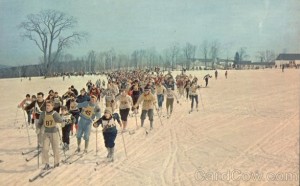
1970 Washington Birthday Race start. Everyone goes at once. Credit: Lewis R. Brown via CardCow.com

It is that special interim period here in New England between the end of winter and the start of spring.  Last week, we headed out across the corn snow at Appleton Farms in Ipswich, MA., in the bright, and, yes, warm sunlight.  We recalled the first time we skied around the edges of farm fields, way back in 1970 when we stayed at the Whetstone Inn in Marlboro, VT.  We were there for the Great Washington Birthday Race, an annual “people’s race” at the Putney School started and run by the legendary cross-country racer and coach John Caldwell.  In those days, hundreds of skiers came to Vermont for what must have been the defining event of Nordic skiing in the United States.  Modeled after the famous Vassaloppet race in Sweden, the massive starting line stretched across a hay field and, when the gun sounded, it was off you went.  We remember skiing along with the then-movie critic of the New York Post, an older chap who said he skied around the field behind his house in Westchester every morning before heading into work.  We also remember struggling in dead last in that race along with a couple of other members from the then-staff of SKIING magazine, our wax long worn off, but still laughing at our disastrous first-time-ever trying cross-country skis.

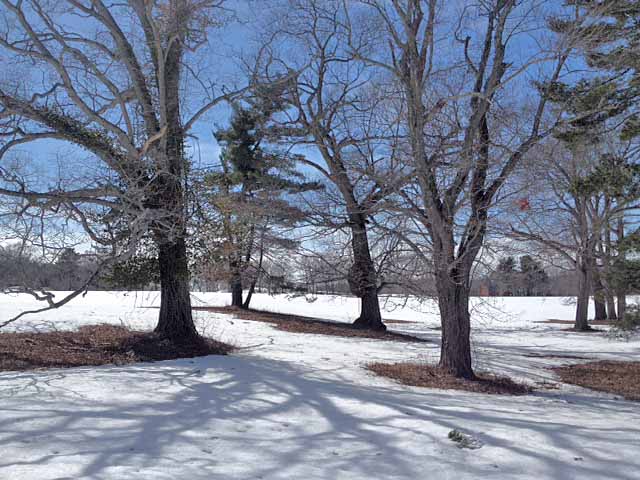
Snow is hanging on this year, melting slowly but inevitably, starting with the trees. Credit: Mike Maginn

Snow is hanging on this year, melting slowly but inevitably, starting with the trees.
Credit: Mike Maginn

These thoughts came back as we went around that big field at Appleton’s.  For a long time, we favored wooden skis, woolen sweaters and wax potions; these days, we go waxless and polypropylene.  But the pleasure of being in the sun, noticing the melt around the edges, and the rhythm of planting pole, gliding, planting was the same as ever. As the snow rolls back and the sun comes in and out, Robert Frost’s Two Tramps In Mud Time came to us. This verse hits home:

The sun was warm, but the wind was chill. You know how it is with an April day.
When the sun is out and the wind is still, you’re one month on in the middle of May.
But if you so much as dare to speak, a cloud comes over the sunlit arch,
A wind comes off a frozen peak, and you’re two months back in the middle of March.

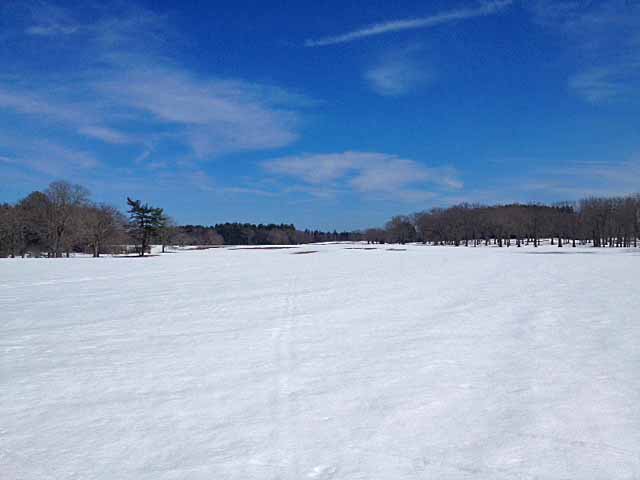
Sunny day, springtime snow, skiing across the field at Appleton Farms, Ipswich. Credit: Mike Maginn

Sunny day, springtime snow, skiing across the field at Appleton Farms, Ipswich.
Credit: Mike Maginn

Portrait Of A Weird February: East, Coldest; West, Warmest

Here’s a picture of our weather record-breaking mid-winter month.

Black and White, Ying and Yang, Macy’s and Gimbel’s, Felix and Oscar: These opposites come to mind when we look at this picture of what happened to the weather in February, 2015.  The Washington Post reports there were coldest months on record throughout the East, while the West cooked.  There are some in both places who aren’t having fun with this.  You can understand the frustration of Western snow sport enthusiasts when they see brown hills, but there are plenty in the East who find the cold abysmal, the roads to ski areas challenging, and the need to deal with ice dams at home more demanding than recreation.  Nevertheless, as the month turns (Rabbit, Rabbit), there are signs the West is entertaining new storms.

One glance at the February weather composite shows why we've had a weird mid-Winter: Cold East, Warm West.  Credit: Weatherbell.com

One glance at the February weather composite shows why we’ve had a weird mid-Winter: Cold East, Warm West.
Credit: Weatherbell.com

Come On Over, Western Skiers: Eastern Snow Is Epic

Boston Reports Over 100 Inches, 2 1/2 More Than Normal, With Three More Weeks Of Winter To Go.

If you are a senior skier from the West, you are probably wondering what’s going on with the snow.  Our correspondent in Utah report skiers taking two or three runs on ice-covered, snow-deprived slopes and calling it a day.  We’ve heard of areas closed in Montana due to “dirt”.  On the other hand, we Easterners are luxuriating in historically epic piles and piles of the stuff.  It’s fun to look back on NOAA’s prediction for the Winter of 2014-15.  Notice they had it kind of right in the West, major wrong in the East.

NOAA Winter 2014-15 Prediction shows warm in the West and the East. Credit: NOAA

NOAA Winter 2014-15 Prediction shows warm in the West and the East.
Credit: NOAA

To be sure, there is good snow everywhere in the Northeast, from the Poconos to Quebec.  Here’s an article by New York Times travel writer John O’Connor who reports on ecstatic conditions in New England.  Bottom Line:  It may be that if Western skiers want to do some decent skiing, they should plan coming East right now.

NYTimes_022515

Quebec Winter Carnival: Canoe Racing On The Frozen St. Lawrence

A New Extreme Sport Emerges For Those Who Really Love The Cold

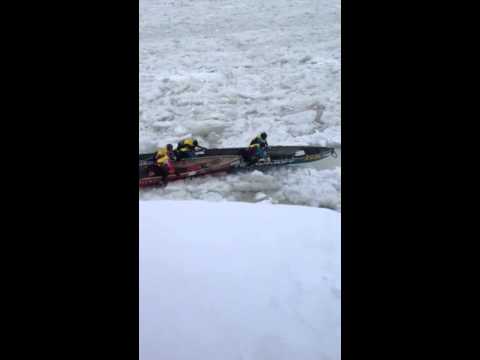
Hearty, are we?  Well, these lads surely are.  These garcons are one of a dozen or so teams, some of them professionals, who are canoe racing on the St. Lawrence during Quebec’s Winter Carnival.  The amateurs included a women’s team, mixed men and women teams and a few folks who just wanted to have some fun.  You might wonder why this is a good idea for a sport.  Don’t bother.  It’s about The Extreme.  And learning to love the magnificent cold.  This was taken on Feb 8, 2015 when the temps were -20 C and the wind was blowing at least 25 knots.  What’s the wind chill? Anyone?  Anyone?

Quebec’s Winter Carnavale was the site of the North American Snowsports Journalist Association Annual Meeting.  More to come on Ice Hotels, ski trains and memorable “versants” (ski areas) just outside Quebec.

Silver Streaks: A Model For How Ski Areas Can Serve Seniors

You Always Have Someone to Ski With at the Waterville Valley Program.

Gold_Waterville_Valley_Resort[Editor Note:  Waterville Valley’s Silver Streak Program was a Gold Senior Friendly Award Winner, based on SeniorsSkiing.com’s First Ski Area and Resort Survey.  Silver Streaks is the oldest senior ski program in the US.  We hope that other ski areas can start “Thinking Seniors” like Waterville.]

“I’m so excited, I just turned 65,” says Anne Pelletier, booster for the Silver Streaks, a program for the 50-plus set at Waterville Valley, N.H.

Silver Streakers Mike and Anne Pelletier totally enjoy the benefits of the Waterville Valley program. Credit: Tamsin Vinn

Silver Streakers Mike and Anne Pelletier totally enjoy the benefits of the Waterville Valley program.
Credit: Tamsin Venn

Nearly 30 years old, it was one of the first senior ski programs in the country to cater those 50 and over, a demographic astutely valued by Waterville’s founder ex-Olympian Tom Corcoran.

Pelletier, a lively woman in fire-red ski pants and state-of-the-art heated jacket, has reason to be happy. At age 65, the Waterville season pass benefits kick in: $379 for non-holiday midweek skiing.

For much longer, though, she has been with the Silver Streaks.

For the $95 joining fee, senior skiers get:

  • Reserved area in Parking Lot # 1 (one 90-year-old joined for that reason alone).
  • Complimentary coffee and pastries in the Base Lodge from 8:30-10 a.m. in special meeting area.
  • Complimentary Snowsports clinics for seniors only.
  • Après-ski party every Wednesday at rotating venues.
  • Banquets and other special events throughout the season.
  • Reduced price NASTAR every Wednesday.
  • Nordic program every Wednesday for two hours of Nordic skiing with professional guides, followed by lunch at the Nordic Center.

The program runs Monday-Thursday, non-holiday, early December to mid-March.

Also every Monday night the Coyote Grill at the White Mountain Athletic Center offers a $12 dinner; après-ski two times a month. (unfortunately $5 martini night was retired for reasons easy to imagine).

Other events: a Memorial ski run from the top in single file to remember those who have died in the past year.

The Pelletiers like the friendships, but they have an ulterior motive.

Says Anne, a platinum (top) NASTAR racer, “We have a need for speed.” Husband Michael, 72, is a top-ranked marathon runner in New England.

Silver Streakers Randy and Reggie Breeckner moved full time to Waterville 15 years ago from their home in the Litchfield Hills in northwestern Connecticut where they raised seven children.

Reggie notes, “I’m going to try snowshoeing when I get old.”

“You develop strategies not to get hurt,” adds Randy, a six-decades-long New England skier. Those include not skiing when it’s icy, foggy, or on busy weekends.

What about snowboarding?

“We know only one person in the group who snowboards,” he says.

Albert and Kristina Ruehli from southern New Hampshire are also on board. Albert learned to ski at age six in his native Switzerland.

Says Albert, “the mountains, the view, it’s a beautiful sport, plus you’re expressing yourself on the hill.”

“I went to a meeting and one of members said, ‘You’re too young to join,’ so of course I joined immediately,” says Kristina, 71.

 “We figure when we can’t ski anymore, we should just let an avalanche take us,” adds Kristina philosophically

Julius Feinleib from Thornton, N.H, has grandchildren ages seven and nine who now whiz by him on the trail. His reasons for joining are simple. “Just being with people I recognize.” He also likes the cup of coffee and doughnuts.

For more on Silver Streaks, click here.


Coming Back From Injury: Avoid One-Sidedness

Adaptive Ski Instructor Provides Advice on Predictable Issues for Returnees

Alisa Anderson, Smuggler’s Notch’s (VT) adaptive skiing program manager, is a highly-specialized PSIA instructor who, over the past 20 years, has applied techniques and tools for skiers of all kinds who need a little extra help getting down the mountain.

Adaptive Ski Instructor Alisa Anderson guides a student on the "Snow Slider" at Smuggler's Notch. Credit: Alisa Anderson

Adaptive Ski Instructor Alisa Anderson guides a student on the “Snow Slider” at Smuggler’s Notch.
Credit: Alisa Anderson

She trained at the National Sports Center for the Disabled, Winter Park, CO, where she learned how to use bi-skis, mono-skis, and outriggers. At Smuggler’s Notch, she purchased a “Snow Slider” which is basically a walker on skis. While these tools are mostly used with people who have chronic physical disabilities, she also helps people who can ski on their own skis get back to skiing after injury, accident, or knee, hip or shoulder replacement.

“It’s important that people coming back from an injury take a lesson from a trained instructor,” said Alisa. “One reason is to help them get through the natural apprehension that you’d expect after being through major surgery and a year or so of rehab. The other reason is to spot and correct physical mistakes before they become habits.”

Most people coming back after rehabilitation, she said, will clearly favor the healing side. “It’s natural. There’s been a trauma to the area, and the body wants to ‘save’ that side. What you see are people not pressing the ski on that side or being very tentative about flexing.” That stiffness is risky because the skier doesn’t have bi-lateral control.

People aren’t even aware they are favoring one side, she said. That’s where coaching comes in.

“If they continue to be stiff and one-sided, they are going to form some bad behaviors. Stiff muscles lead to fatigue, and the risk of injury goes up,” she said. “They need to be constantly in motion.”

The solution is for the instructor to give the student skier active feedback on what she sees. “Basically, I remind the student to focus on keeping pressure on the front of the boot and weight on the ball of the foot. It’s really back to the basics. It’s important for the skier to loosen up, extend, get tall and bend their joints into through the turn.”

Alisa says that one lesson might be all a skier needs, others, maybe a couple more. “Most people get it pretty quickly. It’s just a matter of getting through the first days doing it right.”

Alisa knows what she is talking about. In addition to her experience as an adaptive ski instructor, she’s also recovering from ACL reconstructive surgery. “I have to wear a brace. It reminds me all the time about what it’s like to be rehabbing. Sometimes, I don’t like wearing it, but I do it, and I’m still skiing.”


Get Into The Spirit: Cannon Mountain Aerial Footage

If You Need Some Inspiration To Get Out There, Here It Is.

Cannon Mountain in New Hampshire looks deep in snow as of today.  Wonderful and dramatic shots of a beautiful and venerable ski area.  Credit White Mountains TV 16.

Flash: Colder, Snowier Winter 2015 Forecast For New England

Latest Prediction from WBZ-TV Meteorologist Forecasts Cold and Snow

With the season just getting started, we’ve been diligently watching snow forecasts as we know know you have as well.  As we reported in an earlier post, Joel Gratz, our favorite snow meteorologist who prognosticates at OpenSnow, has been compared a number of weather models and found a consensus for dry in the Northwest, snowy in the Far West, and uncertain from the Rockies to New England.  But, then he says, don’t trust long range forecasts.

2015 Snowfall Predictions for New England Credit: WBZ-TV Graphic

2015 Snowfall Predictions for New England
Credit: WBZ-TV Graphic

With a couple of more months of data and many models to contemplate, Barry Burbank, Boston’s WBZ-TV meteorologist, has just put a new winter prediction in play.  Barry says that he’s “relatively confident of a cold and snow winter overall.”  He is calling for more snow in the New England area, 10-20 inches above average, for a total forecast of 55-65 in Boston.  That places 2014-15 as the third consecutive year above average.  He also is calling for cold, speculating that the Polar Vortex that vexed the Midwest last winter will be moving eastward.  Below average temperatures should reign especially in January when he expects an “outbreak of arctic air.”

So, New England senior snow enthusiasts, this is good news.  It also means you have to dress for the weather, prepare your equipment your car, and your self.  As the old Swedish expression says: “There is no such thing as bad weather, just bad clothing.”  Get ready.

Here’s Barry.  Click here for WBZ’s Winter 2015 video report.


Sugarbush

Sugarbush Offers$199 Mid-Week Boomer Season Pass. Thank you, Sugarbush.

Thanks, Sugarbush, For The Deal!

Mid-Week Skiing Means Deals and No Crowds Credit: Sugarbush

Mid-Week Skiing Means Deals and No Crowds
Credit: Sugarbush


Sugarbush Resort is offering a wonderful deal: Mid-week season pass for $199 for 65+ skiers.   For mid-week Boomer skiers, this is a good thing.  Thanks, Sugarbush, for acknowledging senior skiers. Click here to BUY NOW.

This Bubble Is Heating Up

What is hot, orange and headed uphill?

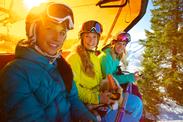
Okemo recently announced installation of its Orange Bubble, a heated-seat, six-pack chair, the first of its kind in New England.  And, Canyons Resort in Park City installed its Orange Bubble Quad a few years ago. I’ve taken that lift, and the warmth and orange-filtered view are nice‑especially on a bitter day.

Like riding up in a ski goggle Credit: Rob Bossi/Canyons

Like riding up in a ski goggle
Credit: Rob Bossi/Canyons

The technology gives the seats a fast charge when the chair passes through the lift terminals. Fannies and spirits are in a good mood on the way up. These seats have been popular throughout Europe for the past decade and recently started migrating to North America. Vail installed the seats on its Number One gondola about three years ago.

Heated seats on a bubble chair are a vast improvement over the heavy wool blankets worn from the 40’s to the 70’s to fight cold at Stowe, Killington, Mad River, Bromley, Aspen, Gore and Holiday Valley.  Under certain conditions, they froze cardboard stiff.  Under all conditions, they were pleasantly musty. Under no condition was your butt comfy and warm.

Scott Pierpont, SVP Sales, Doppelmayr USA, explains this emerging North American trend as providing another level of comfort beyond the bubble. His company built the lift at Canyons Resort.

Credit: Rob Bossi/Canyons

Keeping Tushies Happy Credit: Rob Bossi/Canyons

Both he and Rick Speer, president, Leitner-Poma of America, the company that built the new Okemo lift, believe that we’ll be riding on many more heated seats over the coming years.

“It’s all about skier comfort,” Speer explains. “The older you are, the more you’re going to like it.”

Why orange?  We have our theories, but what do you think?

Here’s how it looks and feels.  The spiel from the Canyons…