season ending

Season Ending: The Last Perfect Turn

Source: Alyeska Ski Resort

The last turn of the last run on any ski day is a bittersweet moment.  If it’s the last day of the trip, it is sad, if not melancholic.

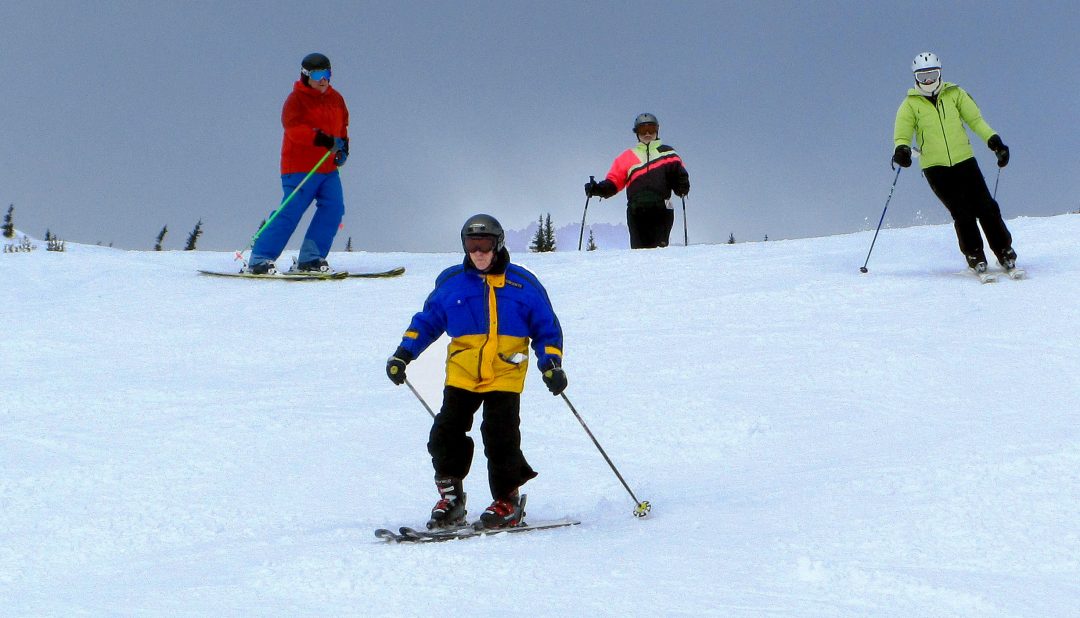
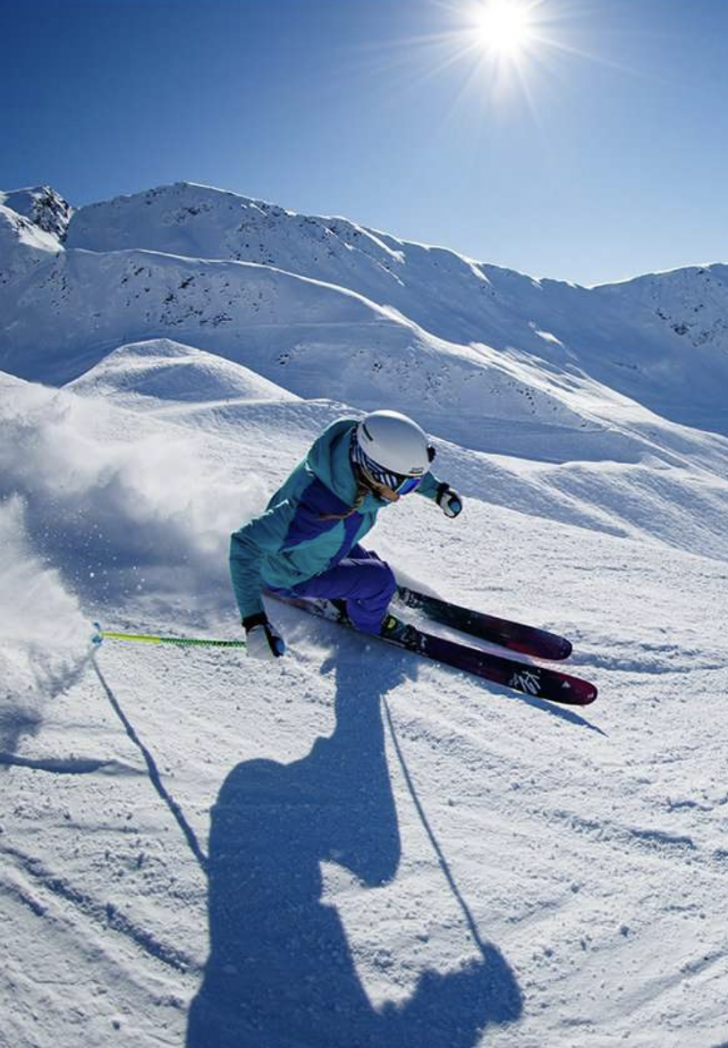
As I come down the mountain on what will be my last run of the day, I go through the same routine.  Partly because I am tired, partly because the beginner runs are easy skiing and take me to the bottom, and partly because I want to be able to imprint the memory of the perfect turns I made, so they will carry me, mentally, to the next trip.

Feet close together, tap the pole, unweight, roll your knees.

It’s also about muscle memory.  I want my body to remember how it felt to have the skis carve through the snow in a perfect turn.

As skis come through the fall line, press the knees forward and into the hill to get the skis on edge.

It is also about knowing that life is short and we never know what tomorrow brings.  As a senior skier, I am closer to the end of my skiing life than the beginning.  It’s depressing but true and makes the desire to carve the perfect turn even more intense.

Feel the edges bite into snow; keep the turn coming across the fall line to control speed.

At the end of every ski day, I want my mind and body to remember the turns, not just one, but a series of linked, perfect round ones.

Body square over skis, or maybe angled down the fall line. Hold the turn long enough to control your speed.

It has to be close to perfect so that even an instructor examiner would smile in approval.

Hands out in front, mid-chest high; feet less than shoulder width apart, ready for the turn.

The last turn was nice and round with the skis on edge that tossed a little snow.  Now time for the next turn, hopefully as good as, if not better than, the last one.

Stay in rhythm. Reach out, tap the snow, unweight, roll the knees.

The process goes on until I reach the bottom, trying to make each turn better than the one before in an attempt to end a day on the snow with a perfect turn.  It may be never-ending, but the quest is reason to head back to the slopes as soon as I can.

Why?  Because at my age, this could be my last day on the slopes. I want to remember that I did all I could do to make the perfect turn.

IS RESORT SKIING GETTING MORE DANGEROUS?

Your Support Helps!

Help us keep SeniorsSkiing.com free. Please support SeniorsSkiing.com with a donation.

DONATE

Editor’s Note: TheSkiDiva.com is an online community of women skiers without the male orientation. The forum’s founder, Wendy Clinch, recently posted this report, comprised, in part, of comments by forum participants.

Source: #RideAnotherDay

In the past few weeks, there have been at least 10 deaths at North American ski resorts. While one death is way too many, The National Ski Areas Association says ski fatalities are pretty rare: as low as one for every one million visitors to a ski resort. (It’s also noted that more men are victims of skiing accident deaths than women).

Despite this, many participants on TheSkiDiva forum believe that resort skiing has become increasingly dangerous.

This season, stories of near misses, collisions, and risky behavior are all too common. And while I don’t have the data, it seems like the situation is getting increasingly worse.

What’s the cause? Some say the slopes are more crowded because of multi-resort passes and the ability of high-speed chairs to get more people on the hill. Some believe the problem is caused by ski movies and social media glorifying risky, extreme behavior, treating it as though it’s part of the norm. Others believe skiers and riders are distracted by music, texting, and selfies. And some feel that equipment has evolved to the point where people are skiing beyond their abilities.

HERE ARE A FEW EDITED COMMENTS POSTED BY FORUM MEMBERS: 

  • I’ve been quitting earlier these days because I’m concerned that someone will hit me. It’s not fun when the slopes are crowded with hotshots or folks who are skiing beyond their abilities. We avoid weekends when we can.
  • As someone who only skis weekends, it seems the mountains are more crowded, and people aren’t being mindful of those around them. I’ve noticed many near collisions and had a few incidents where someone got way too close while trying to pass me. In two cases they whizzed right over the tips of my skis causing me to lose my balance.
  • Cheap season passes have resulted in dangerous slopes on busy days, primarily Saturdays. Way too many people I know have been hit by others. The way the terrain parks are laid out where I ski adds greatly to the kamikaze attitude, ineptitude, and general disregard for anyone else on the mountain. I am sad to say that all I hear are excuses. I’m pretty over it. The perspective definitely changes when you have a child out there.
  • I quit skiing at our local bump because of crowds and out of control skiers. It’s been a zoo. I was working with a friend on the long beginner run when an out of control kid scared the sh*t out of her, causing her to fall and break her wrist. I was done after that; it could have been me.
  • I was hit hard enough to be knocked out of my bindings. Ski patrol did notpull the person’s pass even though he had been straight lining down the mountain while I stood stopped in plain view with other skiers at the bottom

There’s no question that ski safety is an important issue that needs to be addressed. Here are a feww suggestions from forum members about what can be done: 

  • Limit ticket sales:Crowded slopes are more dangerous slopes. Require skiers to go online and reserve their spots at least 24 hours in advance. This might help reduce overcrowding.
  • Require everyone who buys a pass to go through interactive safety presentation. Make it mandatory for those under 18; give everyone else an incentive (e.g. $10. off or special lift access for completing training.
  • Hold people accountable. Don’t tolerate unsafe behavior.This requires policing from resort personnel. Mammoth patrollers take photos of violators’ passes. Guests with a second speeding offense are required to screen the “Ride Another Day” video and take a quiz before their pass is reactivated.
  • Better regulate/police alcohol and marijuana use.Many on the forum believe that the mix of skiing or riding with alcohol and/or weed, particularly among minors, results in alarming behavior. No one should be allowed to ski or ride under the influence.
  • See something, say something.Let resort personnel know when you see unsafe behavior, and make it clear that this is something you will not tolerate. The more we make our feelings known about this, the better.

WHAT CAN YOU DO TO IMPROVE YOUR OWN SAFETY?

  • Wear a helmet. This can reduce can reduce the risk of sustaining a head injury by as much as 29 to 56%.
  • Make sure your bindings have the proper DIN setting for your size and ability.
  • Always look uphill before taking off, and always be aware of your surroundings.
  • Give the downhill skier the right of way.
  • Always ski in control.
  • Don’t ski alone in the trees or backcountry.
  • Avoid tree wells.

Stay safe out there, everyone.

Crested Butte

Skiing Crested Butte

Your Support Helps!

Help us keep SeniorsSkiing.com free. Please support SeniorsSkiing.com with a donation.

DONATE

Source: Travel Crested Butte

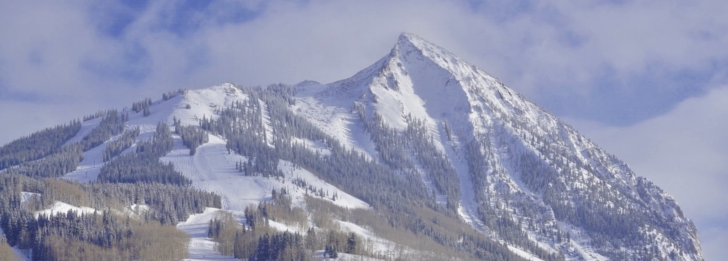
The first thing one notices about the terrain at Crested Butte is the jagged, arrowhead shaped mountain peak thrusting into the sky. The base of the mountain is 9,820’, and lifts take you to a notch, several hundred feet below its 12,162’ summit.

There’s lots to like about skiing Crested Butte: beaucoup, well-groomed beginner, intermediate and expert trails spread over ~3,000 feet of vertical;  121 runs in all, 23% beginner, 57% intermediate and 20% expert.

The runs off the East River and Paradise Express lifts – hallelujah, they have footrests – are an intermediate’s dream with rolling terrain coupled with some interesting pitches. Or, if you prefer greens, you can yo-yo up and down Red Lady Express. In fact, all the lifts with the word Express in the name, have footrests!

If you like it steep, groomed, or ungroomed, ride Silver Queen Express and pick International or Keystone. Both were groomed when my brother and I were there a few weeks ago. They have challenging steep pitches and are gratifying to ski. If your knees can handle moguls, Joker, Crystal, or Twister await.

Source: Travel Crested Butte

If you’re more adventurous, take Paradise Express and ski to the North Face Lift which provides access to several steep tree runs. You’ll end on the intermediate Black Eagle Trail that will take you to the bottom of the East River Express. Be advised, some hiking may be required to ski the areas served by North Face.

Good news for senior skiers: on-hill lodge restrooms tend to be on the same level as the snow. At the base, they’re downstairs but serviced by elevator!!!

Accommodations are plenty. There are condos at the base of the area in what is known as Mount Crested Butte. Crested Butte is owned by Vail Resorts, and our Epic passes got us skiing and a 20% discount off the nightly rate at a condo 500 feet from the lift and discounts at some of the stores, bars, and restaurants.

According to my iPhone, the town of Crested Butte is 2.8 miles down the road, where you’ll find plenty of restaurants and stores. Gunnison is 27 miles to the south and has its own charm. If you stay in a condo and want to bring food, Gunnison’s City Market is well stocked and reasonably priced.

We reserved gear via Black Tie Ski Rentals. They bring the equipment right to your condo.

Gunnison is the nearest air-carrier served airport with direct flights from Dallas, Houston, and Denver. From the Dallas -Fort Worth Metroplex, Crested Butte is, weather permitting, about a 13-hour drive. From the  Denver area, it is 4 – 5 hours.

Would we go back? Oh yeah!!!

Ice Fishing With Skis?

Your Support Helps!

Help us keep SeniorsSkiing.com free. Please support SeniorsSkiing.com with a donation.

DONATE

I was skiing with three friends at Lake Louise in 1995. We were heading over to “Rock Garden” on the far side of the mountain. On the way, we took a tree run. Only three of the four of us made it out. Where was Dick? We waited a while before trudging up into the woods to find him. It didn’t take long: In attempting to ski across a small creek, he had broken through the ice and was hanging by his armpits! It took a while to fish him out. If you ever doubt the wisdom of carrying a loud whistle, remember this incident. We went back and skied Rock Garden the next day.

Don Burch: Things I See While Skiing

Your Support Helps!

Help us keep SeniorsSkiing.com free. Please support SeniorsSkiing.com with a donation.

DONATE

This fast-paced, short video from Don Burch combines several artistic techniques, including some fleeting Mondrian-like moments. I think it’s fair to say that Don is developing a new genre of ski video. Watching it evolve is a treat.


Breezy Days Skiing the Ice Coast: Don Burch’s Newest Video

Your Support Helps!

Help us keep SeniorsSkiing.com free. Please support SeniorsSkiing.com with a donation.

DONATE

FINALLY, the East Coast got hammered. Although this newest addition to the Don Burch ski video canon was produced before the big storm, everything about it – color, sound, scenes – expresses its title: Breezy Days Skiing the Ice Coast.

Hanging On for Life and (Almost) Getting Eaten by the Rope Tow

Editor’s note: Spend enough seasons skiing and most of us will get into some form of trouble. Last issue, I explained how I got into hot water by inadvertently becoming end-of-day Pied Piper to a bunch of kids who followed me on a long winding trail, while their parents anxiously waited their return. A few readers emailed their tales of on-slope woe. 
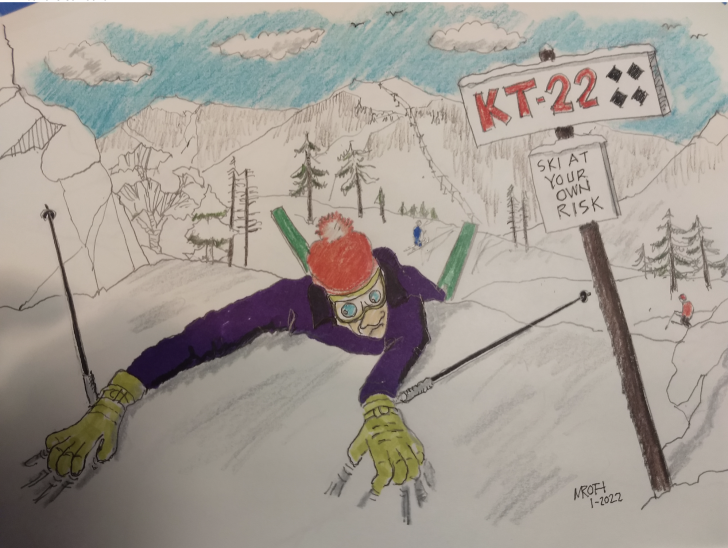
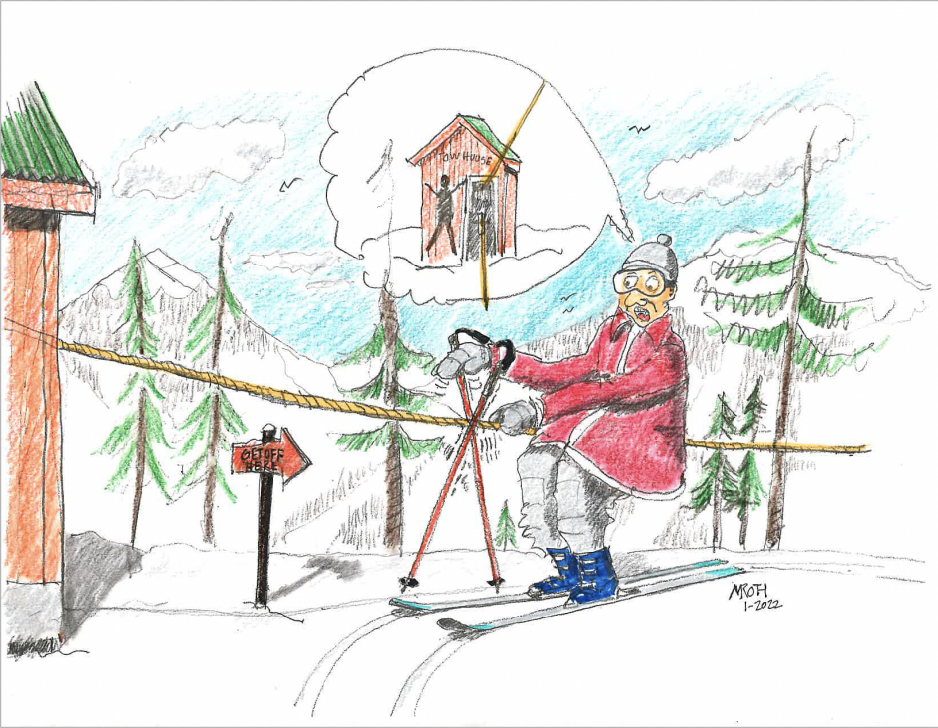
Mike Roth is a ski journalist who writes a regular ski blog for the Albany Time Union. He is also a talented cartoonist and and architect. When asked, last minute, if he had time in his busy schedule to illustrate these reader stories, he responded, “When do you need them?” A few hours later, Mike emailed his drawings.

This cliff-hanger happened to Jeffrey M. Fine when he was 40, but he still remembers the day. Jeffery is now based in Dillon, CO.

Sometime in the 1980’s while living in Indiana, I took a trip out to Squaw Valley.  I thought I could ski KT-22, and it almost cost me my life.  While skiing down the right side of the run, I caught an edge and almost went off a cliff with a 50’ drop.  I managed to fall just before going over the edge and held on with my fingers in the snow (I was highly motivated to grab anything) while my skis hung over the edge in space.  The ski patrol was able to throw me a rope and pull me to safety.  I feel very lucky to have survived!

And here’s a rope tow tale from Ed Schultz, Penn Yan, NY. It happened when he was 30.

Back in the early 70’s skiing a small area in Massachusetts near Wooster, (can’t remember the name), I got on the rope tow. I had one arm behind with my pole straps around my wrist. What I didn’t realize was that the poles were bouncing in the snow behind and my pole straps somehow got twisted so when I went to get off I was caught on the rope. The rope tow rose up at the end toward a building housing some of the tow’s mechanism. I had visions of being carried up and going splat on the building. There were no safety stops in those days. Fortunately, I wriggled and twisted, freeing the straps and exiting the tow just in time.

Have a personal ski story you’d like to share? It can be about almost anything. Send it to info@seniorsskiing.com. We’ll share the most interesting with SeniorsSkiing’s 17,000 subscribers, along with an original Mike Roth illustration.

Four Bucket List New England Cross Country Ski Towns

XCSkiResorts.com recommends these classic New England towns and areas for a cross country  ski vacation:

Stowe, VT, is quintessential New England with its white steepled church and main street lined with stores.

Source: Trapp Family Lodge

  • It’s also the home of the Trapp Family Lodge of Sound of Music fame. Trapp Family Lodge has a 110 km trail network with 60 km of groomed and machine-tracked trails. Stowe has a full range of dining and shopping options. Other nearby XC resorts include Bolton Valley, Stowe Cross Country Center, and Edson Hill.

Woodstock, VT is another winter mecca with inns, restaurants, unique shops, and a national historical park.

  • The Woodstock Nordic Center operated by The Woodstock Inn & Resortoffers two trail systems right in town covering more than 45 km. The Mount Peg trails begin on the golf course at and climb to the summit overlooking the village below. On nearby Mt. Tom, the Center grooms more than 20 km of trails on old carriage roads in the midst of Vermont’s first tree farm and Marsh-Billings-Rockefeller National Historical Park.

The Mt. Washington Valley in the White Mountains of New Hampshire has some of the best cross-country skiing in the East.

  • “Enchanting” is the best word to describe Jackson, the paragon of New England towns and home to Jackson Ski Touring Foundation, a non-profit organization chartered to provide and maintain XC trails on more than 80 private properties and national forest. Country inns are scattered throughout the region. The base lodge is accessed through a scenic covered bridge.

Covered bridge at Jackson Ski Touring Center, New Hampshire Photo: Roger Lohr

  • Great Glen Outdoors at the base of Mount Washington is a magnificent setting with 45 kilometers of XC skiing, snowshoeing, and an ol’ fashioned tubing hill. Great Glen’s scenic trail system offers an enjoyable combination of well-protected spruce and fir-lined trails plus wide-open areas with breathtaking views of Mt. Washington and surrounding peaks. On the trails is the classic New England Glen House Hotel, with 68 rooms, a pub and restaurant. For even more adventure, enjoy a comfortable winter tour on the 9-passenger Mt. Washington SnowCoach, which transports guests to an unforgettable journey to a sub-Artic world on Mt. Washington.

Skiing at Bretton Woods, NH Photo: Roger Lohr

  • Bretton Woods Nordic Center is a thriving cross country ski center on the grounds of the Omni Mt. Washington Hotel. It. The grand Bretton Woods hotel has 100 km of XC ski laced throughout 1,700 acres of spectacular scenery. The Mountain Road, accessed via a lift at the Bretton Woods alpine ski area, offers spectacular vistas of Mt. Washington from a 7 km groomed trail down to Route 302.

Bethel, Maine is home to the Bethel Inn and Carter’s XC Ski Center, and Sunday River Resort’s alpine ski trails. The town settled in 1774, retains its small-town lifestyle.

Bethel Inn Resort , Bethel, ME

  • The XC ski trails, which meander through forest to a picturesque, covered bridge are canine friendly. Several inns along the trails are operated by the nonprofit Bethel Inland Woods and Trails organization. The Carter’s XC Ski Center has beautiful views of the Mahoosuc and Presidential mountain ranges. Alpine skiing, dogsledding trips, and snowmobile rentals are available nearby.

Many businesses in each of these New England ski towns organize special events on winter weekends and vacation weeks to encourage people to get out and enjoy the snow.

If you’re into XC skiing and keep a bucket list, Stowe and Woodstock, VT, the Mt. Washington Valley, and Bethel, Maine are classic New England destinations not to be missed.

Latigo Ranch: High-Country Nordic

Sometimes life exceeds expectation. That’s what I’ve found with winter ranches in the Rockies.

In summer, hundreds of dude ranches draw thousands of visitors. They’re crazy-diverse: homespun and elegant; private and heavily peopled; mostly self-service or with staff at your call. You’ll find Spartan working ranches as well as places with canapés and kidney-shaped swimming pools.

The few ranches open in winter are outstanding – magnificent settings and staff, excellent facilities and food, and snow so delicate it drifts through the air like cold smoke. They’re run for cross-country skiers, snowshoers, and, increasingly, fat bikers by people who love the season and their profession.

Wecome to Latigo Ranch

A prime example is Latigo Ranch, near the town of Kremmling in north-central Colorado’s Gore Range. It’s owned and managed by Lisa and Randy George and their kids.

Latigo used to run cattle, sheep, and “dudes” before it totally converted to guest ranching in 1987. Once you turn off Highway 134, you start climbing, trading sage for pine, spruce, and aspen, interspersed with vast meadows. It feels like the top of the world.

Latigo can cater to pretty much any culinary taste, be it red meat, vegetarian, kosher, low carb, or low fat. Breakfast is my favorite meal. I have fond memories of buttermilk pancakes imprinted with the ranch brand, complemented by genuine maple syrup.

Latigo comfortably handles 22 guests, but you’ll seldom find that number except during holidays. Cabins are ski-in/ski-out, nestled in pines above the lodge with wood-burning stoves. This is a ski ranch, not a resort (no phones or TVs in the rooms).

50km of groomed trails lace through Latigo

Latigo grooms 50 kilometers of trail for track, skating, and fatbiking.

This is gorgeous, rugged country, with some of the most enjoyable skiing and diverse trails I’ve ever experienced. For example, the descent on Arena Run can be like silk in fresh snow; lightning in the spring.

High up on windswept Jumper Flats, you’ll find a broad panoramic view. You can tear down The Luge at sunset, when you may be greeted with a spectacular play of colors over the Indian Peaks Wilderness – 70 miles of mountain and valley snowscape.

If you’re altitude-sensitive, book a longer stay and take it easy for at least the first day. (Latigo’s trails range from around 8,600’ to 9,400’ above sea level.)

It’s a wonderful thing to ski back to the ranch on a crisp afternoon, saunter over to the Social Center, and finish the day with a sybaritic Jacuzzi soak!

When You Go

Latigo is 150 miles from Denver International Airport. In addition to trails, you can go sledding, tubing, and snowshoeing. Skis, snowshoes, and pulks can be rented at the ranch, but you’ll need to bring your own fat bike.

Adult rate for winter 2021-’22 is $225/day and covers lodging, meals, trails, and “100 % free views.” The season begins just before Christmas and runs into early March. Interested in learning more? Call 970-724-9008; email Randy@LatigoRanch.com, or visit www.latigoranch.com.

Out Of Control

The Day Three Slump

This is my shortest ever blog, but it may have a significant impact on your next ski holiday.

Should have taken the day off.

It’s your first day back on the slopes, and you want to hit the ground running.  You don’t want to miss a thing, so you‘re up early, on the first chair, and skiing like a mad thing all day.  It feels so good!

The next day you’re just a wee bit sore, but not enough to stop you.

But on the third day you hit the “Day Three Slump”.  Your skiing seems to have got worse.  Your energy levels have slumped.  You hoped you’d get better; it’s frustrating.  At the end of the week you feel you’ve made no improvement; got no better than last year.  This is how your week may go:

Source: Bob Trueman; Bobski.com

I have a suggestion for “slump day”:  take it easy, be patient, don’t push it, do lessthan you might.

Would it be sacrilege to suggest taking a later breakfast?  An even greater sacrilege to suggest starting at 11:30 and finishing at 2:30?  Or, if it pleases you, consider taking a half day out and visiting a local place of interest. You could spend an amusing hour or two in a ski shop trying to guess which of this year’s new wonder skis is actually last year’s but in different livery.

Tomorrow do just a little bit more.  On day three you’ll be ready to fly; stronger, your muscle memories will have kicked-in.  You’ll find yourself skiing better, not worse.

At the end of the week, you’ll be skiing better than last year, and you won’t get home feeling frustrated that your skiing is in decline.

Your week will go like this and end on a high:

Source: Bob Trueman; Bobski.com

It will be a better feeling and well worth a try!

FreeSkier

Things to Remember when Choosing Alpine Ski Equipment

Source: FreeSkier

SKIS

  • The ski shop makes more money renting out or selling higher performance equipment.
  • Be honest with yourself – if you don’t ski hard and fast you probably don’t need it.
  • Higher performance skis perform worse when not skied hard – they need higher momentum, and more force to get them to work well. Skied slower they can be harder work.  Is that what you want?
  • It may well have been a year since you last skied – maybe more. You likely won’t ski too hard on days one and two.  Try renting an easy, flexible ski first.  If you find you ski hard enough to make it “chatter”, you can always change up.

Dizzy of Dizzy’s boot fitting shop at Big White ski resort shows off an early 1970s ski boot that boasted fantastic ski technology that, sadly, was ahead of the boot’s ability to support it. The boots famously would come apart during skiing.
Credit: Yvette Cardozo

BOOTS

  • Same rules apply. Boots designed for beginner/early intermediate will be less expensive.
  • Priority number one is comfort. Don’t put up with anything less.
  • Very few skiers need boots as stiff as the ones they have; or rent. Most skiers are “over-booted” and it holds back their skiing.  Plus it’s often painful.
  • Start off the vacation with a lower grade boot: it’s easy to exchange them.
  • Why do I say this? Because if you cannot forward flex your ankle very readily, your skiing will never be as good as it could be. And you’ll never be as stable.
  • When you do-up your boots don’t have the higher buckles too tight.
  • When the buckles are done flex your shin forward and hold it there, and only then fasten the unfortunately named “power strap”. It will be somewhat slack until you flex your shin forward.  At first you may feel this is a bit “wobbly” – but for heaven’s sake you don’t have your ankles clamped when you move about at home!  And it doesn’t make you lose control.

Source: Praxis Skis

SKI POLES (The ski shop will have a small fit when you tell them this.)

  • You want them
  • They hate it. They will patiently explain to you as if you were a child that they know what length you need, and will explain how they derive it.
  • At this point listen attentively, take the pole they proffer, and then tell them you want a pair like that but 3” (7.5 cms) shorter. Insist on it. They will suggest that if you do, you will die.  You won’t.
  • Why shorter poles? Because the length ski shops always hand out, makes skiers stand upright and almost lean back every time they do a pole plant.
  • Try it – all experiments are worthwhile. You will very quickly prefer the shorter ones because they will help improve your posture.  Anyway you can always go back up a length later if you want to – it’s not a lifetime contract.

A Down-Under Skier Reminisces About His 2019-20 Canadian Road Trip

I was inspired by (SeniorsSkiing.com contributor) Yvette Cardozo and her excellent missives re skiing Canada and the world. Her unique turn of phrase will inspire some to write, but mostly will move others to keep skiing when they can. Those three words, ‘when they can’ are important. COVID has jolted us to the here and now, prompting many to get vaccinated. To those with a needle phobia, I would suggest that a death phobia trumps needle phobia anytime.

Which leads me to think back to the 2021-20 season and this Aussie’s Canadian skiing road trip with three good senior skiing mates brimming with optimistic youthful exuberance.

We set out to tour the snow resorts of central British Columbia…just as reports of the mysterious virus were beginning.

Source: Lake Louise Ski Resort. Image by Philip Forsey

First we skied Nakiska, a family, friendly resort, steep in places and well-resourced with lifts in all the right places (season pass for those 75+ is less than $100).  Then we drove to Sunshine and Lake Louise (season pass for 80+ is $20), two of the planet’s most scenic places. In Lake Louise, large ice sculptures adorned the area between the Lake Louise Chateau Fairmont Hotel and the lake. They’re magnificent (hotel and sculptures)!

Skiers are among the many ice sculptures. Source: Lake Louise Tourism

Next, we drove the mighty Trans Canada No.1 to Golden to ski legendary Kicking Horse Mountain Resort (season pass for 75+ is less than $100). It features views that take your breath away and fall lines steep and deep enough to keep it that way. If you go, don’t fail to lunch at Eagle Eye Restaurant for great views and food. If wallet permits, you can arrange for a helicopter to transport you to the super deluxe Eagle Eye Suites, each assigned with a personal butler and the highest accomodations in Canada.

A few days later, we plunged into the unpopulated wilderness of the Western side of the massive Canadian Rockies. Our large rented SUV delivered us to Panorama  (season pass for 75+ is $39) our next ski in-ski out accommodation. The resort has plenty of back country double blacks.

Fernie is big!

Following Panorama we drove to Fernie (season pass for 75+ is less than $100), where out friend Pat shared with us his years of skiing advice and his knowledge of Fernie’s more famous watering holes. Fernie is a destination which receives prodigious dumps of dry powder all season. If visiting, be sure to partake of a lager or three, upstairs in the Griz Hotel.

Navigating the pass at Crows Nest, on the border of BC, we were soon back in Alberta on our way to Castle Mountain Ski Resort (season pass for 75+ is $19), a great hill driven by ski enthusiasts; not accountants. My kind of place. Unfortunately, a flu virus prevented me from experiencing what my friends Ray and Allen pegged to be one of the best places skied of the entire trip.

Ski buddies at the start of their journey. Source: Dave Chambers

On this journey, we were mostly constrained to groomed runs because of a lack of fresh snow. Whenever you go, I recommend driving. It’s the best way to indulge in the culture and to experience the human kindness displayed by the Canadian people.


Ski class

Secrets for Your Best Ski Season Ever

Over 11 seasons I’ve probably taught 500-600 kids and adults as a part-time instructor at Stratton/VT & Butternut/MA. “Never-evers”, experts, 4-yr olds to 80-yr olds. Me: flipping through trail names like a deck of cards, choosing the best run for the task at hand and my eager, anxious learner. 

Here’s the huge thing I’ve learned:

Anyone can become a better skier, if the skier has both a desire and determination to improve…simply by taking a few ski lessons at the outset of ski season.  

Why at the beginning?  

Because each season, starting out, we’re all squirming and thinking, trying to put our skiing back together again.  So instead of once again reinforcing some of the “bad” habits carried over from last season, you can trade them for one or two new/better ideas that will help you ski with more skill.  

But wait, there’s more: any improvement in your skiing proficiency ALWAYS leads to enjoying skiing more!  (Shoot me your questions at the end and I’ll reply.)

As an instructor, I’m lucky.  In early December we do OUR training.  We take refresher lessons with the best instructor “trainers” at our resorts.  We’re brushing up on our skills.  It helps me a lot.  But it took me a while to accept the fact I still needed to be in “learning” mode.  

This season try this… either by yourself or with a friend who’s at a similar ability level.  Sign up for a private lesson of 2-3 hours on your second day of the season. On the first day, ski around and get a feeling for what’s working and… what’s not.  Think about what you’d like to change, what’s confusing or difficult, what you’d like to ask questions about, then write it down.  Now you’re ready for that lesson on Day 2.  Because now you’re engaged in being an “active learner”. Real progress as a skier doesn’t just “happen” to you.  It comes as a result of efforts you make to change what’s not working, in favor of more useful approaches.

I witnessed this approach in action, in Utah, last March.  One of my best friends, with whom I’ve skied for 40 years, took a short program of four group lessons at Alta.  Called “Intermediate Breakthrough” it seeks skiers who truly desire improvement.  My friend wanted to improve, and was ready to do what it took.  He explained what he wanted from the lessons, and he worked hard to use the skill tips offered by his instructor.

And he not only improved…he made a quantum leap in his overall skiing proficiency, and in his ability to ski more challenging terrain while enjoying it.  It was remarkable to see, and it was the result of only four lessons, but four lessons in which both student and instructor were invested in producing real results.  Alta’s “Intermediate Breakthrough” is awesome.

Believe me, you can do it too… It’s totally worth it.

Ski class

Have A Banana: A Senior Skier’s Friendly Fruit

A banana a day goes a long way in keeping you fit.

[This article was originally published in October, 2014. The message is still relevant and worth reprising. Put a banana in your boot bag!]

We have recently discovered the magnificence of bananas which we long regarded as a kid food and something to by-pass on breakfast buffets. Wrong attitude.  Turns out, bananas have multiple benefits for those who are active, especially senior snow enthusiasts.

Fun Fact: Bananas skins can help mollify mosquito bites. Credit: Mike Maginn

Fun Fact: Bananas skins can help mollify mosquito bites.
Credit: Mike Maginn

For starters, have a banana before you ski to give you a natural  and fast energy boost.  And they are high in potassium which makes your internal electrical system—heart, muscle cells—working very nicely, reducing chances of muscle cramping.  Sour stomach, acid reflux?  Have a banana to coat your stomach lining; bananas are a natural antacid. Not feeling regular?  Have a banana which contains soluble fiber to keep you moving.  Working on low cholesterol numbers?  Have a banana; zero cholesterol.  Saving your pennies?  Have a banana; they are remarkably inexpensive, given the number of great things that come from them.

We’ve barely scratched the surface on how wonderful bananas can be.  For more, check out this list of 25 banana’s powerful benefits.  We never expected to see shoe shining on the list, but there it is.  Also, for more about health benefits, see this article.

Regardless, bananas, you are still a funny fruit.

Find Ski Buddies Near You Through NSCF

Now Our Readers Can Pinpoint Local Ski Clubs. Check Out Their Events And Activities.

Clubs rule. Ski with friends and the fun begins. Austria circa 1920s.

In Flying Solo, a recent article by XCSkiResorts.com publisher Roger Lohr, the joys of solitary skiing, nordic or alpine, are highlighted.  From the comments, many readers agree.  There are definitely benefits to going at your own speed, especially when you ski with people whose skills are at different levels.

On the other hand, wouldn’t it be great if you could find like-level companions to ski trip with? Share costs, enjoy group discounts, even socialize and form friendships with? Well, in last spring’s Subscriber Survey, we found that 49.33% of respondents wanted to find other skiers in their region to ski with.  That’s a huge need we identified in the senior sport sport enthusiast population.

With those needs in mind, we approached the National Ski Council Federation to see if we could work together to bring its resources together with our subscribers search for ski pals.

The National Ski Council Federation is an umbrella organization that serves 29 ski council across the US, providing communications, education and benefits to member councils.  Those councils are comprised of many ski clubs with a total membership of about 300,000 folks.  These ski clubs plan trips, both locally and to distant resorts, providing serious discounts on lift tickets, instruction and other expenses. You can decide to join a club or join a club’s trips to see if membership might be for you.

If you want to check out ski club activities near you, just go to SeniorsSkiing.com’s top Navigation Menu bar, click on COMMUNITY, then pick FIND SKI BUDDIES WITH NSCF.  There you will find a map you can click on that will take you to the NSCF site where you can drill down to discover ski clubs in your region, state, and city. From there, you can identify a club officer’s email.  Connection made.

Now don’t be shy.  Ask a friend to join you.  This might open up a whole new and improved snow sport experience.

All of this is offered to SeniorsSkiing.com readers, including non-subscribers, at no cost.

Special thanks to the National Ski Council Federation executives who worked with us to create this link.

The National Ski Council Federation can connect you to a local ski club.


Skiing North America: Every Resort, Everywhere

An 85-Year Old Believes Someone Has To Do It; It Might As Well Be Him.

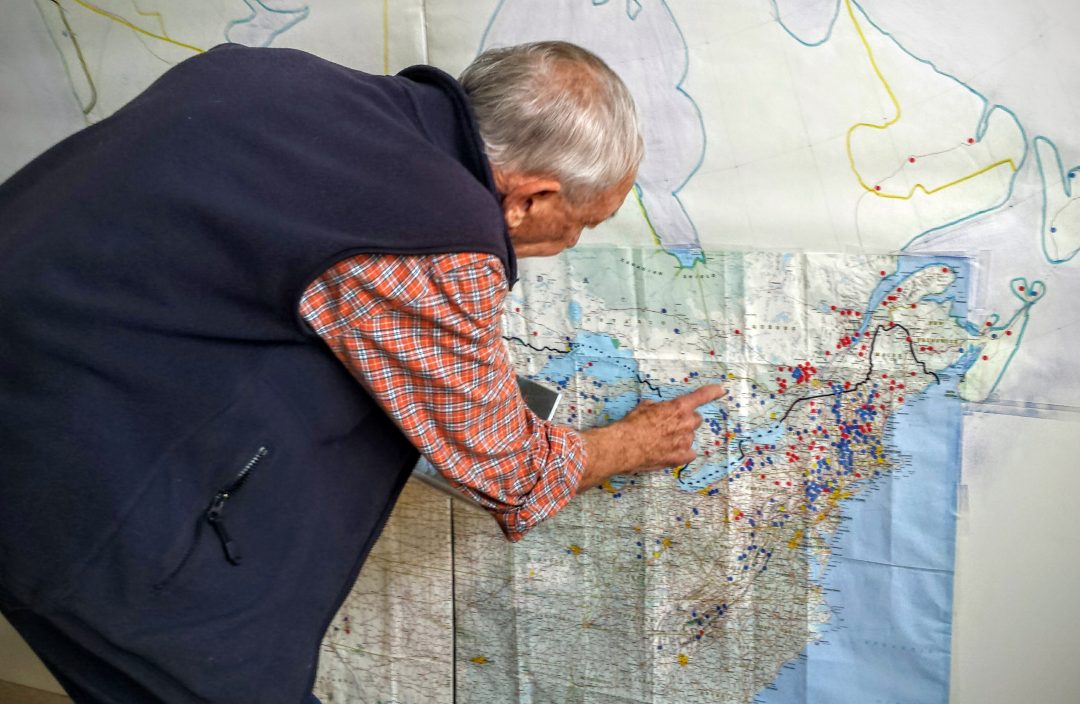
John Andrew points out ski areas he's skiied on a the wall-sized map in his Renton, Wash., home. Credit: John Nelson

John Andrew points out ski areas he’s skiied on a the wall-sized map in his Renton, Wash., home.
Credit: John Nelson

So many ski areas, so little time.

Yet at age 85, John Andrew is still busily crossing them off his list. Over the past 20 years, Andrew has been on a mission to ski all 700 alpine resorts in North America. He’s currently at 528, and he has several new targets in sight for this winter.

“I’m going to die trying to finish my quest,” says Andrew, a retired Boeing executive from Renton, Wash. “I won’t get it done, but I’m going to keep trying.”

It’s a big project, one that has consumed Andrew’s life since he retired at age 65.

It began innocently enough with a book. Andrew and his wife Jewel were shopping for a vacation home in the mountains using a guidebook of every ski resort in North America. Instead of narrowing the choices, the book opened up possibilities in Andrew’s mind.

“If we were going to buy a ski condo, I didn’t know where I wanted to buy it,” he remembers. Then, leafing through the resort guide, he wondered, “Why don’t we ski them all and find out?”

John Andrew and his wife Jewel on the slopes of Pine Creek Ski Area in Wyoming last February. Photo courtesy of the Andrews

John Andrew and his wife Jewel on the slopes of Pine Creek Ski Area in Wyoming last February. Photo courtesy of the Andrews

Over the following years, the Andrews embarked on their quest with gusto, sometimes with friends, sometimes with family, always keeping detailed records, grabbing trail maps, souvenirs and taking pictures. Jewel skied with John until 2007, when she quit the slopes after a knee replacement surgery. She still comes along on most trips.

“We are still skiing North America as a team,” he says.

“I think it’s fun,” Jewel says. “It gets you to all these places that you’d never go to—in the dead of winter.”

Their longest road trip covered 13,000 miles across the northern U.S. and Canada, when they hit 45 resorts in 16 states and provinces, including White Hills, the easternmost ski area in North America near St. John’s, Newfoundland.

Other trips took them to California, to New Mexico, to the mid-Atlantic, to the Deep South. They skied Cloudmont in Alabama, Ober Gatlinburg in Tennessee, Hidden Valley in Missouri. It’s all there, detailed on the spreadsheet and on the wall-sized map where Andrew places blue dots for the completed ski areas, red dots for those he has left to do.

Andrew gets the biggest thrill out of skiing places like Sawkill Family Ski Center, N.Y., with its 70 vertical feet, the smallest hill in North America.

When he stopped in at Sawkill, the lifts were closed. Andrew asked at the resort office if he could hike up and ski down, but the friendly general manager offered to drive him to the top in a pickup truck instead.

They roared up, Andrew hopped out, clicked into his skis and another resort bit the dust.

As he ages, Andrew has slowed down a little. Expert runs are a thing of the past—now it’s mostly greens and blues.

“It’s easy to get hurt and I don’t take foolish chances,” he says. “I look at the slope and if I don’t think I can do it, I won’t do it.”

“There’s a lot more to do,” he says as he gazes at his ski map on his living room wall . “But I like a job that’s tough. Even if I don’t get there, it’s something to do.”

John Andrew, 85, skis at Crystal Mountain, Wash., last March, checking another resort off his list. Credit: Emilio Trampuz

John Andrew, 85, skis at Crystal Mountain, Wash., last March, checking another resort off his list.
Credit: Emilio Trampuz

Cycling Series: Around Crater Lake

Riding The Rim Was One Of The Best Rides Ever.

Crater Lake water is pure and deep blue. It's 33 miles around the rim and 4000 vertical feet of ups and downs. Credit: John Nelson

Crater Lake water is pure and deep blue. It’s 33 miles around the rim and 4000 vertical feet of ups and downs.
Credit: John Nelson

As I topped a ridge near 8,049-foot Llao Rock on the north rim of Oregon’s Crater Lake, I had that giddy moment cyclists get when everything comes together.

I felt great. I had just finished one of my biggest climbs of the day. And I was alone on a road ringing one of America’s natural wonders.

I picked up speed on the downslope and screamed for joy.

Climbing along East Rim Drive on the south side of Crater Lake National Park. Credit: John Nelson

Climbing along East Rim Drive on the south side of Crater Lake National Park.
Credit: John Nelson

It was early October. I had left my home in Seattle a week before on an extended road trip around the west. I had no real itinerary, except to camp, hike, bike and enjoy beauty.

I hadn’t planned on coming to Crater Lake National Park. But while camping on the Oregon Coast, I met a fit retiree who had just done the 33-mile ride around the rim.

“It’s incredible,” he said in a hushed tone over the campfire. I decided then and there I had to try it.

A few days later, under cool, clear skies, I clipped in and started what would be one of the best rides of my life.

When you tackle the Crater Lake ride, the first thing to understand is that almost none of it is flat. You’ll do more than 4,000 vertical feet of climbing over the next few hours, so get used to the long ups, and the lovely, all-too-quick downs.

A stop at an overlook along East Rim Drive at Crater Lake. Credit: John Nelson

A stop at an overlook along East Rim Drive at Crater Lake.
Credit: John Nelson

I started at the park headquarters and immediately had a 1,000-foot climb to the rim of the lake. Cresting the top of the rim, I was treated to views of something really special.

Crater Lake is America’s deepest lake (1,943 feet deep, to be precise) and rests in the caldera of Mount Mazama, which collapsed during an eruption 7,700 years ago. The average annual snowfall here is 44 feet, which melts in warmer months, keeping the lake filled with some of the purest water on earth. Its color is a dramatic deep blue.

The rim road sits many hundreds of feet above the lake. From a car, the view is stunning. From the seat of a bicycle, it’s much more than that—you become part of the earth, water and sky as you grind past each jaw-dropping viewpoint.

If you go

Which direction? Most people choose to go clockwise, which puts you on the lake side of the road on your journey. Starting at park headquarters gets a big climb out of the way early when you have the energy to do it.

Fitness concerns: The ride is strenuous and not to be taken lightly. Besides the many ups and downs, you’ll be pedalling at up to 8,000 feet elevation. Temperatures vary wildly from below freezing to well into the 90s.

Safety: Auto traffic can be heavy in the summer months, and rubber-necking drivers don’t always watch for cyclists while taking in the views. Wear bright clothing. If you want to avoid cars, visit on one of these dates in 2016: Sept. 17 or Sept. 24, when the East Rim Drive will be closed to automobiles for runners, walkers and bicycles. Information is here.

Water, food: The Rim Village Visitor Center is a good place to load up. Bring lots of water for the ride: There are no drinking fountains along the rim. The Visitor Center has cafeteria-style food service if you want a meal.

Stops: There are 30 overlooks that ring the lake; plan on stopping frequently to rest, take pictures and enjoy the views.

Accommodations: Inside the park, the historic Crater Lake Lodge has commanding views from its location at Rim Village. You’ll need to make reservations a year in advance to book one of these in-demand rooms. The Cabins at Mazama Village have scattered availability through summer and fall of 2016. Reservation information is here.

Camping: Two campgrounds are available. The full-service Mazama Village Campground has 214 tent and RV sites. A limited number can be reserved, the rest are available on a first-come, first-served basis. The primitive Lost Creek campground has 16 non-reservable tent sites.

National Park Bicycling Info:  Highly useful guide to the Rim Drive, including safety, camping and ride information.

Crater Lake National Park MapA beautiful map of the lake and surrounding area.

National Park Service Map of Crater Lake. Hills and altitude make the ride around challenging.

National Park Service Map of Crater Lake. Hills and altitude make the ride around challenging.


Special Edition: Great News for SeniorsSkiing.com Subscribers!

Subscribers to SeniorsSkiing.com are now eligible to receive substantial discounts on a wide variety of equipment, gear, accessories, clothing, etc.

Flipping out: Lofoten, Norway Credit: Oystein Aasheim

Flipping out over deals for SeniorSkiing.com subscribers!
Credit: Oystein Aasheim

We have arranged for this subscriber benefit with ProMotive.com, the online community for industry experts and influencers that matches qualified members with exclusive discounts on top brands.

These offers—the same as or similar to those available to professional ski and snowboard instructors—are based on the understanding that SeniorsSkiing.com subscribers influence buying decisions by their peers.

There is no cost for being a SeniorsSkiing.com subscriber, and there is no fee for using ProMotive.com.

Look for emails from us soon and over the coming weeks. They will explain the simple registration process and will link to ProMotive’s “Snow Influencers Team.”

Our Subscriber Survey revealed our readers want discounts for seniors. We hope you enjoy this new subscriber benefit!

Mike Maginn, Jon Weisberg, Co-Publishers


B_Sun Valley 1950

Bebe Wood: Approaching 90 And Going Strong

Skiing Since The 30s, She Has Seen Lots Of Changes.

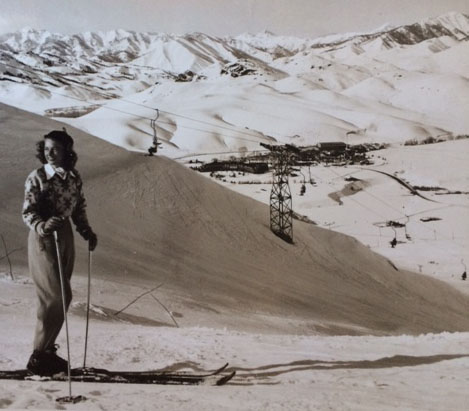
In 1949, 23 year old Bebe Wood left her job at Dartmouth College and traveled to Idaho seeking adventure as a ski bum in Sun Valley. By then, she had already been skiing for about 10 years!  Thus began her long association with the ski industry. Today, approaching her 90th birthday, she remains actively involved as a Host at Ragged Mountain in New Hampshire.

As a youngster in Marblehead, MA, she and her siblings taught themselves how to ski at a nearby golf course. By the late 1930’s her sister, five years her senior, had a driver’s license so they started going up to Cranmore in North Conway, NH. It was there that she became immersed in the sport.

Bebe Wood was an original ski bum in Sun Valley in 1950. Credit: Bebe Wood

Bebe Wood was an original ski bum in Sun Valley in 1949-50.
Credit: Bebe Wood

Following graduation from college, she went to work at Dartmouth as medical secretary. She and her friend Jean Adams joined the Dartmouth Outing Club which was an opportunity for travel around Northern New Hampshire and Vermont—Stowe, Cranmore and Suicide Six. They also skied locally at the Oak Hill rope tow in Hanover. “The DOC was a wonderful experience”, says Bebe. “We all loved to ski, yodel and sing. We had a great time.”

In the winter of 1949-50 Bebe and Jean Adams headed west to be ski bums in Sun Valley. They worked as waitresses and had plenty of time for skiing during the day. Bebe also had time to be a Sun Valley model for a Life Magazine shoot there and appeared in a February 1950 issue. “We had the best time there,” Bebe says. “Dartmouth was connected to Sun Valley back then and we were able to ski with some top notch eastern skiers.”

During the following ten years or so there was not much skiing in her life as she and her new husband were starting a family and moving around. But in 1963 they moved to Bristol, NH. And that move heralded her return to skiing in a big way.

In 1964 she began her long tenure at Ragged Mountain where she directed the junior program for school kids. She continued in this role until the mid 1980s when Ragged closed. During the next few years, Bebe taught at nearby King Ridge in New London, NH where she was part of the ski school until Ragged reopened in 1989.

All along the way Bebe found time to become PSIA certified, a first aid instructor, make two trips to the Alps skiing in Switzerland, Austria an Italy and a return trip to Sun Valley.

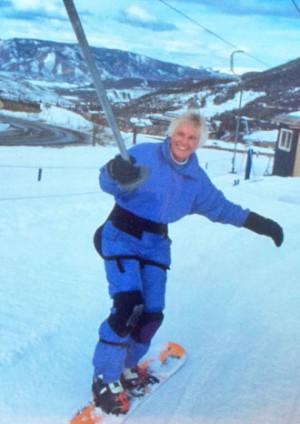
Bebe learned snowboarding at 70. Credit: Bebe Wood

Bebe learned snowboarding at 70.
Credit: Bebe Wood

Bebe retired from instructing in 2007 but continued as head the Courtesy Patrol until it was phased out a few years ago. Not wanting to be idle, however, she remains active at the resort today as a mountain host. You can find her in the base lodge greeting skiers and boarders, chatting with folks as come in for a break, checking with patrol on the latest conditions and dispensing all kinds of local knowledge and information about the resort and the general area.

Bebe stopped skiing five years ago at the age of 85. “Not because I can’t ski,” she says, “but because I’m now too afraid of getting hurt. I have no one to take care of me if I were to get injured. I do miss it, though.”

Bebe sees the evolution of equipment and technique as a positive thing that has made the sport much easier to learn and continue. “Sometimes the technical details get confusing but if the continued development of new equipment and technique makes the sport easier that’s good for its growth,” she said. When asked about other changes she’s seen, she said that in the old days skiers were just one big happy family. They sat around the fireplaces in old ski lodges and never complained about rope tows that wore out ski gloves or conditions that were less than ideal. Now she says, skiers want everything to be perfect. And there are so many people you have to be a little more careful.

According to Bebe, “It’s still a wonderful sport. It should be available in all schools free of charge so all kids have a chance to experience it.” She thinks there are more seniors skiing now than ever before. “New and better equipment keeps people going longer,” she says, and hopes that “more people being on the hill does not discourage older skiers.” She knows some seniors in their late 70s and early 80s who still ski, including some 10th Mountain veterans. “But the group is dwindling.”

What keeps her coming back? Why does she continue to work even though she no longer gets out on the hill? Love of the outdoors, a desire to keep up with the sport and the people in it, the opportunity to meet new people with similar passions are just a few of the reasons. “You don’t have to be young to enjoy it. It brings family and friends together.” Of teaching she says, “I can still look at skiers and tell what they’re doing wrong. I can tell who has had lessons and who hasn’t.”

Bebe Wood today.

Bebe Wood today. Tuckerman’s Ravine was a favorite spot. Credit: Joan Wallen

Approaching her 90 th birthday in a few months and summing up her lifetime involvement in a sport she loves, Bebe states, “I wouldn’t have changed a thing.” Including, or perhaps especially, her ski bumming year in Sun Valley. “If young people have a chance to be a ski bum, they should go for it. It’s an experience to always remember.”

American Airlines Introduces Direct Flights to Big Sky

Now It Is Easier To Get To A Montana Destination Resort.

Now you can get a direct flight from Dallas to Bozeman. Welcome to Big Sky Country. Credit:Michel Tallichet

Now you can get a direct flight from Dallas to Bozeman. Welcome to Big Sky Country.
Credit:Michel Tallichet

American Airlines now has direct service between Dallas/Ft Worth and Bozeman Yellowstone International Airport (BZN), 40 miles from Big Sky Ski Resort. The once a day flights are scheduled through April.

Big Sky is one of America’s most spectacular resorts. It has 5800 acres spread over four peaks and sports a vertical of 4,350′, making it the longest drop in the lower 48.

It is a snow magnet, attracting on average 400″. Best of all, it’s vacant. If a few people are ahead of you in line, you’ll be talking about it that evening at one of Big Sky’s terrific lodging options.

Karst Stage provides shuttle service to the resort. Multiple car rental options are available.

Snowbird

Special Edition: SeniorsSkiing.com Announces “Senior-Friendly” Resorts

Results of SeniorsSkiing.Com’s Recent Survey And Industry Research Reveals 16 Winners

Snowbird

Snowbird is one of 16 ski resorts designated as “Senior-Friendly” through SeniorsSkiing.com’s second annual ski area survey.

Sixteen resorts in the East. Midwest, West/Northwest, and Canada are recognized as “Senior Friendly” for their proactive efforts to meet the needs of older skiers.

The selection is based on input from SeniorsSkiing.com’s second annual survey of US and Canadian resorts, reader input, and industry sources. Factors taken into account include free or discounted lift tickets and a variety of features—such as resort-sponsored clubs, close-to-lodge parking, and other amenities—which readers of SeniorsSkiing.com have identified as important.

The resorts designated as friendliest to seniors are (*designated Senior-Friendly in 2014-15): 

East

Attitash Mountain Resort, Bartlett, New Hampshire

Special ski school clinics, discounts, clubs, social activities; $50 season pass (80+), 30% discount (65-79).

Cannon Mountain Ski Area, Franconia, New Hampshire

Ski school clinics, discounts, curbside assistance, $50 season pass (80+). 14% discount (65-79).

Cataloochee, Maggie Valley, North Carolina

Free skiing (65+).

Smugglers’ Notch Resort, Jeffersonville, Vermont

Reserved areas in lodge, discounts: ski shops, rentals, school; area sponsored clubs, social activities, $20 season pass (70+0.

Sugarbush Resort, Warren, Vermont

$199 mid-week season (65+); free skiing (90+).

Waterville Valley Resort*, Waterville Valley, New Hampshire

Silver Streaks ski club: clinics, races, social events. 30% discount (65-79), $25 season pass (80+).

Midwest

Crystal Mountain, Traverse City, Michigan

“Retired Not Tired” program: provides local retirees opportunity to return to skiing; actively enjoy winter in the company of peers. 42% discounts for mid-week season passes (56+), $29 season pass (80+).

Mt Zion Ski Hill, Ironwood, Michigan

Ski school clinics, curbside assistance, close-to-lodge parking, restaurant discounts. Free skiing (70+), 20% discount (65-69).

 West/Northwest

Arapahoe Basin, Keystone, Colorado

Close-to-lodge parking, clubs and activities. Single day tickets $25 (70+), season pass $75.

Hogadon Ski Area, Casper, Wyoming

School clinics, equipment carts for gear, clubs and activities. 25% discount (65+), free skiing (70+).

Mt Hood Skibowl*, Government Camp, Oregon

School clinics, mid-week parties, clubs/activities, mid-week motor coach transportation. Free skiing (75+), 30% discount (65-69).

Purgatory Resort, Durango, Colorado

School clinics, equipment carts for gear, mid-week parties, curbside assistance, valet parking, close-to-lodge parking. 30 percent off season pass (65 -79), $120season pass (80+).

Snowbird, Snowbird, Utah

Generous season passes discount; 10% food discount for seniors in all dining facilities (including new Summit at Snowbird). Ask the cashier.

Sundance Mountain Resort, Sundance, Utah

Sundance Senior Ski Group (free for 65+); lift ticket ($15), season pass ($125). Includes all skiing, x-c ski/snowshoe trail facilities, use of lift in summer months. Coaching available on select dates throughout season.

Tahoe Donner, Truckee, California

School clinics and discounts, mid-week parties, close-to-lodge parking, clubs, awards banquets, equipment rental discounts. Free skiing (70+), 45% discount (65-69).

Canada

Lake Louise Ski Resort*, Lake Louise, Alberta

School, equipment discounts. Free skiing (80+), 20% discount (65-79)

All Senior-Friendly resorts will be receiving an award plaque from SeniorsSkiing.com.  Many of these resorts report that up to 40 percent of mid-week skiers are seniors taking advantage of fast lift lines, space in the lodge to spread out, as well as other low-cost, or no-cost amenities.

SeniorsSkiing.com salutes these resorts and thanks them for setting an example for the ski industry and for making seniors feel welcome.

Wheelie__510

Time To Get Moving: Now

Five Ways To Start Your Fitness Program.

Motion helps muscles, joints, ligaments limber up for snow season.

Motion helps muscles, joints, ligaments limber up for snow season.

No more procastination.  You have from six weeks to three months, depending on where you live, to get ready for snow season.  If you are a year-round sports activist, then good on you.  If you are a part-timer, weekend warrior, you probably have to start getting more diverse muscles toned up.  If you are as not as active as you could be, reflect on your habits.  You will be safer and feel better when you head out to slopes or trails if you are physically toned.  It is a huge mistake to go from zero to a ski run or cross-country trail without being physically prepared, especially if you are one of those people who distinctly remember the Beatles on their first Ed Sullivan Show appearance.

Here are five ways to begin, especially if you’ve been off your program for whatever reason this summer.

1. Walk.  Simple.  Morning, lunchtime, or evening.  Walk fast, swing your arms, work up a sweat, carry light weights (2 pounds) or walk with ski poles (Nordic walking burns more calories), use a pedometer, keep a record of how far and how many steps.  After a week or so of daily walking,  the “training effect” will kick in, and you will feel looser, more steady and, guess what, you’ll be outside in the beautiful Autumn weather.  Here are some guidelines for getting started.

2. Stretch. Loss of elasticity of connective tissue, an effect of the aging process, can be nasty.  Muscles tighten up, and back and joint problems ensue.  Stretching makes a difference. Learn to stretch your hamstrings, quads, hip flexors, and lower back.  There are many resources you can access for how-to.  Here is a good starter from the NIH. There’s always yoga. This is really, really important: If you aren’t using it, you’re losing it.

3. Gym Class. Going to a class led by a trainer provides structure, discipline and challenge.  An hour-long class will probably keep you in more motion than the same time spent alone in your basement.  In a good gym class, you will also learn about the muscles you are exercising, how to stretch them and gradually build up strength and flexibility all over your body, not just your favorite parts.  Probably most important, you will learn proper form so you get the most out of your efforts and help prevent injuries.  SeniorsSkiing.com’s Harriet Wallis wrote about Silver Sneakers, a national program sponsored by insurance company targeting seniors. There’s probably one near you.

4. Focus on four essentials.  No gym nearby? If you do head down to your basement or studio for exercises, here are four to get you going:  Lunges for legs, lower back, hips, Plank for core and probably one of the two top exercises of all, Pushups for core, upper body and arms, and the other top exercise, and Squats, a fundamental leg and back strengthener.  You must learn to do these correctly; form counts for everything.  Doing a zillion reps without proper form is not that effective and could get you hurt.

5. Get an app or two. There are many apps you can get for your smartphone that can be your training buddy.  This link has a few of many. Point is you will able to get feedback on how you are doing and see progress using a cool app. And in a strange way, the app builds an expectation. Just like the GPS voice in your car, you can have a relationship with your app.

As usual, see your doctor before trying any of this, or if you start a program, and it doesn’t feel good.  Remember this is meant to be a starter kit.  Stay tuned for more advanced fitness activities.

Now, don’t hesitate, get going. What’s your advice?

A Skier’s Journey: Pushing The Envelope

A Senior Skier Reflects On The Thinking Part of The Sport.

Since I was five I’ve been on a voyage of self discovery through skiing that started at the ski areas of the Laurentian Mountains of Quebec, Canada and grew to be an integral part of my life the older I became. Initially learning to ski on riverbank in Winnipeg wasn’t the most auspicious start to any skier’s career but the passion for the sport of those around me left an indelible impression. Certainly I picked this up from my father, a local and eventually nationally recognised builder of the sport in Canada. It probably meant that skiing and not hockey would become the central sport of my life but I was under no pressure to do this. Instead I was attracted for its own merits to this activity that rewarded individual effort yet was always way more fun in the company of others. And then there was the connection with nature and the fact that skill wasn’t just about the size or sex of the participant. It appealed to me on an intellectual level too. The best skiers always seemed to me to be aware and afterwards reflective of what they were trying to accomplish yet in the moment of performance instinctively connected to the snow. They were and are my inspiration.

As I gained more experience it became obvious to me that I would want to pass this joy on to others so at the age of 14 I became an instructor. I also realised that one of the best ways to understand the sport that was rewarding in so many ways was to never stop trying to learn yourself. In 1986 a close friend invited me to enter the sport from a different angle and coach. Along the way I made a career in the retail sporting goods field and still strive to learn everything I can about the impact of equipment on performance as a professional boot fitter, technician and ski shop manager since 1974. All of which led to jumping off points in my life which I was completely oblivious to at the time. It was never just the destination but the journey that with hind sight mattered most. Like having a great run where sometimes a moment of reflection at the end when you realise what you just accomplished. Now I’m not saying that skiing is somehow always a metaphor for life but it was for me.

So here I am 55 years later from that little boy in Montreal and still learning and pushing the envelope. It’s a fascinating period of time in the evolution of the sport for any of us that have experienced the full range of changes in the last 60 years. Thanks to this website for allowing me to share some of the ride.

Contributor Glenn Allen is an “employee athlete” at Sport Chek, Canada’s largest retail chain of sports equipment.  Thanks for letting us use the video clip.

Hike Vermont: Trails For Seniors And Families

Great Advice From Roger Lohr, Publisher of XCSkiResorts.com.

There’s no better way to enjoy the outdoors than hiking on a trail alone or with your friends or family. Whether you are a first time hiker or a walking aficionado, hiking with the family provides quality time together, allows the family to grow closer, develops life-long memories, and introduces the next generation to the outdoors. It’s no wonder that statistics show that nationally more than 34 million people went hiking in the year 2013 and that has remained somewhat consistent in the last few years.

Family hiking in Smuggler's Notch is a perfect summer vacation. Credit: X-CSkiResorts.com

Family hiking in Smuggler’s Notch is a perfect summer vacation.
Credit: X-CSkiResorts.com

You don’t need to walk very far to experience the joys of being outdoors with your kids or grandkids. It’s about discovery and having fun. For parents taking their kids on a hike, it is recommended that the child’s early experiences be positive, so avoid plans to reach that favorite spot or the top of the mountain. Keep it simple by being flexible and adaptive to make sure the younger ones have a good time.

Perhaps short hikes at first near home or a local park will provide a positive experience. Bring a snack, water, and invite your kid’s playmate. They can find joy in clouds, flowers, tadpoles, splashing water, getting dirty, colorful bugs, etc. but you don’t want them to get sunburned, hungry, thirsty, or exhausted.

Safety and Other Considerations on a Hike

Be careful of rocks, rubble, brush piles, or fallen logs where kids might lose their footing, sprain an ankle, or take a fall. Tell kids not to drink the stream water or eat berries or mushrooms, and the rule with poison ivy, oak, and sumac is “leaves of three, let it be.” Be wary of places where bees and wasps might nest.

Wearing bright clothing is a good idea so you are easy to see and find if lost. Layer clothing, and be prepared for weather changes. Synthetic clothing (such as a capilene shirt or a pile jacket) is lighter, a good insulator, and dries faster. Socks and supportive boots are important. Traditionally hiking socks were made of heavy wool but more recently socks that are made of a variety of materials that provide warmth, durability and keep your foot dry. Hiking boots are not required but they can help kids feel like explorers.

A list of items that could be useful on the trail includes: signal device (whistle, mirror), water bottle, emergency blanket, map, compass, flashlight (with spare battery and bulb), extra food, extra clothing, sunglasses, sunblock, insect repellent, knife, waterproof matches, firestarter or candle and a first aid kit.

If you think that you are lost, try to retrace your course rather than continuing on in an effort to reach some destination. An emergency call consists of three short audible or visible calls repeated at regular intervals. Use a whistle for making noise and a mirror or smoke puffs during the day. At night, use a flashlight or small bright fires to signal.

 You may consider leaving your dog at home if he or she cannot be kept under control. Respect the privacy of residents that live along the trail unless there is an emergency and you desperately need help.

Leave No Trace

Some basic concepts for outdoor and trail etiquette include: Plan ahead and be prepared; Travel on durable surfaces to minimize trail erosion; Pack out what you bring in to the outdoors (don’t bury trash or diapers); Leave the outdoors as you found it, don’t feed the wildlife, and take only memories away with you; Minimize the use of fire and take extra care if you do use it.

Here are some hiking destinations in Vermont and for more locations, check the XCSkiResorts.com Resorts Page:

Bolton Valley: There are 100km of Nordic and backcountry ski trails at Bolton Valley Resort and in the summer these same trails provide paths for outdoor adventure in over 1,000 acres of wilderness. Some trails lead up the valley to the ridge-line where hikers can connect with Vermont’s Long Trail.

Killington Resort: With 15 miles of hiking trails at Killington Resort, you can summit Vermont’s second tallest peak to be treated to 360 degree views of Vermont’s Green Mountains, New York’s Adirondacks, and New Hampshire’s White Mountains. Additionally, near the top of the mountain provides access to the Peak Lodge, Killington’s state of the art facility, which offers fresh food and cool drinks to hikers and mountain bikers all summer. The K1 gondola lift is open for rides to reach the summit.

Smugglers’ Notch Resort: The Green Mountain setting at Smugglers’ Notch Resort creates many opportunities for guided and self-guided hiking for all ages. The resort hosts guided outings designed for families with young children, with a gentle pace and fun learning opportunities. Other guided outings entice new hikers and experienced hikers with the opportunities to learn more about the history of the surrounding area and the local flora and fauna, and to summit some of the area’s most challenging peaks. Guided hiking is included in the resort’s vacation packages. The resort provides informational sheets on self-guided outings nearby.

Trapp Family Lodge: There are over 60 kilometers of wooded hiking trails for all levels of ability at Trapp Family Lodge in Stowe. There is a short, peaceful hike to the Chapel, built by the Trapp family sons on their return home after World War II. A more challenging hike takes you to the Slayton Pasture Cabin, a favorite resting spot for cross country skiers or snowshoers in the winter. Guided nature walks are available to guests to learn about native plants, wildlife, and the evolving landscape.

Woodstock Inn & Resort: Step outside the Woodstock Inn & Resort and choose from more than 60 miles of interconnected trails and pathways that wind through the Woodstock Village, nearby meadows and woodlands, scenic vistas, and rural countrysides. Pedestrian pathways skirt local landmarks, while off-road trails yield to magnificent vistas from the summits of Mount Peg and Mount Tom. For a historic walking tour of Woodstock’s past, stroll the 20+ miles of colonial carriage roads as they wander through the Marsh-Billings-Rockefeller National Historical Park and intersect with the Appalachian Trail.

Keep Moving: Fighting Arthritis With Activity

Here’s What You Can Do To Manage Your Inevitable Osteoarthritis.

If you’re a snow-sport enthusiast and subscriber to SeniorsSkiing.com, you are most likely a senior with an active life style.  We know from our SubscriberSurvey 2015 that many of our respondents not only enjoy Alpine skiing, but also Nordic and snow shoeing, and you ski a lot.  More than 55 percent of the responses say they ski more than 30 days a season.  Anecdotally, we’ve also heard how our subscribers love to hike, cycle, kayak and generally keep moving all year round.

In a recent article by NY Times Personal Health columnist Jane Brody, we see how critically important it is for seniors to keep that kind of active lifestyle.  Not only does activity help stem arthritis, reasonable levels of activity help avoid other chronic health problems. Brody quotes a researcher at the Alabama Research Institute on Aging: “As we get older, if we don’t get up and move around as much as we can, then we soon won’t be able to move at all.”

Read the Comments section attached to this article as well.  There are some insights and advice from NY Times readers you might find interesting.  If you’d like to comment on SeniorsSkiing.com, please do.  How do you stay active?  What does that do for you?  What’s your challenge in keeping in motion?  What works that you can share?

NY Times Columnist explains why activity is a way to fight arthritis. Credit: NY Times.

NY Times Columnist explains why activity is a way to fight arthritis.
Credit: NY Times.