Test Your Skiing Knowledge

Your Support Helps!

Help us keep SeniorsSkiing.com free. Please support SeniorsSkiing.com with a donation.

DONATE

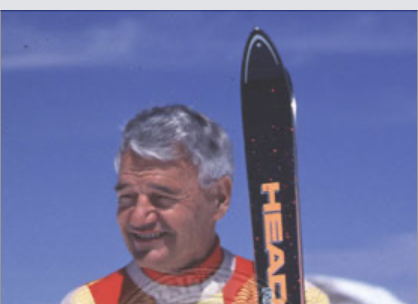
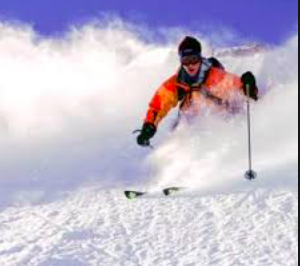
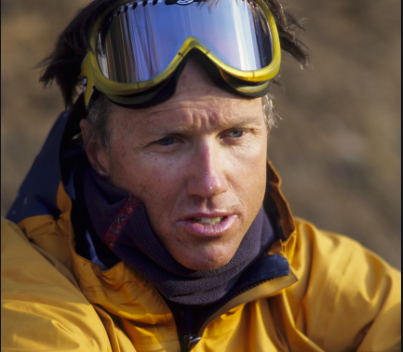
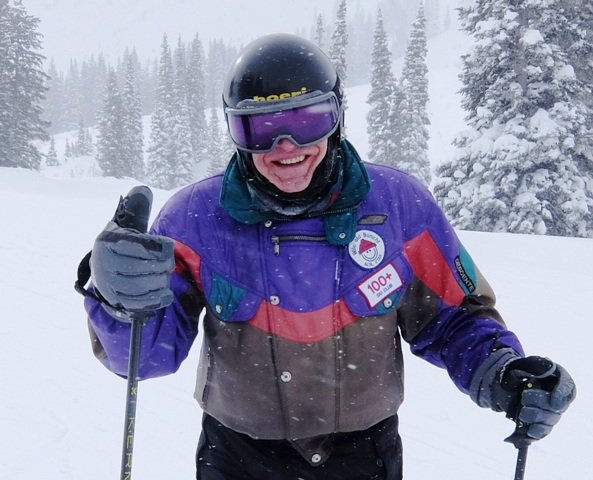
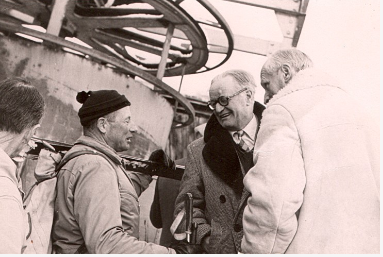
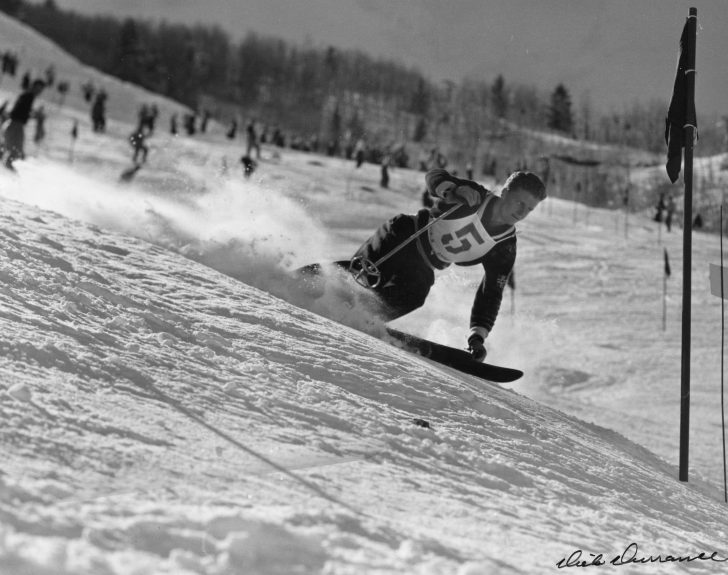
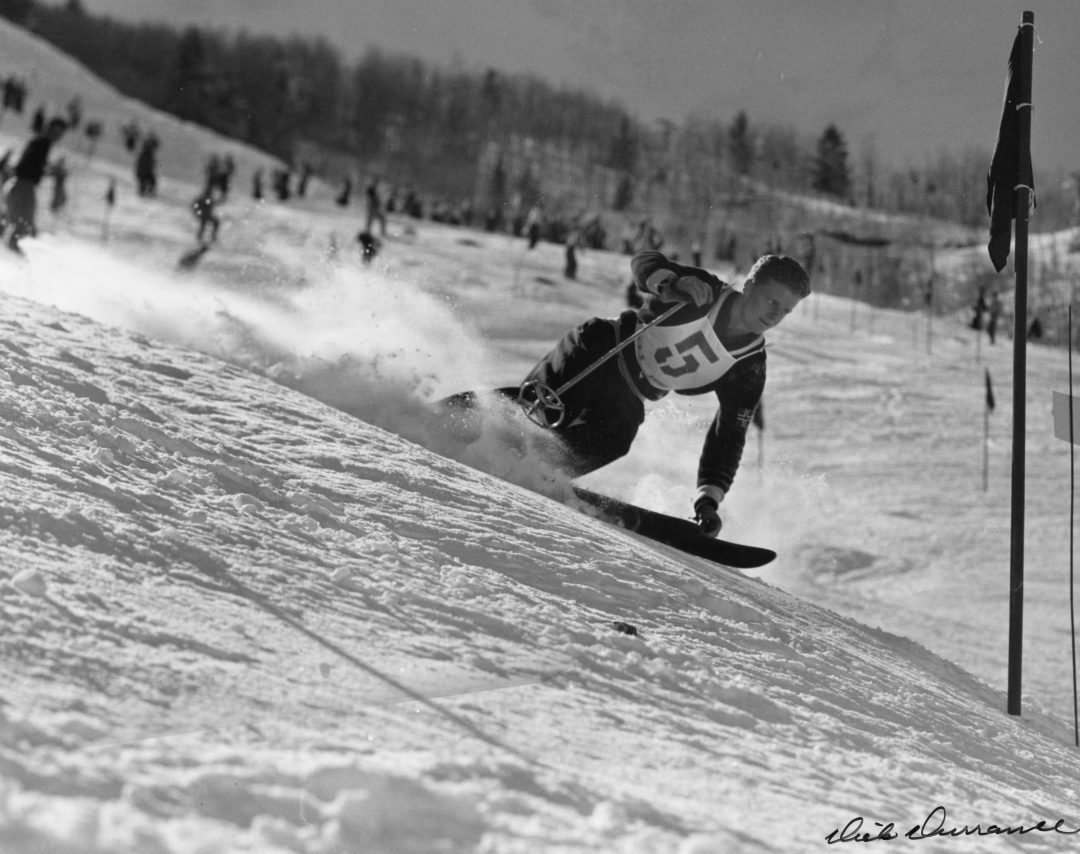
Each issue of SeniorsSkiing.com has a picture to help test your skiing knowledge. Generally, the pictures are from collections in a variety of participating ski museums, which we encourage readers to visit. This image is from the Utah Ski & Snowboard Archives, which preserves the history of skiing in Utah and the Intermountain region. The extensive collection contains thousands of digitized images of photographs and print materials, all of which can be accessed online.

Source: Utah Ski and Snowboard Archives

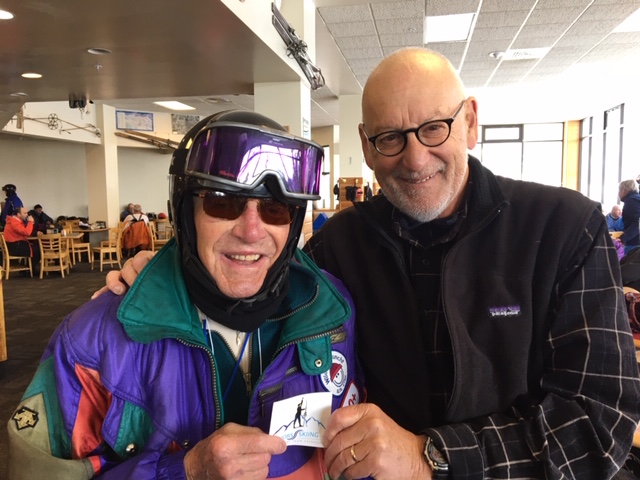
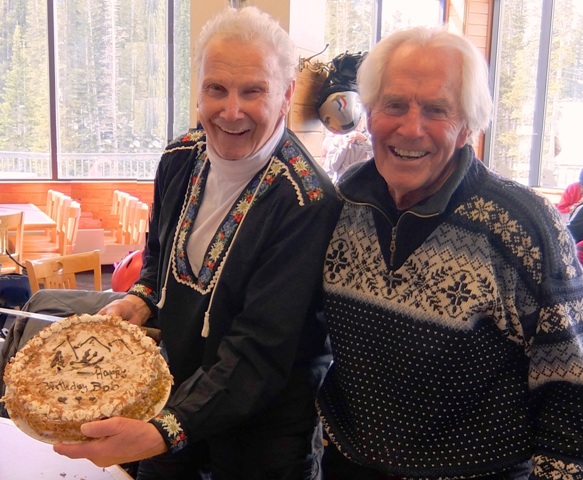
This picture was taken in 1963 during Park City’s preseason ski school. The man on the right was a participating ski instructor. He went on to become one of Utah’s most celebrated skiers. Now a nonagenarian, he can still be spotted carving his way down the mountain. The first reader to correctly identify him will receive the new SeniorsSkiing.com poster of ski-themed license plates. (Only answers sent to jon@seniorsskiing.com will qualify).

Winner of February 4 Test Your Skiing Knowledge

Several readers correctly identified the object being transported by dog sled as a tire for the massive Antarctic Snow Cruiser, which was part of Admiral Byrd’s 1939-41 United States Antarctic Service Expedition. But the first reader to send the answer in was Rob Henning of Pittsburgh, Pa. Rob is a frequent denizen of Seven Springs Ski Resort and each season visits Big Sky in Montana. He enjoys chasing his 13-year-old son around the mountain. Congratulations, Rob. You’ll soon be receiving the new SeniorsSkiing.com Licensed To Ski poster of ski-themed license plates.

Junior Bounous

Meet 96-Year-Old Ski Legend: Junior Bounous

Ski industry icon Junior Bounous, 96, is a mover and shaker whose passion is to keep people skiing throughout their lives. In a nutshell, he tells seniors: Just “keep moving.”

Junior’s career spans nearly eight decades with a list of accomplishments and awards longer than both my arms: Intermountain cross country and national gelande jumping champion, national race course setter, ski patroller, founding member of Professional Ski Instructors of America, father of today’s American Ski Teaching System, an advisor to ski manufacturers, a ski trail designer for resorts, and the director of skiing in California and Utah including Sundance and Snowbird. In 1996, he was inducted into the National Ski Hall of Fame.

Snowbird’s Pipeline

Junior takes his own “keep moving” advice. To celebrate his 80th birthday he skied Snowbird’s treacherous Pipeline chute, a couloir lined with jagged rocks and with no room for error.

And he keeps on moving. On a bright spring day in 2021, he heli-skied from the 11,489’ Twin Peak summit, the highest point in the Little Cottonwood Canyon range, making him — at 95 years and 244 days — the Guinness World Records’ oldest heli-skier. Getting out of the helicopter was difficult because his knees don’t bend as well as they used to.  “The skiing was the easy part,” he said.

Follow the legend

A role model for seniors, Junior continues to ski for the joy of it.

A few days ago my senior ski friend Beth Tait was skiing at Alta when she saw a yellow helmet. Junior always wears a yellow helmet. As she got closer, she saw it really was Junior. He was talking with skiers around him, and she joined in. Later, Beth followed him, trying to ski as smoothly and fluidly as the 96-year-old.  “Junior is an incredibly athletic skier not to mention his heartwarming personality,” she said.

From barrel staves and manure piles to Alta and Snowbird

Junior was the youngest of six children in an Italian farming family in Provo, Utah. His first ski experience was on the farm at age 8 when he attached barrel staves to his feet and skied down a slope trying to miss the manure piles at the bottom.

Alf Engen (l) and Junior Bounous Source: J.Willard Marriott Digital Library

Fast forward to 1948, when, at age 22, he became one of the first certified instructors in Utah, and he began a long-lasting relationship with his cherished mentor, Alf Engen. For the next 10 years, Bounous was Engen’s primary assistant in Alta’s Alf Engen Ski School known worldwide for teaching students how to ski powder. His skiing and teaching careers kept accelerating.

When Snowbird was on the drawing board, founder Dick Bass recruited Junior to lay out the trails, and when it opened in 1971, he became its Ski School Director inspiring generations of skiers.

Junior’s top tips for Seniors

It’s a bird, it’s a plane, it’s Junior in the air in 1957. Photo credit: Harriet Wallis

Balance and coordination are major factors for senior skiers. “Older people have trouble with their eyes and ears, but you can extend the life of both senses if you practice,” he said.

He advises cross training. “Stay active. Do not confine yourself to just skiing. Play golf, ride a bike, take a walk. Do whatever you enjoy – but do it. It will help you get out of the bathtub, get out of the car, and go up the stairs.”

He also recommends improving balance by skiing slightly different terrain and snow conditions. Don’t get stuck skiing only on bluebird days or just on your favorite trails. “It boils down to just doing it. Stay active in as many ways as possible,” he said.

Take Junior’s advice: Just do it.

However, “Many older people drop out because they no longer have anyone to ski with. They’re physically capable, but they’ve lost the social fun of skiing. Find somebody to ski with,” he said.

Help Us Compile SeniorSkiing.com’s list of senior ski groups

To help seniors find someone to ski with, SeniorsSkiing is starting a list of senior ski groups around the country. If you know of a senior ski group, please use Leave a Reply at the end of this story. Include as much information as possible about the group.

Women Played Integral Role at One of Nation’s Oldest Ski Areas

[Please consider supporting SeniorsSkiing.com with a donation. We appreciate your help. Click here.]

Janet Davis Mead, June Aker, Verlene Belden All Kept Pico Going And Growing, Despite Obstacles and Challenges.

Janet and Brad Mead started Pico in 1937.

Vermont’s Pico Mountain survived a war, two owners’ deaths, and a neighbor called Killington to become one of the 30 oldest continually operating ski areas in the country.

It’s a feat that was largely driven by women in its first 30 years, a time when the ski industry was known to be “a man’s world.”

Women also played major roles in Pico operations since that time, continuing the strong family influence that began with co-founder Janet Davis Mead.

A feisty woman given to exaggeration, Janet Davis told Brad Mead she had skied at the Lake Placid Club, so he invited her to go skiing.

“I had to follow him down what looked to me then like Mount Everest. I made it, but without poles,” she would write years later, explaining she had thrown them in the bushes, not knowing what they were for.

Her bravado paid off; they married and researched building a ski area.

Envisioning a year-round resort with mountainside homes, aerial tram, swimming pools, ice rinks, and tennis courts, the Meads leased Pico Mountain and opened Thanksgiving Day 1937 on Little Pico with a 1,200-foot rope tow and a rough-cut, 2.5-mile Sunset Schuss skiers could ‘skin up’ to the summit.

The Meads hired Swiss racer Karl Acker to run the ski school, added two tows, widened Sunset Schuss — renowned for downhill racing and the Pico Derby — and installed the first U.S. Constam T-Bar to the top of Little Pico.

After Brad died in a boating accident in 1942, Janet carried on with support from skiers, the Otter Ski Club, and Otter Patrol. When workers including Acker left for World War II, she kept Pico open despite hardships of rationing and shortages that caused many areas to close. Using her marketing skills, charisma, and tenacity, she gave special rates to schoolchildren and servicemen who visited on furlough weekends.

Karl and June Acker took over from Janet and continued to expand the resort.

Having survived wartime, Janet bought the mountain (1947) as Acker returned to teach and help operate Pico. (He coached daughter Andrea Mead, first American to win two Golds in the 1952 Olympics, bringing acclaim to Pico’s strong racing tradition.) As the first woman to own and run a U.S. ski area still operating, Janet survived four lean snow years, weak finances, and growing competition by lowering ticket rates and offering summer rides on chairs hung on the T- Bar (1950). With the ski boom on and her children not interested in running Pico, she sold to Karl and June Acker in 1954.

Karl added trails, a T-Bar, and a J-Bar. “The lack of access to funding caused him to do too much of the work himself; the long hours and the stress of the new J-Bar which he couldn’t get to work quite right contributed to his fatal heart attack” in May 1958, June told me in 2007.

“The three banks that had lent us money to purchase Pico had insisted on a life insurance policy on Karl. Because I was a woman they needed to know I could repay the loan if he died,” June said of becoming Pico’s owner at age 30.

She added trails, replaced a lift, and obtained financing for Pico’s first chairlift, a Stadeli double that went halfway to the top ($110,000 in 1962).

“Pico needed lift service to the summit to compete and survive.  Being a woman contributed to the banks’ reluctance to provide more loans,” June said, of her decision to sell to Bruce and Verlene Belden (1964) in hopes they would carry on a family-oriented mountain.

Bruce had helped build Mount Snow (1955-1964), while Verlene ran their 30-guest ski lodge and raised four children. With former guests investing, they became majority owners with Verlene as office manager. Her business acumen coupled with their strong family orientation and expansion of the mountain enabled Pico to survive the trying 1970s when all but five major Vermont ski areas changed owners, and most surface lift areas closed. Vermont had 81 areas in 1966 but just 39 by 1988.

When they retired in 1987, Pico had a reputation as the “friendly mountain” with strong racing and instruction programs and new base village engendering a loyal following.

Women played significant roles in achieving that reputation. “They taught youngsters to ski and race and were instrumental in the Pico Ski Club. They also ran various departments from ski shop to ski school, tickets to childcare. They contributed to the skier loyalty that saw kids who grew up at Pico return as instructors or coaches and bring their own families to the mountain,” noted former GM Frank Heald.

Current Pico Director of Operations Rich McCoy added, “Pico staff make people feel at home and welcome. That’s a legacy that women through their leadership roles have contributed to throughout Pico’s long history and still do today.”

Sunset Schuss: Had to skin up in the old days.

Stein Shows The Way

Remember Classic Skiing?

Those sweaters, that hair, those baggy pants. Stein was a one-of-a-kind.

Here’s a really great tribute video from Outside TV on Stein Eriksen’s role in creating the world of modern skiing. From extreme skiing to blue cruising, Stein has had a deep and lasting impact on the sport.  Who hasn’t tried to ski with knees locked together in a comma position just like him?

Click below to watch real wedlen and gelandesprungen in action. He sure makes it look easy.


George and Jon

Skiing With a 103-Year-Old Legend

[Editor Note: SeniorsSkiing.com is asking our readers to contribute to support our online magazine. Yes, we have grown in the number of subscribers and advertisers. But our expenses have also grown. You can help us defray some of these expenses by helping us out with a donation.]

Support SeniorsSkiing.com by clicking here.

______________________________________________________

This week, I had the privilege of taking a few runs with George Jedenoff, the 103-year old Californian who enjoys skiing at Alta.

He was there with the 70+ Ski Club, one of 160 people on its annual Utah trip.

George and Jon at Alta.

I had arranged to meet Richard Lambert, the capable proprietor of the 70+ Ski Club, and learned that George would be there as well. 

We were in Alf’s, the day lodge near the Supreme and Sugarloaf lifts. George entered, all smiles, shaking many hands.

We sat and chatted. I had looked at his autobiography on Amazon and knew a bit of his story. Parents fled the Russian Revolution when he was a toddler. Arriving in the US in 1923. Working as a miner in California for 50¢ an hour. Graduating with honors from Stanford University. Serving the US in WWII. Entering the steel industry, eventually rising to president of Kaiser Steel.

Quite the impressive story.

In the lodge, young and old asked to have their pictures taken with George, a symbol of skiing’s possibilities.

Frequent SeniorsSkiing.com contributor, Harriet Wallis, was there. She, Richard Lambert, and I met George and his son outside. We followed him down some Sunnyside trails. His turns were smooth and graceful. A few times, he entered chopped powder on the side of the trail for more turns.

The Alta photographer took some shots for Alta’s Photo of the Day.

George and his son had taken several runs before we met at Alf’s. Now, we were taking several more. 

The sun was shining. The air was brisk. The snow was great. George didn’t want to stop skiing.

John Fry (1930-2020)

Journalist, Historian, Innovator, Hall of Fame Member Passes On.

[This article first appeared in Ski History Magazine. We thank the International Ski History Association for permission to reprint this memory of a ski industry legend.)

John Fry. Credit: SKI Magazine

John Fry, the dean of North American ski journalists, died suddenly but peacefully on January 24, two days after celebrating his 90th birthday

Fry was in apparent good health. According to his wife, Marlies Fry, he suffered a probable stroke while floating quietly in shallow water off a beach on Vieques Island, Puerto Rico.

Over a 60-year career devoted to ski journalism, Fry served on the staffs of the magazines SKI LIFE, SKI, Snow Country and Skiing Heritage (now Skiing History). He was editor-in-chief of SKI, founding editor of Snow Country, and served as president and then chairman of the International Skiing History Association.

“John’s love of skiing, combined with his talent for in-depth reporting and crystal writing style, set the standard for ski journalism not only in English but world-wide,” said Seth Masia, who went to work for Fry in 1974 and is today president of the International Skiing History Association. “Those of us who had the good fortune to work for him loved his wit, warmth and mentorship. He was the heart and soul of each magazine he edited and was more productive and inspiring than ever during his final years with us.”

Kathleen James, editor of Skiing History, had this to say: “In 1994, John Fry gave me my first big-time magazine job as an associate editor at Snow Country. Over the years, working for him there and later at Skiing History, he taught me how to hold every issue of every magazine to the very highest standards: to examine story ideas with a critical eye, ask authors the right questions, and artfully present the finished article on the page. At the age of 90, his comments on stories, his suggestions, and his headlines — succinct, funny, compelling — were always the very best. He was my mentor, my friend and a second father who always pushed me to be better. To my occasional frustration and eternal gratitude, he was (almost) always right.”

Fry edited America’s Ski Book, revised edition (1973), co-authored with Phil and Steve Mahre their autobiography No Hill Too Fast (1985), and authored the award-winning book The Story of Modern Skiing (2006) and a work of Canadian history, A Mind at Sea: Henry Fry and the glorious era of Quebec-built giant sailing ships (2016).

In addition to his writing, as editor-in-chief at SKI Fry created the Nations Cup of alpine skiing, ranking the worlds’ national ski teams based on World Cup points; and NASTAR (National Standard Racing), the nationwide recreational alpine racing series now owned and operated by the U.S. Ski and Snowboard Association.

Born January 22, 1930 in Montreal, Canada, Fry first donned skis at age six. After a few years he was able to ride the world’s first rope tow, which had been built at Shawbridge, Quebec in 1932.  For high school, he attended Lower Canada College (class of 1947), and was a member of its championship ski team. At McGill University he raced for the Red Birds Ski Club and earned a bachelor of arts degree in 1951.

Fry emigrated to New York City in 1957 to join the daily trade paper American Metal Market, where, in 1960, he was named managing editor. Meanwhile, he freelanced as contributing editor of Ski Life, a national magazine launched in 1959, soon to be merged with SKI Magazine. In 1963 he joined the staff of SKI as executive editor, and editor of its sister publication Ski Business. In 1964 he was named editor-in-chief of SKI, and in 1969 became editorial director of SKI and Golf Magazines. After the Times Mirror Company acquired the titles in 1972, he served as editorial director of Outdoor LifeSKI and GOLF, with circulations ranging from 350,000 to 1.8 million. During this period, he created two new publications: Action Vacations and Cross-Country Ski. In 1965 he married Marlies Strillinger.

In the summer of 1987, the New York Times Co. retained Fry to create a new magazine, Snow Country. When the magazine debuted in January 1988, he became the full-time editor-in-chief. Snow Country attained a circulation of 450,000.

In 1996, the New York Times Sports/Leisure Group appointed Fry as editor of new magazine development. In this role he launched Golf Course Living Magazine. He retired from the New York Times Co. in 1999 and returned to SKI as a contributing editor. He remained an active contributor at Skiing History magazine until his death. 

Fry was elected to the U.S. Ski and Snowboard Hall of Fame (1995), to the Laurentian Ski Hall of Fame (2016), and to the Canadian Ski Hall of Fame (2018). A founding member of the International Skiing History Association, he first served as its president in 2001, and from 2014 until his death was the association’s chairman. He also served as a director at the environmental organizations Riverkeeper (1992-2000), Pinchot Institute for Conservation (1994-1999), and Beaver Dam Sanctuary (1995 until his death). In 1997 he was honored by the International Ski Federation (FIS) with its Journalism Award.

Fry is survived by his wife of 55 years, Marlies; their daughter Nicole Fry; his children by Ann Lyons, the sculptor Leslie Fry and William Fry; and grandchildren Sarah and Emily Fry.

A memorial will be planned later.

Hip Hip Hooray! I Turned 80 Today!

Harriet Hits The Big Eight-O.

[Editor Note: A big hug and salute to Harriet Wallis, snow sports journalist, who has written dozens of interesting and useful articles of these pages since SeniorsSkiing.com began in 2014. Happy Birthday, Harriet.  Many more and have a great year ahead!]

Harriet’s daughter bought her a cupcake helmet cover. Seriously, there are such things. Credit: Alta

I planned to celebrate my landmark 80th birthday by taking cookies to my aerobics class. Instead, I skied with a cupcake on my head and a ribboned badge with “80” in big numbers. It was a hoot. Here’s some insight in case you’ll turn 80 soon.

The pink cupcake helmet cover came with a flashing LED candle on top. My daughter gave it to me, so I couldn’t say no. I timidly stretched the cupcake over my helmet, turned on the candle, pinned on the 80 badge, and braced to look absolutely silly on the slopes.

My get-up drew attention, and everyone laughed at lot. A pack of skiers burst into singing Happy Birthday, and Alta sent a photographer to capture the event. I was skiing with my son and daughter and they enjoyed seeing their mom have a big day. It was a lot more fun than taking cookies to my aerobics class.

Skiers’ reactions were surprising.

To younger skiers, I’m a fossil, and they insisted on taking selfies with me. They had never seen anyone “that old” still skiing.

However, skiers in their 80s and 90s—skiers I’ve never met—gave me a hug and welcomed me to the vintage group. To them, I’m just a youngster.

I Want To Share The Fun.

When I went to the party store, I found their birthday badges only went up to 60 years. Dang. I decided that with some office white out and a marker I could turn 60 into 80. It worked. My doctored-up badge is unique.

Harriet will pass this badge on to someone turning 80 before April. Credit: Harriet Wallis

If you’re turning 80 before April and want to ski wearing the badge on your birthday, please post a comment to this article.

Please say where you’ll be skiing and a little bit about why you’d like to have the badge. Unfortunately, I have only one badge, so I’ll chose someone at random, contact you for your address, and mail the badge to you. Then you can pass it on.


But I’m keeping the pink cupcake to wear on my birthday next year!

John Denver

John Denver Ski Music Video

“Dancing With The Mountains” Ode To The Lure of Skiing.

John Denver singing and dancing down and with the mountains.

“Dancing With The Mountains”

Everybody’s got the dancing fever, everybody loves to rock and roll.
Play it louder baby, play is faster, funky music’s gotta stretch your soul.
Just relax and let the rhythm take you, don’t you be afraid to lose control.
If your heart has found some empty spaces,
Dancing’s just the thing to make you whole.

I am one who dances with the mountains. I am one who dances in the wind.
I am one who dances on the ocean,
my partner’s more than pieces, more than friends.

Were you there the night they lost the lightning?
Were you there the day the earth stood still?
Did you see the famous and the fighting? Did you hear the prophet tell his tale?

We are one when dancing with the mountains.
We are one when singing in the wind.
We are one when thinking of each other
More than partner’s, more than pieces, more than friends.

https://www.youtube.com/watch?v=XM5wA2L4MPE&feature=youtu.be


Tracking The Wild Cooba: An Appreciation

Doug Coombs was one of the most celebrated steep and deep skiers of the ‘80s, 90s, and 00s. Many of you will remember his film exploits and his steep skiing camps at Jackson Hole and in Tinges and elsewhere in Europe. He died in La Grave France in 2006, when he slipped off a cliff on skis trying to find and help a fellow skier. 

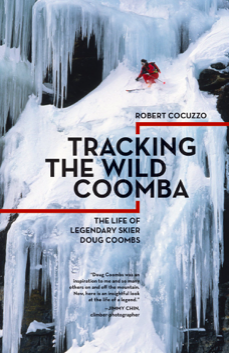
I found “Tracking the Wild Coomba” in a used bookstore on Cape Cod. Authored by Robert Cocuzzo, it was published in 2016. Handwritten on the title page is this note from the author: Sebastian, The inspiration to write this book came when I first read The Perfect Storm. Your words drove me to become a writer. Thank you.”  An unexpected find.

Coombs grew up in a skiing family in Bedford, Masachusetts. From the beginning he was a risk-taker, performing crazy stunts and showing off for friends. When he was 17 at Waterville Valley, New Hampshire, he crash-landed. Dazed, he went to the clinic at the base of the hill. No one was there. He went back up the hill and continued to ski. When he got home, his mother took him to the hospital where he was diagnosed with several broken neck vertebrae. His muscular neck had saved his life. He was wheelchair-confined for months, with a stabilization device screwed into his head. Doctors informed him that he would die if he fell again.

Over the ensuing years Coombs established himself as one of the world’s preeminent steep skiers. In telling his story, the author also tells us about the evolution of steep skiing and introduces us to many of the sport’s more prominent personalities. He takes us to numerous places where Doug hung out. These include Valdez, Alaska, where he and his wife, Emily, lived in a trailer, purchased cheap helicopter rides, and specialized in skiing first descents of previously unnamed steeps in the Chugach Range. Before long he was attracting a robust clientele to his heli-ski guide service. 

We learn how he and Emily started the Steep Skiing Camps at Jackson Hole and how he became the area’s public face. But trouble was brewing. As a key member of the underground Jackson Hole Air Force – a cadre of highly skilled, hard core rope-duckers – he is pursued by the Jackson Ski Patrol. It is Les Miserables on skis. He’s caught and banned from Jackson. Soon after, he and his wife set up shop in the French Alps.

Once there, he integrates well with top-ranked skier/climber/guides, eventually earning their respect and becoming a fully credentialed guide. 

Throughout the book, the author paints Coombs as a remarkably caring and congenial person, always there to help others.

Doug Coombs

On April 6, 2006 in La Graves, he was skiing with three friends, including Chad VanderHam, a young American who had attended multiple Steep Skiing Camps and worked with Coombs in France. The last run was through some couloirs they had skied before. VanderHam skied down and went out of sight. Coombs skied to the edge of a cliff and called down to him. The other two heard Coombs call for a rope. One skied part way down  but before reaching him, Coombs, on skis, had slipped off the cliff. 

Chad VanderHam was declared dead by the time his copter reached the hospital. Doug Coombs, warned at 17 that his next fall would be his last, died from a broken neck. He was 48.

The book weaves Coombs’ story with Cocuzzo’s travels to document it. He follows Coombs’ path, interviewing and skiing with the people who knew him.

The author finds his stride not too far into the book. It becomes an absorbing read.

Tracking The Wild Coomba: The Life of Legendary Skier Doug Coombs. Copyright 2016 by Robert Cocuzzo. Mountaineer’s Books. Available online from $3.44.

100+ Skiier

102-Year Old Skier George Jedenoff’s Autobiography Published On Apple Books

It’s A Thriller, A History, A Love Story And More. Read It Free On Your Computer.

George Jedenoff never gives up. Credit: Harriet Wallis

George skis with enthusiasm. He cruises steep trails and shouts with glee when he jumps into powder. That’s George!

Skiers at Alta flock to him for inspiration. “Age is just a number,” he says. “Don’t let it be a barrier.” His motto is: “Never give up.” His positive outlook is a cornerstone of his life.

George’s autobiography, My Centenarian Odyssey, chronicles his life and adventures starting with his family’s flight from the Russian Revolution when he was just a toddler, coming to America, and later working as a young man in a California magnesite mine for 50 cents an hour. He graduated with honors from Stanford, served in World War II then worked his way up in the steel industry to become president of Kaiser Steel, a premier supplier of shipbuilding steel.

Along the way he learned to ski, and he’s passionate about snow and the beauty of the world around him.

Read his autobiography free on Apple Books. Or you can download it free onto your computer. Be patient as downloading takes several minutes. Click to Download

George Jedendoff is out and about. Not bad for 102. But age is just a number, right? Credit: Harriet Wallis

George Jedenoff: 101!

[Editor Note: As the new year begins, SeniorsSkiing.com is again asking our readers to contribute to support our online magazine. Yes, we have grown in the number of subscribers and advertisers. But our expenses have also grown. You can help us defray some of these expenses by helping us out with a donation.  This year, we have a mix of premiums for different level of donations, including stickers, sew-on patches, our new SeniorsSkiing.com ball cap. All donors will be entered into a drawing for a pair of bamboo Polar Poles to be drawn in late March.  You can donate by clicking here.]

He inspires with fitness and wisdom.

George at 101. Credit: Harriet Wallis

For George Jedenoff, skiing is a way of life. He skis Alta’s slopes every day when he’s in Utah. He charges down steep groomed slopes, but he loves to tear up powder. 

He can do it at 101 years of age because he keeps himself fit. He does a 45 minute workout every day before breakfast.

“I know I’ve got to stay in shape or I won’t be able to ski,” he says. Staying fit for life is a lesson we all might learn from him.

George was 43 when he learned to ski — not exactly a spring chicken. He was athletic, so he decided to try skiing after he came to Utah to be the general manager of the Geneva Steel Plant, the largest steel plant west of the Mississippi.

He learned from the best: Alta’s legendary Alf Engen, ski pioneer Junior Bonous, and Earl Miller, the granddaddy of release bindings.

“While buying my first pair of skis in Orem, I ran into Earl Miller who offered to teach me how to ski. Of course I used Miller bindings – the only safe bindings available at that time. We used the rope tow at Alta Lodge for my first lesson,” he said.

Miller promoted his bindings with photos of himself in wild falls showing how the bindings released. “One day Earl paid me quite a compliment: ‘You know, George, you’ve made some falls I’ve never seen before!'”

But George learned quickly, and he fell in love with the sport, the scenery, the fresh mountain air, and especially the powder.

When he was transferred away, community leaders gave him a gift to lure him back — a Lifetime Season Pass to Alta. He’s still using it!

He bursts with enthusiasm for snow and for life. I recently rode the chairlift with George, and I asked for his advice.

George Jedenoff, 101 year old Patriarch Of The Powder. Credit: Harriet Walls

“You don’t have to be good, you just have to live long enough,” he quipped.

Then he offered serious wisdom. “Always be kind to others. Count your blessings, and don’t let life’s problems overshadow the good in life. And above all, never give up.”

We can learn a lot from this patriarch of the powder. He’s a role model for skiers or all ages.

Ski Utah makes a video of George every year when he returns to ski. Click here to view last year’s video of George when he was 100.

To read more from Harriet click here for her stories on SkiUtah.

Sir Arnold Lunn

In Praise Of Ski-ing

Sir Arnold Lunn wrote the rules for slalom and downhill. Credit: JungfrauStories

When this passage (below) from The Mountains of Youth (1925) by Arnold Lunn was published, “skiing” still had a hyphen and “ski” was both the singular and plural form. Lunn (1888-1974) invented downhill and slalom racing, introducing them when the sport was mostly jumping and nordic racing.

Lunn was knighted in 1952 “. . . for services to British skiing.” He was a major figure in promoting ski sports in the Olympic games. As is obvious in this selection, he was a competitive skier who loved speed and took daring chances.

*   *   *   *   *   *   *   *

Arnold Lunn on his first ascent of the Eiger 1924. Credit: Walter Amstutz

The worst and best moments in ski-ing are often separated only by seconds. You are standing at the top of some fierce slope which you have vowed to take straight. You look at the line and observe with sick disgust that the change of gradient is abrupt at the bottom, and that the slight bump half-way down will probably send you into the air. A kind friend says: “I shouldn’t take that straight,” and your enemy remarks: “Oh, it’s safe enough. Jones took it straight yesterday.”And then suddenly, before you quite realize what has happened you are off. The wind rises into a tempest and sucks the breath out of your body A lonely fir swings past like a telegraph pole seen from an express train Your knees are as wax, and your stomach appears to have been left behind at the top. You fight against the tendency of your ski to run apart—the inevitable sequel to undiluted funk—by locking your knees and turning your ski on to their inside edges. And now comes the supreme crisis—the run-out where the gradient suddenly changes. You throw your weight forward, and mutter “Hold it, hold it.” You clench your teeth, and make strange noises as the shock drives up through your legs. Your ski quiver with the strain . . . and you realize to your intense astonishment that you have not fallen.

The pace relaxes. The hurricane dies away. You are drunk with the wine of speed, and you marvel at the faint heart which so nearly refused the challenge. You glory in the sense of control which you have recaptured over your ski no longer untamed demons hurrying you through space, but the most docile of slaves. You are playing with gravity You are master of the snow. You can make it yield like water or resist like steel. Suddenly you decide to stop. A rapid Telemark, the snow sprays upwards, and the “slabberie snow broth,” to quote an old Elizabethan,”has relented and melted about your heeles.”

A laugh floats upwards, and you much enjoy telling your enemy that his diagnosis was correct, and that he can safely venture to take it straight. And, if he falls, your triumph is complete

*   *   *   *   *   *   *

Lunn’s classical education is apparent in his allusion to “an old Elizabethan.” The “slabberie snow broth” quotation, reports the Oxford English Dictionary, comes from the first English translation (1600) of Livy’s Roman History. Shakespeare mentions “snow-broth”—mixed snow and water—once, with reference to the blood in the veins of a villain. (Measure for Measure, I, iv, 57).


British athlete Sir Arthur Lunn helped create a sport out of a past time.

My Search For Stein’s Studebaker

Having A Studebaker In Common With A Legend Prompts A Sherlockian Pursuit.

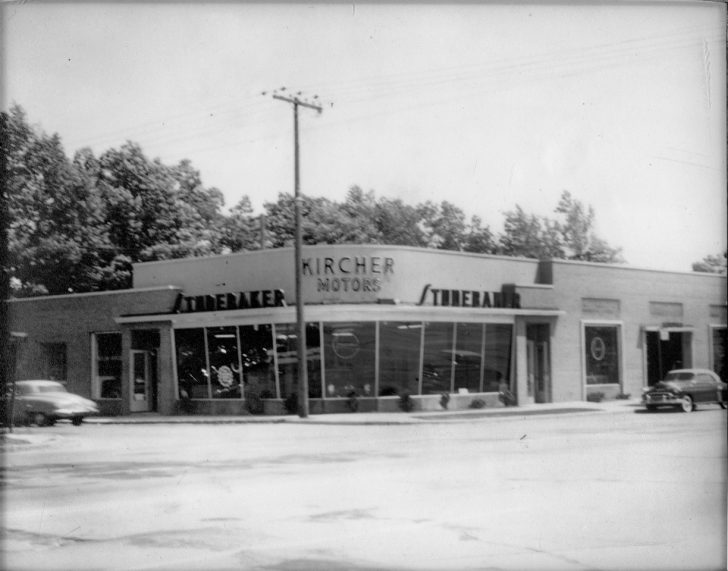
The Kircher Studebaker dealership in Detroit in the early 1950s. The car on the left is clearly a ’50 or ’51 bullet nose model, even though only the back of the car shows here. Those are the only years this model was made.

Stein Eriksen bought a new Studebaker in April 1953. That much is certain. I’d like to know which model Stein bought, what happened to it, and if there is a photo of Stein with the car.

Why? Because my father-in-law bought a Studebaker that same spring, and my wife Judy and I have had it restored. Is it possible that we own a close match to Stein’s Studebaker?

Stein bought his in Detroit from the dealership owned by Everett Kircher, founder of Michigan’s Boyne Mountain ski resort. Judy’s dad bought his from a dealer in Benton Harbor on the other side of the state. Studebakers, seniors may recall, were manufactured in South Bend, Indiana. The company folded in 1966.

Car salesman Don Thomas, also a weekend ski patroller at Boyne, met Stein through mutual Norwegian friends when he attended the 1952 Oslo Winter Olympics. When Stein came through Detroit en route from Sun Valley where he had been training. Thomas invited him to dinner and introduced him to his boss.

Everett Kircher offered Stein a job at Boyne, but Stein wanted to compete in the 1954 FIS World Championships before turning pro. He took the job the next year and spent two seasons at Boyne before moving on, ending up at Deer Valley. But he did buy that Studebaker in 1953.

Various sources describe the car as a “sports car,” a “sports coupe“ and a “graceful 1953 Studebaker coupe.” These ’53’s were a sleek breakthrough concept by the Raymond Loewy design team at Studebaker, coming between the “bullet nose” models and the later Hawk series.

A 1953 model might be the hardtop “Starliner” version or the “Starlight” coupe (our car) which has a pillar supporting the roof. Either version came as either a 6-cylinder “Champion” or a V8 “Commander.”

In an interview, Don Thomas described the car as a “five-passenger coupe,” which could fit either model, although it seems likely a salesman would refer to a hardtop by its proper term.

Once at Deer Valley, I was able to ask Stein about his Studebaker. I was in the singles line at the Northside quad when Stein approached the lift with a couple of celebrity guests. He gestured for me to join them.

I had met Stein a couple of times before, so I used the typical Norwegian greeting for acquaintances, “Goddag, og takk for sist.” Then I asked him about his Studebaker. “Ja,” said Stein, “that was the one that looked like an Italian sports car. I took it with me to Oslo and sold it.”

That’s all I learned straight from the source. But Stein remarked as we got off the lift, “Brunvand, you should speak better Norwegian!”

Since then. I have queried Stein’s son Bjorn, Kircher’s daughter-in-law Molly Clark Kircher, and a Norwegian Studebaker club member, hoping to unearth more information.

The closest I’ve come is finding a 1950’s-era photo of Kircher Motors in the Boyne archive at the Bentley Historical Library in Ann Arbor. Oh, how I wish someone had posed Stein there with his new car for another picture.

Likely Stein’s Studebaker was eventually junked, but it’s barely possible that someone somewhere has the car, perhaps unaware of its past connection with skiing royalty. I plan to keep on searching.

Correspondent Jan Brunvand with his 1953 Studebaker Starlight coupe. In the background, early snow on the Wasatch mountains. Credit: Jan Brunvand

John Henry Auran: Ski Journalist Extraordinaire, Dies At 90

The Creative, Intense, Funny, Unique Journalist Will Be Remembered As One-Of-A-Kind.

John Henry Auran, journalist, raconteur, skier, sailor, innovator, enthusiast.

Ski journalist John Henry Auran was the kind of person you could never forget. I worked for John Henry, or JHA, as he was known to some, in the early 70s at SKIING Magazine, then located at One Park Avenue in New York City. Despite different life paths since then, we kept in touch, even as his declining health brought him farther and farther away from the sports he loved.

John Henry was always interested in delving into new products, new racing results, new personalities on the ski scene, new ideas for connecting the reading public with the outdoor winter sports industry. His enthusiasm was uncontainable for finding, thinking, analyzing, reporting, and watching the world for news.

I will never forget when he and I went to a ski boot manufacturer somewhere in New Jersey who promised to show us a then new development in boot fitting. This was the first foam-fitting demonstration ever, as far as I know, in the business. Since John Henry was SKIING’s boot expert, he went for a sneak preview, and I tagged along to take pictures.

At the manufacturer’s “plant”, John Henry was seated in a high chair, like the shoe polishing chairs you see at airports or train stations.  His foot was placed in a plastic bladder which was gradually filled with foam and placed in a boot shell. I distinctly recall him reporting all the sensations that involved: “It’s getting warmer, I feel some pressure,” while a big smile crossed his face. “I’m getting foamed!”

After that, John Henry couldn’t resist asking people if they’ve been “foamed”.  Since no one had, that gave him license to launch into describing the experience complete with gestures and enthusiastic and dramatic commentary. “Everyone should try it.”

He was also an innovator in what created a new genre: the industry show newsletter. At the time, the ski business had three regional shows for equipment and clothing manufacturers and wholesalers to meet retailers run by Ski Industries America. John Henry had a terrific idea: Publish a daily newsletter at each show that reported news, gossip, personnel moves and the like every morning of the show. Sounded like a great idea.

JHA enlisted the staff of SKIING to do some reporting, bring it to us in our editorial corner where he and I would create columns by typing copy into an IBM Selectric. We then pasted the columns to a piece of oaktag with a pre-designed masthead and logo and brought it to a printer where we waited until the job was done. We picked up the edition and distributed it throughout the show venue. Did I mention this process took almost all day AND all night? Trial and error was the name of the game. Despite being exhausted, we knew we had a hit when we saw the show people reading the Show News over coffee. That was true journalism.

John Henry always had a story ready whenever we talked over the years. One of his favorites was about his hometown where he was born in Germany. As a young boy, he was a witness to Kristallnacht in November 1938.  A few years ago, the town government had a commemorative event marking that dark past and invited JHA to come back to join the few other surviving town residents to bear witness and tell their stories of what happened.  Despite his disability, he went all the way back to Germany with a companion, all sponsored by the town. It was a remarkable and touching journey.

John Henry was also an enthusiastic member of SeniorsSkiing.com’s Advisory Board.

John Henry lived in a nursing home in upstate New York for the past decade or so. When I called, the nursing staff would chat while John got to the phone. They would tell me he enjoyed being taken to nearby Hunter Mountain where he would sit in the base lodge watching the skiers and the lift traffic. I can see him there, in my mind’s eye, reminiscing to himself about the equipment, the racers, the dramatic places, the deadlines, and the great writers he knew. Watching the lift go around and around.

Rest in peace, John Henry.

Bob Beattie, Legendary US Ski Team Coach, Dies At 85

Beattie, Who Coached The US Team For Nine Seasons, Was A Ski Competition Innovator.

Bob Beattie, the coach who put the US Ski Team on the world stage in the 60s, has died on Easter Sunday in Aspen, according to his son, Zeno. For details, click here for the news story from The Aspen Times. 

Bob Beattie, 85, was a colorful leader, coach, and sports commentator.

Mystery Glimpse: Who, Where, And What?

Here’s A Classic-Looking Skier In A Classic Pose.

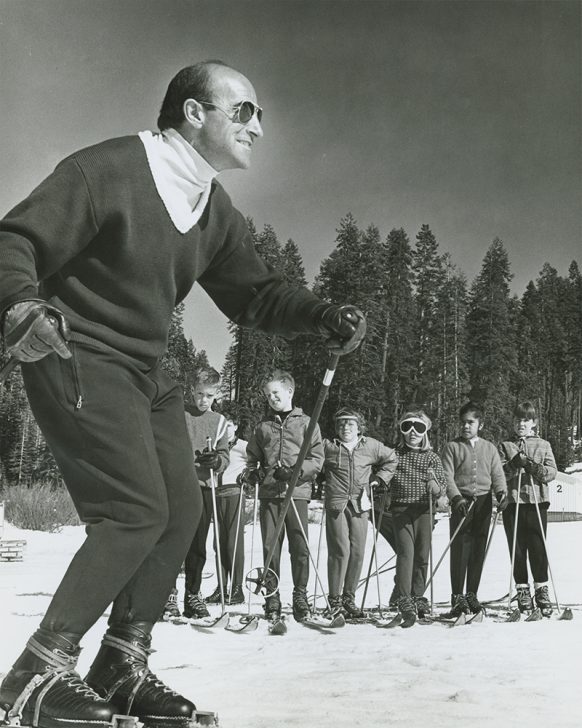
Looks like an instructor demonstrating to a kids’ class. Check the straps around his boots, and you will get a hint about the era depicted here. Don’t you love that turtleneck? No, parka, hmmm. Looks a little like California-stylin’.  That’s enough of a hint for this one. Who is he, where did he hang out, and what’s his claim to fame?

Thanks to the Museum Of Sierra Ski History and 1960 Winter Olympics for contributing this.

Last Week

Mystery Glimpse has stumped the collective hive mind for the first time.  No, not Stein Eriksen’s older brother, but good guess.
The handsome, young skier is Dick Buek, an extreme skier before there was extreme skiing.  Here’s John Jerome, the noted ski writer, talking about Dick back in the January, 1970 issue of SKIING magazine.

“To Dick Buek, the human body was a device with a certain potential, and the only sensible course for the intelligence which guided that body was to find out what that potential was….Collecting Dick Buek stories is an exercise in the suppression of disbelief.  Shussing Exhibition the first time he saw it. Winning a ski jump the first time—maybe the only time—he ever went down an in-run. Sky-diving with a parachute he found in a scrap heap. Diving off cliffs in Acapulco to win a bet for gas money. Piloting a light plane over a slalom course around lift towers at Squaw Valley, beneath  the cables. And so on. The stories are legend.”

He won the 1952 National Downhill Championship. Then, severe injuries from a near fatal motorcycle accident left him in really tough shape. Despite his knee and shoulder being held together by pins and plates, his leg only able to extend to 60 degrees, he entered and managed to win the Downhill at the 1954 Nationals at Aspen. He was passed over for the 1954 FIS World Championships because he was “a basket case.”

Dick Buek, 1929-1957

There are other stories, like watching Stein Eriksen do his famous flip at Sun Valley and immediately trying it himself, crashing spectacularly, catching a ski in the face, getting up, skiing down the rest of the run on one ski, handing the broken one to Ed Scott (Scott Poles) and telling him to fix it. Reports were he was trying a double flip.

Dick was a daredevil stunt pilot and managed to crash twice into Lake Tahoe, the first time when he was towing water skiers. In the second crash, he was actually giving a flying lesson to a friend, the wings froze up, and the plane went straight down.  He was just short of his 28th birthday.

He was inducted into the National Ski Hall of Fame in 1974.

You can read more about Dick Buek here.


It’s Birthday Party Time at Alta.

Hip, Hip, Hooray! Skier Bob Turns 94!

Bob Murdoch celebrates his 94th on skis at Alta. Credit: Harriet Wallis

You might say that 94-year-old Bob Murdoch is a “senior’s senior” skier. He represents many skiers across the country who are skiing into their 90s and enjoying their mountain friendships as much as the slopes.

Ski friends matter. Skiers gave Bob a birthday card that said: Count your age in how many friends you have, not in years.

Bob’s pal, Nick Looser, baked two special cakes
for the party at Alta. Credit: Harriet Wallis

At Alta, Bob is following in the footsteps—in the ski tracks—of 100 year old George Jedenoff who celebrated his milestone birthday on skis in July. Alta’s snow had melted by July, but its neighbor, Snowbird, gathered enough snow to groom a long swath so George could ski on his 100th birthday.

Next to George, Bob is the oldest skiing member of Alta’s senior group, the Wild Old Bunch—and the Wild Old Bunch threw an on-mountain party to honor him. And what a party it was!

Age has its rewards.

Bob, a retired hydro engineer, skis with his good friend Nick Looser, a retired culinary artist, who baked two specialty cakes for the event. He knew there would be a big crowd to celebrate Bob’s 94th birthday.

Bob currently skis three days every week, and his love affair with Alta goes back a long way. He skied the mountain in the 1930s before it was a resort and before it had lifts. He hiked up to ski down.

Skiing has changed a lot since the days of ungroomed snow and long uphill hikes, but we’re lucky we can celebrate with those hardy, early skiers, and we hope we can grow up to be like them.

To read more from Harriet click here for her stories on SkiUtah.

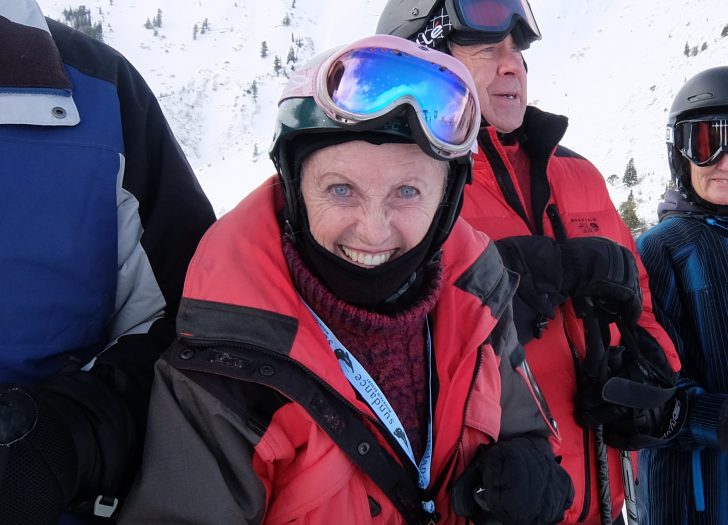
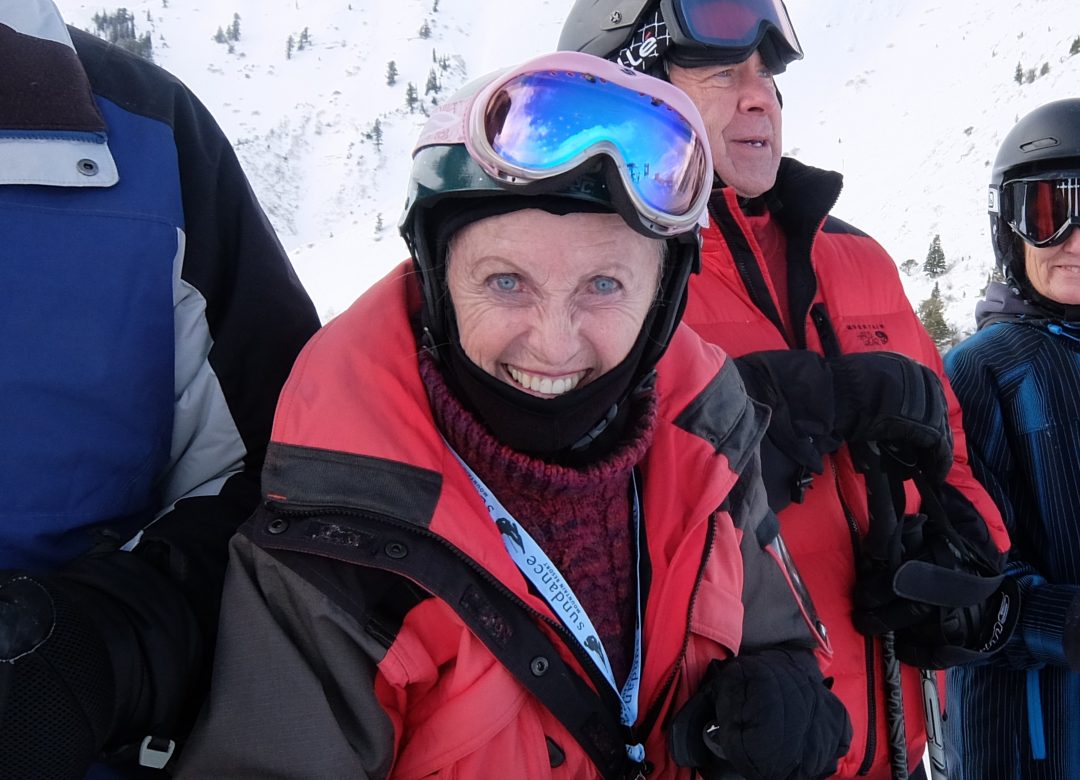
Barbara Stewart Anderson

Barbara Stewart Anderson: A Woman Ahead Of Her Time

At Age 82, She’s Athletic And Adventuresome. And She’s The Legacy Of Her Ski Pioneer Father Founder Of Utah’s Sundance Resort.

Barbara Stewart Anderson keeps going at 83.
Credit: Harriet Wallis

Barbara Stewart Anderson is like the pink Duracell bunny. She keeps going and going. She lives by her philosophy: “If I can do it today, then why not? I may not be able to do it tomorrow.”

Her accomplishments prove her philosophy. She scuba dived the Great Barrier Reef, completed seven treks in Nepal, rode a yak in Tibet, heli-hiked in British Columbia, and reached the summit of 13,679 foot high Mona Loa in Hawaii. What makes it remarkable—she did it in her 60s.

Looking back, Barbara grew up in the era of the 1930s, 40s, and 50s when women observed strict gender roles. But she was never strapped by the expectations of society. Instead of feeling suppressed or confined, she picked up speed. She has always been a woman ahead of the time.

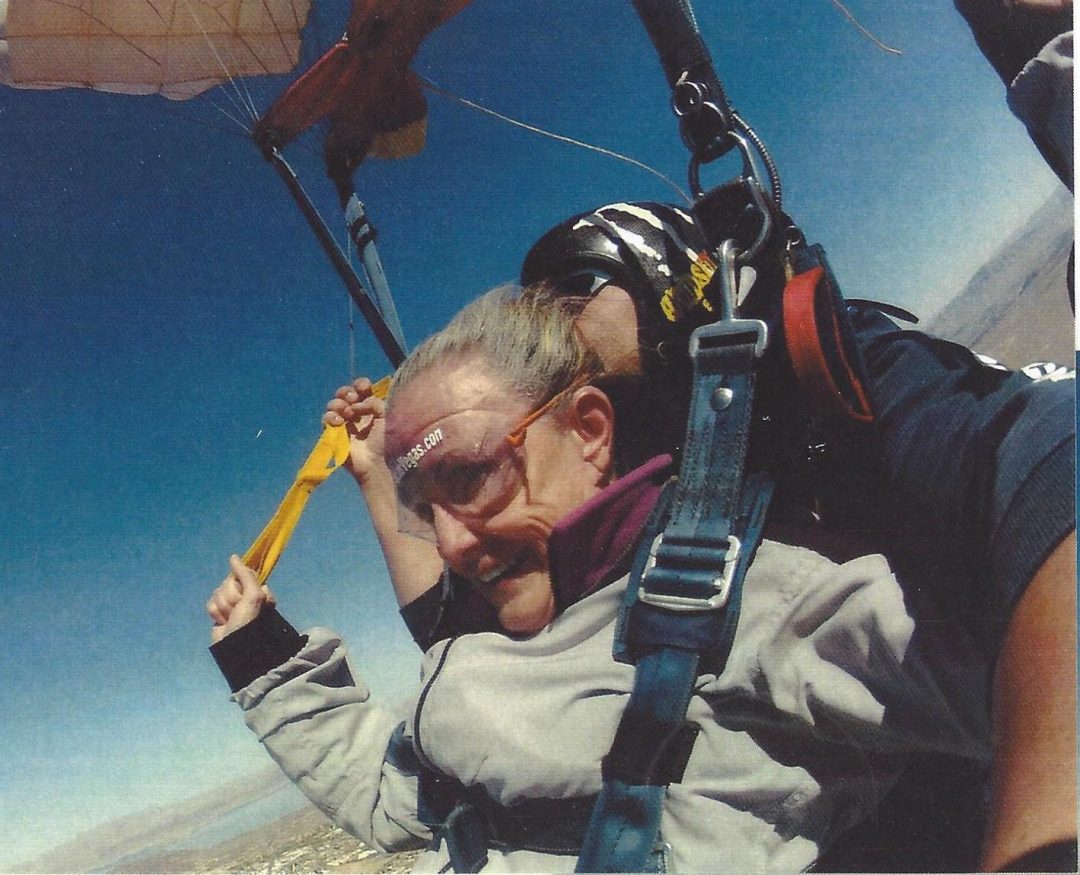
Her list of accomplishments keeps growing. Just 5 years ago, she sky dived, and she also summited 19,341 foot high Mt. Kilimanjaro, the highest point on the African continent. She was 76.

Growing up loving the outdoors

Her passion for unbridled outdoor adventures began when she was a youngster.

Her family homesteaded in the beautiful North Fork of Provo Canyon. Her dad, Ray Stewart, built a little cabin near the base of Mt. Timpanogos. During the summers, Barbara and her siblings roamed the hills and hiked to the waterfalls. It inspired Barbara to a life of over-the-top outdoor adventures that continues to this day.

WWII changed the course of lives and skiing

During WWII, the little Stewart cabin became headquarters for training the Civilian Defense Ski and Mountain Corps—sort of a civilian version of the military’s 10th Mountain Division. In addition to first aid and other skills, ski pioneer Stewart taught the recruits how to ski. And that fanned their enthusiasm to continue skiing after the war.

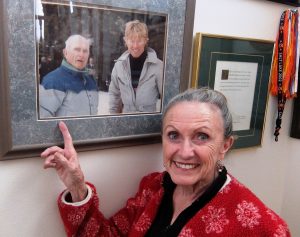
Barbara with photo of dad Ray and Robert Redford.
Credit: Harriet Wallis

When the war ended, Stewart, along with legendary skier Junior Bounous and others from the Defense Corps, cobbled together a rope tow. Stewart bought 1,200 feet of new manila rope for $61 and an old truck for $125 to power the tow. Using written instructions, he learned how to splice the rope into a loop — and it worked. It was the first ski tow in the area.

The tow created new challenges for the whole family. As the oldest child, Barbara was often called on for help. The tow was powered by car batteries, and nine-year-old Barbara helped her dad the lug heavy batteries on and off the mountain so they wouldn’t freeze at night and lose their charge. She also learned to run the snack bar, punch ski tickets and help skiers onto the tow. It was all part of growing up in a ski pioneering family.

As skiing quickly became popular, they built a 50-meter ski jump and raced on the Mt. Timpanogos glacier in the summer. In 1948, famed skier and Olympic coach Alf Engen set the Giant Slalom course on the Timpanogos glacier. The event drew notable racers including Jack Reddish, Dev Jennings, Corey Engen, and Olympian Suzy Harris.

Ray Stewart modified skis so young, energetic Barbara could ski on the glacier too. By the time she was 12, she was winning junior ski tournaments in Downhill, Slalom and Cross Country.

The burgeoning little ski area grew, and it was named Timp Haven. Years later Robert Redford bought it, and it became Sundance.

Stewart was inventive and creative with a passion for tackling the difficult and never giving up. Today, ski pioneer Ray Stewart’s name lives on at Sundance. The main lift is named for him: Ray’s Lift.

Now at 82, Barbara is an icon of taking on challenges and achieving results much like her dad did. She skis regularly with the Sundance Seniors, walks three miles a day, works out at the gym, took first place in a 5K race, and is active in her church and community. Nothing stops her. Many would be exhausted trying to keep up with her.

Over the years, Barbara built a collection of more than 600 miniature skier figurines that are on a rotating exhibit at the Alf Engen Ski Museum at the Olympic Park in Park City. Visitors can also learn about avalanches, sit in a real bobsled, try their knack at interactive ski jumping, and more.

The $10.5 million museum was funded entirely by private donations, including donations from Utah’s famed and philanthropic Quinney and Eccles families. There is no admission charge. Visit and enjoy the museum.

To read more from Harriet click here for her stories on SkiUtah. 

Barbara sky diving. Quite a selfie.
Credit: Barbara Anderson


Mystery Glimpse: Who And Where?

Hint: 1950

Can you spot who this is dashing through the poles? Might be easy. But where and what event and what’s the significance? That’s the challenge. Note your replies in Comments, just scroll down.

Thanks to the Colorado Ski and Snowboard Museum for contributing this photo.

Who, where, 1950. Credit: Colorado Ski and Snowboard Museum

Last Week

Credit: John Emery

Yes, a rope tow gripper. We’ve never used one, we just grabbed the twirling rope. But, many readers certainly have. It is significant that memories of using this device—from the 60s!—are so clear to our respondents.  John Emery, a reader who submitted this picture, says, “There used to be a heavy belt which the clamp was attached to via the short rope. It had a pouch that the clamp fit into when not in use. You would grab the tow rope with one hand and close the two halves of the clamp over the tow rope. The clamp was attached to the belt, and you would just lean back and enjoy the ride—one-handed even.”

Using this device took a bit of concentration.  From what we’ve read in the Comments section, it was getting it off at the top that was tricky.  It is a long way from a rope tow gripper to quadruple, high-speed chairs, and an impressive number of our readers have seen the transition from one to the other.


warren miller

A Tribute To Warren Miller (1924-2018)

At Sometime In The Past, You Watched A Warren Miller Film That Made A Difference In Your Life.

Remembering Warren Miller: In His Own Words

How Wheaties Affected The 1936 Olympics

The Breakfast of Champions Kept Champion Ski Jumper Alf Engen From Competing.

Wheaties Ad 1936, Courtesy of Alan Engen

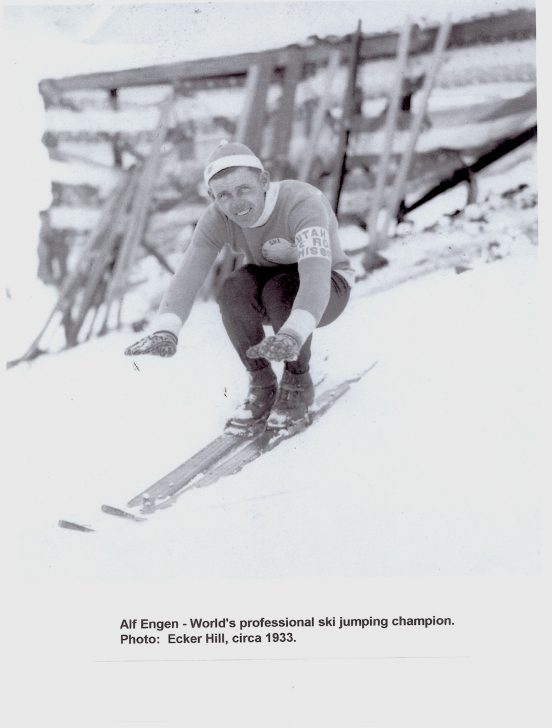
Legendary extreme athlete Alf Engen, known as the greatest all-around skier ever, was a champion soccer player, skier and ski jumper. During the 1930s, he set ski jumping world records. He helped design and establish more than 30 ski areas in the western United States. And he’s fondly remembered for pioneering deep powder skiing techniques and for his ski school at Alta.

But world champion Alf Engen was banned from competing in the 1936 Olympics because of a Wheaties breakfast cereal box.

It was just the fourth time that countries faced off against each other in wintertime Olympics. Competition included just four sports: bobsleigh, ice hockey, skating, and skiing. Twenty eight countries sent their best athletes to the IV Olympic Winter Games.

As background, Engen came from Norway to the United States in the 1920s, and he played professional soccer. By the 1930s, he was acclaimed for his ski jumping feats, he joined a ski jumping team, and he soon won 16 national ski jumping titles. And his jumps set world records. He also won national titles in all four ski disciplines: ski jumping, cross country, downhill, and slalom skiing.

Alf circa 1933, Courtesy of Alan Engen

Also in the 1930s, radio was the mass media communication method of the era. There was no television. People used their imaginations to create pictures from the words they heard.

But another form of mass media was taking hold: cereal boxes. Until then, breakfast cereal had to be cooked, but when food manufacturers invented cereal that could be eaten right from the box, they faced a marketing dilemma. How could they convince families to switch from cooked cereal to this newfangled ready-to-eat cereal? A cereal box sitting on the breakfast table with pictures of all-star athletes would be the marketing device. And unlike radio, the images were right there on the box.

Four athletes appeared on the Wheaties box—Bob Kessler, basketball star; Mike Karakas, champion hockey player with the Chicago Blackhawks; women’s speed skating champion Kit Klein; and famed skier Alf Engen.

Meanwhile, Engen became an American citizen. In 1935, at the U. S. Olympic Ski Jumping Finals held at classic Ecker Hill, he out-jumped everyone. He was immediately named as a member of the U.S. Winter Olympic Ski Jumping Team which would compete in the 1936 Winter Games in Garmisch-Partenkirchen, Germany.

But just before he was scheduled to leave, Avery Brundage, president of the International Olympic Committee and a zealous supporter of amateurism, ousted Engen from the team because his picture had appeared on the Wheaties box. He declared that Engen’s image on the cereal box made him a professional, not an amateur athlete.

“Engen said he didn’t remember getting any money from the cereal company, ‘Just a lot of Wheaties. I think I gave everyone in Salt Lake City free Wheaties.'”

Alf with trophies, courtesy of Alan Engen

Ironically, shortly after the Olympics, Engen jumped against—and he beat—both the gold and silver medalists from the Olympic Games, Norwegian gold medalist Birger Ruud and Swedish silver medalist Sven Eriksson.

The remarkable skiing Engen family is the only family to have four family member in the U.S. Ski and Snowboard Hall of Fame: Alf, his two brothers Sverre and Corey, and his son Alan.

Alan lives on in his father’s tradition. He’s a champion skier and athlete as well as an accomplished scholar, author, and historian. He carries on the Engen tradition of serving the skiing community.

Alan dreamed of displaying hundreds of Alf’s ski trophies and memorabilia for the public. The dream grew into the $10.5 million Alf Engen Ski Museum at the Olympic Park in Park City, Utah. Visitors can also learn about avalanches, sit in a real bobsled, try their knack at interactive ski jumping, and more. The museum was funded entirely by private donations, including donations from Utah’s famed and philanthropic Quinney and Eccles families. Visit and enjoy the museum when you’re in Utah.

To read more from Harriet, click here for her stories on SkiUtah.

Alf in flight, circa 1936, courtesy Alan Engen


Fast Freddie

Blind Skier Inspired All Who Knew Him.

Fast Fred Siget on the left with Pat McCloskey, center, and friend at a long ago National Blind Skiing Championships.


The first time I skied with Fred Siget was in Snowshoe, WV, with Larry Walsh of the Pittsburgh Post Gazette. This was my maiden voyage guiding a visually impaired skier. I had Fred, the first blind skier in our area, in front of me. Right turn, left turn, right turn, stay, stay. All of a sudden the only tree around popped up right in front of us as I yelled “Crash,” and Fred sat down as he ran into it.  I felt so bad, but Fred dusted himself off with a smile and said, “Pat, don’t worry about it at all. This will be one of many.” And we continued down the slope. This began a 40-year friendship with the one and only Fast Freddie Siget.

Fred lost his vision as a result of an accident with a high pressure hose when he was a volunteer fireman. As devastating as this injury was, he was undaunted. He became the first visually impaired computer programmer for Koppers Corporation. He continued dancing, and he learned to ski with guys like Larry Walsh, Jim Conley, Lynne (Kravetz) Hartnett, Shorty Leco and Micky Hutchko.

Fred always had ideas on how to make things easier for blind skiers and how to improve guiding techniques. He had a transmitter rig where the guide used a microphone and Freddie had an ear piece which made calling out commands easier and more understandable.

Once I used the transmitter while standing on top of a slope, calling commands to Fred as he skied by himself down to the chairlift. With his “Blind Skier” jacket on, people were shocked viewing his run. In the bar afterwards, we had some fun with Herman Dupre the owner of Seven Springs Mountain Resort. I put the microphone on and guided Fred over in front of Herman and told him to tell Herman how much he admired his red flannel shirt. Herman was stunned and later remarked to me laughing that he was starting to “get hot thinking about all the free passes I gave to Fred and now he is telling me how much he likes my shirt!” Hilarious.

Fred was always anxious to help new guides. He put himself at risk during the training but always felt that it was worth it not only to train guides that could assist him, but to help the other visually impaired skiers who were beginning to show up at BOLD (Blind Outdoor Leisure Development) outings at Seven Springs.

Perhaps the most compelling thing about Fred was his kindness and appreciation for his fellow skiers and guides. He always remembered your birthday and when he called me, he sang, “Happy Birthday to you, Happy Birthday to you, get plastered, you bastard, Happy Birthday to you.”

He was popular for his skiing for sure, but as a person, you could not get a better guy who was always interested in others and never talked much about himself.

We lost Fred this fall at 94 years of age. He had an amazing life, and we will miss him. Fred never let his accident slow him down. He always said that he did more as a visually impaired individual than he ever did before losing his sight. He took a perceived bad thing and turned it into opportunity. Shouldn’t we all learn from that lesson?

X-C Olympian Celebrates 98th Birthday

From The Ski Museum Of Maine.

Chummy Broomhall in his stride. Help him celebrate his 98th.
Credit: Ski Museum Of Maine

Chummy Broomhall, two-time Olympic cross country skier and the oldest living member of the Chisholm Ski Club, will be celebrating his 98th birthday on December 3rd. Last year the Chisholm Ski Club sponsored a card campaign for Chummy’s birthday and he received almost 150 cards! Let’s blow that number out of the water this year and start sending him birthday wishes now.

Send birthday cards to Wendell “Chummy” Broomhall c/o Maine Veterans Home 477 High Street, South Paris, ME 04281

George Turns 100 And Skis On His Birthday

Snowbird Made Special Arrangements So George Could Celebrate By Skiing In July.

Birthday boy George Jedenoff flanked by old friends Junior and Maxine Bounous.
Credit: Harriet Wallis

George Jedenoff became an avid skier 51 years ago when he moved to Salt Lake City to oversee the Geneva Steel Plant. He learned from the best: iconic Junior Bounous, legendary Alf Engen, and release binding inventor Earl Miller.

At that time, Miller performed stunt falls to show how well his bindings released. But he credited George with doing whacky falls that he’d never seen. In spite of the falls, George learned to ski and to love the sport.

Junior Bounous, director of skiing at Sundance and then Snowbird, mentored George and they became fast friends. They’ve skied together for 51 years. Even now, I continue to learn new things from Junior, said George.

The two friends skied on July 5—George’s 100th birthday.

George belongs to a very special ski club.
Credit: Snowbird

George lives in California but he returns to Utah every winter to ski at Alta and Snowbird. He skis with the vigor of a teenager and charges through powder with ease. He loves powder.

He also has a philosophy that guides his life and inspires others. “Be kind. Do your best. Don’t be discouraged by bad things that might happen to you. Always be positive,” he says.

When George was 95, Ski Utah, the umbrella organization over all Utah ski resorts, produced a video of him skiing. It was an immediate hit and each winter Ski Utah produces a new and inspiring video of him.

Thanks to Snowbird, George celebrated his 100th birthday by skiing a large field of snow near the top of the mountain with his friend Junior Bounous. He was also awarded a plaque, shared a cake with everyone who attended, and enjoyed a birthday lunch at Snowbird’s slopeside Forklift Restaurant. He also received a letter of congratulations from the nationally known 70+ Ski Club. Only 3 of its 3,000 members have been over 100 years old.

But there’s a back story too. A day earlier, George and Junior drove up the gravel summer road at Alta to search for a patch of snow on which to practice before today’s big event. They found a suitable patch and made turns. “It was about as big as a room and about as wide,” said Junior. “But we skied it.”

The day’s festivities wrapped up with George’s typical, positive outlook. His skis were leaning against a wall, and he spoke to a family member saying: “Let’s remember to pick up my skis, I’ll need them this winter.”

Click on the video below to see George celebrate his 100th on the snow.


Waterville Valley Pioneer Tom Corcoran Dies At 85

Tom Corcoran, an Olympic skier and developer of Waterville Valley Resort, has died at 85 at this home in Seabrook Island, SC.

Read the story of how he created a mountain resort from scratch and brought the Kennedys to visit by clicking here.

Two-time Olympian Tom Corcoran was an all-around athlete who put Waterville Valley on the map.
Credit: Waterville Valley Resort.