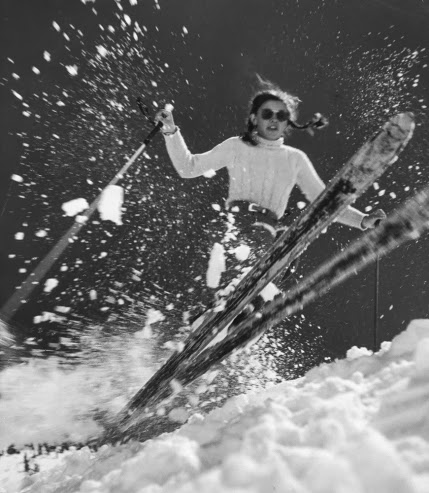
When Errol Flynn Skied at Alta

Many famous Hollywood movie stars came to Alta to ski during the 1940s. Two of the best known were Claudette Colbert and Ray Milland, but most famous of all was Errol Flynn, the swashbuckling leading man.

My uncle, the late Sverre Engen, was Alta’s Ski School Director in 1946 when the legendary action hero visited Alta for a ski outing. I remember my uncle telling me, with a big grin on his face, about the experience.

As I remember, Sverre said that Flynn arrived with great “fanfare,” accompanied by several assistants to make sure that he received the finest treatment possible, on and off the slopes.

The morning after his arrival, it was snowing and visibility was somewhat marginal.  However, Flynn made it known among the other guests at Alta Lodge that he was not intimated and was going to tackle the challenging Alta mountain terrain regardless of limited visibility conditions.

My uncle was requested to be Flynn’s personal escort for the anticipated ski outing.  Sverre wrote about the experience with Flynn in his book, Skiing a Way of Life (1976).   Here is what he had to say:

“When Errol Flynn got to the Alta Lodge, he wasn’t in very good physical condition, but was anxious to get up on the mountain. In the morning, the porch was full of people watching him put his skis on, curious to see what kind of a skier he was. This was his penalty for being famous.

Flynn insisted on taking the lift to the top, but this was something he never should have done. It took most of the day to get halfway down.

I would get him started in a slow traversing position, but he would gain more speed than he could handle, head for the trees, and sit down. I would help him up, and we would do the same thing over again.  We worked our way down the mountain until he wore himself out completely.

Finally, I had to call the ski patrol for help.  He gratefully crawled up on the toboggan, and the patrol took him the rest of the way to the Alta Lodge.  His pride was bruised a little, but he was still a good sport and smiled when he got up from the toboggan and walked into the lodge.”

Personally,I have always wished I could have been there to see the famous “swashbuckling” actor arriving back at the Alta Lodge, without his skis, and facing his adoring public.  As my uncle inferred, I am sure Flynn’s ego was impacted – perhaps even deflated – at that particular moment.

I mentioned a few of the celebrities who frequented Alta ski area in the 1940s.  Since then, there have been many others, from film and politics, and I was lucky enough to know some, including skiing with them. To name a few –

Lowell Thomas, the national commentator who pretty much invented travelogues; “Gunsmoke” star James Arness; famous TV host Art Linkletter; Senator Charles Percy; Secretary of Defense Robert McNamara; former Ambassador to Belgium Tom Korologos; and  Dr. Henry Heimlich, who invented the maneuver named for him, which has saved many lives from choking.

All were outstanding individuals and several, like Senator Robert F. Kennedy – who skied at Alta just a few months before his tragic assassination in 1968 – were excellent skiers. Senator Kennedy, as I remember, liked to ski fast.

 Time continues to move forward, and even though I retired as Alta Director of Skiing in April 2012, I am sure there are many more celebrities who have since frequented the beautiful mountainous resort of what some have referred to as “Romantic Alta.”

Ski Heil!

Historic photos provided by Alan K. Engen

Photo of Errol Flynn at the bottom of the old Collins chairlift, circa 1946 is by Ray Atkeson. It has been provided to Alan Engen by Alta Ski Area with the understanding that it would be used exclusively for Alta related ski history.

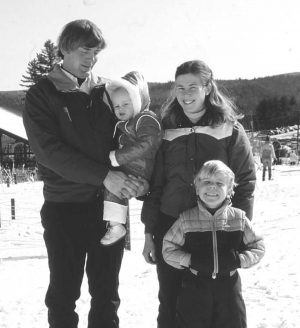
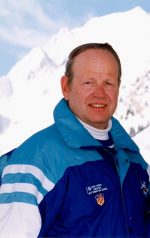
Photo of Alan, Alf, Corey and Sverre Engen is circa mid-1950s.  All four are inductees of the National Ski Hall of Fame.  Photo part of the Alan Engen Ski History Collection, which resides at the University of Utah J.Willard Marriott Library, Ski and Snow Sports Archives.

SKIING HISTORY LOGO

Skiing History Magazine

The May-June issue of Skiing History will hit the mail around May 13 (a Friday, of course)., but will be posted online about a week ahead of that.

Look for these articles:

-Skiing Schruns and the Montafon Valley: The old smuggling route between Austria and Switzerland where refugees escaped during World War II.

-Marco Tonazzi, the Vail-based entrepreneur recalls his days on the Italian ski team and adventures with Thoeni, Tomba and Gros.

-Lifts that went nowhere: Gone are the weird experimental ski lifts that didn’t pan out.

-Willy Schaeffler, rebel at heart.

-Warhol in Aspen.

-The man who designed the medals: artist Helmut Zobl.

-Swann poster auction results.

-Report on Skiing History Week in Sun Valley.

-Fritz Wiessner, world-class climber and ski wax alchemist.

To read the new issue online and get the print magazine, visit skiinghistory.org/join.

The Skier’s Subway: Most Unusual Lift in Skidom

Park City, Utah started as a mining camp in the 19th century, transferred business from silver mining to skiing in the early 1960s and never looked back. These days Park City Mountain Resort, owned by Vail Resorts, has about 1,200 miles of underground tunnels and shafts and mining structures all over the mountain that you ski by and over along 348 trails.

In 1963 United Park City Mines, the last active operation in Park City, opened Treasure Mountain Resort on the 3,700 acres it owned. Relying on mining engineering know-how, it put up J-bars, a gondola, and a Skier’s Subway.

Now in the Park City Museum, this “subway” car used to transport skiers into the mountain, where they would enter an elevator and travel to the base of the Thayne’s chair.

In what has to be the most unusual lift in skidom, the Skier’s Subway ran from January 1965 to July 1967, starting near the spot where the Silver Star chair is now located. Skiers rode more than three miles through the west end of the Spiro Tunnel on repurposed mining carts, water dripping onto their parkas, to the Thaynes Shaft where they got hoisted 1,700 feet up to the Thaynes chair lift. From out of the dark depths…Voila!, the slopes. The ride took about 25 minutes. Most skiers did it once for the novelty, once for the kids, and that was enough.

Early March, I skied to the Silver Star base area and discovered this bit of mining history: In 1917, owner Solon Spiro built a tunnel 21,675 feet into the mountain to draw excess water down and away from mining operations above.

The town now uses the tunnel to provide about a quarter of its water for drinking, snowmaking, and golf course irrigation. To protect this resource, a few years ago the town removed debris and shored up the first 400 feet of the tunnel to prevent cave-ins.

On a guided skiing tour of Park City’s mining history.  Photo: Tamsin Venn

The very active Friends of Ski Mountain Mining History collaborated with the town to open a commemorative plaza in the fall of 2021 with signage at the fenced-off tunnel entry at Silver Star Village. It’s a delightful starting point to the day, away from the crowded Park City Mountain Resort’s nearby free parking area. The Silver Star chair  gives easy access to King Con chair. The village has a small lift ticket booth, friendly lift attendants, the well-equipped Silver Star Ski & Sport, located in an old mining building, and the Silver Star Café that transforms from skier-patio-lunch-spot to award winning restaurant at night.

For a fuller view of Park City’s mining history spread throughout the mountain, take the Silver to Slopes Historic Tour, a complimentary two-hour visit led by PC’s mountain services guide (See SeniorsSkiing article: There’s Silver in Them Thar Hills!).

Your Next (or Last) Ski Lesson Can Be Traced Back to Alta

Your Support Helps!

Help us keep SeniorsSkiing.com free. Please support SeniorsSkiing.com with a donation.

DONATE

The origins of the Professional Ski Instructors of America’s (PSIA) harmonized approach to ski instruction in the United States can be traced back to Alta.

When skiing was first taking hold as a participation sport around the Intermountain region in the mid- to late-1930s, ski instruction was informal; limited to tips provided by anyone who had been on a pair of skis more than once.

By the early 1940s, many people were taking up the sport, and it became evident there needed to be some form of training, control, and certification for people teaching others how to ski.

During the 1946-47 season, the Intermountain Ski Association (ISA) took the first steps to form a unified approach to ski teaching in the Intermountain region. One of the organizers was my uncle, Sverre Engen, at the time, head of Alta’s ski school.

During the 1946-47 season, the Intermountain Ski Association (ISA) took the first steps to form a unified approach to ski teaching in the Intermountain region.                                                                                  Source: Alan Engen Collection

Two years later ISA conducted the first Intermountain region instructor examination at Alta.  According to Bill Lash, former Alta ski instructor and founder of the Professional Ski Instructors Association (PSIA), “Alf and Corey Engen ran the program.  The test was given in three grades: master instructor, instructor, and apprentice instructor.  The cost of the exam was $10.00 and the renewal fee was $2.50 per year.  In 1950, instructor pins were given out.  There were two pins and classes of certification: apprentice and instructor.” My father was Alf, who headed the Alta Ski School from 1948 to 1989 and for whom the Alta Ski School in named.

Early December,1950, another certification examination was conducted at Alta. This time, under the direction of Friedl Lang, a noted ski instructor who had been certified by the U.S. Eastern Ski Instructors Association. Lang had taught skiing in North Conway, New Hampshire for Hannes Schneider, father of the Arlberg Technique. He brought special insights to the new ski instructor certification process.

At the same time, the Intermountain Ski Instructors Association (ISIA) was created to oversee certifying instructors.

1958 National Ski Association Certification Meeting at Alta                                                  Source: Alan Engen Collection

Throughout the 1950s, Alta hosted numerous Intermountain Ski Instructor Association examinations. And in 1958, coordinated by the Alf Engen Ski School, Alta hosted the first National Ski Association “on-snow certification conference” to establish national certification standards. A significant outcome of this gathering was Outline of Ski Teaching, by Bill Lash. The first complete ski-instructors manual, it was distributed nationwide and became the basis of the American Skiing Technique. A few years later, in 1961, representatives of the National Ski Association met and agreed to formalize teaching the American Skiing Technique under a new umbrella: the Professional Ski Instructors of America.

So, wherever you take your next ski lesson at an area in the United States, if the instructor is PSIA-certified, she may not know it, but Alta played a role in bringing professional, harmonized instruction to the sport.

Test Your Skiing Knowledge

Your Support Helps!

Help us keep SeniorsSkiing.com free. Please support SeniorsSkiing.com with a donation.

DONATE

Each issue of SeniorsSkiing.com has a picture to help test your skiing knowledge. Generally, the pictures are from collections in a variety of participating ski museums, which we encourage readers to visit.

This Englishman was instrumental in formalizing ski racing in the early part of the 20th Century. 1908, He founded the Alpine Ski Club in 1908, and in 1911 organized the Kandahar Challenge Cup, a race that continues annually to this day. In 1922, he set the first modern slalom course. For these and other skiing race innovations, he was knighted in 1952 by Queen Elizabeth for “…services to British skiing…”.The first reader to correctly identify his name will receive the new Licensed To Ski poster. Please email answers to jon@seniorsskiing.com.  


Greg Zoll, of Hillsdale, NJ, was the first reader to correctly identify the image as Gilbert’s Hill in Woodstock, VT. In the 1930s,it was a popular New England ski location. A rope tow, powered by the motor of a Ford Model T truck, was placed on the hill in 1934, making it possible for skiers to quickly get to the top. The hill was used as a ski area until 1965. There’s now a historical marker near the site. Greg, who will receive the new “Licensed To Ski” poster, currently is celebrating his 60th ski season. He was introduced to the sport by his father, a a 10th Mountain Division veteran, who, at one time, held the patent on the Curtiss-Wright Jet-Air compressor used for making snow at New Jersey’s Great Gorge ski area. He’s carried the skiing tradition to his own family and has skied throughout the US, the Alps and in Chile. Congratulations, Greg!

Test Your Skiing Knowledge

Your Support Helps!

Help us keep SeniorsSkiing.com free. Please support SeniorsSkiing.com with a donation.

DONATE

Each issue of SeniorsSkiing.com has a picture to help test your skiing knowledge. Generally, the pictures are from collections in a variety of participating ski museums, which we encourage readers to visit.

In the 1930s the hill pictured here was a popular New England ski location. The first reader to correctly identify its name and location will receive the new Licensed To Ski poster. Please email answers to jon@seniorsskiing.com.  

While several readers correctly identified the man in the picture as Junior Bounous, Terrell W. Smith of Salt Lake City was first. Terrell has been on skis 70 years. He raced in high school and  taught  at Alta when Junior headed Snowbird’s ski school. He says, “Skiing is cheaper than psychiatry,” a sentiment hard to disagree with. Junior is a celebrated deep powder skier and contributed to the sport’s development throughout the Intermountain West. He is 96 and still skiing. The picture came from the Utah Ski & Snowboard Archives, which preserves the history of skiing in Utah and the Intermountain region. The extensive collection contains thousands of digitized images of photographs and print materials, all of which can be accessed online.

Skiing History March April 2022

Skiing History Magazine (March/April)

Your Support Helps!

Help us keep SeniorsSkiing.com free. Please support SeniorsSkiing.com with a donation.

DONATE

The March-April issue of Skiing History magazine is scheduled to mail at the end of February. Here’s what you can look forward to:

A major tribute to Spider Sabich, the charismatic racer who helped put World Pro Skiing on the map and was shot to death at age 32. Spider will be inducted into the U.S. Ski and Snowboard Hall of Fame on March 26, in Sun Valley.

Another new Hall of Famer is Sven Coomer, the man who made plastic boots comfortable and skiable. In an excerpt from his memoirs, Sven recounts the development process, beginning in 1968, that led to the revolutionary Nordica boots of 1971-74.

Because we’ll hold our 30th Annual ISHA Awards Banquet in Sun Valley on March 24, we’ll take a look at one of the overlooked aspects of the resort’s history: The ski-jumping and slalom hill on Ruud Mountain, developed in 1936 by Alf Engen and Sigmund Ruud. Abandoned in 1965, Ruud Mountain hosted two decades of spectacular competitions.

Lindsey Vonn has just published a memoir, Rise. We have a review of the book. Also, we’ll publish the list of ISHA Award winners for this year.

Overcrowding at ski resorts, and delayed opening of lifts and terrain made national news in January. We offer an analysis of the business decisions and economic trends that led to a nationwide skier revolt this winter.

John Allen writes an appreciation of the British landscape artist Adrian Allinson (1890-1959), who created some spectacular canvasses of Alpine scenery.

To read the new issue online in February, and get the print magazine in March, go to skiinghistory.org/join.

Test Your Skiing Knowledge

Each issue of SeniorsSkiing.com has a picture to help test your skiing knowledge. The pictures are from collections in a variety of participating ski museums, which we encourage readers to visit.

The object pictured here was made in the kitchen, but its nothing you’d want to eat. It was available throughout New England in the 1960s and 70s. One more clue: The image comes from the Maine Ski and Snowboard Museum‘s exhibit, “Made in Maine.” What was the brand name for this useful little object? The first reader to send the correct answer to info@seniorsskiing.com wins a soon to be determined but useful prize.

The Maine Ski and Snowboard Museum shares many stories from Maine and  the state’s role in the development of skiing and snowboarding. Last summer, the museum moved from Kingfield to a new home on the Access Road to Sugarloaf. The current “Made in Maine” exhibit explores the development of skiing and snowboarding through equipment made in the Pine Tree State. If you’re in the area, be sure to visit.

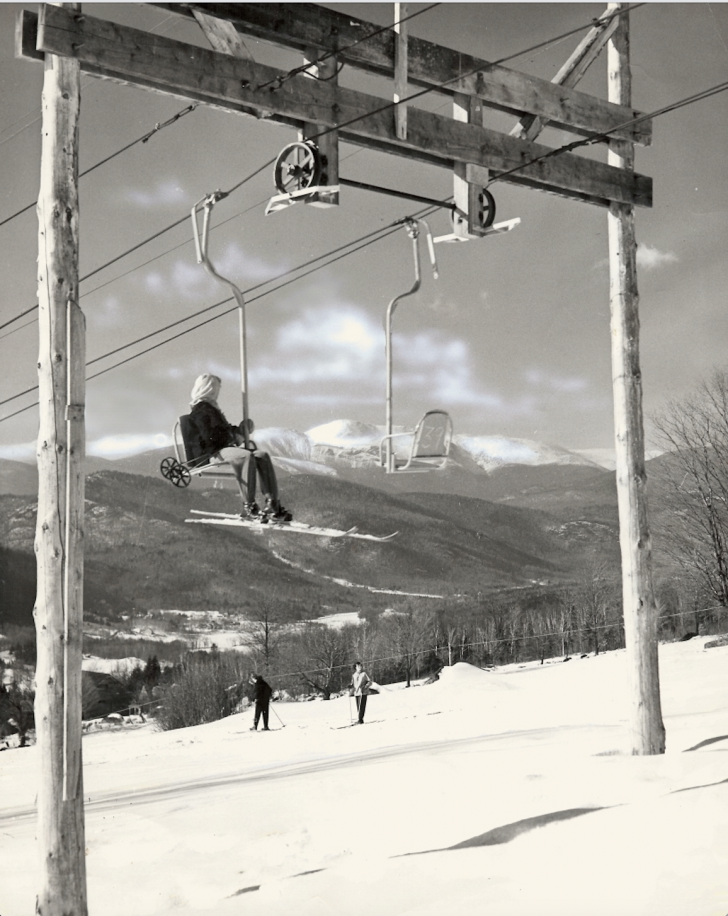
Michael Bannon, Bartlett, NH, was the first reader to correctly identify the picture in the last Test Your Skiing Knowledge. It’s the upper chairlift at Thorn Mountain, Jackson, NH. Thorn Mountain opened in 1949 with two single chairlifts stacked one above the other to give a vertical rise of more than 1,000 vertical feet. Thorn closed about 1956. Michael has been a Level 3 PSIA instructor since 1966. He’s been a SeniorsSkiing.com subscriber for 5 years. Congratulations, Michael! You’ll soon be receiving a container of Slide On, the dry lubricant spray that helps your feet slip in and out of ski boots. One application lasts for a month of frequent boot use. One 2 oz. can is good for the entire season. The picture was submitted by The New England Ski Museum, located in Franconia Notch State Park, New Hampshire. Admission to the museum is always free.
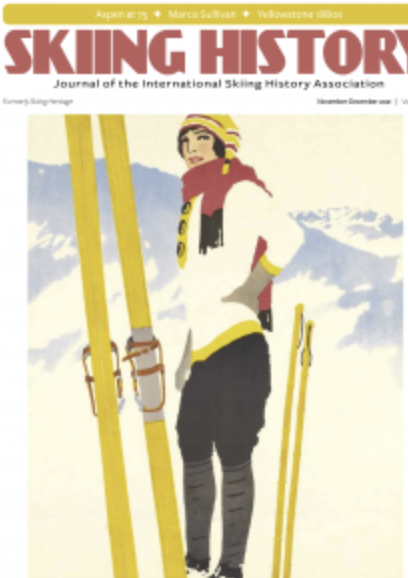
 

Skiing History Magazine

Covid-related delays at the printer and post office caused the November-December issue of Skiing History to mail a month late. The online version posted right after Thanksgiving, and you can read it here. Here’s what you’ll find:

Aspen’s Anniversary: 75 years ago, Aspen built its first chairlifts and opened for business. Most of us are familiar with the story of how racing champion Friedl Pfeifer returned as a wounded veteran of the 10th Mountain Division and forged a partnership with Chicago industrialist Walter Paepcke to form the Aspen Skiing Company. In this issue, Aspen-based writer and editor Cindy Hirschfeld tells the story of the locals who surveyed the ground, cut the trees, dug the footings, hauled and poured the concrete, assembled the towers, hung cables and chairs, and then ran the lifts and ski school.


100th Anniversary of Megève, the first purpose-built resort in France. When the Baroness Noemie de Rothschild took a break from running a military hospital during World War I, she went skiing at St. Moritz. There she bumped into the German arms-maker (and notorious antisemite) Gustav Krupp. She swore to build an all-French resort, and in December 1921 opened her Hotel Prima in this medieval village just off the main road from Geneva to Chamonix. Under the stewardship of four generations of Rothschilds, the resort has maintained is ultra-luxe ambience. The skiing is good, too: After all, Megeve produced Emile Allais. Article by Bob Soden.


Ron’s Last Run: We go into the New Year mourning the sudden death of our great friend and longtime contributor Ron LeMaster. His obituary is on the SkiingHistory.org website now. This issue contains the last article he wrote for us – the history of ruade, the “horse-kick” turn that evolved into down-unweighting and paved the way for avalement.


American Downhiller Marco Sullivan retired after 105 World Cup starts and went to promote Alpine speed through coaching and an award-winning film. Edie Thys Morgan reports.

Walter Kofler Invented Kofix, the first polyethylene base, in 1952. It replaced celloid bases and revolutionized ski racing, making the Austrian and Swiss teams dominant at the 1956 Olympics. By Seth Masia.

150 Years of Skiing in Yellowstone. Explorers, poachers and even the U.S. Cavalry skied into the bitterly cold, snowbound National Park beginning around 1872. By Jay Cowan.

Meet the U.S. Ski and Snowboard Hall of Fame Class of 2021, with boot designer Sven Coomer, snowmaking genius Herman Dupre, skiing stuntman John Eaves, retail pioneers Dave and Renie Gorsuch, broadcaster Peter Graves, freeskiing hero Mike Hattrup, ski mountaineer Jan Reynolds and pro freestyler Alan Schoenberger.

Farewell to Ski Pioneers Rupert Huber of Atomic Skis, inventor of the fat powder ski; racing promotors Anne and Joe Jones; adaptive ski coach Hal O’Leary; Whistler general manager Peter Alder; Burke Academy founder and ski-racer Martha Coughlin Corrock; and pro racer Paul Carson.

The January-February issue should mail around mid-January, but you can already read Edie Morgan’s brilliant report on the upcoming Olympics, Beijing Olympic Alpine courses are a mystery.


Thorne Mountain

Test Your Skiing Knowledge

Each issue of SeniorsSkiing.com has a picture to help test your skiing knowledge. The pictures are from collections in a variety of participating ski museums, which we encourage readers to visit.

This picture, submitted by The New England Ski Museum, shows a chair that serviced a New England area in the 1950s. It was the upper of two lifts that, combined, providing more than 1000′ of vertical. The area closed in the mid-50s. What was the name of this short-lived ski area?

The first person to submit the correct answer to jon@seniorsskiing.com wins a yet to be determined, but skiing-related prize. Note, only answers sent to that address will qualify.The correct answer and the name of the winner will appear in the next issue of SeniorsSkiing.com.

Unfrtunately, there were no correct answers to the last Test Your Skiing Knowledge quiz. Perhaps the answer was a bit arcane. Nonetheless, it is quite interesting.

Source: New Mexico Ski Museum and Ski Hall of Fame

The man in the middle is Bruno Hans Geba, and he’s shown instructing two coeds from the University of New Mexico at Sandia Peak Ski Area in 1968. Several readers thought it might be Ernie Blake at Taos, probably because the image was submitted by the New Mexico Ski Museum and Ski Hall of Fame. Geba was born in 1927 in Salzburg, Austria. After World War II, he received bachelor’s, master’s and doctoral degrees in medical science, psychology and physical education from the University of Vienna. In 1955 he was invited to the US to serve as a consultant for the Aspen Institute for Humanistic Studies. At about the same time, he received his American doctorate in clinical psychology at the University of Colorado. While in Aspen, he trained the U.S. men’s and women’s Olympic ski teams and coached the International Professional Ski Racers Association. In 1966 he started a private psychotherapy practice in San Francisco; later becoming a professor at San Diego State University. He retired in 1992, moved to Hawaii. and passed away there at age 74.


Source: New Mexico Ski Museum and Sk Hall of Fame

Return To The Rockies

Part Five: Jan and Judy Move To Utah

Our residence in Illinois proved to be similar to grad school in Indiana. I progressed in my academic career, we had another baby, and (sigh) there was no skiing. But a phone call changed everything.

At SIU-Edwardsville, we were renting from a colleague on sabbatical, and we had just started looking for a house to accommodate our growing family. Karen, our last child, was born in February, 1966.  Then a call came from folklorist Barre Toelken in Salt Lake City. He was leaving, and he sought someone to apply for his position at the University of  Utah.

I responded, “Barre, you don’t ski do you?” My interview trip was an eye-opener. I assumed that the season had wound down by late March, but the department chairman assured me. “We’ll have skiing through April.” So it was an easy decision to leave the Midwest again after just one year.

We arrived in Utah at the cusp of the development of major skiing there. Alta and Brighton had been in business since the late 1930’s; Snowbasin opened in 1940, and Timp Haven (later Sundance) started in the mid 1940’s. Park City’s ski resort, then called Treasure Mountains, was in its third season and had its trademark gondola pictured on a patch. You could still buy little houses used by former silver miners for a pittance, and skiers could park within a few yards of the gondola base.
None of the local resorts had much in the way of base facilities or housing at that time. Solitude opened in 1957, then underwent a couple of name changes and at least one closed season before prospering. Park City West opened in 1968, then had several name changes before eventually being acquired by Vail and merging with Park City. Snowbird opened in 1971.

This photo of Judy and me at Alta was taken in 1967. The old Snow Pine Lodge is seen just off Judy’s right shoulder. A luxury hotel replaced it last season.

This was the year we finally got modern skis. I know the exact date (October 31—Halloween—1967). Stein was in the shop representing Head skis, and he signed and dated a poster for us.

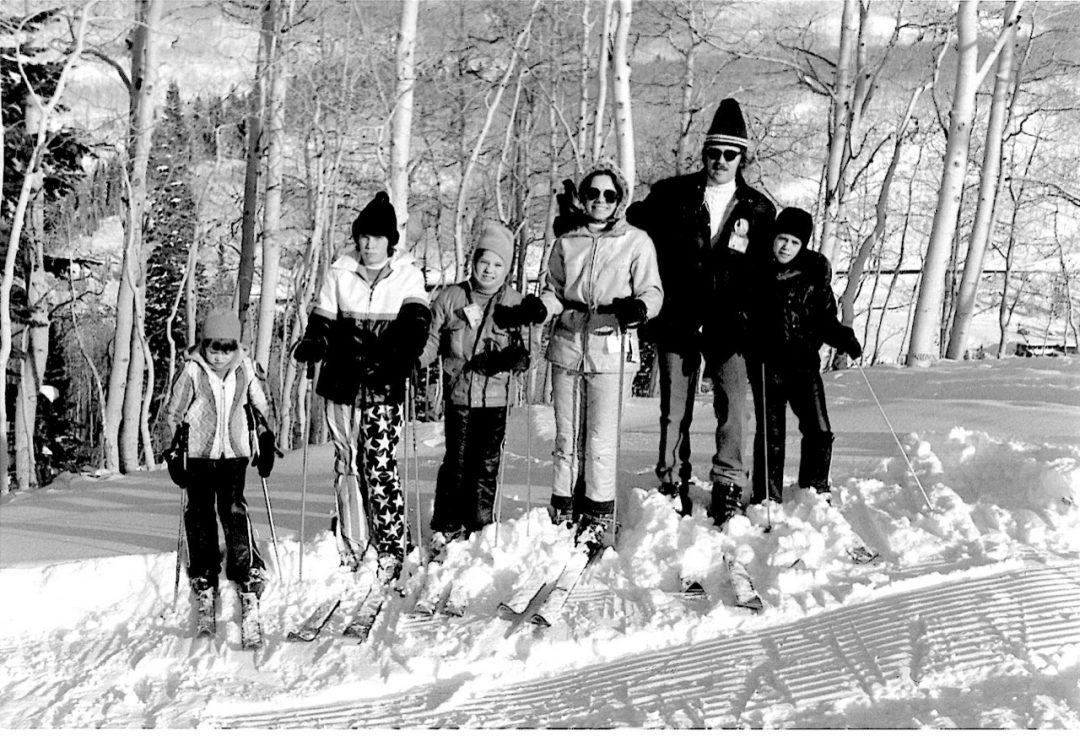
As the kids grew up, we shopped for the best family season pass deals. Here’s a photo of us at Solitude in 1972. Left to right: Karen, Erik, Amy, Judy, Jan, and Dana. After the photo was taken I stepped forward to retrieve my camera, leaving Dana without support. She slipped backwards into the trees and had to be rescued.

In 1981 we skied in Austria with two of our daughters. I had developed an interest in the folklore of Romania, and we had all been there twice in the ‘70s. In 1981 I received a grant to return from January through the summer. We brought Amy and Karen with us.

Erik was in college then and stayed in our house. Dana was on an exchange in New Zealand. Both were able to ski, so why not the rest of us? We each packed one ski outfit and hoped for the best.

As we drove south from Salzburg into the mountains in our Renault Le Car, I parked in front of a sports shop in the town of Wagrain. I asked a clerk in my best college German whether there was any skiing nearby. He grinned and pointed to a map on the wall, explaining that we were right in the middle of  “The Three Valleys,” a major ski center. There were 45 lifts linking Wagrain with the towns of St. Johann and Flachau.

We rented gear, found a B&B, and had a delightful weekend skiing the Alps. Here are Judy and the girls waiting for the ski bus. Wherever you ended up at the end of the day there was a free bus to take you back “home.” I almost gave up on Romania and switched to Austrian folklore.

Although we never managed to ski in Romania, the weekend in Wagrain made up for it. When we returned to Utah in the fall we learned that Deer Valley was opening that season. Modern skiing had arrived in the Beehive State, and we kept on enjoying it through our middle age and into senior status.

To be concluded . . .

Moving To Indiana Then Idaho

Part Four: Jan and Judy Find Lots Of Places To Ski.

We returned from Norway in 1957 and headed to Indiana University. We skied Caberfae near Cadillac, MI, a couple of times, but otherwise, our four years at IU were devoted to my studies and having Bloomington’s New Year’s Baby in January 1960. Where and when would we ever start little Erik on skis?

When I graduated in June 1961 we had a second child on the way, and I had a job offer from the University of Florida. Then came a call from Moscow, Idaho. The chair of the Humanities Department wanted to expand offerings in American Studies, and he had contacted the well-known IU program to see whether any newly-minted folklorist was interested.

This was the only job I ever took without a site visit and a personal interview. Everything was done by telephone and letters. The offer came as a telegram. It worked out perfectly: Moscow was a pleasant small town, the university was solid, my colleagues were smart and friendly, and—best of all—there was a nice little ski area just north of town.

The North-South Ski Bowl had a couple of rope tows and a log warming house. Here is a photo of Judy and me with toddler Erik ready to ski. His baby sister Amy, was with a sitter. Yes, I’m still wearing that old Norwegian sweater.

Jan, Judy, Erk, 1962.

Besides our local area, we visited other ski resorts in our region. We skied Mt. Spokane a couple of times, and returning from a meeting in Seattle I skied Snoqualmie Pass. When I gave a lecture for an extension course in Boise I brought my skis and had a day at Brundage Mountain near McCall, a place Judy and I also skied together. By then we had replaced the front clip on our Norwegian skis with first-generation “safety bindings.”

In early 1962 I was surprised by orders to join the US Army and fulfill my ROTC obligation. Even this led to some  skiing.

On my way to join my class at Ft. Gordon, Georgia, I visited my parents in Lansing. My dad suggested that we go skiing. But was there time to drive up north? Not a problem. A new little area called Mt. Brighton was on I-96 down towards Detroit. In my dad’s garage I found some gear that fit, and thus I had what turned out to be my last ski day in my home state. Hard to believe that little old Mt. Brighton is now part of the Vail empire.

I was assigned to Fort Monmouth, New Jersey, for a year. Judy and the two kids joined me, and we found a local ski club that met in a neighborhood bar. Their meetings were the last time either of us were carded to buy drinks. We never took a ski trip with the club, but we did get to some eastern ski areas on our own.

Judy’s aunt lived in upstate New York, so we could leave the kids with her and go skiing. Here’s Judy in 1963 at the now-defunct Petersburg Pass. It’s not clear whether she was planning to ski an expert or a novice trail.

Judy checks trail map at Petersburg Pass, 1963

Back in Idaho a major new area opened in the mountains above Sandpoint: Schweitzer Basin, now Schweitzer Mountain. We skied it in January 1964 when Judy was pregnant with our second daughter, Dana, born in Moscow in June. The views from the mountain looking past the frosted trees to Lake Pend Oreille were stunning.

Lake Pend Oreille from Schweitzer.

In spring 1965 opportunity knocked in the form of an offer from the Edwardsville campus of  Southern Illinois University. I felt I should not pass up a chance for a promotion to Associate Professor and time off for folklore fieldwork. So back we went to the Midwest with our three little kids, hoping that eventually we would be able to teach them skiing.

To be continued . . .

Okemo Mountain Resort: A Mom And Pop Success Story

The Muellers Saw The Potential And Took The Risk.

The young Mueller family in their first season at Okemo. Credit: Okemo Resort

When Tim and Diane Mueller purchased Okemo Mountain  in August 1982, it was a ski area with six Pomalifts and three double chairlifts. Under their mom-and-pop hands-on leadership, it became a year-round destination resort with summer activities and programs as well as a vastly expanded two-mile wide ski area with 667 acres of terrain, 46 miles of trails, 98 percent snowmaking, 121 trails and glades, a 2,200 foot vertical, and 20 lifts.

Attorney George Nostrand characterized the purchase as  “a struggle and a monumental risk. They had limited funding and if it failed, they would have lost everything they owned. I told Tim that I wouldn’t have had the stomach to take this kind of risk. He said to me, ‘Well, George, that’s the difference between an entrepreneur and a lawyer.’”

Referring to a Sno-Engineering 1981-82 Master Plan which concluded Okemo could become “a major destination resort,” with $8 million in improvements, mountain expansion and additional condominium complexes, Tim cited “the potential” as worth taking that risk.

“We assumed we would be successful because that is part of being an entrepreneur, but never in our wildest dreams did we foresee Okemo becoming what it did. Tim thought going from 90,000 skier visits to 200,000 annually would be doable, and that was our idea of being successful. We never thought we would reach 600,000 or operate three resorts — that was not a goal then,” Diane said.

Hospitality and Service Orientation

The Classic Red Poma Lift in 1956 which the Muellers replaced. Credit: Okemo Resort

With their background operating and expanding a beach resort on St. Thomas — and a Vermont home construction business prior to that — they had “a lot of energy and experience. There were good employees here with experience so it wasn’t as if we were wildly entering some field blindly,” Tim noted.

Still their first season was a struggle. With no time to research a chairlift, they focused on sprucing up with paint, new signs (saving money because Diane did them), and fixing the lifts as fast as possible when they broke down.

With natural snow not falling until mid January, the Muellers relied on snowmaking and had six trails by Christmas with two from the top, contributing to loyal skier appreciation and a “we can do it” attitude among staff.

They also focused on service. Diane cited their beach resort experience as giving them “a jump on the ski industry” in terms of offering quality service. The emphasis on Okemo and its employees providing top notch service was part of Okemo’s core values that enabled the ski area to grow to such a success, she added.

Their hands-on management style was impressive as they worked alongside their staff and management team . They listened to staff suggestions and were able to delegate responsibilities, which eventually allowed them to add Mount Sunapee (NH) in 1998 and Crested Butte (CO) in 2004.

Expansion and Success

Sunburst Six as it approaches the summit. Credit: Okemo Resort

With employee input as to where the replacement chair for the main Pomalift should go, the Northstar Triple was installed in 1983 (later a quad and then a sixpack). The development of the Clock Tower reception area and base village followed in 1984, creating excitement and a growing confidence in the mountain and the Muellers.

Hands-on resort operators Tim and Diane Mueller shown at the 2005 start of the Spring House at Jackson Gore. Credit: Karen Lorentz

The continuing addition of chairlifts, snowmaking, and new trails was impressive. The expansion to Solitude Peak in 1987 provided the Muellers’ first new lift-and-trail complex on 225 acres and was enhanced by a lodge and trailside units.

The development of convenient trailside condominium complexes — on private land the founders had purchased and on land the Muellers acquired — enabled profits to be invested into mountain improvements, including lodges, halfpipe and terrain parks, another new trail-and-lift complex at South Face (1994), a novice area at lower Solitude (1995), and the Jackson Gore complex (2004-06).

The offering of children’s daycare and ski instruction programs combined with an early welcoming of snowboarding in 1987 enhanced the area’s appeal as family friendly and an avant garde ski and snowboard school further propelled its growing popularity. By 2009, Okemo ranked in the top two in Vermont and the East and top 13 in the nation by skier visits!

When Vail Resorts acquired Okemo Mountain Resort September 27, 2018 it may have been the end of the Mueller era at Okemo, but thanks to their success, it was also the beginning of an Epic era that pays homage to their legacy of creating a great family-oriented resort.


A Brief History Of Skiing “Style”

Author’s Note : I owe much of the following to a close personal friend. This is wholly my interpretation of his observations, it does not necessarily reflect or deny his views.

In France

In the 1940s/50s France and Austria began competing for increasing skiing tourism. The rivalry was both commercial and political. Each wanted a national “product,” supposedly better than their competitor, that they could differentiate and sell.

At that time, the French believed they had the answer to the question, “What to teach?” They needed a product that trainee ski instructors could be trained to deliver in ski schools.

JCK embodies the French style in 70s Head ad.

Remember that the instructor training systems were nationalized. The Ecole de Ski Francais was a government monopoly. Its name is frequently mistranslated into English, as the “French Ski School” but that is not what it means: it means the School of French Skiing. A product.

They offered the “Rotational Method” which they claimed exemplified the physics involved. What you were to do was to slightly crouch as the “turn” approached, then extend the legs rapidly to unweight the skis, and at the same time rotate your torso in the direction you wanted your skis to go.

This transferred the angular momentum (the twist if you like) of your “upper body” toward the impending new direction, down to the legs and skis. From a physics viewpoint that was “Transference of momentum from part to whole” , your body can only twist so far before it imparts that twist to your legs via your pelvis.

Some of SeniorsSkiing’s respondents to my earlier contributions insisted on this being “the way to ski” and were critical of my introduction of the concept of “arcs” instead of “turns”. Which does not reflect badly on them, but it does illustrate the power of inertia and how susceptible we are to Confirmation Bias.

In Austria

At the time, a leading figure in the Austrian National Ski Instruction System was Prof. Stefan Kruchenhauser. He had been studying, photographing, and filming Austrian racers as they went through the racing gates.

Unlike the French, he observed that as they approached the gate po they turned their shoulders away from the intended “turn” and had their back toward it as the direction change occurred.

Kruckenhauser was a ski photographer as well as a pioneer of the Austrian technique. This photo is by him.

Other writers picked up on this supposedly “New Austrian Technique”, explaining it via Newton’s 3rd Law of Motion (every action has an equal and opposite reaction). It became known as the Counter Rotational Method, conveniently providing a different “product” to that of the French, and endless column inches to the magazine writers.

Because both were governmental, political projects, they each quickly developed their own followers in the ski schools, and woe betide anyone who thought any different. Austrian instructors, attempting to find analogies to help their pupils, began teaching “point your skis across the mountain, and your chest down to the valley.”

In fact, the Austrian racers were not employing Newton’s 3rd Law, they were simply trying to avoid whacking their shoulders into the slalom poles which back then were tree branches cut off the pine trees and bedded very firmly in the snow. Had the good professor filmed his skiers changing direction when not racing round sticks in the ground he would have found they did not “counter rotate”. Be careful what you think you see!

The Austrian concept was exported comprehensively to the USA because Austria provided back then a great many instructors to the newly expanding American ski school industry. The system satisfied ordinary recreational skiers, if it’s making money why change it?

Prof. Georges Joubert.

In late 1960’s early 70’s, Prof Joubert of Grenoble University stood both the French and Austrian instructing methods on their heads. Note that it is academics who are making the discoveries not the ski schools, which simply followed the “official line”, and pretty much did so until their monopolies were broken. Monopolies are not innovators and not good learners.

Still sought after book by French team coach Georges Joubert

What Joubert proved was that racers ski with Independent Leg Action. Racers never skied with their legs together. The legs do NOT act as a single unit. Each rotates independently in its hip socket unless the feet and legs are jammed together, which inhibits such free movement and necessitates throwing your torso about one way or the other.

What this means, and it is very significant indeed, is that the “upper” body is not defined at the waist; it is defined in the pelvis. The leg rotation can be either active or passive, but it happens in the hip socket. There is therefore no need for either the Rotational nor the Counter-Rotational concepts which were not based in physics after all.

To his credit, Prof. Kruchenhauser was one of the first to recognize and adopt this new realization that all that is required is effective balancing (not “balance” which is different and static), accompanied by independent leg rotation with accompanying leg flexion and extension. He called it “Beinspiel” or “leg play”.

Those earlier concepts still facilitate getting folk down skiing pistes, but not in a way that can can now be classified as skillfully. It either matters to you, or it doesn’t. Shakespeare observed “nothing matters, but thinking makes it so”.

It is regrettable that even after 50 years much of the ski school industry has not recognized either the change, or its significance. Though of course, a few have.

[For more thoughts and videos on ski technique, as well as links to Bob’s books, visit https://www.bobski.com/]

Women Played Integral Role at One of Nation’s Oldest Ski Areas

[Please consider supporting SeniorsSkiing.com with a donation. We appreciate your help. Click here.]

Janet Davis Mead, June Aker, Verlene Belden All Kept Pico Going And Growing, Despite Obstacles and Challenges.

Janet and Brad Mead started Pico in 1937.

Vermont’s Pico Mountain survived a war, two owners’ deaths, and a neighbor called Killington to become one of the 30 oldest continually operating ski areas in the country.

It’s a feat that was largely driven by women in its first 30 years, a time when the ski industry was known to be “a man’s world.”

Women also played major roles in Pico operations since that time, continuing the strong family influence that began with co-founder Janet Davis Mead.

A feisty woman given to exaggeration, Janet Davis told Brad Mead she had skied at the Lake Placid Club, so he invited her to go skiing.

“I had to follow him down what looked to me then like Mount Everest. I made it, but without poles,” she would write years later, explaining she had thrown them in the bushes, not knowing what they were for.

Her bravado paid off; they married and researched building a ski area.

Envisioning a year-round resort with mountainside homes, aerial tram, swimming pools, ice rinks, and tennis courts, the Meads leased Pico Mountain and opened Thanksgiving Day 1937 on Little Pico with a 1,200-foot rope tow and a rough-cut, 2.5-mile Sunset Schuss skiers could ‘skin up’ to the summit.

The Meads hired Swiss racer Karl Acker to run the ski school, added two tows, widened Sunset Schuss — renowned for downhill racing and the Pico Derby — and installed the first U.S. Constam T-Bar to the top of Little Pico.

After Brad died in a boating accident in 1942, Janet carried on with support from skiers, the Otter Ski Club, and Otter Patrol. When workers including Acker left for World War II, she kept Pico open despite hardships of rationing and shortages that caused many areas to close. Using her marketing skills, charisma, and tenacity, she gave special rates to schoolchildren and servicemen who visited on furlough weekends.

Karl and June Acker took over from Janet and continued to expand the resort.

Having survived wartime, Janet bought the mountain (1947) as Acker returned to teach and help operate Pico. (He coached daughter Andrea Mead, first American to win two Golds in the 1952 Olympics, bringing acclaim to Pico’s strong racing tradition.) As the first woman to own and run a U.S. ski area still operating, Janet survived four lean snow years, weak finances, and growing competition by lowering ticket rates and offering summer rides on chairs hung on the T- Bar (1950). With the ski boom on and her children not interested in running Pico, she sold to Karl and June Acker in 1954.

Karl added trails, a T-Bar, and a J-Bar. “The lack of access to funding caused him to do too much of the work himself; the long hours and the stress of the new J-Bar which he couldn’t get to work quite right contributed to his fatal heart attack” in May 1958, June told me in 2007.

“The three banks that had lent us money to purchase Pico had insisted on a life insurance policy on Karl. Because I was a woman they needed to know I could repay the loan if he died,” June said of becoming Pico’s owner at age 30.

She added trails, replaced a lift, and obtained financing for Pico’s first chairlift, a Stadeli double that went halfway to the top ($110,000 in 1962).

“Pico needed lift service to the summit to compete and survive.  Being a woman contributed to the banks’ reluctance to provide more loans,” June said, of her decision to sell to Bruce and Verlene Belden (1964) in hopes they would carry on a family-oriented mountain.

Bruce had helped build Mount Snow (1955-1964), while Verlene ran their 30-guest ski lodge and raised four children. With former guests investing, they became majority owners with Verlene as office manager. Her business acumen coupled with their strong family orientation and expansion of the mountain enabled Pico to survive the trying 1970s when all but five major Vermont ski areas changed owners, and most surface lift areas closed. Vermont had 81 areas in 1966 but just 39 by 1988.

When they retired in 1987, Pico had a reputation as the “friendly mountain” with strong racing and instruction programs and new base village engendering a loyal following.

Women played significant roles in achieving that reputation. “They taught youngsters to ski and race and were instrumental in the Pico Ski Club. They also ran various departments from ski shop to ski school, tickets to childcare. They contributed to the skier loyalty that saw kids who grew up at Pico return as instructors or coaches and bring their own families to the mountain,” noted former GM Frank Heald.

Current Pico Director of Operations Rich McCoy added, “Pico staff make people feel at home and welcome. That’s a legacy that women through their leadership roles have contributed to throughout Pico’s long history and still do today.”

Sunset Schuss: Had to skin up in the old days.

Growing Up Norwegian-American on Skis

A classic ski poster shows a blonde baby in a quaint wooden cradle, one outstretched hand holding ski poles, with a pair of skis protruding from the other side. The caption is “Norway. The Cradle of  Ski-ing.” This poster reminds me of my roots.

Jan Brunvand, age 3

I was on skis from before I can remember. An undated snapshot in the family album proves this. I appear to be about three years old.

I suspect that my parents posed me on adult skis, as those boards are super long, even for the late ‘30s. ( I was born in 1933.) My mother surely knit that hat, while those fancy mittens were from Norway. I’m holding one long ski pole, but I don’t seem to be going anywhere.

In a second childhood photo I’m posing with my brother Tor in what could be about my seventh year. Tor was born in 1935, and we had matching ski jackets. The snow sticking to my pants hints that I must have fallen on the run before the shutter clicked.

Jan and brother, Tor

My parents came from Kristiansand, Norway. They were married in 1929 in Windsor, Canada, then moved to Northern Michigan. I was born in Cadillac. By the time Tor arrived we had moved to Lansing.

I have one slightly damaged photo of my dad on a ski trip in the old country, captioned “Easter 1925.” He’s on the right with his hand on the railing. Check out those vintage skis!

Jan’s father

As Tor and I grew up Dad would take us to parks or golf courses to climb up and slide down on skis. Before we gained some proficiency with “snow plow” and “stem” turns he would hold his poles out horizontally for us to cling to for balance as we schussed the gentle slopes. 

We climbed either by traversing and kick-turning, or using the herringbone method. When our skis got sticky, we rubbed on a mix of graphite and paraffin.

In 1948 realtor Rollie Stebbins convened a group of skiers to form the Lansing Ski Club with my dad as a charter member. A portable rope tow in Stebbins’ backyard was my first experience with motorized uphill ski travel. After the club bought rural property and installed a real rope tow we enjoyed many days there working on our turns. We also made occasional trips north to ski Caberfae near Cadillac.

In photos of me in those days I am usually wearing  a dark blue or red V-neck ski-jumper’s sweater sent to me by my maternal grandfather in Norway.

My Dad carved a graceful Telemark turn, and Tor soon got the hang of it. I never mastered Telemarking, but instead worked on my stem-Christies and eventually achieved a more-or-less full Christiania turn. It was gratifying to learn that both these turns were named from places in Norway. Never mind that the Christie was part of the Austrian-inspired Arlberg system.

Starting college at in 1951 I joined the Michigan State Ski Club and entered a new world of skiing with friends who had actually taken lessons and learned from pros. This led to further trips to Caberfae, and eventually to skiing in the Rockies..

At college I met my non-Norwegian non-skiing future wife and converted her to the sport after a disastrous first experience.

To be continued . . .  

Alf Engen

Mystery Glimpse: Season Retrospective

Last Week

Credit: Alf Engen Museum

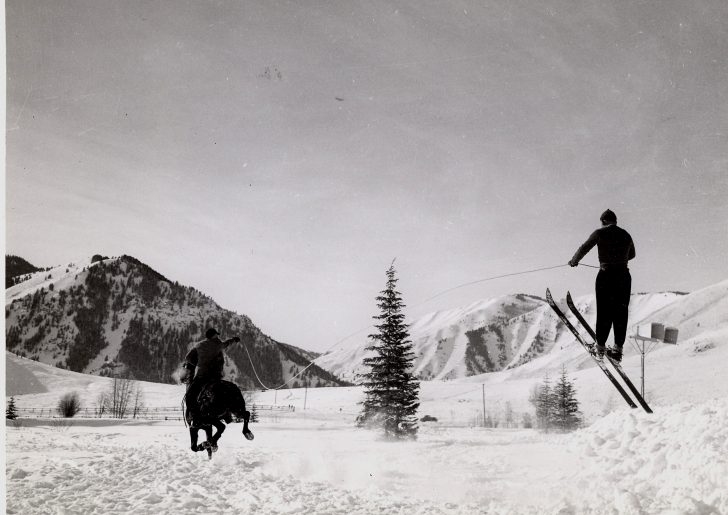
This is an Engen family photo, depicting Alf Engen himself ski-joring over a mini-ski jump behind a cantering horse. According to Jon Green, from the Alf Engen Museum, Alf participated in ski-joring quite often in Jackson Hole and Sun Valley in the mid- to late-30s,  While he was most known as a ski jumper, having won the national championship title 16 times , Alf excelled at just about anything that involved skis. This is evidenced by the fact that in 1940 he became the only person to win the National Four-Way Skiing Championship (downhill, slalom, jumping and cross-country). It would seem ski-joring was just one more ski-related activity that Alf enjoyed. 

In the 1930s, Alf was employed by the U.S. Forest Service as a technical advisor, assisting in the development of over 30 winter recreation areas in Utah, Idaho, and Wyoming. This included Snow King Mountain in Jackson Hole, close to where this photo was taken. Thanks again to the Alf Engen Museum, Park City, UT, for offering this picture from its collection.

Season Retro

Since last October, SeniorsSking.com has published 23 Mystery Glimpse photos for our readers to identify. These came from the wonderful and important collections of artifacts and photos from ski museums across the country.  These museums, all supported by ski history enthusiasts like our readers, range from tiny to substantial, mostly volunteer, all non-profit, all dependent on your support. We encourage our readers to visit them online and in person. They are all carry the history of snowsports in their collections, a history that can’t be found in as much detail anywhere else.

Below are some of our favorites from this year. Click on the photo to find out the story behind the picture.

After almost 50 years, we now know this is Buddy Werner.

Alta 1952. Credit: Ray Atkeson

Bailey Basher. The whole idea was to bust up moguls and smooth out crud. Gravity was both a friend and an adversary.

Queen Maude of Norway (r) with her sister Princess Victoria.

A rescue at Vail.

A Princess visits Mittersill Mountain Resort

Thanks for your guesses and comments.  More to come in the Fall.


Alf Engen

Mystery Glimpse: Up, Up And Giddy-Up

Horses And Skiing Have A History.

Yes, skijoring.  But where, who, when?  Anyone ever skijor? What’s it like?

Credit: Alf Engen Museum

Many thanks to the Alf Engen Museum, Park City, UT, for contributing this spirited photo of skijoring in (hint, hint) the West.

The Alf Engen Ski Museum Foundation was established in 1989 with a mission to preserve the rich history of skiing in the Intermountain Region. It strives to provide a world-class facility which highlights the many contributions made in ski area development, athletic competition, snow safety, ski innovation and ski teaching methods.

Last Week

Yes, indeed.  This is the venerable Cannon Mountain Aerial Tramway. The following was adapted from the Journal of the New England Ski Museum (Winter, 2019).:

The Aerial Tramway was the first such conveyance in North America and opened for business in Summer 1938. In its first summer and fall, it carried 100,000 passengers up Cannon Mt.  

That year, Hannes Schneider also arrived in North Conway to begin his stellar career as a ski instructor and innovator. Between the new tramway, the advent of Schneider, and the robust support of Harvey Dow Gibson, a North Conway-born New York financier, New Hampshire was poised to become a mecca for skiing.

Thanks again to the wonderful New England Ski Museum, now with two locations, a new  gallery and archive in North Conway, and at the base of this aerial tramway at Cannon.

Miss Tweedie Goes Skiing In Norway

Was ever anything so vexatious?”

One of the most enthusiastic English Victorian tourists who made a ski trip to Norway was Mrs. Alec Tweedie, author of A Winter Jaunt to Norway (1893). Not only did she sketch a vivid picture of Norwegian skiing equipment, technique, and terrain, but she also reported on the second-ever Holmenkollen Day events.

Mrs. Tweedie, then a young widow, travelled with her sister to Christiania (now Oslo) where they were met by her brother and a friend, then joined by “Herr Schmelck, one of the best skiløbers in Norway.”

Never having skied before, she decided to try it. As it turned out she loved skiing, which she described as “one of the most exhilarating and enchanting sports in the world . . . [which] bids fair to become a fashionable winter amusement for English people.”

Her description of the gear used at the time:

“An ordinary-sized man’s ski are eight or nine feet long. They are about four and a half inches wide and an inch at the thickest part, immediately under the foot, but towards either end they taper to half this thickness. . . . In the middle the toes are fastened by a leather strap. Another strap goes round the heel in a sort of loop fashion, securing the foot, but at the same time giving the heel full play.

Although Mrs. Tweedie’s description of her “ski costume” included “short skirts, reaching but little below the knee . .  .[worn over] thickly lined black knickerbockers,” the commercial photo used as a frontispiece in the book shows her skirt going right down to the ankles. The photo also reveals that the skiers used just one pole for control and balance.

Their first attempt at skiing was frustrating:

“We struggled on to the incline of the hill. Hardly had we arrived there, when off started the ski, taking us unexpectedly along on them. The pace increased each yard of the way, until over we went, dejected bundles, into several feet of snow. Was ever anything so vexatious?”

As the English tourists gained more confidence, they took a ski tour to a saeter [mountain pasture], staying in a log cabin, and working on their form, assuring the reader that “No amount of tumbling in Norwegian snow would ever give as much as a bruise. It is like falling into sand or flour, and one has only to have a shake to be as dry as if nothing had happened.”

On their last day in the mountains the determined Brits even organized races:

“We tried who could steer most equally between two given posts with only a few inches to spare on either side of the ski. Then we raced in couples, which nearly always ended in some frantic spill. Oh, how we fell over, and how we laughed and enjoyed ourselves, while the way we improved was marvelous!”

Herr Schmelck remarked, “Why, there is nothing you English ladies will not dare,” a kind observation considering that the local expert had surely seen many Norwegian ladies expertly skiing since their childhood.

Mystery Glimpse: This Lady Created The First…

…What?

Hints:  New Hampshire. She went to Smith. Her husband’s last name was the name of the creation.

Credit: New England Ski Museum archive

Many thanks to the New England Ski Museum, now with an Eastern Slope branch in North Conway, NH, in addition to their home base at the foot of the Cannon Mountain gondola, Franconia.

Last Week

Lots of clues here. Who’s in the speed suit?

Yes, Buddy Werner is the skier on the cover of the January 27, 1964 edition of Sports Illustrated, harkening the Winter Olympics, held that year in Innsbruck, Austria.  At the time, Werner was a vibrant, new personality in the ski world, a Steamboat native, and a persistent competitor. Werner, as many senior snow sports people know, went to the 1964 Winter Olympics with Billy Kidd and Jimmie Heuga, but never placed. It was just after the Olympics that Buddy joined other athletes filming a movie in Switzerland, produced by Willy Bogner, the fashion designer. He and German racer Barbi Henneberger were lost in an avalanche during the production.  He was only 28.

What makes this photo so interesting to me is that I had a similar photo tacked above my desk at SKIING Magazine, One Park Avenue, NY, NY. That was in 1970. The photo which you can see below, you have to agree, is pretty dramatic, an airborne downhill racer coming full on, in helmet and speed suit. There was no identification on the print as to who it was or when it was taken. I always wondered.

Last week’s photograph from the Tread of Pioneers Museum archive, triggered a response. I rifled through several old files, and there it was. That old picture matched the cover shot of Sports Illustrated, but obviously a different frame from the shoot.  It been taken at the same on-hill session as the cover photo, and somehow a print made its way to SKIING magazine’s offices, where I commandeered it, and pinned it to the wall. When I went on to other things, I took it with me, and it’s been around ever since.  And here it is.

After almost 50 years, we now know this is Buddy Werner.

History Lives At Cranmore Mountain

Celebrating Hannes Schneider, A Pioneer Of Alpine Skiing In North America.

Jubilation at the vintage fashion show at the Hannes Schneider Meister Cup. Credit: Tamsin Venn

Every year, the Hannes Schneider Meister Cup Race, sponsored by the New England Ski Museum and Cranmore Mountain, NH, celebrates the legacy of the venerable Austrian ski instructor. For 23 years, the Cup has drawn people to Cranmore from all over to race or just cruise on this low angle dual slalom course on the Alley, where the old Skimobile ran up.

Schneider and his wife arrive via train at North Conway, greeted by his new employer banker Henry Gibson, owner of Cranmore. Credit: NE Ski Museum

This year’s March event poignantly marked the 80th anniversary of Schneider’s arrival via the Eastern Slope Express 7 a.m. Feb. 11, 1939 at the railroad station that still sits in downtown North Conway.

Any major ski resort in the US would have been thrilled to hire Schneider as ski school director, but he chose to make Cranmore his home. His family followed him into the ski business and now four generations of Schneiders are part of the family narrative.

At the recent festivities, great grandson Hannes Schneider dedicated a plaque to his grandfather, Herbert Schneider (Hannes senior’s son), who served in the 10th Mountain Division and also owned Cranmore from 1963-84. His goal had been to make sure every kid in the valley had a chance to learn to ski.

Instructors from Army’s Mountain Warfare School stand to attention at beginning of festivities. Credit: David Eden

The organizers went all out. The weekend started with a reception and hearty dinner at Zip’s (Hannes’ nickname) Pub & Grill and torchlight parade. It continued Saturday morning at Cranmore’s base with dedication ceremonies, a vintage ski fashion show (one winner rifled through her mother’s closet for an award-winning outfit), silent auction, awards ceremony, bratwurst and beer, all serenaded nonstop by the oompah music of the Bavarian Brothers Band. One felt quite transferred to Austria, instead of a quaint  North Conway. All proceeds went the New England Museum, the goal being to preserve the rich ski history in this region.

Schneider’s story is an intersection of politics and skiing. Here’s the short version.

Hannes Schneider ran a ski school in St. Anton Austria, where he promoted the new Arlberg technique and helped bring important tourism business to the region. As a high-profile critic of Hitler, he drew ire from the Nazi party who threw him into prison. With the intervention of a German skier friend who was also an attorney, and Harvey Gibson, an influential American banker, Hannes eventually found refuge in the US where Gibson set him up as ski school director at the new snow-train-served resort Gibson opened in North Conway.

For competing in the Ski Meister Cup, or any ski race, here’s general advice for seniors. If it’s a fundraiser for a worthy cause, it’s easier to justify having more youthful competitors heartlessly whiz by you on a parallel GS course.

In North Conway, visit the Eastern Slope Branch of the New England Ski Museum, opened only a year ago, a companion to the one in Franconia.

Click here for more on skiing at Cranmore Mountain.

Click here for Cranmore’s website.


Book Review: Boarding Southern Vermont

[Editor Note: SeniorsSkiing.com is again asking our readers to contribute to support our online magazine. Yes, we have grown in the number of subscribers and advertisers. But our expenses have also grown. You can help us defray some of these expenses by helping us out with a donation.  This year, we have a mix of premiums for different level of donations, including stickers, sew-on patches, our new SeniorsSkiing.com ball cap. All donors will be entered into a drawing for a pair of bamboo Polar Poles to be drawn in late March.  You can donate by clicking here.]


How Did A Then-Revolutionary Sport Become Mainstream? Hint: Epic Parties.

[Editor Note: Roger Lohr is the publisher of XCSkiResorts.com and SeniorsSkiing.com’s cross-country editor.]

The book Snowboarding in Southern Vermont: From Burton to the U.S. Open” by Brian Knight on History Press is a snapshot of the 1980s and 1990s during the early days of snowboard lore. The book is a fine encapsulation of snowboard history with an amazing collection of photos of those early days at the region’s ski areas Stratton, Bromley, Magic Mountain, and Snow Valley.

The book traces Jake Burton Carpenter’s life through Londonderry, Manchester, and Stratton Mountain, VT, as he became the proprietor of Burton Snowboards. He shared the spotlight with Donna Carpenter,  a woman he met whom he eventually married. She is cited in the book for “heavy lifting” in the early development of Burton Snowboards which was to become a significant force in the sport. Jake’s infectious enthusiasm and the lengths he went through to get Burton Snowboard started required visionary decision-making and resulted in a very influential company in the snowsports world.

There are hundreds of names that are weaved into the Southern Vermont story such as Paul Johnston the Stratton mountain manager, who had an open mind about snowboarding in the beginning; Lyle Blaisdell, the backhoe operator with the half pipe-carving Midas touch; and other snowboard dignitaries such as Tom Sims, Chuck Barfoot, the Hayes brothers, Neil Korn, Lindsey Jacobellis, Mark Heingartner, Craig Kelly, Dave Schmidt, Terje Haakonsen, Tricia Byrnes, Ross Powers, and Shaun Palmer.

The book’s vibe of the times is also expressed with tales of epic parties and Burton home-grown spirit. The competition parties perhaps far-out shined the half pipe competition.  Spectators at the U.S. Open experience left the event site littered with beer cans and booze bottles, enjoying debauchery and mayhem at “snowboarder residences” throughout the region. The parties hosted by Burton and other purveyors of every imaginable snowboard-oriented product were often topped by the Hayes’ brother infamous gatherings.

The early days were rife with teenage posse behavior both on and off the slopes and age antagonism as skiers fought back to reject the newcomers at the ski areas. The book outlines the certification concept which was a test that snowboarders took to earn the right to get access to the slopes at Stratton. There were many nights when sneaking snowboarders walked up the ski area slopes to make some runs.

The U.S. Open was established as an institution before snowboarding got any television coverage. The time when the Olympics gobbled up snowboarding as a prime time hook for viewers was still in the distant future. During the sunrise of snowboarding, the camaraderie between participants was more important than winning the Open. But the event declined as limits were continually pushed with profanity, violence, and even death when two guys snow caving in the parking lot were crushed in a very sad mishap.

The road to the Olympics was very bumpy for snowboarders coming out of Southern Vermont. Jake Carpenter called the Nagano Olympics, which was the first of the quadrennial competitions to feature snowboarding, “kind of a disaster.” The U.S. Open grew each year and eventually mainstreamed with the elimination of alcohol, superior rider athleticism, and a send off to Stratton’s Sun Bowl so it was not in the main area.

Southern Vermont in the late 80s may have been the epicenter of snowboard culture and the U.S. Open was the crown jewel of snowboard contests. By 2012, that sub-culture had run its course, and it was the end of the era. The event was moved to Vail. The book states “The Vermont brand can launch a business but rarely can sustain it.” For years, coverage of snowboarding was invariably about the jargon, the fashion, and the rebelliousness rather than the joy of floating in powder, dodging trees after a snowstorm, or twisting in the air. “Snowboarding in Southern Vermont” is a quick read that establishes the record of snowboarding’s early days there, and we should be thankful that this record is now public for all.

Mystery Glimpse: More Ski Jumping

[Editor Note: As the new year begins, SeniorsSkiing.com is again asking our readers to contribute to support our online magazine. Yes, we have grown in the number of subscribers and advertisers. But our expenses have also grown. You can help us defray some of these expenses by helping us out with a donation.  This year, we have a mix of premiums for different level of donations, including stickers, sew-on patches, our new SeniorsSkiing.com ball cap. All donors will be entered into a drawing for a pair of bamboo Polar Poles to be drawn in late March.  You can donate by clicking here.]


While We’re On Ski Jumping…

Two jumpers? Looks like a long time ago.

Last week, a few readers who know their ski history, nailed the Mystery Glimpse Big Jump as the Big Nansen Jump in Berlin, NH (see below).  Let’s see if anyone can identify what is happening here and where. Hint: Not New Hampshire.

Last Week

The Big Jump is Big Nansen, the venerable jump in Berlin, NH. Some highly knowledgeable SeniorsSkiing.com commentators got the facts exactly right. Built circa late-1930s, Big Nansen dominated US ski jumping for many decades. Here is an excerpt about the jump published in the Journal of the New England Ski Museum (Winter, 2018):.

“Built on steep trusses and towering 171 feet high, the Nansen jump was at the time the largest ski jumping tower in the world. In 1938, the jump’s inaugural winter, the Nansen hosted the Olympic trials. Over the next several decades, it would be the site of the myriad jumping competitions, from Winter Carnival events to four U.S. Ski Jumping National Championships in 1940, 1957,1965, and 1972 before falling into relative obscurity.”

The last competition was held there in 1985. A severe accident to a college-age ski jumper in 1977 had brought a lawsuit to the US Ski Association, the Nansen Ski Club, and others that added to the jump’s decline. However, in recent years, the Friends of Nansen Ski Jump was formed to revive the jump and the sport in Berlin. Red Bull, the energy drink folks, happened to be working on a documentary about US Ski Team Jumper Sarah Hendrickson, and became interested in restoring the jump. In 2017, Hendrickson took off from Big Nansen, the first jump from the structure since 1985.  She went on to compete in the Pyeongchang Olympic games.

The Friends Of Nansen are planning to use the site as a training ground for young jumpers.

SeniorsSkiing.com highly recommends exploring The New England Ski Museum and its well-researched Journal. The Museum has two locations in New Hampshire, one at the base of Cannon Mountain’s gondola in Franconia  Notch, and a newly opened Eastern Slope Branch in North Conway. For more information, consider visiting online and in person. 

Sarah Hendrickson’s jump from a restored Big Nansen in 2017. Credit: Red Bull

Lessons From Folk Tale: X-C Ski Adventure

[Editor Note: As the new year begins, SeniorsSkiing.com is again asking our readers to contribute to support our online magazine. Yes, we have grown in the number of subscribers and advertisers. But our expenses have also grown. You can help us defray some of these expenses by helping us out with a donation.  This year, we have a mix of premiums for different level of donations, including stickers, sew-on patches, our new SeniorsSkiing.com ball cap. All donors will be entered into a drawing for a pair of bamboo Polar Poles to be drawn in late March.  You can donate by clicking here.]

Finnish Folk Tale Ingenuity Saves The Day.

Many years ago my wife and I had a small weekend cottage in southeastern Vermont. One Saturday I stopped by the West Brattleboro Library and checked out a book of Finnish folk tales by General Kurt M. Wallenius.

The tale I liked best told of two young fishermen who skied north for a few days ice fishing in winter. They separated one day, agreeing to meet up early evening at camp. One of the fellows snagged a good haul of fish, put them in a sack, and headed back to base. As he was skiing along, he realized he was being stalked by a wolf. He skied faster, but the wolf was closing on him. So, he skied up a small incline, turned abruptly, and skied at the wolf. The wolf leaped to attack him. At the same time, the fisherman leaped, pointing his skis at the oncoming beast. He stabbed it with both skis, killing it but breaking his equipment. So, he sat down, built a fire out of the broken skis, and waited. Sure enough, an hour or so later, his companion saw the firelight and found him. They knew exactly what to do. The fisherman with two good skis gave one to his friend, and they skied back to camp that way, pushing with one leg, skiing on the other. And they brought back all the fish and the wolf’s skin as well.

Not long after I read this story my wife and I were out cross country skiing on a primitive trail. We went fairly far from our cottage when the wet snow started to adhere to the base  of her waxless skis, impeding her progress. I had old-fashioned wax skis and was not having a problem. It started to get late and my wife, making very slow progress, got spooked. She told me to go on without her. She told me that if she did not get back, I had to remember to buy our two boys new shoes every six months, since they were growing quickly.

Remembering General Wallenius’ story, I traded one of my wax skis for one of her useless, waxless skis. Fortunately, we used the same bindings back then. The trick worked. We pushed with the waxless ski, glided on the wax ski, and got back home safely. For many years afterward I made sure we had the same bindings.


70s Ski Testing: On The Snow

Step 2: Go Out, Do It.

One of the joys of working at Ski Magazine was that I was paid to test skis!!!  Ski manufacturers shipped skis to our lab for testing and when it was completed, the skis were covered with self-adhesive shelf-paper and numbered so the testers couldn’t identify the ski. 

Mother Nature dictated our location and we didn’t want to test at the same area Skiing used.  One year we started at Mount Hood but weather and poor snow forced a move to Mammoth before we settled on Park City the following year.

Areas were picked that could give testers access to a lift that served terrain suitable to our needs.  To create a hard, icy surface, the area allowed us to spread ammonium nitrate on the snow to create a hard frozen granular.

For racing skis, we set up a NASTAR type course with thirty gates and applied ammonium nitrate to make it rock hard.  Racing skis were tested just like the others before we pulled them aside for the days when we would ring them out on a racecourse.

Our contract testers – six men and four women – and me were all certified instructors with either coaching and/or racing experience.  John Perryman and his wife Joan were expert skiers and were part of the test team.  We wanted strong skiers who could ski consistently and could handle a ski without changing their technique. 

To get it right, it wasn’t about blasting down the mountain on one ski after another.  SKIpp demanded a disciplined methodology.  Each year, we reviewed the on-snow maneuvers designed to replicate how beginners through experts skied.

Because some brands were putting their name under clear P-Tex, testers were not allowed to pick up the ski prior to skiing on them.  To help ensure that each ski was tested the same way, the methodology was designed to minimize the tendency of a tester to adapt his/her technique to the ski.  Testers were limited to two runs per ski. 

 The tester came to the tent to score the test ski and write his or her comments before taking another ski.  Each day we tested ten skis because we learned beyond that it became hard to differentiate each ski’s performance.

The best skis didn’t generate many memorable comments although one tester wrote “On the icy snow, this ski tracks like a train on rails and in the soft stuff, it will derail you.”  Another wrote, “A two-by-four with an upturned end would be better than this ski.”

In the evening, skis were prepped for the next day and the day’s data tabulated.  Even though it was preliminary, we were pleasantly surprised at how well the on snow results compared to the lab’s prediction.

Testing ten skis took us to lunch.  For the afternoon, the testers could pick a ski from that day or prior days to enjoy.  It was tough, demanding skiing, but somebody had to do it!