The Ski Diva Focuses On Senior Skiers

Women’s Ski Site Offers Advice To Seniors

SeniorsSkiing.com’s favorite online resource for women skiers is The Ski Diva, a one-stop shop for interesting ideas, information and a meet-up forum for like-minded women.  In this recent article, The Ski Diva explores how a senior woman approaches skiing at 72.  She also describes how the senior segment in snow sports is growing and quotes SeniorsSkiing.com’s co-founder on how the industry can be more accommodating to seniors returning to the sport after a hiatus.  Click to read the article, Age Is Just A Number, Right?

SkiDiva_2


Managing Fear, Building Confidence

Ski Instructor: “Encouragement Is The First Lesson For Returning Skiers”

It makes no difference whether a skier has just recovered from joint replacement, traumatic accident, ski injury or is returning to skiing from a long hiatus. There is going to be some level of anxiety.

Walt Lattrell, ski instructor at Smugglers Notch (VT), teaches a clinic on managing fear for other instructors. “We see people coming back to skiing who are harboring apprehension, negative thoughts and low expectations for performance. The good news is that they take a class from a professional instructor. That’s an indicator they want and need help.”

Thinkin' about it.  Revelstoke, BC, cornice has some folks wondering. Credit: Walter Latterell

Thinkin’ about it. Revelstoke, BC, cornice has some folks wondering.
Credit: Walter Latterell

The goal of ski instructors is to help their students to acknowledge their fears. “Our first challenge is to help returning students believe they are capable of higher performance. Self-limiting beliefs lead to self-defeating behavior. The instructor has to inspire their students, provide a vision of success and lots and lots of positive reinforcement,” says Lattrell.

Lattrell tells students not to expect perfection, to pay attention to their thoughts, and to visualize success. He provides clear goals for each lesson, and explains how the student is going to get there through a series of small steps.

There are some stages that Mermer Blakeslee, in her book ,“In The Yike! Zone” sees some students going through as they gain confidence. It seems it is key for the instructor to positively reinforce the student at each step:

  • At first, the student doesn’t want to try. Small attempts are guided and reinforced by the instructor.
  • Then, the student will try a skill, but only on “safe” terrain. Success will bring the student confidence to try again at a higher level.
  • Next, the student will try a more ambitious skill, but bails out. Now, the instructor demonstrates, guides, and encourages again.
  • Finally the student tries again and follows through with sense of relief, joy and accomplishment. The instructor points out what the student did right and acknowledges the progress.

“The goal of any lesson needs to be a progression from simple skills to more challenging ones. Each step is built upon with growing confidence,” says Lattrell, a PSIA Level 2 instructor.

As we have learned from Harriet Wallis’ series on Knee Rehabilitation, some returning skiers need a run or two by themselves to adjust to the slopes after illness, injury or rehab. Others could benefit from a supportive lesson or two. Lattrell, himself, had bilateral knee replacements.

To paraphrase the great Yankee Hall of Famer Yogi Berra: “Half this game is 90 percent mental.”


A Much Better Way To Boot-Up

Taking The Pull Out Of Pulling On Boots.

Every now and then I come across a product that makes a big difference in the comfort of older skiers. I’ll explain in a minute.

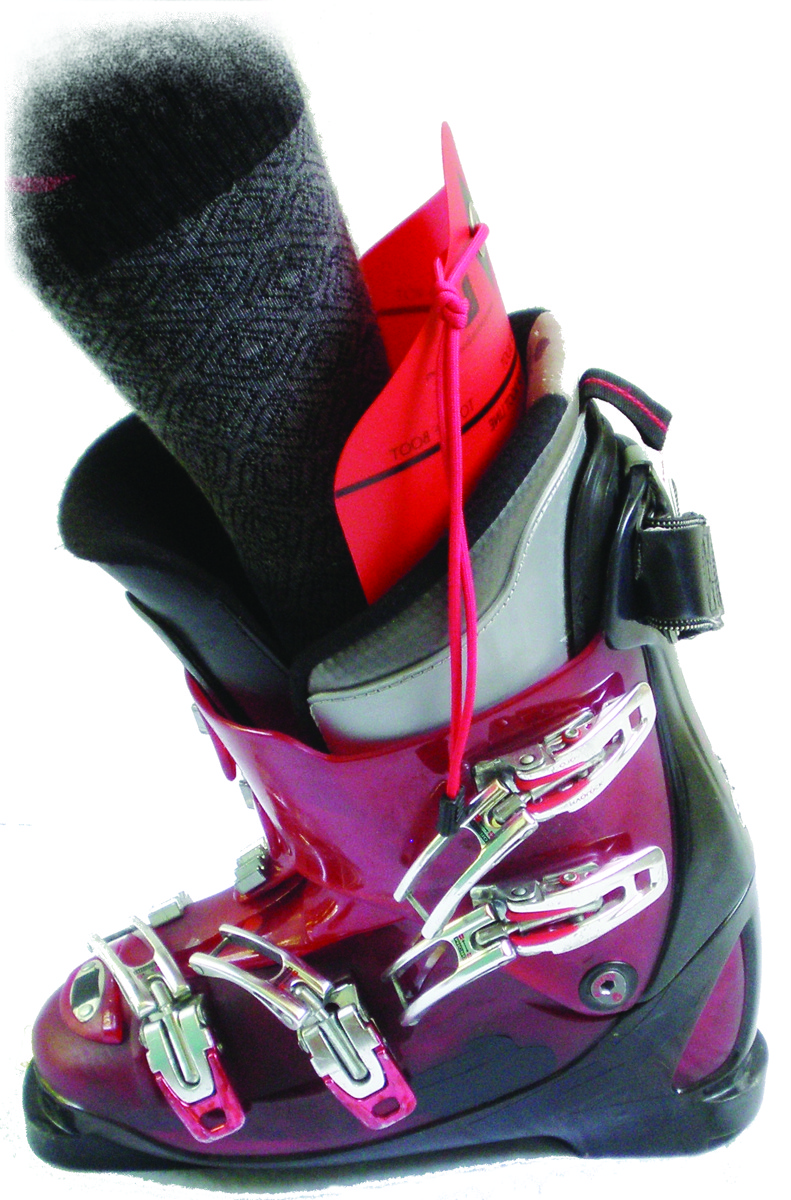
No more wrestling with boots. Ski Boot Horn makes a BIG difference. Credit: Ski Boot Horn

No more wrestling with boots. Ski Boot Horn makes a BIG difference.
Credit: Ski Boot Horn

I always boot-up in the parking lot. The difficulty of that process advances with age. Over the years, I’ve found that using boot warmers on the way to the mountain makes it easier to get boots on — especially on very cold days, when the shells are stiff and resistant. Because I find it easier to be seated, I carry a folding chair in the car.

Recently I learned about the Ski and Snowboard Boot Horn, and, WOW, does it make a difference! This specially-designed sheet of flexible and slippery plastic is placed in the boot and helps your foot slip into place. It is simple, effective, and costs less that $10, when purchased online.

In addition to letting your feet slip in easily, the boot horn helps avoid foot and ankle pain from earlier injuries, while putting on boots. It also protects hand and finger injury and discomfort that can occur in the frustration of trying to get boots on in very cold conditions.

The ski boot horn website features a few useful videos about ways to improve getting your boots on, including useful tips about boot liner care. For reasons I don’t understand, there’s even a video of a group of skiers dropping into Jackson Hole’s iconic Corbet’s Couloir. I checked that one off on a deep powder day almost 25 years ago.

I haven’t tried the boot horn with cowboy boots, fishing waders, skates, etc., but the makers claim it works well for them and for all types of shoes. I’ll try those as the seasons change, but for now, I treat my Ski and Snowboard Boot Horn like I treat my AMEX card. I don’t leave home without it.

Knee Replacement—What Do I Do Now? Part 5

If you want to get back to skiing, learn to love your physical therapy.

It took my expert knee replacement surgeon one hour to cut, saw, hammer and install each new knee. It took me a year to rehab them. I was astounded by how long it took.

Correspondent Harriet Wallis works it. The key to recovery is following through with your  physical therapy regimen. Credit: Harriet Wallis

Laurie O’Connor, friend of correspondent Harriet Wallis, works it. The key to recovery is following through with your physical therapy regimen.
Credit: Harriet Wallis

I was in good physical condition before surgery, and I had the mind set that I would bounce right back. I’m strong. I’m tough. I thought that a set of new knees would be something like taking my car in for an oil change. Drive in with old oil. Drive out with new oil and keep on rolling. I was incredibly wrong. The analogy didn’t work. Healing and rehab take time

The good news is: The body is a healing machine.

The bad news is: Lots of people slack off their physical therapy exercises as soon as they can get into the car and do their grocery shopping. They lose their motivation and unfortunately they don’t get full benefit of their new knees. They probably aren’t skiers. We skiers are motivated to get back to the sport we love.

Eight months after surgery I was back on the slopes – starting on the opening day of the season. I skied 93 days that year. EEEhaw! (During the winter before knee replacement, all I could do was skid down a bunny slope.)

Friends asked: “How long did it take to get used to artificial knees?

My response: “About six turns.” My new knees worked wonderfully.

Skiing is good exercise, but it’s not focused physical therapy. Continuing the prescribed exercises was vital. Now, two years later, I still do certain exercises. I believe that maintaining artificial knees is an ongoing process.

My new knees do have some minor disadvantages. I cannot squat with my butt down to my heels. Artificial knees aren’t designed to bend that far. Therefore I sit on a low stool while weeding the garden. And swimming laps confounded me because it took more strokes to get across the pool. I think that’s because metal is heavier than bone, so my legs are lower in the water. I had to find a new balance point for swimming.

The bottom line is this: When the surgeon is done, your work is just beginning. Do your rehab exercises with gusto – and I’ll see you on the slopes.

Note: This is a five-part series in which SeniorsSkiing.com’s correspondent Harriet Wallis describes her knee replacement journey with tips to guide you if you’re anticipating knee replacement. Part 1: Inspired by a ski patroller with artificial knees. Part 2: Research 101 – why and how to do it. Part 3: Interviewing surgeons and questions to ask. Part 4: How I found the right doctor for me. This is Part 5, the final segment of the series.


Seniors: Don’t Hit The Snow Without Preparation

Here’s a Must-Read for Seniors Before They Head for the Slopes.

Paul Petersen, who begins his 38th season running Bear Valley Cross-Country in California this winter, is 56 years old and comes with the kind of credentials that should make you sit up and take note of what he has to say! He’s been a certified alpine and cross-country ski instructor for nearly four decades. He’s also the former coach of the national nordic team of the Professional Ski Instructors of America and is currently on its education advisory committee.

“I’m a fully addicted skiaholic, and I don’t see that getting better any time soon,” avows Petersen. “It’s one of the most fun things you can do in life outdoors.”

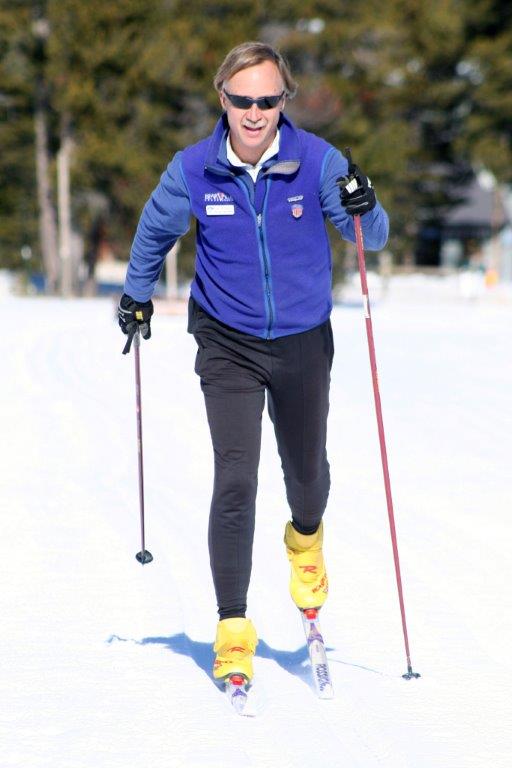
Long-time coach Paul Petersen has wise words about physically preparing for the season.

Long-time coach Paul Petersen has wise words about physically preparing for the season.

He’s made “staying in the game of skiing a life goal,” and he’d like to help you do the same. First and foremost, plan ahead. You can’t just hit the slopes or trails without any preparation after several months of not skiing. Start with exercises that simulate the movements you make when you ski or snowboard. Here are Petersen’s four cornerstones to focus on in the weeks before the wintersports season begins:

  • BALANCE: Stand on one foot, moving from foot to foot every 15 seconds or so multiple times; look for other balance-focused exercises you can do easily anywhere, any time.
  • STRENGTH: Simulate a chair—every skier’s “go to” thigh-strengthening exercise! Slide your back down a wall so that your hips and knees are at right angles. Hold for as long as you can stand it, slide back up, and repeat! Check out other leg and trunk strengthening exercises, such as lunges and squats.
  • FLEXIBILITY: Streeeeetch! Do yoga, or any other stretching exercises you’re comfortable doing.
  • CARDIO: Take the stairs. Park in the farthest parking space in parking lots. Walk around two or three blocks several times a week. Run in place.

What about fitness classes? Paul recommends aerobics for cross-country skiers to enhance cardio and yoga for downhill skiers/boarders to stretch out tight muscles and loosen joints.

And don’t forget about pre-season equipment safety. What good will it do you to plop your fit-as-a-fiddle body atop skis that negate all the prep? It’s worth the money to get your skis tuned up ahead of time, getting the edges sharpened, and most importantly, having your binding settings checked to be in sync with your age, current weight, and ability—all of which might have changed since the last time you had your bindings checked.

Not a big fan of helmets? After all, you’ve skied unencumbered by headgear for eons without any ill effects. Petersen says, “It’s a no-brainer [pun not intended]…wear a helmet! It keeps you warmer, and it doesn’t affect your balance or equilibrium. It’s not so much that you might hit a tree, but rather that some out-of-control newbie snowboarder can come crashing into you.” Petersen also suggests buying some of the incredibly well-designed sports padding that’s available today, such as padded shorts that protect one’s hips, which are particularly vulnerable as we age, and wrist guards for snowboarders.

Editor Note: Petersen also has a lot of excellent tips for the day before you ski and things that are very important to do the morning of. But that’s another whole article for another day…watch for it coming soon!

Warren Miller’s Newest: “No Turning Back”

This one is not to be missed.
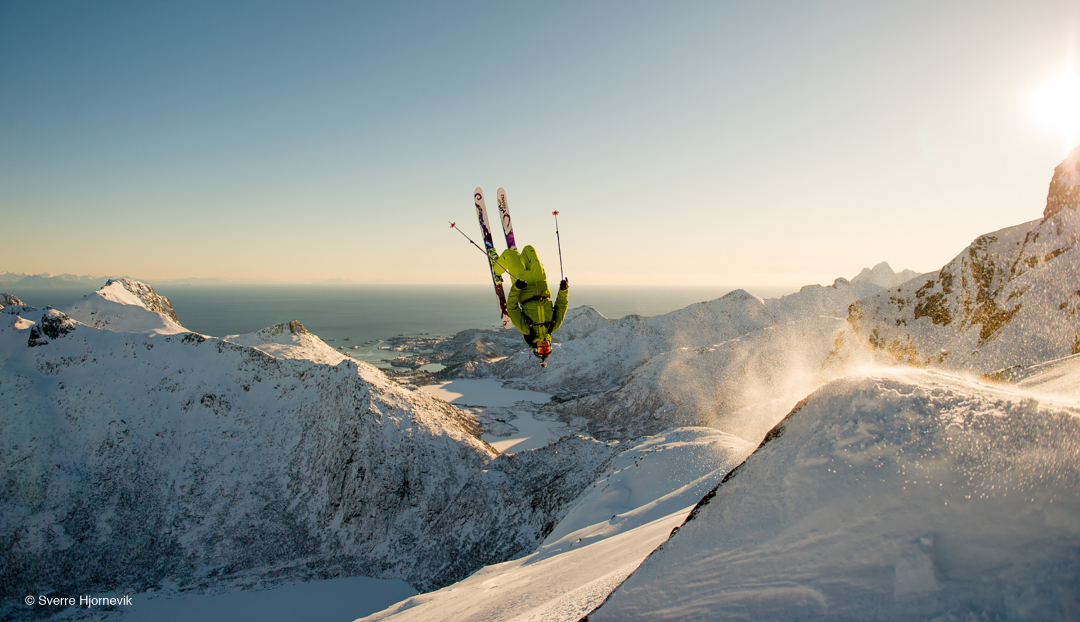
Flipping out: Lofoten, Norway Credit: Oystein Aasheim

Flipping out: Lofoten, Norway
Credit: Oystein Aasheim

My first Warren Miller film was in the early 50’s. That was when the Master, himself, was present to narrate each showing. You knew the season was
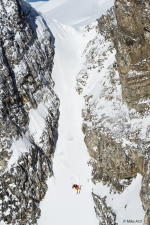
Chute running: Mt. Olympus, Greece Credit: Josh Bibby

Chute running: Mt. Olympus, Greece
Credit: Josh Bibby

starting when Warren rolled into town.

I’ve seen many ski films over the years. After a while, despite camera tricks, ski gymnastics, and the latest soundtrack, they took on a boring sameness. How many times can you watch a daredevil huck the big cliff?

But I just watched Miller’s newest production, “No Turning Back”, and I’ve gotta tell you, this is not to be missed. It is a beautifully shot travelogue of some magnificent lines carved through some of the world’s best terrain.

For the SeniorsSkiing.com crowd, there’s a segment shot in Chamonix featuring a few 50+ skiers (52 and 60) and filled with wisdom about aging and skiing. One line sums it up: “When skiers say 50 is the new 40 (I’d make that 70 is the new 60), what they’re really saying is, Thank you, fat skis!”

“No Turning Back,” Miller’s 65th film, is narrated by Jonny Moseley, who, in his own way, channels the Warren Miller feeling with artful script laced with philosophy and humor. Interspersed throughout are great snippets of skiing history, including a northern Norway search for a ski that was carbon-dated to 3200 BC.

There’s a beautifully shot segment in steep powder runs in Cordova, Alaska, boarding in the bottomless powder of   Hokkaido, Japan, and a piece on skiing in Greece, where there’s more than 20 areas less than two hours from the Aegean.

Two skiers hike and ski Mount Olympus while the narrator links it to Daedelus and Icarus.

A few hundred miles west, we’re introduced to two “speed riders” in Switzerland, guys skiing with paragliding kites, which allow them to huck enormous cliffs, touch down on a stretch of snow and get airborne within seconds.

Throughout, the film pays homage to female skiers, featuring several carving great turns on incredibly steep terrain.
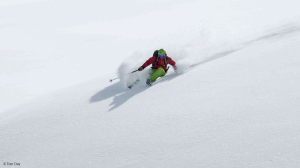
Powder running: Chamonix, France Credit: Mike Hatrup

Powder running: Chamonix, France
Credit: Mike Hatrup

For me, the most enjoyable segment was shot in Montana with big mountain skiers Julian Carr and the charming Sierra Quitiquit. (Julian has done any number on mind-boggling cliff jumps, including a 210′ front flip in Engleberg.) Montana has many smaller areas known for steeps and deeps. And their towns, unaffected by contemporary ski culture, remain time-warped, non-commercial, and down-home friendly.

“No Turning Back” is being shown around the country (locations and schedule). If ski films are your thing, or if you’ve been away from that genre for a while, find a hall where it’s playing. Regardless of age, it will make you want to be on the hill.


Fogless, Wide-Screen View While Wearing Glasses From Osbe Helmet

How To Look Like A Skiing Top Gun

Like many seniors dependent on glasses and contact lens-phobic, I’ve always searched for a way to keep my specs from fogging up while skiing.  I overheat easily and goggles steam up so none of the usual tricks (rubbing dry soap on the lenses, etc.) help for long. I tried different goggles with a tiny built-in fan, but those have other drawbacks. A very good solution is

The Osbe's visor allows a flow of air to evaporate fog. Credit:  Michael Conley

The Osbe’s visor allows a flow of air to evaporate fog.
Credit: Michael Conley

the Osbe Proton Senior, a helmet featuring an integral pivoting visor that covers your face— but not your nose—from the cheeks up. I’ve used mine for a few years now in a variety of conditions, and I’m quite happy with it. There are several advantages to this visored helmet over the traditional helmet/goggle combo.

Most important for me, no fogging of my glasses at all!  The visor doesn’t actually contact your face to form a seal like a typical goggle. There is an “air dam” of foam rubber on the inside lower edge to minimize the gap, but a small amount of air can circulate through the inside of the visor. This is necessary to continually clear away any buildup of humidity, and it works very well. Occasionally on the lift a bit of fogging can occur depending on the wind but never while skiing.  Another important benefit is a greatly increased field of vision. The Osbe visor, unlike goggles, does not make a frame around your face with thick foam that restricts peripheral vision; this helps avoid what I consider the biggest danger on the slopes:  other skiers.

Since the visor does not touch your face there is no pressure to restrict breathing through the nose. Goggles tended to press my glasses into my face, and occasionally I almost pulled my glasses off when removing them. It’s a simple

Admit it.  Navy pilot helmets are cool.  Check that visor. Credit: Andrea Salimbeti

Admit it. Navy pilot helmets are cool. Check that visor.
Credit: Andrea Salimbeti

matter to pivot the well-made, distortion-free visor up or down as needed.  Since the visor is very light, it doesn’t affect the balance of the helmet.

Visors are available in clear, mirrored, smoke and orange and can be easily changed in a few minutes. One minor problem is a small loose part that can fall off in the visor-changing process, so be careful. I just leave the orange visor on at all times and use clip-on shades when needed.

Osbe is an Italian maker of motorcycle helmets with years of experience in helmet design. Maybe being European-designed the sizing seems to run small. I’ve always worn a large in helmets, but the sizing chart on the Osbe website indicated I should wear a medium (my head is about 23-1/2″ around). I ordered a large anyway, and it was definitely too tight, so I ended up with an XL which fits fine.

The Osbe tends to start conversations on the chair—some say it looks odd. I’m 58, and I couldn’t care less at this point in my life if it does. Seeing clearly at all times is key. If I make someone smile, hey, what’s bad about that?

For more information: check Osbe Ski Helmets

What’s your experience been with Osbe?

SeniorsSkiing Contributor Michael Conley re-discovered skiing in his late 40’s when his daughter took up snowboarding. A Brooklyn, NY-based artist and furniture maker, he skis as often as possible (not nearly enough…) in upstate New York and New England, with excursions to Montana where that now grown-up daughter is in college. In warmer weather he kayaks and hikes and bikes with his cold-phobic wife.

Editor’s Curiosity Corner:  According to the NSAA, 77% of skiers 55-64 and 81% of skiers 65 and over wear helmets.  If you do, what’s your rationale?  If you don’t, what’s up?  Let us know.