Book Review: Staying With It

An Aging Athlete Becomes Enlightened

[Editor Note: We are reprising this article from Nov. 2015 because it contains important themes of persistence and adaptability. And the book Staying With It was written by one of our favorite authors, the venerable John Jerome, a former editor of SKIING magazine.]
StayingWIth__501

What happens when a 50-year-old writer decides to fight aging by becoming an athlete? Will physical awakening, sharpening, perfecting hold off the loss of function, range, performance? When former SKIING Magazine editor John Jerome found himself at the doorway to old age, he decided to do something about it. That something was his four-year voyage into athleticism to see if he could counter the effects of aging with muscle power, insight, and, as it turns out, mindfulness.

He tells his story in Staying With It, (Breakaway Books, 1992), a journey of trial, error and learning told in his usual reflective—and discursive— style. We recently re-discovered Jerome’s writing while paging through old, bound copies of SKIING magazine. When we learned he decided to become a competitive, masters-level swimmer at age 50, we wanted to explore his journey for our own edification as well as for our readers’.

At the beginning, he says, “Aging is very rude, making no attempt at diplomacy, at softening its message. It just starts slamming doors in your face, yanking things out of reach.” Jerome said he “was interested in giving up any capacity as slowly as possible…understanding and acknowledging the process.” His goal was “the maintenance of full function beyond the years of youthful vigor.”

To do that, he starts an experiment, swimming first as a fitness replacement for running and then training hard as a competitor. He discovers the Training Effect, body’s response to increased physical demands that gets cells to respond and do more. “To age,” he says, “is to begin asking the cells to do less.” The only antidote he says he could find was “movement—exercise and stretching.”

Jerome tells us about his training regimen, his lessons in exercise physiology, his trips to swim camps where he meets fellow enthusiasts, his many swim meets and consults with scientists. When he talks of perfecting his swimming stroke, he finds that simple physical task opens the door to complex mental aspects. He discovers “pre-verbal” tempo, right-brain control of the action, what we now call “flow”. “Learning to operate in your right brain is another part of the athlete’s job I had never considered before.” You know it, of course, when you ski cross-country “in the groove”, or swing through giant slalom turns without, well, without thinking. One way to induce that, he says, is to relax. “The athlete has to maintain a small amount of relaxation…The right brain knows this. Sometimes you have to wait, to ease up, to feel around in your capacities for just the right touch to make the motion work.”

Because his training program was largely self-directed and John was a self-admitted type-A personality, he eventually drove himself too hard, over-training and catching “Olympic Flu”, the syndrome that leads finely tuned athletes into exhaustion and even depression. After resting, he turned to a sport physiologist who used software and underwater video to analyze his stroke. Result: return to racing more enlightened. But, he says, “I wish I hadn’t started so late. I wish there were more time. I keep hurrying, and I’d really rather not do that.”

Of his experiment, he says, “I may not have stopped aging in its track…but I have certainly stopped the loss of intensity.” And, “the more I trained, the better the rest of my work goes, the sharper, and clearer and more efficient.”

John Jerome has written several books on fitness as well as other topics. Staying With It is available from Amazon.com.
Thoughts on Aging and Ageism

“You haven’t aged a bit.” “You can’t teach an old dog new tricks.” “Young at heart.” “So when are you going to retire?” “Still skiing at your age?”

We’ve all heard, read or experienced comments like that, because American culture is grotesquely youth-centric.  The notion is that it is sad to be old, that wrinkles are embarrassing and so on.

There is ageism in the workplace, in the doctor’s office, and in the bedroom, all reinforced by pervasive myths developed throughout our lifetime.

Even The Beatles questioned aging when they sang, “Will you still need me, will you still feed me when I’m 64.”  That was in the 60s, when they – and we – were in our 20s and 30s, suggesting perhaps that there is a question about love and relationships for older people.

The well-regarded Pew Center found recently that accepted “hallmarks of aging” include obvious perceptions about gray hair, having grandchildren and being retired.  More importantly, perhaps, the research revealed a common view about us older people that includes forgetfulness, problems with bladder control and decreased sexual activity.

Before you start claiming that this “ism” is just more “woke,” the stereotype of ageism lies in the assumption that all members of the older people (elders) group are the same – too old for a certain type of car, specific haircut, type of clothing, how to speak, etc.  Not to mention too old to ski, snowboard or X-C.

Despite seeing more grey-haired and otherwise older models in commercials, there is an overwhelming and incessant daily barrage of messages of socially sanctioned prejudice.  That message is – simply – that people who are no longer fashionably young and fashionably slim  find themselves exiled to the margins of society.

Aging is perceived with weakness, forgetfulness and decline. We are afraid of aging, are in denial about aging, and many societal norms keep us blind to the many benefits of aging (and this is not referring to senior discounts offered at the movie theater or on the ski slopes).

There is research that shows that on average, those with positive perceptions about aging live eight years longer than those with negative beliefs about ageing. This is due in part to their motivation to take better care of themselves and/or their engagement with meaningful activities.  Like skiing/riding.

Negative stereotypical beliefs can impact health through psychological and behavioral pathways. They operate unconsciously and increase in power as they become more self-relevant and these beliefs are internalized within American society from childhood throughout a person’s lifespan.

Negative beliefs such as “having a senior moment” have pseudo-scientific legitimacy. Age related frailty and similar age-oriented miss-attributions can influence how we even think about ourselves and if not counteracted by positive beliefs these thoughts can impact how we feel and act.

There are no biological markers for reaching “old age”, despite the prevalence of social security, senior discounts, and retirement age.

“Elderspeak” which is using simplified language, sing-song cadence, and a louder than normal voice is not acceptable as a method for communicating with all older people. Serious mental decline is NOT a normal or inevitable part of ageing.

Aging and memory have much to do with environmental factors and how we approach and think about aging, and the way we tell ourselves how to grow old. The accepted stereotype that the brain inevitably deteriorates as we get older is false.

If you relate to statistics here are a few:

  • 75% of those over 85 years old perform everyday activities (i.e., dressing, cooking, relieving themselves) without personal assistance;
  • 90% of older folk who are not in nursing homes can think (finding their slippers, making their way) just fine;
  • Only 3% of Americans older than 65 are in nursing homes and that rate is down from 5% in the last decade while 9% of those older than 85 are in nursing homes;
  • 3.6% of those aged 65-75 in the US have dementia and those rates have been declining;
  • of 145 medical schools in the US, only five have a geriatric department and all medical schools require pediatric training compared to less than 10% that require geriatric training.

Do you think that elders are bad drivers? Statistics show that as a group we have fewer accidents, we are more likely to use seat belts, follow speed limits, are not intoxicated, don’t text while driving, and drive much less at night. Hmmm.  Sounds like seniors are smarter behind the wheel than their kids or grandkids.

If you want to know more about the slow and subtle shift away from labeling us 50+ folk as doddering idiots, check out these two books –

“Breaking the Age Code” by Dr. Becca Levy (Vermilion, 2022),  and “This Chair Rocks, A Manifesto Against Ageism” by Ashton Applewhite (Celadon Books, 2016).

They cover a litany of age-related topics ranging from sex, workplace issues, legislation to address discrimination, the longevity economy, caregiving, independence and self-reliance, retirement living, loneliness, the value of intergenerational relationships, and so much more.

Just in case you don’t already know the answer to the question of whether you’ll still need me and feed me when I’m 64 – ask me on the chairlift.

Health Tips for Spring Skiing

Protecting your exposed skin, your eyes, and the rest of your body on the slopes in the strong spring sun is important at any age, and especially for us seniors who are more vulnerable to skin cancers, cataracts and dehydration.

These tips and reminders are from the University of Utah Health Services.

Snow can reflect up to 90% of sunlight and UV rays, increasing your exposure to damage.  Since UV exposure increases at altitude, at the top of the mountain your UV exposure could be up to 50% greater than a day at the beach.

This is true even on cloudy days, because sunlight can still filter through the cloud layers.

Any exposed skin needs sunscreen of SPF 40 or higher.  Zinc-based sunscreens provide the best protection since they reflect the sunlight.

  • Re-apply sunscreen every 2-3 hours.

Women should avoid high-gloss lipsticks or balms in favor of a product with SPF.

  • Re-apply every 1-2 hours to prevent dryness, chapping and sunburn.

Opt for a thin neck gaitor for added sun protection of the face and neck.

If you do find yourself sunburned, try calamine lotion, aloe or Vaseline to reduce pain and irritation.

  • It’s a good idea to plan ahead, and pack a small bottle, jar or tube of one of these sunburn treatments in your toiletry kit.

Eye Care

Up to 90% of the sun’s ultraviolet rays can bounce off the brilliant white snow surface back into your eyes. This means skiers and boarders – especially seniors – are at a greater risk for snow blindness, corneal sunburn, eye cancers and macular degeneration.

Long-term overexposure to UV radiation has also been linked to an increase in developing cataracts. And UV rays can prematurely wrinkle and damage the delicate skin around the eyes, and who needs more wrinkles!

Since prolonged exposure to snow reflection can cause lasting and permanent damage to your eyes, it is critical to always wear sunglasses or goggles on the mountain, including apres ski.

Wear tinted goggles, or sunglasses that completely wrap around the face.

Use polarized lenses with a UV400 rating, which filters out 99.9% of harmful UVA and UVB rays.

Don’t be fooled by cloudy days. UV rays can penetrate through clouds and haze, even on overcast days, when it’s difficult to see in the dreaded “flat light”.

Hydration

You work up a sweat in spring skiing/riding, so staying hydrated is even more important than in zero-degree downhill days.

Carry a small, flexible water bottle in your parka for hydration on the go. Even a few sips mid-run will help.

Polish off a glass of water at lunch or during a snack break.

Never pass a drinking fountain without using it.

Have a glass of water for each alcoholic drink you consume, and one more before bed.

This article was adapted from one on the Ski Utah website.

https://www.skiutah.com/blog/authors/lexi/spring-break-beyond-safety-tips-for

The Connection between Diet and Longevity Skiing/Riding

Photo by amoon ra on Unsplash

Congratulations, your passion for skiing/riding has rewarded you. If you are reading this, you are a quinquagenarian, sexagenarian, septuagenarian, octogenarian, nonagenarian, or even a centenarian.  That’s a lot of “-genarians”, and a question we all face is how long we want to or intend to ski or ride.

A few seasons ago, I met a 91-year-old man who skis 120-130 days per season. He told me the Grim Reaper will need better skis than his to find and catch him.  The comment attests to his positive attitude and upbeat personality, both important to longevity, on the slopes and off.

If you distill the research on longevity, three factors stand out – genetics, attitude and lifestyle.  You are your genetics, so reading this checkmarks attitude.  That leaves lifestyle, diet and exercise.

More and more longevity research shows that social connections with family, friends and a community such as the community of skiers/riders, are among the most significant indicators of longevity.  We navigate the hill as individuals, however, choosing to do so with family, friends, and other skiers makes us an integral part of the mountain community.

Your doctor probably has told you the same thing as mine, that “your running days are over, so swim or walk.”  We all know aerobic capacity is essential for skiing, and recent research has shown that muscle mass and strength are much more a factor in longevity than previously.

So go take a walk or for a swim or to the gym.  Not crazy about the gym?  Use your ski boot to exercise at home or in your hotel room or condo. Raise a ski boot from the floor to over your head, first with one arm, then with the other; use both boots for a two-arm press, together or one at a time; hold the boot in front of you and do squats.

Diet is perhaps the most confounding factor in longevity.  Unfortunately, government dietary guidance over the last fifty years has been confusing, misleading, and in some cases flat-out wrong.  We lived through the low-fat years eating unsatisfying baked cardboard.  Now we know that fats are dietary essentials, but the right kind of fats – the unsaturated ones found in fruits, vegetables and nuts.

Many of us switched to diet drinks and “diet” foods in the belief that artificial sweeteners contribute zero calories, which is mostly true.  Consequently, we think we can eat more low-cal whatever because each one contributes fewer calories; we end up consuming even more total calories.  As that old advertising slogan goes – “Bet you can’t eat just one ….”

Now we know that artificial sweeteners stimulate appetite and promote weight gain.  We also now know that they make us crave sweeter food by overstimulating our sweet taste receptors.  Plus, they affect our gut biome, which can trigger even more serious health consequences.

What should a longevity skier do about diet?  It’s easy to be overwhelmed by all of the diet recommendations and their justification.  But most research, and your physician, still point to the benefits of the Mediterranean diet – fresh, minimally processed, seasonal, local vegetables and fruits; meats and fish in moderation; olive oil as the primary fat; and most importantly, wine in moderation.

Your guidepost is easy – don’t eat anything your great-grandmother would not recognize as food.  Sadly, the industrial agriculture-based food supply and distribution system makes it hard to do that, to eat for longevity.

So here’s your test – how much time do you spend in the center aisles of the grocery store?  The center aisles are where you find industrially-processed foods, so-called Frankenfoods, that do not contribute to longevity. The fresh foods you seek are on the peripheries. Also, grocery store shelves are stacked with the most appealing packages at eye level, so bend down or reach up for the better choices.

Walking around the outside of the supermarket, and reaching up and bending down is good exercise, too.

Flat Light

BLINDED BY THE (FLAT) LIGHT: SENIOR SKIERS CAN SEE CLEARLY IN SNOW

A version of this article first appeared in 2015 in Huffington Post.

I was hardly able to move; disoriented on terrain I’d skied for years. Other skiers seemed to be managing fine. But the light was flat, and my eyes could no longer pick up contours in the white on white.

Flat light sucks.                                                       Credit: Jan Brunvand

Flat light,” a version of whiteout, greatly reduces the contrast that helps anyone on snow see where the dips and moguls are.

In extreme conditions, every skier of every age is affected, and the best way to get to where you’re going is to ski near trees, where their dark forms create visual contrast against featureless snow.

But these were not extreme conditions. Skiers and boarders were easily moving around, while I was in a featureless and confusing snowscape.

Credit: Jan Brunvand

Older skiers have older eyes. According to Dr. Jeff Pettey, Assistant Clinical Professor at the University of Utah’s John A. Moran Eye Center, all skiers eventually experience decrease in on snow contrast sensitivity. The most common culprit is cataracts, the cloudiness that forms on the eye’s lenses, causing loss of clarity and decreasing the quality of light focused on the retina. Cataracts can start forming when we’re in our 40s and 50s, though they’re more commonplace in our 60s and 70s.

Less common are processing issues related to diseases such as glaucoma and macular degeneration. They decrease the quality of the signal transmitted to the brain.

For me the eye opener was the other skiers who hardly slowed down while I was straining just to find the trail. I had been treated for age-related macular degeneration. But cataracts? A few weeks earlier, the ophthalmologist told me they were early stage. Those baby cataracts compromised what I could see in the snow!

After a minute or so of discomfort, I donned my goggles and headed down.

Getting Goggles Right

Choice of goggles and goggle lenses can make a big difference helping senior skiers with compromised vision navigate flat light conditions.

Most goggle manufacturers agree that the more light entering the lens the greater the definition and contrast. The trick is to select a lens whose color helps enhance depth perception. Amber, yelloe, rose, green and gold lenses tend to transmit more light. Photochromatic lenses, which change color under varying light conditions, can be effective.

While some industry experts recommend polarized lenses, the glare-reducing technology used in many sunglasses, others advise that in extremely flat light a little glare helps distinguish between ice and snow, making the trail more readable.

No More Fog

Regardless of light quality, fogged lenses get in the way of good vision. Having lived through many seasons of foggy goggles, I’ve explored many approaches to reducing the curse. Wipes, saliva, goggles with built in fans, products and technologies that claim to keep lenses clear under all conditions. Some work better than others, but none do a really good job.

SnowVision Rx goggles integrate prescription with inner lens

The unique SnowVision prescription goggle, virtually eliminates foggy goggles by positioning the presciption lens at a distance from the face where it remains cool, while providing a full range of vision using bi-focal or progressive lens technology.

Gee Whiz!

Some inventors have gone beyond goggle and lens with ideas that would remove the “flat” from flat light. Among them, twin laser beams projecting a contoured grid of the surface in front of the skier. The idea is to navigate, videogame-like, through the contours. Lower tech, but equally out there, is a built in spray gun system that skiers would activate to send a fine blue color onto the snow, forming the contrast needed for better visibility. Similar sprays are used to make race courses easier to read in flat light.

Artist’s concept of Earth and Sun. Credit: NASA

While lasers and sprays remain in the planning stages, Michael Barry, past-president of the National Ski Areas Association has this advice for those of us with aging eyes: Get to the mountain early and ski until early afternoon. This strategy works best for the first half of winter when light tends to flatten as the day progresses.

As the Earth’s axis shifts and daylight lengthens, pop on those rose-colored goggles and enjoy every last run.


Out Of Control

The Day Three Slump

This is my shortest ever blog, but it may have a significant impact on your next ski holiday.

Should have taken the day off.

It’s your first day back on the slopes, and you want to hit the ground running.  You don’t want to miss a thing, so you‘re up early, on the first chair, and skiing like a mad thing all day.  It feels so good!

The next day you’re just a wee bit sore, but not enough to stop you.

But on the third day you hit the “Day Three Slump”.  Your skiing seems to have got worse.  Your energy levels have slumped.  You hoped you’d get better; it’s frustrating.  At the end of the week you feel you’ve made no improvement; got no better than last year.  This is how your week may go:

Source: Bob Trueman; Bobski.com

I have a suggestion for “slump day”:  take it easy, be patient, don’t push it, do lessthan you might.

Would it be sacrilege to suggest taking a later breakfast?  An even greater sacrilege to suggest starting at 11:30 and finishing at 2:30?  Or, if it pleases you, consider taking a half day out and visiting a local place of interest. You could spend an amusing hour or two in a ski shop trying to guess which of this year’s new wonder skis is actually last year’s but in different livery.

Tomorrow do just a little bit more.  On day three you’ll be ready to fly; stronger, your muscle memories will have kicked-in.  You’ll find yourself skiing better, not worse.

At the end of the week, you’ll be skiing better than last year, and you won’t get home feeling frustrated that your skiing is in decline.

Your week will go like this and end on a high:

Source: Bob Trueman; Bobski.com

It will be a better feeling and well worth a try!

Sleep-full Nights and Painless Days

Something exceptional happened in our bedroom over the past several nights.

Pam and I have been together for more than 50 years, and for at least 20 of them she’s had difficulty sleeping.

It’s been made worse by my ability to sleep almost anywhere and at any time…a skill honed over decades on planes, in the back seats of cabs, and in hotels around the globe. 

Not sharing my good-sleeping fortune, she’s experimented with every sleep aid: pharmaceutical and supplemental. Some knock her out for a few hours. Others make her groggy the next day. You should know that she is an active meditator and an experienced yoga teacher/practitioner. Since menopause, nothing has helped her get a full, untroubled, night of rest.

Last week, we received a bottle of  Deep Sleep, a product from Biofit 360, a relatively new SeniorsSkiing.com advertiser. It combines hemp oil extract with other organic, natural ingredients. 

Pam applied a single full dropper of the liquid under her tongue about a half-hour before going to bed. She slept soundly through the night. Actually, she’s repeated the drops every night since and has slept soundly six nights in a row. 

She hasn’t experienced that for years. No sleeping pills. No white sound. Simply a full dropper under the tongue, followed by a really good night’s sleep.

I was not planning to write about this, but the result is so impressive that I want to share it. I don’t know how many of you have difficulty sleeping, but it’s not uncommon among seniors.

Before the Deep Sleep drops arrived, I spoke with Heather Hughes, Biofit’s president and founder. She explained what makes her products different from those made by other CBD companies. Among other considerations, Biofit uses only medical grade ingredients.

During the call, I learned a bit about cannabidiol (aka CBD), an extract of the industrial hemp plant. 

CBD occurs naturally in the human body and has a positive effect on the brain and other organs, each of which has CBD-specific receptors. It is legal in all states and does not make people high. 

One of CBD’s many benefits is that it reduces cortisol, the hormone that surfaces early in the morning causing anxiety. CBD also releases serotonin, often known as the “happy” chemical because it contributes to the feeling of well-being.

Deep Sleep, the drops giving Pam such sound and untroubled sleep, combines CBD, CBN  (another hemp extract that has a calming effect and promotes longer and deeper sleep), and melatonin.

Biofit’s current advertisement features Relief CBD Cream, a topical anti-inflammatory that reduces pain. That product is what led the company to advertise on a site geared toward active older skiers. As you know, it’s not unusual to experience achy body parts at the end of the day. 

Relief CBD Cream is engineered to mitigate that pain within 15-20 minutes of being applied. A little bit goes a very long way, so don’t be put off by the cost; the jar lasts a while. Heather recommends applying a small amount before hitting the hill and after skiing.

A friend in her early-70s whose shoulder was bothering, tried Relief CBD Cream. It worked quickly and effectively.

Many CBD options have surfaced over the past few years. About 30 of them exhibited last winter at the big OR/SIA ski trade show in Denver. Claims ranged from reasonable to absurd.

What you’ll find at www.biofit360.com is a well-organized and educational approach to explaining CBD in general and its products (for relieving pain, improving sleep, reducing anxiety) in particular.

I haven’t tried the products yet. I will the next time something hurts. My hope is that I never need Deep Sleep drops. But I am grateful that, finally (and by accident), Pam has a product that gives her a good night of sleep (and that she’s no longer waking me to tell me to stop snoring).

Keeping Tight: Maintain Muscle Mass As You Age

Four strategies make fitness simple

When it comes to fitness, the old saw about “use it or lose it” is not only true, for certain age groups, it is a challenge of sorts.  Why?  Because, according to Dr. Frank Lipman, founder of the Eleven Eleven Wellness Center,  New York, muscle decline starts at age 40 and actually accelerates every decade you grow older.  By the mid-70s, there is potential for losing half your muscle mass, he says.  That is, if you are sedentary and inactive.

On the other hand, if you are reading this, chances are you are an active and engaged sportsperson and have been for a good chunk of your life.  Nevertheless, if you want to maintain your muscle fitness as you age and slow muscle-mass loss, there are some important strategies Dr. Lipman recommends.  You may be doing some of these things already; if you aren’t, consider how you might adopt some new practices.

1.  Press and pant.  Dr. Lipman says exercise is the prime strategy.  Resistance training and aerobics are the cornerstone exercises

Light weights are good for bone density and muscle mass preservation. Credit: SeniorsSkiing.com

Light weights are good for bone density and muscle mass preservation.
Credit: SeniorsSkiing.com

to pursue.  Our personal preference is year-round group exercise classes at a good gym, fitness club or YMCA.  Regularly scheduled group classes give you a specific time to show up, and keep you motivated.  You can also learn a lot about muscles and the impact of exercise from an excellent class instructor.  Skilled instructors will vary their workouts, and when you take a couple of classes a week, you get into a habit.  And then there’s the camaraderie of working with a group of like-minded, supportive classmates from week to week. Of course, your personal doctor can give you advice about what kind of exercise is best for you.

2.  Ramp up protein.  Forget the low-fat diet.  Raising your protein consumption is the best weapon in slowing muscle deterioration, according to Dr. Lipman.

“Take your body weight, divide it in half, subtract 10. The resulting number will give you the approximate amount of protein you should be eating every day. So, for example, if you weigh 160 lbs, then half of that is 80, minus 10 = 70 grams of protein spread over the course a day’s worth of meals…If you have renal issues, you should work with your doctor to determine an appropriate daily protein intake for your specific needs.”

3.  Make it high-quality protein.  Dr. Lipman advocates grass-fed beef or organic chicken.  Also organic white beans, black beans,

High-quality protein comes from grass-fed cows. Credit: Mike Maginn

High-quality protein comes from grass-fed cows.
Credit: Mike Maginn

chickpeas, lentils and leafy greens.  He also suggests adding Whey Protein from grass-fed cows.

4.  Add the right supplements.  According to Dr. Lipman,

“the supplements that have shown promise in preserving and supporting muscle mass, topping the list are Omega-3 f

atty acids; Vitamin D; L carnitine; Glutamine and B12/folic acid.”

What are you doing to remain fit?  Are you on a high protein diet?  How’s that working for you?

This article was adapted from www.drfranklipman.com.  Check with your doctor before starting any fitness or diet program.

Pat McCloskey

Covid Fitness

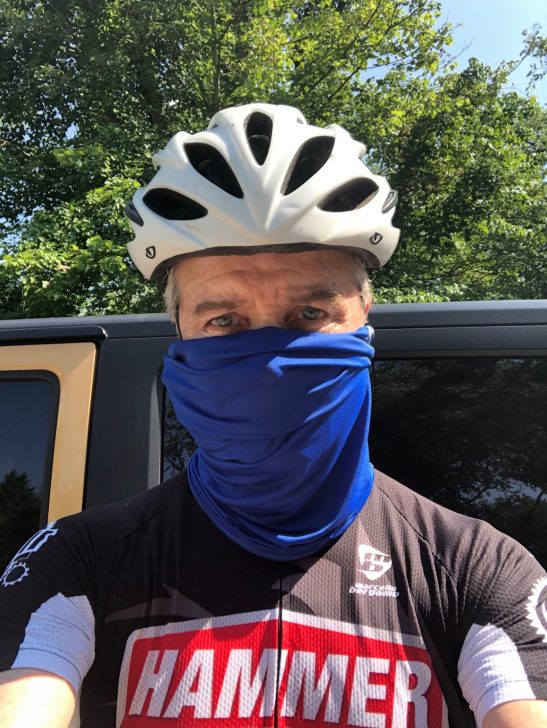
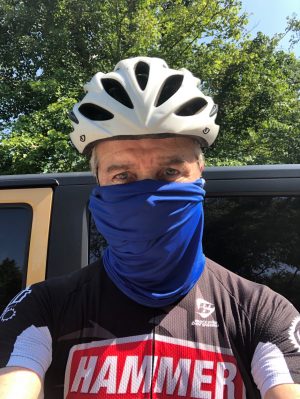
Pat in his ‘Rona mask, riding into great shape.

A Lot Of Us Are In The Best Shape We’ve Been In For Many A Year.

Gasping for breath up a steep climb recently on the mountain bike with my riding friends, I thought to myself, “Where is the race? Nobody’s going to the Olympics, why are we racing on this ride?” 

Then it occurred to me that my group and a lot of other groups of cyclists, runners, and other fitness enthusiasts are in really great shape.  People are not traveling for work or pleasure just yet, and a lot of folks have a lot of free time to get their work done at home and then go ride, run, walk, hike, or  some other form of exercise.  I am calling it Covid Fitness. and it is a national phenomena. 

I recently went into my local bike shop, Dirty Harry’s, in Verona, PA and learned their business is booming.  Barry Jeffries, the owner, told me that they have 350 bikes on back order and their repair business is off the charts.  Barry, Scott, Brocc, and the boys will have a record year in sales and service because a lot of people are turning back to cycling as a recreational activity during this pandemic. 

The health clubs are not fully operational yet and people need to get out.  What better way to do it than on a bicycle? As the bikes roll in the door from the manufacturers, the boys at Dirty Harry’s build them up as fast as possible and out the door they go.  Sold!!  All kinds of bikes.  High end mountain and road bikes, E-Bikes, kids bikes, commuter bikes, you name it.  They are selling like a fish sandwich in Lent. 

The Peleton home cycling exercise equipment is back ordered by at least six months and that is the case with a lot of sports equipment providers.  Most outdoor equipment manufacturers have had a strain on supply because of the surge in purchases due to the Covid 19 crisis.   A good news-bad news scenario for the sporting equipment industry in that record sales are being offset by a strain in supply.  They have the customers, many new to the sport, but are having a hard time keeping up with demand. 

So back to my group.  We have guys and gals who travel for work, guys and gals who are retired, and many working from home.  These folks have always been active but recently, they probably have ridden mountain bikes and road bikes more than they ever  have in recent years because the distractions have been put aside due to this pandemic.  I have complimented a lot of cycling friends on their fitness and their response has been, “Hey, Pat, I don’t have much to do.”  And, “We have not been able to go to work at the office, or sit and socialize in a restaurant, or go to a movie or concert, so really, outside of exercise, what do we have to do besides work at home  and read a book?” 

The end result is that a lot of us are in the best shape we have been in for many a year and my group keeps pushing, pushing, pushing every week on scheduled rides in various venues around our area of the country. The CDC says nothing better to combat this virus than boosting the immune system with sunshine and outdoor exercise. The texts and emails buzz every week with the proposed riding schedules, and the good thing is that at least we are not sitting around with nothing to do.

So, again, the pandemic has caused a lot of disruption to our lives as well as to lives all around the world.  It has caused a lot of us to reflect on what is really important in life and how we have taken things for granted.  This too shall pass, and the world will learn to live with these kinds of viruses and change our daily habits on how to deal with them.  But in the meantime, there have been some good things that have come out of this time and the great outdoors has been calling to a lot of us. 

Is A Hip Replacement In Your Future?

Here Are Some Tips From A Two-Hip Skier.

Here’s Harriet. Two new knees, two new hips. When it comes to joint replacement, she knows what she is talking about. Credit: Courtesy of Alta

Your decision to replace any body part is a serious decision. Unlike a purchase from a retail store, you cannot return an implant!

But when your “original equipment” wears out, it’s time to have it replaced. Overall, we’re living longer, we’re living healthier, and we want to enjoy life—and ski.

As background, I have two artificial hips, two artificial knees, and I skied 78 days during this last winter before resorts closed because of the Covid virus. Artificial hips and knees work really well.

Here are some tips if you’re considering new hips.

Choose your surgeon carefully. Your future depends on it. Pay the cost of visits to several surgeons. Those visits will help you choose the right one for you.

1. Ask hip questions

Here’s the list of questions I asked each surgeon. I printed a sheet for each surgeon and I wrote down their answers so I’d remember what each one said. Unexpectedly, their answers were quite different. Print out these question and bring them with you to each visit.

  • Do I need a hip replacement?
  • How many hips do you replace a week?  A year?
  • Do you do the surgery or does someone else do it?
  • Do you do anterior or traditional cut? Why?
  • GPS guided? Robotic? Manual?
  • What kind of anesthesia? Why?
  •  What brand of implant do you use?
  • Metal or ceramic?
  • Glue? What kind? Why?
  • Bone density. What if my bones aren’t good when you get in there?
  • Do you resurface instead of replace? Why?
  • How long in hospital?
  • Will I need help when discharged?
  • What kind of PT do you recommend?
  • Can I ski?
  • Why should I choose you?

2. Do a visual check

Are the surgeon’s shoes clean and polished? How’s the hair? It’s a quick measure of how well the surgeon values him/herself. Neat and clean is a good sign. Think twice if s/he’s scruffy.

3. Find out if he’s/she’s athletic.

A surgeon who is physically active will understand your need to keep your active lifestyle and ski. If she or he’s a golfer, plays tennis, bikes, water skis or is active in some sport, she or he’ll identify with your need to keep your body in motion.

Personal note, funny story:

I met with a noted—but fat—surgeon, and I asked: “Do you ski?”

He replied, “No, but I own a house at the resort!” And he said I should give up skiing. I eliminated him from my pool of possible surgeons.

Get your X-rays on a disc

Be prepared. Take the disc of X-rays with you each time you visit a surgeon so they don’t have to take new X-rays. Surgeons might be in different networks and therefore not have access to your X-rays. Or, even if they’re in the same network, the computer system might be down that day.

Before surgery, plan ahead for PT

Visit some physical therapy studios, ask about their rehab for hip replacement, and decide where you want to work out. Do that homework before surgery.

Personal note: When I came home, I did the prescribed home exercises exactly as I should. But the exercises got easy and I stopped making progress.  I was glad I’d checked out PT studios and switched to one with electronic equipment, gym-type equipment and a heartier workout. Recovery came quickly.

After surgery

Expect to start moving right away. Expect to be walking the day after surgery, and expect to have in-hospital physical therapy.

Personal note: I was in the hospital for a couple days and I progressed quickly. The PT studio stairs became too easy, so the PT therapist took me to the hospital stairwell for greater challenge and practice. On a nice day, we went outside and walked around the entire building.

Shoes and boots

Your new metal hip might like more cushy shoes or a different pitch than you’re used to. Buy your shoes and boots at a store such as REI that lets you wear them, see if you like them, and bring them back if they’re not right.

Personal note: With two metal hips and two metal knees, my body is fussy about what’s on my feet. I now buy all my footwear at REI so I can test drive them for a while in real life, not just in the store.

Look forward to a new hip. Work hard at PT. And I’ll look for you on the slopes.

To read Harriet’s five-part series on knee replacement, click these links.

Book Review: Fitness Can Be Everywhere, Every Day

How To Integrate Exercise Into Just About Everything You Do.

SeniorsSkiing’s readers all know and appreciate the value of fitness and exercise. Our surveys have shown that when the snow season is over, out come the golf clubs, bikes, tennis racquets, kayaks, hiking boots, and the like. Active lifestyles are us and part of who we are.
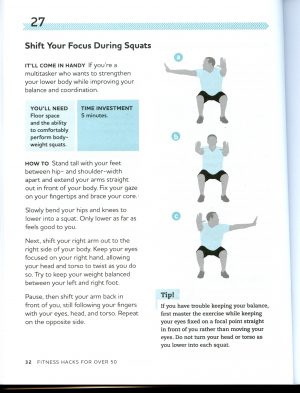
Enter the Corona Virus which, for reasons still unknown, goes after some people more viciously than others. Several risk factors are correlated with severity, according to Michael Osterholm, PhD, MPH, an internationally known infectious disease epidemiologist at the University of Minnesota. “If you’re over 65, you’re male, if you have underlying heart disease, hypertension, diabetes, certain lung or blood cancers or if you’re moderately to severely obese, then these are all risk factors for developing the disease,” said Dr. Osterholm in a recent interview. 

He goes on, “Healthy lifestyles are so important in reducing your risk for severe disease.”

Maybe your gym has been closed, you can’t ride trails in locked up parks, you’re bored beyond belief with walking your usual three mile loop, or, after four months of lock down, you’ve retreated to the couch and binge 0n Netflix. These are strange times, requiring new ways to do old things. Fitness is one habit to figure out how to maintain.

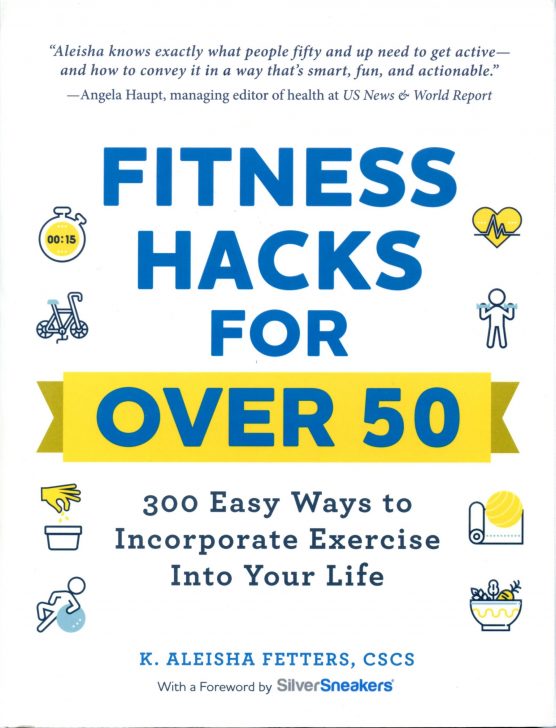
We recently received a brand new book that gives us 300 ways to keep that healthy lifestyle going.  Exercise specialist K. Aleisha Fetters’ Fitness Hacks For Over 50 is strike-zone for senior athletes and actives like us.

Fetters has created a number of simple things you can do—she calls them “hacks”—that build fitness activities into your day.  The book is divided into four major sections: Balance and Coordination, Flexibility and Mobility, Muscular Strength, and Aerobic Capacity and Endurance.  Note that while you are probably already engaged with a couple of these—we are overloaded on muscular strength—there are others that need attention.

For example, how many readers focus on Balance and Coordination activities, a skill critical to aging? Here’s an interesting one. Close your eyes when you’re exercising in place, brushing your teeth, making the bed, or washing dishes. Use your senses like hearing and touch to compensate.  Simple? Try it. This is a mental game—brain-body coordination—that’s really important to master as we age.

Fetters defines flexibility as being able to touch your toes—the ability for muscles to lengthen and stretch. She calls mobility the ability to get up off the floor—how your joints actually move.  Different things.  Some hacks here include Lifting A Knee while standing against a wall, Reaching Behind your back, one hand over the shoulder, the other coming up the back. In this category, there are a number of yoga asanas (poses) including a full Salute The Sun sequence.

In Muscular Strength you’ll find a number of class gym-type exercises as well as novel ideas like Hover Over A Toilet Seat, handy in public rest rooms, or Squeezing Your Cheeks. Yes, those cheeks.

Fetters has 75 ideas for upping your heart rate from Hitting Intervals to Tickling Someone to adding steps in the mall, the parking lot, the airport.

This is an excellent reminder to us that it is important to move the body in a variety of ways every day.  Fitness Hacks For Over 50 makes exercise accessible to us all, so we can continue our healthy lifestyle even though the gym is closed, and the couch is calling us.

Fitness Hacks For Over 50: 300 easy ways to incorporate exercise into your life, by K. Aleisha Fetters, CSCS, is available on Amazon for $12.99 (Kindle) or $15.99 (Paperback).


Spring Is Time To Bike Fit

Ride More, Enjoy More With Properly Fit Bike.

Harriet gets fit in a bike shop studio with an Oriental rug on the floor. Credit: Harriet Wallis

If you think your bike hates you, it’s time to schedule a bike fitting. If you hurt when you ride, there’s probably a mismatch between your body’s geometry and the geometry of your bike.

Sure, all bikes look pretty much alike. They have wheels, pedals, handlebars and seats. And they come in sizes – essentially small, medium and large. But your body’s measurements are more complex than that.

Unfortunately, many dedicated bike shops will say: “Find the bike you like and we’ll fit it to you.” That usually means they’ll jiggle the seat up and down.

A real bike fitting includes taking body measurements: shoulder width, arm length, leg length, sit-bone width, and more. You’ll have to ask around to find who’s the real bike fitter in your area.

Some physical therapists are qualified bike fitters, while others are bicycle fitting gurus. A skilled fitter can solve arthritis-related and other structure-related aging problems so it will be fun to ride your bike.

This is what the computer sees. Credit: Harriet Wallis

A fitting  can take about an hour, and the fitter is likely to suggest a different seat or stem or some other component to make it compatible with your body’s unique geometry. They can’t change your body, but they change the bike to suit your body! All this comes with a price tag, but it’s worth it if you want to have fun riding after the snow melts.

Here are some ways to figure out what’s wrong, but if you change one thing then something else will probably feel wrong. A real bike fitting should help you be “one with your bike.”

1. If your knees hurt, you’re seat’s probably too low, too far back, or both.

2. Ask a friend to watch you from behind. If your hips rock back and forth even a little bit, your seat’s probably too high.

3 If your hands, arms, shoulders or neck hurt, you’re probably too far away from the handlebars.

4. If your neck hurts, your handle bars might be too low, too far away, or both.

5. If you feel you’re just not getting enough power for your push, lots of things are probably out of whack.

Friend Laurie is fit by a physical therapist. He placed markers on key areas to analyze her alignments on the computer. Credit: Harriet Wallis

The Future Is Here

Among the thousands of reasons the abrupt end to the season is a bummer is this: Those of you who were planning to demo the Roam Robotics Elevate will need to wait until we’re back on the hill.

Roam Elevate backpack and control device

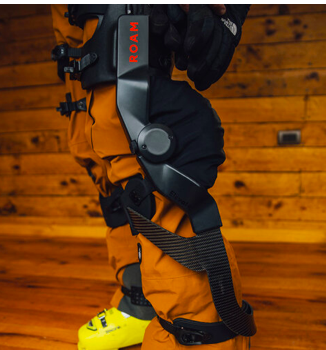
Elevate is world’s first computer-assisted knee exoskeleton for skiers.

I had the good fortune to try the device toward the end of February. I met DJ, a company representative, at Deer Valley on a bluebird day and we spent much of the afternoon trying the Elevate on a variety of terrain.

If you missed our earlier article reporting on Rick Hovey’s experience with Elevate, click here. I think that Rick, a PSIA II instructor and a person with a serious knee condition, reports more thoroughly on the many benefits Elevate delivers.

But I wanted to go on record with my positive experience and encourage any skier with knee or other orthopaedic conditions to give Elevate a test run.

DJ helped me get the exoskeleton on my legs; a simple procedure involving a few easy-to-fasten straps. It’s a good-looking product that the company keeps refining. 

Next, I hefted the pack containing computer, battery and air compressor onto my back and attached air hoses and power connections. The initial sense of weight and bulk disappeared quickly. That said, DJ explained that next season’s version will be lighter and sleeker.

We skied to one of the lifts and took a few runs. DJ asked if I could tell the difference. Elevate is supposed to anticipate your moves and send puffs of air to the exoskeleton to relieve pressure on the knees. I told him I didn’t feel a thing.

Then he asked me to turn it off. The control is a device mounted near the shoulder. I did what he said and immediately and dramatically felt the difference. Elevate had been assisting me in such a subtle and effective way that I couldn’t tell until I turned it off. Amazing!

Then we entered a field of moguls. DJ had suggested moguls farther down the hill that weren’t quite as big. I took that as a challenge and went where I shouldn’t have gone. Not that I don’t ski moguls. I do. But that day was the first using new skis (I had the bindings mounted that morning) and I was a bit tired, and…enough with the excuses. I fumbled my way down and felt foolish.

That was me, not the Elevate. By then I was ready to call it a day and we headed back to where we began.

Bottom line is that Roam Elevate is approaching the end of its development stage and will be ready for primetime and purchase next season. If the season were still going, I’d strongly recommend that anyone trying to avoid knee surgery for a while try Elevate. I’d also recommend it to anyone wanting to add more ski days to the week and more ski hours to the day.

Roam Elevate is an entirely new approach to assistive ski devices. Unlike others that wrap around the knee or use springs or pistons, Elevate uses intelligence to inform how it functions in real time. The manufacturer has been using its demo centers at nine major resorts in California, Colorado, Idaho, Montana and Utah to educate future purchasers, to collect more data, and to further refine an already highly developed piece of equipment.

It’s the future. And as all of us realize, especially at this moment, sometimes the path to the future has some bumps. The difference is that the people at Roam know where their path is taking them and they’re using this time to refine and miniaturize an already elegant solution to a common problem for older skiers.

Knee issues? Wish you had greater stamina? The solution is here and getting better. Tune in this fall.

Nordic Walking Burns More Calories

If You’re Going For A Walk, Bring Those Poles. Easy, Accessible Efficient.

Add Nordic walking to your virus-beating activities to stay in shape.

Staying active outdoors during the COVID-19 virus crisis is easy and very accessible with Nordic walking, which is a fitness activity that combines walking with specially designed poles to engage the upper body muscles. Like cross country skiing, the poles are used to match each step a person takes. It’s an easy, inexpensive workout with remarkable benefits, according to a study by the Cooper Institute, Nordic walking burns up to 40 percent more calories compared to just plain walking.

It’s better than walking because it provides an easier cardio workout by increasing the heart rate 5-17 beats per minute more than normal walking without increasing the perceived rate of exertion. It also provides an upper body workout that includes shoulders, arms, chest, and back muscles. And it’s a low impact exercise, so it’s easy on knees and joints.

A good pair of walking or running shoes, comfortable clothing, and Nordic walking poles will get anyone started. People of ALL ages and ALL fitness levels can receive the calorie burning and aerobic benefits of Nordic Walking. The winning combination of improved posture and the shock absorbing benefits of the poles help many individuals to walk comfortably – even those with balance issues, knee issues or new knees, hip issues or new hips, back issues (including those with rods in their back), weight issues, multiple sclerosis (MS), Parkinson’s, neuropathy, arthritis, bursitis, scoliosis, lumbar stenosis, fibromyalgia, post polio, osteoporosis, stroke recovery and other limitations to walking.

For those who are unfamiliar, trekking (hiking with poles) and Nordic walking are two different activities that use very different poles and techniques. It may sound silly, but perhaps “walking is not just walking.” The pole angle, weight, grip, and straps are different between those modes of walking. The Nordic walking pole is designed to allow your hands to relax in order to target the larger wrapping muscles of the back. But using poles of any kind automatically stimulates your spine and all of the muscles around it, even with inefficient technique. When walking, the key postural muscles of the core and upper body are engaged.

I’ve been a Nordic Walker for a few years and found many of the claims for the activity regarding posture and exercise to be true. I’ve always been in search of a way to decrease the amount of time spent exercising, so I was sold when I heard that using the poles increases caloric burning by 40 percent. Cross country skiers will find it easy to quickly master Nordic walking. As a bonus, after a summer of Nordic walking, I noticed a marked improvement in my cross country ski poling in terms of strength and timing. It seemed that I increased the amount of forward momentum that was attributable to poling and I was able to pole stronger and longer when skiing.

Nordic Walking provides an exercise foundation for anyone, ranging from those just looking for an activity to lose weight to health aficionados interested in taking it to higher levels of fitness

Transition To Cycling

“Start Slow And Taper Off.”

Keep your distance and take it easy, especially at one your first rides. Credit: Pat McCloskey

The ski season came to a screeching halt as most of us are now staying inside with some socially distanced outings.  As I look back on this shortened season, I can take heart in the fact that I made the most of it before cancelling my last trip.  Skied a lot in the rain locally, dropped some of the Daly Chutes in Deer Valley, and had a great time skiing with my wife and our dear friends out there in Utah.  Skied some great conditions again  locally and was looking forward to another trip with the guys this time and —voila!  Covid -19.  So, for me, I  sharpened and waxed the skis and put them away for another year and look forward to some dry trail time on the mountain bike. 

The good thing about transition time for us seniors is that we can go about it slowly.  We have paid our dues, and those of us who rode over the winter have a good base already on which to build. I have a friend who has a great saying when asked about how he will start his rides.  He smiles and says, “Start slow and taper off”.  We all laugh at this and have made it our motto, but, really, there is some truth to this especially in the spring.  There is no reason to be a world beater when it is still early. Like anything—running, gym work, or any other springtime resolution—if you start too fast or go too hard, you will most likely quit.  Especially if you are new to the sport or perhaps have not done your homework over the winter.  If you approach Spring with the idea that you will start slowly, each day becomes more and more enjoyable as you build your fitness. 

This social distance deal is a bit confining, so it is important to safely get outside and get some fresh air.  You can still build your fitness for the summer in a socially responsible way. For me, I look for trails that I know will not be crowded.  I went out yesterday, for instance, and saw two ladies on horseback—(seniors actually), and a family of hikers.  That was it. 

It was a warm and sunny day, and I felt good getting out under the socially correct protocol.  Eventually, we will be able to regroup with our friends and life will move on. 

For the moment, if you do venture out of your home, avoid the parks, and crowded trails and seek some solace in the more remote places.  A mountain bike is good for that, and, if you take it easy, you will find that you feel good getting out and not killing yourself.  I always say to my friends, “Nobody here is going to the Olympics so slow down.” We will all get through this.  Better times ahead but now is the time to be responsible and “Start slow and taper off.” 

“I Felt Like I Skied One Run, Not Eight”

[Editor Note: SeniorsSkiing.com is asking our readers to contribute to support our online magazine. Yes, we have grown in the number of subscribers and advertisers. But our expenses have also grown. You can help us defray some of these expenses by helping us out with a donation.]

Support SeniorsSkiing.com by clicking here.

______________________________________________________

Roam Elevate is a computer-driven exoskeleton that anticipates turns and adjusts knee and quad support to aid the skier’s natural motion. It helps people ski stronger and longer by offloading up to 30% of the user’s body weight from the skier’s quads and by reducing painful knee joint compression.

Elevate can be rented at several Western ski resorts and will be available for sale next season.

To get a better understanding of how Elevate works on the hill, we asked Rick Hovey to give it a test drive.

Rick Hovey and his signature turns.

Rick is 65 and is a longtime resident of Park City. A Level II PSIA instructor, he skis 100+ days a year. Last season, despite a diagnosis of chondromaiacia patella (arthritic knees), he skied one million vertical feet. 

Rick has put off recommended partial knee surgery, opting instead for Physical Therapy. He has given up teaching and reduced his time on the hill.

He tried the Roam Elevate a few weeks ago and submitted this report.

Clay, the Roam Robotics rep, showed me how to use the straps to attach the exoskeletons to my boots and then to my lower and upper legs.  It was simple.  

The product uses a slim backpack that contains a lightweight laptop, battery and compressor. Two connectors per side come out of the pack to attach to each exoskeleton. One connection is an air hose; the other is a connection to the computer.

While walking, the apparatus felt light and unencumbering, even if the exposed carbon fiber and wires made me feel a bit like RoboCop

We clicked into our skis as Clay explained the available settings. The controller is mounted on the shoulder strap and easy to use with gloved hands.  There are levels of assist and speed adjustments to suit your style and desired terrain. The speed adjustment sets how fast the computer tells the compressor to release the assistance pressure. In general, the idea is to quicken the speed adjustment for short radius turns or where unweighting is needed quickly. 

As soon as we pushed off I lost the sense I had an exoskeleton on and that it was assisting the load on my legs. It felt completely natural and improved my sense of stability.

There is a noticeable vibration from the compressor in the pack, which Clay says to think of it as a massage for your back (bonus!). The vibration became less noticeable after one lap.

A few runs later, we played around with different settings. I really liked the high assist and slow speed setting for the easy cruisers with long radius turns. I felt stronger and forgot about protecting my arthritic knee and I experienced more complete turns with less effort. It also gave me the confidence to lay down deeper carves than I would without the device.

We then changed the settings and tried linked, short radius turns on steeper groomers. I was impressed with how well this worked with no encumbrance of the inside ski hanging-up because the pressure was released right when needed. I used this same setting on a long bump run and was equally impressed. 

Roam Elevate backpack and control device

The apparatus always seemed to agree with what I was doing, while enhancing my skiing in a controlled and predictable way. 

I should mention the “chop.” Rough snow was on the edges of the groomed runs, just enough to rattle the bones if going fast… this is where I would normally take the first exit to Smoothsville. The Roam Elevate seemed to absorb the bumpiness; no jarring of the knee joints or loss of control. It was like a good suspension on a mountain bike.

After numerous fun and various runs, Clay and I did a final, fast top-to-bottom cruiser. At the bottom, I told Clay my legs and knees felt like I just skied one run, not eight! 

I would recommend the Roam Elevate to any skier who has knee and/or leg strength issues. And, if it helps you avoid surgery and extends your skiing life, the value could be great.

The Roam website is taking first-come, first-served reservations for a slimmed down, next generation product for $3500 (includes a 30% discount). To learn more, click on the Roam Elevate ad on the home page.

Have You Been Drinking? It’s Time To Start!

Hydration and Stretching: Two Things You Must NEVER forget to do before you hit the slopes.

If you’ve taken to heart the advice in a previous seniorssking.com article of Paul Petersen, president of Bear Valley Cross-Country in California, on the best way for seniors to get in shape for skiing, you’ve developed and faithfully followed a fitness regimen focusing on balance, strength, flexibility, and cardio. But the 56-year-old certified alpine and cross-

Bear Valley Cross Country's Paul Petersen swigs water, something we should all remember to do. Credit: Paul Petersen

Bear Valley Cross Country’s Paul Petersen swigs water, something we should all remember to do.
Credit: Paul Petersen

country ski instructor will quickly tell you that this is not enough. What you do in the days before and right up to the minute that you put ski or board to snow is just as important as all the pre-season conditioning you’ve done.

One of the most overlooked factors in preparing for a day on the slopes is hydration. When your body is well-hydrated, your body temperature and heart rate are more stable, your joints and muscles function better, and you have more stamina. Conversely, if you’re dehydrated, which can happen more quickly at elevations above 5,000 feet—especially to flatlanders, you won’t be able to perform well for any length of time, you’ll tire more easily, and you may experience dizziness, headaches, or shortness of breath. Says Petersen, “When it comes to hydration, you have to think ahead. You can’t properly hydrate for athletic activities the day before; you need to begin several days beforehand. Remember, you’re not trying to hydrate your stomach, but rather your joints and muscles and that takes a while.”

If you’re a typical skier, before you head out for the slopes, you probably have a cup of piping hot coffee or tea in the lodge (this may be in addition to the glass or two of wine you had at dinner the night before). This is a total recipe for dehydration! “Any liquids with caffeine or sugar, including sodas,” says Petersen, “are NOT a net positive in the hydration department!” For every cup of coffee or other caffeinated beverage you drink in the morning or while on the mountain, Petersen insists that you drink an equivalent amount of water.

Noting that senior wintersports participants schedule longer trips and thus ski more consecutive days than the average skier, Petersen emphasizes the importance of recovery for seniors after a day on the slats and boards. “Right after you’re done on the slopes and before you hit the bar, hit the protein bar,” he strongly advises. “For me, the magic bullet is protein powder in water. Either helps you recover from that day and helps your body get ready for the next day.”

An equally important factor in ensuring a safe, fun day on the slopes is adequately stretching your muscles right before you start out. We’ve all done those cursory arms over our heads while stretching our waists and quick calf stretches, right? Not good enough per Petersen! “You can’t just touch your toes, grab your ankles, stretch your thighs, and then walk out the door,” he warns. “The night before, put aside a few minutes to stretch your hips, calves, and thighs, and again the next morning before you put your boots on, either in the parking lot or at your locker.”

In sum, make “water, stretch, go” your wintersports mantra if a perfect day “doin’ it” is what you’re after!

Foam Roll Out Those Nasty Knots

An amazingly simple and immediately effective DIY massage relaxes stiffness and removes pain

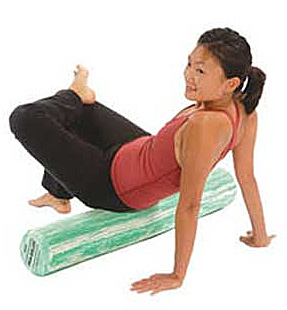
The foam rolling technique of self- massage is exceptionally beneficial in increasing athletic performance, reducing pain, and helping with injury recovery/prevention —especially for older snow enthusiasts.

The medical term for rolling out is self-myofascial release.  “Myo” means muscle, and “fascial” refers to the fascia, a framework of

Foam Roller gently elongates tight muscles and relieves pain. Credit: Protherapy Supplies

Foam Roller gently elongates tight muscles and relieves pain.
Credit: Protherapy Supplies

connective tissue that covers the muscles and organs in one continuous structure from head to toe, like a tight sweater over our musculoskeletal system.  A restriction in one area can affect fascia and muscles in a completely different part of the body, not unlike pulling fitted polypropylene long johns in one direction and causing the fabric to twist and tighten on another part of the frame.

When fascia is restricted (e.g. injuries, surgeries, poor posture), the muscle beneath may not be able to return to its normal length after contracting, resulting in compromises in range of motion, blood flow, nerve stimulation, and lymphatic drainage.  This produces an inflammatory response and nasty little trigger points—or “knots”—that develop in the muscle and/or fascia. Any pressure applied to these trigger points can cause pain.

It’s not uncommon to feel areas of referred pain from another part of the body when compressing a particular trigger point, something to expect with the rolling device.

The good news about trigger points is that when pressure is repeatedly applied against a rolling device in a slow manner with the person taking FULL, DEEP breaths, the pain dissipates quickly, eliminating the myofascial

A massage ball can really concentrate gentle pressure on knots. Credit: Pro-tecathletics

A massage ball can really concentrate gentle pressure on knots.
Credit: Pro-tecathletics

restriction and allowing the muscle to elongate and nearby joints to move fluidly with increased blood flow to the area. The result is enhanced athletic performance.

It’s best to roll out before heading to the mountain.  Your muscles will be more supple, and your joints limber and pain-free. For maintenance, roll out daily, either at night or in the morning (or if you can, both.)  Start small and progress to longer sessions of myofascial release. While this technique works for all physical activities, skiers should focus on the lower body–hamstring, IT band, Achilles, quads. That said, don’t forget to include the back and any other areas of chronic pain. And for your (HIGHLY recommended) post-skiing stretch, roll out first.

You may have some pain at first, but that should subside after a few times rolling out. In fact, your muscles may soon crave the roller at the end of a long day on the mountain, even more than you crave that après ski beer.  And with some dedicated time to rolling out, don’t be surprised if your body feels years younger! It may hurt at first, but the pain should subside after a few times rolling out. In fact, your muscles may soon crave the roller at the end of a long day on the mountain, even more than you crave that après ski beer.

[Ed Note:  We have tried myofascial self-massage and can report immediate relief from lower back pain stemming from tight hip flexors and knotted piriformis muscles.  Your mileage may vary, but we are very impressed with this technique. As these videos show, you can use a foam roller or a massage ball.  We used a hard lacrosse ball to really focus on tight knots. Here are some links for rolling exercises and products:] 

Runners World Foam Roller Instruction Series

Finally, some rolling device vendors:

OPTP Foam Rollers

Orb Massage Balls


Ski Instruction

Gone In A Flash

What Happened To Me And WhyYou Should Treasure Your Health And Fitness.

As I get older, each ski season is more precious than the one before.  I’m pushing 60+ years of skiing, and early in my life, I learned never to take one for granted.  Except for being deployed overseas during Vietnam and Desert Shield and Storm, I haven’t missed a ski season in decades.

There is a rhythm to my ski year.  After the ski season, I change my conditioning routine and start ramping back up after Labor Day up so that by December, I’m ready to ski my usual 25,000+ vertical feet.  Yes, at my age I’m bragging!

On August 23rd, my routine changed thanks to a bacterial infection in my right elbow.  During the bursectomy, the surgeon found an infected ulna bone, tendons and muscles in my forearm.  Aaaaaaarrrrggggghhhh!

Samples were sent to a lab to grow cultures and find out what the bug was.  Over the next four weeks, the four drains were slowly removed.  Exercise was not possible because dirt in the sweat could lead to a staph or other type infection, and I had very limited use of my right arm.

Eleven weeks later, the culture and susceptibility tests told the doctors that the infection was a hard to kill avian acid fast bacilli.  It takes a combination of three powerful antibiotics taken daily over eight to 12 months to kill it. It gets worse because this is one of the bug that often develops immunity to antibiotics so sometimes in the middle of the treatment, one has to start over.

As luck would have it, I had an allergic reaction to the antibiotic that was the most effective against the avian bacilli that sent me to the emergency room having difficulty breathing, a 102 degree fever, rashes and hives all over my body.  I was off everything other than steroids and antihistamines to get my system back to normal.

The bug and the toll the antibiotics were taking on my body sapped my stamina.  I’d work on a book for four to five hours in the morning and after lunch, I was exhausted and it was nap time.  By nine at night, I was ready for bed!

Exercise, you have to be kidding!  Go skiing?  No way.

So now in early December, two MRIs and two sets of x-rays later, I’ve started walking again and am up to about four miles every day.  By the time this is published, hopefully I’d daily sessions on an elliptical or a stationary bike.

Next major checkpoint is another MRI and x-rays in early January to see if my ulna bone is continuing to heal.  Blood work every other week gives an indication the drugs are working.  My goal is to ski late in late March but its 50-50.

The point of this piece is simple.  Don’t take any ski season for granted.  Each season, each trip, each run is precious, and they could be taken away from you in a flash.  Just ask!

Have A Banana: A Senior Skier’s Friendly Fruit

A banana a day goes a long way in keeping you fit.

[This article was originally published in October, 2014. The message is still relevant and worth reprising. Put a banana in your boot bag!]

We have recently discovered the magnificence of bananas which we long regarded as a kid food and something to by-pass on breakfast buffets. Wrong attitude.  Turns out, bananas have multiple benefits for those who are active, especially senior snow enthusiasts.

Fun Fact: Bananas skins can help mollify mosquito bites. Credit: Mike Maginn

Fun Fact: Bananas skins can help mollify mosquito bites.
Credit: Mike Maginn

For starters, have a banana before you ski to give you a natural  and fast energy boost.  And they are high in potassium which makes your internal electrical system—heart, muscle cells—working very nicely, reducing chances of muscle cramping.  Sour stomach, acid reflux?  Have a banana to coat your stomach lining; bananas are a natural antacid. Not feeling regular?  Have a banana which contains soluble fiber to keep you moving.  Working on low cholesterol numbers?  Have a banana; zero cholesterol.  Saving your pennies?  Have a banana; they are remarkably inexpensive, given the number of great things that come from them.

We’ve barely scratched the surface on how wonderful bananas can be.  For more, check out this list of 25 banana’s powerful benefits.  We never expected to see shoe shining on the list, but there it is.  Also, for more about health benefits, see this article.

Regardless, bananas, you are still a funny fruit.

Recreational Therapy For Injured Vets

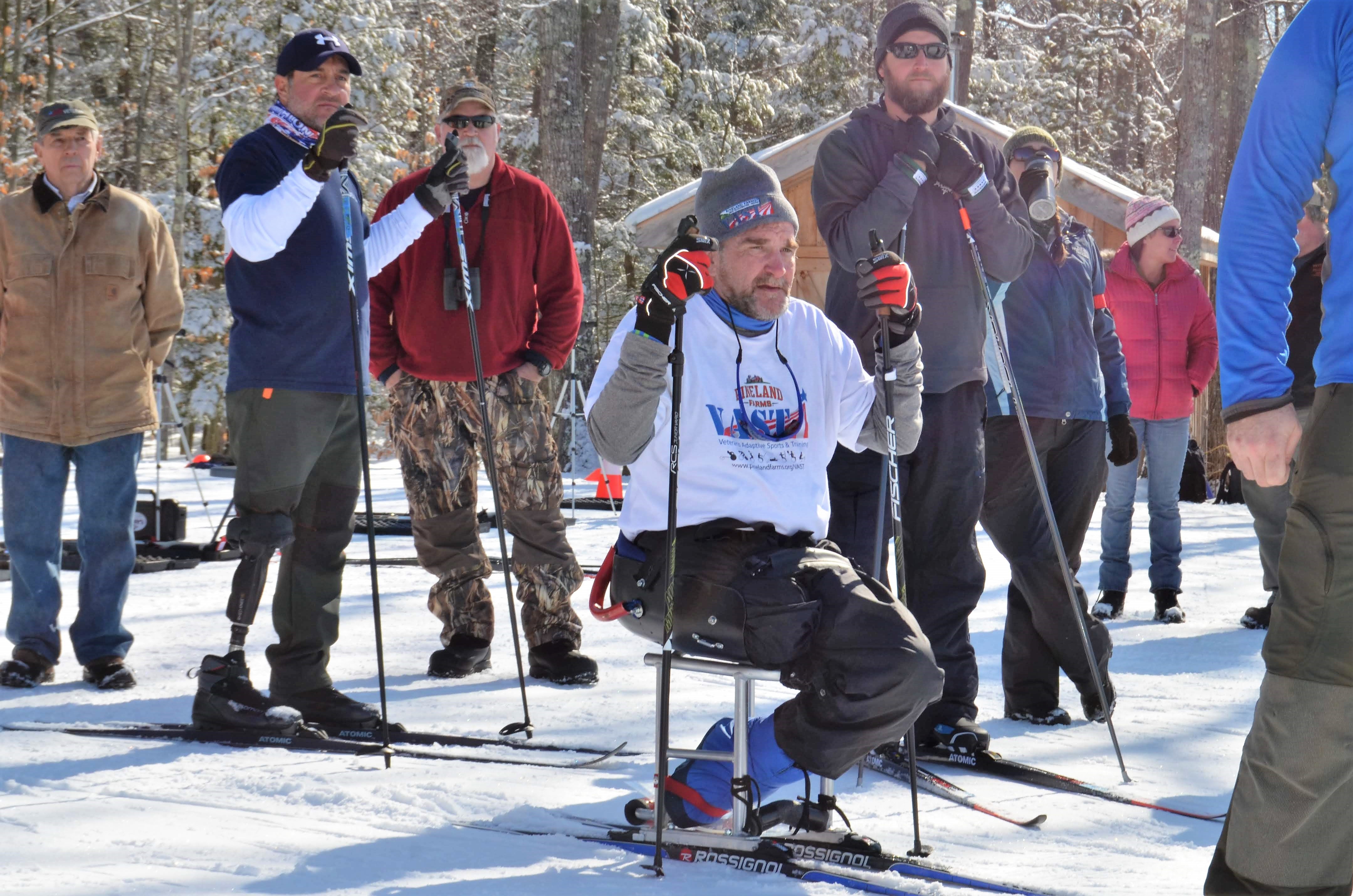
Pineland Farms Veterans Adaptive Sports and Training in action.

More doctors may be prescribing outdoor recreational therapy instead of Xanax if the proposed Federal legislation entitled the Outdoor Recreation Therapy for Veterans Act (HR 2435) passes. Studies are showing evidence that outdoor recreational activities can be therapeutic. I met Veterans Ray Gilmore and David Binford recently at a ski industry meeting, and they were engaging anyone who would talk with them about the Azimuth Check Foundation, which provides injured veterans and first responders challenging year-round athletic activities to create wellness in an atmosphere of camaraderie.

“Whether these vets have seen or unseen injuries, they can find peace in the outdoors,” they said. They feel that participation in activities such as alpine and Nordic skiing, snowboarding, kayaking, hiking, fishing, cycling, indoor rock climbing, wood carving and art, aquatics, golf, water skiing, stand up paddle-boarding, archery, and even bowling will build self-esteem and accomplishment.

Some veterans and first responders who have experienced visual impairments, amputations, and other physical and mental challenges have discovered organizations that orchestrate recreational activities, which can positively impact their well-being through adaptive recreation programs. Azimuth partners with other organizations such as the Veterans Adaptive Sports and Training, Adaptive Sports of the North Country, Ability Plus Adaptive Sports, Vermont Adaptive Ski & Sports, and Northeast Passage.

Misha Pemble-Belkin of Vermont Adaptive Ski & Sports’ Veterans Ventures program commented, “I’ve taken anti-depressants and done talk therapy but nothing I tried has worked. It was like my brain was still at war.” Different than working with healthcare providers in an office setting, this real world/real time approach to creating solutions for active and engaged living takes the guess work out of what happens when you go home or are discharged from care.

Gilmore talked about difficulty “shutting the motor off whereby the adrenaline remains and has become toxic.” The recreational activities help to create new memories and meaningful relationships. Beside physical challenges, many vets are faced with post traumatic stress (PTSD). While a stigma may remain about this condition, more veterans are now acknowledging it and seeking help.

Some of these program participants express that they’ve have had enough of meds and therapy Recreational programs can stimulate problem solving, collaboration, camaraderie, relevant and meaningful goals, as well as develop sustainable healthy behavior.

One vet referred to taking “meds” which made him feel like a “zombie” and took away the passion and joy of life. That vet commented that participating in recreational programs and outdoor activities such as skiing, hiking, rock climbing has helped to re-instill periods of passion and joy in his life.

How does it work?

At Northeast Passage, a recreation therapist (RT) meets with an individual to complete an initial assessment.  The RT talks about health conditions, interests, personal strengths, and local resources.  They will also use standardized assessment tools as part of a collaborative process to identify goals, and a plan for achieving them, while working together.

In follow up appointments, the vet and RT are in the community actively engaged in recreation. At the same time, they’ll likely be creating community connections, learning about equipment, developing skills, and aspects of themselves that support continued active participation and a healthier experience.

Kristina Sabasteansk,i an Army Veteran, runs programs at Pineland Farms’ Veterans Adaptive Sports & Training in southern Maine, which offers year-round programming for vets with disabilities. She said, “Last year we took veterans and volunteers to Maine Huts and Trails in Kingsfield, ME. It was -9 F the day we left to go home, and there wasn’t a single complaint among the group. Sometimes the vets crave challenges similar to what they experienced in the military such as harsh winter conditions and strenuous activities.

Pineland Farm’s yearly Biathlon Camp had 16 Veterans with disabilities – ranging from SCI, amputations, TBI, blindness, PTSD and TBI, and other orthopedic issues. “Many had never even seen snow before the camp and by the last day they cross country skied and competed in a biathlon race against each other. These trips and activities with fellow Vets allow them to share their experiences in the military and they realize they are not alone in their struggles.”

Retired SSG Misha Pemble-Belkin of Vermont Adaptive Veteran had 170 vet participants for more than a thousand activities including winter sports such as skiing, XC skiing, and snowboarding. “It’s vets helping vets to learn these sports.” According to Pemble-Belkin, “There was a study of 1,200 Vets who were split into a group taking three of the major meds and a group taking a placebo, and it showed similar results. While the war experience was stored in your brain, outdoor recreation can provide some joy and passion that is a relief to the miserable times being home alone or unengaged.”

For more info:

Azimuth Check Foundation: acfne@azimuthcheckfoundation.org

Pineland Farms VAST Program in southern Maine with Kristina Sabasteanski Kristina@pinelandfarms.org

Northeast Passage in NH with David Lee david.lee@unh.edu

Vermont Adaptive Ski & Sports Veterans Ventures with Misha Pemble-Belkin veterans@vermontadaptive.org

Shape Up 3: Challenge Yourself

Five Basic Exercises Ramped Up To High Intensity Levels.

[Editor note: This is the third and final in our series of preparation exercises for senior skiers from Rick Silverman, physical therapist and certified strength and conditioning specialist. We started with basic hip and leg exercises (Oct 25), raised the intensity of those (Nov. 7) and now present a more challenging level of those same exercises.  As you can see, these are clearly a step up in intensity. Use these to extend your exercise program.  If you haven’t been limbering up so far this season, don’t start here.  Seriously.  These are challenging.  As always, if you have any issues, complications or questions, consult your medical advisor before beginning.]

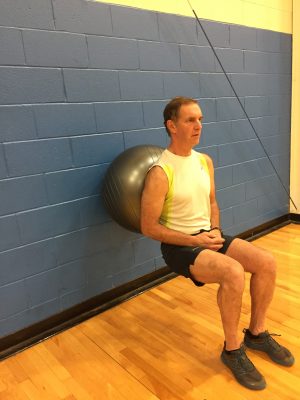
 Quad Squat Jump

Last time, we introduced the Static Quad Wall Sit.  In this one, we get dynamic. Use a small exercise ball or a light weight. Squat down, jump up.  Repeat.  Try doing this for 20 seconds on, 10 seconds off for two minutes.

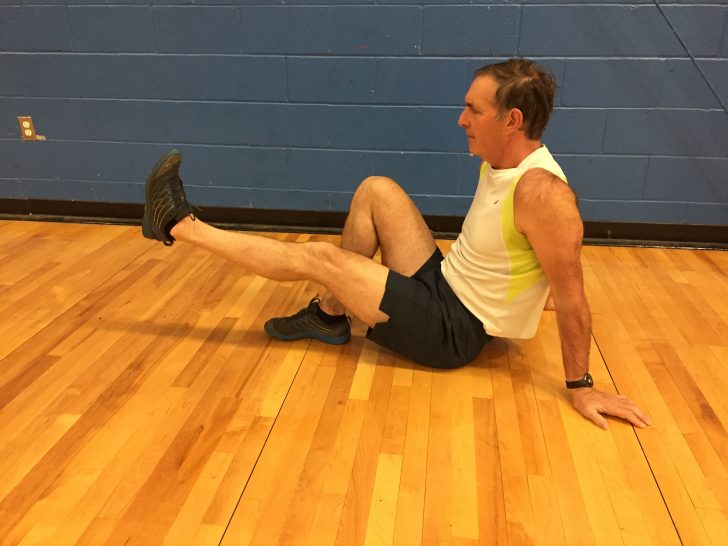
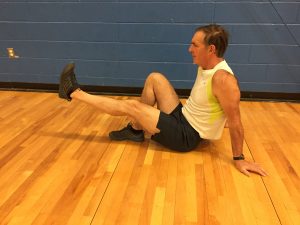
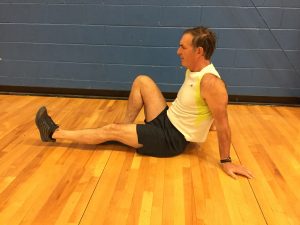
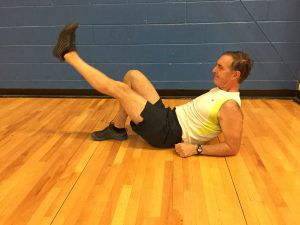
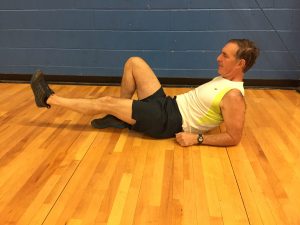
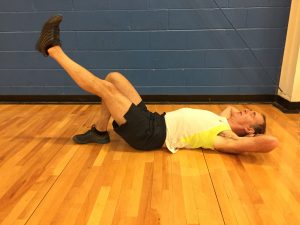
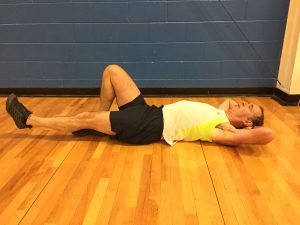
Leg Raise Sitting Up

The key is straight leg and toe pointing up.  Support yourself on your hands.  A variation is to point your toe inward on the way up and outward on the way down.  And vice versa.  Don’t let your heel touch.

legraise_situp_1legraise_situp_2


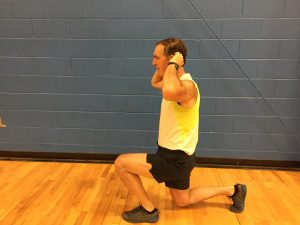
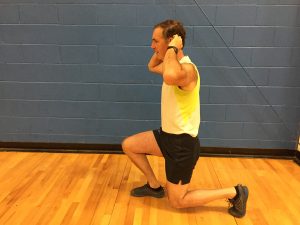
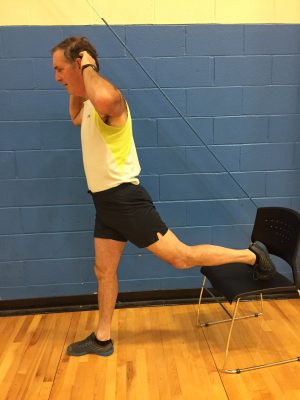
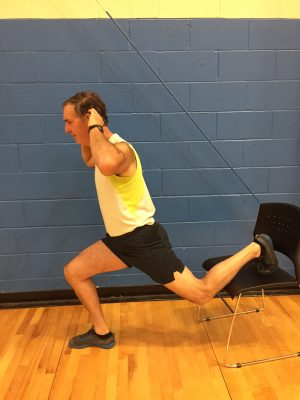
Dynamic Lunges

Rick has been a Telemark skier for 25 years.  He said this move imitates the same leg motion used in making Tele turns.

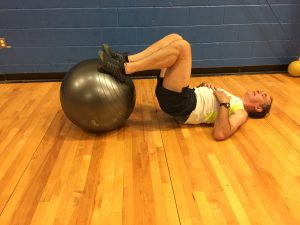
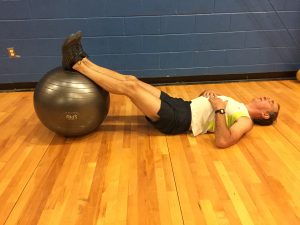
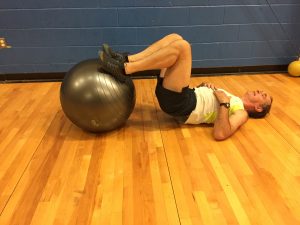
Hamstring Bridge

Keep the ball rolling in and out.  Use a chair with rollers.  Watch your lower back on this one.

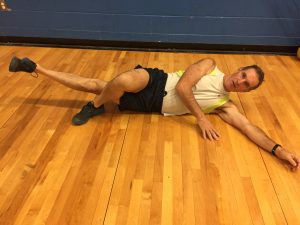
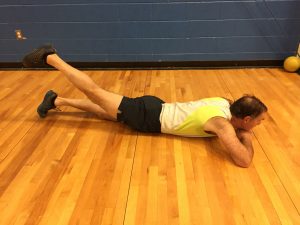
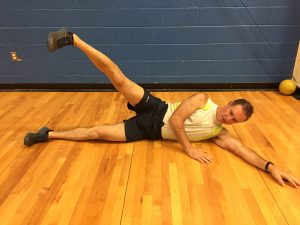
Inner Thigh Lift

In previous articles, we showed you how to work your glutes and outer hip flexors.  Here’s one to use for the inner thigh.  You might want to rotate through all three exercises in your work out.

hipflexor_inner


A huge thanks to Rick Silverman for showing us how to ramp up for the snow sports season.  If you don’t have a regular exercise work out habit, consider starting with our first series of exercises here.  But, please, don’t start the season without some physical preparation.


Shape Up 2: Up A Notch

Revving Up Intensity For Our Five Basic Exercises.

[Editor Note: Last month, we reprised a set of baseline exercises focusing on legs and hips as part of a get-ready strategy for this season’s snow sports activities that was originally published in 2016.  This week, our exercise guide, physical therapist, certified strength and conditioning specialist and teleskier Rick Silverman, shows us how to up these exercises to the next level. As with any exercise plan, make sure you don’t overdo it; recognize your limits. If you have any issues or complications, please check with your medical advisor. In a couple of weeks, we will show you the highest intensity level for these activities.]

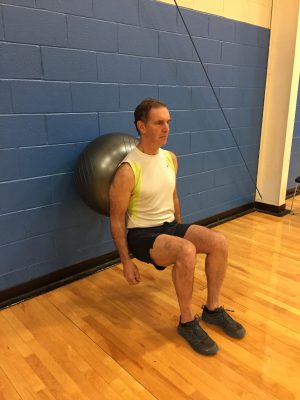
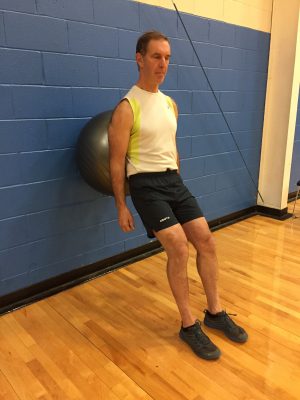
Static Quad Wall Sit

We used to do this in our college freshman dorm as a macho challenge. Sit against the wall, legs at 90 degrees.  You can use a ball, as Rick does here, or just lean against the wall.  Start with a relatively comfortable time, say, 20 seconds. Work your way up to 60 seconds. And don’t overdo this one!

quadwall_static_1


Sit Up Leg Raises

Bring your upper body up, support yourself on your elbows.  The key here is keeping your leg straight and toes up.  Don’t rest your heel on the ground on the downbeat. A variation is to point your toes to the right on the up and to the left on the down and vice versa.

legraise_sit_1

legraise_sit_2


Alternating Lunges

Bend knee to 90 degrees and no more. Alternate right and left if you want or do eight reps on the right, eight on the left and repeat.

lunge_alt1

lunge_alt2


Hamstring Bridge

You can use an exercise ball for this or a chair with rollers.

hamstring_bridge_1


Glute Leg Raise

Add this hip area exercise to the Outer Hip Abductors we showed you last time.  Remember, hip strength plays a big role in all snow sports moves. You will feel this in your butt, for sure.  Don’t raise your leg too high. Again, work your way up to 16 reps x 2 sets.

hipflexor_glute


The most important take-away from all this is to do something to get into shape for the snow sports season.  Cycling, hiking and all those other summer sports are terrific conditioners.  If you’ve been active all summer, try some of these as a test of sorts to see where you stand, conditioning-wise.  If you’ve not been as active, please take time to run through some of exercises. If you do these every other day, you will start seeing results in a couple of weeks.

Shape Up 1: Easy Starters for Seniors

Ease Into Shaping Up For Snow Sports With Five Basic Exercises.

This is an archive article reprised from Oct, 2016.

[Editor Note: It’s time to focus on strengthening legs and hips for snow sports.  This year, we are going to offer three “flights” of exercise with increasing challenge and intensity for the same group of muscles. We’ll publish these about two weeks apart, so get started now. We asked Rick Silverman, a physical therapist and ultra marathon athlete from Ipswich, MA, to suggest which exercises to focus on and to demonstrate them for you. Rick is a Certified Strength and Conditioning Specialist with an MS in Physical Therapy.  He’s also a 25-year telemark skier, climber and kayaker.  As with all activities like this, you may want to check in with your physician if you have any questions or complications.]

Please don’t start the snow sports season without toning up your muscles.  If you don’t get into shape, you’re inviting strains and sprains at the the very least.  You’ll tire more easily and, at the end of the day, you’ll be risking more serious injury.

Here are five basic, get-started exercises that you can do with minimal time, equipment and space. This exercise series will just focus on hips and legs. There are other resources online for core, lower and mid-back and shoulders and arms. We will add intensity and variation to these basic exercises in a couple of weeks.

Do at least two sets of eight reps of each for starters.

Quad Wall Squats

Either use an exercise ball or just slide up and down a smooth wall.  Squat down so your thighs are 90 degrees to your lower leg, and no further.

quadwall_ball_2quadwall_ball_1


Leg Straight Raises

The key with this one is keeping the leg you are raising straight and your lower back flat on the floor. Feel that hamstring! Raise to 45 degrees and down, not letting your heel touch the floor.

legraise_1 legraise_2


Static Lunge

Here’s one that focuses on hips and quads. You can put your back leg on a chair or on the floor.  Great one for balance, too.

staticlunge2staticlunge_1


Hamstring

Keep your butt off the floor. If you don’t have an exercise ball, use a desk chair with rollers.

hamstring_1 hamstring_2a


Outer Hip Abductors

Tight hips can cause mischief if they are not strong and supple.  These muscles run up to the central back and down to your knees.  If you have back problems, strengthening hips and core might help. This exercise is for the outer hip abductors. We’ll work the other hip muscles in a few weeks. Try to keep your toes pointing straight ahead.  A variation is to lift your leg with toe pointing down and lowering with toe pointing up.  Then reverse the pattern.

hipflexor_outer_


In a couple of weeks, Rick will show you how to notch up these exercises to the next level.  Right now, get some of these started.  And Just Do It!


Stem Cell Injection Alternative To Knee Replacement?

[Editor Note: Robert Leaverton presents a positive experience with stem cell therapy for ailing knees. However, there are many caveats in pursuing this route. As Robert indicates in his conclusion, there are some indications that the therapy may have gotten ahead of the science. For a report on the state of stem cell therapy for joint repair, see this NYT article.]

I am a very active 82 year old skier, former runner. My knees were in pain to the point that I had to consider replacement if I wanted to continue skiing. I live and ski in Utah during the ski season. I ski at least six days a week,  seven if the POW is good.

Viable alternative? Research carefully, caveat emptor. Results may vary.

I went to a stem cell seminar in Spring 2018. I listened to the information and decided I should investigate further. I had the exam, some x-rays, and it was determined I was a good candidate for stem cell therapy. The previous ski season was a painful time. I was taking OTC pain meds to be able to ski all day. If my knees touched while I was sleeping, I would wake up. I knew that if I wanted to continue skiing, I would have to do something. I also knew that there was no guarantee SC would work, and I would pay $4,000 for each knee. I did not want to endure general anesthetic, pain, and re-hab. There is high success for total knee replacements, but no absolute guarantee.

I went to Wisconsin Stem Cell Therapy for injections in May 2018. The stem cell injections in each knee were painless. [Editor Note:  Stem cells are extracted from a patient’s own bone marrow and injected into worn or injured joints to promote healing.] I did therapy as suggested, and the results have been way more than I expected. I was being practical, and I would have been happy with 60 or 70 percent improvement. I rate my stem cell therapy as 100 percent success. I waited until I was done skiing for the season to make a final judgment of the SC therapy. After many years of painful skiing, I had a season with NO knee pain.

I have returned from more than two months in Utah. Had great snow and a lot of powder. Wind and visibility made for some difficult conditions (bumps & drifts) that were a real test for the SC therapy. SC therapy has been a huge success for me and will allow me to enjoy skiing for many more years.

Without any hesitation I would recommend stem cell therapy for anyone who suffers from joint pain and wants to continue to be active and enjoy life to the fullest.

Caution: When considering a clinic for stem cell therapy, be sure you investigate the clinic thoroughly. There are some “snake oil salesman” out there.