Keep Moving: Fighting Arthritis With Activity

Here’s What You Can Do To Manage Your Inevitable Osteoarthritis.

If you’re a snow-sport enthusiast and subscriber to SeniorsSkiing.com, you are most likely a senior with an active life style.  We know from our SubscriberSurvey 2015 that many of our respondents not only enjoy Alpine skiing, but also Nordic and snow shoeing, and you ski a lot.  More than 55 percent of the responses say they ski more than 30 days a season.  Anecdotally, we’ve also heard how our subscribers love to hike, cycle, kayak and generally keep moving all year round.

In a recent article by NY Times Personal Health columnist Jane Brody, we see how critically important it is for seniors to keep that kind of active lifestyle.  Not only does activity help stem arthritis, reasonable levels of activity help avoid other chronic health problems. Brody quotes a researcher at the Alabama Research Institute on Aging: “As we get older, if we don’t get up and move around as much as we can, then we soon won’t be able to move at all.”

Read the Comments section attached to this article as well.  There are some insights and advice from NY Times readers you might find interesting.  If you’d like to comment on SeniorsSkiing.com, please do.  How do you stay active?  What does that do for you?  What’s your challenge in keeping in motion?  What works that you can share?

NY Times Columnist explains why activity is a way to fight arthritis. Credit: NY Times.

NY Times Columnist explains why activity is a way to fight arthritis.
Credit: NY Times.

Try Nordic Walking: Many Benefits By Adding Poles To Hike

Poling While Hiking Is An Exercise Multiplier

Roger Lohr is co-founder and editor of XCSkiResorts.com and a noted writer on all the varieties of Nordic skiing.

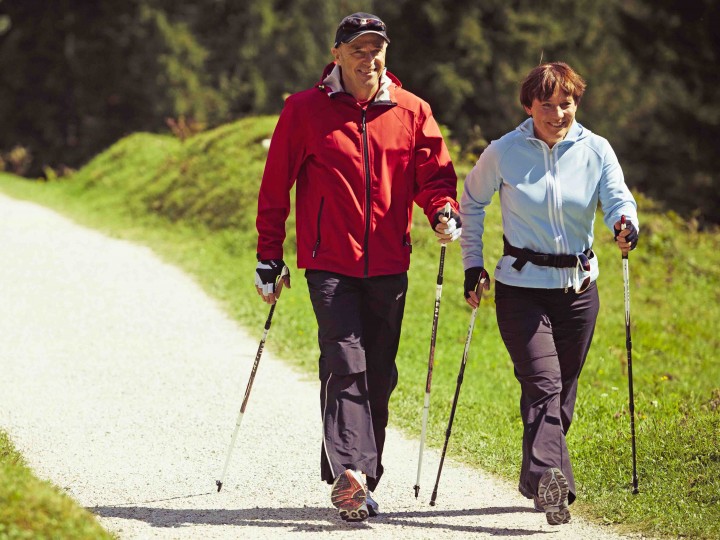
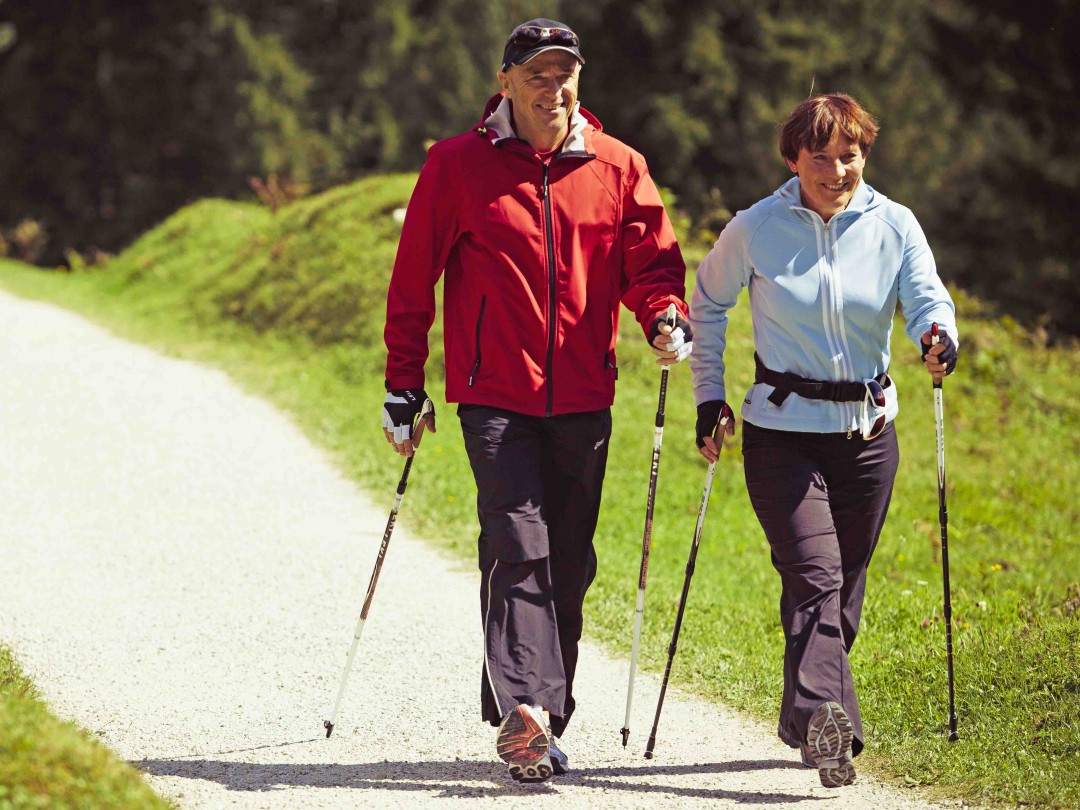
Walking a la Nordic raises efficiency of exercise by 40 percent. Credit: Leki

Walking a la Nordic raises efficiency of exercise by 40 percent.
Credit: Leki

More than 10 million Europeans of all ages and fitness levels are Nordic Walking (also known as Ski Walking) with special Nordic Walking Poles. This new fitness activity turbo-charges the normal walking regimen burning as much as 40 percent more calories compared to regular walking.

For those who are unfamiliar, Nordic walking is a fitness activity that combines walking with specially designed poles to engage the upper body muscles.

Nordic Walking poles help individuals with balance issues, knee issues or new knees, hip issues or new hips, back issues (including those with rods in their back), weight issues, multiple sclerosis (MS), Parkinson’s Disease, neuropathy, arthritis, bursitis, scoliosis, lumbar stenosis, fibromyalgia, post polio, osteoporosis, stroke recovery, cancer recovery, and other limitations to walking. Nordic Walking is helping thousands of people get off the couch, get outside, start walking safely, and effectively launching much needed walking campaigns.

The Human Kinetics book entitled Nordic Walking for Total Fitness by Suzanne Nottingham and Alexandra Jurasin covers the topic. Trekking (hiking with poles) and Nordic walking are two different activities that use very different poles and techniques. It may sound silly, but perhaps “walking is not just walking.” The pole angle, weight, grip, and straps are different between the aforementioned modes of walking. The Nordic walking pole is designed to allow your hands to relax in order to target the larger wrapping muscles of the back. But using poles of any kind automatically stimulates your spine and all of the muscles around it, even with inefficient technique. When walking, the key postural muscles of the core and upper body are engaged.

The book also includes fitness assessments, sample workouts for varying levels of interests from first timer to cross training triathletes. There are also suggestions about customizing your program. Training program recommendations are offered for building distance, fluctuating daily intensity, and rest days.

I’ve been a Nordic Walker for a few years and found many of the claimed attributes in the book regarding posture and exercise to be true. I’ve always been in search of a way to decrease the amount of time spent exercising, so I was sold when I heard that using the poles increases caloric burning by 40 percent. Being a cross-country skier, it is easy to quickly master Nordic walking. After a summer of Nordic walking, I noticed a marked improvement in my cross-country ski poling in terms of strength and timing. It seemed that I increased the amount of forward momentum that was attributable to poling and I was able to pole stronger and longer when skiing.

Nordic Walking for Total Fitness provides a foundation for anyone, ranging from those just looking for an activity to lose weight to health aficionados interested in taking it to higher levels of fitness.

Nordic Walking for Total Fitness is available for $19.95 plus shipping from Human Kinetics at www.humankinetics.com or call 217-351-5076. 

A Worry In The Woods: Tick-Borne Powassan Virus

Shifting From Snow To Summer Activities?  Beware Of This New Menace.

We’re starting to hike or bike in the woods between the receding snowbanks here in New England.  We’ve just learned that you better make sure you review your tick-avoidance-and-protection practices.  Powassan virus is yet another tick-borne disease that, according to this new report from CBS, can be lethal.  So, this is very serious stuff to pay attention to.  Don’t get complacent: check this site for more information on ticks and tick checks before you head to the woods.

Click for CBS News story on Powassan virus in Connecticut.

Click for CBS News story on Powassan virus in Connecticut.

Adult Stem Cell Therapy For Skiers

Is This Trendy Therapy Right For What Hurts?

Just a week ago, a skier friend underwent stem cell therapy for his painful knee. Ever since, he’s been sending me emails extolling the wonders of this cutting edge technology. We’re all skiers and our knees take a beating over time, so when he began singing praises about adult stem cell therapy, I took notice and became curious. Then I did some superficial homework on adult stem cell therapy. There’s good news and bad news.

Not exotic fruit, fellas.  It's a blossoming stem cell that can be used in healing senior skier joint ailments.;

Not exotic fruit, fellas. It’s a blossoming stem cell that can be used in healing senior skier joint ailments.

The good news is that adult stem cell therapy has been going on for a long time with great success for many health conditions.

However, at this time it can’t cure everything, and I learned that some conditions can be aggravated by it. Patients must pay for the procedures out of their own pockets as insurance does not seem to cover it. And sometimes it takes more than one procedure to solve or make a dent in the health problem.

Stem cell therapy is trendy and clinics are apparently springing up like mushrooms after a rainstorm. The sites I checked have flashy websites with lots of glowing testimonials. But before you jump on the bandwagon of hope, find out if the bandwagon is going where you want to go or whether it might be a pricey ride to nowhere.

So here’s the bottom line: Is adult stem cell therapy the alternative, cutting edge miracle cure for what hurts — or might it be one size fits all hype? Look before you leap. Then decide.

If you’re interested in adult stem cell therapy, the International Society for Stem Cell Research website is a place to start.

Editor’s Note: SeniorsSkiing.com Correspondent Harriet Wallis has two artificial knees, loves life and skis four days a week. She wrote the 5-part series on knee replacement for SeniorsSkiing.

The Art of Cross-Country Skiing: The Basics

Cross country (XC) skiing is a terrific way to enjoy the great outdoors in winter. Is it great for older people that want to stay active? You betcha!

From Roger Lohr, founder and editor at XCSkiResorts.com and prolific writer on cross country skiing

The pleasures of XC skiing can be a wonderful change of pace for winter activities.  Whether you seek the solitude of solo skiing or are spending some quality time with family and friends, it’s relatively inexpensive, accessible and aesthetically pleasing. It’s also a great rhythmic, aerobic activity, enabling you to burn up hundreds of calories per hour without straining joints such as ankles and knees. You’ll get a low-impact workout while enjoying the outdoors, and the scenery sure beats the view at your local health club. Here are some tips:

Boundary Country Trekking x-c skiers in northern MN enjoy some hot chocolate. Credit: Roger Lohr

Boundary Country Trekking x-c skiers in northern MN enjoy some hot chocolate.
Credit: Roger Lohr

Where do you plan to ski? The terrain and location helps determine your equipment choices. XC skiing allows you to choose from a variety of locations. parks, golf courses, hiking trails, or XC ski areas are all good choices. Commercial XC ski areas charge a fee for access, but they offer maintained trails and tracks, signage, and you can get help if you run into trouble out on the trails.

You can rent equipment at your local ski shop or at the ski area. This is often recommended for first-time skiers, and some ski shops will apply the price of rentals toward purchasing new equipment.

Buying used equipment at a ski swap may be a mistake. Be aware that at garage sales and some swaps, you may wind up with gear that is outdated or inappropriate for you. Buy a package deal that offers a discount when you buy skis, boots, bindings, and poles together.

In-track XC skis are used with a traditional kick-and-glide motion on maintained track systems set by special grooming machines. They have minimal sidecut so the skis will stay in the tracks. Sidecut refers to the narrowness of the middle part of the skis in relation to the wider tip and tail.

Off-track XC skis are often used to navigate ungroomed trails and terrain in parks, open fields, and on golf courses. They are wider than in-track XC skis and provide more flotation and stability in fresh snow. Wider and metal-edged backcountry skis are for the more adventurous skier, who experience variable snow conditions.

Some XC skis have waxable bases, on which you put “kick wax” for grip. Other skis have waxless bases, where a pattern in the middle third of the ski base, such as small plastic ridges or scales, provides the grip. Waxless skis have been designed to run beautifully in just about any kind of snow. Your decision will center on whether you want optimal performance by waxing or optimal convenience with waxless skis.

Have the ski bindings professionally installed on the skis. Be aware that the bindings come in different integrated systems so they must be matched to the type

Quebec's Charlevoix region is a wonderful destination for cross-country skiing.  Credit: Tourisme Quebec

Quebec’s Charlevoix region is a wonderful destination for cross-country skiing.
Credit: Tourisme Quebec

of boots that you select. Your boots should feel just like running shoes so try on the boots wearing the socks that you plan to wear when skiing. Consider foot beds or fitted insoles if you have problems with your feet. Because of these various sizing methods, it’s important to try on boots before buying them. The fit should be snug and your heel should remain in place. You should be able to wiggle your toes.

XC ski poles are used to help forward thrust. Skiers plant their poles behind on an angle. If this is your first set of XC gear, any reasonably light pole will be fine. Select poles that fit comfortably under your armpits when you stand on the ground.

Now get going – XC skiing is relatively easy to learn, but first-timers should take a lesson from a qualified instructor at a commercial XC ski area to greatly enhance the experience. As your confidence on the skinny skis grows, you’ll have a life time of nature outdoors, fitness and fun.

Huff Post: Skiing With Senior Eyes

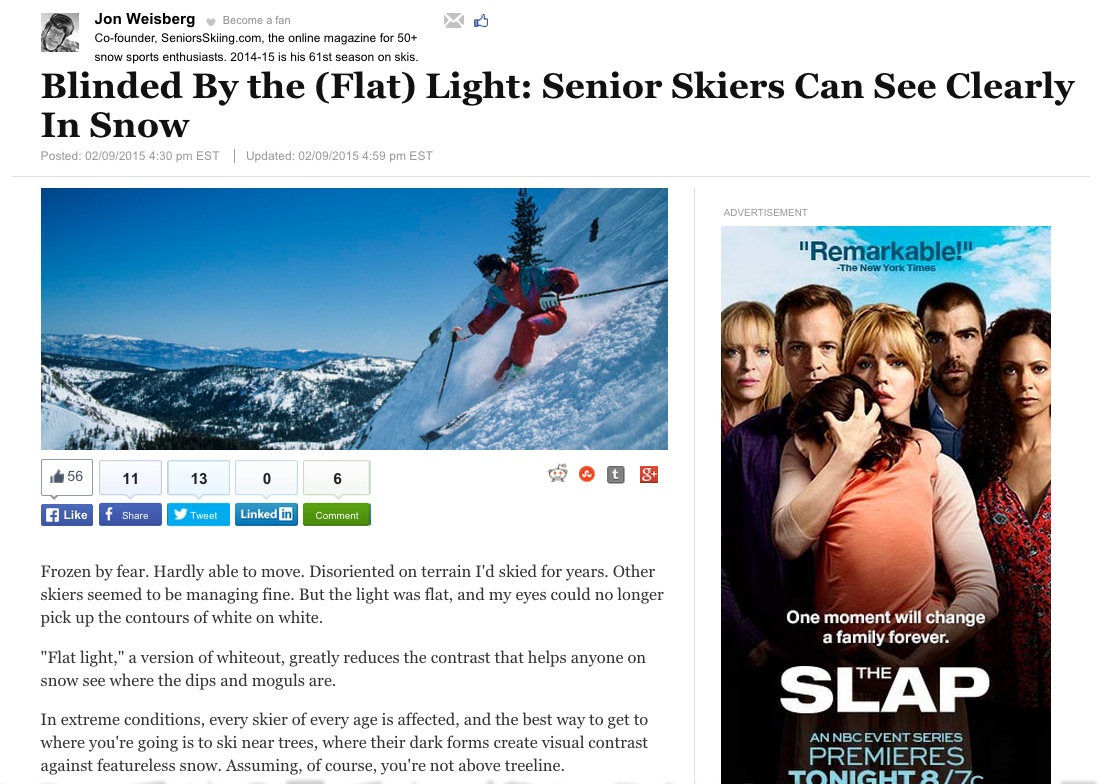
Huffington Post Features SeniorsSkiing.com’s co-founder Jon Weisberg On Light, Goggles and Lenses

We’ve all been there.  Flat light conditions, slow down, stop.  Take your goggles off and put them on.  Peer down the slope.  Proceed slowly, cautiously down, perhaps calling it a day. In his latest Huff Post Post-50 article, SeniorsSkiing.com’s co-founder Jon Weisberg explores the impact of aging eyes on seeing and skiing.

BlindedByLight

Hydration Chronicles: An Easy Way To Keep Drinking

Carry Water On Your Back Like A Camel.

In my younger days, my friends and I launched our adventures without giving a thought to proper nutrition, hydration and so on. On one fondly remembered camping trip, provisions were down to shredded wheat, peanut butter and warm beer, and we still had fun.

Dehydration is pretty common and may be the reason for low energy.

Dehydration is pretty common and may be the reason for low energy.  Benefits of drinking water are many. No joke.

Now we have the benefit of decades of research in sports medicine, nutrition and physiology. When planning my slope time, I try to take advantage of this knowledge to give myself any boost I can, whether it’s diet, exercise or technique. Proper hydration, while an often-discussed topic, is easy to overlook when it comes to winter sports yet surprisingly easy to maintain.

Easy to overlook, because, well, it’s cold out! Cold, dry air and modern technical clothing which so effectively manages perspiration combine to mask how much you may be sweating even on the most frigid day. The “start/stop” exertion common to skiing, where you do a run then relax on the chair, can further hide the amount of water you may be losing through sweat. Medium intensity steady exercise can cause you to lose an average of two liters of water an hour; even if you halve that because the exertion in skiing isn’t steady, it’s still a significant loss. If you get cold, you can still lose through “cold dieresis”, where the body loses water through increased urine production.

The benefits of staying well hydrated are many: You avoid fatigue, confusion, irritability, dizziness. Your joints function better. When dehydrated, the body will draw water from the blood; decreased blood volume leads to colder extremities and greater susceptibility to hypothermia and frostbite. As dehydration increases the heart rate can rise as blood pressure drops.

For my water supply, I like to wear a hydration pack. I prefer a simple, minimal design like the CamelBak Bootlegger ($55) which is made to be worn under your jacket. This keeps the drinking tube from freezing and keeps the pack from shifting around as I ski, or snagging on a chairlift. It’s a simple matter to unzip my jacket a bit & pull out the tube to take a sip every 15 minutes or so,

Camelbak Bootlegger carries the right joy juice to keep hydrated. Credit: Camelbak

Camelbak Bootlegger carries the joy juice to keep you hydrated.
Credit: Camelbak

whether stopping for a breather on a run or while sitting on a lift. The Bootlegger holds 1.5 liters; usually I’ll only fill it halfway and press all the air out to keep it as flat as possible. It’s easy to refill when stopping for a break or lunch. The bulk is barely noticeable, and the water bladder is sturdy enough that I can lean back on the chair lift without fear of bursting it.

I use plain water, which makes keeping the bladder and tube clean very easy. Sports drinks like Gatorade aren’t necessary; they all contain some form of sugar, and some contain up to 150 mg of sodium per cup, which may be an issue if you need to watch sodium intake. I think electrolyte loss in skiing is minimal; it’s more an issue when hot-weather exertion causes copious sweating.

A hydration pack is a much more comfortable way to carry water than having a big bottle banging around in your pocket. Making access easy and convenient means you’re more likely to stay well-hydrated and keep the fun going!


Knee Replacement—What Do I Do Now? Part 5

If you want to get back to skiing, learn to love your physical therapy.

It took my expert knee replacement surgeon one hour to cut, saw, hammer and install each new knee. It took me a year to rehab them. I was astounded by how long it took.

Correspondent Harriet Wallis works it. The key to recovery is following through with your  physical therapy regimen. Credit: Harriet Wallis

Laurie O’Connor, friend of correspondent Harriet Wallis, works it. The key to recovery is following through with your physical therapy regimen.
Credit: Harriet Wallis

I was in good physical condition before surgery, and I had the mind set that I would bounce right back. I’m strong. I’m tough. I thought that a set of new knees would be something like taking my car in for an oil change. Drive in with old oil. Drive out with new oil and keep on rolling. I was incredibly wrong. The analogy didn’t work. Healing and rehab take time

The good news is: The body is a healing machine.

The bad news is: Lots of people slack off their physical therapy exercises as soon as they can get into the car and do their grocery shopping. They lose their motivation and unfortunately they don’t get full benefit of their new knees. They probably aren’t skiers. We skiers are motivated to get back to the sport we love.

Eight months after surgery I was back on the slopes – starting on the opening day of the season. I skied 93 days that year. EEEhaw! (During the winter before knee replacement, all I could do was skid down a bunny slope.)

Friends asked: “How long did it take to get used to artificial knees?

My response: “About six turns.” My new knees worked wonderfully.

Skiing is good exercise, but it’s not focused physical therapy. Continuing the prescribed exercises was vital. Now, two years later, I still do certain exercises. I believe that maintaining artificial knees is an ongoing process.

My new knees do have some minor disadvantages. I cannot squat with my butt down to my heels. Artificial knees aren’t designed to bend that far. Therefore I sit on a low stool while weeding the garden. And swimming laps confounded me because it took more strokes to get across the pool. I think that’s because metal is heavier than bone, so my legs are lower in the water. I had to find a new balance point for swimming.

The bottom line is this: When the surgeon is done, your work is just beginning. Do your rehab exercises with gusto – and I’ll see you on the slopes.

Note: This is a five-part series in which SeniorsSkiing.com’s correspondent Harriet Wallis describes her knee replacement journey with tips to guide you if you’re anticipating knee replacement. Part 1: Inspired by a ski patroller with artificial knees. Part 2: Research 101 – why and how to do it. Part 3: Interviewing surgeons and questions to ask. Part 4: How I found the right doctor for me. This is Part 5, the final segment of the series.


Eat Your Way To Fitness: Gourmet Ski Tours

Lots of Chocolate: Nordic Ski and Snowshoe Events Collected By XCSkiResorts.com

From Roger Lohr, XCSkiResorts.com: Want a guilt-free way to indulge yourself with food while exercising? XC Skiing is one of the best forms of aerobic exercise but if you go on a “Gourmet Ski Tour” on your xc skis or snowshoes, you may very well eat your way to fitness at a number of trailside food stops. What a grand time so go ahead, eat, ski, and be merry – appetizers, wine, champagne, fondue, entrees, desserts, and more.

Here’s a cross section of the culinary XC ski events that are planned this winter across the country with a varied menu of fun and fine cuisine.

EAST

Smugglers Notch in VT has Sweets and Snowshoes every Wednesday night 7-9 PM for adults only. Hot cocoa, coffee, and desserts await snowshoers after a 30-minute trek to a pavilion and campfire. A warming meal of hot soup, bread and beverage at a trailside cabin is a destination for the Soup and Snowshoes guided trek mid-day on Sundays, and on Tuesday nights there’s a Snowshoe Adventure Dinner at the mountain summit.

Eastman (NH) Cross Country’s Nordic Nibbles in Grantham, NH on January 18 has a Scandinavian theme with a visit to a fire pit at each stop for cheese from a local smokehouse, Lindt chocolate, gingerbread cake and pastries, local dairy milk for hot coco, soup, and the main meal from 11 AM – 1 PM.

Munching along at Eastman's outdoor ski party. Credit: Roger Lohr

Munching along at Eastman’s outdoor Nordic Nibbles ski party.
Credit: Roger Lohr

The Valentine’s Day Destination S’Mores Station at Bretton Woods Nordic on February 14 with two self-guided tour for sweets from 10 AM – 4 PM. The shorter tour will be less than 2 km on easy trails so it’s great for the kids. Purchase S’Mores Kits at the center or at the station to make your own.

The Chocolate Festival at Mount Washington Valley Ski & Snowshoe Center in Intervale, NH on February 22 is an inn-to-inn affair at 10-12 stops to experience your chocolate fantasies including moose and fondue. Go on a tour of any length and actually gain calories, even if you ski as far as 20 kilometers. A shuttle is also available for those that have overindulged at the event dubbed the “Sweetest Day on the Trails.”

CENTRAL

The Upper Peninsula of Michigan in Ironwood features cuisine from local restaurants that can be purchased at a nominal fee along a designated route along the trails at the Taste of the Trails on the ABR trails on March 7 at 11 AM – 2 PM.

MOUNTAINS

Snow Mountain Ranch in Granby, CO hosts the Grand Huts.org Progressive Dinner on Feb 28 with a multi-course meal at outposts along the trail in a fundraiser for the huts.

Just Desserts Eat & Ski in the Enchanted Forest in Red River, NM on February 28 features goodies from 20 different local restaurants at three trailside stations with up to 100 desserts within a 4 kilometer loop. Their motto is, “It’s not a race, just a gorge fest.”

The Rendezvous Trails in West Yellowstone, MT features cuisine from local restaurants that can be purchased at a nominal fee along a designated route along the trails at the Taste of the Trails on February 7.

Crested Butte Nordic Center has has the Magic Meadows Yurt Dinners reached by a 2 km ski or snowshoe tour where 10 gourmet dinners are offered during the winter including the Saturday Yurt Dinners each month, and special dinners on Winter Solstice on December 20, New Year’s on December 31 and Valentine’s Day on February 14.

Look to the Galena Lodge in Ketchum, ID for the Full Moon Dinners on nights associated with the full moon, (Jan 3 & 4, Feb 3,4, & 5, Mar 5,6, & 7, Apr 3 & 4) whereby you can go ski or snowshoe ($5 snowshoe rental offered) and then return to lodge for a four-course dinner at $40 or half price for kids under 12. There are also special Wine Dinners, Holiday Dinners, and a Valentine’s Day Dinner.

Lone Mountain Ranch in Big Sky, MT has the Glide & Gorge event on March 8 from 11:30 AM-2 PM with trail luncheon stationed with appetizers, soups, entrees, desserts from the Ranch’s four-star kitchen, local brew, wine, music and shuttles.

WEST

Royal Gorge XC Ski Resort in Soda Springs, CA has the Royal Fondo Tour on Jan 25 with skiing or snowshoeing to various huts along the trails for snacks and lunch at the resort deck.

Tahoe Donner Cross Country Center in Truckee, CA has the Taste of Truckee presenting food from local restaurants along the trails on Mar 22.

Cypress Mountain outside of Vancouver, BC has Ladies Only Chocolate Fondue Snowshoe Tours on Friday and Sunday nights starting at 6:30 PM. Warm up with a mug of steaming apple cider before enjoying appetizers then a chocolate fondue Jan 9 & 23, Feb 6 & 20, and Mar 6. These programs include rental equipment, trail access, guides/instructors, and the appetizers.


Coming Back From Injury: Avoid One-Sidedness

Adaptive Ski Instructor Provides Advice on Predictable Issues for Returnees

Alisa Anderson, Smuggler’s Notch’s (VT) adaptive skiing program manager, is a highly-specialized PSIA instructor who, over the past 20 years, has applied techniques and tools for skiers of all kinds who need a little extra help getting down the mountain.

Adaptive Ski Instructor Alisa Anderson guides a student on the "Snow Slider" at Smuggler's Notch. Credit: Alisa Anderson

Adaptive Ski Instructor Alisa Anderson guides a student on the “Snow Slider” at Smuggler’s Notch.
Credit: Alisa Anderson

She trained at the National Sports Center for the Disabled, Winter Park, CO, where she learned how to use bi-skis, mono-skis, and outriggers. At Smuggler’s Notch, she purchased a “Snow Slider” which is basically a walker on skis. While these tools are mostly used with people who have chronic physical disabilities, she also helps people who can ski on their own skis get back to skiing after injury, accident, or knee, hip or shoulder replacement.

“It’s important that people coming back from an injury take a lesson from a trained instructor,” said Alisa. “One reason is to help them get through the natural apprehension that you’d expect after being through major surgery and a year or so of rehab. The other reason is to spot and correct physical mistakes before they become habits.”

Most people coming back after rehabilitation, she said, will clearly favor the healing side. “It’s natural. There’s been a trauma to the area, and the body wants to ‘save’ that side. What you see are people not pressing the ski on that side or being very tentative about flexing.” That stiffness is risky because the skier doesn’t have bi-lateral control.

People aren’t even aware they are favoring one side, she said. That’s where coaching comes in.

“If they continue to be stiff and one-sided, they are going to form some bad behaviors. Stiff muscles lead to fatigue, and the risk of injury goes up,” she said. “They need to be constantly in motion.”

The solution is for the instructor to give the student skier active feedback on what she sees. “Basically, I remind the student to focus on keeping pressure on the front of the boot and weight on the ball of the foot. It’s really back to the basics. It’s important for the skier to loosen up, extend, get tall and bend their joints into through the turn.”

Alisa says that one lesson might be all a skier needs, others, maybe a couple more. “Most people get it pretty quickly. It’s just a matter of getting through the first days doing it right.”

Alisa knows what she is talking about. In addition to her experience as an adaptive ski instructor, she’s also recovering from ACL reconstructive surgery. “I have to wear a brace. It reminds me all the time about what it’s like to be rehabbing. Sometimes, I don’t like wearing it, but I do it, and I’m still skiing.”


Knee Replacement—How I Chose My Surgeon: Part 4

How To Identify An Athletically-Empathic Surgeon.

I’m lucky to live in Salt Lake City. There are 10 ski resorts nearby, and there are opportunities for an active lifestyle year-round. Because of that, there are many top surgeons here who put athletes back together when they get injured or need replacement parts.

Correspondent Harriet Wallis chose Dr. Beck for many reasons. Credit: Harriet Wallis

Correspondent Harriet Wallis chose Dr. Beck from Salt Lake City for many reasons that made sense to her.
Credit: Harriet Wallis

But when I needed to have my knees replaced, I wanted to choose the right doctor for me. My list of questions helped me differentiate between the five surgeons I interviewed. Here’s the essence of just three of my questions and how the doctors’ answers focused my decision.

Do my knees need to be replaced? When?

            Doctor X: Yes, they need replaced — when you’re ready.

Doctor Beck: When the quality of your life is gone, and you can’t do the things you want to do, it’s time. Do it while you’re still active enough to get the best outcome and get back to the things you want to do.

What’s your surgery technique?

            Doctor Y said: I do the surgery this way. I do it this way all the time. I never vary from doing it this way.

Doctor Beck said: This is what I plan to do. But when I get into your knee I might find something that doesn’t show up on the x-rays and I’ll have to take care of it — but “I don’t want to hurt you any more than I have to.”

Can I ski?

            Doctor Z said: I wouldn’t ski anymore.

Doctor Beck said: “You’re darn tootin’ you can ski!” Pick good snow days, take some breaks, and you probably should stay out of the moguls.

For many reasons, this was the right surgeon for me.

         Good luck finding the right surgeon for you.

Editor’s Note: This is a 5-part series in which SeniorsSkiing’s correspondent Harriet Wallis describes her knee replacement journey with tips to guide you if you’re anticipating knee replacement. Part 1: Inspired by a ski patroller with artificial knees. Part 2: Research 101 – why and how to do it.  Part 3: Interviewing the docs.  Upcoming Part 5: Rehab and why to love it.

Move It! Get Fit Your Way With Silver Sneakers

Nationwide Health Insurance Program Supports Senior Fitness.

Tune yourself up for ski season and beyond. Get started by checking your health insurance plan to see if it includes Silver Sneakers. It’s a nationwide program sponsored by many health insurance plans, and it encourages older adults to get fit in whatever way they want to.

Correspondent Harriet Wallis loves her Silver Sneakers aerobics class. Credit: Harriet Wallis

Correspondent Harriet Wallis loves her Silver Sneakers aerobics class.
Credit: Harriet Wallis

Silver Sneakers gives you access to gyms where you can walk on the treadmill, swim laps, stretch with yoga, lift weights and work out with certified instructors. You may also enjoy community-based programs that include everything from line dancing to boot camp. There are 12,000 Silver Sneaker facilities across the country. Find one near you and get going.

For me, I enjoy an aerobics class designed for seniors. It gets the heart rate up and the joints moving – but the class does it gently. My classmates and I are a heap of replacement parts. We’re full of metal hips, knees and shoulders. The instructor understands, and when she introduces a new move that’s too hard for some of us, we make adaptations. Nobody laughs. We’re all there for the fun of it and to keep our bodies moving.

But we “mambo” and we “grapevine.” We huff and we puff. We feel like prima donnas because we face a mirror and we can see ourselves. But we’re all wearing T-shirts, not tutus!

Silver Sneakers allows you to choose the exercise programs you like. Credit: Harriet Wallis

Silver Sneakers allows you to choose the exercise programs you like.
Credit: Harriet Wallis

Classes also offer the benefit of socializing with others of like age before and after class. Just for fun, our class goes to lunch once a month. The recent lunch reminder email said:  “We go right after class with sweat and no make-up. So far we have never been turned away looking and smelling of exercise.”

Many seniors fear trying something new because their heads fill up with negative thoughts such as: Will the class be too hard? What should I wear? Will I fit in? Skip those thoughts.

Find a Silver Sneakers program near you. Put on your sneakers and get going. Now.

Seniors: Don’t Hit The Snow Without Preparation

Here’s a Must-Read for Seniors Before They Head for the Slopes.

Paul Petersen, who begins his 38th season running Bear Valley Cross-Country in California this winter, is 56 years old and comes with the kind of credentials that should make you sit up and take note of what he has to say! He’s been a certified alpine and cross-country ski instructor for nearly four decades. He’s also the former coach of the national nordic team of the Professional Ski Instructors of America and is currently on its education advisory committee.

“I’m a fully addicted skiaholic, and I don’t see that getting better any time soon,” avows Petersen. “It’s one of the most fun things you can do in life outdoors.”

Long-time coach Paul Petersen has wise words about physically preparing for the season.

Long-time coach Paul Petersen has wise words about physically preparing for the season.

He’s made “staying in the game of skiing a life goal,” and he’d like to help you do the same. First and foremost, plan ahead. You can’t just hit the slopes or trails without any preparation after several months of not skiing. Start with exercises that simulate the movements you make when you ski or snowboard. Here are Petersen’s four cornerstones to focus on in the weeks before the wintersports season begins:

  • BALANCE: Stand on one foot, moving from foot to foot every 15 seconds or so multiple times; look for other balance-focused exercises you can do easily anywhere, any time.
  • STRENGTH: Simulate a chair—every skier’s “go to” thigh-strengthening exercise! Slide your back down a wall so that your hips and knees are at right angles. Hold for as long as you can stand it, slide back up, and repeat! Check out other leg and trunk strengthening exercises, such as lunges and squats.
  • FLEXIBILITY: Streeeeetch! Do yoga, or any other stretching exercises you’re comfortable doing.
  • CARDIO: Take the stairs. Park in the farthest parking space in parking lots. Walk around two or three blocks several times a week. Run in place.

What about fitness classes? Paul recommends aerobics for cross-country skiers to enhance cardio and yoga for downhill skiers/boarders to stretch out tight muscles and loosen joints.

And don’t forget about pre-season equipment safety. What good will it do you to plop your fit-as-a-fiddle body atop skis that negate all the prep? It’s worth the money to get your skis tuned up ahead of time, getting the edges sharpened, and most importantly, having your binding settings checked to be in sync with your age, current weight, and ability—all of which might have changed since the last time you had your bindings checked.

Not a big fan of helmets? After all, you’ve skied unencumbered by headgear for eons without any ill effects. Petersen says, “It’s a no-brainer [pun not intended]…wear a helmet! It keeps you warmer, and it doesn’t affect your balance or equilibrium. It’s not so much that you might hit a tree, but rather that some out-of-control newbie snowboarder can come crashing into you.” Petersen also suggests buying some of the incredibly well-designed sports padding that’s available today, such as padded shorts that protect one’s hips, which are particularly vulnerable as we age, and wrist guards for snowboarders.

Editor Note: Petersen also has a lot of excellent tips for the day before you ski and things that are very important to do the morning of. But that’s another whole article for another day…watch for it coming soon!

Magnesium Magic For Senior Skier Muscles

How’s Your Magnesium Level These Days?

Feeling fatigued on the hill despite intense pre-season training? Muscles cramping during or after a day on the slopes?

Magnesium deficiency may be the culprit.

Kale is a rich source of Magnesium. So is Spinach.  Popeye was right!

Kale is a rich source of Magnesium. So is Spinach. Popeye was right!

Magnesium, essential for normal muscular contraction and relaxation, is a key player in over 300 biochemical reactions in the body, including production of ATP, the main source of energy for our cells!

Without proper magnesium levels, muscle cramping and fatigue can result. Even slight magnesium deficiency can impair athletic performance and intensify post-workout soreness. Unfortunately, about half of the US population lacks adequate magnesium—with seniors especially affected.

Processed foods are devoid of potassium and magnesium, and magnesium rich foods like dark green vegetables generally are seen (and consumed) as a side dish.

Stomach acid is an important factor in absorption of nutrients, including magnesium. But stomach acid declines with age, often resulting in reduced magnesium absorption, a process further complicated by heartburn reduction drugs like Nexium and Prevacid.

We also lose magnesium as we age because of increased excretion by the kidneys, something compounded by regular use of diuretics (e.g. Lasix or hydrochlorothiazide), prescribed for high blood pressure. Alcohol consumption doubles the rate of magnesium excretion as well.

Here’s how to improve your magnesium intake.

  • Eat green leafy vegetables at least twice a day. These include foods like kale, spinach, chard, beet greens, mustard greens, and collard greens. Enjoy them raw and lightly cooked (magnesium is lost through boiling). Check out the SeniorsSkiing Mega Magnesium Smoothie recipe below.
  • Munch hemp seeds, a great source of magnesium! They’re low in a substance found in other magnesium-rich nuts and legumes that inhibits intestinal absorption.
  • Reduce reliance on acid blocking meds by identifying food sensitivities causing heartburn. This is best accomplished under the guidance of a physician or nutritionist.
  • Limit intake of diuretic drinks (e.g. alcohol, coffee,) or counterbalance their influence with more green leafy vegetables.
Magnesium-up your diet makes sense as you age. Credit: Vega-licious.com

Magnesium-up your diet makes sense as you age.
Credit: Vega-licious.com


If you follow those simple steps and still cramp on the mountain, consider supplemental magnesium. Magnesium chloride, magnesium citrate, and magnesium lactate are the types that absorb best. Dosages vary between 200 – 600 mg per day, depending on gender, age and health. People with kidney disease and those using bisphosphonates (e.g. Fosamax and Boniva) should use caution with supplemental magnesium. Consult first with a health professional experienced in nutraceuticals.

That said, magnesium pills are safer than the average over-the-counter NSAID, and a popular magnesium drink mix called Calm (available at natural food stores) can help with muscle cramping and soreness.

Once your body’s magnesium stores are replenished, you may find yourself getting the most use out of that season’s pass in years!

Recipe: SeniorsSkiing Mega Magnesium Smoothie

Try using organic ingredients, as they contain higher mineral content

1.5 cups milk of your choice (regular milk, hemp milk, soy milk, rice milk, coconut milk)

2 teaspoons unsweetened cocoa powder (a great source of magnesium!)

1 banana

1 cup kale, spinach, or chard

2 teaspoons hemp seeds

Blend and enjoy!

Knee Replacement—Interviewing The Docs: Part 3

Practical tips to help you evaluate surgeons

Inspired by a Brighton, Utah, ski patroller with two artificial knees, I buckled down and researched the knee replacement process. I soon felt like I had a PhD on the subject. I’m glad I did the homework. It charted my course.

Make a list. From my research, I generated 20 questions to ask potential surgeons. [Editor Note: You can download Harriet’s Knee Replacement Questions here.] I typed the list, printed five copies, and took a sheet with me to each of the five knee surgeons I interviewed. The list allowed me to ask the same questions, and I had space to write down

Harriet waits to interview a surgeon amidst clear evidence of sport-orientation. Credit: Harriet Wallis

Harriet waits to interview a surgeon amidst clear evidence of sports orientation.
Credit: Harriet Wallis

their answers. In addition, I could evaluate their answers later without forgetting what each one said.

I literally interviewed them while they examined my knees. It might sound ludicrous to interview five doctors, but why not? They’re my knees.

And their answers were amazingly different.

The visits were worth it. I evaluated the surgeon’s differences and choose the right one for me.

Use your radar. When you go to an appointment, look around the waiting room. Does anyone there look athletic? Or does everyone look fat, old and sedentary? It could be a clue for you.

Check the doc’s girth. Does an obese doctor understand an active life style? Will a fat doc comprehend how you want to use your new knees and that you want to ski?

Consider the alternatives. I bet you know at least one person with a replacement body part: a hip, knee or shoulder. But replacement might not be right for you. Be open to doctors’ recommendations to try another solution first.

I’ve heard many people say: “My knee really hurts. I want to have it replaced.” Replacement is not a magic bullet. And it is a major and irreversible action. You need to be sure that replacement is the right solution.

Editor’s Note: This is a 5 part series in which SeniorsSkiing’s correspondent Harriet Wallis describes her knee replacement journey with tips to guide you if you’re anticipating knee replacement. Part 1: Inspired by a ski patroller with artificial knees. Part 2: Research 101 – why and how to do it.  Upcoming Part 4: How I found the right doctor for me. Part 5: Rehab and why to love it.

Who Are You? The Ski Patrol Wants To Know

Carrying Identification Can Help The Ski Patrol Help You.

HIghly trained ski patrollers will be looking for your id. Credit: Deer Valley

Highly trained ski patrollers will be looking for your id.
Credit: Deer Valley

Accidents happen. And when they do, the ski patrol will likely be your savior. But the patrol needs your help. Here’s what you should have with you every time you ski or ride–just in case.

Carry identification. If you’re injured and can’t speak for yourself, the patrol will have to figure out who you are. Chris Erkkila, assistant ski patrol manager at Deer Valley resort in Utah, said: “We’re trained to look for ID and medical necklaces and bracelets.”

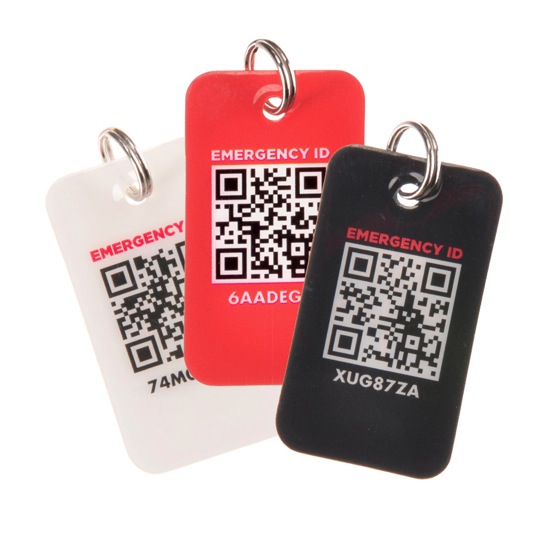
Emergency ID tags from Ecosperformance can be worn as bracelets, plastic tags or as stickers that can be applied to a helmet or even stuck on a phone.

EID Tags contain important profile information in case of emergency. Credit: Ecosperformance

EID Tags contain important profile information in case of emergency.
Credit: Ecosperformance

EIDs store identification, emergency contact and important medical information. When the QR code on the EID is scanned by a Ski Patroller’s smartphone, a skier’s Emergency Profile appears. A seven-digit EID number that can be entered into Ecosperformance website is a backup.

Other times patrollers have to be Sherlock Holmes to find even the most basic information about you—your name. They’ll look for a season pass that carries your name or look for your driver’s license. Sometimes they have to search your cell phone for information. “Often skiers don’t know each other very well, but a ski companion can tell us that the phone is in his injured friend’s right pocket,'” he said.

Carry a list of medications. “Seniors typically take more medications than others,” he said. Based on your condition, it might be vital for the patrol to know what prescriptions you’re taking. Same goes for allergies to medications

“Be sure to carry this information every time you go skiing,” Erkkila said. “Very basic things help us the most.”

And one more thing.

If you’re part of an accident, stay and identify yourself. And then there’s another aspect of accidents, he said. Sometimes there’s a collision between several skiers. Erkkila pointed out that the local city’s ordinance requires you to stay on the scene and identify yourself.  And, “We’re trying to educate the public about this,” he said. For those of us who are veteran skiers, staying on the scene after a collision seems to be common sense courtesy. But it’s also an official part of some resort areas’ regulations.

Still Time for a Winter Tune-up

Get Ready Now to Ski and Snowboard!

Cold weather is approaching fast. Don’t procrastinate. There’s still time to get ready for the ski season. Fitness can help prevent injury, improve abilities and ensure a long, safe season.

Alpine fitness programs routinely include movements to enhance balance and stability, strength, power, agility, mobility and flexibility. Workouts

Exercise ball crunches tune up those all important abs. Credit: Harriet Wallis

Exercise ball crunches tune up those all important abs.
Credit: Harriet Wallis

often combine exercises in a circuit-type workout which includes an aerobic component. Although alpine sports are anaerobic in nature with short hard bouts of activity followed by rest, basic aerobic fitness can help the average winter enthusiast avoid fatigue related injuries. In addition to training more specific skills and energy systems, it’s prudent to include 60 minutes of aerobic activity 3-4 times per week.

Focus strength training on core, legs and shoulders. Incorporate exercises that require some twisting movements since many of our summer activities like hiking, biking and running are performed in a single plane of motion. Quad muscles and those in the lower leg are important for balance and turning. Hamstrings help protect knees. Hips play a role in lateral movements. Core and shoulders function as stabilizers.

Although gym machines can be helpful and certainly convenient, considerably larger benefits can be reaped with routines that use body weight, dumbbells, stability balls, kettle balls, medicine balls and exercise bands. Or check out TRX Suspension Training. Originating in Navy SEALs training,

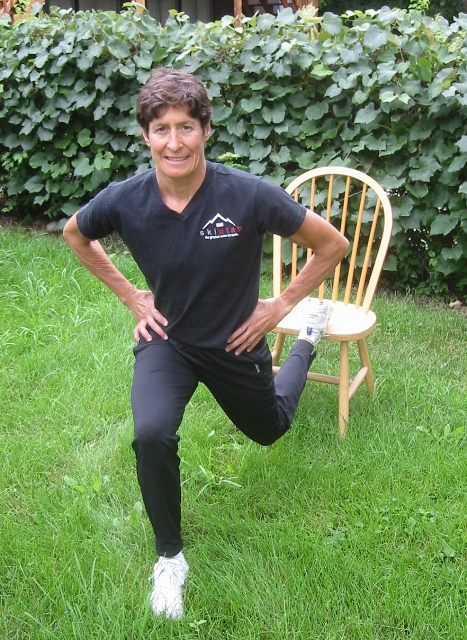
Work on balance with one-foot lunges. Credit: Harriet Wallis

Work on balance with one-foot lunges.
Credit: Harriet Wallis

TRX is used in the NFL and in USA Ski and Snowboard Teams to prepare for the season. TRX classes have also become extremely popular at many fitness clubs and recreation centers.

Look for exercises that include multiple joints because that’s how we move in all sports. Squats, leg curls and dead lifts, overhead press and rowing movements are good examples. With the lower body, progress from two-legged exercises to one-legged and then add some instability to the exercises to improve balancing abilities. Eventually add plyometric—explosive movement exercises—for power. Progress from two-footed hits to one. An easy activity associated with this ability is jumping rope.

Don’t neglect flexibility. Stretch after training and include muscles that were worked during the session as well as problem areas. A good yoga class is great way to improve flexibility. Pilates is another option and adds a little more of a strength component to the mix.

I hope this will help guide your quest for winter fitness. I wish I could individualize an actual exercise routine for each of you, but you can get help by looking for a trainer or class instructor in your area who has a solid understanding of the concepts covered above.

Jo Garuccio is a PSIA Trainer and Examiner, and she teaches at Snowbird. She’s also a Triathlon World Champion and a USA Triathlon Certified Coach. She’s a mega athlete and a mega sports enthusiast who loves to get people moving to be their best.

Knee Replacement Isn’t For Sissies: Part 2

Tips to Kick Start Your Research

A Brighton, Utah, ski patroller with two artificial knees assured me there’s definitely life – and skiing – after knee replacement. Her unbounded success motivated me to launch into research. I’m glad I did my homework. What I learned affected the direction I took, the outcome and ultimately my success. Here are some tips to help you get started.

Metal Knee Model: Is there one in your future? Credit:  Harriet Wallis

Metal Knee Model: Is there one in your future?
Credit: Harriet Wallis

Don’t be duped. Learn about the whole knee replacement process. Don’t be duped by a well-meaning friend who says: “I’d go to Doctor Smith. He’s such a nice man.”

That would be as stupid as buying a car because your friend says: “I’d buy a Honda. It’s such a nice car.”

Do your own research

Get on the phone. Call athletes you even vaguely know who might have some insights on artificial body parts, surgery, and rehab. I called several ski instructors, an operating room nurse, and a 75-year-old mogul skier. I picked their brains .

I also plopped down at the table with ski patrollers while they ate breakfast in the lodge. My question to all of them: What should I learn about?         

They’ll all have different angles, so write their answers down or they’ll become scrambled mush in your head.

Knees, glues and cadavers. With clues you gather from the athletes about what’s important, get on the internet. Do not start on the internet. There’s so much information you’ll get overwhelmed and quit.

Read up on bone-to-metal adhesives, quad-sparing technique, risks, new knee limitations and more. Be sure to separate information from marketing hype. If you have the stomach for it, I recommend that you watch a YouTube video of a knee replacement on a cadaver.  Warning: it’s not for the faint of heart.

Find the top docs. Use the internet to review potential surgeons. They’ll all have illustrious credentials, so do some creative screening. Call each one’s office and ask what his/her specialty is. The phone-answerer should be well informed. Listen carefully. If you get mixed vibes or uncertainty as to whether this is truly a knee replacement guru, it should be a red flag.

Get the inside track. Physical therapists work with patients after surgery. They have refined knowledge about which surgeons give the best outcomes. But they might be reluctant to blurt out a doctor’s name. You’ll probably have to phrase it subtly: “Do you think Doctor A’s outcome is better than Doctor B’s?”

Good luck with your research. Check back for the next installment: Questions for surgeons and how to interview them.

 Note: This is a five- part series in which I describe my knee replacement journey with tips to guide you if you’re anticipating knee replacement. Part 1: Inspired by a ski patroller with artificial knees. This is Part 2. Upcoming will be Part 3: Interviewing surgeons and questions to ask. Part 4: How I found the right doctor for me. Part 5: Rehab and why to love it.

Ski Patroller Nancy Pitstick

Is There Life After Knee Replacement? Part I

Inspiration Is The First Step.

There’s a saying: If you can’t run with the big dogs, stay on the porch. I had to stay on the porch. My knees had quit, and I spent ski days mostly on the deck of the ski lodge while everybody else went skiing. I slathered on the sunscreen, drank hot chocolate and chatted with visitors. But I was bored. I wasn’t skiing.

Skiing wasn’t fun any more. I’d tried physical therapy, injections and finally an expensive custom made brace with pads, straps and a happy butterfly design all over it. Nothing helped. My knees balked at skiing. Even though I could bicycle, walk through the grocery store and climb stairs, my knees refused to ski. They reduced me to doing out of control wedge turns on easy slopes. I believed that my ski life was over. I was caught between non-skiing knees and the panicked feeling that I’d have learn to knit.

Ski Patroller Nancy Pitstick's comment started Harriet's journey Credit: Harriet Wallis

Ski Patroller Nancy Pitstick’s comment started Harriet’s journey
Credit: Harriet Wallis

Then Brighton Ski Patroller Nancy Pitstick entered my life. It was New Year’s Day. The sun was shining. The snow was perfect. But 20 minutes after the lifts opened, I was done for the day. One careening snowplow run was all I could do. I hung up my skis and headed for the deck.

“Happy New Year,” a voice said. “How’s your day going?”

I ignored the cheerful patroller.

“Guess you didn’t hear me,” she said. “How’s your day?”

She wouldn’t let me off the hook, so I poured out my knee frustration to her.

She listened carefully. Then she told me that she’d had both knees replaced. Right there in front of me was a healthy, active, vivacious patroller who was skiing and patrolling with two artificial knees. She assured me there can be life after knee replacement.

In true patroller style, she rescued me—not from a crash on the slopes but from my fear. And she inspired me to find a solution so I could return to the sport I love. It was New Year’s Day, and it began a fresh start on life.

Ed. Note:  In upcoming issues, Harriet will describe what she learned on her knee replacement journey, offering helpful advice and insights.  Look for articles on how to do your research homework, unusual tips to help you choose a doctor, questions to ask when interviewing doctors and more.

Need to See to Ski?

 Check Your Assumptions: Physical Obstacles Don’t Have To End Your Runs.

The first time I witnessed blind skiers I was blown away.  I assumed vision was a prerequisite for being on the slopes, but was I wrong!

That was years ago. Today, adaptive sports programs around the country train both specialized instructors and the visually impaired. The National Ability Center in Park City is the preeminent program for people with physical and mental impairments. It serves as a model for similar efforts around the globe. And groups like the American Blind Skiing Foundation help train instructors to work with the visually impaired. By learning how to ski—or adapt to their visual impairments—people with compromised vision get a sense of independence and are able to gain confidence that can lead to taking on other life challenges. Getting on the slopes also leads to greater contact with friends and families. Then there are the awe-inspiring visually impaired athletes competing in a broad range of Alpine and Nordic events. Visually-impaired Paralympic athlete Danelle D’Aquanni Umstead explains it this way:

“It is a ‘visually impaired team,’ not an athlete and their guide. Guiding is not something just anyone can do. As a guide, you have to be just as committed, ski faster and also be able to turn around at any given moment to look behind you at the other athlete when at high speeds. This is not an easy task, and takes a lot of training as a team. Finding the right guide is definitely the hardest part for a visually impaired skier. To be able to trust in that person one hundred percent, and find a guide who has the same goals as you.”

 Which brings me to a spirit-lifting tale told in an April 2014 segment on WBUR, Boston’s Public Radio station.  Dick Perkins, 78, and Tony Carleton, 80, Dartmouth Ski Team chums from the 1950s, found a way to keep doing the sport they loved despite encroaching disabilities.  Twenty years ago, Tony was hit with a neurological condition that compromised his upper body strength. But, he could still ski!  Then, Age Related Macular Degeneration (AMD) made his old friend Dick legally blind.

Tony Carleton guides his old pal Dick Perkins.  Credit: Sharon Brody/WBUR

Tony Carleton guides his old pal Dick Perkins.
Credit: Sharon Brody/WBUR

Giving new meaning to the expression “lean on me,” Tony, even with his neurological condition, learned to become a ski guide for his legally blind buddy. The two of them now carve graceful patterns together at Wachusett Mountain Ski Area, a 110 acre/1000′ vertical area not far from Boston. “That lifelong identity as a skier is something that’s really sustaining as we age,” said Dick in the WBUR story.  “It’s a great feeling to say ‘By gosh, I can do that, and I can do it pretty darn well’.” The story of their skiing partnership and a video can be seen at Skiing Together, Old Friends Conquer Uphill.

Senior Skier’s Skin Game: Five Protective Tips

SkinCareElephant_FAIL

While a great mid-winter day on the slopes may nourish the soul, it can do the opposite for aging skin. It’s common knowledge that our skin changes with age. It becomes thinner, loses fat, loses sweat and oil glands, and generally takes longer to heal than it did in younger days. Fortunately, with a little extra effort, skin can be kept healthy skiing into your golden years. Here are five keys to maintaining healthy, aging skin:VanillaMint

1. First and foremost, prevent skin cancer. Even on cloudy days, skiing at high altitude on sun-reflective snow can expose the skin to harmful ultraviolet rays. Skin cancers like basal cell and squamous cell carcinomas can take residence on areas of the face exposed to sun. That’s why choosing the proper sunscreen is key. Since both UVB and UVA rays are linked to skin cancer, it’s important to use a “broad spectrum” sunblock of at least SPF 30. Click here for natural products-based sun screen.

2. Be mindful of your meds. Antibiotics like tetracycline and sulfonamides make the skin more photosensitive, as do thiazide diuretics used for hypertension. If you take these meds, think of reapplying your sunblock more frequently or aim for an even higher SPF.

KissMyFace3. Don’t forget your lips! Not only is the skin on the lips thinner than on the rest of the body, your kissers contain very little melanin, a pigment that helps protect against the sun. People use lip balm to combat dryness, but if it doesn’t contain SPF , its glossiness can attract the sun’s rays even more! Choose a lip balm with a high SPF. Here’s a natural product-based balm to check out. It’s called Kiss Your Face Lip Balm.

4. Stay well hydrated. Seniors tend to have dry skin in general and spending most of the day outdoors in the cold, dry air can make this problem worse. One way to combat dryness is to stay well hydrated. Aim for drinking half your body weight in ounces of water, and replenish an additional 8 ounces for every “vice” drink (caffeine or alcohol) consumed. Not sure you’re drinking enough water throughout the day? Check your pee! Unless you’re on certain medications or supplements that would change the hue of your urine, aim for a light yellow to beige color. Anything darker than that is a cue to reach for the water bottle.YesToCarrots_edited-1

5. Cool it during apres ski. After a day on the hill, nothing feels better than a hot shower, jacuzzi or bath. While great for sore muscles and relaxation, it may not be so good for dry skin. Hot water strips the skin of moisture. Keep your time in the bath to a minimum or lower the water temperature. And be mindful of soaps and body washes; chemicals like sodium lauryl sulfate can strip the skin of its natural protective oils and trigger irritation. Aim for sulfate-free cream cleansers that contain skin-nourishing ingredients, like oatmeal or shea butter. After your bath or shower, moisturize with an alcohol-free lotion. Like sulfates, alcohol can strip away the protective barrier on the skin and cause flakiness and irritation. Two ideas for moisturizers: Yes To Carrots Body Butter and Vanilla Mint Body Wash. Sounds yummy.

Skincare is probably the last thing on your mind when exploring the hill. By incorporating these healthy habits into ski days, common skin issues are less likely to arise, and your focus can stay where it belongs: Down the mountain!

Long Time Between Runs

SeniorSkiing

It is a sunny and cold Thursday morning in early February.  There are a handful of other skiers on the mid-New Hampshire ski area lift.  I decide to go right at the top.  Trail is untouched, the corduroy grooming marks fresh and waiting.  I turn, effortless.  Ahhh.  I turn again, making a big, wide arc.  The feeling is like floating, my new skis carving and then, almost without a conscious notion, shifting to the other edge.

Hard to believe this is my first real run in thirty-five years.  Okay, there was an expensive, uncomfortable holiday weekend on rental skis and boots in the 90s with cranky children, cheesy condo and unrelenting cold.  It was an exception.  I had left my real skiing behind long time ago.

I started in college, in the mid-60s.  Back then, it was blue jeans and rice-paddy parkas with Moriarity hats, wooden skis, leather boots and Cubco bindings.  In the early 70s, I lucked out and worked as an assistant editor at Skiing Magazine working and rubbing elbows with some of the greats.  Now, that was fun.

I was Associate Editor in the early 70s

I was Associate Editor in the early 70s

The next few decades had me running a business, flying here and there, finding and keeping clients.  No time, no interest in skiing.  Too cold, too time consuming.  The closest I made it to the slopes was working on my laptop while watching my wife kids from the day lodge window.

Then I came back.  With retirement came time.  I looked at boots and skis in a ski shop one day and said to myself, “I can do this now.”

I find almost everything about skiing has changed for the better during my long hiatus.  The skis are magical instruments, boots are comfortable, clothes are warmer, the lifts are faster, the trails well groomed and, because of my senior status, the lift tickets are relatively cheaper.  And, there is no more need for speed.  Instead, I relax into the slow turn, pressing down to feel the slice of the edge.

Parabolic skis rule! Turning has never been more easy or more fun.

Parabolic skis rule! Turning has never been more easy or more fun.

Apparently, I’m not the only veteran coming back to skiing.  Although we are still a small percent of the total, the number of skiers over 65 has doubled since the 1997-98 season, according to a National Ski Areas Association demographic study published in 2013.  And we ski more often than younger skiers, too.  We get in 9.5 skiing days per season compared to a national average of five days.  We are using the gift of time that retirement has bestowed.

What does it take to get back?  Fitness for starters. That’s a good idea, regardless. A good ski shop to fit you out with the proper equipment, maybe starting with decent rentals.  A lesson might be helpful, too.  A couple of friends to go with.  A nice winter day in the middle of the week.  More and more runs.

What’s your return-to-skiing advice?