History Awaits Your Next Ski Trip (Part 1)

Your Support Helps!

Help us keep SeniorsSkiing.com free. Please support SeniorsSkiing.com with a donation.

DONATE

As serious skiers gain years and experience, many become interested in the history of their sport. And a lot of us are also better positioned economically to savor that heritage by checking into some of the country’s more historic ski settings. A budget bunker motel beside the access road might be OK, but it’s surprisingly easy and affordable to set your sights higher.

No article can list all the options, but the choices are many and range from historically significant ski lodging at specific resorts (think the 1936 Sun Valley Lodge) to atmospheric hotels and lodges that represent the enduring appeal of many ski country locations.

Since 1989, the National Trust for Historic Preservation has rounded up a classic lodging collection called the Historic Hotels of America (HHA), many of which are located in ski country. Ski destinations in New England and the South make perfect examples of places where these distinguished accommodations raise the bar on a ski vacation, especially with available senior discounts.

New England


The Presidentials are awesome from Bretton Woods Ski Area.                           Photo courtesy Omni Hotels and Resorts


A one-time Appalachian Mountain Club backcountry researcher, I enjoy New Hampshire’s Presidential Range. Last time, I overdosed on Nordic and downhill on both sides of the range, with stays in Jackson, south of Pinkham Notch, and Bretton Woods, north of Crawford Notch.

I remember the area’s rambling grande dame Crawford House Hotel before it burned in 1977, so I’ve occasionally chosen the Omni Mount Washington Resort as a substitute. The original 1902 hotel is massive and immaculately restored, with spectacular views of the Presidential Range. There are even better views from Bretton Woods ski area, New Hampshire’s largest. I took my first Nordic ski instructor’s training here in the ‘80s so I lean Nordic. Bretton Woods has 100 km of great valley touring that also includes a lift-served cross country trail network near the slopes.

The historic Mount Washington Hotel makes a riveting backdrop from the resort’s cross country ski trails.            Photo courtesy Omni Hotels and Resorts

If the big historic hotel experience is a no go, nearby Bretton Arms Inn is part of the same HHA Omni resort as the Mount Washington Resort, but it’s an 1896 former private residence on a more intimate scale.

While in Bretton Woods, don’t miss the New England Ski Museum, a short drive away in nearby Franconia.

The Historic Hotel of America option in Jackson is the Eagle Mountain House, literally on the village’s intensively groomed, 150 km Jackson Ski Touring Foundation trail system. The 1879 hotel’s Eagle Landing Tavern is a cozy setting, but skiers also have Highfields at the hotel, literally steps off the track.

Randy Johnson (right) and friends pose in the early 1980s at Hall’s Ledge on the way to Jackson after skiing down from the summit of Wildcat Mountain. Mount Washington towers above.                               Photo: Randy Johnson

Many nearby options are available, and I never seem to miss a stay or meal or two at the trailside Wildcat Inn and Tavern, not far from the foundation’s center. What a relaxed, quirky, full-of-character place. No wonder my best ski buds and I still talk about the times we’d base at Wildcat Inn and telemark the Wildcat Valley Trail down to town from the summit of Wildcat Mountain. Speaking of higher up, Pinkham Notch’s Joe Dodge Lodge accommodations still appeal to me long after I used to weigh my alpine hut-bound pack on the porch. This is old-school ski lodging but I’m not too special to call this rarefied throwback experience something I still savor.

Next Week, Part 2 / The Rest of the Country

Hair Cutting Skills Save Skier’s Day

Your Support Helps!

Help us keep SeniorsSkiing.com free. Please support SeniorsSkiing.com with a donation.

DONATE

Editor’s note: Virtually all of us have amusing or near-miss skiing stories. Send in your stories and we’ll publish the most interesting…along with an original Mike Roth cartoon depicting the event.

An original Mike Roth illustration.

Reader Michael Hudson writes: I was a ski patrolman at Mt Hood, Oregon, back in the 60’s. I helped rescue a young lady whose long hair got twisted into the rope. Thanks to an alert lift operator and the scissors I was carrying, the event didn’t end in tragedy.

Celebrate Winter: Anecdotes and Insights from a Cross-Country Skier’s Experience

Over the past 50+ years, John “Morty” Morton has cross-country skied around the world, been an international-caliber racer and coach, and, as far as I’m concerned (this is homage from a friendly competitor), is the premier Nordic ski trail designer in North America.

Morty has seen dramatic evolutions in the sport – from wood skis to synthetic, wool to spandex, the introduction of skate technique, grooming snowmobiles replaced by snowcats, narrow trails sometimes giving way to highways, etc. Over these years, he served in Vietnam, taught high school English, and has served as broadcast journalist and newspaper columnist.

Now he’s written Celebrate Winter, a book filled with anecdotes and insights based on his intriguing life. It’s his third book, preceded by Don’t Look Back (1992), where he shared his story and training program, and A Medal of Honor: An Insider Unveils the Agony and the Ecstasy of the Olympic Dream (1998), a novel about biathlon.

John Morton, age 76.

Celebrate Winter is a compilation of memories, from John’s days as a kid in New Hampshire to skiing for Middlebury College in Vermont; competing and coaching internationally in biathlon; coaching at Dartmouth College in New Hampshire; designing multi-use trails for the past 30+ years; to (most recently) skiing with his young granddaughter in a backpack while she calls out for more downhills!

Biathlon is a theme tying many of the roughly 70 stories together, as are observations on the human condition (ego, anger, generosity, laughter, inspiration). He covers the role TV plays in popularizing biathalon; Coca Cola at feeding stations; weather and altitude as they can affect racing; Olympic politics; doping; saunas; holding the Olympic torch for a moment at the Calgary Winter Olympics; and a constant sense of the magnetism of cross-country skiing, its beauty, diversity, and comraderie.

As trail designer, Morty has worked with schools and colleges, lodges and real estate projects, alpine resorts and pure cross-country areas, communities and private land owners, ski clubs and non-profits. Unlike some other designers, he’s well aware of the fact that really tough trails are only suited for elite athletes, whereas the great majority of us are recreational skiers (and the bread-and-butter for most Nordic ski areas).
If having your own professionally planned and built trail system sounds intriguing (cross country skiing, hiking, running, biking, snowshoeing, equestrian…), John Morton (https://www.mortontrails.com/) is still going strong in his mid-70s.

I recently purchased several copies of Celebrate Winter to give as gifts. Many of the anecdotes are just a few pages long, making for a delightful – no, mesmerizing – read.


IMG_1071

The Fear Monkey in Our Heads

When was the last time this happened to you on the mountain: you’re skiing down one of your regular trails, having fun, where you know every turn by heart, and then, as you approach a trail sign for a more difficult run than you’re used to, you think maybe it’s a good time to try it…but then you keep on skiing down the regular old way.
So what happened?  It happens to me also: a tiny little wave of discomfort/anxiety/fear creeps into my head (I call it the “fear monkey”) and causes me to ski the easier way, meanwhile telling myself, “I’ll do this one tomorrow.”  And just like that… fear becomes the boss of me!  I hate that, but it happens.  How can we change our patterns, so we take the turn down the more challenging terrain?

Don’t let the fear monkey get in your way.

I’ve noticed this for years in my own skiing, although I’ve gotten better at deciding when I’m going to “go for it” and challenge myself more than usual.  The key for me in making positive changes, and skiing more challenging terrain on a regular basis, started when I began ski instructing twelve years ago!  Huh?  Let me explain…

I’d take a group of skiers, usually 3-6 people, ranging in ages from 18-50.  While the group was being organized, I’d always introduce myself to each skier, and ask each person a few questions about why they were taking a lesson, what types of sports and activities they enjoyed, what they hoped to get out of the lesson; stuff like that. I’d also ask, ”What are you worried about?”


I’d hear a lot of things that would help me figure out what each person’s “takeaways” were for their lesson.  It was almost like each person would give me the magic key for solving their “personal skiing puzzle.”  Everyone’s got one, hidden away, just waiting to be revealed, including me: “afraid of going too fast,”  “getting my skis more parallel in the turn,” “keeping my speed under control to lower my fear,” ”not be so afraid,” “looking as good skiing the tough stuff as the easier stuff!”   What’s yours?

For skiers, the degree of FEAR in their heads is the ultimate limiter on both performance and improvement. Of course, we need fear to warn us away from true danger, but fear is greedy, and likes to hang around unless we send it away.

The good news is that you can send fear to the back of your mind.  It’s simple.  Just figure out your own magic key to your own skiing puzzle.   What do YOU need to do on a tougher run to stay confident?  For me it was this: take the more difficult trail, but plan to ski it in a very measured way, slower than the other runs, pausing to pick each line, just one turn at a time, and stay smooth.  Once I started thinking differently about skiing the tougher stuff, it became much easier to choose those double blacks, and it felt good at the end of each day to have skied them.


Screen Shot 2021-12-02 at 10.43.36 AM

Skiing Technique: Where should you be headed?


Several responses to a recent article under the same heading suggest I left the wrong impression on some readers. That’s anathema for a coach, so this is an attempt at clarification.

Source: Bob Trueman

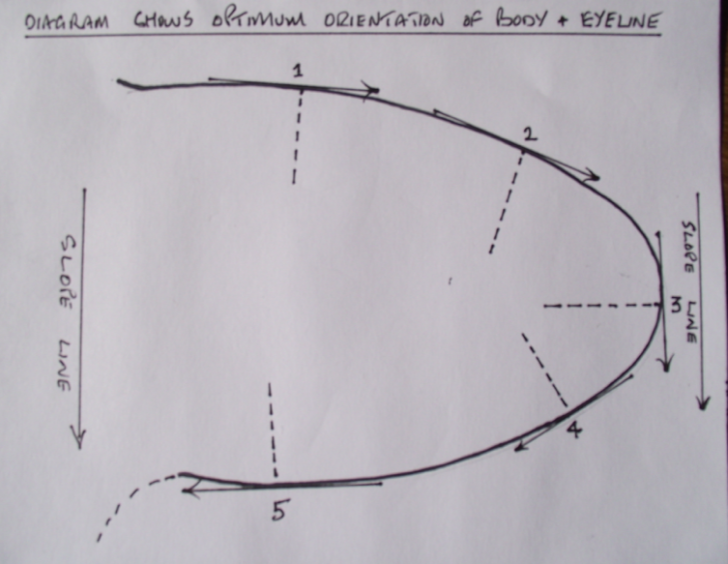
The sketch is my attempt to explain the direction in which the skier’s torso is best oriented; not the direction your skis will be taking.

In reality, every arc comprises an infinite number of “points”, not just the ones I picked out for illustrative purposes.  For now, let’s consider those few identified points.

RADII AND TANGENTS

 At each of the points I have drawn a dashed line at a 90º angle to the radius. Focus on the direction of the line.

That dashed line indicates the direction in which your body would travel if you suddenly became detached from your skis.  (Where your skis went after such an event is anybody’s guess and of no importance to anyone other than the poor unfortunate who happened to be in the way!)

 Good skiers orient their torsos in the direction of the dashed line, with the axis across their shoulders and their hands at right angles to the dashed line. That is to say, facing slightly outward of the arc.  If you imagine an arrow glued smack in the centre of the skier’s chest, facing forward, it would point in the direction of the line.

 The optimal degree of difference between ski direction and body orientation will vary; on this sketch it’s noticeable if you look at the point where the arc is “sharpest” – in this case just momentarily as skis and torso encounter the slope line (aka fall line).

 This “outward” orientation is counter-intuitive, which is why unskilled skiers have a strong tendency not to do it, instead consistently aligning torso with ski tips or rotating into the arc; sub-optimal movements to be avoided.

 LEG ROTATION

A more effective and controlled technique is to utilize the hinge-like mechanism of our bodies. While legs travel in the direction of the skis and the torso faces outward in the direction of the dashed line, the thighs rotate in the hip sockets. Importantly, this is why skiers must be flexed forward at the hip joint. When standing upright on skis, effective and efficient turning are impossible.

 Lito Tejada Flores, celebrated ski instructor, author and filmmaker used to call it being “anticipated”.  What it gives you is enhanced stability and improved form.

 I hope this helps.

Around Walden Pond

There are two trips around Walden Pond near Concord, MA. The first is a ski tour through a picturesque New England landscape, with sharp and steeply wooded hillsides surrounding an ice-covered, lambchop-shaped lake.

Around the same pond is a second trip, a pilgrimage that passes the cabin site of Henry David Thoreau, “self-appointed inspector of snowstorms”, conjuring the spirit of a special place and inspiring the thoughts of the pilgrim visitor.

Henry David Thoreau in 1856. Source: Wikipedia

If you choose the first trip, you‘ll find a pleasant ski tour: maples, birch, and oaks, rubbing branches in the wind, a frozen-solid pond to ski across, varying widths of trails in and out of sunlight, all free of charge, all well-tended, all convenient to the Walden Pond State Reservation parking lot on the Concord Road.

But, if you choose the second, be prepared to confront a man who discovered himself in those very woods and hills of Walden Pond, giving us a model of independence and renewal. One thing is for sure; if you take this trip around Walden, you won’t come out the way you went in.

What is it about Thoreau that initiates such pilgrimages? Why are visitors on foot and on skis so drawn to this singular place, the site of a small cabin gone long ago?

The answer is in the subtle message Thoreau left in those winter woods. To know the message, you have to know why Thoreau went to the woods to live alone by Walden Pond and what changes the woods made to his life.

Born in Concord in 1817, Thoreau went to Harvard College where he was homesick for the fields and forests where he once had played. Upon graduation, he and his brother, John, started a school in Concord. John became ill, the school closed, and Henry went to live with Ralph Waldo Emerson, serving as the philosopher’s gardener and handyman. Shortly after moving in, John Thoreau died, and Emerson’s five-year-old son passed away; their mutual grief bonding the two.

Now, Thoreau turned his attention to the community of thinkers surrounding Emerson, splitting his time between handyman and writing philosophical essays.

He was 28, an unsuccessful writer and poet living among the most dynamic American literary and philosophical giants of the time.  Frustrated by the complexities of society, Thoreau returned to the woods, to think, write, learn and sort out his life.

Replica of Thoreau’s cabin. Source: The Walden Woods Project

On July 4, 1845, he moved into the cabin he had built on the northwest shore of Walden Pond on land owned by Emerson.

You can ski up to the site of Thoreau’s cabin by following the shoreline trail on the north side of the pond or by a ridge trail also to the north of the pond but in more rugged terrain. If conditions are right, you can ski right across the frozen surface.

All of these trails are short, about a quarter-mile from the parking lot. A circumnavigation of the pond is less than three miles. If you want more skiing,  cross Concord Road and link into the web of well-tended trails that spread around Sandy Pond and into the town of Lincoln.

But this is a pilgrimage.

Thoreau’s house site and cairn. Source: The Walden Woods Project

The cabin site is in a clearing of pine and hickories “on a pleasant hillside.” A cairn nearby has been building since the site was discovered  in 1947. Stone markers indicate a small cabin, about 11 by 15 feet, the door facing the pond.

Much has been written about Thoreau’s two-year residence in the woods as a practical experiment and a naturalist’s odyssey. However, as you stand in that clearing by the cabin site, imagine Thoreau writing  on his little desk, remembering his brother and struggling to express his thoughts about life, values, and simplicity. Surely, the time spent at Walden was a time of renewal.

“I went to the woods because I wished to live deliberately, to front only the essential facts of life, and see if I could not learn with it had to teach and not, when I came to die, discover that I had not lived,” he wrote later.

In September 1847, Thoreau left Walden and moved back to his father’s house in Concord. He left knowing he could live the life he wanted. For the rest of his life until he died in 1862 at 43, Thoreau wrote, lectured, travelled, and continued to wander the woods.

Walden had been a turning point; the woods were a catalyst that helped him recognize who he was and where he was going, a man marching to a different drummer.

If you make this pilgrimage in winter, go early. You’ll find yourself alone in the woods next to Walden Pond. Stop skiing and stand quietly. The wind will crackle the branches, and you’ll hear your heart pounding.

Like Thoreau, let the woods give you respite. Recall what these woods have done, what any woods can do to vexed souls. Reflect on the simple beauty around you, read aloud from Walden, go back to the parking lot, different than when you went in.

“Intermediate Breakthrough – IB” at Alta, Utah

Hello readers, super great comments and questions on my “Secrets for Your Best Ski Season Ever” piece.  Also spoke with two readers in follow up.  I can sense everyone’s excited for this ski season – me too.  Shoot me your thoughts or questions and I’ll reply.

Alta’s Intermediate Breakthrough program help people go from blues to blacks

Previously I mentioned my good friend (60+) who improved bigtime from only four group lessons at Alta, UT last March.  Result: his skiing improved from confident “blue” skier to eager “black” skier.  In just four lessons.  So let’s dig in to what Alta’s program looks like and why it works.

And it’s worth doing even if you’re NOT going to visit Alta.  Here’s why: it’s a great template for asking the right questions of any ski school or instructor.  As a ski instructor, I LOVE when any skier in a group or private lesson tells me what they want to be able to do better/different.

Source: Alta

Now, back to Alta’s “Intermediate Breakthrough” group lessons.  Curious, I reached out to both Alta’s Ski School Director, and to the instructor who led the program my friend had found so helpful.  A few key observations:

  1. They seek decent “blue run” skiers who want to improve.
  2. They want skiers who will put some thought into their skiing, actively thinking of improvements they’d like to make.
  3. And, they want skiers to go out and practice the improvements a lot, and talk about what they’re seeing and feeling in their skiing.

I spoke with both Jonathan Doty, the on-snow instructor who led the Intermediate Breakthrough (IB) program, and with Jeremy Moore, Alta Ski School Director, who helped design it.  IB consists of one half-day group lesson per week for four consecutive weeks; a total of four group lessons. Talk to your ski buddies and try to pull together 3-4 who could join the lesson; next, talk to ski school and try to schedule a half-day morning lesson for four consecutive Sundays with same instructor.Many Sundays are QUIET at ski schools, so you may have better luck creating a special deal.

Jeremy insisted “the IB program is well-suited for anyone who’s skiing at least easy blue groomed terrain comfortably, and also is willing to put some time and energy into thinking about and hopefully improving their skiing”.

Source: Alta

Best preparation?  Here’s Jeremy again, “You don’t have to prepare in any specific way. However, it would potentially help improve your overall experience if you took some time to think and feel your skiing and come up with some concepts of what you like or don’t like about your skiing so you have a baseline to start from with your coach.”

From my friend, I learned that the IB format focuses on several “themes”, specifically one per week.  I asked Jeremy to unpack this a bit for me.  Jeremy: “The Alf Engen Ski School at Alta is a skills-based ski school, and we help students understand the How/What/Why they are doing with their skis.”  He added, “There are only 3 things you can do to your skis: rotate them, pressure them, or tip them on and off their edges”.  Sounds like a little, but it’s a lot!

Jonathan expanded on the “theme” focus: “We want skiers to succeed not only with us but on their own.  Each week we focus on a specific task they can practice outside of IB lessons, and a theme creates a flow to the lesson where the skills build on each other.”

As an instructor mostly doing private lessons, I know many people are concerned about “being judged” by others, particularly their friends.  Jonathan insisted: “This is a common thought, but everyone is putting themselves out there, and are on a personal journey.  This is a judgment-free zone!”

Like I wrote last time, whenever we improve our skiing proficiency…we have more fun!  Try to create this program at your favorite ski area…or just go to Alta.

Yellowstone’s Winter Magic

SOURCE: YELLOWSTONE EXPEDITIONS

In 1991, while guiding a small group in Yellowstone National Park, I tried to describe walking outside as the sun rose one February morning near Old Faithful:

Morning light pours over the hills, reflecting off the frost in a blinding cloud of diamonds. Elk and bison shake snow off their backs, stirring after a long night’s chill. Duck and geese stretch and preen. Billows of geyser steam hover and settle, creating dense, lacy patterns on bowed pine branches. Yellowstone tastes of winter magic.”

Summer and Winter

To me, Yellowstone isn’t a great treat in summer. Yes, the combination of animal and geothermal activity is unique – but this year there were close to three million visitors, June to August. That’s too many vehicles and frowning faces jammed along narrow roads.

Winter is totally different. First, there’s almost no traffic (no bears either, although they may peep out of their dens in January). The only road that’s kept plowed runs east from Mammoth in the northwest to Cooke City, where it dead ends. All other roads are snow-covered and accessible by snowmobile, snowcoach (enclosed and heated tracked vehicles), or on skis or snowshoes.

Yellowstone’s winter is created for superlatives. No other place in the world has such an inspiring combination of wildlife and wild geology. It’s rich in history; has spectacular mountain scenery; and the park’s 2.2 million acres are yours without crowds or pollution.

Getting There

Yellowstone is located in the northwest corner of Wyoming, with little extensions north into Montana and west into Idaho.

To enter the park, you can travel north from Jackson Hole; west from Cody, Wyoming; or east from West Yellowstone, Montana. My favorite (fourth) route is east from Bozeman to Livingston; south through the Paradise Valley; pass through the sleepy town of Gardiner; and drive up to Mammoth Hot Springs, where you can overnight at the venerable Mammoth Hot Springs Hotel, with elk grazing outside the ground floor windows.

Using Mammoth as a base, you can drive toward Cooke City, with a lot of photos stops for wildlife in the Lamar Valley, and then backtrack.

Heading South

From Mammoth you can get to Old Faithful by snowcoach or snowmobile, sight-seeing, skiing, and snowshoeing along the way. Norris Geyser Basin and the jaw-dropping Canyon of the Yellowstone River, with ice-laden and thunderous falls, are natural stops.

The center of the park is a volcanic crater, 40 miles across, with the world’s greatest concentration of geothermal features: geysers and fumaroles, mud pots and hot pools. One of my favorite Yellowstone memories is a morning ski on a snow-covered wooden boardwalk, watching a bison standing above a steam vent, basking in the warm air billowing around his belly.

Snowpack around Mammoth can be thin, but Old Faithful has reliable conditions and all kinds of good trails. You’re guaranteed to see lots of elk and bison, maybe coyotes, possibly wolves.

SOURCE: YELLOWSTONE NATIONAL PARK LODGES

In winter, bison are relatively indifferent to humans, since they’re intent on scarce forage and surviving sometimes bitter cold, but it’s not something to count on. I’ve skied within feet of a bison, on a narrow trail with a cliff to one side and sheer drop on the other. We came around a corner and there they were. We carefully didn’t make eye contact with the cows and calves that plodded toward us, and I could hear muttered prayers from the other skiers (my teeth were chattering too hard to enunciate).

Of all the times I’ve visited Old Faithful, the most indelible and endearing memory isn’t a glorious streamside tour, two feet of light fresh snow, or being mock-charged by a bull elk. It’s the smiles on three kids’ faces as one cold morning they dropped tablets of food coloring in glasses of hot water, ran outside the Snow Lodge, and threw them in the air! It was a cold morning, and the droplets turned into rainbows of frozen mist – blue, red, green – that slowly drifted in the breeze and disappeared. So a half-dozen of us adults did the same thing.

Now, that’s magic.

Resources

The Mammoth Hotel and the Old Faithful Snow Lodge provide Yellowstone’s only winter accommodations and dining other than yurt village/guide service Yellowstone Expeditions (https://yellowstoneexpeditions.com/). They typically open for the season mid-December 20th through early March.

You can book accommodations by contacting Yellowstone National Park Lodges (https://www.yellowstonenationalparklodges.com/). For a snowcoach tour, I’d recommend Yellowstone Alpen Guides in West Yellowstone (https://seeyellowstone.com/), especially if you want skiing or snowshoeing.

ShortSwings!

This is to thank the 3000+ of you who completed our August reader survey. We learned that on average, those of you who did not take last season off skied an average of 26 days. That’s down from a few seasons back when the average was more than 33 days. But, when you figure that the national average is 6.5 skier/boarder days, you quickly realize that we’re the ones using the resorts…especially midweek.

We seniors are a very luck lot, doing what we love, when we want to.

Like many of you, I missed last season. That was a first since I started at age 10. Now I’m psyched about getting back on the hill. Skiing brings me immense pleasure. Each of you feels this in your own way. Whether it’s snaking slowly through a mogul field, cruising down a well-groomed slope or floating through thigh-deep powder, you understand.

Ski often enough and you’ll experience a great mix of conditions. Although I haven’t done so in several years, I’ve found pleasure skiing in a blizzard. Very cold days bring their own form of bliss. Warm, bluebird days are a form of skiers’ nirvana.

It is wonderful to age and ski and to be outside in the snow. It doesn’t matter the size of the mountain or the number of runs. It’s simply being there and skiing that brings joy.

This is the first issue of SeniorsSkiing.com for the 2021-22 season. We’ll be posting new articles each week and emailing them to you as a package every other Friday. As a heads up, we’ll  occasionally email advertisements. Each of these ads has been vetted to be relevant to your skiing interests. 

I hope you continue to enjoy SeniorsSkiing.com. Best wishes for a great 2021-22 season!

Patagonia Offering Store Credits for Trade-Ins

With the goal of keeping its stuff out of landfill and improving the environment, Patagonia has introduced a program that gives credit for old and worn Patagonia products. The credits can be used in its retail and online stores. Click here for details about the program and the amount of credit offered.

Will This Replace Day Lodge Burgers and Fries?

A new eatery — Oxygène Caféin the French ski resort, Tignes, specializes in vegan, vegetarian and gluten free food. Started by Oxygène, the French Alps based ski school specializing in English speaking ski and snowboard lessons. The company is partnering with Caffè Vergnano, a socially and environmentally friendly Italian coffee brand.

Snowbasin to Add Base Village and Club Med

Source: The Salt Lake Tribune

Snowbasin, the vast ski area north of Salt Lake City, near the city of Ogden, was the site of the 2002 Olympic Downhill events. The place offers terrain for every ability. What it hasn’t offered is a place to stay at the mountain. All of that is about to change as Club Med builds a 300 room facility (projected opening: December 2024) and as plans develop for a base village with restaurants, shops and lodging (project to start in 2025). 

Sundance Mountain Resort: New Owners Make Changes

Sundance

Founded by Robert Redford in 1969, Sundance changed hands last December. Over the summer, the new owners installed two new lifts and upgraded snowmaking services, among other changes. A high-speed detachable quad will access the mid-mountain summit. The second lift will provide expanded terrain choices to guests returning from the back mountain. Sundance is a Utah gem. Off the beaten path, it’s not far from Salt Lake City, Park City and Provo and rarely has crowded slopes. Lodging is primarily in the form of condos and it has always been a foodie destination. Most importantly, there’s a range of excellent terrain. 

Squaw Valley’s New Name: Palisades Tahoe

According to a news release issued by Alterra, the company that owns the resort, the “…name change was an important initiative for our company. At the end of the day, “squaw” is a hurtful word, and we are not hurtful people. It was a change that needed to be made for us to continue to hold our heads high as a leader in our industry and community. We have a well-earned reputation as a progressive resort at the forefront of ski culture, and progress can’t happen without change.”

Deep Discount on Stocking Stuffer Ski Books

Arcadia Publishing has a roster of 27 books covering localized skiing history. They paperback books are loaded with vintage photos and have titles such as Skiing in the Mad River Valley, New Hampshire on Skis, and North Carolina Ski Resorts. Part of the series explores “lost ski areas,” those that existed years ago but no more. Among them, Lost Ski Areas of the Berkshires, Lost Ski Areas of Southern Vermont, Lost Ski Areas of Tahoe and Donner, and Lost Ski Areas of Colorado’s Front Range and Northern Mountains. Arcadia is offering SeniorsSkiing.com subscribers a 30% discount on all of its skiing titles. Click here to shop the books and enter the code, SENIORSSKI, when checking out. The offer is good from October 7 to November 7.

The Perfect Gift for Older Skiers

Bootster is a clever, compact device that makes it easy to get into a ski boot – even when it’s cold. It has a super slippery surface that helps the foot slide in effortlessly. And unlike shoehorns, sprays, etc., Bootster is compact and easily carried in a parka pocket (click on the video above). If you or an older skier you know likes to shed boots during lunch, getting them back on with Bootster is a breeze. It is pretty much indestructible, making it ideal to pass on to the next generation of skiers. At $25 (+ shipping) the price is right. Looking for something to give your favorite older skier? Bootster will be appreciated for years to come.

Boston and Denver Ski Shows Cancelled

This is second year in a row. The cause? Covid.

It’s a Bird?

People have been dreaming about being able to fly without a plane for years. Technology is finally making it possible, as shown in this video compilation of several different approaches from around the world. Who knows? At one point, some version of these flying machines may eliminate the need for ski lifts. About 16 minutes.


skiing weatherman map

Skiing Weatherman: 2021-22 Outlook

Even though we are just a few days past the first day of astronomical summer, I find myself already taking a peek at the northern Rockies when I am working on forecasts for my golf course clients. Why? The skier/weather nerd in me comes out as I look for the first weather station reporting snow in the air. Like you, I am already starting to anticipate the coming winter sports season, so here are my early thoughts on the weather for the upcoming season.

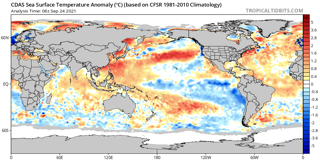
As always, the first thing I do in putting together a long range outlook is to check the status of ENSO…El Nino Southern Oscillation. ENSO is a measurement of the surface water temperature anomalies in the equatorial regions of the Pacific Ocean. When those waters are warmer than the long term average, we have an El Nino. When they are cooler than average, La Nina is present. Last winter we had a La Nina, and another round of La Nina is in storm for us this winter. The following map shows the cooler than normal anomalies already in place in the Pacific basin.

skiing weatherman map

Computer model forecasts designed to focus on ENSO suggest that the La Nina will strengthen in the coming months, as illustrated by this summary of those models. The thick red line is the consensus of the models, and as you can see, that line drops slightly below the -.0.5 Centigrade threshold that indicates La Nina for several months, suggesting that this episode of La Nina will be a weak one, in a fashion similar to last winter.

skiing weatherman map

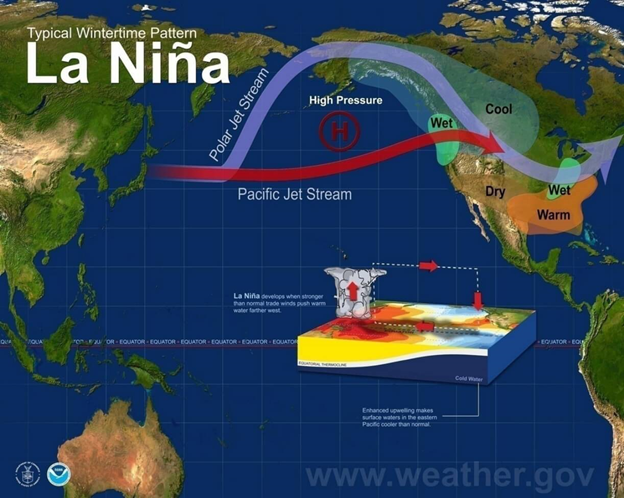
So, what does that all mean? Well, because the oceans contain 1,000 times the energy that is contained in the atmosphere, the state of the ocean’s water temperature distribution exerts a major influence on what the overlying jet stream looks like. Here is a graphic that shows you the most common jet stream configuration during a La Nina Winter…

skiing weatherman map

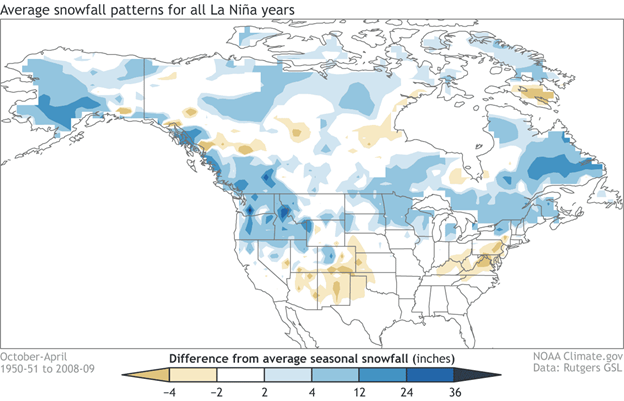
The first thing to note is the confluence of the Polar and Pacific branches of the jet over the northwestern corner of U.S. as well as western Canada. These are two areas that typically have a solid to spectacular season of snowfall in La Nina. The combined jet stream delivers cold air and carves out a trough much of the time across the Great Lakes and Northeast and these two regions also usually benefit from a cool Pacific setup. Across roughly the southern half of the country, La Nina winters can be more of a challenge. That doesn’t mean that the Pacific jet can’t deliver storms to the Southwest…it can, and will…but the more common jet pattern will favor resorts across the northern half of the West. The region that finds a La Nina least desirable is the Southeast. Here, an upper level ridge is more favored, and that leads to milder than normal temps more often than not. Snowmaking will likely be king in the southern Appalachians this season. The final graphic I would like to share with you summarizes snowfall anomalies during La Ninas…

skiing weatherman map

Skiing Weatherman: Action West, Cool Down East

Not Quite Spring Yet. More Snow In The Forecast.

While the resorts in the Midwest and East got a solid taste of spring this week as temperatures soared well above normal for a few days, the winter weather action picked up in the West.  A cold trough spun its way down the coast from B.C. to SoCal, depositing wonderful low density snow along the way.  The highest totals came from the Sierra, thanks to the left hand turn of the trough, which brought the core of the circulation closer to the coast than it was when it passed by further north.  The trough will spin across the southern Rockies this weekend and as it does, moderate snow will fall across the western half of Colorado into Wyoming while a major dump will unfold on the Front Range, including metro Denver, so access to the fresh snow is likely to be disrupted.

Over the Midwest and East, the warmth of this week has taken at least a modest toll on trail counts at most areas, but colder air will return this weekend and potentially set the stage for fresh snow next week.  With the return of the cold air, this weekend you should seek out sunny trails in the Northeast, where the surfaces have a chance of softening up.

Next week, another low will move from the Gulf of Alaska toward Oregon and California, and snows will return to the Cascades (Monday) and Sierra (Tuesday).  That low will track eastward and blanket the Wasatch and central and southern Rockies by midweek, so the prospects for skiing and riding in the West next week are outstanding.

The pattern is going to be very active going forward, as illustrated by this jet stream map for Monday.

The blue areas are upper level storms (cold) and the orange peaks are ridges (milder).  The storm over Kansas is the one that will hit the Front Range this weekend and as it works east, we could see a surface low get pushed through the Mid-Atlantic States with high elevation snow during midweek.  You can see the storm on its heels along the west coast. That system will arrive in the eastern half of the country by Friday morning as you can see on this map.

The surface map at the same time looks like this…

From a position over the central Appalachians, the low center will head northeastward.  With the clockwise flow around the high over Minnesota helping to push cold air into the path of the storm, there is the potential for significant snow, at least at the higher elevations, over the northern Mid-Atlantic and Northeast at the end of the week.  Beyond that opportunity, the pattern will remain favorable for late season snow events right through the end of the month.  This week’s warmup was just a spring mirage.

REGIONAL HIGHLIGHTS:

Pac NW/B.C.:

Coastal ranges in B.C. get moderate snow this weekend.  Oregon snowy early next week.  Larger storm late next week extends further inland in B.C. and throughout the WA and OR Cascades.

Central and southern Sierra:

Great weekend after fresh snow…another moderate to heavy event early next week. Rest of next week looks quiet.

Rockies:

Jackpot is Front Range in Colorado this weekend.  Another moderate to heavy event unfolds central and southern Rockies Tuesday/Wednesday next week.

Midwest:

Northern MN resorts close this week with fresh snow…rain elsewhere.  Colder air arrives this weekend will firm/preserve snow.  Snow threat across this region later next week.

Northeast:

“Spring Break” ends Friday.  Cold weekend firms up the snow.  Pattern looks promising for meaningful snow late next week.  Season far from over.

Mid-Atlantic/Southeast:

Colder air comes back this weekend.  Higher elevation snow potential early next week…again late in the week.

Blind-Sided And Body-Slammed

Is It Time To Address Ski Slope Collisions? How?

[Editor Note: This summer, we published a little play about the speeding, out of control skier and what the ski patrol can do about it. You can read it here. Bottom line: It’s not their job, at least, that’s the party line. They are there to maintain the lines, help injured people, sweep the slopes. They are not trained nor prepared to confront unruly or out of line customers who are not complying with the Skier’s Code of Responsibility. What to do? Here’s SeniorsSkiing.com XC editor and publisher of XCSkiResorts.com publisher Roger Lohr’s story about his collision and consequences.]

This year, I was one of the many skiers and riders who got blind-sided and body-slammed by someone on the slopes. After seeing me bounce into the snow a couple of times and violently twist my lower body, the “guy in orange” who plowed into me said nothing and skied away. No apology, no asking if I needed help.

I got up slowly after the collision and immediately thought about how effective my new MIPS helmet worked. Just afterward, I felt shooting pain in my lower back.

Out of the corner of my eye I saw the guy in orange about 40 yards away. He had stopped and was looking across the terrain at me while I was taking stock of my bruises and sprains associated with the collision. Then he took off.

I stopped in at the patrollers’ cabin and saw six guys sitting at a table. I requested some kind of heat compress or rub for my pain and was told that they are not allowed to distribute anything like that.

This incident was in fact, the third collision that I’ve had in recent years. What can the industry do to deal with the increasing number of slope collisions?

Can we blame lack of skill in the kind of collision I experienced? It might have been a miscalculation of his line, his ability to change course, his maintenance of too much speed, inattention, an obstruction, etc.

The collision occurred near the bottom of the slope, so was there a chance that I cut him off? Would more patrollers on the slopes talking to people about control, speed, where they stop, and so on, make a difference?

I often ride the chair with patrollers but I don’t remember the last time I heard from a patroller out on the slopes. I can’t say that I’ve seen many of them speaking with skiers and riders about unsafe situations. Would a broad skier/rider education campaign about speed and skiing in control make a difference for safety purposes and curtail the collisions?

As I’ve aged I’ve become much more cautious keeping an eye on the slopes around me. In my collision situation, I was heading to the lift line and did not look up the slope for five seconds on a day when there were very few people skiing. I paid for those seconds with medical bills and three weeks of pain.

The statistics on ski area collisions are mounting and this past spring’s SeniorsSkiing.com reader survey showed a serious concern among site visitors about these incidents. And we all know parents who have freaked out watching their child get steamrolled and mangled on the slopes.  It is not only older skiers who have cause to worry about collisions.

What happened after I was hit was significant. The speedster took off, offering no help and no curiosity as to whether I was injured.

There are seven points in the Skier’s Responsibility Code about staying in control, avoiding others, stopping in places that do not obstruct, and the like. There is no suggestion in the code that there is any responsibility to help a victim or check that the subject who’s been hit is able to ski away after the incident. Yeah, you’d think it was common courtesy for the slammer to apologize and see if aid is required but in my experience and other incidents that I’ve heard about, this is not the case; this is not standard protocol.

I understand the ski area operators’ perspective: no one wants a “patroller policeman” yelling at guests, but can we develop a more robust educational campaign to curtail slope collisions and incorporate a new tenet for courtesy when such incidents occur? Can we amend the Skier’s Responsibility Code to include helping people who are hit?

INVITE

Come To Our 5th Anniversary Bash!

Ski Chile: An Introduction For Neophytes

Chase The Snow To Summer’s Skiing Headquarters In The Southern Hemisphere.

Come May, you have probably set your skis into hibernation and begun patiently waiting for the snow to fly next fall. But you really don´t have to wait!  Southern America’s greatest mountain range starts getting snowed on in May, and by June the ski areas are normally in full swing.

In Chile the resorts are sprinkled just east of the Pan Am highway along the 700 mile stretch from Santiago south, at roughly the equivalent latitude of central California. With an 80 year tradition of skiing, you will find a whole new world of winter adventure, lasting into October on good years.

Santiago and the Andean foothills, after a rare low altitude snowfall. Credit: Casey Earle

Visitors will be happy to know that within a two hour drive of the airport in the capital, Santiago, there are four good ski areas, and upwards of 70 percent of winter days are sunny. Closest are the Three Valleys, which hang above Santiago on the western slopes of the Andes. At night, you can see the snocats grooming trails from this metropolis of seven million!

The La Parva, Valle Nevado, and El Colorado ski areas are interconnected, and it is possible to enjoy a total of 40 lifts and dozens of groomed runs, with multiple options for lodging and dining. Skiing here starts at 8,000 to 9,000 feet, reaching up to 12,000 feet, and is entirely above the treeline. The sunsets are extraordinary.

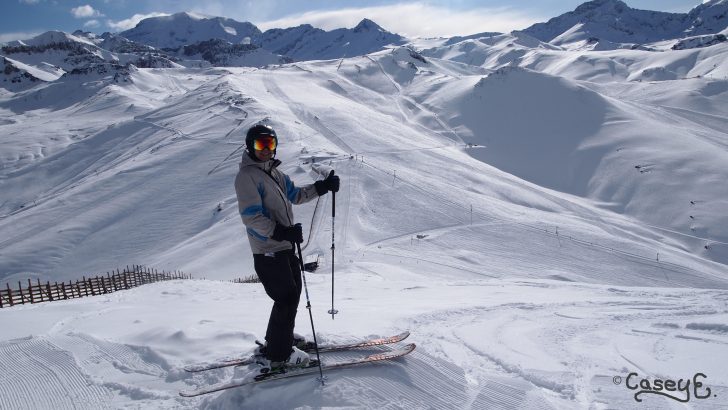
Casey looks out from El Colorado ski area towards the upper Valle Nevado and La Parva lifts. The 18,000 foot El Plomo mountain looms in the background. Credit: Casey Earle.

Two hours north of Santiago is the world-renowned Portillo hotel and ski area, smack in the middle of some of the highest mountains in the Western Hemisphere. The hotel sits looking north over the mysterious and beautiful Laguna del Inca lake and boasts a long tradition of great service and entertainment. Here you can rub shoulders with racers and ski fanatics from all around the globe.

Portillo and the Plateau chairlift (spot it!), with the Laguna del Inca. Credit: Casey Earle.

Further south, the ski area infrastructure and access may leave a bit to be desired, but I love it nonetheless. All of the ski areas are situated on volcanoes which have varying levels of activity. They are also surrounded by gorgeous temperate rainforests, lakes, rivers, and hot springs. The main ski areas are Nevados de Chillan, Corralco, Villarrica, and Antillanca. The first three have adjacent towns within a 30 minute drive with plenty of lodging and other touristic services. All but Villarrica have a good hotel at the ski area base.

Villarrica ski area, note the smoking volcano. Credit: Casey Earle.

My recommendation for potential visitors is to contact one of the tour companies operating in Chile, or book directly with one of the on-hill hotels such as Portillo. You will have one of the best and most unusual ski trips of your life. Most of the tour operators

Las Araucarias ski area, west side Volcan Llaima. Credit: Casey Earle

in Chile are mainly for younger, adventurous skiers, such as Casa Tours or Powder Quest. However, for the +50 crowd, I can recommend DreamSki Adventures which offers group guided resort based tours in Chile and Argentina for the 45-70+ skier. Their guides are seasoned ski instructors trained in the CSIA (Canadian Ski Instructor Alliance) and offer a high degree of customer service on and off the snow.

Come on down!

For the latest in conditions in Chile from Casey Earle, click here.

Here are the resorts mentioned.

Buying A Mountain Home? Ponder This.

A Veteran Real Estate Agent Shares Tips You Might Not Have Thought Of.

[Editor Note: See Joan Wallen’s earlier article: Commute, Rent, Or Buy? for advice on renting.]

Condo on the mountain?

Want to buy a home in snow country? Perhaps you’ve rented and now decide that a second home is right for you. Or maybe you’re ready to take a leap of faith and go directly into ownership. What are some of the considerations you should take in to account?

Location is key. You may already have a favorite mountain or region that you like to ski. This makes it easier. If you don’t have a preferred area, think about what’s right for you and your family. Do you want to ski one mountain all the time or be in a location where you can reach several resorts? Will a specific resort be good for your family for future years? You don’t want to end up at an area that the kids will outgrow. Do you want to be slope side, in town or out in the countryside? Condo or single family home?

If you decide on a condo, investigate before buying. Is it a new development or an established community? If the development is older you would want to know the history of upgrades to the buildings and grounds, roofs, building siding, roads, etc? If there are amenities like a swimming pool or fitness room, what’s their condition? Are condo fees reasonable or so high as to feel like a second mortgage? Carefully review the condo association documents to be informed not only of their rules and regulations but also their financial status. The capital reserve fund should be adequate for both planned and unexpected maintenance costs so you don’t get hit with a special assessment.

House in the country?

Consider usage of the condo in the off season. If you won’t be coming to the mountains in the summer you may want to rent out the unit. Some associations enforce minimum rental periods of anywhere from two weeks to two months or more. This could impact your ability to secure a tenant. And if you want, or need, to rent it out, be sure it’s in a location where there’s a demand for summer activity.

Although condo fees add to the cost of ownership, there are advantages also. Outside maintenance fees cover snow removal, shoveling, lawn mowing and trash pickup.

Condo living is not for everyone, however. You may prefer the privacy of a single family home either close to town or in the country. But, you’ll have to arrange for plowing, perhaps someone to check on the house after a power outage and of course maintenance will be your responsibility. The advantages are privacy, perhaps a more tranquil setting and if you’re in the country you can likely cross country ski or snowshoe right out your front door. If you wish to rent it,  you’ll be your own boss, no association restrictions. And, more responsibility also. If something goes wrong, you can’t just call the office, you’re on your own to find a repair person.

Finally, does owning make financial sense? What will you do with the property in the off season? Is it in a location where you and your family will use it both in the summer and winter?

Buying a home in ski country is a big commitment but also can bring big rewards. As a gathering place for family and friends to enjoy the outdoors together, many lasting memories will be created. Family members who may not ski will still have a base from which to enjoy other outdoor activities, or to just hang out by the fire and read. And you don’t have to worry about making reservations, finding a place to stay after that two foot snowfall or lugging your gear and clothing back and forth. The home and your belongings are right there waiting for you.


Commute, Rent, Or Buy?

The Best Way To Enjoy Your Ski Time.

Choose a small chalet…

While some snowsports enthusiasts are fortunate enough to live and work in ski country, most skiers and riders have to commute from their homes, often two, three or more hours from their favorite mountain. For the frequent skier—those who want to spend every weekend, plus vacation weeks on the slopes—their commute can become very tiresome.

This can be especially true for families with young kids. Parents, and grandparents, have to get the kids organized every morning to get in the car at an early hour so as to be at the slopes for the start of the day. If the kids are in some kind of racing program or weekend recreational class, hitting the road in a timely fashion becomes even more important. “Did you remember your gloves, goggles, hat”, even “your boots”, is sometimes heard as the car heads out the driveway.

…or a luxury, slope side condo. It all depends…
Credit: Steamboat Springs

Many families opt out of this weekly hassle by renting a house or condo near their favorite resort or perhaps in close proximity to several areas so they have a choice throughout the season. Ski gear and clothing can be left there, they can drive up on Friday evening, relax and be ready to go on Saturday morning without the stress of an early morning drive, and return after a day on the slopes for a relaxing evening.

What should you look for when renting a property in ski country?

Well, that depends a bit on your lifestyle and the resort where you want to spend your time. If very young grandchildren children are part of the mix, you might want to find something slope side or very close to the mountain so one family member can take a child home when he tires out. A ski in, ski out unit is best for this, but even a house or condo a mile or two from the area will let someone be delivered home easily without disrupting the entire family’s day.

Another thing to consider is what you like to do in the evening. If you’re content to return to your rental after the lifts close, have dinner in, watch tv or movies or play games, then you might look for something out of town in a quiet, country setting. But if you want entertainment, like to eat dinner out frequently, sample the nightlife, then perhaps a house in a town or around the base area (depending on the resort you choose) is a better option.

As far as the actual property goes, you need to again examine your lifestyle as well as your budget. How many bedrooms do you need? Will you or your children or grand children be bringing guests? Is one living space, whether large or cozy, where you can all be together preferable? Or would separate spaces for relaxation work better for the family? Do you prefer something upscale, in a condo community with amenities such as a spa, swimming pool, workout equipment? Or will a simple house work fine for your group?

Budget is an obvious important consideration. If you rent a single family house, in addition to the rent, you will likely be responsible for paying utilities including cable and wifi as well as plowing costs. Be sure to ask about the type of heat the house has and how efficient it is. Fuel costs over the course of a winter can sometimes come as a big, surprising shock, and you want to be prepared.

When searching for a seasonal rental property, it is a wise idea to use a real estate rental agent. These folks know the properties and, by asking a few questions, can often direct you to something you might not find on your own. They will have a handle on expenses for the winter, condition of the property and lots of tips on location relative to the mountain and other activities that may be of interest to you. There are plenty of ways to book lodging on line, but if you go this route be sure to use reputable web sites and ask a lot of questions.

Another option is purchasing a home in ski country, clearly a more complicated process which will be addressed in a future article.

Confessions Of A Ski Thief

[Editor Note: This personal account by contributor Harriet Wallis makes me smile. It appeared in SeniorsSkiing.com January 2, 2015.]

Start the Season Off Right: Know Where You Put Your Skis

It had been a glorious day on the slopes. Toward the end of that day, skiers and riders were coming off the hill and settling onto the patio to enjoy the late afternoon sunshine with some beverages and live music. Before I could join them, I had to park my skis, but it was nearly impossible to find an empty slot in the racks.

Where O where art thou? Getting skis mixed up is too easy in this forest of fiberglass. Credit: Harriet Wallis

Where O where art thou? Getting skis mixed up is too easy in this forest of fiberglass.
Credit: Harriet Wallis

With so many people and so many skis, I reasoned that it might be easy for someone to grab the wrong skis when they were ready to head home. To prevent such an accidental mix up, I put one ski in the rack and placed the other against the building. They were old skis, but they were my only skis, and I didn’t want them to go home with somebody else. With one ski here and the other ski over there, I was sure my skis would be waiting for me when I was ready to leave the mountain.

And sure enough, skis were waiting. I gathered one ski from the rack and the other from against the building. I threw them into the car and headed home.

A few days later – just as I was ready to ski again – I picked up my skis and was horrified. They didn’t match. I had a 170cm ski and one that was 163 cm. They were identical except for the size. Same ski, same integrated binding. Just different sizes!

I replayed the scenario in my head. I had put one in the rack and the other against the building. But another skier had done exactly the same thing – one ski in the rack, one ski against the building. And I had stolen a ski that belonged to somebody else.

I made frantic phone calls. My ski was waiting in the resort’s lost and found. When I retrieved it, there was an angry note taped to it saying: “It was the last day of my vacation, but I had to fly home to North Carolina with only one ski. Someone stole my other ski.”

I shipped the 163 cm ski to her immediately, and I included some goodies as an apology.

But when I told my son, he capped the matter. “Mother, I told you to use a ski lock. Now do it.”

Kids. We raise them with our wisdom, and then they turn around and give us a dose of their wisdom.


Where To Find Skis For Senior Recommendations

Subscribers Want To Know.  Here’s Where To Find The List.

On December 15th, we simultaneously announced our new list of skis for seniors, created in collaboration with realskiers.com, on Huffington Post and SeniorsSkiing.com. Since then, we have received a number of inquiries as to where to find the list.

If you are a subscriber, simply go to the top navigation bar, click on Community.  Then select Subscriber-Only Content.  In the drop down menu, you will find SeniorsSkiing.com’s special offerings for subscribers. Click what you want to see and download.  You will be asked to confirm your email address and, bingo, the content you want will be available as a PDF download.

If you are not a subscriber, consider signing up.  It’s free, we have a lot of content in our inventory of stories, covering ski history and heroes, destination reviews, gear and clothing recommendations and lots of other senior-focused articles. You can find ski clubs near you, locate where seniors can ski for free, download a 16-page eBook of historic ski posters, and find instructions for getting serious discounts from top clothing and gear brands through Experticity.com.

MOONLINE Mathieu Bijasson

Moonline: Night Skiing In a Whole New Light!

Holiday Cheer.

MOONLINE Mathieu Bijasson

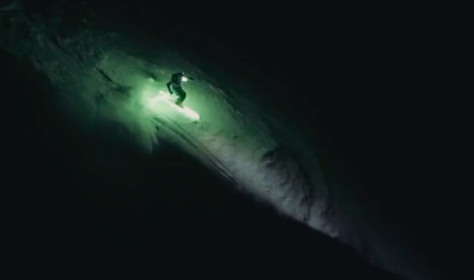
Enjoy this short, uplifting, award-winning video. Cozy snowbound cabin. Illuminated skis and poles. Powder. Moon. What a joyful pleasure! Moonline

Where Seniors Can Ski For FREE: Huff Post

108 Ski Resorts In North America Recognize Seniors With Free Lift Tickets.


SeniorsSkiing.com’s co-publisher Jon Weisberg has another article on Huffington Post, this time describing where seniors can ski for free or for very little money.  [NOTE: You can only download this list from SeniorsSkiing.com. There is no download link in the Huff Post article.  See instructions in BOLD below.]

We are told by ski industry veterans that free skiing for seniors used to be much more widespread. However, a decade or so ago, some resort owners decided that they would rather cash in on seniors rather than gift them a ski lift ride in recognition for years of loyalty to the sport; big discounts and free skiing were gone.

From this list of 108 North American ski resorts, it appears that some more enlightened resorts might be swinging the pendulum back to free skiing.  Sure, some of these resorts are small- or medium-sized, but they are attracting seniors, filling lifts, especially mid-week, and perhaps hosting their families.  The impact of having a loyal group of seniors gathering at the lodge, skiing together, having lunch, staying occasionally for dinner is a huge positive for a ski resort.

Part of our mission at SeniorsSkiing.com is to show the industry the value we bring to their businesses beyond passes and tickets.

If you ARE a subscriber to SeniorsSkiing.com, you can download the list of resorts that offer free skiing by going to the top menu, click on COMMUNITY, then click on SUBSCRIBER-ONLY CONTENT.  In the drop down menu, you will find the list of resorts.  Re-enter your email address, and you can download the file.

If you ARE NOT a subscriber, sign up.  It’s totally free, and we have strived to bring our readers value in the form of ski recommendations for seniors, discounts from top brands, and a collection of historic ski posters from the International Ski History Association.  All free and focused on helping seniors continue to enjoy the outdoors and snow sports of all kinds.


Warren Miller’s ‘Here, There And Everywhere’ Ushers In 2016-17 Season

He’s 91. This Is His 67th Production.

Get ready for the new season with some mind candy from Warren Miller.

Get ready for the new season with some mind candy from Warren Miller’s Here, There, And Everywhere.

Warren Miller is back. The patriarch of outdoor adventure films is 91 and at the beginning of the trailer for the 2016-17 film Here, There And Everywhere, he asks, “What do people really get out of skiing?”

His answer? “It satisfies our innermost urges…for freedom.” He mentions being in square boxes, “This building…is square. The walls are vertical.” Then he delivers a prototypical Warren Miller punch line: “Out there nothing is straight. It’s all crooked.”

The beauty of the outdoors and the freedom of skiing are Warren Miller's trademarks.

The beauty of the outdoors and the freedom of skiing are Warren Miller’s trademarks.

And suddenly we’re transformed to the magnificent Warren Miller landscape we’ve come to know and to anticipate over the years: blue skies, bottomless powder, and endless runs.

Miller’s first film was presented 67 years ago. Since then, the genre he created has psyched and pumped snow sports enthusiasts for the coming season. Here, There And Everywhere features elite athletes descending exotic terrain in Alaska, Montana, Greenland, and Switzerland. Other locations might be more familiar to viewers, including Deer Valley, where the film pays tribute to the late Stein Eriksen. Warren, himself, participates in the narrative—a return to his origins when every Warren Miller film presentation featured him in person.

I haven’t screened the film yet, but I know it will be terrific. How could it not? It’s Warren Miller, and it’s the beginning of another ski season!

The website for Here, There & Everywhere has trailer, film excerpts, and a full schedule of where the film will play.

Skiing In Oz: The Season Is Just Beginning

Here’s A Snapshot Of Skiing Down Under.

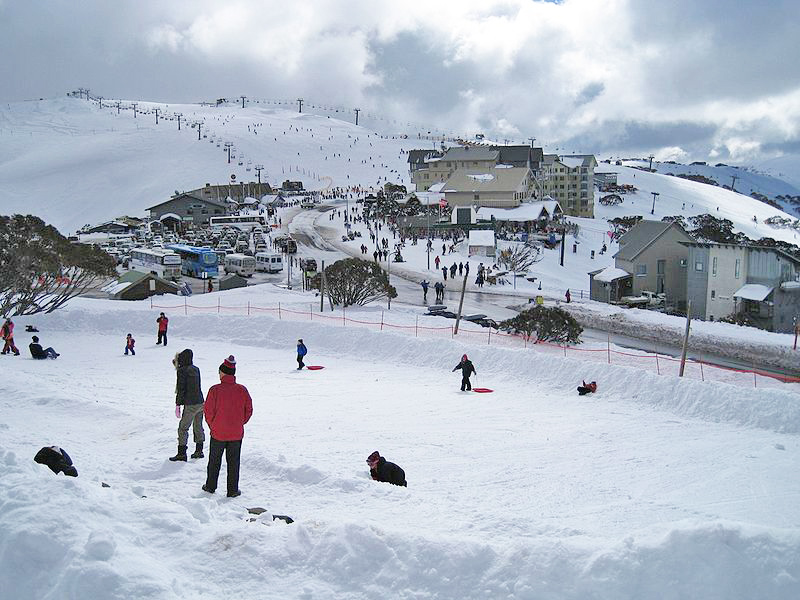
Popular Mount Hotham's summit is at 6,100 feet (1,862 metres) Credit: Kman Tran

Popular Mount Hotham’s summit is at 6,100 feet (1,862 metres)
Credit: Kman Tran

[Editor Note:  This was written by Melbourne, Australia-based Marg Malkin, a retired ski industry veteran who spends February and March at SilverStar, BC.  She is SeniorsSkiing.com’s first Australian contributor.  We hope to see more news from her.]

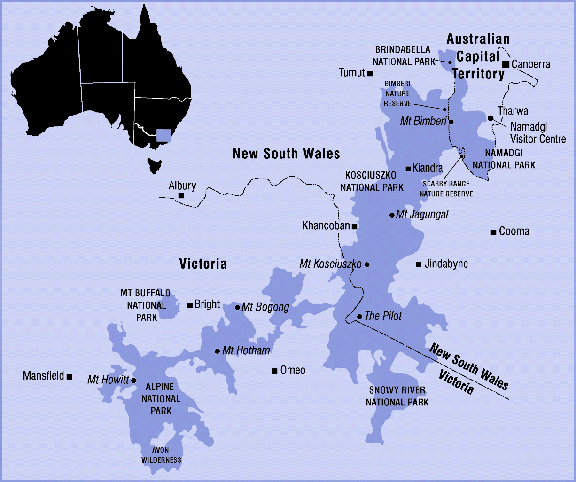
Australian seniors only have a very small window to enjoy skiing in Australia given the ski season is a short 14 weeks from the first weekend in June through to the end of September. Historically, the season is a bit “scratchy” when it begins and then the snow comes with a blustery vengeance, often covering the slopes with almost a metre of snow. Given the elevations of ski resorts vary between 1300 and 2000 metres in altitude, a two metre snow-depth season is a good one.

Ozzie ski resorts are clustered in the southeastern states: Victoria and New South Wales Credit: Wikipedia Commons

Ozzie ski resorts are clustered in the southeastern states: Victoria and New South Wales
Credit: Wikipedia Commons

The major ski resorts—Thredbo, Perisher, Mount Hotham, Falls Creek and Mount Buller—are all located in the high country of New South Wales and Victoria, the South Eastern states of Australia. The resorts also serve as summer hiking, mountain bike riding, and bush walking destinations. Only one resort, Mount Buller is an easy day-tripper resort, two-plus hours access from Melbourne.

The other Victorian resorts are three and a half hours away, so therefore overnight destinations. New South Wales ski resorts are a five-hour drive from Sydney, however they are easily accessible from the Australian capital city of Canberra.

Unlike the New Zealand resorts, all these Aussie resorts are accessed by car or bus right into the main resort areas within easy distance from the accommodations.

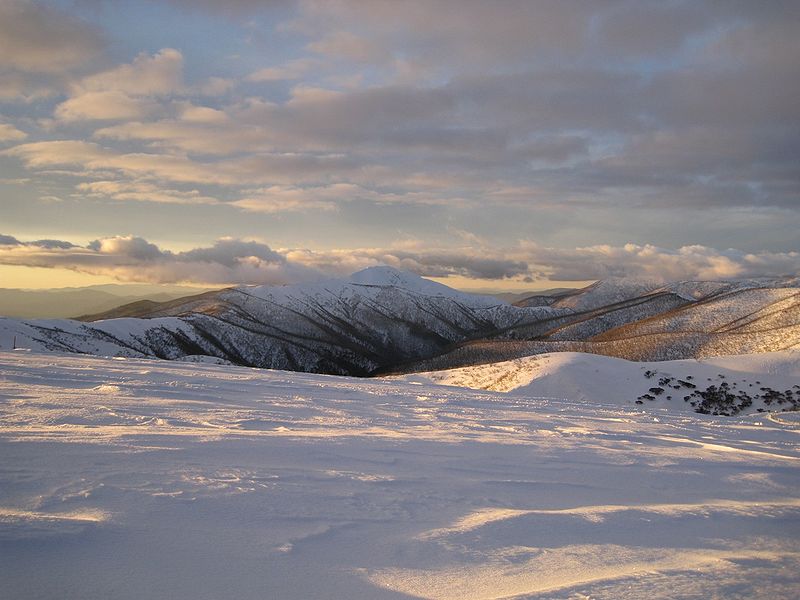
View from Mount Hotham summit. Credit: Kham Tran

View from Mount Hotham summit.
Credit: Kham Tran

The resorts began with small private lodges (or cabins) built by a few die hard skiers walking in with skins. More private lodges developed in the 50’s and 60’s, and, in the 70’s, commercial investors began developing private condo complexes and licensed taverns, most of which thrive today. Generally most of our “baby boomer” sector began as members of private lodges, these lodges becoming open to the public in the 80’s to cover infrastructural costs.

Majority of the ski fields are surrounded by National Parks, and there is a fair amount of government infrastructural control throughout the ski fields. The Australian ski lift companies make skiing very attractive to our generation, providing over 65-year-olds with 50% discount of lift passes. And if you are inclined to keep skiing after 70, then your ski lift pass is free! However there is a government entry fee per car for the ski season to access the Victorian resorts.

For current ski conditions in Australia, click here.  Looks like the “scratchy” start of the season is here.

For more information about skiing in Australia, click here.

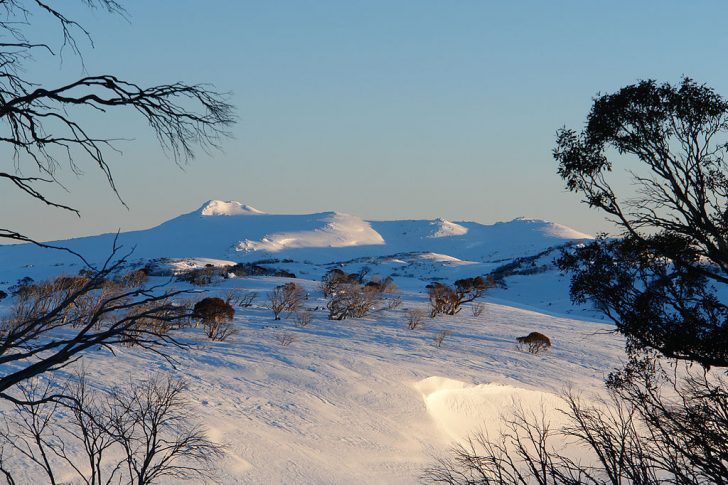
Sunrise on Mount Jagungal. Credit: Jerry Nockles

Sunrise on Mount Jagungal in Kosciuszko National Park, NSW.
Credit: Jerry Nockles


Cycling Series: Finding And Riding The Lost Coast Trail

Senior Skiers Shift To Mountain Bikes To Ride Coast Of California.

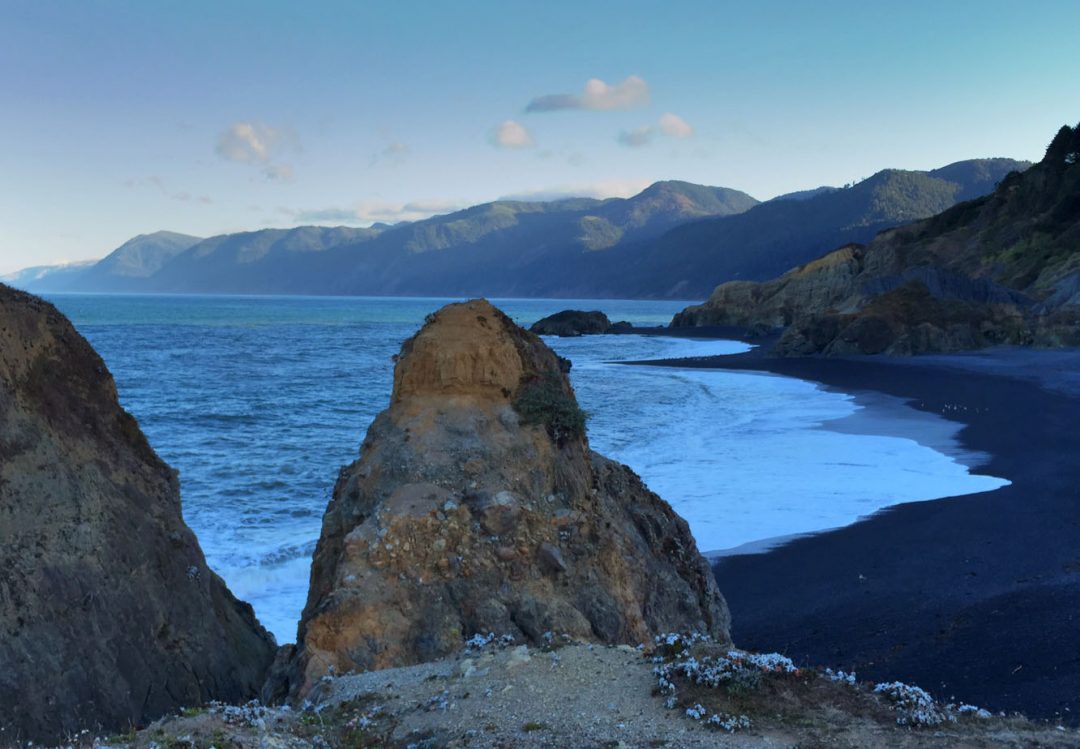
Cycling By The Sea, the Lost Coast Trail has spectacular scenery. Credit: Pat McCloskey

Cycling By The Sea, the Lost Coast Trail has spectacular scenery.
Credit: Pat McCloskey

So, my ski buddy Eric says to me, “Patrick, let’s ride the Lost Coast of California”.  The next thing I know I am winging westward to Sacramento with my mountain bike packed securely in my bike box and looking forward to a week of “van camping” with my good friend from Tahoe.  Now when I say van, the vehicle is really a Sportsmobile—a van conversion that is an amazing off road vehicle equipped with everything including a pop up compartment on the roof which was my room for the week. We have used this vehicle for skiing, but it also serves to house two old guys wandering around the Lost Coast which is about 160 miles north of San Francisco.

Fast forward: We have our RV spot right on the ocean in Fort Bragg, CA., and are ready to ride 150 miles of single and double track which is easily accessed from the camp site.  Most of the trails are in the Jackson Demonstration State Forest, Woodlands State Park, and Big River State Park.  We were amazed at the variety of trails which are loamy and smooth and give you a great appreciation for Redwood trees which are ever present and ancient.  You can even ride through an old Redwood which is called “The Drive Through Tree,” a fun diversion from the standard mountain bike trail.

SeniorsSkiing.com correspondent Pat McCloskey switched a mountain bike for his skis and headed out up the Lost Coast Trail. Credit: Pat McCloskey

SeniorsSkiing.com correspondent Pat McCloskey switched a mountain bike for his skis and headed out up the Lost Coast Trail.
Credit: Pat McCloskey

The amazing thing about riding in this area is the lack of riders and general feeling of remoteness.  The only riders we encountered were the original designers of the trail and are the current trail stewards.  They are all in the late 60s and 70s—amazing senior mountain bike riders.  Jack Columbe, a 74-year-old ex fireman and World Senior Games champion and Roo Harris have mapped out, carved out, and maintained this 150 mile network of trails that stretch from Mendocino to Ft. Bragg.  At 48,652 acres, Jackson State Demonstration Forest is one of California’s crown jewels and is maintained by CalFire (California Department of Forestry and Fire Protection).  In speaking with Pam Linstedt, a 24-year veteran of CalFire, we learned that although tourism is replacing some of jobs lost after the 2002 closing of the GP lumber mill in Ft. Bragg, research and logging are still first and foremost priority in the California forests.  With the efforts of the senior cycling community under the guidance of Jack and Roo, mountain biking is becoming an attraction which they hope will once again put Ft. Bragg and Mendocino on the map for riders all over the world.

The amazing advantage of riding in this area is that you have access to the coastal mountains but you can camp or stay right on the ocean in Ft. Bragg or Mendocino.  Lots of available bed and breakfast options as well as an abundance of RV parks which seems to be the preferred way for Californians to see the coast inexpensively.

As we made our way northward, we rode a trail called Paradise Royale near the Lost Cove area in Humboldt County.  The trail is filled with berms and features and one wonders who maintains this nationally known trail literally in the middle of nowhere.  After finishing our time in Lost Cove, we drove our way through the Redwood National Forest which was truly a visual cornucopia of thousand year old gigantic trees.  Camping out under those behemoths really make you understand that you are only passing through life in a very short time period.  These giants have been around for over a thousand years and still flourish today under the California sunshine and coastal mists.

Lot to Trails

From any campsite or Bed and Breakfast on the coast, the access is available by bike in only a matter of a few miles. We rode to the McDonald’s for breakfast in Ft. Bragg and were on the trails in less than 15 minutes.

Terrain

None of the trails in this area are overly technical.  I would rate them intermediate with the exception of the Paradise Royale trail which had a killer of a climb stretching over 4 miles of vertical ascent.

For More Information

Fort Bragg Cyclery (707-964-3509) can provide rentals and accessories like complete maps to the area.  Most of the rides are currently on MTBProject.com

Also, Mendocino Bike Sprite can provide tours at a nominal fee.  707-962-4602.  Ask for Amy.

Not too often can a couple of 62 year olds van camp and ride trails as pristine as these, and the only guys we ran into were older than us.  Senior riders rule!

Remote and beautiful, the Lost Coast Trail had few other cyclists. Credit: Pat McCloskey

Remote and beautiful, the Lost Coast Trail had few other cyclists.
Credit: Pat McCloskey

SeniorsSkiing Guide: Deer Valley Sets The Gold Standard

It’s the Deer Valley Difference.

Deer Valley at the top with a view of Jordanelle Reservoir. Credit: Harriet Wallis

Deer Valley at the top with a view of Jordanelle Reservoir.
Credit: Harriet Wallis

When Deer Valley opened 35 years ago, it was a novel concept to commit to top notch service in skiing, dining and lodging. Today it’s the gold standard.

The resort is known for its impeccable grooming, incredible dining and attention to every detail. Senior skiers really like that.

How to start your day right. Uniformed valets will unload your equipment at slope side. No need to schlep it.

Ride the open air shuttle to the day lodge. Save your energy for the slopes.

Enjoy secure basket checking with unlimited access so you can change layers throughout the day.

You’ve been pampered, and you haven’t even reached the slopes yet. Little things really do mean a lot.

“We’re committed to excellence in everything we do,” says Bob Wheaton, resort president and general manager.

Where should I start? It’s a big resort with four peaks and 101 trails. If you’re an intermediate or advanced skier, you can take a complimentary ski tour with a Mountain Host and find new runs and learn about the resort’s history. You’ll discover powder stashes that you’d never find on your own.

Outdoor patio dining in high altitude sunshine at one of 12 DR restaurants. Credit: Harriet Wallis

Outdoor patio dining in high altitude sunshine at one of 12 DR restaurants.
Credit: Harriet Wallis

Lunch time. Deer Valley has 12 restaurants, including outdoor dining patios, plus five evening restaurants right at the resort. A lunch favorite is the signature Deer Valley turkey chili. I especially love the Natural Buffet with its exotic salads and hearty breads.

Terrain. Deer Valley’s manicures more than 60 trails nightly from gentle slopes to its long steep runs. But it also has gnarly mogul fields, glades and ungroomed powder. Take your pick.

When your legs fall off, check your skis at a complimentary ski check station. Then relax in a beach chair on McHenry’s sunny “beach”.

Don’t miss this. When you’re ready to wind down the day, take the Last Chance beginner trail to the base and enjoy the trailside sculptures at homes along the way. They’re absolute must-sees.

One of the many raccoon sculptures along the trail side houses near the base run out. Credit: Harriet Wallis

One of the many raccoon sculptures along the trail side houses near the base run out.
Credit: Harriet Wallis

One home is plagued by mischievous raccoons. They ski off the roof, snooze on the railing and look uphill through binoculars. My favorite skiing raccoon is the one that went splat when he hit the house.

A family of life-size bronze elk stand trailside at another home. There’s also a bear house, a totem pole house and a mountain goat house. The charming critters add a bonus to a great day on Deer Valley’s slopes.

Just the facts

  1. Easy access. Just 40 minutes from Salt Lake International Airport.
  2. Skiers only. Deer Valley is for skiers only. It does not allow snowboards.
  3. Dining: 12 restaurants including five evening restaurants right at the resort. My favorite is the Seafood Buffet.
  4. Limited lift tickets. To enhance your experience, Deer Valley caps lift ticket sales to limit lift lines and lodge lunch lines ,and it opens up lunch seating.
  5. Grooming. The resort has 101 runs from four mountain peaks. Over 60 runs are groomed nightly.

2015-16 Bottom Line

A day ticket is $85 for those 65+, but on holidays it’s $92. A season pass is $1,195 for those 65-71, and it’s $1,085 for those 72+. However, mid week season passes are $1,085 for all who are 65+. There’s a pre-season discount for those who buy season passes early. And locals are eligible for reduced prices. Click here for more Deer Valley information.

Trail Map

Web Cam

McHenry's sunny "beach", absorbing the bennies and waiting for the surf to come up. Credit: Harriet Wallis

McHenry’s sunny “beach”, absorbing the bennies and waiting for the surf to come up.
Credit: Harriet Wallis