My Knee Replacement Story

Conditioning Makes A Huge Difference To This Skier’s Post-Op Experience.

A lifetime of abusing my body never really bothered me until it did. Coming down a blue trail five miles long at Park City, UT, one of my all time favorites because of the killer views, suddenly posed a problem.

My knees were killing me. The pain traveled into my hips and the last three miles of the slope seemed to be as long as a trip around the world. It was never going to end. My knees seemed to be grinding into each other.
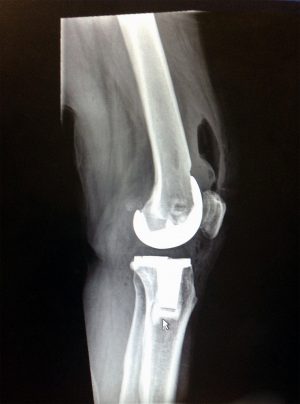
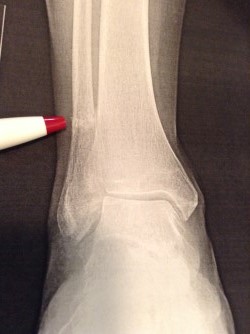
What a new knee looks like when it is all over. Credit: Bob Nesoff

At the base, the skis came off, and I used them as crutches on the way to the lodge. With some help, I made it back to our accommodations and iced my knees. Walking they felt as though the bones were rubbing against each other. Fortunately, this was the last day of the trip, and before the flight home, I called and made an appointment with my orthopedist.

The day after arriving home, he x-rayed my knees and, as I feared, was told my ski season was over. The bones in the joint were actually rubbing against each other and the only realistic course of action was a replacement. The question then became one knee or both at the same time.

The skier’s mind went to work. I’m 80 years old and not getting any younger. The surgery won’t be any easier when I’m 81 and why do one at a time and then have to come back and rehab all over again.

With a recommendation from my doctor, I made an appointment with Dr. Gregg Klein of the Hartzband Center for Hip & Knee Replacement, Paramus, NJ.  Doing due diligence, I looked them up and found out that they arguably do more knees and hips than any other medical facility in the country. That gave me some comfort.

Meeting Dr, Klein for the first time I was pleasantly surprised to learn that he too was a skier and was able to not only answer my questions, but had an understanding of my special desire with regard to skiing.

“Age is not a problem in knee replacement surgery,” Dr. Klein said. As long as the candidate is in relatively good health, there is no adverse problem.

“However,” he said with a smile on his face, “you won’t be doing moguls any more. You’ll be able to ski more comfortably, but stay away from high impact slopes.”

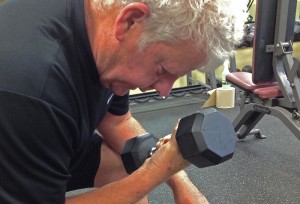
Physical conditioning is one of the most important factors both prior to and following the surgery. Dr. Klein prescribed six weeks of physical therapy, three times weekly, both prior to and following the operation. I added another two days of workout at my home gym. That, I was told later, made the operation and recovery go faster.

Three hours after the surgery I was up, standing and walking. No great distance, but there was far less pain that I anticipated. That, according to the nurses was due to my pre-op workout regimen.

After only two nights in the hospital, I was released and the following week a therapist visited daily for two weeks. He called my recovery “absolutely amazing,” again due to the workout I had done before surgery.

The two weeks at home were followed up by six weeks of outpatient physical therapy three times a week. Here I threatened the life of my therapist when he bent my legs into positions God never intended them to go.

Less than three weeks following surgery, I was walking without a walker. For jaunts outside of the house I used a cane but was able to walk comfortably without one at home. Another couple of weeks and things returned to normal.

There is some debate as to whether holding the prosthesis in place with special cement or using one that adheres to the bone is better for sports such as skiing. The cement holds and heals more quickly. Waiting for the bone to adhere to the replacement will take longer. The opinion appears to be that one is not better than the other.

“If you are a good skier and enjoy the sport,” Dr. Klein commented, “keep on doing it.”

There are a couple of long scars on my knees but they’ll fade with time. I won’t be doing moguls or extreme blacks, but I don’t care. I’m working out on a regular basis and by the time of the first decent snowfall in the fall of 2019, I’ll be waxing my boards and heading for the hills. As a prelude to the ski season, I’m also planning on making a parachute jump this summer. Hey, George H.W. Bush ain’t the only one who can do that kind of stuff.

Sometimes Our Bodies Need Help

There are times when we can benefit from some extra help, especially as we age or develop chronic medical conditions. 

Nick Manley, a remarkable athlete with a degenerative neurological condition, swears by the Ski-Mojo knee bracing system. The product’s shock absorbing springs reduce the load on his knees, allowing him to continue to race and ski for the entire day without tiring. 

I haven’t used it, but I have talked with Nick and at least a dozen other older skiers who tell me that it has made a profound difference in their skiing experiences. Ski-Mojo also helps maintain correct posture while skiing and makes it easier to ski longer.

If you feel you could benefit from some assistance, my strong suggestion is to visit Ski-Mojo’s site.


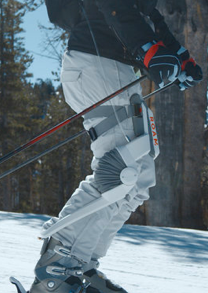
Now, on a limited basis, there’s another innovative approach to helping your knees. I wrote briefly about it a few months ago, when the company started advertising. The product, being developed by Roam Robotics, is called Elevate. It is a computer-influenced soft exoskeleton that utilizes pneumatics to assist movement in your legs and knees.

It may sound sci-fi, but it’s for real. Starting March 9, the company is making Elevate available on a unique demo basis in three locations: two in Lake Tahoe; one in Park City

Rent the device, and Roam will arrange for one of its trained ski hosts to accompany you for a few runs or for the entire day, based on your preference. If you’re staying within a certain radius of their facilities, the company will deliver the device to you the night before and provide enough orientation so you’ll be good to go the next morning when you meet your ski host on the hill.

If this sounds a little protective, it is. As a product, Elevate is ready for prime time, but the concept is so new that the company wants to provide hands-on education about its use. It also wants to collect information about customers’ experience to improve future versions. All of this is to assure a smooth roll-out when it ramps up production and makes Elevate available more broadly in seasons to come.

The cost for a one-day demo is $109, which includes drop-off and ski host services. If you are in the Tahoe or Park City neighborhoods and want to try an entirely different approach to protecting your knees and getting more out of your ski day, this is your opportunity. To reserve a demo, click here.

Short Swings!

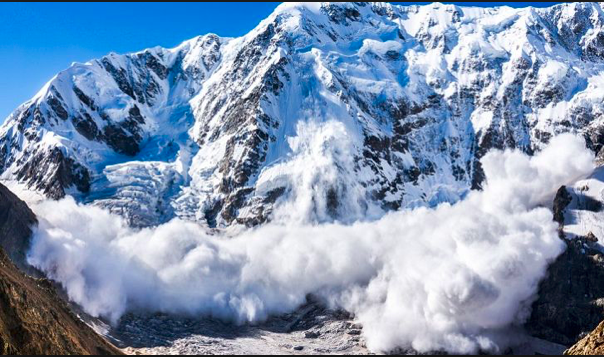
Have you ever been in or near an avalanche? Big Mountain skiers everywhere are accustomed to hearing and feeling the reverberations of bombs and other technologies used to dislodge slides, making the areas safer.

A few years ago, Taos added a chair to improve accessibility to Kachina Peak.  Last week, following inspection by patrol, a slide there killed two. 

At the top of NinetyNineNinety at Park City Mountain Resort (the part of the area formerly known as The Canyons), there’s a gate and signs clearly spelling out avvy risks of going into that part of unpatrolled backcountry. Similar warnings probably exist on Kachina Peak.

Warnings at the top of NinetyNineNinty

Several years ago a friend instructing at The Canyons joined a search party looking for a couple whose car was in the otherwise empty parking lot and who hadn’t picked up their child from daycare. My friend explained the methodical nature of combing the post-avalanche slope where the couple was thought to be buried. It was late in the day, but there was ample light. My friend, a geologist, had been trained to seek anomalies…things that were different from the surroundings. Looking up the slope, he detected something angular, possibly the back corner of a ski. He told the search leader, who advised him and the rest of the party to continue probing the cement-like snow to detect what might be buried below. They found nothing until they reached the angular ski tail jutting from the snow. It led them to the two buried bodies. A tragedy.

Last year, I became friends with a man in his 40s who was rescued from a backcountry avalanche. I don’t remember his full description other than how horrific an experience it was and how, after months of hospitalization and rehabilitation, it altered his life.

The website of the National Avalanche Center, a unit of the National Forest Service, shows 551 US avalanche fatalities since 1998. All but five (on Mt Washington in NH and on Mt Mansfield in Stowe) occurred in the West. Most were in back and side country. 177 skiers died. 68 boarders died. 2 were snow shoers. 196 were snowmobilers. 48 were climbers. Five were ski patrol.

This year, alone, there have been 26 snow-related deaths at European resorts.

Once, skiing a remote in-bounds section of The Canyons, I set off a minor slide. It only made it to the tops of my boots, but it was dense and difficult to get free.

There are older skiers who seek out the adventure and solace of side and back country. I no longer have the lungs to climb, but if conditions are right, I rarely hesitate to take a gate or duck a rope for a promising patch of powder on the other side. But with every year I think a bit longer before I do.

Free Lift Tickets for Furloughed Government Employees

Mad River Glen  (VT), Sugarbush (VT) and Snow King (WY) announced free skiing benefits to furloughed government employees. Sugarbush upped the ante by extending the freebie to immediate family members. The deals will end when the shut-down ends. 

Knee Issues?

Ski-Mojo and Elevate are products for those experiencing knee problems. Both are advertisers. Ski-Mojo is a set of light-weight shock absorber springs that reduce pressure on the knees by 33%. Worn under ski pants, the device reduces pain and fatigue. The people I’ve talked with who use Ski-Mojo, swear  by it. Elevate is a soft, robotic ski exoskeleton that boosts quad strength and reduces muscle fatigue and joint pressure. The product causes loads to pass the knee entirely;  improving knee stability and preventing normal wear and tear. Elevate is available to demo at locations in Lake Tahoe and Park City.  

Saturday is Ski California Safety Day 

Resorts throughout California and Nevada will participate in Ski California Safety Day this Saturday, Jan. 26. Each of the 15 participating resorts will host activities designed to inform guests about skiing and riding safely. Topics range from avalanche and deep snow safety to proper chairlift loading and riding. More at skicalifornia.org.

Will Renovated Snowpine Bring New Vibe to Alta?

That’s the question explored in an article this week in The New York Times Travel Section. The Snowpine Lodge was the funkiest of Alta’s five lodges. I know this from multiple stays at each of them over my 45+ years skiing Alta. Accommodations were less than luxe. Food was okay. Guests – maybe because we were all subjected to the same musty smells and low, head-bumping passageways – always seemed to bond. That was back then. The new Snowpine is said to be super-luxe, Aspen or Vail style…with prices to match. It may raise eyebrows among readers who know and love Alta, or simply raise the bar for the other lodges.

Solitude to Host FIS World Snowboardcross and Skicross Championships

The world’s best snowboardcross and ski cross athletes will compete at Solitude, Feb 1-3 in the 2019 FIS World Championships. It will be the biggest winter event in Utah since the 2002 Olympics.

Mont-Tremblant International Airport

The single strip airport is about 20 miles north of the resort. Porter Airlines and Air Canada flights connect through Toronto. A quick check shows that New Yorkers and Bostonians can get round trip fares are as low as $275. Both airlines include free flights for kids and free lift tickets. Click here for details. 

Breckenridge to Ski to Memorial Day

That’s the plan for this and future seasons, conditions and US Forest Service permitting.

Videos Worth Watching

Teton Gravity Research generally produces interesting ski videos, and this one (4+minutes) is no exception. It focuses on the challenges a young skier faces at the top of a cornice before skiing a beautiful, steep line.

Kings and Queens – The Evolution of Corbet’s Couloir is fun. The 7+ minute video shows a competition of men and women skiing and boarding Jackson Hole’s famed chute.  Please comment if you’ve had the Corbet’s Experience, and we’ll compare notes.

Experience Something New at Whiteface

Mirror Lake Inn ,in Lake Placid, is a lovely place to stay when visiting Whiteface Mountain and other North Country attractions. Starting this season, Andrew Weibrecht, son of the Inn’s owners and an Olympic medalist, is available to ski with Mirror Inn guests at Whiteface. For details, click on the adjacent ad.

Cell Phone Dying on the Mountain?

Try the GearBeast phone holder. The $9.99 – $12.99 device (SeniorsSkiing.com readers receive a 20% discount; enter SENIORS-SKIING at checkout) fits over the neck and under the parka where your body warmth keeps the phone battery from draining. Other benefits? You won’t drop the phone when using it on the lift. And the mini pocket for credit card, ID and a few bills lets you leave bulky wallets in the car or lodge. Click on the company’s ad. 

Focus On Conditioning: Still Time For This Season

[Editor Note: This article was contributed by Peter Schmaus, MD, Orthopedic Spine and Sports Medicine Center, Paramus, NJ. and Senior Attending Physician, Hackensack University Medical Center. SeniorsSkiing.com is very grateful to have his view on conditioning.]

Pay Attention To Body Tuning Before You Hit The Slopes Or Trails.

Many of us pay more attention to our equipment than the most important equipment of all—us! Many ski injuries and overuse syndromes can be avoided by simple preventative maintenance. While sharpening your edges and maintaining bindings are smart, even more important is a musculoskeletal tune up on yourself. This is even more crucial as we age and the musculoskeletal system inevitably displays the wear and tear of the years.

We lose muscle mass annually as we age over 40, but this can be reversed with the correct exercise regimen. Joints inevitably become stiffened both from cartilage thinning as well as tightening of the soft tissues surrounding the joints and spine. These conditions, while not completely reversible, can be managed with exercise programs stressing both flexibility and strengthening.

While stabilization and core are buzzwords frequently used in the fitness field, for snow sports those words cannot be repeated too often. Fitness trainers, therapists, and physicians refer to muscle groups that are core stabilizers. These include the rectus abdominus, external and internal obliques, back extensors, and the pelvic floor muscles.

These are your natural weight lifting belt and lumbar support muscles. They stabilize and support the spine in all planes, and a strong core helps provide balance and force required to carve a turn or navigate a field of moguls. Core muscles even support your spine when pulling off your boots at the end of the ski day. Exercise methods include Swiss ball, back extension, modified crunches, various planks and supermen. All can be done in the home without elaborate gym equipment. And do not forget the simple push up and proper squat.

We frequently refer to the posterior chain, which includes the gluteal muscles, the hamstrings as well as latissimus, and back extensors. Regimens can include lunges, modified dead lifts, squats, kettle bells and burpees. If your bodyweight does not provide sufficient resistance, add some light weight. Simple flat plates, kettle bells, or even resistance bands will suffice. Then move on to side-to-side exercises, which simulate ski motion.  Keeping your center of gravity well centered is the physics behind a good day on the mountain.

Be mindful that snow sports, while not overly aerobic, do require exertion and therefore increased cardiovascular activity. That is aside from the long walk uphill though the parking lot with all your heavy equipment.

Also important especially as we age are balance exercises. Stand on a balance or wobble board. Not a challenge? Hold two light weights. Go through your regimen while remaining balanced on the board. It is not easy in the beginning, but the benefits of enhanced balance and stability are crucial on uneven terrain. Constructing a preventative exercise program well in advance of those first days on the mountain will reduce the risk of injury, making those days on the mountain more enjoyable and injury and pain free.  

Should I Take An Early Season Lesson?

[Editor Note: From time to time, we’re going to dip into our extensive archives for a story that might be useful, interesting, or entertaining.  Here’s one from 2014 from correspondent Harriet Wallis.]

Starting right sticks all season.

My friend says the same thing every winter. She says wants to take a lesson as soon as there’s more snow on the ground or when she has more ski days under her belt.

That’s been going on for as long as I’ve known her, and she still hasn’t taken a lesson.

If you’ve ever said that, you’re not alone. Many skiers and riders think that more snow or more ski days are the prerequisite for a lesson.

So I asked some ski pros about it.

Start early and bond with your instructor! Credit: Harriet Wallis

Start early and bond with your instructor!
Credit: Harriet Wallis

“Skiing is a seasonal activity, so whether you’re a vacationer who skis once a year or whether you ski all season long, you come back to it fresh at the beginning of the season,” said Tom Pettigrew, director of skier services at Park City Mountain Resort in Utah. Early season lessons are really beneficial because “all of your movement patterns are not totally engaged yet, so it’s easier to learn new patterns before you get entrenched in old ones.”

In addition, while the terrain might be limited, it’s actually an advantage. You can get comfortable on your skis and make learning breakthroughs without being distracted by vast terrain choices, Pettigrew said.

Scott Mathers, ski school training director at Alta, UT, says the same thing in a different way. “Your senses are heightened when you first start to ski again. You’re aware of how your body is moving and what it’s doing. But as you ski more, you get desensitized, making it harder for you to make changes.

“It takes a lot of practice for something to become ingrained,” he said. “An early lesson gives you something to focus on for the rest of your vacation or for the season.”

Will you take an early season lesson this winter?

To read more from Harriet Wallis, click here for her articles on SkiUtah!

Can You Ski Yourself Into Shape?

There Are Other, Fun Ways To Get Ready Besides Hitting The Gym.

Sure, you can do the gym thing. It’s not too late to hit the trails, too.

One of the myths I hear from people at the beginning of the ski season is that they can “ski themselves into shape.”  They have not really done any preparation for the ski season and feel that they just have to start skiing, and their ski legs will eventually come back.  If I ever heard fake news, this is it.  Skiing is a dynamic sport and in order to effectively execute a turn, your legs need to be in good shape before the first turn of the season.  I can’t tell you how many times I have see folks whose “legs are killing them” after the first and second day of a ski trip.  They ski defensively, because they are not in good shape and all the money that they have spent on a ski trip is for naught. That’s because they failed to get in shape before they got on that airplane.  The same is true for local skiers who make their way to their local ski area and have the same experience.

So why not start thinking about this now if you have not done so?  There are a lot of articles popping up in the ski periodicals and web sites about exercises that you can do in the gym.  But how many of us really want to spend time in the gym day in and day out to prepare for ski season?  How many times can we pretend to sit in an invisible chair with our backs to the wall to strengthen our legs?  On the other hand, there are outdoor activities that can be engaged to get the legs in shape but are also fun and allow us to be in the outdoors which is where we all want to be in the first place.

With the flaming leaves coming in to view, the trails in our mountains and parks are available for mountain biking, hiking, and trail running.  Hiking and trail running uphill prepare the legs for sure as well as providing an excellent outdoor fresh air activity.  Mountain biking ramps that up a bit by strengthening the legs on climbs, as well as simulating skiing skills like looking ahead and picking a path through varied terrain.

Lots of folks mountain bike, hike, and run during the summer season when the weather is cooperative, but when the time change looms—Nov. 4 this year, by the way—and the days get shorter, the motivation for these activities starts to wane.  If you want to be prepared for ski season, I would strongly suggest that you continue these activities as long as you can during the fall and into the winter if conditions allow.

A good friend of mine says there is no such thing as bad weather, just bad clothing choices. So why not buy a good Gore-Tex suit for running or hiking and also one to ride in the winter if you can do it.  Night riding is a favorite of mine, and there are a lot of options for rechargeable light and battery systems. I have used a lot of expensive lighting  options in the past but with the advance of lighting technology, you can now purchase systems for a fraction of the cost of the traditional main stream lighting systems.  Cree Mountain Bike Lights found on Amazon are an excellent choice for around $32.00 and provide three mode LED lighting with a rechargeable battery that can provide up to two hours of excellent light on high mode.  I use these lights on my handlebar with another one on my helmet.  I store the battery for the helmet light in my hydration pack and also the battery for the handlebar light can be attached to the top tube of the mountain bike.  I also purchase spare batteries and store them in my pack in the event that there are any issues with the primary battery.

It is not too late to get back on that bike, lace up the trail running shoes or hiking boots, and get moving.  Your legs will appreciate your diligence now in the early fall season, and you will enjoy your turns and ski outings much better if you take the time to be in shape when the first flakes start to fly in the mountains.

High tech bike lights allow you to ride into the evening hours when the clock changes back to Standard Time. Credit: MountainRides.com


BowlerSkier_489

Conditioning Can Beat Sarcopenia: Pay Attention Seniors

Sarcopenia Weakens Muscles In Aging Bodies, But It Can Be Managed.

If you’ve been lax about starting, continuing, or expanding your current conditioning program, it is time to get with the program. Many seniors are susceptible to weakened muscle as a natural effect of aging. When was the last time you picked up trash barrel, laundry basket, your bike, kayak, or even your skis, and you realized that they seem heavier than they used to be. The condition is called Sarcopenia, and it affects 13 percent of 60 year olds and as many as 50 percent of 80-plus.

In a recent New York Times article, Jane Brody, a personal health and fitness columnist, says that although the condition is fairly prevalent, not many seniors know about it.

Few practicing physicians alert their older patients to this condition and tell them how to slow or reverse what is otherwise an inevitable decline that can seriously impair their physical and emotional well-being and ability to carry out the tasks of daily life.

Dr. John E. Morley, a St. Louis University School of Medicine geriatrician, says that sarcopenia is to muscles as osteoporosis is to bones. “Sarcopenia is one of the most important causes of functional decline and loss of independence in older adults.”

The good news in all this is that the effects of sarcopenia can be reversed by exercise.

No matter how old or out of shape you are, you can restore much of the strength you already lost. Physical therapist, Marilyn Moffat, a professor at New York University, noted that research documenting the ability to reverse the losses of sarcopenia — even among nursing home residents in their 90s — has been in the medical literature for 30 years, and the time is long overdue to act on it.

That’s yet another reason to get back to conditioning.  Start a strength-building program using weights, bands, or machines.  As Dr. Moffat points out,

Start with two repetitions and, using correct form through the full range of motion, lift slowly and lower slowly. Stop and ask yourself how hard you think you are working: ‘fairly light,’ ‘somewhat hard’ or ‘hard.’ If you respond ‘fairly light,’ increase the weight slightly, repeat the two reps and ask yourself the same question. If you respond ‘hard,’ lower the weight slightly and do two reps again, asking the question again.

If you respond truthfully ‘somewhat hard,’ you are at the correct weight or machine setting to be exercising at a level that most people can do safely and effectively to strengthen muscles. Continue exercising with that weight or machine setting and you should fatigue after eight to 12 reps.

Now here’s a surprising insight. Your current exercise program might not be adequate to hold sarcopenia at bay.

The fact that you may regularly run, walk, play tennis or ride a bike is not adequate to prevent an incremental loss of muscle mass and strength even in the muscles you’re using as well as those not adequately stressed by your usual activity. Strengthening all your skeletal muscles, not just the neglected ones, just may keep you from landing in the emergency room or nursing home after a fall.

Exercise and paying attention to protein in your diet are the keys to remaining strong or at least as strong as you can be as you age. Read Jane Brody’s article and get busy.


Product Review: Company Based On Tea’s Cancer-Fighting Properties

Tea Offers Flavor, Enjoyment, And Health.

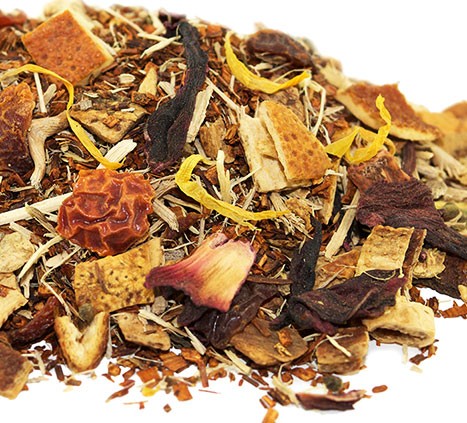
Cold Buster tea blend soothes colds and is caffeine-free. Credit: Harriet Wallis

Let’s make it clear. Tea cannot cure cancer. But the chemical make up of many teas can be part of a healthy anti-cancer lifestyle.

It’s not hocus pocus. Tea is a most studied anti-cancer plant. Check out what the National Cancer Institute says about tea’s anti-cancer benefits: https://www.cancer.gov/about-cancer/causes-prevention/risk/diet/tea-fact-sheet

But let’s start at the beginning.

Maria Uspenski was healthy and active until she was slammed with ovarian cancer that turned her life upside down. That’s when the IBM engineer and tech business owner launched full bore into making nutrition and lifestyle changes to give her a life-saving edge. She learned that teas can boost the immune system and might inhibit cancer.

In 2004, this cancer survivor founded The Tea Spot, a woman-owned tea and tea ware company in Boulder, Colorado.

So what about the teas?

I like tea, but I’m a beginner. I had no clue there are so many kinds of tea, and I don’t speak “tea language.” But I like to explore tea flavors and try new tea techniques. It’s okay to be a beginner and learn as you go. Real connoisseurs, however, will appreciate the breadth of The Tea Spot’s offerings.

They offer many, many types of White, Green, Oolong, and Black teas. And there are also Herbal, Mate, Organic and Pu’erh teas.

I’d never heard of this Pu’erh-thing, so I looked into it. It’s a special process that gives those teas an earthy taste. It’s thought to do good things such as: reduce cholesterol, aid digestion, improve weight loss, and it might relieve hangovers.

Each tea has its special properties and benefits. And the Tea Spot site describes each tea in detail. There are so many teas to try.

The bottom line:

The market is saturated with health drinks. Perhaps it’s time to try tea as your health drink.

To read more from Harriet click here for her stories on SkiUtah.

Cycling Efficiency For Seniors

Bottom Line: Knoweth Thy Limits, Wise One.

Ride with younger guys? Then ride wise and slow down. Credit: Pat McCloskey

As I  was pounding the rocks of  Laurel Mountain on the mountain bike with  a group of younger riders here in Pennsylvania’s beautiful Laurel Highlands, I was thinking strategy.  At 63 years old, I am still in pretty good shape but the older I get, I start thinking about the old adage “age and treachery will beat youth and skill”.  Not really applicable in most cases but at least I can try – right?  So the first thing I think of is: don’t push the anaerobic limit to be the first up the hills and over the rocks.  Let the young guns deal with that and I will just keep them in sight.

I have learned to ride within myself and only exert myself enough to keep a visual on the group, especially with a longer three hour + ride.  A more scientific approach is the below which is done with a heart rate monitor:

  • Zone 1: 60 to 70 %; very comfortable effort; use this for warmup and cool down
  • Zone 2: 70 to 80 %; comfortable enough to hold a conversation; most training is done here
  • Zone 3: 81 to 93%; “comfortably hard” effort; you may be able to say short, broken sentences.
  • Zone 4: 94 to 100%; hard effort; the pace is sustainable, but conversation is a few words at a time.

Author Pat McCloskey ponders whether to go around a big section to get back to the parking lot.

Basically the zones are dictated by two theories.  The original theory is dictated by the target maximum heart rate of 220 minus your age. Then you can calculate with a heart rate monitor which zone you can ride in.  This calculation is not quite accurate because it does account for conditioning.  A better way to use the zones is to calculate what is called Heart Rate Reserve which is your max heart rate minus your resting heart rate. Find out what your real max heart rate is by exerting yourself in Zone 4 with a monitor and then in the morning at rest, calculate your true resting heart rate.  This allows for conditioning and the zones can be used according to that calculation on a heart rate monitor.  All in all, I use a monitor on rides to tell me when I am exerting myself above my perceived rate of exertion which will lead to fatigue on a long ride if I am not careful. Use the monitor and slow down accordingly.  As long as I keep the group in sight and can be in the Zone 2 area, I am a happy rider.

Another strategy is not to ride every section but take a breather and bypass a section and/or coast to the next meeting area.  Sometimes that means taking a fire road instead of a technical trail..  I like to challenge myself and take the technical sections but I know if I take them all, I will not be able to keep up or complete the ride.  Ride to ride another day is my motto, and I am not out to prove anything.

Lastly, know your limits and know when you are finished.  You don’t want to get hurt and if you are too fatigued, it can happen easily on a mountain bike.  Sometimes you have to cut out and take the fire road back to the parking area for a head start on the post ride beer.  Hey, you had a good ride, with younger, stronger riders, but for a guy who is older, this is the way to stay involved without compromising your ride or theirs.

Riding season is upon us, and there is no reason not to challenge yourself within limits.  Go for it.  Have fun but as Harry Callaghan once said, “ A man has to know his limitations.”

Cross or divert? Use your noggin and your heart rate monitor to decide. Credit: Par McCloskey

Sarcopenia: Insidious Muscle Loss Can Be Managed.

It Can Happen, But Don’t Despair.  Read On.

A fitness program that includes resistance training can forestall muscle loss.

Sarcopenia or muscle wasting is a condition which affects almost everyone starting about 50 years of age.  Do you have it?  Look in the mirror: Your once proud biceps and pectorals have sagged, your pants are falling down, no more butt, your legs look skinny. What looks like loose skin is really the loss of muscle. You find yourself skiing on easier slopes, minding how you climb stairs, playing less aggressive tennis, and basically losing muscle tone.

Is all lost? No, indeed.  A prominent medical school subjected a group of older folks who used walkers to a resistance training program.  In 90 days, they were able to ditch the walkers!

Apparently, the secret is a resistance training routine with some dietary changes.  A structured program in resistance, i.e., weight lifting, similar to a body builder’s program is the key.

In addition, older folk do not process proteins well. When it’s snack time, we go for crackers or other carbohydrates. This subdues your appetite but contributes nothing to your protein intake and robs your body of the space that could be utilized for protein.  Find a protein source for your snacks.  I am fond of beef jerky. Or try Greek yogurt, trail mix, almonds, peanut butter and celery, and others. Check here for ideas. Protein drinks are okay, but don’t use them as a meal replacement.

Light weights are good for bone density and muscle mass preservation.
Credit: SeniorsSkiing.com

Resistance training for seniors is a case of make haste slowly. There is potential for injury and an untrained individual needs to be careful. Proper form is absolutely critical for injury prevention and instruction by a professional is required, either at certified trainer at a gym or a physical therapist.

Medicare covers about 20 physical therapy visits a year. Get a referral from your primary care provider. Medicare with a United Healthcare supplement (AARP) has the Silver Sneakers Program which allows you unlimited visits to a gym on the program.

If you do have some resistance training experience but have been lax for a while, start off slow.  Start with a lower body workout—squats, lunges—that use your body weight only for four weeks.  Then add light dumbbells. A weight which allows you to complete three sets of 10 reps without undue exertion is the signal to increase the load, never more than about 10 percent.

Don’t forget your upper body. Most gyms have an array of weight machines which reduce balance issues.  Once again, find a personal trainer for a couple of visits to learn the form and reduce the chance of injury.

Follow your program three times a week.  You will feel stronger in a month, see results in two months and by the third month you will have developed a life-long habit.

As with all exercise programs, seek the advice of your medical professional and get expert help in starting out.


Seriously Injured? High Fives Has A Program For You

A Community That Can Help You To Get Back To Athleticism.

What if you suffer a life altering brain, spinal or physically limiting injury and want to ski again? Where do you turn? One place is the High Fives Foundation started by Ray Tuscany who was a ski racer who broke his back.

After his injury, he founded High Fives to help create a community to get a skier (but it could be anyone or any athlete) through the recovery process. Tuscany is emphatic when he says High Fives doesn’t have clients or customers, they have athletes!

According to Tuscany, once you have clearance from your doctor and are in the best shape possible, they will help find the funding to get you back on the slopes. The foundation works with the rehab staff to create a plan and a budget for each athlete. To help achieve the athlete’s goals, it provides the financial support—typical grants average around $5,000—to help cover the expenses for adaptive equipment, training, and other bits and pieces to get you skiing again. The foundation pays the providers directly so they can accurately track and report back to their donors where and how the money was spent.

The organization is certified to operate in all fifty states and is headquartered in Truckee, CA. It has offices in Reno and Sugarbush, VT as well.

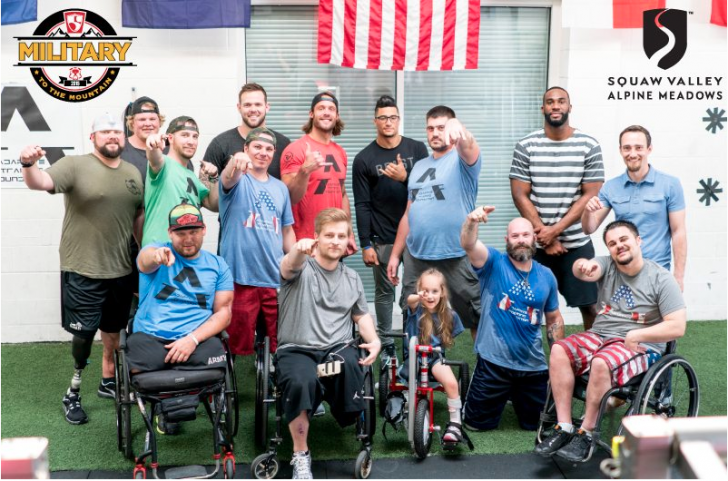
High Fives also has another program to help disabled vets learn to ski. Through its Military to the Mountains program, each year twenty-two injured veterans are selected by the Adaptive Training Foundation in Dallas and taken through a nine-week program to restore, recalibrate and re-deploy these injured warriors. Many become Paralympians.

For more information, contact Roy Tuscany at the High Fives Foundation at www.highfivesfoundation.org or at (530) 562 4270.

For vets who are interested in what the Adaptive Training Foundation has to offer, their web site is www.adaptivetrainingfoundation.org or you can call them at 214.432.1070.

Military To Mountains participants are ramped up for event at Squaw Valley.
Credit: HighFive

XC Skiing: Older, Wiser, And Cheaper

A Veteran Ski Instructor Finds Nordic Matches His Senior Skiing Philosophy.

A seasoned Alpine skier (left) compared to a pro Nordic skier. XC is easy to do wrong.
(Credit: Brad Noren_

Older, wiser, cheaper, what is this about? It reflects on what happens with age for most, but let’s put it into a skiing context. Having taught skiing since 1971, I’ve discovered these are the three adjectives that seem to reflect on one’s skiing philosophy with the passing of time.

Most of us in this age group probably skied a lot in the 70s and 80s, maybe even the 60s. I’m sure those memories are rich with fun, challenge and thrill. But as we move into the present, the love of the sport is struggling against those three words in many ways, and, for some, as the song says, “The Thrill is Gone”.

Over my many years of skiing and teaching skiing, I watched aging skiers make changes that were hard to accept (me included). This often resulted in some quitting the sport (not me included). Back to the “older” adjective; in brief, “the body doesn’t do that anymore”. The “wiser” adjective points to personal safety issues, and the “cheaper,” well, you know what that means.

Being “older, wiser, and cheaper,” I have found cross country skiing to be an excellent sport for seniors but often not understood or accepted by the once serious downhill skiing fanatic of decades past.

XC skiing will give you the opportunity to circumvent most of the “older” issues by building muscular strength, adaptive fitness, respiratory health, and the thrill of learning will return. A new challenge is in your future. XC skiing will make you much “wiser” on how your body parts really work, because you will be focusing on efficient movement, good diet, refined balance and more. XC skiing can also be “cheaper” than the downhill sport.

Being both an alpine and Nordic ski instructor, there’s a problem I’ve seen with the move from alpine to Nordic. Alpine skiers sometimes feel that since they are a seasoned, 40-year plus alpine skier, black diamonds, powder, NASTAR gold and all that they can put on a pair of XC skis and master the Nordic/XC sport.

Yes, you can try that but you will surely miss the fun, challenge, and the thrill. You must learn to XC correctly. XC skiing is easy to do BUT even easier to do wrong. I have seen this happen over and over again with close ski friends who are expert alpine skiers in their day. Ditch the ego and take a Nordic/XC ski lesson, you will not regret it. Yes, you will bring many skills in from your downhill resume, but you will also learn things you never even thought of. Your health will likely improve; you are going to be wiser learning a new skill, and you might—probably will—spend less cash.

And don’t give up your love for downhill because I also know your downhill skiing skills are going to be strengthened, and you will find a new thrill there as well.

For more information on properly learning XC skills, check out my web site, Nordic Fusion. As I tell all I ski with “Glide Long and Prosper”.

Shape Up: How To Get Fit For The Season

Progressive Exercises From Easy To Difficult Can Help You Tone Up.

Okay, it’s late October, and you’ve put this off long enough.  You need to limber up for the upcoming snow season. Without topping up your muscles and stretching those ligaments, you can hurt yourself and have a very short season indeed. With some daily or weekly fitness routines, you can feel and move better on the slopes and trails.  So, get going.

Check out our collection of Conditioning articles under the Health tab.  We have recommendations for some basic yoga poses as well as advice on calibrating your exercise regime to your age.  Be advised, if you’ve spent the summer cycling, hiking or kayaking, you may find that you’ve got to pay attention to muscle groups that aren’t engaged in those exercise activities.  If you’re a walker, you need to think about your upper body.  If you’re a cyclist, what about those hamstrings and shoulders?  Rowing a kayak will build your arms, shoulders and abs, but what about your lower body?  See? Even though you’ve been active, you need to think total body for the season coming up.  Both Alpine and Nordic skiing require active muscles groups all over your body’s geography. So think total body work out.

Physical Therapist Rick Silverman starts us off with a basic leg lift.

Under the Health>Conditioning menu, you will find a progressive series of exercises that are designed to do just that. Physical Therapist Rick Silverman shows us a set of exercises from easy to moderate to more difficult that will get your battery charged up.  In the series, Rick demonstrates exercises for abs, quads, hamstrings, and hips. You can add your own favorites to this basic set including some basic yoga poses like squats, planks, and down dog.  Yes, add Tai Chi, too.

Here are some links the Rick’s series. And we have correspondent Rose Marie Cleese’s own story of her fitness journey for inspiration.  Check them out and start thinking about a regular conditioning program.

Rick Silverman’s progressive exercise series:

Easy Starters For Seniors

Up A Notch

Challenge Yourself

Rose Marie Cleese’s fitness journey starts here.

If you’re reading SeniorsSkiing.com, you are typically an active senior, so the advice in this article probably make sense to you.  Nevertheless, we know older folks who venture out into the snow world without preparing themselves and wind up injured and unhappy.  You can avoid this; get going!


Fitness Focus: The Essential Down Dog

Here’s One Of The Most Important Stretches An Active Senior Can Do.

[Editor Note: Our summer series Fitness Focus is taking a distinctive turn toward several important yoga positions. We’ve highlighted the Squat, the Plank, and now the Down Dog.  We are a bit biased toward these poses because we have experienced personal progress and various muscle pain relief by practicing them.  We’re curious, too, about your experiences with these and others.  Let us know.]

Downward Facing Dog
Credit: Yoga Basics

Hamstrings are the big muscles behind your thighs.  If you stand and raise one heel towards your backside, you are using your hamstrings. When you sit down on a chair, those muscles are relaxed and become shortened and tight.  When they are tight, they pull on your hips and, in our experience, have been one source of classic lower back pain.  There are other sources, of course, i.e., bulging discs, arthritis and even infection.  But we’ve found that stretching those hamstrings goes a long way in resolving that uncomfortable lower back.

According to physical therapists, the most effective way to stretch those hamstrings and many other muscle sets is the Down Dog pose (aka Downward Facing Dog, or Adho Mukha Svanasna).

It is a rather simple pose that involves your entire body.  You start on your hands and knees, hands under shoulders, knees under hips.  With an exhale, up you go, bringing your rear end up, your head between your shoulders and your legs as straight as you can get them.  Spread your hands out like a star fish and gaze back at your shins while keeping your neck in line with your spine. The ideal is to plant your heels down on the floor while your legs are straight, your spine lengthened and your belly button drawn into your spine. Chances are, you’re not going to get your heels down if you’re just starting.  Or perhaps never. Most people feel comfortable just “pedaling” their heels up and down as a first step to getting comfortable.

Breath slowly and deeply from your belly button.  You are strengthening your shoulders, neck, back, glutes, and lots of other muscles while you are stretching your hamstrings.

One-Legged Down Dog is an easy variation.
Credit: Yoga Basics

From Down Dog, you can transition to Plank, hold that for 10-20 seconds, and then go back to Down Dog.  Back and forth between those two is a tremendous stretching and strengthening exercise. Breathe deeply and slowly. We’ve heard this combination is used in various military boot camps to get recruits into shape.

There are several variations you can use once you get into Down Dog.  Lifting one leg straight up is one.  There are others which you can check here.

As usual, if you have any carpal tunnel, shoulder, back, joint issues, or unregulated high blood pressure, please check with a health care professional before you try any of these stretches.

Here’s a demonstration and tips for correcting common problems in doing Downward Dog.

https://www.youtube.com/watch?v=4Z8rZJ6sk48


Fitness Focus: Plank, Plank, Plank

This Pose Is Considered The Simplest, Most Effective Core Strengthener.

Pretty basic, but effective. It’s easy to do it incorrectly so study up.
Credit: Yoga Lily

“Plank, plank, plank,” says Jan, the exercise instructor at the head of our class.  After an hour of kick boxing, we start the floor exercises to end the session.  We get into plank position as she intones, “Plank, plank, plank”. The seconds roll by.

High plank or Phalakasana pose. The most glorious of simple exercises, body weight held in place by core strength.  Arms, wrists, shoulders, lower back, abs, gluts, all working to hold the position.

The proper plank position can be found by putting your hands under your shoulders, extending up to a full, high plank on your toes, body a straight line from heels to back of head, eyes focused about a foot ahead of you, chin tucked. Basically, it’s like the top of a push-up, making sure your body is straight and not sagging or arched. While you’re up there, you can flex your feet, bend one knee in, then the other. Put one foot’s toes on the heel of the other foot, then switch. If you hold yourself still, you can feel your muscles adjusting and keeping you balanced.

High plank can be modified by resting on your knees versus your toes. That might be a good place to start if you haven’t done core exercises in a while.

If your wrists are sensitive, you can support yourself on a pair of dumb bells or yoga blocks. If you have hand or wrist issues, like carpal tunnel or rotator cuff, you’ll have to get some advice from a physical therapist or yoga instructor to help mitigate those conditions.

You can also move from high plank to low plank, moving down to resting on your forearms, arms extending in front of you, one arm at a time.  Then, back to high plank.  And then down to low plank. Do this slowly while mindfully keeping your body in a straight line position.  Man, that’s a work out.

The benefits are impressive; you get toned up in the middle, and you will find yourself using those newly strengthened core muscles to support your back when lifting, twisting, even walking.  We’ve found that lower back problems can be addressed with a strong core.  Your posture will improve, too. Your mileage may vary, but plank and other exercises focused on the core can definitely help that lower back.

The experts say you should shoot for 30 seconds as a beginner to get into this.  Eventually, if you can hold plank for two minutes, you’re doing very well.

You can find more advice from experts on how to safely and properly do plank here.  Jen Reviews has a number of pointers and caveats on doing this exercise.  More advice from the Yoga Outlet here.   Jen Reviews sums up the major benefit of planking:

Planks are a very versatile exercise that target a lot of the most important muscle groups in the body. The core muscle groups are responsible in some way for helping us carry ourselves through almost every action we’ll perform in a day, so making sure your core strength is in check is absolutely vital for someone who wants to leave a healthy lifestyle.

Plank pose is also one of the Sunrise Salutation series of connected poses that cycles through all your muscles, flexing, and strengthening all of you.  We’ll talk about the Sunrise Salutation in another Fitness Focus because it is a really awesome way to start the day.

You can incorporate plank as well as last week’s squat exercise along with others in a regime of strengthening, stretching and flexing that will keep you feeling good.

As with all new activities, please consult your doctor, physical therapist or exercise professional if you have any issues that might cause concern.


Fitness Focus: Do You Know Squat?

Squat Lately? Try It Every Day For A Week And See What Happens.

Editor Note: This week marks the beginning of our summer exercise series, Fitness Focus, where we will highlight one particular exercise, activity, stretch, or pose that leads to increased strength and flexibility.  Our first is the ubiquitous, simple, and under-appreciated squat.

Did you know the squat sit, or the crouch—feet planted shoulder width, as flat on the ground as you can get them, backs of thighs on calves—is one of the most useful and healthy poses you can assume at the gym, at home, or anywhere?

Hanging out in the squat sit is common in many parts of the world.
Credit: Asian People Like

If you’ve traveled in Asia, you’ve seen squat toilet facilities, people chatting with neighbors while squatting, and even squatting while waiting for trains or buses. Children everywhere squat, too, playing in the sand or around a collection of toys. The squat position is a natural pose, something we have grown out of as we grow up and sit at desks and on chairs. Yet, the squat is a powerful and effective position you can use for flexibility as well as strength training.

You can simply squat sit, or you can raise and lower yourself with or without weights.  Learn how to do a body weight squat by clicking here.

Jamie Lauren Keiles’ recent “Learning To Squat” in The New Yorker extols the virtues of this simple exercise. She writes,

“Squatting involves the whole body. The legs and the hips control the lowering motion, while the abdominals and the lower-back muscles work to stabilize the torso. Add a weighted barbell along the span of the shoulders, and the deltoids and the arms become implicated, too. Weight-bearing squats help to improve balance and flexibility and build muscular strength. In a squat’s concentric phase, as the legs extend to stand, the gluteus contracts to pull the hips forward.”

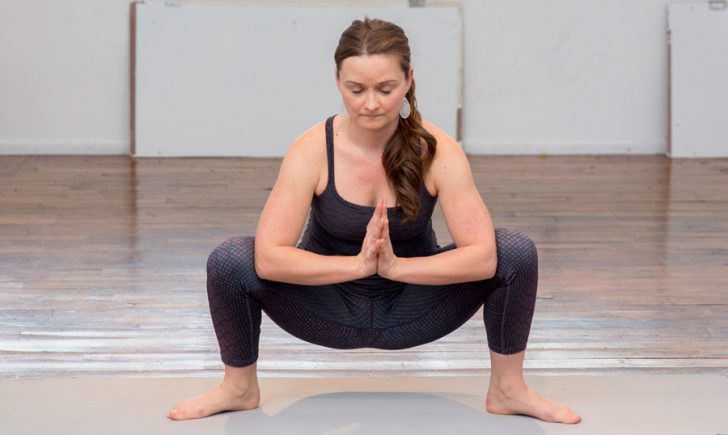
Malasana or garland pose is a squat sit that might be a good place to start.
Credit: REI

You don’t have to flex up and down to get the benefits of the squat position.  In yoga, you can assume malasana or garland pose, where you assume a wide stance—almost a plie position, squat down, lowering your hamstrings to your calves, putting your elbows inside your knees and your hands in front of your chest. Hold that for 30 seconds, gradually building up to a minute or so, and you will be stretching lower back, glutes, hamstrings, inner thighs, and working your core.

From the NYTimes Magazine, What’s the Best Exercise?:

“I nominate the squat,” said Stuart Phillips, Ph.D., a professor of kinesiology at McMaster University and an expert on the effects of resistance training on the human body. The squat “activates the body’s biggest muscles, those in the buttocks, back and legs.” It’s simple. “Just fold your arms across your chest,” he said, “bend your knees and lower your trunk until your thighs are about parallel with the floor. Do that 25 times. It’s a very potent exercise.” Use a barbell once the body-weight squats grow easy.

Click on the picture to learn how to do a body squat.
Credit: New York Times

So you have options: squat with or without weights, flexing up and down, or assume the malasana or garland pose.

To state the obvious, if you have any issues with knees, hips, or lower back, you may want to consult a trainer, physical therapist, or your physician before you try any squatting variation.

What’s Biting You? Part Two: Treatment And Prevention

[Editor Note: This is Part Two of a two-part article on Lyme disease by Steve Hines, outdoorsman and Wilderness First Responder. Click here for Part One: What’s Biting You?]

Treatment

The best treatment for Lyme disease bacteria is antibiotics. According to the Centers for Disease Control (CDC), “Patients treated with appropriate antibiotics in the early stages of Lyme disease usually recover rapidly and completely.” Patients with certain neurological or cardiac forms of illness may require intravenous treatment.

However, the National Institutes of Health (NIH) tells us, “Physicians sometimes describe patients who have non-specific symptoms (like fatigue, pain, and joint and muscle aches) after the treatment of Lyme disease as having post-treatment Lyme disease syndrome (PTLDS).”

So, don’t assume that because you and your doctor caught it early, and you took a course of antibiotics that you need not be careful. This is the case especially for seniors, since one symptom is cognitive impairment. The question comes up, “What’s normal age related ‘forgetfulness’ and what’s a lingering symptom of my Lyme disease?”

Prevention

It seems, then the best treatment for Lyme disease is prevention.

And prevention falls into two categories:

1. Personal protection

The first line of defense is protection when outdoors. Personal tick sprays use the chemical DEET.

The CDC recommends 30-50% DEET to prevent the spread of pathogens carried by insects, and it should be applied every 3-6 hours

Examples of tickproof gators. Worth it if frequently in high scrubs.

Finally, a number of outdoor clothing makers offer clothing in which the fabric’s threads are infused with permethrin. Hats, shirts, pants, socks, bandanas and gaiters are available from brands including Outdoor research, Orvis, ExOfficio, Craghoppers all offer these clothing pieces. Check with your local outdoor retailer.

Clothing containing the insecticide Permethrin (also known as Nix) is effective. Products like Sawyer’s Permethrin Spray can be squirted on clothing to make it tick (and mosquito) repellent.

Once you gear up with these products, don’t get overconfident. The critical activity for Lyme disease prevention is to inspect yourself from head to foot thoroughly when you come indoors. Ticks like warm dark moist places—so you know what that means for inspection.  Don’t be shy.

2. Controlling ticks in the environment.

CDC experts suggest that, in the absence of a human vaccine for Lyme disease, “no single method will be sufficient to substantially reduce Lyme disease.” Therefore, a main goal of researchers is not only to develop new treatment methods, but to assess the effectiveness of combined treatments for habitat.

What’s a potential habitat for Lyme? Richard C. Falco, of Fordham University has conducted research on this and asks questions including:

  • Is the property located in a Lyme-disease-endemic neighborhood?
  • Is there a history of tick bites associated with the property?
  • What is the proximity to woods?
  • Are deer observed on the property?
  • Is the property shaded?

If the answer is “yes” to all these questions, you should consider a tick-management plan from a professional. However, if the answer is “yes” to some of the questions, agree on a plan you are comfortable with given the estimated level of risk.

The deer tick is now carrying a disease more deadly than Lyme called Powassin. The CDC says approximately 75 cases of POW virus disease were reported in the United States over the past 10 years. But the danger is real and no cure exists. So, take precautions. [Editor Note:  As Steve suggests, Powassin is important to know about.  Click here for our SeniorsSkiing.com Powassin story from 2015.]

[A Final Editor Note: Our own SeniorsSkiing.com correspondent Suzie Winthrop alerted us to an important effort to better understand and fight Lyme disease. The Bay Area Lyme Foundation is asking people who get bitten to send the tick to them for analysis. You can learn more by checking out bayarealyme.org. They have been getting submissions from all over and will send you a report on your submission after it is analyzed.]

Find out how you can fight Lyme by submitting ticks from your area.

What’s Biting You? Lyme Is Now A National Problem

If You Are Walking In The Woods This Spring, Be Wary Of Ticks.

[Editor Note: This is the first of a two part article on Lyme disease by Steve Hines, an avid outdoorsman and certified Wilderness First Responder.]

Lyme disease is a bacterial infection caused by the bite of an infected black-legged or deer tick. Lyme disease has become a nation-wide epidemic with 300,000 cases reported last year with a significant increase predicted for 2017. The highest concentration of cases has been the Northeastern United States including the New England states, New Jersey and Pennsylvania. Outbreaks will also occur in the west most noticeably in Colorado, Wyoming and Montana.

NPR has reported that back in the early ’80s, the disease wasn’t that big a problem. Cases were confined to two small regions: western Wisconsin and the area from Connecticut to New Jersey.

However, in 2015, the CDC reported Lyme is present in more than 260 counties. The disease shows up in Maine, swoops down the East Coast into Washington, D.C., and southern Virginia. Then it hops to the Midwest into northern Indiana, Illinois, Wisconsin, and Minnesota. There are also small pockets of Lyme on the West Coast. This map shows the extent of Lyme disease for 2015, the latest year for which complete date is available.

Lyme disease is no longer considered limited to the Northeast.
Credit: CDC

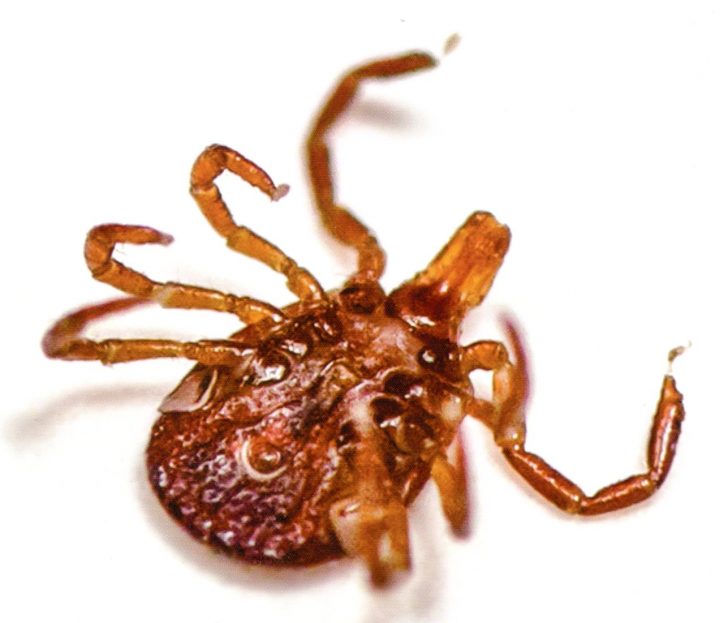
We are vulnerable almost anywhere outdoors. So, hikers, hunters and fishermen and gardeners are all susceptible. The size of the deer tick can vary depending on the sex of the tick, and its maturation state. Approximately the size of a sesame seed, a female adult deer tick measures about 2.7 mm in length. They are orangish brown but may change to be rust or brown-red in hue following feeding. The body becomes engorged after a meal and may expand considerably. Regardless, the deer tick’s body is approximately half as large as that of the common American dog tick.

According to the CDC’s Kiersten Kugeler. “In the Northeast, most people catch Lyme around their homes,” she says. “People out gardening. People playing in their backyard. Mowing the lawn.”  The ticks are transmitters of the disease, picking up Lyme pathogens from deer mice or other infected hosts.

Notice the cycle of Lyme and the tick life cycle.

Deer are hosts; Lyme is transmitted to ticks via mice or other infected organisms.
Credit: CDC

Diagnosis

The main problem in diagnosing Lyme disease has been physicians’ lack of education about it. Many doctors won’t recognize Lyme as an ailment. That denial caused a serious lag in treatment and investigation into an effective vaccine. Some victims have developed home remedies and antibiotics have been reasonably effective with early diagnosis.

Another difficulty has been how Lyme’s mimics other ailments like Influenza, chronic fatigue, arthritis.

The classic symptoms include fever, facial paralysis, joint and muscle pain and the classic Erythema migrans (EM) rash referred to as the “bullseye” rash. All symptoms of infected victims appear within 3 to 30 days, which is why early detection and diagnosis is critical.

Lyme disease is a real threat to our health. As seniors, if infected, we can be very sick and take a long time to recover—if ever (the disease if untreated can be chronic). Next week, we’ll discuss treatment and prevention.

Dermatologist on Sunscreens and Skiing

Memo to Skiers: Always use a “broad- spectrum” sunscreen with a SPF of at least 30.

Commercial sunscreens are divided into two classes: physical and chemical. Physical sunscreens contain Zinc oxide and titanium oxide. They deflect ultraviolet energy from the skin by scattering ultraviolet light.

All other sunscreen compounds are “chemical,” which act by absorbing ultraviolet light and re-emitting the energy as heat. Most commercially available sunscreens are a combination of two or more active sunscreen compounds.

The best sunscreens have a high sun protection factor (SPF) and are labeled as “broad-spectrum” because they protect against both ultraviolet A (UV-A) and ultraviolet B (UV-B) radiation. UV-B causes sunburn. UV-A penetrates deeper into the skin, causing aging.

Most people don’t apply enough sunscreen. A good rule of thumb is to use a strip of sunscreen about 1/4″ wide from the middle of the tip of the index finger to the crease where the finger meets the palm. That will be about the right amount to apply to the face and neck. If you perspire a lot, use a water-resistant product.

For Nordic skiers, I recommend liberally applying product 15-30 minutes before skiing (it allows the sunscreen to absorb), then re-applying every two hours. For downhill skiers, I recommend reapplying at lunch.

I wear a physical sunscreen combining zinc oxide and titanium dioxide (Vanicream SPF 60). I think it performs better than chemical sunscreens and is less irritating. For more cosmetically aware skiers, I recommend a high SPF chemical sunscreen such as Neutrogena Ultra Sheer Dry-Touch SPF 70 or 85 or 100. Other sunscreens along these lines will probably do the job as long as you apply correctly.

Wearing sunscreen takes a bit of consistent effort, but then again, almost every form of skiing takes some effort. Before your next snow venture, add a finger full of sunscreen to your head and neck. Your skin will appreciate it.

Walk-In Orthopedic Clinic Opens Near Salt Lake City’s Resorts

Nobody wants to get hurt while on vacation, but sometimes it happens.

Did you crash at one of the Wasatch Front resorts, think you were okay, but later decide to get checked? This new after-hours clinic treats what was hurt while skiing during the day.

The University of Utah Health Care Orthopedic Center is one of only a handful of academic medical centers in the nation to open an after hours, walk-in injury clinic, and it’s the first of its kind in the state. It’s very convenient for those skiing at Alta, Brighton, Snowbird, Solitude.

Resorts have their own on-mountain clinics, but often things don’t hurt until after you go back to your hotel. Skiers sometimes twist a knee, pull a hamstring, or get hurt some other way; and when the pain doesn’t go away they realize they really should be checked. The walk-in, after hours clinic fits the need.

The clinic treats fractures, strains, sprains, tendon injury or tendonitis, joint problems, or orthopedic injuries.

On a personal note, three friends recently went to the clinic and were delighted with the attention and care. X-rays showed one friend has a bone crack. Two others were identified with muscle tears. All were treated right there; they’re on their way to swift recoveries.

The clinic offers low wait times and an office visit co-payment that’s less expensive than a trip to the emergency room.

“The concept of acute care ortho clinics is a new one,” said Joy English, M.D. 36, sports medicine physician and clinic director. “People are starting to realize it’s a much better place for them than the ER.”


Senior Skiers: Take Care in the Sun!

Advice From a Dermatologist Nordic Skier.

The sun is by far and away the most common cause of both (1) skin cancer and (2) skin aging.

More than two million cases of skin cancer are diagnosed annually in the USA. Caught early, most skin cancers can be removed, leaving a cosmetically acceptable scar. In more advanced cases, valued anatomic parts such as noses and ears can be partially or completely lost. Unfortunately, ten thousand deaths occur yearly in the US from skin cancers.

Many Nordic skiers, blithely dedicate ourselves to going outside as much as we can whether skiing in the winter or running, biking, and hiking during snowless times. My recommendations to preserve skin health while frolicking out of doors:

  • Exercise early in the morning (before 10) or later in the after- noon (after 4) when the sun is less damaging.
  • Wear clothing that covers or shades the skin (e.g., a broad- brimmed hat is better than a visor).
  • Apply a “broad-spectrum” (protects against UV-A and UV-B) reasonably thickly with an SPF of at least 30. If downhill skiing or hiking all day, consider re-applying at lunch
  • Consult a dermatologist periodically, especially if you’re over 50, have a non-healing sore/bump, or have a changing or new brown or black spot.

Adapting your workout to your age.

Stamina, skiing and senior skiers.

Have you noticed that the older you get, you have to work out harder to maintain an ever-decreasing level of conditioning?  Yeah, yeah, yeah…  I know all the reasons but the reality is vigorous work-outs just delay the inevitable.  As we get older our:

  • Bodies aren’t as flexible;
  • Bones are more brittle;
  • Muscles don’t recover as fast; and
  • We lose muscle mass and brain function.

Since I’m losing brain muscle, that must be why I can’t remember why I should stop skiing, so I keep riding lifts.  Then I have to remember how to get down!

Marc Liebman recommends elliptical training for senior skiers.

Seriously, what I did to keep in skiing shape at 40 isn’t appropriate for someone who is 71.  Like my body, it has evolved over time.  Back when I was just four decades old, I ran a 10K five to six times a week at a 7.5 minute per mile pace.  Plus, I did chair sits, squats that strained my thighs and calves, crunches to build my core and other stuff.  All in the name of conditioning for skiing.

Workout menopause started at age 60 during a visit to an orthopedic surgeon.  He gave me a “twofer” of bad news after looking at an MRI.  First, he said if you keep running you’ll need new knees around age 65.  Second, I needed surgery to repair a torn and worn meniscus.  What a bargain!

That was the last day I ran, did squats and chair sits because they strained my joints way too much!  My workout evolved into 50 minutes on an elliptical at least five days a week going fast enough with enough resistance to get my heart rate into the 140s.  Interval training led to strained groin muscles that took months to heal.  My goal in each session is to burn at 475 – 500 calories and cover 4.3 miles.  Crunches and a daily 3.5 mile walk minimize the strain on my leg joints.

All this is in the name of building stamina.  If my legs are dead tired, it is hard to turn or stop which could lead to a bad fall and/or slamming into a tree, lift tower, or worse,  another skier…

I also do much more stretching now than I did before. My focus is on maintaining flexibility. Over time, my body has told me my groin and hamstrings need stretching, and I’ve learned the hard way to listen.  Stretching is also important if for nothing else, flexibility minimizes the pain and strain of putting on ski boots!

You have to tune your body.  Nobody else can.  I’m not big on personal trainers but if that’s what it takes, go for it.  Just remember, as you get older, the whole conditioning process takes more calendar and workout time and effort.  The pay-off in building stamina and keeping flexible is longer ski days.  For me that translates to 27 to 30 thousand vertical.


Can Alternative Medicine Help You?

A Tragic Accident Turns A Ski Racer Into A Believer And A Healer.

Siri says alternative medicine returned her to real life. Credit: Harriet Wallis

Siri says alternative medicine returned her to real life.
Credit: Harriet Wallis

Siri Wieringa was born into a skiing family. It’s in her genes. By college she was an accomplished ski racer. But a horrific on-course accident tossed her down the hill, flipping her over and over, breaking up one side of her body and terrorizing her brain. When she regained consciousness, life as she knew it was gone.

Doctors fixed her broken bones. But they were baffled about her brain which, even though she wore a helmet, was slammed again and again against her skull. Perhaps she should drop out of college, they said. Perhaps she should just rest.

Cancelling life did not suit Siri.

“I needed Western medicine,” she said. For example, “they Life Flighted me to the hospital.” But rather than letting her just rest and stagnate, her mom sought alternative healing methods.

Siri believes alternative healing returned her to real life. “I was in a fog,” she said. “I had to learn to walk and talk and then learn to ski again.”

She finished college with a masters degree, coaches a freestyle ski team, and is so passionate about alternative healing she has studied several healing arts and is a practicing healer.

I met the vivacious, energetic 26-year-old when I went to Alta to get my season pass. She’s the daughter of Alta’s revered, long-time General Manager Onno Wieringa.

Trauma, illness, emotions and the rigors of every day life can stress the body and cause bottlenecks that derail the body’s energy and its ability to heal itself. The body is a closed eco system designed to nurture itself, Siri said. You just have to give it a chance.

Most alternative healing methods were developed by ancient cultures centuries ago. Several are modern combinations. Some you might recognize, such as: acupuncture, crystals, quantum, cupping, Reiki, Accunect, Tibetan cranial and chiropractic. And there are others—all geared to heal the body, mind and spirit.

Siri is now a Reiki and a Accunect healer. Both methods use a light touch and are non-invasive. The effectiveness cannot be measured by traditional techniques. Non-believers call such healing methods nonsense. Others believe that alternative healing saved their lives. Alternative healing worked for Siri.

Might alternative healing be right for you?

To read more from Harriet go to  https://www.skiutah.com

Most Active Seniors Probably Have This Problem

But, There’s A Free Miracle Drug You Can Take.

You can live better when you're hydrated. Credit: TreeHugger

You can live better when you’re hydrated.
Credit: TreeHugger

At the risk of sounding like a spam email headline, I have re-discovered a miracle drug. It’s completely free, it acts quickly, and it can be found anywhere and everywhere. It’s a drug that can directly change your life for the better. I say re-discovered because I knew about this drug, loved its restorative properties, but like many things, I took it for granted and thoughtlessly stopped taking it as much as I should have, especially this summer. The impact of stopping was immediate and perplexing.

Of course, I’m talking about water. And what happened to me just over the summer is what can happen to any senior who is active. You forget to or ignore taking a water bottle to the gym, or you don’t drink after a walk or bike ride. You don’t ask for water with a meal. You spend a sunny day on the water fishing, sailing, kayaking, drinking sodas or beer with a sandwich.

You probably don’t think much about drinking water, but if anyone asks you why you don’t, your rationale is brilliant. Mine was: I have enough coffee, wine, tea, etc. during the week to keep me floating, or that water with a meal takes away my appetite, or I don’t like the taste of water at home because the well is low. (Common in parts of New England these days.)

Or glasses of water are for kids, right?

For me—a fairly active senior, the result of ignoring to hydrate was not positive. My symptoms: Logy, headache, irritability, lower than normal blood pressure (got a heads up during a routine visit), rapid resting heart rate, musty, dark-ish urine, and frequent, yes, frequent urination. I never once connected these to my being dehydrated, just getting a little more senior by the day.

But what signaled that I might have a hydration problem was a gym class instructor mentioning in passing that stiff joints might come from not having enough water onboard. Click. I had developed stiff joints and muscles this summer. I found walking a distance challenging because my hip flexors, psoas, hamstrings and glutes were tightened up. Stretching didn’t seem to help as much as it should have. I thought I was the victim of sitting at a desk for long stretches. That contributed, but lack of drinking water as a clear accomplice.

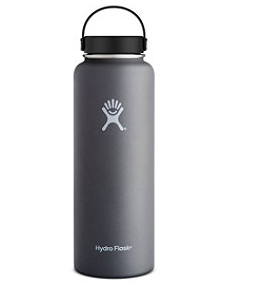
Expensive water bottle, insulated, vacuum. Credit: LL Bean

Expensive HydroFlask water bottle, insulated, vacuum.
Credit: LL Bean

My remedy is to start drinking water again, simple as that. I now have at

Reasonably priced, Nalgene water bottle. Credit: LL Bean

Reasonably priced, Nalgene water bottle.
Credit: LL Bean

least three eight-oz. glasses before noon and three after. I use spring water to replace the mineral-filled well water. When I first started this regimen, the results were immediate. I felt more alert, energetic, upbeat, and the muscle/joint stiffness—combined with dutiful and targeted stretching—is gradually going away. At least, this is working for me. Your mileage may vary.

I am not a medical professional, but I’ve learned that most seniors tend to walk around in a dehydrated state. Medications, living at high altitude, certain conditions like diabetes, just getting older can all contribute to dehydration. And forgetting to drink.

Easy tips from MedicalNewsToday:

  • Drink water, juice or milk at each meal.
  • Moderate how much coffee, tea, alcohol you drink. They are diuretics, and, to varying extents, take water out of your body.
  • Drink small amounts of water frequently throughout the day.
  • Drink small amounts during a workout as well as after to replace what you lose in sweat.
  • Consider an electrolyte-type drink.

Final tip: Buy an expensive water bottle so you feel guilty if you don’t use it; keep it full and handy.

If you have symptoms or questions, see your primary care physician.


On The Fitness Road Again!

How My Fitness Journey Took A Detour, And How One Powerful Documentary Is Going To Help Me Get Back On Track.

Michael Pollan's PBS documentary and book have inspired RoseMarie to renew her fitness quest.

Nutritionist Michael Pollan’s PBS documentary and book have inspired RoseMarie to renew her fitness quest.

So, to let all of you who were following my fitness journey here last summer know, I was doing great…and then I wasn’t. I don’t know exactly when I lost momentum or let complacency set in or thought I could let some old bad habits wiggle back into my life here and there without bad effect. But here I am again a year later feeling like a stuffed sausage in too-tight jeans and nowhere near fitting into that favorite dress of mine again. Somehow I’ve managed to gain back half the weight I lost.

But I’m not throwing in the towel or losing the tape measure or chucking the scale. I’ve got three-plus months to get back to where I was last fall, and I vow to continue this time until I reach my goal. My plan is to continue my exercise program, finally conquer my habit of staying up late and getting up early, stick to a healthy and sensible diet, and make all of this a permanent, everyday part of my life going forward. I’ll report periodically on how I’m doing and share with you any insights or good tips I’ve found on my renewed journey to fitness.

My big piece of advice for you today is to check out In Defense of Food, the excellent two-hour PBS documentary about nutrition produced by Michael Pollan, America’s most personable, passionate, and brilliant nutrition activist, journalist, and award-winning author. At the heart of the documentary, which is based on his best-selling book of the same name and which first aired on PBS last December, is Pollan’s seven-word maxim to help Americans figure out how to eat to be healthy: “Eat food. Not too much. Mostly plants.”

During my fitness program last summer, I had actually incorporated some of his philosophy into my new eating regimen. I became very vigilant about portion control, and I started eating less meat and white food (e.g., bread, cheese, etc.) and more fruit and veggies. But after watching Pollan’s riveting documentary, I have a whole new view on what “food” is.

When Pollan says to “Eat food”, he’s talking about 100% real food, not quasi-food or “edible food-like substances”. Believe it or not, probably most of the food in your local supermarket falls into the latter category. Anything artificial or with additives does not qualify as real or pure food. When Pollan says “the quieter the food, the healthier the food”, he’s talking about the “health” claims that cry out from the packaging, most of which are horribly misleading or worse, untrue. As much as the government tries to regulate what can be said on packaging, the manufacturers find clever ways around the rules. To follow this part of the maxim, always read the labels and buy food that’s free of packaging, which will make it easier to follow the third part of the maxim: “Mostly plants”. Eat lots of fruits and vegetables and consider meats “special occasion” food. For the freshest produce with the least amount of packaging, shop at your local farmers’ markets.

And to follow the middle part of the maxim, “Not too much”, Pollan suggests eating your fruits and vegetables first during a meal, and use smaller plates and glasses. And of course, be mindful of your portion sizes—think palm-full, not plate-full.

Enjoy Mr. Pollan’s documentary…and wish me luck!

Pollan's seven word rule for selecting and consuming food. Makes sense.

Pollan’s seven word rule for selecting and consuming food. Makes sense.