SeniorsSkiing Guide: Historic Dartmouth SkiWay

Big Mountain Fun And Small Mountain Friendly With History All Around.

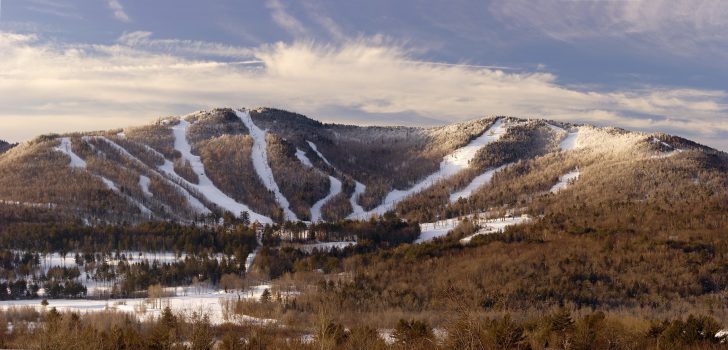
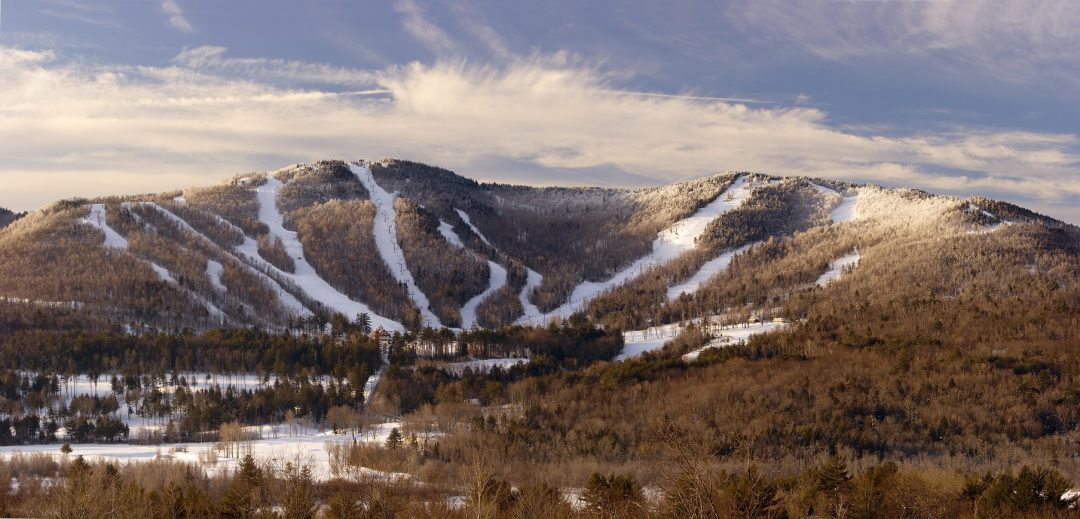
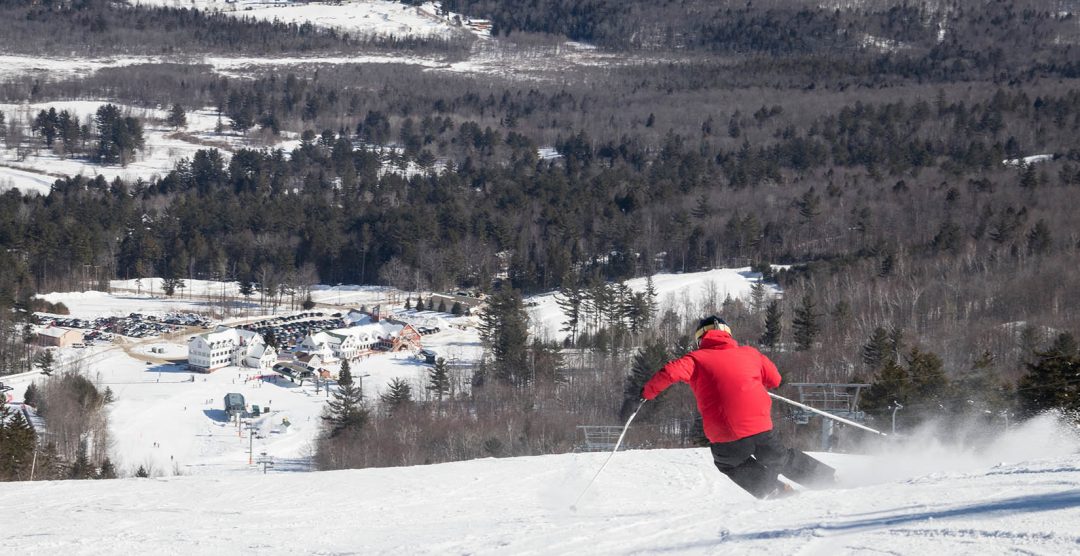
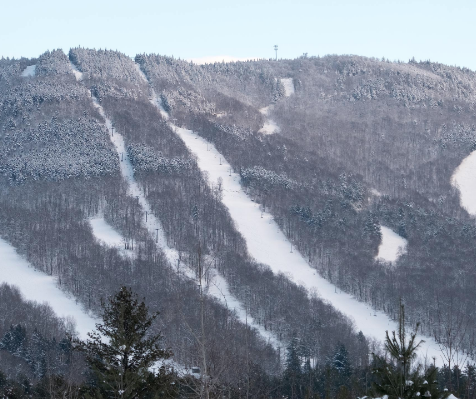
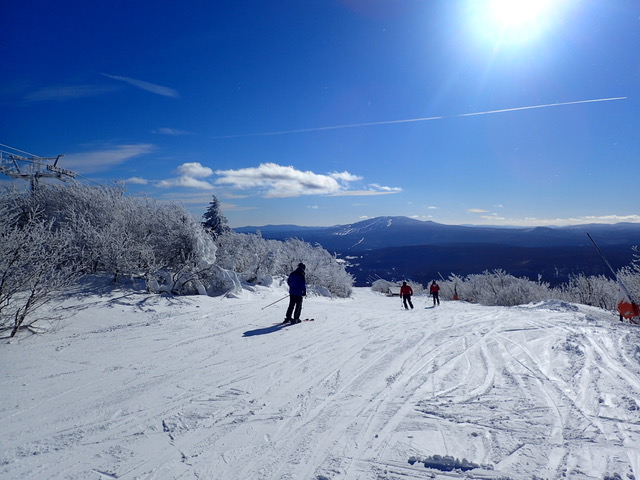
Corduroy in the morning. Dartmouth Skiway has a mix of twisty narrow and open groomers. Credit: TheSnowWay.com

Dartmouth Skiway in Lyme Center, NH was founded in 1956. After six decades the ski area has recently hired only the fourth director in its history. Mark Adamczyk who was the director of outdoor adventure at the Winter Park Resort in Colorado will replace Doug Holler, who is retiring at the end of this season after 19 years on the job.

The Skiway rock guards the entrance to the big, green lodge. That’s Dartmouth green, BTW. Credit: Roger Lohe

The Skiway as it is known locally is family-friendly and reasonably priced with 20-30 runs of terrain that will serve first timers or challenge skiers and riders of all ages and abilities. One-on-one teaching for beginners through advanced skiing is a tradition at the ski area that includes two mountains, a clean, comfortable lodge, a rental shop, and a food court. Visit the area and you’ll see not only kids learning to ski in a beginner area and older skiers doing snowplow turns on the trails, but also ski racers from Dartmouth College training and clacking through the gates.

The Holt’s Ledge side of the resort has a double chair while there is a quad chair and a conveyer lift on the Winslow side. The McLane Family Lodge is open and airy with plenty of space. The large wooden tables and benches and stone fireplace give the lodge a rustic appeal of skiing in the old days. You’ll see after-school groups at the Skiway during the week, but even on weekends the slopes are uncrowded and the lift lines minimal. Dartmouth Skiway has more than 100 skiable acres including tight off-piste trails and glades for advanced patrons, 968 foot vertical drop, and 16,000 square foot lodge.

Watching the races at the Holt’s Ledge, circa 1960. Credit: Dartmouth.edu

This area is quite historical in the world of skiing and ski racing. More than 100 national and Olympic champions have trained at Dartmouth Skiway. The Dartmouth Skiing Wall of Fame on the first floor of the lodge reveals a Who’s Who of ski legends.

Calling the lift ticket prices at Dartmouth Skiway reasonable is an understatement. Adult midweek lift passes are $33 (weekend $58) and half day prices available for morning or afternoon are available for only $28. Prices are lower for teens and children while senior skiers pay only $27 a day or $22 for a half day, and super seniors age 80 and over ski or ride for free! There are low priced season leases for equipment and packages to learn skiing or riding (with private lessons). The beginner area is $14 all day, and there is a Skiway Special on Monday and Tuesday for $23 during non-holiday periods.

From a personal view, the Skiway was about 15 minutes from my home in Hanover, and much of my family ski lore occurred there. Each day of the week there was a different town after-school ski program. I ran the Ford Sayre snowboard program for a number of years there, hiring Hanover High School kids (including my son and daughter) to teach and chaperone hundreds of younger kids in small groups. On a recent visit to the Skiway following a full day snowstorm, I was greeted by the woman at the ticket window stating, “Some things never change, it’s no surprise seeing you here on a powder day.” Riding on and off trail with my kids at Dartmouth Skiway is a deep-rooted part of my family history and on-snow soul.

Dartmouth Skiway is 15 minutes from I-91 Exit 14. For more information  click here. 603-795-2143.

For a Dartmouth Skiway trail map, click here.

For Dartmouth Skiway web cam, click here.

Skiway has a museum in the lodge reflecting 60+ years of history. Credit: Roger Lohr.

Trapp Family Lodge: Some Favorite Nordic Things

[Editor Note: SeniorsSkiing.com is asking our readers to contribute to support our online magazine. Yes, we have grown in the number of subscribers and advertisers. But our expenses have also grown. You can help us defray some of these expenses by helping us out with a donation.]

Support SeniorsSkiing.com by clicking here.

______________________________________________________

A Ski Tour At The Legendary Resort Winds Up With Craft Beer.

Northern VT mountain-scape on the way to the Slayton Pasture Cabin. Credit: Tamsin Venn

One of our favorite things to do at the Trapp Family Lodge in Stowe, VT, is to ski up to Slayton Pasture Cabin, a three-mile steady climb.

The rewards are a screaming yippee-inducing downhill and a cozy cabin with a roaring fire, friendly fellow skiers, and hot chocolate, soup, and sandwiches.

The pasture is named after the farming family that once owned this hill-top acreage, a corner of the gorgeous 2,600 acres of rolling hills and meadows owned by the Trapp Family Lodge.

On a recent crisp mid-February day with new snowfall, nature presented a perfect Vermont day, sun shining through the trees, and impeccably groomed tracks. Every senior who likes to Nordic ski should do this trip.

Sam von Trapp, scion of the famous singing family, leads the tour up to Slayton Pasture Cabin. Credit: Tamsin Venn

Our guide was Sam von Trapp, son of Johannes, youngest of the singing family’s siblings. Sam exudes enthusiasm—for the trails, his family’s business, land, guests, Nordic guides, and epic ski races. He actually waited for us to catch up, then told entertaining stories while we caught our breath.

It was Johannes armed with a masters’ degree from the Yale Forestry School and, with the aide of a Norwegian XC director from Oslo who cut the lovely rolling loops through the woods and fields, created the first commercial Nordic center in the country in 1968.

We reached the cabin via Yerrick’s Yodel to the newly named Hissy Fit trail to Chris’ Run. The sign that marks the half way point to the cabin has been removed for motivational reasons. The official record time from the Outdoor Center to the cabin is 17 minutes 11 seconds, according to von Trapp.

On the way down, follow Haul Road, Chute Bypass, Triple Bypass, cross Luce Hill Road, to Luce Trail, to Lager Lane, and you have arrived. At the Bierhall!

Here the spacious setting offers Austrian fare for lunch and dinner. Dishes like the chicken schnitzel and the Johannesburger, made from the Trapps’ own grass-fed beef await. We sampled the new Berliner Weissbier “test batch,” just out of the brewery. It’s going to market later this month.

Sam and Johannes at the brewery. Beer and XC skiing make a natural combo. Credit: Tamsin Venn

Ever the visionary, Johannes started the brewery in 2010, when the craft beer movement was gaining froth. The goal was to brew crisp, clean craft lagers like the ones the family tasted on trips back to Austria. First opened in a retro-fitted bakery on the property, the brand new 36,000-square-foot brewery that you see today followed, so positive was the response.

A shuttle will take you back to the Outdoor Center. Just ask the host at the Bierhall to request the ride. If you still have some energy left snowshoe the red trail up to the Stone Chapel that Werner von Trapp built. Snowshoeing is increasingly popular here with dedicated trails, another favorite thing.

The facts: 100 km of XC, snowshoe, and backcountry trails on more than 2,500 acres. 36 miles are groomed,

Passes: Senior day $20. Senior Ski Season (65 plus) $185. Senior couples $300.

If you energy to spare, snow shoe over to the Stone Chapel, built by Werner von Trapp. Credit: Tamsin Venn


Jack Frost Geezers Flock To Senior Ski Program

[Editor Note: SeniorsSkiing.com is asking our readers to contribute to support our online magazine. Yes, we have grown in the number of subscribers and advertisers. But our expenses have also grown. You can help us defray some of these expenses by helping us out with a donation.]

Support SeniorsSkiing.com by clicking here.

______________________________________________________

Jack Frost Created A Program For Seniors 20 Years Ago And It Is Still Going. 

Jack Frost Geezers line up for a Wednesday program.

Editor Note: About 20 years ago several Jack Frost PA ski area skiers put their heads together and decided that they should have a brand name. A vote was taken and “Jack Frost Geezers” was the winner.  Every Wednesday from January through early March the Geezers get together and spend the better part of the morning with several pros and review the latest techniques.  The following article was written by Jennifer Learn-Andes of the Wilkes Barre Times Leader. She discovered that Jack Frost offers free lessons to skiers of all abilities from novice through expert and decided that she will join us one Wednesday morning to discover the joy of being in the outdoors in the winter, enjoying the freedom that skiing will add to winter time fun.  Thanks to Bill Runner for bringing this story to SeniorsSkiing.com

Mountain Top resident Felix Rushinski had a post-workout glow last week after participating in a skiing program for older adults sponsored by Jack Frost Mountain and the Luzerne/Wyoming Counties Area Agency on Aging.

“You’re out in the fresh air and get to meet people,” the 74-year-old said. “It’s very relaxing.”

Geared for anyone over 50, the program at Jack Frost on Route 940 near Blakeslee provides free lessons for those new to skiing and tips and pointers for the more experienced.

Aside from bringing or renting skis, participants must purchase a lift ticket, but it costs a discounted $25 instead of the usual $40 or $55, depending on age.

The program is at 10 a.m. on Wednesdays through March 4. Participants sign up at the Jack Frost ski school desk around 9:45 a.m.

A Nanticoke resident, Yozviak said the program draws many regulars seeking outdoor winter fun and exercise.

“You don’t mind the cold if you are properly dressed because of all the activity,” Yozviak said.

Hazleton resident John Hidock, 56, said he participates every Wednesday.

Hidock taught skiing at the complex until 2014 and said he embraces the opportunity to socialize and keep up his skills on the slope.

The sport is great for both physical and mental health, he said.

“It’s wonderful. It can be exhilarating and a thrill to be outdoors and enjoying the scenery this place has to offer,” he said.

Agency on Aging representatives brought lunch for participants last week and spoke about healthy eating and programs offered at active adult centers. The agency is a sponsor and it promotes the program, Yozviak said.

“You guys really rock,” Harley Bobby, the Aging Agency’s senior center services director and health and wellness coordinator, told the group at the luncheon.

Bobby said she was impressed with their skiing and pleased a program is available for make the sport financially accessible for seniors.

“I think it’s amazing that they stay so active,” Bobby said.

Shavertown resident Bill Runner has provided skiing instruction for years and said the program started about 20 years ago.

He stopped to chat with participant Jacki Olsen, 77, of Pocono Lake. Beaming with rosy cheeks, she said she only hits the expert slopes.

“I’m skiing better than ever. This program makes it more affordable and nice to ski with others,” Olsen said.

Rushinski said he has been skiing for 40 years and started regularly attending the Wednesday sessions about five years ago.

Like Olsen, he sticks to expert slopes but said he continues to pick up pointers for improving his technique.

He encourages novices to give it a try. Jack Frost is accessible from the Wyoming Valley via Route 115, the Pennsylvania Turnpike and Interstate 80, he said.

“It’s really in our backyard,” Rushinski said.

SeniorsSkiing Guide: Ragged Mountain

[Editor Note: SeniorsSkiing.com is asking our readers to contribute to support our online magazine. Yes, we have grown in the number of subscribers and advertisers. But our expenses have also grown. You can help us defray some of these expenses by helping us out with a donation.]

Support SeniorsSkiing.com by clicking here.

______________________________________________________

Ragged Has All The Features Seniors Love: Great Trails, Low Crowds, Modest Prices.

Ragged Mtn, Danbury, NH, has two peaks. Credit: Ragged Mtn.

Located less than two hours from Boston, Ragged Mountain in Danbury, NH offers skiers and boarders a wide variety of terrain from a perfect learning area for beginners to some challenging glades for the expert. It’s truly a family mountain as all trails lead back to the quintessential New England base area.

Ragged’s beginner terrain is ideal for learning. There are two carpet lifts serving very gentle terrain that provides a slope that will not threaten or frighten new skiers. From there they can progress to the Barnyard Triple serving a slope perfect for working on turns and building confidence. The whole beginner area is located off to the side of the main mountain, keeping it separate from the better, faster skiers coming off the summit.

Magic Carpet ride for beginners. Credit: Ragged Mtn.

Two high speed lifts serve the area’s two main peaks. A detachable, high speed six passenger chair, New Hampshire’s only sixpack, whisks skiers and riders to the summit of Ragged Mountain in about five minutes. A detachable quad takes about the same amount of time to reach the Spear Mountain summit. From the Ragged peak a variety of trails from easy green to black diamond wind their down. Skiers and riders are able to navigate from the summit to base on all green or all blue trails or a combination of the two. There are some shorter black diamonds on the upper mountain and a couple of top to bottom ones as well. Several steep glades connect Ragged summit to the trails on Spear. Spear Mountain has three main trails down with one called Cardigan being the easiest and longest way down. Flying Yankee is sometimes closed for racing but when open is a nice intermediate cruiser. Showboat, under the lift, is a steeper pitch and is great for what its name implies. There are half a dozen black glades on Spear, open only with natural snow but great fun when the cover is good. There are three terrain parks, including a small introductory one in the Barnyard learning area.

The area first opened in 1965 and being an older mountain, the trails are interesting and varied, from wide and open to narrow and twisting. Their grooming crew does an excellent job. Even in a challenging winter like this one all open trails have been in great shape.

The Learning Center offers the unique Bebe Wood Free Learn-to-Ski or Ride Program for beginners of all ages to be introduced to snow sports without risk to their wallet. This program – it really is free! – offers three two-hour lessons, with rental equipment and a lower mountain lift ticket for no charge. Following graduation from the program students can purchase discounted equipment and seasons passes. It’s named after long time Ragged employee Bebe Wood who worked there until she was in her nineties.

The attractive and well thought out base area is easy to navigate. There you’ll find the Elmwood Lodge, the Meetinghouse Lodge and the Guest Services building all designed with skiers in mind. The Elmwood Lodge, with its attached Red Barn, houses three restaurants. Birches features table service and an upscale menu of classic American cuisine and lovely mountain views of Ragged’s slopes. If you’re there to watch one of the races held on the Main Street trail and don’t want to stand outside, this is the spot to be. The Stone Hearth Bar, located in the Red Barn, serves up lunches and snacks as well as thirst quenching adult beverages including some new and delightful beers brewed at the Flying Goose in nearby New London. Check out the newest one—Rags to Riches. A huge stone fireplace and weekend entertainment complete the picture here. The Harvest Café is great for a quick lunch or snack with soups, sandwiches, items from the grill and more. There’s plenty of table space in the lodge and the bar’s stone fireplace extends to two floors and provides a cheerful spot to warm up.

The Meetinghouse Lodge houses the Learning Center, the rental shop and more gathering space for changing and picnic lunches.

Although a little off the beaten path, Ragged is accessible either via Interstate 89 or 93 followed by a 20- to 30-minute drive on lightly traveled secondary roads. While not the largest of mountains, its 1250’ of vertical, short lift lines and uncrowded trails reward skiers and riders with plenty of time on the hill in a relaxed atmosphere. It is well worth the trip!

Tickets And Passes

Lift Tickets: Seniors (65+-79) $62 Weekend/Holiday, $52 Midweek,  $51 Four Hour Weekend/Holiday, $45 Four-Hour Midweek, 80+ Free

Season Passes: From $349-519, All ages. Purchase of a season pass provides access to four additional resorts: Jay Peak, Pats Peak, Ski Butternut, Whaleback

Click Here For Ragged Mountain Trail Map

Click Here For Ragged Mountain Web Cam

There’s the base lodge down there. Credit: Ragged Mtn.


SeniorsSkiing Guide: Windham—A Gem In The Catskills

A Mid-Week Senior Program Includes Clinics, Group Lunch, Yoga, Plus.

Windham is 2 1/2 hours from NYC and has something for everyone.

Driving from New Hampshire through Vermont to Windham Mountain in the Catskills of New York on a recent weekend I felt some trepidation as to what I would find. There had been rain, lots of it, and temperatures reaching 60 degrees over the course of the weekend. Arriving at the mountain on Monday mornin,g it was not looking promising – lots of bare ground and brown spots. But everyone in our group was game to try it out so we booted up and headed for the lift.

And what a pleasant surprise was in store for us! There had been a small window of snowmaking temperatures Sunday night,, and the mountain crew made full use of it. While it didn’t allow any new trails to be opened, it did a wonderful job of patching and spot resurfacing. The groomers smoothed out the surfaces, and, though only a small percentage of the trails were open, those skied very nicely on softish, granular sugar snow.

Snowmaking is robust and widespread at Windham.

Windham is a sizable mountain with a 1600’ vertical. To me, it feels like a much bigger mountain. There are 54 trails, ranging in length from 300 to over 12,000 feet, serviced by a total of 11 lifts including a high speed six pack and two high speed quads. Snowmaking covers 97 percent of its trails and slopes.  Much of that is fully automated, making it very responsive to changing weather conditions. There were several trails open off the Westside Six, the six-pack going to the West Peak summit, and the Wonderama Express Quad.  We found enough good skiing to keep us entertained over the course of a day and a half. An Express Quad took us up to East Peak where we found a couple of good runs including Wanderer, a long, easy cruiser that sweeps along the ridge at the edge of the resort and eventually winds its way to the base. All were in agreement that the mountain ops crew did a fantastic job in recovering from the “R” event prior to our arrival.

The modern, airy base lodge houses a spacious cafeteria on the ground floor and a table service restaurant with an upscale menu upstairs. Also on the upper level is a private club with its own food service and lounge areas.

The resort has spent more than $12 million in the last two years to elevate the guest experience, and it is quite apparent from snowmaking to grooming to base area and resort amenities.

Midweek Program Just For Seniors

Windham boasts an active 50+ Midweek program which runs for eight Tuesdays from early January to early March. There’s an optional yoga program at the beginning of each day followed by on snow clinics with the instructors then a group lunch. During lunch, there are presentations on snowmaking, product reviews, what’s happening at Windham, and various other topics of general interest. The program currently has more than 70 participants who come from New York City and its environs as well as the local area. The Midweek program costs $250, pass not included.

You can ski the big race courses on the simulator. Credit: Joan Wallen

The Adaptive Sports Foundation has partnered with the mountain to bring in the Ski and Ride Simulator which provides real skiing and riding in virtual reality. Used by the race teams for training, it is also available to the public for a fee. Skiers and riders of all ages can test themselves on virtual race courses from around the globe simulating real World Cup and Olympic courses. From grandparents to grandkids, it can an enjoyable challenging to all. A portion of the proceeds help support the Adaptive Sports Foundation.

The Alpine Spa, kids snowmobiling, snow tubing and ice skating will keep everyone – kids to parents to grandparents – busy when not on the slopes.

While we didn’t get to ski all of Windham, what we experienced was great and certainly whetted the appetite making us eager to return when the mountain is fully operational to explore what is truly big mountain skiing just 2 ½ hours from New York City.

Tickets And Passes

Day tickets for 65-74 are $76; 75+ is $70. Windham also offers a four-hour Flex Ticket good for any four consecutive hours. 65-74, $52; 75+, $35.

Season Passes, 65-74, $659; 75+, $229. A Sunday-Friday mid-week pass is $549 for all ages.

Click here for Windham Mountain Web Cam.

Click here for Windham Mountain Trail Map

The base area is the hub of activity with lifts radiating out.


Book Review: Southern Snow Explores Skiing; Other Outdoor Winter Activities in the South

We all have preconceived notions about skiing.

There’s no ski resort in Mexico. Actually, there is one: Bosques de Monterreal and when there’s no snow, people use a dry, bristle surface.

There’s no place to ski in South Africa: There is. It’s called Tiffindell and it receives ample natural snow.

The American South doesn’t have much to offer when it comes to skiing. WRONG. WRONG. WRONG.

I’ve been reading Southern Snow: The New Guide to Winter Sports from Maryland to the Southern Appalachians, (472 pps; UNC Press) and it’s fascinating! There are 23 ski areas south of the Mason-Dixon line, most of which are in the Appalachian Mountains, the same range that provides elevation and vertical drop for skiers in Vermont, New Hampshire and Maine. But down South, the mountains are higher than their northern cousins, and because of geography and weather patterns they attract a surprising amount of natural snow, supplemented, of course, by snow-making.

The author, Randy Johnson, published the first edition in 1986 and did a thorough update for this 2019 edition by The University of North Carolina Press. His articles and photographs are widely published and, for most of two decades, he was editor of HemispheresUnited Airlines’ inflight magazine.

Johnson does a thorough exploration of his subject. He explains the geography and the weather systems that deliver cold and snow to the region. I found the history particularly interesting, especially the region’s pro-Union role during the Civil War, and how these higher elevations became summer playgrounds for residents of Washington, Roanoke, Baltimore and other flat-land cities. 

The book presents the development of the southern ski industry. The SCWDC (Ski Club of Washington D.C.) organized early winter forays into the mountains, cleared trails, and installed rope tows. More sophisticated lifts were in place by the late 1940s. Howard Head developed the first metal ski in Baltimore. 

Each of the Southern ski areas is categorized by state; the most extensive areas are in West Virginia and North Carolina where vertical drops are as high as 1,500’ (Snowshoe, WV) and 1,200’ (Sugar Mountain, NC). This section includes places to stay and dine. While that information is kept current on the Internet, it’s helpful to have the author’s preferences.

The last part of the book details places for cross-country skiing, winter hiking and winter mountaineering. These cover, among others, state parks, national forests, Blue Ridge Parkway, and Great Smoky Mountains National Park.

The book is infused with personal accounts and points of view. The author is a booster for the region he loves, often comparing conditions there to those on New England and, a few times, to those in the West.

Southern Snow immerses the reader in a general understanding and appeal of winter in the southern Appalachians. In this comprehensive and interesting read, Randy Johnson shares his love of the Southern highlands. Now I feel the need to add some of these resorts to my life list. If only there were world enough and time….

Boston Ski and Snowboard Expo Highlights

Didn’t Make It This year? Here’s A Snapshot Of The Show.

Correspondent Don Burch covered the recent Boston Ski & Snowboard Expo at the World Trade Center. It’s the last year the show will be held at this venue and it’s also the last year it will be produced by Bernie Weichsel and BEWI. Next year, SIA takes over.

Skiing Off Piste: Lessons Learned The Hard Way

He’s Skied New Hampshire’s 48; He’s Pick Up Insightful Tips About The Backcountry.

Editor Note: Ben White skied the 48 4000 feet plus mountains in New Hampshire in a single year as a teenager. We thought the readers of SeniorsSkiing.com would benefit from some of his hard core lessons.

Ben White currently runs White Cloud Adventures in Utah.

As a young whipper-snapper, I had the incredible privilege and opportunity to ski each one of the New Hampshire 48 in a single ski season before I graduated high school. Like any seventeen year old, I had plenty of my own ideas about how the world worked and how to ski in the backcountry, only to learn the hard way that there were better options.

Bring A Really Good Headlamp

Standing in a light drizzle on top of Bondcliff with Alan and Cathy getting ready to ski and hike out nine miles to Lincoln Woods while the sun set was a great learning moment. Instead of complaining about the rain, I knew that I simply had to do the next thing: Toss on a layer to stay dry and get a head lamp out. Being in high school, I brought along whatever means of light I had. In this case, a mountain biking head lamp my aunt gave me for my birthday a year prior. It was a small, lightweight bulb and housing with a long power cord to a robust battery back, and the special clip to attach it to a helmet that was left at home. Holding the light steady in one hand would make using ski poles and blocking branches funny. So, since it would not attach to my helmet, I held light with my teeth the entire time. After skating out the last four miles of the Lincoln Woods trail, I was soaked, tired, and had a really sore jaw. I have since considered it critical to have a well-functioning headlamp with me at all times when skiing in the backcountry, even for an hour at lunch.

It Is Not All Powder

The main motivation to skiing in the backcountry were visions of untouched powder for miles. Without people or groomers, the snow would have to be untouched, except by animals, and therefore soft everywhere. I can distinctly remember that 46 out of The 48 were not powder skiing. Part of the joy of skiing in the backcountry has been the challenge of putting all of the puzzle pieces together, especially the weather and snow conditions forecasting. My goal was to ski The 48, though, not ski powder every day. When Alan and I skied Middle and North Tripyramid, in the White Mountains, we made turns, but they were on some of the most bulletproof snow I can ever remember skiing. Count on it.

Skiing In The Backcountry Is A Team Sport, Especially In New England

The idea that the backcountry is a place to find solace and fresh tracks away from people is in the right direction, but not on the right track. The backcountry is largely free of unknown skiers clogging up lift lines and skiing recklessly, but learning to ski in the backcountry is very much a team sport. At any point in time, team members can contribute to the success of the group as a whole. This teamwork starts with pre-trip planning, encompasses breaking trail and pulling water bottles out of backpacks, and ends with a short discussion about how the day went when the ski boots are off at the car. Everybody brings a different perspective to the table, and somebody just starting to venture out into the backcountry can ask some very thought-provoking questions of a more seasoned backcountry skier. It pays to listen.

Layering: Every Body is Different

Winter is cold and the threat of frost-bite and hypothermia is very real. Just like any other day of skiing, I would put on a certain amount of fleece before I buckled my boots, then head off for some smiles. Hiking uphill with skis on generates a lot more heat than taking a chairlift and, in turn, sweat. After figuring out that I was so slow moving due to heat management problems, a single 39 year old woman I met on the trail, who was way out of my league, told me that I needed to wear less clothing. After some trial and error, I have found that nothing but a polyester t-shirt, shorts, and shell ski pants is all that I ever want to wear while on the skin track. My friends all wear something else, because they run at different temperatures than I do. Gloves are important to layer as well.

There are more lessons, too. Stay tuned for advice and tips in coming months.

If you have a question about getting started in backcountry skiing or if you want to share your experience, just comment in the box below.

moon rocks

Summer Cycling: Riding The Moon Rocks

Riding mountain bikes in the “Mountain State” of West Virginia is nothing short of challenging.  My wife asked me, after my recent trip,  how it went and I said, “tougher every year, dear.” 

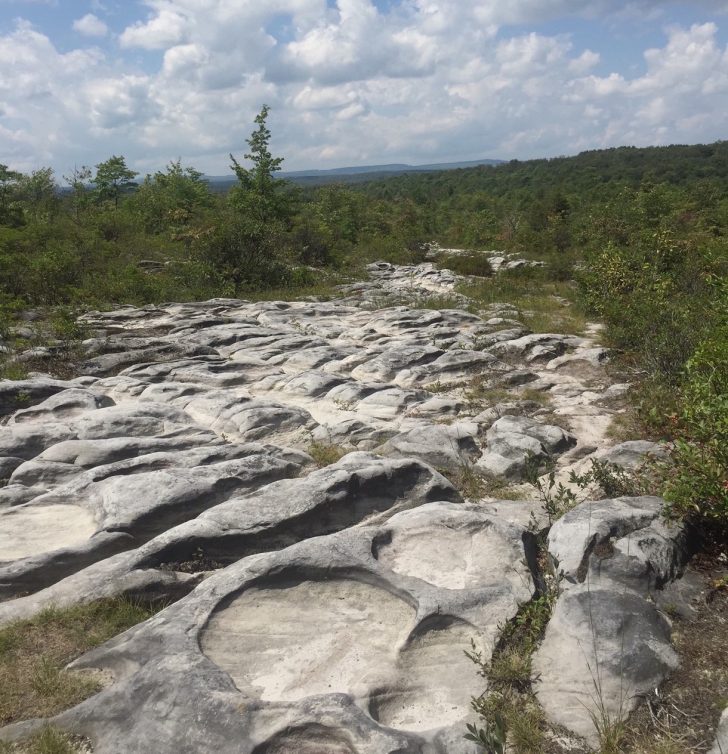
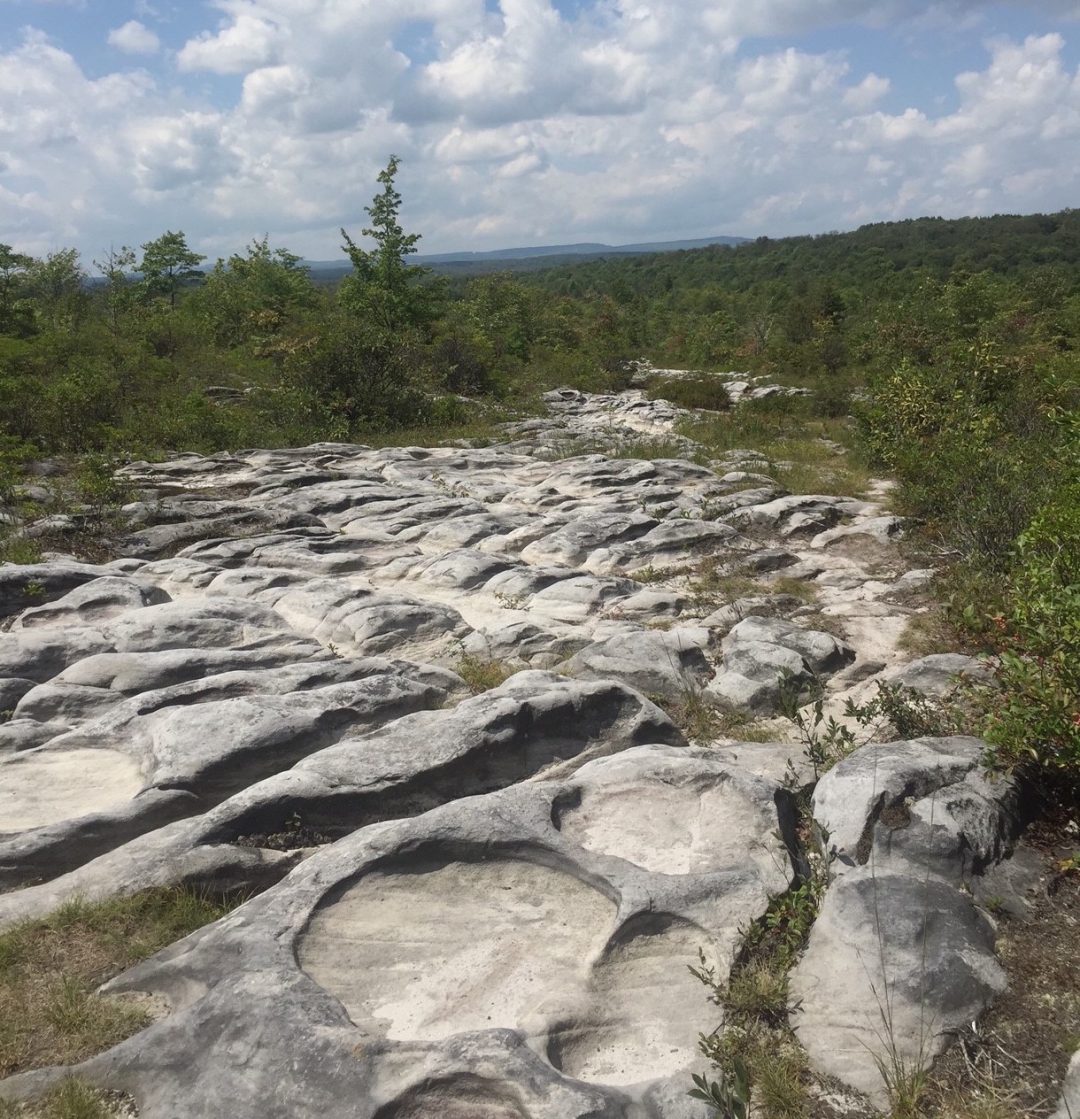
The famous Moon Rocks at Davis, WV, put the “technical” in single-track. Not related to the rocks brought back by Apollo 11, but close. Credit: Pat McCloskey

Riding in Davis, WV, is always fun but you better bring your “A” game because currently there are mostly expert black diamond and double black diamond trails that are well marked and give you plenty of notice.  Not to mention that it rained six inches the night before we got there, according to local legend and mountain bike instructor Sue Haywood.

Davis is making an effort— along with the neighboring town of Thomas—to provide some entry level trails to boost tourism, but the folks who come to Davis know exactly what they are getting. 

If you go to MTB Project and look up :Moon Rocks” and “Hoo Doo Rocks”, you will be led to a post and a map that can guide you from the back end of the Shop N Save in town.  Also a wise move to perhaps check with the guys at Blackwater Bikes.  They can provide sales and service because you will surely need service on your bike if you ride in Davis.  

One of the more interesting places that you  will see if you ride the suggested route is the Moon Rocks.  This outcropping of 480 million year old sandstone is both scenic, unusual, and has sprung up out of the local bogs to provide a challenge to hikers, mountain bikers, and motorcycle enthusiasts. 

The Moon Rocks were included in the Blackwater 100—a classic motorcycle enduro race— and the 24 Hours of Canaan Mountain Bike Race created by Davis resident Laird Knight.  I can remember competing in the second 24 Hours of Canaan back in ’94 and doing my night lap at 4:00 AM. 

The Moon Rocks were not only a challenge but an eerie sight under the moonlight of the West Virginia skies.  In any event, after all these years, I was riding behind a younger guy this past weekend and after I told him I had socks older than him and that I was applying for Medicare this year, he asked me about the old days and how the trails measured up today.  I told him it was still the same challenging track that I always remembered and with the wet roots, deep mud puddles and rivers of water in the ditches that made up some of the trail system, it was still the usual challenging West Virginia riding.  Memories are often embellished, too, as I regaled him with tales of the race thinking to myself, “the older I get, the better I was.” 

It is never a true trip to the Mountain State if you don’t take in some genuine bluegrass music. Our band of aging warriors made our way to the Purple Fiddle to see a band from North Carolina called MIPSO.  After snarfing home made veggie burgers and quaffing local craft beers, we listened to MIPSO and enjoyed some of the mountain music that makes this area of the country so special. 

I don’t mean to scare you away from visiting Davis and the other local attractions like Blackwater Falls State Park and Canaan Valley Resort and Conference Center. There are nice cross country ski trails nearby as well as alpine skiing at Canaan Valley Ski Area located adjacent to the conference center.  Tourism is king in this area and there are many sights and places to see, but if you want to mountain bike, and you are a good rider, these are some of the most scenic and challenging trails you will ever ride.

  Check out the video below for a Moon Rocks reveal.

https://vimeo.com/7285630
Ride the Moon Rocks with this video from Blackwater Bikes.

Slopeside Syrup: Ski Racing And “Golden Delicate”

The Cochran Family Makes Maple Syrup And Ski Racers.

Slopeside Sugar House run by ski racing’s famous Cochran family. Credit: Cochran Family

There are a lot of Vermonters and others in the ski racing world who could tell you a lot more about the famous Cochran Family of Richmond, VT.  I have friends who know them personally and tell the tales of the first rope tow that Mickey Cochran built in his back yard with the vision of a community ski facility.  He and his wife Ginny ultimately had four children who all made the U.S. Ski Team and had outstanding success including a  gold Olympic medal for Barbara Ann and a World Cup GS Title for Marilyn.

World Cup GS Champ Marilyn Cochran helps out at Slopeside. Credit: Vermont Sports Hall Of Fame

My friend Mark Hutchinson remembers the time that Mickey’s jacket caught on fire because of all the oil and engine grease embedded in the fabric as a result of countless hours maintaining the tows at Cochran’s.  Today, Cochran’s is a legendary ski training center for young ski racers all over Vermont with coaching and operational duties falling to the Cochran family, relatives, and grandchildren.  They are currently a non-profit ski area with training and races held each winter.  Donations are gratefully accepted at www.cochranskiarea.com/donate But that is not what the subject of this article is.  I am talking pure Vermont Maple Syrup of which I am a true connoisseur or as my friends say, a “common sewer”.

I have this habit of taking pure Vermont Maple Syrup, heated, in a jar when my wife and son and I  go to breakfast.  They look at me with disdain, but I will not use anything else on my hot cakes, waffles, or oatmeal.  I am always on the hunt for the recently re-named “Golden Delicate” syrup that is elusive.

With the re-naming of the descriptions of different grades of syrup by the Vermont Maple Sugar Makers Association  (www.vermontmaple.org) ,  there has been some confusion as to what is actually the top syrup for consumption.  Personally, I like the lightest syrup currently described as “Golden Delicate”.

Recently, four of the grandchildren—all cousins—of Cochran decent, decided to enter the maple syrup space in Vermont by constructing a timber frame sugar house close to the ski area.  This has expanded since 2010 to an operation of 22,000 taps and PVC collection lines that all feed the operation in the sugar shack.

Maple syrup from Vermont. Hmmmm. Credit: Slopeside

Slopeside Syrup has become the standard bearer for all Vermont syrup, and I am so happy that I found them.  One day, while perusing the Durfee family refrigerator in Lake Tahoe, I came across a bottle of this delectable treat.  I asked Eric Durfee about it as he is a native Vermonter and friend of Marilyn Cochran.  He told me about the operation and how he and Marilyn converse about the old days of ski racing and training to this day.  Turns out that Marilyn helps out occasionally with the syrup operation.  When I ordered several bottles online and told her I was a friend of Eric’s, she wrote me a nice personalized note that she packed in with my order.  That little bit of customer service and kindness will always make me a Slopeside Syrup fan for life.  You should be as well.

Go to www.slopesidesyrup.com, and you will see ordering information as well as some history of the family.  Not often that a World Cup GS Champion will oversee your order.  Take it from me, the “Golden Delicate” is nothing like you have ever tasted before.  Most times when I have ordered the formerly labeled “Grade A Delicate”, I got something less with more of an amber color and traditional taste.  However, the Slopeside Syrup product is truly that elusive grade which I know and love and bring with me to every breakfast.

So treat yourself, buy Slopeside Syrup and support Cochran’s Ski Area for the kids in Vermont.  Not all of them can go to the elite ski academies because of cost. But they can come to Cochran’s, get world class coaching, and immerse themselves in a culture of champions.  Ski racing, and maple syrup.  What a combination.

Cranmore

Seniors Visit Cranmore, Bring Grandchildren

Historic Mountain Is Perfect For Seniors Who Like Mellow Skiing And Kid-Friendly Amenities.

Cranmore is where Seniors and Kids both can enjoy lessons, easy skiing, fun-city. Credit: Brian Irwin

Cranmore offers a lot for seniors to like: Fun and varied terrain, manageable size, easy flat walk from parking lots and most of all, friendly vibe.

I visited Cranmore on a Saturday with a group of senior skiers. Though busy, the main chair lift to the summit, a high speed quad, kept wait times short. A friendly lift line attendant ensured the line moved orderly and efficiently. There was no wait whatsoever at the other three fixed grip chair lifts.

While the mountain has 15 black diamond trails, they are short, and we all agreed Cranmore is the perfect mountain for novices and intermediates. There are wide slopes such as North Slope, East Slope and Zip but keeping things interesting are numerous narrower winding trails such as Kandahar, Skimeister, and Rattlesnake. These classic New England narrow trails reminded us of those we skied “back in the day.”

Several in the group commented that Cranmore is the perfect place to bring the grandkids. There is an award-winning ski school program including terrain-based learning, small terrain parks suitable for younger kids and numerous non-skiing activities to keep the grandkids entertained. The family vibe at Cranmore made us feel safe and free from constantly being on the lookout for reckless boarders and skiers. 

The mountain’s 1200’ vertical drop is enough to keep everyone entertained and the fact all trails lead back to the base means no one will get lost at the end of the day.

Cranmore is located in North Conway which is a vibrant four-season vacation town hosting visitors to the scenic White Mountain region. There is no shortage of restaurants, ski shops, lodging, and shopping in North Conway.  Cranmore feels intimately integrated into the town. It’s about one mile from the main street (route 302) to the resort, and it is immediately adjacent to one of North Conway’s neighborhoods. It makes everything feel real; no fake alpine villages here.

Hannes Schneider statue at the entrance to Cranmore’s base lodge. The celebrated Austrian instructor changed how skiing was taught in the US. Credit: Don Burch

Cranmore has a rich history that I encourage you to check out. In doing so you’ll learn about Hannes Schneider who escaped Nazi-occupied Austria, later trained soldiers of the famed 10th Mountain Division, and operated the ski school at Cranmore for years. You’ll also learn about the Skimobile lift that operated at Cranmore from 1939 to 1989. One of the original skimobile cars is on display in front of Zip’s Pub and Grill (Zip was Hannes’ nickname) which is just a few steps from the lodge. In the video clip my brothers and I are riding the Skimobile in the mid-sixties.

Ticket window price for seniors (65+) is $52. Online ticket prices can be much lower, especially mid-week. Discounts are also available through area hotels and inns.

Click Here For Cranmore Trail Map

Click Here For Cranmore Web Cams


SeniorsSkiing Guide: Sunapee Goes Epic

Seniors Can Still Get A Mid-Week Pass At A Big Discount Before April 14.

Skier falling into slush cup

It’s that time of the year. Sunapee celebrates spring with a splash. Credit: Sunapee

Sunapee in New Hampshire went Epic this past winter, joining Stowe and Okemo, Vt., as Vail Resort’s three footholds in the East.

Sunapee draws many locals from neighboring towns plus a hefty day crowd from the Boston area. Parking lots fill up early on weekends. Midweek warriors descend on discounted Wicked Wednesdays. Many get there early, lap the Sunapee Express Quad, and leave by lunch.

Skiers disperse to two base lodges—the older, funkier Spruce Lodge (no stairs to reach it) with wood cubbies stuffed with lunch coolers, and the roomier Sunapee Lodge at the Sunapee Express Quad. A shuttle truck precludes schlepping from one to the other, connected by The Beach—a popular spring picnic spot.

Sunapee got jolted out of state-strapped limbo when the Mueller family took over operations in 1998 and worked the same wonders here as they had at nearby Okemo. Robust snowmaking (97 percent) and grooming make Sunapee a reliable area even when snow in the woods is sparse.

Off the South Peak learning area is where the Muellers secured rights to build the West Bowl Expansion, and Vail may or may not follow through. Locals are happy about more trails but skeptical of condos and some dead set against disturbing the old growth forest here.

As a mid-sized area, Sunapee has 66 trails that are varied and full of character. For scenery, ski down the Skyway overlooking a snow-covered Lake Sunapee for one of the best views in New England. Follow the woods down the ungroomed Williamson Trail, or skip through the trees in Sunrise Glades. Get an adrenaline kick down Blast Off and bounce off the moguls on Upper Flying Goose. The terrain park attracts a group of kids who grew up there together. Epic or not, Sunapee will always be Sunapee.

The Muellers’ parting gift to skiers was a high-speed quad commandeered from Okemo in the Sun Bowl. Previously one had to think twice before shooting down here knowing one was facing a slow ride back up, especially in a blizzard.

Although many people ski here for the convenience, less than two hours from Boston, the area truly is a place to stay awhile. Long a summer haven with its many lakes, the Sunapee area has a happy sense of continuity. Skiing segues into swimming and sailing. The ski area has zip lining, mountain biking, adventure course, and summer camps. The satellites tend to stick around—Bob Skinner’s ski shop at the Rotary, Bubba’s Bar & Grille in Newbury, Peter Christian’s Tavern, New London Inn, Dexter’s Inn, Colby-Sawyer College, familiar spots all.

Ticket buyers this year buy an EpicDay pass, a direct-to-lift card that they can reload on line. Until mid-April closing, a day ticket cost counts in the purchase of next year’s Epic Pass.

Epic Local Pass for $699 (19 plus) accesses 30 resorts and is unrestricted at Mt. Sunapee and Okemo. Epic Pass for $939 (ages 13 up) has access to 65 resorts including Europe and Japan. Buy at the Epic Pass site.

For its loyal seniors, Sunapee still offers a midweek pass. Seniors (65-69) is $429 and Super Senior (70 plus) is $279, if bought before April 14. Those prices increased slightly but now include ten discount buddy and six ski-with-a-friend passes. Call or stop at Guest Services (603) 763-3576.

Click here for Sunapee Webcams

Click here for Sunapee Trail Map


A less-than two-hour drive from Metro Boston, Sunapee has beautiful blues, views, and lots to choose. Credit: Sunapee

History Lives At Cranmore Mountain

Celebrating Hannes Schneider, A Pioneer Of Alpine Skiing In North America.

Jubilation at the vintage fashion show at the Hannes Schneider Meister Cup. Credit: Tamsin Venn

Every year, the Hannes Schneider Meister Cup Race, sponsored by the New England Ski Museum and Cranmore Mountain, NH, celebrates the legacy of the venerable Austrian ski instructor. For 23 years, the Cup has drawn people to Cranmore from all over to race or just cruise on this low angle dual slalom course on the Alley, where the old Skimobile ran up.

Schneider and his wife arrive via train at North Conway, greeted by his new employer banker Henry Gibson, owner of Cranmore. Credit: NE Ski Museum

This year’s March event poignantly marked the 80th anniversary of Schneider’s arrival via the Eastern Slope Express 7 a.m. Feb. 11, 1939 at the railroad station that still sits in downtown North Conway.

Any major ski resort in the US would have been thrilled to hire Schneider as ski school director, but he chose to make Cranmore his home. His family followed him into the ski business and now four generations of Schneiders are part of the family narrative.

At the recent festivities, great grandson Hannes Schneider dedicated a plaque to his grandfather, Herbert Schneider (Hannes senior’s son), who served in the 10th Mountain Division and also owned Cranmore from 1963-84. His goal had been to make sure every kid in the valley had a chance to learn to ski.

Instructors from Army’s Mountain Warfare School stand to attention at beginning of festivities. Credit: David Eden

The organizers went all out. The weekend started with a reception and hearty dinner at Zip’s (Hannes’ nickname) Pub & Grill and torchlight parade. It continued Saturday morning at Cranmore’s base with dedication ceremonies, a vintage ski fashion show (one winner rifled through her mother’s closet for an award-winning outfit), silent auction, awards ceremony, bratwurst and beer, all serenaded nonstop by the oompah music of the Bavarian Brothers Band. One felt quite transferred to Austria, instead of a quaint  North Conway. All proceeds went the New England Museum, the goal being to preserve the rich ski history in this region.

Schneider’s story is an intersection of politics and skiing. Here’s the short version.

Hannes Schneider ran a ski school in St. Anton Austria, where he promoted the new Arlberg technique and helped bring important tourism business to the region. As a high-profile critic of Hitler, he drew ire from the Nazi party who threw him into prison. With the intervention of a German skier friend who was also an attorney, and Harvey Gibson, an influential American banker, Hannes eventually found refuge in the US where Gibson set him up as ski school director at the new snow-train-served resort Gibson opened in North Conway.

For competing in the Ski Meister Cup, or any ski race, here’s general advice for seniors. If it’s a fundraiser for a worthy cause, it’s easier to justify having more youthful competitors heartlessly whiz by you on a parallel GS course.

In North Conway, visit the Eastern Slope Branch of the New England Ski Museum, opened only a year ago, a companion to the one in Franconia.

Click here for more on skiing at Cranmore Mountain.

Click here for Cranmore’s website.


At Great Glen Trails, Nordic Skiing and Activities for Everyone

New NH Cross-Country Resort Offers Winter Sports Alternatives.

Olympian Sue Long Wymess demonstrates “Gorilla Arms” technique at Great Glens Trails. Credit: Tamsin Venn

Great Glen Trails Outdoor Center just past Wildcat on Route 16 in New Hampshire, sits at the base of the towering Mt. Washington. At 1,600 feet in an area known as the Glen, the snow is plentiful, and the managers cut Nordic trails to perfection daily for both classic and skate.

Cruise around a 45-km network of groomed and backcountry trails. Most trails are double tracked, for two-way traffic.

“Great Glen has some of the finest designed trails for cross country skiing in the world. The late John Frado is famous for designing them for quality and whimsy that the Great Glen trails beautifully convey,” says Roger Lohr, SeniorsSkiing.com cross-country editor and publisher of XCSkiResorts.com. 

“The Meister program at Great Glen may be the most successful in the country with a fat bike component, too,” he adds of the weekly locals’ race series.

Learn from the best. Ski School Director Sue Long Wemyss, a U.S. Ski Team member from 1983-86, competed in all four of the XC races in the 1984 Olympics in Sarajevo. She offers a lesson package of three one-hour private lessons.

Heads up. Nordic equipment has changed radically in the past decade. You can rent or buy skis that are waxable, waxless, or skinned. A new adjustable binding system lets you move your weight forward or backward with the turn of a dial. The new skin skis are much faster than the old mohairs (“slohairs”). Music to our ears: “You can enjoy skiing more with the new gear,” says Great Glen XC shop director Nate Harvey.

A scavenger hunt for grandkids will keep them searching for forest friends. Credit: Tamsin Venn

Take the grandkids out on the green trails and let them spot all their furry friends at animal cartoon stations. Punch all the holes on the map and they earn an official Trails Tracker button.

Come and stay awhile trailside. Just opened in September, The Glen House is the fifth hotel on this site (four others burned down). It’s an airy building that manages to be both rustic and sleek. Thanks to the efforts of Great Glen Trails General Manager Howie Wemyss (Sue’s husband), the hotel uses state-of-the art green technology to harness geothermal for heating and cooling and eventually solar and hydro. Half the hotel’s 68 rooms have balconies facing the Northern Presidential mountains and the Carter Moriah range. The Notch Grille and indoor heated saltwater make après ski relaxing. In the great room, two story windows face the peaks of Mt. Washington, Jefferson, Adams, and Madison, and Architectural Digest recently named it “The Most Beautiful Bar in New Hampshire.”

Great Glen is a good spot to try a new activity or for everyone in the family to enjoy themselves. Choose fat biking, snowshoeing, tubing, or taking the SnowCoach up Mt. Washington to timberline into an Arctic winter wonderland. Ski and stay packages are reasonable. Summer brings a whole other basket of activities.

The Glen House hotel has a truly beautiful bar with dramatic artwork. Credit Tamsin Venn

Nordic Rates: Season Pass Seniors $100 (62 Plus), $75 if bought by Dec. 1. Day pass Senior (62 Plus) $12. Two for 1 Mondays and Fridays (non holidays).

Trails are groomed to perfection at Great Glen. Credit: Tamsin Venn


Mike On A Fat Bike On Snow

A Fat Bike Neophyte Takes To The Trails. Here’s What’s Different.

Correspondent Don Burch (l) and Co-Publisher Mike Maginn pose before heading out. Credit: Tamsin Venn

Exploring alternative snow sports always interests us.  We like snowshoeing around the woods when the snow is too deep for cross-country skiing. We go ice-skating on the pond behind the house when it gets cold enough and there’s no snow cover, an uncommon combination. We even tried snow camping, and we are researching ways to build an igloo or a snow tepee for our grandson in the backyard. So, when the opportunity to go fat biking in the New Hampshire winter mountains came around, we saddled up.

A group of ski journalists were given a chance to explore the Great Glen Trails Outdoor Center in Pinkham Notch, just up the road from Wildcat Mt.  The center with its base lodge, store, cafe, and rental shop is just across the road from the brand new Glen House Hotel, on the exact site of four previous hotels dating back to the mid-19th century at the entrance to the famous Mt. Washington Auto Road.  The spacious Outdoor Center has 45 km of groomed trails for xc, snowshoeing, and fat biking as well as tubing.  Another fantastic activity is riding the Snow Coach up the Auto Road to the 4,200 foot tree line on Mt. Washington. There’s a whole other slate of activities for summer, too.  Only a half hour or so from North Conway, this resort is an historic, ultra family-friendly, non-skier welcoming, Nordic-focused, relatively undeveloped area, and we predict it is going to be growing like a snowball.

Don whisking along on the flat. It helps to have a groomed trail. Credit: Mike Maginn

But we came to try fat bikes because we heard they had become a new winter thing to do. See Pat McCloskey’s recent story on biking in the winter. We’ve seen fat bikes on sandy beaches, on trails in the woods, but we’ve never been on one, let alone riding one on the snow. We’re not new to cycling, that’s for sure.  We’ve been on two Boston-New York AIDS Rides, a Pan-Mass Challenge, and numerous local charity rides. We are happy on road bikes and a rail-trail hybrid. So, not a newbie.

A fat bike has gigantic balloon tires, a triple chain ring in the front with a tiny granny gear, and a frame that looks like beach cruiser. SeniorsSkiing correspondent Don Burch and I started off from the Outdoor Center with a little downhill run to the trail. So far, so good.

To bike at Great Glens, you follow the ski trail, riding in the center of the groomed corduroy, keeping away from the classic cross-country tracks. Right away, you notice the differences.

Rolling resistance is noticeable. With a five inch tire width, you’d expect that. But wow, it is different. We decided that hammering for speed was not our game, instead going slow was good. Finally finding the right gear combination made pedaling easier  Those adjustments helped.

Soft snow acted like a brake. When we hit a soft patch, we felt the wheels sink, and we had to power out. Harder snow is much better. Look for hard snow in the woods; open field snow gets soft first on a sunny day.

Bouncy, bouncy can happen. Somewhere along the way, those big balloon tires made us feel as if we were bouncing up and down along with our pedaling. Perhaps it happened on an uphill where we tended to half-stand on our pedals. Kinda fun, but obviously not very efficient.

For a first outing, it was fun and challenging. Like all new things, now we know what to expect. Give fat bikes a try on a nice, cold, sunny day. You will have a thorough workout, learn some new cycling techniques, and have another way to enjoy the winter.

Mike riding the Fat Bike. Knickers are just for fun. Credit: Don Burch


Book Review: Boarding Southern Vermont

[Editor Note: SeniorsSkiing.com is again asking our readers to contribute to support our online magazine. Yes, we have grown in the number of subscribers and advertisers. But our expenses have also grown. You can help us defray some of these expenses by helping us out with a donation.  This year, we have a mix of premiums for different level of donations, including stickers, sew-on patches, our new SeniorsSkiing.com ball cap. All donors will be entered into a drawing for a pair of bamboo Polar Poles to be drawn in late March.  You can donate by clicking here.]


How Did A Then-Revolutionary Sport Become Mainstream? Hint: Epic Parties.

[Editor Note: Roger Lohr is the publisher of XCSkiResorts.com and SeniorsSkiing.com’s cross-country editor.]

The book Snowboarding in Southern Vermont: From Burton to the U.S. Open” by Brian Knight on History Press is a snapshot of the 1980s and 1990s during the early days of snowboard lore. The book is a fine encapsulation of snowboard history with an amazing collection of photos of those early days at the region’s ski areas Stratton, Bromley, Magic Mountain, and Snow Valley.
The book traces Jake Burton Carpenter’s life through Londonderry, Manchester, and Stratton Mountain, VT, as he became the proprietor of Burton Snowboards. He shared the spotlight with Donna Carpenter,  a woman he met whom he eventually married. She is cited in the book for “heavy lifting” in the early development of Burton Snowboards which was to become a significant force in the sport. Jake’s infectious enthusiasm and the lengths he went through to get Burton Snowboard started required visionary decision-making and resulted in a very influential company in the snowsports world.

There are hundreds of names that are weaved into the Southern Vermont story such as Paul Johnston the Stratton mountain manager, who had an open mind about snowboarding in the beginning; Lyle Blaisdell, the backhoe operator with the half pipe-carving Midas touch; and other snowboard dignitaries such as Tom Sims, Chuck Barfoot, the Hayes brothers, Neil Korn, Lindsey Jacobellis, Mark Heingartner, Craig Kelly, Dave Schmidt, Terje Haakonsen, Tricia Byrnes, Ross Powers, and Shaun Palmer.

The book’s vibe of the times is also expressed with tales of epic parties and Burton home-grown spirit. The competition parties perhaps far-out shined the half pipe competition.  Spectators at the U.S. Open experience left the event site littered with beer cans and booze bottles, enjoying debauchery and mayhem at “snowboarder residences” throughout the region. The parties hosted by Burton and other purveyors of every imaginable snowboard-oriented product were often topped by the Hayes’ brother infamous gatherings.

The early days were rife with teenage posse behavior both on and off the slopes and age antagonism as skiers fought back to reject the newcomers at the ski areas. The book outlines the certification concept which was a test that snowboarders took to earn the right to get access to the slopes at Stratton. There were many nights when sneaking snowboarders walked up the ski area slopes to make some runs.

The U.S. Open was established as an institution before snowboarding got any television coverage. The time when the Olympics gobbled up snowboarding as a prime time hook for viewers was still in the distant future. During the sunrise of snowboarding, the camaraderie between participants was more important than winning the Open. But the event declined as limits were continually pushed with profanity, violence, and even death when two guys snow caving in the parking lot were crushed in a very sad mishap.

The road to the Olympics was very bumpy for snowboarders coming out of Southern Vermont. Jake Carpenter called the Nagano Olympics, which was the first of the quadrennial competitions to feature snowboarding, “kind of a disaster.” The U.S. Open grew each year and eventually mainstreamed with the elimination of alcohol, superior rider athleticism, and a send off to Stratton’s Sun Bowl so it was not in the main area.

Southern Vermont in the late 80s may have been the epicenter of snowboard culture and the U.S. Open was the crown jewel of snowboard contests. By 2012, that sub-culture had run its course, and it was the end of the era. The event was moved to Vail. The book states “The Vermont brand can launch a business but rarely can sustain it.” For years, coverage of snowboarding was invariably about the jargon, the fashion, and the rebelliousness rather than the joy of floating in powder, dodging trees after a snowstorm, or twisting in the air. “Snowboarding in Southern Vermont” is a quick read that establishes the record of snowboarding’s early days there, and we should be thankful that this record is now public for all.

Magic Mountain

SeniorsSkiing Guide: Magic–Where Skiing Has A Soul

Magic Mt. Has $29 Tickets On Thursdays!

Magic is right-sized for seniors and families.

We are zipping down Wizard, a 1.6-mile-long intermediate trail that hugs the West Side, in seven inches of new snow with lots of woohoos and yippees. At many areas, this trail would be flattened by now. Not so at Magic Mountain in South Londonderry, Vt.

Groomers will leave the snow to powder hounds until the weekend. They will, however, smooth trails out on the more easy going East Side to keep everyone happy.

Is Robert Frost hanging around Magic Mt? Credit: Tamsin Venn

Natural snow makes some of the East’s most interesting, fun, and challenging trails and glades all the more sweet. Add a trail mainly to yourself midweek, friendly locals, and reasonable prices – Throwback Thursdays lift tickets cost only $29 – and it’s like skiing back in the old days.

When Swiss instructor Hans Thorner started Magic in 1960, he picked Glebe Mountain for a reason: exciting, wooded terrain that reminded him of his home in the Alps. Back in the 60s and 70s, Magic Mountain had a huge following. Thorner sold it in 1985. After, the vagaries of skiers, investment, real estate, and weather meant customers drifted away because they could not count on it to be open,  and it has had its ups and downs since then.

President Geoff Hatheway and his band of 16 investors (Ski Magic) are changing all that. They have launched an ambitious five-year plan to make Magic appeal both to die-hard skiers, families, and the 18- 19– year-old set. The group is investing in snowmaking (now at 60 percent) and lifts. Notably they are putting in new lifts to provide mid-mountain skiing and more lift capacity to the summit.

Hatheway typifies the die-hard Magic loyalist. He skied here in 1998 and his kids went through the racing and free skiing programs. Like others he appreciated the family friendly alternative to nearby Stratton Mountain.

“Here’s what you won’t find at Magic, a high speed lift and trails groomed Soup to Nuts,” says Hatheway frankly.

Magic President Geoff Hatheway likes early runs on snowy days. Credit: Tamsin Venn

What you will most like find are other senior buddies either on the lift or in the Black Line Tavern, a popular locals’ watering hole. Throwback Thursdays extend to food and drink specials here, the bands are live, and no one is in a hurry.

Magic is open Thursday to Sunday, plus holidays, and on any day it snows 6 inches or more. It has a daily sales ticket limit of 1,500 to keep lift line wait times short and glades uncrowded.

Mountain Facts

Vertical Drop 1,500 feet

205 skiable acres

29 trails, 11 gladed runs

3 Chair Lifts, 3 Surface Lifts

Tickets

Seniors (70+) day $54; season pass $499

Buy online in advance and pay as little as $44.99

Throwback Thursdays $29 (except holidays and powder days of 6” or more) with purchase of Throwback Card ($149)

Magic Mountain Trail Map Click Here

Magic Mountain Webcam Click Here

There it is. An accessible mountain that has something for every senior. Credit: Magic Mt.

SeniorsSkiingGuide: Big Bromley

Bromley Mountain Is Just Right For Seniors.

Bluebird day at the top of Bromley Mtn, VT. Credit: Tamsin Venn

At Bromley Mt. in southern Vermont, runs are not too long and not too short, just right for senior legs to make a top-to-bottom, 1,300 vertical-foot run without a thigh-burn break.

Although you would be remiss not to stop. Views from the top of the Sun Mountain Express stretch from the Adirondacks to the White Mountains. In the near distance, snow-dusted hills and ridges roll away. Trails curve through bright deciduous trees, and dipping into a glade is a friendly undertaking.

I found the sweet spot on a trail called Corkscrew over to Pabst Peril, smooth as Guernsey butter, after a recent seven-inch snowfall. The Pabst reference is to Bromley’s original owner, Fred Pabst, grandson of Captain Frederick Pabst, founder of Pabst Blue Ribbon Beer.

Black diamonds here are really what other areas would call blues, reducing the high alert meter. A high speed lift and groomed trails ensure sharable speed and vertical feet tallies on your Ski Tracks app. A south facing slope, flooded in sunshine on a wintry day, is enough to banish SAD for the entire winter, although some skiers’ fondest memories are sun-and-shorts spring ski days, and the world is grand.

Bromley is known as a young family-friendly mountain, which is always good news for seniors. It welcomes a lot of others as well: tele skiers (a popular annual telefest); moms (Feb. 8 is Mom’s Day Off); snowboarders  (Sochi Olympics medalist Alex Deibold is a native son); uphill skiers sunrise through dusk . (The Appalachian Trail swings around back.); and exchange students (who trade Lima, Peru for Peru, Vt., to work here in their summer). Also innkeepers, young racers guided by the Bromley Outing Club, and lines of kids in weekly afternoon school programs.

Bromley is right-sized for seniors, lots of do-able trails, even the Black Diamonds. Credit: Bromley

As an independent mountain, managed by Brian and Tyler Fairbank of the Fairbank Group, which also runs Cranmore Mt. and Jiminy Peak, Bromley still has a senior’s season pass, and senior day pass discounts as low as $39 for a midweek day ticket if bought at least a day in advance.

The Silver Griffins is “for skiers 60 plus with a sunny attitude.” For $15 annual dues, you get parking near the base lodge midweek non-holiday (the youngsters have to park on the other side of Route 11), discounts in the cafeteria, ski shop, rental and repair service area, plus a name badge, monthly after ski parties in the Stratton View alcove, other social functions, and lots of tall tales from when Bromley was a two J-Bar mountain.

Fun Facts

Marvie Campbell celebrates 50 years as a ski instructor at Bromley.

Seniors Seasons Pass: 70 plus, $549; age 65-69, $599. No blackout dates.

Advance Sale Lift Tickets: As low as $39, depending on day and month.

Bring the grandkids: Bromley put in a terrain park this year, built by the experts at Arena Snowparks.

Fat Tire Fridays: Burger and Beer Special for $10 in the Wild Boar Tavern.

Skiing History Day: March 2. Fanatics unite. https://www.bromley.com/winter/events/

Why Stay Home Lodging: Midweek $99/night, includes lodging, tickets, and breakfast for two. http://lodgeatbromley.com/vermont-vacation-packages/

50th Anniversary: Marvie Campbell celebrates her 50 years as a Bromley ski instructor this year.

Mountain Stats

  • Summit Elevation 3,284 feet
  • 47 Total Trails
  • Nine lifts
  • 86 percent Snowmaking
  • www.bromley.com

Click here for trail map


SeniorsSkiing Guide: Belleayre, A World Away…

…But Close Enough To Enjoy The Day.


The new Belleayre Gondola whisks skiers to the summit in comfort. This is part of the continuing upgrading of facilities at the mountain. Credit: Belleayre Mtn.

Folks living in and around major urban centers, with the exception of places such as Denver and Salt Lake City, often find it difficult to plan a ski day within an easy drive. And while the population is graying, more seniors are skiing that ever before. So the hunt for ski areas within easy driving distance becomes a chore.

Belleayre Mountain in Highmount, NY, off New York Throughway Exit 19 and about 40 minutes west of Kingston on a straight run along Rt. 28, neatly fills that bill. About an hour from Albany and two hours more or less from the New York City/North Jersey Metro area, the resort makes a day trip a reality for urbanites.

While there’s no danger of Belleayre ever becoming an Olympic ski venue, its trails offer enough of a challenge for expert and novice skiers alike.

The Catskills resort is owned by New York State’s Olympic Regional Development Authority, a public benefit corporation originally formed to manage the facilities at the 1980 Lake Placid games. Not too long ago in a move to cut expenses, New York dispensed with the Belleayre Gold Lifetime card that granted seniors over 70 the opportunity to ski for free. There was also a Silver Sliders Card for those with little color but silver in their hair, that also offered older skiers courtesies. But according to mountain spokesmen that program was discontinued because of a lack of participation.

Holders of the Gold Card often arrived at Belleayre on midweek days and more often than not were practically the only ones on the slope. Looking at the Gold and Silver cards, it’s difficult to understand why they would have been discontinued for lack of participation. The cost to the state of granting such privilege was microcosmic. 

In view of the fact that they did not detract from the mountain’s bottom line, they could have carried on infinitum. But powers beyond the mountain—read that to say “Albany”—decided that those over 70 years of age should pay to ski. The savings hardly filled the budget gap for Gov. Cuomo.

Onondaga trail looks ready for action. Nice blue! Credit: Belleayre Mtn.

There are discounted program that are currently offered. A septuagenarian will pay only $20 for a daily lift ticket. That’s not bad. If you fall into the 65 to 69 age category, your ski tab is $52 mid week and $60 weekend at the ticket window. If you buy online, that mid week price drops to $32. Belleayre also offers a variety of differently priced passes. A Season Ski3 combo pass good for Belleayre, Gore and Whiteface now costs $999 for those from 65 to 69. A Belleayre only pass was listed as $459 for 70 plus. Season passes would have been way cheaper if purchased in August.

All of that being said, Belleayre is one of the more attractive ski destinations in the Lower Northeast. It’s easy to get to and drive time is more than reasonable. The runs offer enough excitement for expert skiers with a variety of Black Diamonds running from the summit to the lodge. 

The blues are a terrific variety that give skiers an opportunity to condition their legs and move on to a more challenging blue before hitting the steep moguls and runs on the black diamond trails. Green trails are often used to loosen up before hitting  blues or blacks and are both easy enough for true novices and interesting enough for older skiers who simply want to put on skis and enjoy a day on the slopes.

Even on holidays and weekends when the caravans of buses head to the mountain from New York City, North Jersey, Albany and every school district in-between, the lift lines move along at a rapid pace giving you the opportunity to spend more time on the mountain and less time getting there.

The mix of skiers and snowboarders, young and not so young gives Belleayre a great panache. Respect for each other is paramount and it’s not uncommon to see a senior skier stopping to help or offer advice and suggestions to a younger skier who seems to be struggling down hill.

The mountain’s ski/snowboard school offers instructors capable of working with any age group to truly imparting the love of skiing.

For a trail map, click here.

For web cam, click here.

Two hours from New York/New Jersey is Belleayre. That’s doable for a mid-week run where you will find lots of room on the slopes. Credit: Belleayre Mtn.

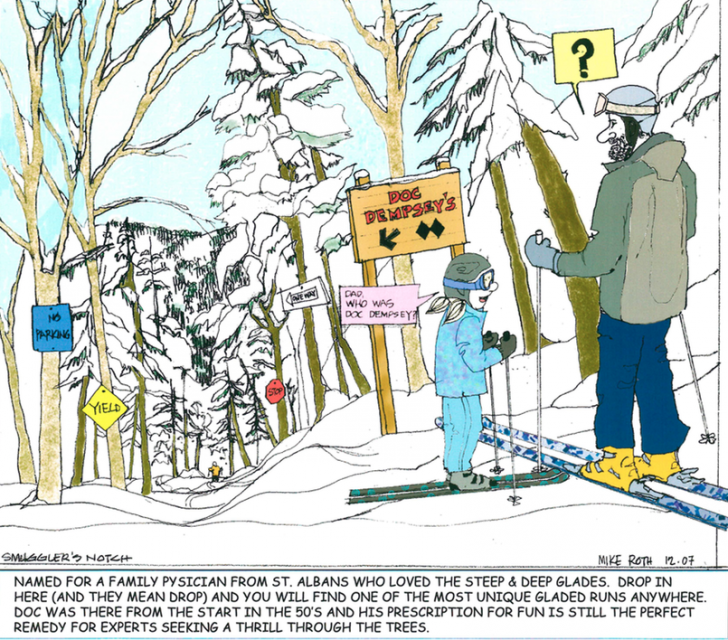
Trail Name Series: Doc Dempsey’s

A Wonderful Cartoon From Mike Roth, Ski Journalist From Albany.

Mike writes and draws cartoons for the Albany Times-Union Ski Blog. This one is about Smuggler’s Notch’s Doc Dempsey’s run.

Credit: Mike Roth

Trail Name Series: Pennsylvania

Extrovert, Powder Puff, and The Elevator

Spend a little time looking at resort maps and you’re sure to find some attention-grabbing trail names. When I looked at Pennsylvania resorts I found some beauties. Powder Puff and The Elevator at Jack Frost along with Extrovert at Blue Knob topped the list.

Among the best is High Hopes also at Blue Knob. Seven Springs has three trails making it into the top of the list; Santa’s Beard Terrain Park, Lost Boy Trail and Lost Girl Trail. Also noteworthy are Vertigo Park at Liberty Mountain and White Lightning at Montage Mountain.

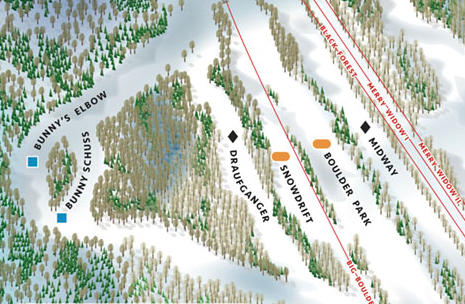
See if you can spot Draufganger on Big Boulder’s Trail Map.

Rounding out the list is Draufganger (German for daredevil) at Big Boulder.

Several Pennsylvania resorts stand out for having trail names that follow a theme. At Roundtop Mountain many trail names relate to the Revolutionary War. These include Recruit, Bunker Hill, Lafayette’s Leap and Fife and Drum. At Camelback trails are Egyptian themed such as Nile Mile, Pharaoh, Asp, King Tut and Cleopatra.

As you’d expect, at Eagle Rock trails (and lifts) are eagle-related. Trails include Baldy, Talons, Nestling and Screaming Eagle. Lifts include Wings and Soaring Heights. At Elk Mountain trails have Native American names such as Mohawk, Kickapoo, Seneca, Iroquois and Chippewa.

Do you have a favorite trail name that’s been overlooked? Please let us know in the comments section.

ReaderReport: Mt. Snow Opens Before Halloween

We Love Reader Submissions. Please Send Us Reports From Out There To Info@SeniorsSkiing.com.

From Reader Alyce Perez: In the 41 years that I have skied, it is the first time I have ever skied in October. Mount Snow’s earliest opening day in 64 years. Another first to add to my bucket list.

Coasting Most Of The Way

Senior Cyclists Love Gravity And Vice Versa.

Franconia Falls offer a cooling off spot. Bring your bathing suit! Credit: Tamsin Venn

Pedaling up and down hills on a mountain bike has its rewards, but we prefer trails that have an emphasis on the downhill. We suggest three great places in the White Mountains of New Hampshire at or near ski areas to do just that. Important: We use suspension mountain bikes that absorb the bouncing over roots and rocks.

The Lincoln Woods Trail off the Kancamagus Highway (Route 112) just west of Lincoln, N.H., is one good trip. You cross the suspension bridge over the East Branch of the Pemigewasset River and follow it on a gradual climb 2.8-mile bed of an old logging railroad (https://www.fs.usda.gov/recarea/whitemountain/recarea/?recid=74669). At the next bridge, you turn left up the trail to Franconia Falls, which is spectacular with a natural water slide. Go ahead, jump in and cool off. The return trip is a screaming downhill all the way back to the parking lot. You dodge some of the old ties and rails still visible. Total trip 6.5 miles up and back.

Another good coaster is The Franconia Notch Recreation Path (https://www.traillink.com/trail/franconia-notch-recreation-path/). The asphalt path runs the length of the Franconia Notch State Park, following the Pemigewasset River for nine miles, ending at the Flume Gorge, then merging onto Route 3 for the last five miles back into Lincoln. The first leg is a bit of a climb up to Cannon Mountain, then the path drops, tempting you to whiz down the hills after you’ve crawled your way up, but there is a 20 mph speed limit (!)

The path passes Echo Lake, the Cannon Mountain Aerial Tram, The Old Man of the Mountain Historic Site, where you can use a brilliant visual gizmo to recreate the old stone face above you (the Old Man tumbled down in 2003). You also pass Lafayette campground (ice cream anyone?), The Basin (icy water cool down?), and finally the Flume Gorge. Bring a lock for your bikes. This trip is eminently doable thanks to Rodgers Ski & Sport (http://rodgersskiandsport.com/) which will shuttle you from its store in Lincoln to the path’s start for $10 a person.

Remember the Old Man? Here’s a unique tool to bring him back, sort of. Credit: Tamsin Venn

Next day, we zipped south to Waterville Valley Resort via I-93. The extensive well-maintained cross-country ski trail system is a blast for biking. You cut through the woods and explore a variety of trails for all abilities through the National Forest. Everything from meandering dirt fire roads to gnarly single-track is available, plus lift access to biking trails on Snow’s Mountain, the first ski trails in Waterville Valley. (http://www.waterville.com/adventure-center/).

Our favorite run is to take the Snow’s Mountain Chair ($9 single ride and $21 all day pass) and zoom down the wide Livermore Road back into town, crossing babbling brooks and wood bridges, in an Eden-like setting. We branch off onto Swan’s Way, a single track, which leads you back to the Town Center. More scenic is to follow the Connector past the Mad River. Then relax outside with live music and cold drinks, even if you didn’t necessarily break a sweat.

Trail junctures post YOU ARE HERE maps (a good printed map is also available), graded beginner, intermediate, expert in XC ratings, so you always know where you’re going.

Do you have a coasting trip you could recommend? We’re open to suggestions.

At the top of Snow Mountain Chair at Waterville Valley. Credit: Tamsin Venn.

Cycling Efficiency For Seniors

Bottom Line: Knoweth Thy Limits, Wise One.

Ride with younger guys? Then ride wise and slow down. Credit: Pat McCloskey

As I  was pounding the rocks of  Laurel Mountain on the mountain bike with  a group of younger riders here in Pennsylvania’s beautiful Laurel Highlands, I was thinking strategy.  At 63 years old, I am still in pretty good shape but the older I get, I start thinking about the old adage “age and treachery will beat youth and skill”.  Not really applicable in most cases but at least I can try – right?  So the first thing I think of is: don’t push the anaerobic limit to be the first up the hills and over the rocks.  Let the young guns deal with that and I will just keep them in sight.

I have learned to ride within myself and only exert myself enough to keep a visual on the group, especially with a longer three hour + ride.  A more scientific approach is the below which is done with a heart rate monitor:

  • Zone 1: 60 to 70 %; very comfortable effort; use this for warmup and cool down
  • Zone 2: 70 to 80 %; comfortable enough to hold a conversation; most training is done here
  • Zone 3: 81 to 93%; “comfortably hard” effort; you may be able to say short, broken sentences.
  • Zone 4: 94 to 100%; hard effort; the pace is sustainable, but conversation is a few words at a time.

Author Pat McCloskey ponders whether to go around a big section to get back to the parking lot.

Basically the zones are dictated by two theories.  The original theory is dictated by the target maximum heart rate of 220 minus your age. Then you can calculate with a heart rate monitor which zone you can ride in.  This calculation is not quite accurate because it does account for conditioning.  A better way to use the zones is to calculate what is called Heart Rate Reserve which is your max heart rate minus your resting heart rate. Find out what your real max heart rate is by exerting yourself in Zone 4 with a monitor and then in the morning at rest, calculate your true resting heart rate.  This allows for conditioning and the zones can be used according to that calculation on a heart rate monitor.  All in all, I use a monitor on rides to tell me when I am exerting myself above my perceived rate of exertion which will lead to fatigue on a long ride if I am not careful. Use the monitor and slow down accordingly.  As long as I keep the group in sight and can be in the Zone 2 area, I am a happy rider.

Another strategy is not to ride every section but take a breather and bypass a section and/or coast to the next meeting area.  Sometimes that means taking a fire road instead of a technical trail..  I like to challenge myself and take the technical sections but I know if I take them all, I will not be able to keep up or complete the ride.  Ride to ride another day is my motto, and I am not out to prove anything.

Lastly, know your limits and know when you are finished.  You don’t want to get hurt and if you are too fatigued, it can happen easily on a mountain bike.  Sometimes you have to cut out and take the fire road back to the parking area for a head start on the post ride beer.  Hey, you had a good ride, with younger, stronger riders, but for a guy who is older, this is the way to stay involved without compromising your ride or theirs.

Riding season is upon us, and there is no reason not to challenge yourself within limits.  Go for it.  Have fun but as Harry Callaghan once said, “ A man has to know his limitations.”

Cross or divert? Use your noggin and your heart rate monitor to decide. Credit: Par McCloskey

Kingdom-Trails-Fatbike

Kingdom Trails: Vermont’s Fat Bike Mecca

A New Sport Bridges Snow and Non-Snow Seasons: Fad Or Here To Stay?

On the Kingdom Trails in Lyndonville, VT. Credit: Herb Swanson

[Editor Note:  SeniorsSkiing.com is interested in bringing new activities to our reader.  In this story originally published on XCSkiResorts.com on biking with fat, balloon tires, publisher Roger Lohr does an explainer and reports the adventures of a group of neophytes on Kingdom Trails in Northeastern Vermont.]

Fat bikes, dubbed the “Hummers of the two-wheelers’ world” are proliferating with more than 150 cross country (XC) ski areas in North America that welcome fat bikes on their snow covered trails. These specially-made bicycles accommodate ultra-wide tires that can be run at very low pressure 4-8 pounds of pressure, allowing fat bikes to roll over soft, slippery surfaces like snow. XC ski areas and regional pockets across the nation from Vermont to Michigan and Arizona to California and Washington now have fat bike trails with single track groomed and signed trails, rental bikes, and special events.

Snow Sport journalists head off on a fat bike familiarization tour. Credit: Roger Lohr

A small group of North American Snowsports Journalist Association members were recently introduced to fat biking by the welcoming folks at Kingdom Trails in Lyndonville, VT. The group found the bikes easy to balance and maneuver. Similar to XC skiing, the fat bikes provide exercise when going on flat terrain with more effort required up hills, earning thrills on the downhills.

An industry source at QBP, manufacturers of fat bike brands Surleybikes and Salsacycles, boots, gloves, accessories and apparel recently reported that 150,000-200,000 fat bikes that have been sold since 2010. These bikes provide a great way for avid cyclists to stay in shape during the winter season, and they provide different recreational fun for people who are active or love the outdoors.

Fat biking at Kingdom Trails in northeastern Vermont is no small matter. It is the foremost mountain bike destination in the east with more than 40,000 day passes sold in 2017 (20 percent increase from the previous year), and they’ve quickly parlayed this notoriety into becoming a mecca for fat bikers in the winter. Kingdom Trails has 100 miles of bike trails, 30 of which are used in winter for XC skiing, snowshoeing and fat biking, and works with 80 different land owners. Kingdom Trails also hosts Winterbike, which is the biggest fat bike festival in the east. The organization conducted a survey of bikers showing that they are generally aged 45-60 and reportedly attract $8-10 million of business to the region!

At Darling Hill Road in Lyndonville, the Village Sport Shop has a trailside facility adjacent to the Kingdom Trails Nordic Adventure Center renting fat bikes for $55 a day and sells the bikes ranging from $1,800 to $2,800. Fat bike products include softgoods, accessories, and bikes available from companies such as Liv Bikes, Giant, and Pivot among others.

Bike in winter? Fatties make snow country accessible.
Credit: Herb Swanson

Another option for those who would like an introduction to fat biking is to have a guide at Kingdom Experiences take care of all the details. They’ve got certified instructors and want to help cyclists have an experience catered specifically to rider skill and ability levels offering kids camps, women’s clinics and getaways and more.

Kingdom Trails employs three paid groomers, who pack and maintain about 30 miles of trails. Day membership prices (day pass for trail access) are $15 a day for those aged 16-69 and $7 for youth aged 8-15. There are also year-round memberships available with an annual family membership priced at $150. Memberships and rules of fat bike etiquette can be found at the Kingdom Trails Welcome Center in East Burke or the Kingdom Trails Nordic Adventure Center on Darling Hill Road in Lyndonville.