Fatal Collision: It’s Time to Act

One week before the end of the ski season in Jackson Hole, a 71-yr old veteran ski instructor, was hit and killed by another skier. Both were skiing the intermediate trail, “Rendezvous”. This should never have happened, especially in mid-April when the season is all but over and crowds have thinned.
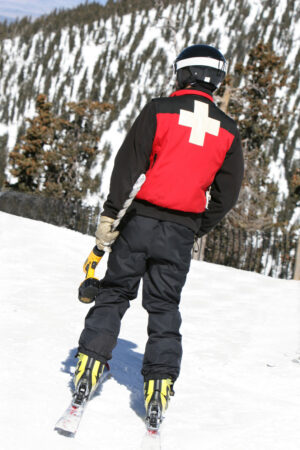
The Teton County coroner has ruled it a homicide, because the uphill skier did not “maneuver around” the victim, who was downhill.

When I heard about this, I was shocked and angry but not surprised. It’s getting worse and worse out there – even in mid-April when no one can complain about “the crowds”.

Several years ago, a rogue skier or snowboarder hit me while I was stopped on the edge of a trail at Stratton Mtn. I must have been hit hard, because I blacked out momentarily. When I regained consciousness, I was in a sitting position, just off the trail. The skiers standing on the trail’s edge said the guy who hit me never stopped.  Something similar may have happened to you, too.

The incident was on one of my favorite black diamond trails in Vermont – a mostly very wide, well-groomed and perfect trail for cruising, practicing carved turns or any turns. I was between lessons, and wearing my instructor’s jacket, so I felt any fast skier would know to stay away from me, a resort employee! Stupid me.

Luckily, I was not hurt that day, but sadly the male skier hit at Jackson on April 14, 2023 by an uphill skier who did yield right of way is still dead.

Fellow senior skiers and snowboarders, enough is enough!

It’s time for us to complain to management: firmly, politely, and insistently. Our sons, daughters, and grandchildren are on the mountain now, and all of them are at risk, along with us seniors.   

Pretending the “Skiers Responsibility Code” is doing enough is a joke.

Here’s what we can do about out-of-control skiers and snowboarders –

  1. Speak to ski area management and request “NO FAST SKIING” signs and ropes at key places on GREEN and BLUE runs. If you can force the high-speed dangerous skiers to slow down, it’s a start toward sanity and greater safety.
  2. If you personally witness a dangerous incident, volunteer your name to victims involved. Encourage victims to speak to management.
  3. If you experience danger personally, attempt to get a photo of the person who caused the danger. (Might come in handy down the road.)

ALL the waivers we are required to sign, either when purchasing season passes like IKON or EPIC, or simply by buying a day lift ticket, contain language, upheld by courts going back to 1978. The language says: YOU ACCEPT 100% RESPONSIBILITY FOR ANYTHING BAD THAT HAPPENS TO YOU WHILE MOVING AROUND AT OUR SKI RESORT: SKIING, WALKING THRU CAFETERIA LINE, WALKING TO RESTROOM, WALKING TO/FROM PARKING LOT. The resort is not responsible.

I believe ski resort management should do more to crack down on the super-fast, out-of-control skiers. The time is now for sensible, long-time skiers to begin making noise at ski areas we visit. There’s no alternative, except for you and me to insist that mountain operations must do more to educate their skiing/riding public, and make Green and Blue trails safer with signage. It’s just sensible.
https://www.tetongravity.com/story/news/teton-county-coroner-jackson-hole-skier-collision-death-ruled-a-homicide-sheriffs-office-seeking-witnesses

What is the oldest ski shop in the country?

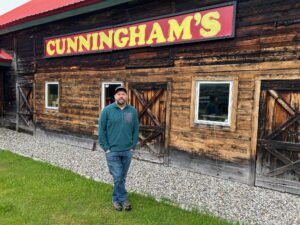
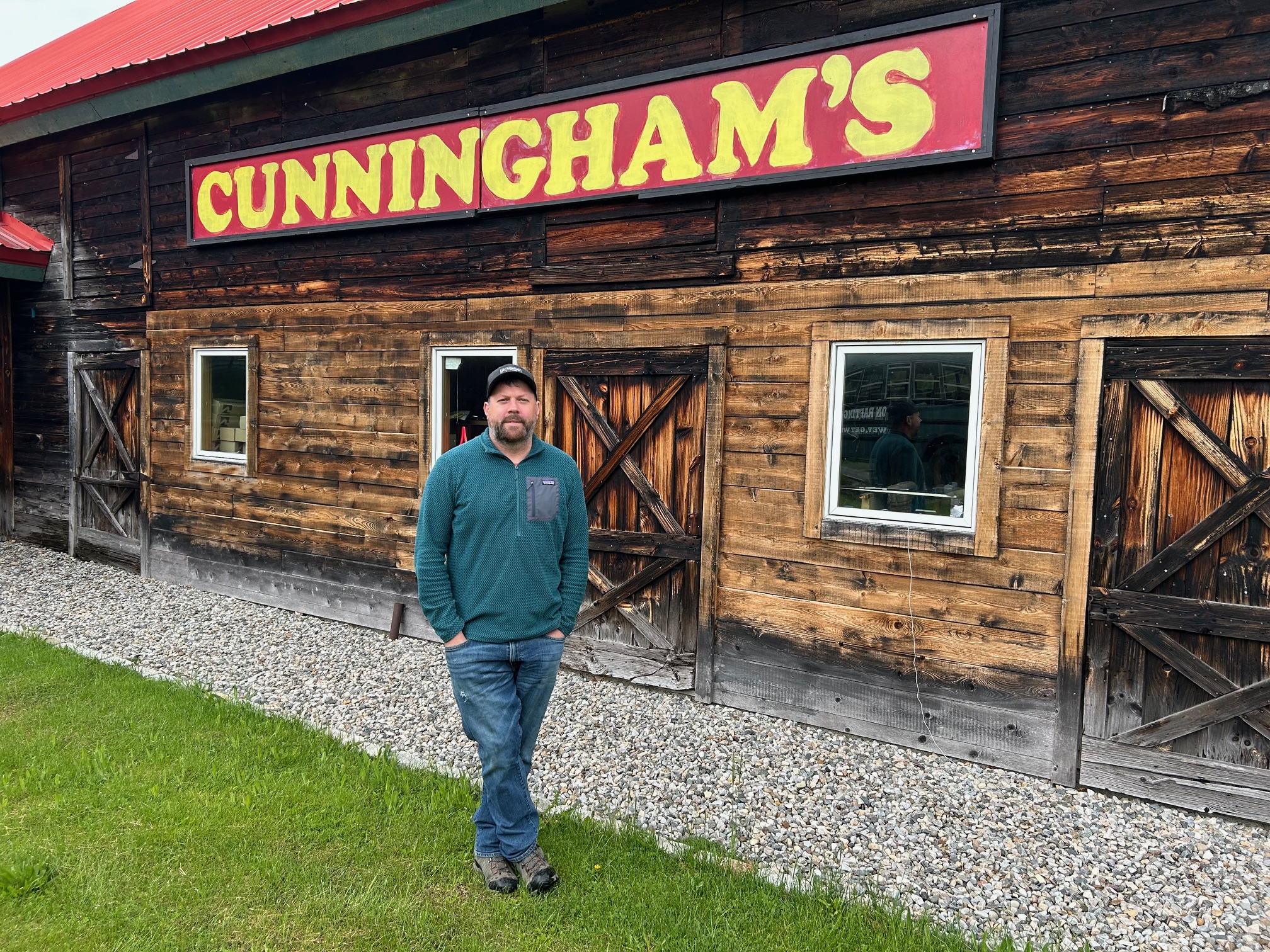
Div I ski racer Tyler Cunningham, now the 4th generation member of the Cunningham family to run the North Creek NY based ski shop.

A common answer to that question is Lahout’s in Littleton NH which was founded by Herbert Lahout who came to the US from Lebanon as a teenager and in 1920 started by selling dry goods from a horse drawn wagon throughout the White Mountains.   After World War II. the store, then run by his son Joe, began selling ski gear and today there is the original store and  seven more Lahout’s  shops in the area where the business began.

However, it turns out now there is another shop with a claim to be the first.

As part of the recent research on the 90th anniversary of the first snow train to North Creek NY, local historians came up with records of The J.E. Cunningham General Store that opened in that Adirondack hamlet in 1918, two years before Lahout’s.

Today, more than 100 years later, both businesses  run by their founding families, still operate in their hometowns

PJ Cunningham, who was born  in Chestertown NY in 1871, was a New York Forest Ranger when he resettled his family in North Creek in 1908. He spent much of his time in the outdoors and became well know for his work building fire towers in the area.  In 1918, he bought the general store in town and named it after his oldest son.

When business slowed in the 1920’s, his younger son Butler dropped out of his engineering studies at Union College to come home to help run the store. While there was no formal ski area at the time in North Creek, there was winter sliding on the logging roads from the nearby Barton Garnet Mines on Gore Mountain. Between mining and logging, the slopes outside the village had been largely stripped and and winter sliding on the open land was a popular pass time.

If you needed skis,  Cunningham’s offered barrel staves rigged with boot toe straps mounted by a local harness shop.

Although primarily a mining and logging town, locals who visited the 1932 Olympic Games in Lake Placid saw the potential for winter recreation in their town 60 miles to the south. The North Creek Ski Bowl just outside the village was established in 1934.  At first there was a rope tow that, in 1947, was replaced by the first T-bar in New York State. Butler Cunningham in 1949 became President of the Gore Mountain Lift Corporation and, while still running the store in town, opened a ski hut on the hill between the lodge and the lift.

Over the next decade, his son Pat was building his reputation as a ski racer. He competed for Norwich University and, after college, while in the US Army in Europe. he  competed in the the iconic Hahnenkamm downhill race in Kitzbuhl Austria. He was training for a spot on the US ski team in the 1964 Winter Olympics when an elbow injury forced him out of competition. Pat came back to North Creek and subsequently joined the family business which was growing as New York opened its third state run ski center at Gore Mountain in town.

There were setbacks.  The original store in town burned down in 1968. At the time, the Cunninghams were also running the retail shop at Gore Mountain. They would eventually lose the concession bid at the ski area, but by then a new store had been built in town on the site of an old horse barn less than a mile from the original general store location. Over the years, the business expanded to other locations including Cunningham’s across the street from the Olympic Center in Lake Placid.

Butler Cunningham died in 1985 and Pat ran the the business until his death two years ago. By then, Tyler Cunningham, a former Burke Academy and St Lawrence University ski racer, had given up a career as a derivatives trader on Wall Street to return home to the family business.

Tyler is the forth generation of the Cunningham family to run the business. It is the same story in New Hampshire where Ron Lahout, grandson of business founder Herbert, has been joined by nephew Anthony and more recently daughter Phebe.

So who can claim to be Number One?

Is it Cunningham’s, founded in 1918?

Is it Lahout’s, doing business in the same location since 1920?

Both families have now been in business in their hometowns, in ski country, for more than a century. It seems that should be more than enough to share bragging rights.


Stored Skis

Putting Away Your Skis And Stuff

It Pays To Spend A Little Extra Effort On Your Gear. Here’s How.

[Editor Note: Don Burch’s article on storing your gear is published each year around this time.  We are reprising it to help remind you that a little care for your stuff goes a long way.]

Hopefully your ski equipment has taken good care of you all winter, now it’s time for you to return the favor. Some simple steps now can save you the frustration of rusty edges, musty clothing and mouse invaded boots.

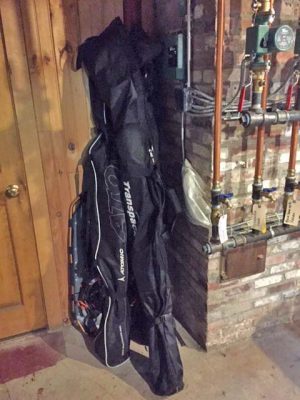
Are your skis still in the bag by the furnace where you left them after your last ski day? Hmmmm.
Credit: Mike Maginn

Skis: At the end of ski season, the bottom of your skis will be dirty. This will especially be the case if you did a lot of spring skiing. With today’s black bases it may not be that noticeable. Back in the day when a lot of bases were white the grime was obvious. Before having your skis waxed and sharpened, you want to clean the bases with a gentle cleaner. If you wax dirty skis, you’re just going to embed dirt into the wax.

I wet my skis bases with a garden hose, spray on Simple Green, wipe them down with a rag and then thoroughly rinse everything off. While you’re at it, thoroughly rinse off the top of your skis and bindings. I don’t recommend using cleansers on the top of your skis as these can interfere with the lubricants in your bindings.

Some people use commercially available ski base cleaners or Dawn dishwashing soap. Cleaning ski bases will dry them out so it’s imperative that you have them waxed afterwards and don’t let them sit all summer without a wax cover.

Racers and others who are demanding about their equipment will clean their bases using the hot scrape method. This involves hot waxing the skis and scraping the wax off before it cools. This process literally pulls the dirt off the ski. The process is repeated until the warm wax scrapes off clean. I have done this method, and it works, but it is time consuming.

A good edge sharpening and hot wax will not only have your skis ready for next season and will prevent the edges from rusting.

Boots: It’s essential that your boots and liners be totally dry before storing them. I use a boot dryer after every day skiing and before storage. If you don’t have one, I highly recommend that you take the boot liners out in order to get the boots thoroughly dry. I know it’s a pain to get the liners in and out. Warming your boots and thereby making the plastic softer will make it much easier to deal with the liners.

Store your boots in a place where mice cannot get at them. A friend of mine stored his in a shed and in the fall found them chewed on and full of things you’d wouldn’t want put your foot into.

Poles: These get the same attention as they did all winter, none.

Parkas and Ski Pants: At the end of the season, I wash my parka and ski pants in the washing machine with Nikwax TX.Direct® Wash-In. This is a product that cleans and restores water repellency and breathability, and I’ve been happy with the results. I’m not an expert on clothes washing so please go online to learn more and read the washing instructions listed on the label inside your garment.

Anyone else have any equipment maintenance tips for the off-season?

Saas Fee, Switzerland: Season Closeout

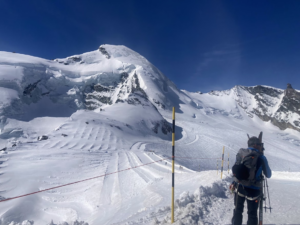
Not as well-known as its neighbor, Zermatt, Saas Fee is a good bet for snow in April. Taking advantage of my granddaughter’s Spring vacation, we planned a week’s skiing on one of Europe’s largest glaciers. But make no mistake about it, there are no closeout bargains in Switzerland. A senior discount for the ski pass, is an unknown concept and food at the resort was expensive compared to other venues in the Alps.

But there are advantages to Switzerland. Getting off the plane in Geneva Airport, we hopped on the train to Visp and from there took the bus up to car free Saas Fee. On the way up we were treated to Heidi-like views of traditional Swiss mountain homes and alpine meadows. Arriving at the bus terminal at the entrance to Saas Fee, the owner of the apartment we booked, picked us up

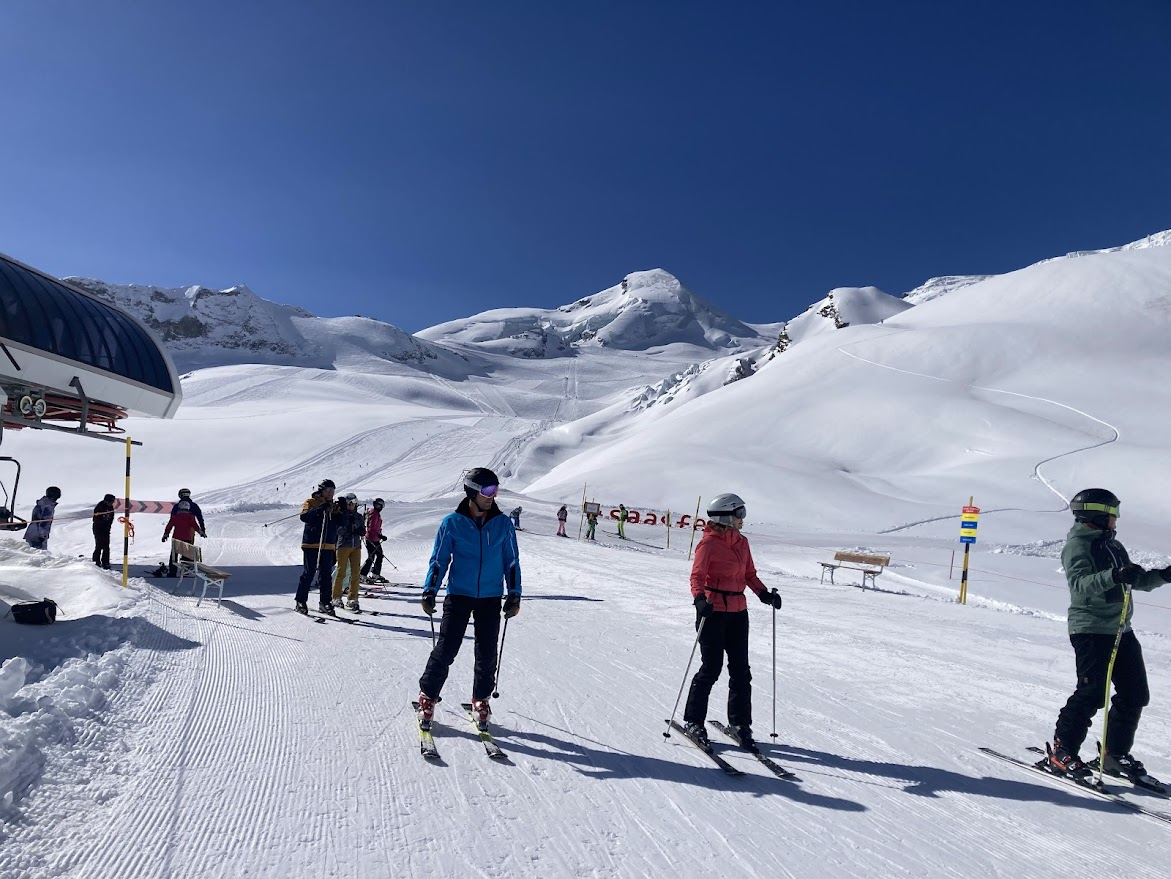
with his electric cart and brought us and our luggage up to the apartment. Remnants of snow could be seen throughout the village, but there was plenty of snow on the mountain and we could ski all the way down to the village at 1,800 meters. Our apartment was advertised as “ski in – ski out,” and this was basically true, although this late in the season we did have to walk a bit as the snow in the village was disappearing on a daily basis.

The configuration of lifts in Saas Fee is unlike most other alpine ski resorts. Three cable cars, take skiers up to the mid-stations where you connect with a underground funicular, which goes all the way up to the top at 3,500 meters. There are only two chair lifts where you can ski the lift line. Most of the skiing is up on the glacier at this time of year and there are T–bars wherever you look. A caveat for senior folk:, access to the cable car lifts and the funicular involves climbing and/or descending stairs while carrying skis and poles. It’s doable, but requires a deep breath and a slow but steady pace.

The skiing at Saas Fee is huge. The off-piste possibilities are almost unlimited and all within the ski area itself. Nearly all the marked runs are classified as “red,” which means advanced intermediate skiers can ski basically everywhere. The skiing is not difficult and the alpine views are spectacular. The pistes were groomed on a daily basis and we enjoyed winter conditions above 2,900 meters, and spring conditions lower down. There are four mountain restaurants including a revolving restaurant at 3,500 with unforgettable views in all directions.

While we were there, we had the opportunity to watch the annual Allalin amateur ski race, which starts at the top and finishes in town. The race course is a downhill course with vertical drop of 1,700 meters. Hundreds of men and women compete; with the fastest young skiers completing the race in 4 minutes plus and the older racers in their 50’s and 60’s getting down in 10 – 12 minutes. On the day after the race, I skied the top half of the piste with my granddaughter, who was into her second week as a skier. The long gentle sloping course was great for both of us as we cruised, each at his/her own pace, from the top down to the restaurant at the mid-station.

We enjoyed the skiing that Switzerland has to offer; the Swiss alpine atmosphere, good skiing conditions even in mid-April, the convenience of the Swiss rail system, the friendly Swiss folks, and of course the fondue, but we closed out the season with no bargains.

What We Know About Next Season

Thanks to late season storms, some downhill destinations will be skiing and riding into August, while others have closed and already starting construction on new lifts. Here’s what we know now about the 2024/25 season, including pass price changes, so you can put these resorts on your bucket list – or not.

 Prices Going Up for Going Downhill

Don’t wait.  The price of sext season’s Epic Pass goes up on Memorial Day, Monday, May 27.  In addition to paying more, you’ll lose two Buddy Passes for friends and family along with skip-the-lift-ticket-line for any passes you buy or redeem for day-of skiing. The same price increase deadline applies for regional Epic passes, including the Northeast Value Pass and the Epic Military Veteran Pass.

You have until September or October to buy an Ikon Pass before prices go up again.  But do it now, before you forget, because the closer you get to the price increase deadline, the more the website is overwhelmed with procrastinators. 

Jackson Hole

The iconic Wyoming resort is replacing the Sublette lift over the summer with a faster and more powerful detachable quad chairlift, which will be up and running in time for the 2024–25 winter season.  The new lift cuts uphill time from eight minutes to four, while climbing approximately 1,600 vertical feet at 1,000 feet per minute. That means you can get to Laramie Bowl – my personal favorite run at Jackson Hole – in half the time, and wear out your legs and lungs twice as fast. The original Sublette lift was built in 1987.

This past season, JHMR was open 143 open days and clocked 447 inches of total snowfall, helped by a series of heavy late winter and early spring storms that blanketed the West.

 Big Sky 

The Montana resort celebrated its 50th Anniversary last season with the introduction of a new, larger Lone Peak Tram, and making more changes for season 51.

The new Madison 8 lift will replace the Six Shooter 6 on the Moonlight Basin side of the resort.  It will nearly double uphill capacity out of the Madison Base, reducing ride time by an estimated 30%. The Madison 8 is another eight-seater, which Big Sky introduced to the world with its Ramcharger lift on the main mountain. The new lift is named for the nearby Madison River, and expected to be operational by December 2024.

Big Sky also says it is changing ticket pricing to the new Lone Peak Tram, although the changes affect only a small number of guests.

Starting next winter, those who buy lift tickets directly from the resort no longer will have to pay extra to access the new 75-passenger Tram. But that deal applies only to elite Gold and Double Black pass holders.  Everybody else still will have to pay $10-$50 per ride, depending on conditions.

https://www.instagram.com/p/C4gwSW5MomH/?img_index=1 

That means all Ikon, Mountain Collective, and non-Gold and Double Black pass holders will continue to be charged per ride on the Lone Peak Tram, with pricing unlikely to change much from this past season.

Mammoth Upgrade at Mammoth

Mammoth is replacing its very first chairlift – known both as Chair 1 and Broadway Express – from a quad into a high-speed detachable six-pack. It’s part of a larger upgrade to the base area that includes a new lodge and amenities.

 This was a t-bar when the resort opened in 1953, upgraded to a two-seater two years later, and then to a four-seater in 1995.  The new six-pack will be able to whisk 3,200 people up the mountain each hour, reducing wait times at the base at peak times (pardon the pun) to under four minutes.

If you want to buy one of the chairs being retired, contact Mammoth Mountain Community Foundation.  Prices start at $299.

We’ll have more news about next season as soon as it is available.

See you on the slopes!