

Addressing Climate Change: Meteorological Malpractice
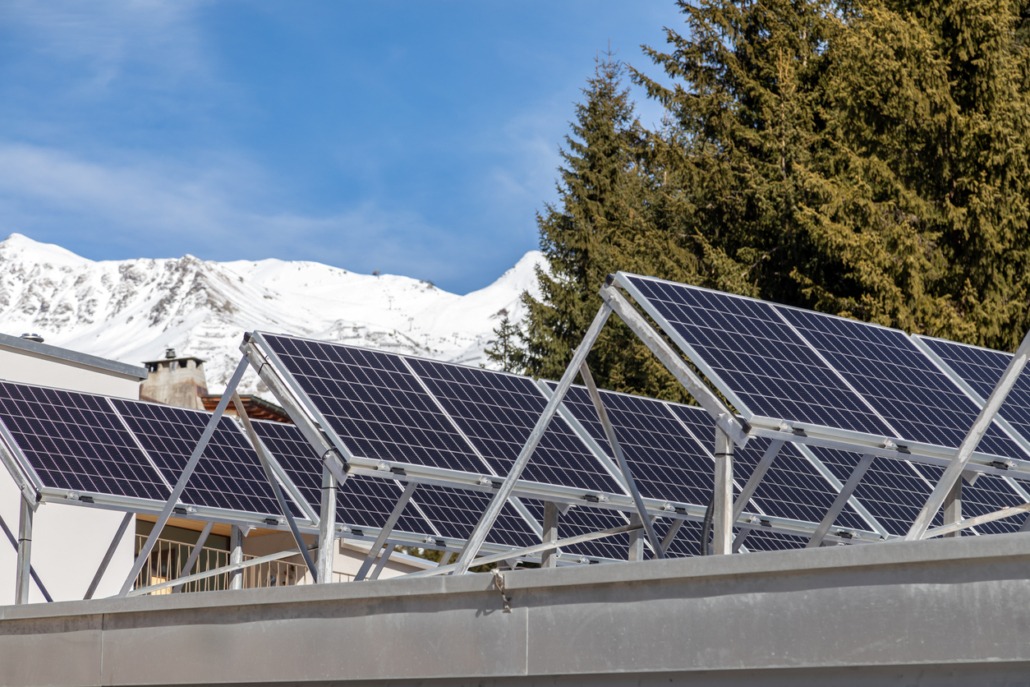
Flat roof solar power plant in the alps Photo Credit: Canetti
The snow sports industry has been in a quandary about climate change. Some in the industry see snow sports as the “canary in the coalmine,” which translates to ski areas facing shorter seasons due to global warming. Statistics show that the snow sports population and skier visit numbers have mostly plateaued in recent decades. Relevant factors regarding the lack of growth include the aging population of skiers, economics and the cost of skiing, available time, and global warming (climate change).
In a recent North American Snowsports Journalists Association (NASJA) discussion session, a panel of interested parties discussed climate change and the snow sports industry. One long-time snow industry pundit, stated that “global warming is already baked in” and “some owners in the industry are preparing exit strategies and maximizing their profits before they go,” commenting that this is how Wall Street works. The meteorologist on the panel stated that “December is now a fall month and many broadcast weather personalities only reference the daily weather and astrological information while being guilty of meteorological malpractice because they refuse to educate and alert the public about climate change.”
There was also a clean energy/government consultant panelist who was comparatively more optimistic than the other panelists, stating “the Inflation Reduction Act will take about a decade to show results, and there is a need to deliver the climate facts in a nonconfrontational and unbiased manner.” She also saw clean energy as an investment opportunity that is preferable to the fossil fuel industry. The panel discussed various related issues including snowfall history, shrinking European glaciers and even mentioned a coming book about climate change and ski racing, but they never mentioned adaptive skier behavior.
Last Winter in New England
I learned that a local New England Nordic ski area’s 2023-24 winter season operation was open for 65 days and was closed for business from December 16 to January 17. The 10-year average of the number of operational days for the area is 93 days, so last year there was a 30% decline of operational days including loss of the December holiday period.
The Nordic area had four days above freezing during the season and significant snowfall occurred only 4 times once each in December, January, February, and March (64 total inches of snow for the winter). On a monthly basis the amount of snow alternated with January and March getting more than two feet while December and February received about two inches! The local alpine ski areas can make snow for more consistent conditions, but warm periods and rain events suggest that they were impacted similarly. A local alpine ski area reported a 74 day season in 2023-24 compared to normal 90 day seasons.
Were the last season statistics due to annual weather patterns or longer trend climate change – science proclaims the answer, but I suppose that we are not aware of the amount of impact annual weather versus climate change is responsible for a given day on the slopes or trails. As a New Englander who relies on Nordic skiing and snowboarding for mental and physical wellness during the winter, I Nordic skied 51 times in 2023-24 and about 20% of the days were skiing on slushy or icy short loop trails. I went snowboarding 19 times. This is what semi-retirement looks like for the snow sports aficionado, who lives in snow country. But I’ve incorporated the impact of global warming in my snow sports activity and there is evidence of ski behavior adaptation that seem to be related to climate change.
Skiing Behavior Adaptations
Personally, I like to ride on sunny days and before I leave my home for the slopes, I pay attention to hourly daily temperatures and I often plan to arrive at the ski area on warmer days for softer snow conditions. My advance planning includes the use of ski area weather reports, webcams, and so on and it has worked very well.
It is apparent at alpine ski resorts that many midweek skiers leave the area before noon and this might explain why so many small ski areas only open their mountain restaurants on the weekend. One day last year I was excited about a half foot snow overnight and arrived at a local ski area in the morning to find almost three full parking lots. I never stopped my car, turned around and went home deciding to return later in the week. The mega ski passes allow skiers to hit the slopes more often for shorter time periods and there are still fewer midweek patrons on the slopes. Most skiers among the weekend crowds learn to select slopes and lifts to minimize their lift line ensnarement.
Many skiers wait for snowmaking to accumulate in the early season until there are more trails open to ski. Fairweather skiers take advantage by going when the snow conditions and weather are most palatable (waiting for warmer temperatures or avoiding crowded days).
I prefer to go Nordic (XC) skiing on the weekend or when it is colder because groomed Nordic ski trails are very skiable, there are no crowds as fewer people go XC skiing and the skiers are spread out along miles of trails, it’s easier to keep warm while XC skiing (muscle utilization warms the body), and Nordic area trail passes are significantly less costly compared to the weekend/holiday rates at alpine ski areas.
For XC skiing, there are days when skate skiing is excellent on hardpacked or frozen groomed trails and other days when classic skiing makes skiing harmonious for outdoor immersion in nature.
Most ski areas and snow sport product suppliers are investing in sustainable efforts in their operations such as renewable energy sources, waste reduction, operational and snowmaking efficiencies, electric vehicles, political lobbying, and so on. These efforts are worthwhile and commendable but they’re a drop in the bucket when it comes to combatting global climate change, but most of the companies in the snow sports industry are moving forward.
Snow sports are important as a winter recreation for people but there is a substantial cost paid even in the snow sports business in terms of climate change. Scientists claim that they are able to forecast outcomes and calendars but we do not know the type of adaptations that will be undertaken for the snow sports business to continue, nor do we know how quickly global warming may change how and when we ski. But we can guarantee that skiers will continue to adapt as necessary to continue enjoying their winter pastime.

- The Comeback XC Skier - December 1, 2025
- Nordic Walk for a Fitness Option - October 23, 2025
- Comparing Alpine and Nordic Skiing - March 19, 2025


No doubt you are right adaptation is part of the game, then will it be enough. Over recent years I have focused on equipment and techniques which work well for the freeze thaw cycle which is now more common here in Australia. And it can be a lot of fun given the right mind set. So that is my demand side of the equation. The supply side is what industry, investors and researchers can come up with. If there is a lesson from advances in computing over the past half a century, it is we can’t really guess the future of innovation with certainty. Just stay positive. Future generations may look back on the technologies we are using to mitigate climate change, for what they are, namely field trials. Pegs in the sand. The thing is to keep on keeping on.
Since you mentioned “freeze thaw cycle which is now more common here in Australia”, I am curious if ski season has been shrinking downunder? My parents friend took us tour in Victoria’s Southern Alps, where snow was melting in early September 1983, as I observed melting snow. But after leaving Australia for home (in Virginia, USA), my wife and I spent 8 days in New Zealand, where I skied at Coronet Peak (with plenty of snow before melting) next to Queenstown.
Many examples of sustainable practices in the ski industry can be found in the Green Energy Times.