“Your Problem Is, You Don’t Know What You’re Doing”.

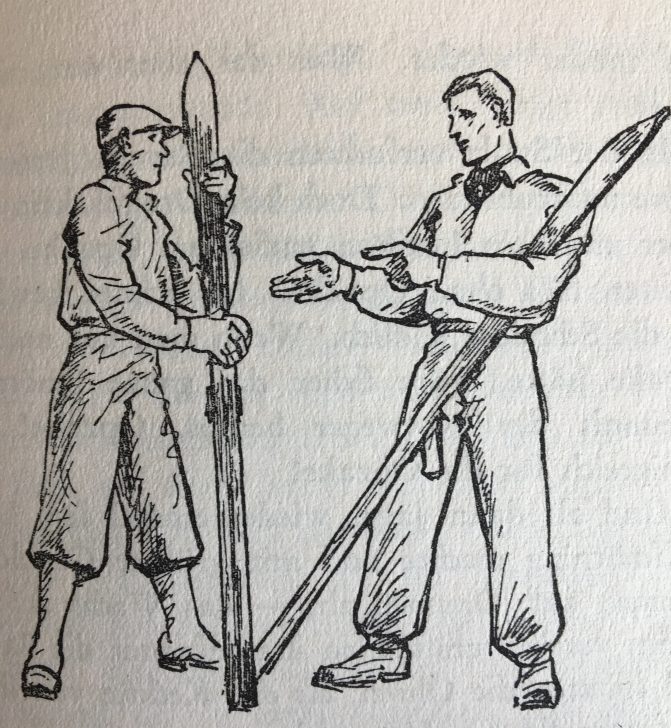
Ski Coach Bob Trueman (r) puts emphasis on the mental aspects of skiing.
In modern times this sentence wouldn’t score well on the “how to make friends” scale. And yet it is in reality very informative. You just have to look at the real meanings of the words used, and not the colloquial inference.
In fact, from the view point of performance enhancement it is a critically important observation. Whether that performance is in something physical, like skiing, cerebral, like academic endeavor, or practical, such as business.
The most fundamental tenet of Neuro Linguistic Programming, and other performance enhancement psychologies, is that if you want to change your outcomes you must change your behaviors. “If it isn’t working, do something different”.
The instructional approach to this is either to tell you what you are doing wrong, or just to tell you what to do. It sounds reassuringly practical, but doesn’t work well in practice.
The reason for its limited efficacy is that in order to do something else, it is best to know what you are doing just now. And that is the hard part. And here, dear reader, we come to the import of the insulting first sentence above.
Frustration
More often than not, indeed I’d say pretty well on every occasion, when I first begin coaching someone (in anything at all, not just skiing), they do not have a mechanism to help them to know what they are doing. It is what they are doing, that is creating the outcomes they don’t want. And it is not having current awareness of what that behavior is that is getting them so frustrated and making it so difficult to change.
When I ask a skier after a short section of skiing, “What were you doing as you skied down there?”, it is incredibly common to get the answer , “I don’t know. What do you mean?”
Well, what might I mean?
What are you doing? You must have been doing something, or nothing would have happened. If what happened was what you wanted in all respects, then what you were doing was, for you, at that time, 100 percent appropriate.
If what happened was not what you wanted, then whatever it was you were doing, was not 100 percent appropriate to the achievement of your desired outcome.
The first, and most important job to be done, then, is to find out what it was you really were doing. To do that we’ll need to work together to discover ways that will work for you in letting you become aware of what you are actually doing as you ski.
Six Senses
We’ve got six senses: Smell, Taste, Hearing, Sight, Touch, and Proprioception
The best for skiing are the last three. You could look to see what you’re doing. You could feel for something tangible. And you could feel in a generalized “feely” kind of way.
You could also listen, say, to your skis on the snow. The remaining two require a degree of proximity to the snow which, even were they to work, you might not want to try too often!
Give this some thought. It could help you enormously.
Can you come up with some ways that would suit you for enhancing what is known as your “present moment awareness”? It is this awareness that will enable you to make the changes you are looking for.
Controlled Skiing.
Awareness example:
Here is the kind of thing I’m getting at. You will already know that leaning back in your boots is a tendency to which we are all subject. You will also have discovered through doing this, what James Thurber characterized in his “Fables of Our Time”, when he wrote that “you might as well fall flat on your face, as lean over too far backward.”
You need to be not leaning, or sitting, back. Rather, you need to be forward “in your boots”.
But how to do this? More importantly, how to ensure you are always doing this? There is often so much going on inside your head when you are skiing that you haven’t got the attentional focus required to know if you are or are not
So, we need a simple mechanism to employ that will tell us in real time whether or not we are “forward”, and if so, to what degree. Next time you ski, choose an easy—nay—very easy slope. Set yourself the challenge of skiing pleasantly, down the next 200 meters. No more.
Set yourself the additional goal of being aware of your shins. Your goal is to know, at all times, how much pressure between your shin and the front of your boot, you can feel.
Nothing more! Absolutely no other goal on this 200 meters.
At the end of the 200 meters, it does not matter at all how good bad or indifferent your skiing was. DO NOT GIVE YOURSELF FEEDBACK ON THAT ASPECT.
You must, if you wish to learn how to improve, ONLY review your original goal. Did you feel your shins against your boots? Yes/No? Were you able to do so at all times? Yes/No?
There is NO answer to these questions which will not help you. If you answer your own question with “I don’t know”, you’ve learned something useful. If your answer is “yes, and no”, you’ve learned something useful. If your answer is “yes, and yes”, you’ve learned something useful.
It’s one of the few real win-win scenarios that exists.
Whatever your answer, you can reset your goal, refocus your attention, and learn something extra on the next200 meters.
The key to success with this process is to be very strict in your goal setting. It must be simple, singular, and susceptible to review.
[Editor Note: Check out Bob’s website for more articles and videos on how to ski in control. Click here.]
© Bob Valentine Trueman. All rights reserved.







 A reader asks: