

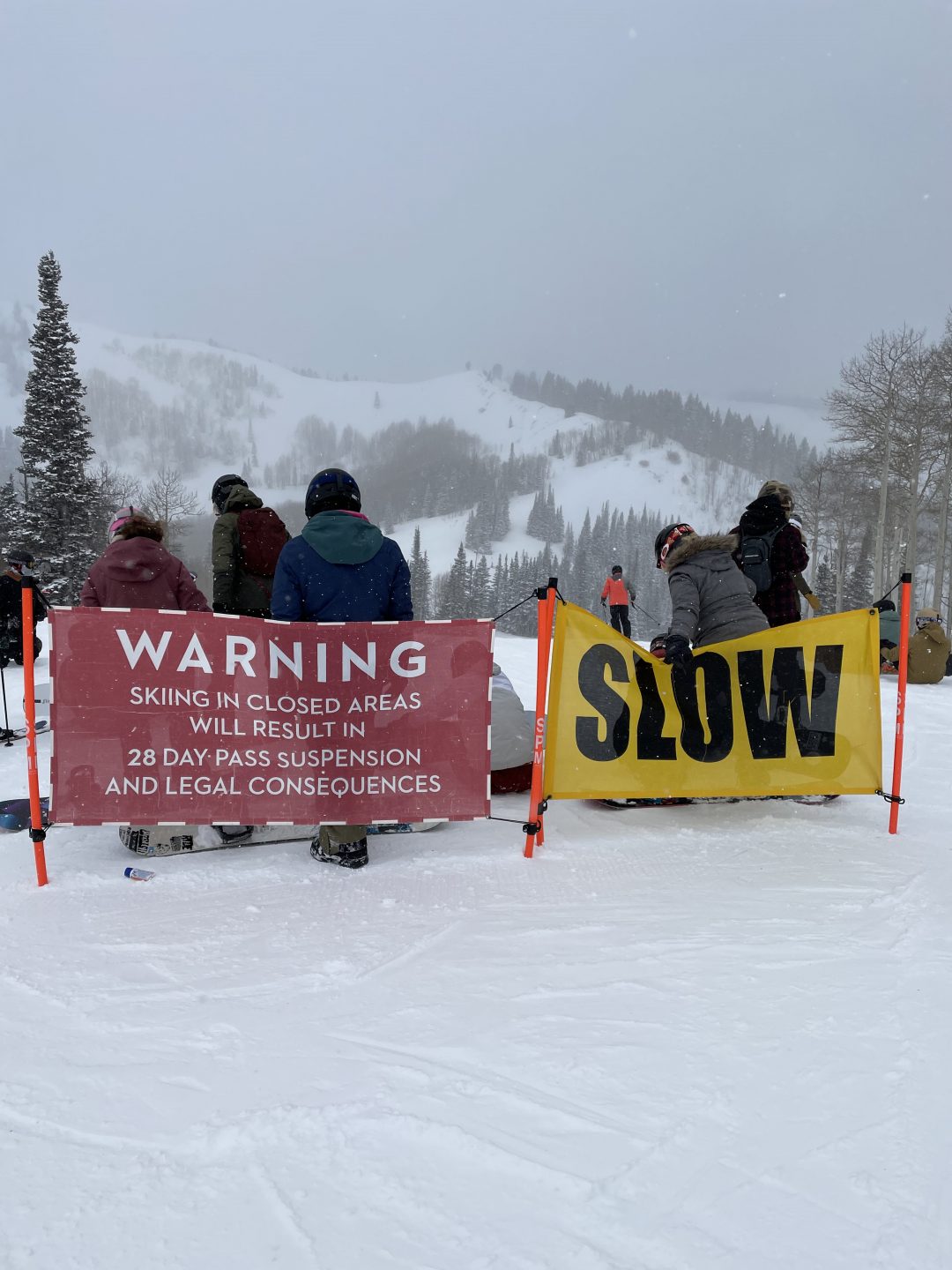
More on Safety, My Favorite Subject

On trail signage at Park City Mountain Resort Photo: Jon Weisberg
As I sat around this summer counting the days until ski season begins again, I started thinking of my most favorite subject. SAFETY!
While I was out on the bike path for my run (more like walk!) someone approached on their bicycle, and as they were getting closer to my back side they announced, “on your right”. That was a good sign, much appreciated and just good common sense, and I started thinking about other instances outside of ski season when such politeness is expected, even required.
When one plays golf to pass the time between ski seasons, someone will shout FOUR if they think a ball might have a possibility of hitting you. It’s a warning, to protect everybody’s safety.
A couple incidents while driving my car also got me thinking. When we drive, we use – or should use – directional signals when preparing to turn. Agan, it’s for everybody’s safety. When someone is a reckless driver, there is a chance they can get a ticket, get in an accident, even lose their license.
Driving on the Garden State Parkway in New Jersey recently, a pickup truck sped past me on the inside lane at 80+ mph and suddenly cut in from of me with no directional signal. So I flashed my lights, in case this driver was trying to run me off the road. He hit his brakes and tried to edge me off with a few birds flipped at me.
That was extreme and only happened twice in my life of 82 years, both times young and crazy drivers.
Luckily, there are few such these incidents – including on the slopes when a reckless skier or boarder cuts you off and you yell and get the bird.
Recently also, two motorcycle drivers sped by me on the inside at an extreme speed weaving in and out of traffic to a point that I expected to see them somewhere off the road in an accident. Such young drivers on crotch rockets are the basic statistics of motorcycle accidents and deaths – although they won’t stop me from riding my motorcycle or downhilling on my skis.
Driving is dangerous and lethal at high speed and is a weapon of sorts, so you must pass a skill test to get a license, and insurance to own, even rent, a car.
What else requires a license? Boating. You need to take a safely course before you can operate a boat, of course all reason disappearing when one drinks, but that never happens when out boating! Now the waters are patrolled by the local jurisdiction frequently.
Hunting – the same goes, with safety courses required before getting a license. Also scuba diving. Because recklessness can cause injury and/or death.
So, let’s talk about what we could do to improve our chances on the slopes, which appear to be the most under regulated situations. Possible introduction to skiing should be a safety course. It should be requried when newbies rent ski equipment.
There must be other ways to get the message out. An article here on SeniorsSking about “Ride Another Day” aka “Snow Angel” promotes safety education to know to give the skier in front of you the right of way. In my opinion of all the safety rules that is the most important because it deals with the other person and not just yourself. Technically the other skier is a weapon, and you are the target and with limited protection it can and has been lethal.
I have had many instances when someone passed me too close, but when I caught up to them and said something, I was yelled for getting in their way, instead of apologizing for nearly causing an accident.
Recklessness is a common issue on the slopes, whether that’s caused by alcohol, cannabis, or a simple lack of education and courtesy.
The big question is what and how can we do something about it?

- My 80 Plus Patch and Its Potential - March 19, 2026
- Optimism vs. Pessimism: Update on Skiing Private-Public Powder Mountain - March 5, 2026
- Skiing is Less Expensive Than Other Activities - January 8, 2026


My wife and I drove in Europe with a group of friends this summer. We drove 8 alpine passes starting in Germany, through Austria, Italy Switzerland, Lichtenstein and back to Germany. We didn’t hear anyone use their horn, although traffic was congested in a few cities. Polite use of turn signals and Europeans must have all gone to kindergarten as they took turns merging and in intersections. Driving was wonderful (it was a bucket list trip for all of us). I would urge you to NOT flash your lights, even if someone cuts you off, or make any hand gestures…….it merely raises your blood pressure and with the number of guns in the USA…..you risk being shot…..and anyway the other drivers don’t understand or don’t care….
I understand about not flashing my lights, numerous people have mentioned that. So, you’re saying that the Europeans drive politely?
It starts with ski areas more proactive in dealing with reckless skiers. First it requires aggressive patrolling and stopping reckless skiers to warn them and if they persist, yanking their lift tickets and or season passes. In this day of lift tickets with RFI chips and bar codes, it is simple to track the repeat offenders. But, you ask, what if they go to another area. Ahhhhh, create a secure/tightly controlled (and transparent so one can access it to see if you are on the list) national database of reckless skiers that ski areas can access before they issue you a ski pass of any kind. It’s not Big Brother, but common sense. We already do it with driver’s, pilot’s and all sorts of other licenses. It just takes money and will and until the industry does it, skiers will continue to be injured by skiers who are drunk, stoned, skiing recklessly or a combination of both.
I understand about not flashing my lights, numerous people have mentioned that. So, you’re saying that the Europeans drive politely?
So Mike, i love to bike too and couldn’t get past the second paragraph where you said the biker approaching from behind said “on your right”. Question is why were they on your right and not your left? I suppose you could be writing from England. See u on the slopes, right and left.
Your correct, at least he did an announcement
Technically, golfers yell “Fore!”, not “Four”, but as they are homophones it matters not too much. I agree with the need for more patrol presence, especially as ticket prices have gone up so astronomically. Resorts rely on riders to self enforce, but I also have seen people become aggressive when confronted about reckless behavior. This could be unsafe for elderly, people with young children, or a single approaching a group. Having more patrol actually skiing the mountain could possibly dampen the reckless, aggressive behavior.
It would be wonderful if there were more patrolling.
I have had a couple people yelling at me when I caught up to them at the lift ,that I got in their way
Article was a too much about other things and not enough about ski safety. Safety on the ski slopes is for everyone. Vail seems to have cut their safety presence back dramatically as it was overhead and non revenue producing. Maybe Katz will bring back Vail Safety as a priority.
So here are some things that could be done:
1. Limit the number of people on the hill
2. Post the Responsibility Code (yes there is one for those of you who don’t know) on the Ski Lift POLES so people are aware of the rules.
3. Resorts should start giving free lessons to help people learn better technique and teach them the Responsibility Code
4. Talk with your money…and your feet. Support resorts that focus on safety.
5. Ski only on week days
6. Wear bright colors – black is ok, but not in the shadows – as it is hard to see – remember at our age our eyes do not adjust to color differences quickly
7. Establish Senior Programs at the Resorts and encourage participation- use only older instructors who focus on SAFETY FIRST.
8. DO NOT WEAR WHITE – it is death wish outfit – hard to see and distinguish.
9. Here is the Responsibility Code. Read it, study it, Know it……. You are responsible – and in some states LIABLE.
———
1. Always stay in control. You must be able to stop or avoid people or objects.
2. People ahead or downhill of you have the right-of-way. You must avoid them.
3. Stop only where you are visible from above and do not restrict traffic.
4. Look uphill and avoid others before starting downhill or entering a trail.
5. You must prevent runaway equipment.
6. Read and obey all signs, warnings, and hazard markings.
7. Keep off closed trails and out of closed areas.
8. You must know how and be able to load, ride and unload lifts safely. If you need assistance, ask the lift attendant.
9. Do not use lifts or terrain when impaired by alcohol or drugs.
10. If you are involved in a collision or incident, share your contact information with each other and a ski area employee.
——————–
And Finally:
SKI DEFENSIVELY
All good points. I wrote the piece a couple months ago. As a summer piece. Just recently got posted
One other thing. Publicly post the reports of incidents so actions can be taken on causes. ie. Number of incidents, by skier, by snowboarder, on weekends, week days, etc. This information is now held secret.
This will indicate the safer resorts to ski in, and the days to ski, as well as the groups that need more education or watching.
Totally agree
One more thing….. in case of an accident…..here are some tips:
In Case of an Accident…
1. Place a pair of crossed skis in an “X” position close to the injured skier.
2. Do not attempt to move the injured person.
3. Be sure that they are kept warm.
4. Look around for trail markers, or landmarks that can be used to determine your location.
5. Call for help.
6. Enlist the aid of a fellow skier.
Just as scuba diving requires licensure due to its inherent risks, it’s worth asking whether skiing—another high-risk sport—should follow suit. Mandatory safety courses could precede the issuance of ski licenses, ensuring that participants understand the dangers and responsibilities involved. Those who engage in reckless behavior on the slopes could face license revocation. But how would such violations be identified? Resort patrol teams, supported by surveillance cameras, might serve as impartial enforcers.
Lift ticket purchases—including Ikon and Epic passes—could be contingent upon proof of licensure at kiosks or counters. Resorts that voluntarily implement such safety measures might attract a more conscientious clientele, gaining a competitive edge. Transparent reporting of accidents and safety incidents could further elevate awareness and position licensure as a desirable standard.
Skiing remains a hazardous activity, often complicated by the presence of individuals under the influence of alcohol or drugs. Enforcing safety protocols is undeniably complex, but the current absence of regulation leaves a critical gap. Establishing a framework—however incremental—could be the first step toward a safer skiing environment
Great comments, scuba is a great example but it relies on yourself not the other person taking you out but its still a good comparison. Driving your car requires a license and if your hit at 40 or 60 at least you have a better chance of survival with all the safety features. Skiing and getting hit at that speed is deadly with no protection.
Mike, A very unpleasant experience forty years ago taught me not to flash my lights at an offending car. I this case traveling NW on route 17. These SOB’s repeatedly swerved their car into me as if to hit me only to back off at the last minute. They did this for perhaps a half hour when they continued to follow me off the Liberty Exit and into the State Police barracks. After they were questioned and I was questioned it was ascertained that they had outstanding arrest warrants so they were marched off to jail and I continued to drive home. I would t be surprised to find a similarly outrageous response from confronting a reckless skier. Ski area management and patrol rarely pull passes. Let me rephrase that to never. Pulling passes would help. One friend did have his pass pulled for a year at Snowbird for ducking roles despite owning a condo and skiing daily – the immortal Cool Whip for which the Cool Whip Traverse is named. He invented Cool Whip when he worked for General Foods.
How did you get that guy to follow you to the police. Was he an idiot? Must have been to act that way to begin with.
I ski with Mike and we see examples every outing except at Powder Mountain Utah. Few guests and lots of space. I bike in the Saratoga State park. I always pass on the left. I slow down (speeding up again is good exercise) and try to say as clearly as I can passing on your left. I get many thank yous. However the people with headphones and listening devices worry me because I don’t know if they hear my warning – I just pass them slower. Skiing – I cannot believe with a wide open slope on one side why people insist upon squeezing between me and the trees at speed. On busy days I leave! I do believe the resorts could all develop a friendly way to remind all age groups about the 15 foot rule and common courtesy. I do complain to staff and coaches when the racers ski too fast on intermediate and beginner slopes. The ski hosts could help with this problem and communication. We need to pull a few tickets here and there!
Right on Jon
Some resorts have programs for school kids that restricts where they can ski until they develop certain skills. This same approach could be used for all new skiers and with RFID they only get on a lift when they are ready.
Technology that tracks vertical feet, number of runs, maximum speed to create leader boards and award badges makes the slopes more dangerous, but it could be used to improve safety. Speed limits could be set in crowded areas and violators automatically have their pass shut off for a certain period. Speeds could be displayed before the zones start.
Anyone involved in an accident could be tracked even if they don’t stop and have their pass turned off. Just knowing they are being tracked would improve safety. Cameras don’t identify anyone, and they usually have their face covered.
This would require resorts to be serious about putting safety first. It would be a competitive advantage if a resort could promote a top safety record and it would lower their insurance costs. Guests could enjoy a vacation and go home with their family alive and no catastrophic injuries. Maybe Rob Katz would like to be an innovator again with resorts that lead the industry as the saftest place to take your family on vacation.
Great points, how to get the resorts to implement is the big question and if they are willing to?
Safety- Boyne Mountain has committed to Snow Angel Foundation to “Make a Difference”! Watch and Learn.
I am a retired ski instructor and we used to teach saying “on your right/left” to all students. I have been told by several students, in the last several years, that “on your right/left” is currently frowned upon because ski schools feel that saying “on your right/left” scares skiers.
Could current ski instructors please comment on what ski schools are teaching concerning passing other skiers?
What scares skiers is someone flying by you not saying on your right or left! Let’s hear from the ski instructors!!
Here’s an incident that shows seniors are just as able to go Rambo as the young hotshots. I’m 73, an intermediate/advanced skier. Last year at Crystal Mt. WA I was at fault in a very minor near miss with another skier. No injury, no falls, just a close call. I stopped to apologize. The other skier, who seemed about my age, in his 70’s would not stop screaming obscenities at me. I eventually gave up, turned to leave, and this guy pushed me over and preceded to whack on my helmet! My friend who is a snowboarder saw it all and let him know this was assault. That got his attention and he took off; My skis had come off when I was down, so we were never able to find him. So don’t assume your older skiers can’t act like idiots too.
Older skiers can be jerks as well however probably in the minority as compared to younger skier. I had an older guy maybe 50ish accuse me of getting in his way!
Interesting topic. I’m a longtime ski instructor at Breckenridge and an international-level racecar driver. I’ve skied all over the world, extensively. Likewise, I’ve driven all over the world, both on the roads and on-track. My observations are that Europeans are generally more skilled, more knowledgeable, and more courteous drivers than Americans, both on the road and on the track. That is because it takes much more to obtain a driver’s license in the USA, and road laws in Europe are more extensive and more enforced than in the USA. My sense is that the opposite tends to pertain in skiing. Americans are generally more aware of safety rules and are generally more courteous, certainly in lift lines. That said, there seem to be fewer overt yahoos in Europe than in the USA. Just my impressions.
Oops. Meant to say, “…That is because it takes much more to obtain a driver’s license in Europe than in the USA, …”
I really like some of the points made by many as they pertain to what Mike S. summed up nicely in his last paragraph and especially last few words . . . “the safest place to take your family”. Who wouldn’t want that! Great opportunity for resorts that figure out it can be done. It’s out of hand. We all know someone thats’ been hit, often by someone who could have been removed proactively. To begin with, guests that clearly (to a keen experienced eye) present ‘a clear and present danger’, either to themselves or others, can be identified. A task-team of 2 roamers w/ radios, come together and agreement, kindly escort the guest(s) for a refund and told not to return (or until education?). It’s pretty much as simple as that. Word would quickly spread that XYZ mountain doesn’t tolerate out of control riders/skiers. Mark L., YES more proactive, transparency would be sweet but i don’t see it happening anytime soon. Charles, love #4 “talk with our $” that sends the best message. Richard, never say never but i agree, every reckless guest removed is an accident prevented. John, the 15 foot rule i’d plaster front and center, lift towers to bathrooms, with (their only) warning. Education programs targeted at youth, like Boyne is doing w/ Snow Angel, thanks Monica, are important b/c most offenders are younger in age. Awareness and respect by everyone on the slope should be part of the lift ticket price.