


Rope Tow Escapades
Grabbing That Twirling Rope Was Not Easy.

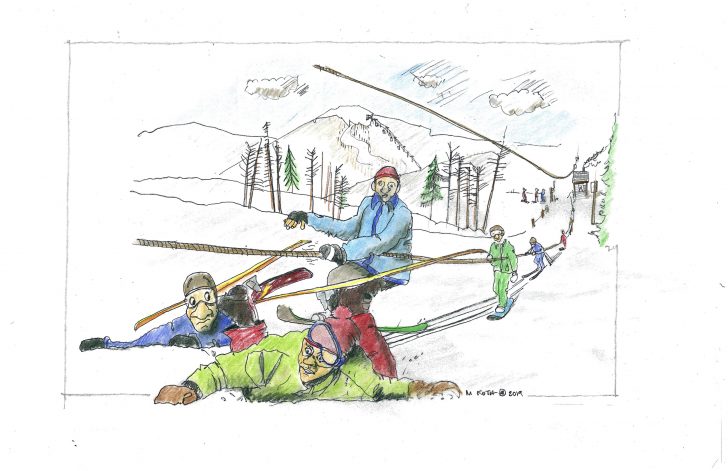
We’ve all been there. Cartoon Credit: Mike Roth
It was the early 1960s, I was in first or second grade and learning to ski at Mohawk Mountain in Connecticut. At the time Mohawk had just installed the first chairlift in Connecticut but most of the experiences I remember where on their numerous rope tows.
The first thing newbies had to master was slowly gripping the rope. Despite instructions to slowly grasp the rope, all first-timers, including myself instantly use a death grip. As a result I’d get hurled up the mountain about five feet before doing a face plant.
To my relief (and later amusement) there was no shortage of people making the same mistake. Every so often there’d be heaps of beginners tossed about on both sides of the tow. Sometimes people got so jumbled up it was impossible to tell whose arms, legs, skis or poles belonged to whom.
After repeating this several times in front of my laughing, older siblings and their friends I finally learned to adjust my acceleration by gently grabbing the rope. Once underway it was an exhilarating ride up the hill.
It was exhilarating because the rope tows at Mohawk moved at about 16 mph. To put that in perspective, modern-day high-speed chairlifts travel at about 12 mph.
After a few tiring rides up the hill someone showed me how to reach my left hand behind my back and grasp the rope while still holding on with the right hand. This did wonders in making the ride physically tolerable.
Another essential skill was learning how to stop once underway. This skill was needed when someone further up the tow fell and blocked the path. Until this skill was learned there would be spectacular pileups. Easing up on your grip wasn’t sufficient because the friction of the rope would tear your gloves apart. Instead you would have to turn one of your skis perpendicular to the hill and use it to keep you from sliding backwards.
The people who didn’t learn this skill would inevitably slide backwards down the hill bumping those behind them. I remember struggling to maintain my place on the tow while two or three skiers slid back into me.
Being six or seven years old the last thing I wanted was to be on the rope tow without others close ahead and behind me. Without other riders close by I would desperately try to hold the rope up off the snow. Being so heavy I’d have to bend over and hold the rope just inches above the snow; a backbreaking way to ride up the hill.
Another challenge was following a tall skier and when you’re a little kid they’re all tall. One of my friend’s fathers was 6’2″. When I rode behind him I’d have to reach up at head level to hold on to the rope. This was another excruciating way to ride up the hill. In the lift line there was always jostling among my friends to be in the middle of the pack among like-sized skiers.
Being the youngest of three brothers and skiing with a bunch of boys from our neighborhood there was no shortage of mischief. When unloading from the rope tow the older boys would whip the rope in an attempt to knock those following off the tow.
The art form was perfected when one could whip the rope enough to knock off a follower but not so much as to get yelled at by the lift attendant. Those who excelled at this learned to look innocent and express dismay over what happened.
Years later it occurred to me that it was ironic that rope tows, one of the most difficult lifts to master, were most often found serving beginner slopes. I guess they served to toughen us up.
End note: I just recently learned about rope tow speeds at Mohawk having read Nicholas Howe’s fabulous article The Wonders of Walt in the December 2004 issue of Ski Heritage Magazine. Walt Schoenknecht was the ski visionary who founded Mohawk and soon after Mount Snow, Vermont.

Fryeburg, ME, 1936. First rope tow. Credit: MaineSkiMuseum