Tag Archive for: Jonathan Wiesel

This Issue: March 18, 2022

In Short Swings!, Jon pairs French philosopher Simone de Beauvoir’s thoughts about aging with giving the finger to some disrespectful kids at Park City.

Skiing Weatherman, Herb Stevens, previews what to expect in ski country over the coming weeks.

Wendy Clinch of TheSkiDiva discusses what the women on her forum are saying about the state of on-hill safety.

Tamsin Venn profiles Deer Valley and the pleasures it delivers for senior skiers.

You probably didn’t know about Alta’s role in the development of a national approach to ski-teaching. Alan Engen, who headed Alta’s Ski School, shares that important chapter in American skiing history.

Jonathan Wiesel, President, Nordic Group International, encourages readers to propose that local golf courses start cross-country ski operations. He establishes a strong case and provides information resources to help make the pitch.

Finally, Mike Roth illustrates a verrrry long fall he took years ago in the French Alps; Test Your Skiing Knowledge poses a new puzzler and announces the winner of the last one, and LUV2SKI presents a few new reader-submitted license plates for your pleasure.

Enjoy the issue. The entire site, including our archive of more than 1,700 articles is accessible at any time. The next editorial package will be distributed Friday, April 1.

Make lots of happy turns, and, remember, Senior Skiers Rock!

Email jon@senorsskiing.com to request the new Senior Skiers ROCK! helmet sticker.


Make More Tracks: Yellowstone Expeditions

A Rustic Retreat In Remoteness.

Yurts and heated tent cabins accommodations in remote corner of Yellowstone.

When skiers talk about great backcountry, they often cite the Tenth Mountain and Braun systems in Colorado; Sierra Club huts in California; Skoki Lodge, Assiniboine and Shadow Lake in the Canadian Rockies. I’d like to add a new destination, near Canyon in Yellowstone National Park. (Check an atlas, find Yellowstone in the northwest corner of Wyoming; Canyon is in the north central part of the Park.)

Actually, Yellowstone Expeditions is in its 38th season. And to be honest, they use yurts and tent cabins, not log huts or lodges. But “great” is perfectly appropriate, whether it’s skiing or snowshoeing, staff, dining, or the amazing landscape of the world’s first national park (1872).

Yellowstone isn’t exactly a winter secret, but skiers visit the Canyon area only when they’re passing by in enclosed heated snowcoaches or on snowmobiles, mainly because there’s no lodging within 35 miles except Yellowstone Expeditions.

The company was founded by Arden Bailey, who in summer works as a geologist who once specialized in radioactive waste disposal. (There’s a theory Arden is such a bright guy that no one in his vicinity needs a headlamp.)

The high point of my winter used to be running winter trips in the U.S. and Canadian Rockies, so it was a joyous thing to be a guidee around Canyon. Most of the time I skied with Erica Hutchings, a Renaissance woman who’s been office manager, snowcoach driver, PSIA-certified instructor, and super-guide. Come summer, she’s been a river ranger in Grand Teton National Park.

Who Are Those Guys?

Dining room and kitchen yurts glow at sunset.

All the guides are a hoot. They’re also naturalists, dishwashers, and talented cooks, working crazy hours with all kinds of clients, and carrying it off with humor and panache and quick wits. What a work ethic!

Arden’s talents include amazing stories and still more unbelievable jokes. This sense of humor seems to inspire guests, who tend to be crazy-diverse in their professions and interests anyway. Our group on one visit included a doctor from New Mexico, a writer from New York, and the owner of a trucking firm in Texas. I learned something about publishing fiction, summer weather around Houston, anatomy, movies, Superfund sites, national politics, and succession tree species after the Yellowstone fires of 1988.

A typical four-, five- or eight-day trip begins with a snow van ride from West Yellowstone to Canyon with skiing near the rim of the Yellowstone toward the end of the day. We enjoyed a novel experience along the Gibbon River—a herd of maybe 200 slow-moving bison. We couldn’t pass them for almost two hours. It was a photographer’s dream, including the chance to take pictures of fuming snowmobilers who revved engines but still didn’t intimidate the beasties.

And There’s Skiing

Here’s why people come to Yellowstone.

You can visit the park for its beauty, for wildlife, for geysers. I did it that time for long tours, powder, and downhills. It’d been a long time since I’d really skied hard in the backcountry. It’s easy to forget how few miles a small group can REALLY go in eight hours when you’re breaking trail through two feet of fresh snow.

The Yurt Camp is based at 8,000 feet, so it gets and holds 200-250 inches of snow, usually the light stuff Montanans call “cold smoke.” It’s in a spectacular area, minutes from the deep canyon of the Yellowstone. Terrain runs from long-open-steep to wooded-gentle.

I’ve always been a so-so unenthusiastic telemarker, never quite found that ideal combination of grace, strength, and technique. After that trip, I’m a certified Wannabe.

It stood to reason that 205 cm light touring gear would do the trick for touring, even for low-angle telemarking. This might have worked if the heels of my boots hadn’t kept jamming with snow. It’s demoralizing to start a turn, come round just far enough that skis are pointed down the fall line, and find the only part of the boot/binding system meeting its obligations is the toe.

Humility is a great teacher.

Yeah yeah, I know, “It’s the equipment.” But the next day I used mid-length general touring gear with a 3/4 metal edge with backcountry boots and bindings. Spectacular improvement! Even carrying a full pack, those skied floated and came around on request.

Actually, we could have skipped hills almost entirely. There’s a huge variety of trails—groomed, ski-set, or just marked—taking off right from camp, including gentle tours to places like Inspiration Point and Cascade Lake.

Wilderness luxury

Guests stay in warm, comfortable hut tents, a moments walk from the kitchen and new dining yurts. Here’s the thing you sweat for and dream of on skis or snowshoes: getting home at twilight and trying the new cedar sauna before dinner. Or better yet, a backwoods (indoor) shower—rapture!

Among my favorite moments were the intermittent thunder of the Yellowstone’s Lower Falls (much higher than Niagara); walking around Washburn Hot Springs (it’s a map-and-compass trip in); watching a park ranger skate at dusk beside the Grand Canyon of the Yellowstone, just after a grooming machine came through; learning the differences between fisher and coyote tracks; digging a snow pit for evaluating avalanche potential; and the pleasure of a heated outhouse.

Now, that’s livin’!

More Detail

Packages include delish meals, lodging, snowcoach, sleeping bags and sheets, and guiding. The season runs December 17-March 7th. Four-day/three night visits run $1,260 per person, double occupancy. The camp holds 10-12 guests. Check out the dynamite web site by clicking here or call 800-728-9333.

Late afternoon along the thermal waters of Alum Creek


 

Make More Tracks: Corrugation For Groomed Trails

The Technical Reason Why Ski Trails Are Corrugated.

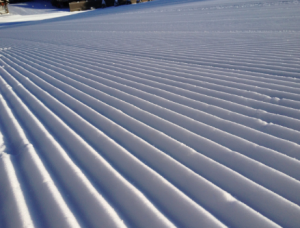
Freshly groomed XC trails last longer. Credit: North Shore Nordic Association

[Editor Note: This article was written in collaboration with Auguste Lockwood, Yellowstone Track Systems.]

Interest in winter recreation promises to grow phenomenally in winter 2020-’21, despite—or because of —COVID-19, and a lot of us are looking forward to more friends and families on more and better groomed trails.

One of the subtle, unsung, but vital elements of high-quality (read “fun”) cross-country ski, snowshoe, fatbike, and snowmobiling grooming is corrugation. You’re probably familiar with metal or plastic corrugated panels that increase strength and rigidity for roofs and siding. Those same qualities apply to trails, where consistent, durable, beautiful surfaces are essential for skiers, snowshoers, and riders as well as groomers. 

If you’re interested in either producing or using high-quality trails, first thing to know about corrugation is something about the physics of snow. Corduroy —that’s the grooming version of corrugation —has peaks and troughs that create minute pressure differentials. These differences promote the movement of free moisture up through the snowpack to the tips of the peaks, where evaporation is accelerated by increased exposure to cold air.

The phenomenon of “hot moves to cold” describes the movement of moisture from a warm material to a cold one, like condensation on a cold drink on a hot day. Corduroy increases the surface area of the trail, exposing more snow to the air where moisture transfer can happen.

Corduroy creates a strong, stable surface if it’s in place long enough before being used. In addition to faster set-up time (“mechanical age hardening”) and increased snow metamorphism, the triangular shape of the individual ridges adds strength and stiffness. Ideally, corduroy peaks form a thin glaze that extends about 1/3rd of the way down the trough, in effect building a little ice cap. With a well-distributed load, these caps are the first defense against trail flattening, friction, and melt.

En masse, these caps are extremely strong, easily holding the weight of a skier, fatbiker, etc., leaving virtually no damage or even marks. Once the caps or tips fail, the upper half of the ridge is fairly soft, but the layer just above the trail base (about 1/4 inch high) remains extremely strong.

This slightly ridged trail can last for days or weeks under the right conditions. A ridged trail sets up faster, bonds harder, and lasts longer than a flat trail.

Fat Biking On Corduroy

Fat biking promises to become a major winter sport that complements cross-country skiing and snowshoeing, and it’s new enough that grooming for it is a little mysterious. Groomers’ knowledge about any of these sports can help create a premium product for the others.

With the widely-spaced lugs of a fat bike tire, there are two types of interaction with the trail: the lugs, and the smooth rubber of the tire. A corduroy surface makes for a better riding experience by providing consistent traction. With corduroy, tire lugs fall between the peaks of the ridges, allowing the smooth rubber to evenly distribute pressure between the tips of three to five ridges at a time.

Lugs that contact the ridges will crush the snow, digging in and providing lateral traction, while the lugs between ridges grab the edge of a ridge and provide lateral traction, without damaging the trail. This creates a superior surface, as an increased number of ridges per foot of the grooming comb has several advantages.

One advantage is increased surface area, decreasing setup (consolidation) time. Another is more surface contact with a tire, since with widely spaced ridges, the tire will only be contacting a couple of ridge tips, increasing the pressure on the tips and breaking them. In contrast, on a smooth trail, tire lugs either don’t penetrate enough if the trail is too firm, thus reducing traction; or they’ll penetrate the top surface of the trail, until the weight is transferred to the smooth rubber of the tire.

The ideal density can be hard to achieve—too hard and there’s not much traction, too soft and the weight of the rider will crush the top layer of trail, creating a weak spot.

Finally, from an aesthetic point of view for fat biking, really good corduroy leaves a small line of snow on the tire. So while riding, there are three or four (depending on tire width) thin white lines that circle the tire. This produces a mesmerizing pattern on the wheels to watch on your front tire or on the back tire of someone you’re following. The lines run longitudinally around the tire if you’re going straight, but you can zigzag and make cool patterns as they interact with the regularly spaced lugs while turning.


Make More Tracks: “Tasty” Three Forks Ranch

Luxury Ranch Includes Gourmet Food And Outdoor Sports.

I’m a winter guest (or “dude”) ranch specialist – ski at them, write about them, consult with them, love them. Which is a little ironic because when you think “ranch,” you probably also think “horses!” – but I’m a wondrously inept horseman, whatever the season.

I’ve been lucky enough to visit maybe 50 guest ranches in the West, including a bunch near downhill resorts in Colorado, Wyoming, Idaho, and Montana. So it was intriguing but not a huge novelty some time ago to get a writing assignment about Three Forks Ranch, some forty miles northwest of Steamboat Springs, Colorado, along challenging narrow roads.

I came home gushing, totally out of character for a reserved New Englander. Here’s a whole string of adjectives about Three Forks that might sound ludicrous but are absolutely true—“vast,” “majestic,” “exquisite,” “tasty,” and on and on.

“Tasty”? Ohh yes, when there were multiple professional chefs (head, sous, pastry…? – I’m a gourmand, not a gourmet) under the command of an Executive Chef. The ranch serves no more than 30 guests (probably fewer in winter) – something better than a 3:1 ratio of staff to guests.

The majestic but graceful 35,000 square foot lodge, which opened in 2008, offers not just fabulous dining – my experience was three or four dinner entrées, vegetarian options, two desserts (you can have both; I did) – but also wine tasting and cooking classes in making delicacies such as chocolate truffles. In fact, the chocolates set on your pillow are made in-house. It’s pricey (from $1,695/person/night); it’s worth it.

The lodge-and-spa is the centerpiece of the more than 200,000 (no typo!)-acre getaway, in the midst of the Sierra Madre mountains. You can fly to airports in Wyoming and Colorado and take a guided snowmobile tour on 100 miles of private groomed trails the same day. Other options are guided trips on 50 kilometers of groomed cross-country ski trails – starting virtually outside your door – as well as snowshoeing, dog sledding, and sleigh rides where you’re wrapped in warm furs and can sip hot toddies.

I didn’t try them but there’s also private snowcat skiing and ’boarding (1,100’ vertical), tubing, snowshoeing, and ice fishing – no lift lines, no crowds

The bar with art work. Three Forks has been called “A Ritz with an art collection”

St. Louis businessman David Pratt bought the spread in 1999. Pratt out-bid developers who wanted to subdivide the working cattle ranch, and then he commissioned restoration of 16 miles of the Little Snake River – a huge project that has made it into one of the most productive fisheries in the Rockies. Three Forks as evolved into a world-famous fishing and hunting destination. As a former manager told me, “There’s just not more that you can do outside in Colorado on one property.”

There’s really no typical winter day at the ranch – instead they’re tailored to your wishes. Judging by my experience (after visiting more than 200 resorts in North America), Three Forks is an off-the-charts winter attraction, with superb recreation, setting, facilities, and staff. And did I mention the food? Sumptuous accommodations? Super-nice people?

The lodge is the ranch signature piece, the epitome of elegance. At the same time, it’s an imposing building, starting with the high-roofed porte-cochere and leading to the Great Room, with a 40’ ceiling. There you’ll find an autographed 1866 Steinway grand piano built of silky polished woods – one of the two in the world of this model. (No, I didn’t bang on them keys. Now if they’d had a house Stradivarius, as an ex-violinist…)

The lodge interior is a marvel. Walls are paneled with flawless American cherry wood and imported Russian Pine, a rare knotless wood. The 6,000-square-foot spa downstairs offers massage, body treatments, and an indoor/outdoor swimming pool. There are 15 luxurious bedrooms and suites, dining, conference space, and a fitness room.

I heard one visitor call the place “Ritz-Carlton on a ranch, with an art collection” – a fun summation. The art collection was a unique melding of dominant Western with Oriental, including some pieces from the Ming dynasty. Among the more recognizable artists were Charlie Russell and Frederic Remington, though there were also paintings and bronzes by almost -contemporary artists.

Outside the lodge you’ll often see elk grazing among life-size bronzes of fishermen and Ute Indians, adding still another dimension to the remarkable winter experience that’s Three Forks Ranch.


Make More Tracks: Nutter Butters And The Tour Of Anchorage

Joining A Race Without Training? Hey, It Could Be Fun.

Ski the TOA. Race? Fun? Both? Up to you. Credit: Anchorage Daily News

In this strangest of times, I think back to the great and diverse and sometimes unorthodox adventures I’ve had cross-country skiing. And although I haven’t competed often, there was this one time, some years ago…

As I understand it, you’re supposed to train for a major race. Seems sensible, right? But sometimes it just doesn’t work out that way.

Chalk it up to an uninspiring winter in the Rockies or maybe just a lazy streak, but I didn’t bother to prepare for the Tour of Anchorage. Didn’t train, hardly skied, ate too well; then flew up to Alaska at the end of February, did a little track skiing. Lay awake the night before the race, thinking: “Hey, my first marathon! I’ve never done anything longer than 25 kilometers. I’ve skied three times since prepping skis. What am I doing?”

As it turned out, what I did was have the time of my life. First, you can’t help but love Anchorage—150 km of groomed trails, maybe a quarter lit, eight mountain ranges visible on a good day, and incredible hospitality. There’s a large and dedicated racing community, from kids to Masters, represented by the Nordic Skiing Association of Anchorage is one of the most active XC clubs in North America. Their Alaska Ski for Women (held on Super Bowl Sunday) is the most popular all-women XC event in North America.

The Tour of Anchorage rings the city with a choice of distances.

The Tour of Anchorage is actually four point-to-point races, 25 km classical and 25 km, 40 km, or 50 km freestyle. The longer distances begin on one side of the city and go through the center of town—strange and wonderful to pass through birch and spruce forest, over roads streaming with traffic, and along the ice floes of Cook Inlet.

I chose the 50 km (don’t ask). Luckily the day was perfect, starting off cool with great snow, air crystalline, so we had great views of Denali.

I was saved by four things. First, at home I lived at 8,500 feet, so Anchorage’s altitude was an oxygen-rich dream. (Highest point on the trails is around 1,000 feet, lowest is four feet below sea level.) I got tired enough to do several face plants in the last 15 km, usually at conspicuous spots (why does that happen?), but never ran out of breath.

Second, friends who’d skied the race said to take it easy on the first ten kilometers because that’s where the hills are. Right! They’re not very prolonged, but a lot of up and down. You finish the Tour with a longish uphill in Kincaid Park (weirdly wonderful to see moose on these trails and jets flying low overhead).

Racing fuel.

Third, I carried several packages of Nutter Butters. They tasted good from the beginning, better as I got more tired. 

And last, people made all the difference between dropping out (which was a definite possibility) and finishing—not graceful but grinning. Race volunteers kept us hydrated and full of cookies and enthusiasm; spectators yelled us on; other skiers were inspirational, like the guy who broke a pole in the first series of hills and just kept going. (We passed one another at least a half-dozen times; I stuck around the finish area to give him an exhausted cheer.)

Best of all, I talked with two people who’d skied the Tour before, and they slowed down to give me an emotional lift. Without that, they’d probably have finished in the middle of the pack instead of waaay back. (My time was 4:04:20.6, 276th out of 292 male finishers. My pre-race fantasy had been 3:45.)

So what do you do when you’ve finished a 50 km, are staggering around beaming groggily, and one of your kind hosts takes you back to your hotel? I’d hoped to attend the awards banquet but slept through it; grabbed a late dinner; headed back to bed, and flew home the next morning, stiff but not hurting.

I’d love to ski the Tour again, with a few changes. Like about two consecutive months on skis, distance training, a much higher general fitness level, and hotter skis. But there’ll still be Nutter Butters.     

Anchorage Convention & Visitors Bureau is a great resource on the region. My favorite place to stay is Copper Whale Inn, a snowball’s throw from the Tony Knowles Coastal Trail and with 80 mile views over Cook Inlet.

The Tour of Anchorage is scheduled to be held on Sunday, March 7, 2021.  Plenty of time to train.

Choice of 25, 40, and 50 km and classic or skate races at the TOA. Credit: Anchorage Daily News

Make More Tracks: Jackson Hole Nordic

States Of Euphoria

More than great, these are superb conditions. Credit: Teton Pines

The week before Christmas, 1980, I drove west from Cody, WY, through the rugged Absarokas, over Togwotee Pass, dropping into the northeast corner of Jackson Hole, then south to the town of Jackson. Deep fresh snow covered the landscape, with occasional bison, moose, and coyote tracks crossing broad meadows. The road parallels the Snake River. So do the Tetons, which tower about 7,000’ above the river, with maybe the most spectacular skyline of any mountains in the Lower 48

For the next ten years, I skied, hiked, ran, and biked on both sides of the Tetons on the western edge of the valley (“hole” in frontier lingo), the Absarokas, and the Gros Ventre and Hoback ranges to the east. It was a fantastic time to live there, working as one of the world’s first Nordic ski area consultants.

Watching Jackson’s explosive transition from a cow town to a resort region was a little alarming. Happily the surrounding country stayed pretty much unchanged because almost 97 percent of the region is federal land that won’t be developed. Yellowstone National Park is just north of the valley.

Jackson Hole is a special place for winter lovers. Part of that’s the beauty and the pristine quality of Grand Teton National Park; some of it’s the amount and quality of snow. But for Nordic skiers, maybe the main draw is diversity in that stunning setting. It doesn’t matter whether you’re a track aficionado or skater, tourer or telemarker, loner or family skier —there’s not just that sad cliché, “something for everyone,” but a lot that’s absolutely superb quality. Today you can find an online resource that introduces you to all things Nordic (including snowshoeing and fatbiking) in the Jackson Hole area: click here for JH Nordic. You can figure on 300 km of groomed trails in total regionally.

Movin’ and Shakin’

Perhaps the most influential XC player around Jackson has been a specialty shop, Skinny Skis, which provides high quality rental gear, retail equipment, and clothing.

There’s also a core of friendly long-time locals in town who’ve played a huge role in popularizing Nordic skiing. They’ve been coaches and racers, backcountry guides and Olympians, as well as people who ski non-competitively, just delighting in the outdoors in such a beautiful place. A lot of them are members of the Jackson Hole Ski & Snowboard Club, whose Nordic division has been grooming at Trail Creek Ranch since the late 1960s, at the base of Teton Pass.

Private Tracks

Teton Pines has 16 km of gentle golf course skiing, complemented by instruction, rentals, and guided tours with affable Nordic director Cody Downard.  (You’ll often find his photos in Cross County Skier magazine).

Grand Targhee Nordic Center, on the western slope of the Tetons, has 15 swooping kilometers of groomed trails. The resort is about a 75 minute drive from Jackson.

Open since 2014, Turpin Meadow Ranch is a relative newcomer locally but already has a national reputation. Anchoring the north end of the 50-mile Hole, they’re a complete destination—cabins and chalets, great food (check out the Bob Dylan photo in the lodge, taken at the ranch in the 1980s), amiable staff, and 20 km of groomed trails. The ranch is a little higher than most other regional skiing, but generally routes are on the gentle side in meadows and forest, though there are some climbs and thrills too, starting right behind the lodge. Dogs, snowshoes, and fat bikes are all welcome.

Public Trails

Jackson Hole doesn’t have interconnected trails on the scale of Sun Valley, Idaho, or the Methow Valley, Washington, but public trails are immensely popular locally—and they’re free.

As much as 30 km (and growing) of the Jackson Hole Community Pathways and Trails are groomed, some very close to town. Teton Valley Trails and Pathways, at multiple locations on the west (Idaho) side of the Tetons, is rapidly evolving into a destination. And Grand Teton National Park grooms almost 25 km of summertime road, with wonderful profiles of the Tetons to the west and no snowmobiles within sight or sound.

When you visit

Plan a week’s stay, or you’re depriving yourself of grand exploration. There’s also world-famous downhill skiing, dog sledding, the fabulous National Museum of Wildlife Art, sleigh rides on the National Elk Refuge, and recreational eating at dozens of restaurants (try Fish Creek Inn in Wilson for breakfast and The Blue Lion in Jackson for dinner).

My favorite lodging is the Alpine House,  a 22 room B & B that’s owned and run by Nancy and Hans Johnstone, both former Olympians. They’re still avid skiers with great stories about everything from international competition to climbing in the Tetons.

Could this be Nordic Heaven? Credit: Teton Pines

The North Crater

Make More Tracks: Craters Of Moon

Ocean Of Volcanic Lava Offers Awesome XC/Snowshoe Experience.

“[It is an] area of about 60 miles in diameter, where nothing meets the eye but a desolate and awful waste, where no grass grows nor water runs, and where nothing is to be seen but lava.” (Washington Irving, The Adventures of Captain Bonneville, 1868 )

The North Crater shows the jagged lava outcrops. Credit: NPS

Some things leave a lasting impression. I flunked geology my freshman year of college—just couldn’t figure out technical things like how to measure a geosyncline or why it matters—and consequently rejected the whole science for years. And then I found that in the right context, absorbing geology can be amazing fun. Aside from Yellowstone National Park, the place that’s had the most volcanic effect on my geologic viewpoint is Craters of the Moon National Monument and Preserve  in south-central Idaho.

I used to pass the entrance a couple of times a year, driving between Jackson Hole and Sun Valley, at 5,900 feet in the middle of high-desert seeming-nothingness. Hummocks, ridges, cones, lava and cinders don’t create an inviting landscape; in fact, formations are so moon-like that the Apollo astronauts studied geology there prior to their lunar landing.

Craters isn’t exactly a winter destination. There’s not a whole lot of temptation to stop because there’s not much sign of human activity; there’s no on-site lodging; the nearest restaurants, motels, and gas stations are some miles away.

Beautiful snowshoeing and XC skiing on a volcano. Credit: NPS

Man doesn’t seem to have had much impact on the Craters locale. Oh, there’s more air pollution drifting through than a few decades ago, so you’re not as likely to see the high mountain ranges along the Snake River Plain; and larger animals like grizzlies and big-horn sheep disappeared a century ago—but overall, there’s not a lot of visible change.

The region began erupting around 15,000 years ago and stopped around 2,000 years ago. There’s a school of thought that another eruption is due in the next few centuries; but it’s expected to again be flowing lava rather than an explosion like Mount St. Helens in 1980.

There are no streams and few water holes, but the ecosystem is home to 2,000 species of insect, almost 200 bird species, 59 species of mammals, plus reptiles, amphibians, and a remarkably diverse plant population. Of course, you don’t see a whole lot of any of them in winter – primarily shrubs and limber pine.

It’s a unique land of tremendous extremes that an early visitor called “the strangest 75 square miles on the North American continent.” My first visit was in mid-summer with a geologist-friend who was ecstatic to see both aa lava (a Hawaiian name that’s spelled at least three different ways, meaning a jagged surface best avoided) and pahoehoe lava (smooth and ropey-looking). The heat was stifling – air temperatures may only reach the 90s in July, but surface temperature on that black rock can reach 170 degrees Fahrenheit. That’s more than hot enough to fry an egg – if you can find a flat surface.

I remember the physical shock of following a trail into a lava tube that’s perpetually chilly. We lost perhaps a dozen feet in elevation, started to shiver, and came across ice.

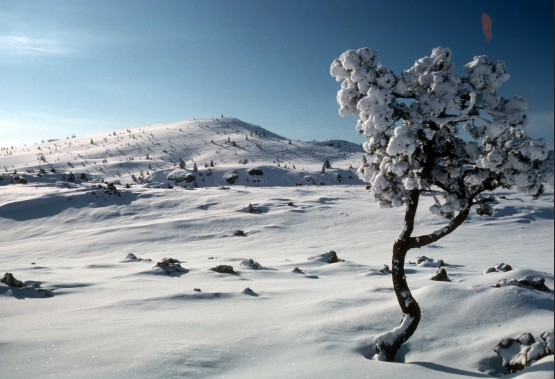
Snow covered spatter cone arises from the landscape. This is a place for other-worldy exploration. Credit: NPS

Winter Landscape: Milk And Vanilla Ice Cream.

Snow can bring a gentler face to Craters, or as one guide told me, a “Sahara arctic flavor.” He added, “It’s an entirely different experience from what you can have in any other area because of the brilliant white snow and the black basalt rock. It kind of looks like cookies and cream ice cream out there.”

Explore the snow-covered lava on snowshoes with a guide. Credit: NPS

Winter conditions can see -30 degrees Fahrenheit at night, with the wind rising to 30 miles per hour and not much tree-cover. It’s a great time to have the right clothing and good judgment on how far to venture from your car. There’s usually about a four-month season for skiing and snowshoeing.

The Park Service grooms up to seven miles of two-way trail along a summertime scenic loop drive. When I visited it was double-tracked, with a skate lane shared by snowshoers plus a separate snowshoe trail. There’s no fee, no dogs, no bikes, no snowmobiles. It’s easier to ski clockwise if you’re a beginner in order to avoid a downhill on the southwest edge of Inferno Cone.

In some ways, snowshoeing around the Monument is more fun than skiing because you get more flotation so can do more off-track exploring. But if you enjoy downhills, it’s a blast to make some turns on the open-sloped cinder cones, which can give you 400-500 feet of vertical drop.  

You can climb to the summit of Mt. Paisley for grand views before heading back to the Visitor Center. As a guide once noted to me, “How many places can people say, ‘Ya know, I went out Saturday and snowshoed to the top of a volcano?’”

At 6,000 feet, snow dominates the landscape from November to April. Credit: NPS


Make More Tracks: Sun Valley Sabbatical

Classy And Classic, Sun Valley Has Magnetism And Charm.

Sun Valley Nordic Center has beautiful vistas and trails. Credit: Visit Sun Valley

I’m a total sucker for romance, and Sun Valley, ID, radiates charisma, beauty, diversity, skiing history— the whole shebang. Known as “America’s First Destination Ski Resort,” it’s 2.5 hours from Boise. Happily, there’s a jet airport only a dozen miles away.

Set in the rugged Sawtooth Mountains, Sun Valley Nordic & Snowshoe Center was one of the first cross-country areas in North America, chronologically just after Vermont’s Trapp Family Lodge and just before California’s Royal Gorge. It’s complemented by a series of trail networks, mostly maintained by the Blaine County Recreation District.

Snowshoeing can also bring you out into the scenery. Credit: Visit Sun Valley

I’ve visited many times in winter and skied maybe a quarter of the trails. That’s actually not negligible, since we’re talking about a cumulative 200 km. There’s tremendous diversity in everything from terrain to snowfall to surroundings—some trails on the edge of Sun Valley Resort and the neighboring town of Ketchum, some higher and far from sight of any structure or even a road.

So here’s my take on skiing the two centerpieces of the region. It feels like a long and affectionate shared history.

The Resort: Sun Valley Nordic & Snowshoe Center


The Sun Valley Nordic & Snowshoe Center  has easier trails diverging from the trailhead, leading to more difficult routes, and thence to the challenging stuff. Set at around 6,000’, it’s mostly delightful beginner-to-intermediate terrain, totaling 40 km. Much of this is on golf course grass, a lot winds through sage, with some aspen and pine, with great mountain views, including alpine skiing on famous Bald Mountain (aka “Baldy,” 9,150’).

Almost everything is groomed daily. Sun Valley is a recreation-crazy region, so you see a lot of ski-skaters, including local folk of mature years who are tearing along the trails. Steve Haims, a Sun Valley fixture who runs the Center and is former owner/operator of Galena Lodge, says that most visitors, skiers and snowshoers are women, and a typical skier is 50+ years old.

You can also enjoy 14 km of snowshoeing and 16 km of fat bike routes. A typical season starts a bit before Christmas and runs through March, with 100” of snow in a good winter.

The Center itself is a 58,000 square foot golf clubhouse in the off-seasons, though I suspect summer visitors don’t think of it in quite those terms. You can rent skis, snowshoes, or fat bike rental, and arrange instruction.

The County

Galena Lodge

Historic Galena Lodge is the region’s other Nordic kingpin. At 7,865’, it’s a snow magnet. If you’re coming from sea level, it’s smart to acclimate down below, and then drive up to Galena, where you can overnight in one of their yurts.

Yurt will welcome you.

The lodge is owned by Blaine County Recreation District, which does the grooming. Erin Zell and Don Shepler are the concessionaires and have been running the lodge since 2006. Erin says, “We make all of our food from scratch and have wonderful house-made soups, sandwiches, salads and sandwiches.”  In addition to restaurant and bar, you’ll find ski and snowshoe rentals, instruction, and many happy dogs.

Galena is the centerpiece of 50 km of groomed ski trails, along with 25 km of snowshoe trails. There’s not much that’s truly flat, since terrain near the lodge is rolling, while it gets hillier as you get farther away. The landscape is dominated by lodgepole pine forest, with lots of meadows, and populated by wolves, coyotes, elk, and smaller critters.

For a personal touch, “Psycho” is a humbling black diamond route. I managed to stay upright until the final downhill, did a face plant in front of a bunch of other skiers right at the junction with Gladiator Creek Loop. At least I didn’t lose my glasses.

Accommodations

I’ve stayed at Sun Valley/Ketchum motels, inns, and B&BS and crashed with friends, but the most elegant and opulent visits have been at Sun Valley Lodge.  

Make More Tracks: Rendezvous Ski Trails

Catch Early Snow in West Yellowstone.

West Yellowstone Rendezvous Trails might be the center of XC in North America.

If you head to West Yellowstone, MT, in late November, you can visit the early winter cross-country ski epicenter of North America: the Rendezvous Ski Trails.

There are a bunch of fall camps in the Rockies – including Silver Star, BC, Crested Butte and Steamboat Springs, CO, plus Mt. Bachelor in Oregon – but the Yellowstone version is the oldest, largest, and incredibly convenient: literally right beside town (http://www.skirunbikemt.com/yellowstone-ski-festival.html). You can fly into Bozeman, MT, and stop to downhill at Big Sky Resort on the way to or from the Rendezvous Trails.

For decades, West Yellowstone was known as Snowmobile Capital of the World, partly because Yellowstone National Park is right next door (geysers! wolves! bison!). These days, the winter economy is also driven by cross-country skiing. (The Park isn’t open to over-snow traffic until December 15th this year, but you can ski from town before that onto snow-packed roads inside Yellowstone.) XC has changed from a handful of locals who thought XC was cool to a community where skiing is a life-style for a lot of residents.

A Lovely Trail System.

“West” has as lovely and lilting a trail system as anywhere in North America. What’s remarkable is that the roughly 35 km are loved by racers (like the Norwegian, Latvian, and German national teams, who trained there for the 2002 Salt Lake City Olympics) and recreational skiers. Perhaps the favorite recreational trail is the Rendezvous Loop, which passes by the biathlon course. A lot of competitors like a good long workout on Dead Dog and Windy Loop, on the far end of the network.

The Rendezvous Trails routes can hone your technique but aren’t a survival challenge (there’s only about 200’ of vertical change). And while they’re full of free-skiers and Fall Training Camp participants around Thanksgiving, the rest of the winter (especially non-holiday weekdays) they can be so peaceful that you can be out for an hour and see only a dozen people.

The trail system is a cooperative venture on U.S. Forest Service land, managed by the Forest Service, the West Yellowstone Chamber of Commerce, and the non-profit West Yellowstone Ski Education Foundation. A WYSEF Director once told me, “I would personally love to see West Yellowstone known as the Cross-country Ski Capital of the World. Our proximity to the trails inside Yellowstone National Park, our lengthy ski season, and competition-worthy grooming lend themselves to this possibility.” 

Several thousand skiers, from beginners to families to elite athletes, flock to “West” in November for the marvelous skiing, moderate altitude (around 6,700’), superb grooming, and reliable snow. In rare years when the white stuff arrives a little late in town, groomed skiing begins on a higher plateau, accessible by four wheel drive vehicles.

Yellowstone Ski Festival.

YSF has racing, but there’s a lot more including Pilates, kids activities, clinics, classes, demos. YSF is modified for this year but may be back full strength again in 2021

Before the upcoming “interesting” winter, the Fall Training Camp was known as the Yellowstone Ski Festival. It included natural science programs for kids, Pilates, backcountry films, indoor equipment expo and clinics, beer tasting, on-snow ski demo, and an end-of-week party. While the indoor component has been reined back – thanks, COVID-19! – there’s still a wide-ranging array of XC clinics with outstanding coaches, biathlon, and an FIS race (Ma Nature cooperating). Winter 2021-‘22 may be back to full-scale festivities.

Post-Festival, there’s still plenty of activity, with the winter schedule getting nailed down as I write this in early October. There are plans for ski races, biathlon (ski-and-shoot) competitions, and fun events, perhaps including the annual “Taste of the Trails.”

West Yellowstone has a daily trail fee (probably $12). Amenities along the trail are pretty limited (there’s a trailhead building with bathrooms and a communal room), but you can rent skis at several locations in town. Freeheel and Wheel (www.freeheelandwheel.com) has instructors, clothing for sale, and equipment rental and retail – plus they’ve got great coffee and a sense of humor!

There’s a mix of hotels and motels in “West”—check http://www.skirunbikemt.com/sleep.html for recommended lodging.

Rendezvous Trail System. Something for everyone.

Resort Review: Crested Butte, CO

Skis, Dogs, Bikes. It Must Be Crested Butte.

Crested Butte Nordic has rentals for $20 a day. Credit: CB Nordic

It sometimes feels like not much of the American West remains unspoiled, but the town of Crested Butte, CO, comes mighty close. It’s a ski town that used to be a mining community (gold and silver, then coal). Somehow it’s kept the serenity (population is pretty steady at around 1,700) and retained its Victorian architectural integrity.

Meanwhile, the mountains around town haven’t changed at all. They’re beautiful; inspiring; stunning! So is the Nordic skiing, from groomed trails all around town to famous telemarking at nearby Crested Butte Mountain Resort. (Now there you’ll see a lot of change—it’s morphed from a mid-sized area to a significant alpine ski destination. Still, it’s a great complement to XC for folks who like to split their time downhilling or snowboarding.)

Where?

Crested Butte is located in southwestern Colorado, about 30 miles north of the jet airport at Gunnison. It’s a genuine contender for the “Best Kept XC Secret and Remote from Everywhere” award. (Denver is about a four-hour drive, including a sometimes character-building trip over 11,312’ Monarch Pass, especially interesting in snow and wind.)

It’s a place you visit because you want to be there, not because you’re wandering the neighborhood. And you should want to visit, because it’s gorgeous (the Elk Mountains are spectacular), friendly, and kinda charmingly quirky.

The Skiing

The Crested Butte Nordic Council (https://cbnordic.org/) grooms 50 km of trail, usually starting in mid-November and running into early April. Winters can see up to 25 feet of genuine powder.

Trails are rated about 40% Easier, 40% More Difficult, and the rest Most Difficult. That beginner-intermediate emphasis is especially welcome to visitors, since elevation (up to 9,500’) is literally breathtaking. Give yourself a couple of days to get used to the altitude, and then stay a week (or two).

The skiing is very convenient, since you can hop on the trails at several points on the edge of town, plus there’s a free shuttle. Along with skiing, there’s snowshoeing and 10 km of groomed fat bike trails.

First place to visit is the Nordic Center. It’s your primary source for rentals, instruction, and information, with a pleasant lounge upstairs and ice skating next door. You can ski from the Center to The Bench (there’s some uphill) and tootle around on mostly intermediate trails, with good forest protection.

My favorite trails are around Magic Meadows, combining wonderful terrain and mind-boggling views. There’s also a ski-in yurt where you can book dinner or Sunday brunch.

For variety, the Nordic Center also offers guided trips. Another intriguing option is touring up to the old mining town of Gothic and overnighting (heat, electricity, and running water – BYOB, food, and bedding).

XC Idiosyncrasies

CB’s Alley Loop marathon starts in the middle of time. Credit: Xavier Fane/CB Nordic

Did I mention quirky? There’s the 42 km Alley Loop marathon (“best costume party of the year”) each February, which winds its way through town (a bunch of streets are closed to traffic during the event) – lots of fun, but serious enough to be an American Birkebeiner qualifying race.

A Taste of Town

One of the things I like best about Crested Butte is that everything is walking distance from everywhere else, and virtually any place you go is architecturally and historically captivating. Along the way, you’re going to see dogs and fat-tire bikes, whatever the weather.

There are a lot of dining options, but a local favorite is Sherpa’s Café (https://www.sherpascafe.com/), with Nepalese, Indian, and Tibetan cuisine, also serving beer and wine. Prices are surprisingly low for a resort town.

I’d recommend staying at Elk Mountain Lodge (www.elkmountainlodge.net). An easy walk from the Nordic Center, it’s run by skiers for skiers and has pleasant rooms, fine breakfasts, and great staff. Rooms for two run from around $170/night.

Elk Mountain Lodge in Winter.


Snowshoe hiking

Learning To Love Snowshoes

Not XC’s Poor Cousin Anymore.

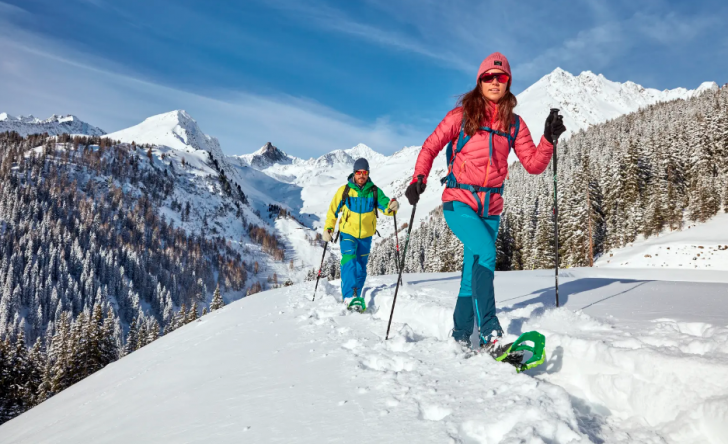
Snowshoe hiking gets you out on the snow and sunshine.

Back in 1971, when I transferred winter affections from downhill to Nordic skiing (due to a spectacular fall in Austria, that racked up one knee and stripped off my nifty French-made Fusalp ski suit– but that’s another story), I tried snowshoeing too. After all, cross-country skis and snowshoes were both made of wood and quite beautiful; they’re both ways to travel over snow rather than wade through it; they’re both very low-impact sports…

But cross-country evolved into my lifelong true love, while snowshoeing became merely the affably boring cousin you contact every few years. Too much work; bindings were crappy (now you’re in, now you’re not – and your fingers are gonna freeze putting the damn things back on); ‘shoes didn’t slide like skis, except sideways downhill on crust; wood frames cracked; rodents enjoyed chewing the rawhide webbing in summer storage…

Modern snowshoes confirm the theory of evolution. They’re clearly descendants of the woodies but fill new niches in design, materials, flotation, fun…

We moved ‘way beyond Sergeant Preston and his gigantic snowshoes.

I found this out one January about a dozen years ago, designing XC trails near Big Sky resort in Montana. (Sadly, I hadn’t visited that cousin in almost 30 years.) The snow was too deep, buried underbrush and deadfall too catchy, to use Nordic skis; so since slogging through waist-deep powder on foot was out of the question, what to do? Happily, intuition had suggested bringing my new aluminum snowshoes along, to test the frozen waters; and they behaved magnificently, though I dumped a couple of times trying to back up, sinking the tails of the ‘shoes. (My style of absorbing knowledge always seems to be “education through error.”)

So what’s new about this next generation – or two – of snowshoes? It may seem minor at first, but bindings have improved incredibly – they’re easy to use, stay on, sturdy, and they don’t stretch so they slide off your boots. The ‘shoes themselves are durable and have no food value, since they’re generally made with aluminum frames and synthetic decking that’s durable and gives great flotation – that combination also allows light weight, so less effort. The addition of bottom metal cleats gives you much better grip on crust and even side-hills (though it’s still smart to avoid those when possible).

Let’s, what else? Modern models definitely aren’t as pretty, but it’s a trade of aesthetics for dependability, longevity, convenience, and ease of movement.

Snowshoes are usually not as pricey as Alpine (or even Nordic) gear, but it’s still smart to rent before you buy to see if you like the sport. You can use hiking or snow boots with today’s adjustable bindings, or even sneakers with neoprene booties. A pair of gaiters will help keep out the snow and make sure your feet stay warm and dry.

There’s a new kind of ‘shoe that came on the market recently from a Colorado company (www.crescentmoonsnowshoes.com). They’re made of foam (foam!), but from my destructive testing are not just light but also sturdy, incredibly maneuverable (I backed up in them, did a 180 degree jump-turn for no good reason – no falls!), have great bindings, and are setting the snowshoe industry on its butt.

There are a thousand more subtleties to fun snowshoeing – using poles, running vs. walking, clothing, etiquette, blah blah. They’re relatively unimportant. Snowshoeing has become easy, and easy on your bones and joints. And even if you don’t glide, just repeat too yourself, “600+ calories per hour!” enjoy the burn, and head for the dessert tray after your outing.