Tag Archive for: NOAA

historic6

My Personal Skiing Safety Primer

To stay safe, all older skiers should prepare themselves for what might go wrong. I call this a “safety mindset,” and it’s kept me safe in more than 40- years of rock climbing, mountaineering and skiing.

Part of that preparation is answering these questions: 

  • What should I wear to protect myself?
  • How will I be found?
  • What are the most common dangers and how can I survive them?
  • What skills/knowledge/training do I need?

What should I wear to protect myself?

Wear a helmet and make sure it is securely fastenedIf your helmet isn’t adjusted properly and snugly attached it might not do much good. I check the helmet strap frequently. About half the time it needs adjustment. If you’re using an old helmet or one with a damaged shell, replace it with one of the modern impact distributing technologies like MIPS (Multi-directional Impact Protection System).

How will I be found?

When skiing I always carry a Fox 40 whistle. If you’re skiing inbounds, a series of three loud whistle blasts will summon help. Your phone, also is useful, assuming there’s a signal and juice. Make sure 1) it’s fully charged at the start of the day, 2) the area’s number is in your “Contacts”, and 3) you have a GPS app that will give your coordinates for when you call patrol. To keep the battery from draining, I keep my phone warm on a neck lanyard between base layer and mid-layer fleece. 

Several ski clothing companies incorporate RECCO reflectors into their products. It can help rescuers find you. If RECCO is not built in to your parka or pants, Marmot makes a RECCO belt.

I also carry a Personal Locator Beacon (PLB). Mine is a McMurdo FastFind 220. About the size of a pack of cigarettes, it cost a couple of hundred bucks, is waterproof, requires no annual fee, and has a 6-year battery life. It gets registered with NOAA and, when activated, broadcasts a signal to the same rescue network used when commercial planes crash. It’s not to be used frivolously, but when it is, rescue will be on its way.


What are the most common dangers and how can I survive them?

In addition to avoid being hit by others or losing control, I try to avoid tree wells and avalanches; just a few of conditions that can lead to suffocation and/or hypothermia.

When skiing powder in the trees, I wear a Black Diamond AvaLung Sling. If I were stuck in a tree well, it would help me extract air from the surrounding snowpack and divert exhaled CO2 away from my head. It costs $130 and weighs 9 ounces. 

Hypothermia occurs more frequently in seniors and twice as often in men. When it’s cold the body reduces blood flow to the extremities in order to keep sending it to the brain and key organs. I use glove warmers and boot cozies to keep hands and feet warm.

Helmets help prevent heat loss from the scalp but if there’s exposed skin on your neck, body heat will be lost there. Neck gaitors are a good preventative.

What skills/knowledge/training do I need?

The answer to that question depends on your level of on-snow engagement. If you’re a resort skier, knowing and following the responsible skier’s code and being hypersensitive at trail intersections and to the people around you may be sufficient. A step up would be basic first aid and CPR training. If you’re spending time in the backcountry, take a Wilderness First Aid course (REI offers several 2-day courses) and investigate educational offerings from the American Institute for Avalanche Research & Education

Short Swings!

SeniorsSkiing.com Needs You!

…especially if you’re willing to write articles that would be of interest to our readers.

Articles can cover prepping for the season (exercising, nutrition, personal accounts, etc.); thoughts on equipment, gear, clothing; technique; profiles of older skiers (well-known or not), destinations, planned trips, nostalgia, ski/board/snowshoe history, skiing with kids and grandkids, etc.

We prefer articles no longer than 500 words and like them to be accompanied by pictures.

Articles don’t need to be Pulitzer Prize ready. We edit as needed.

If you’re not ready to draft something but have an idea you think might interest readers, feel free to send it along.

Sorry that we’re not in a position to pay. But there are other perks: the opportunity to receive products for review, occasional skiing privileges (some areas will comp your lift ticket if you’re on assignment), and the personal pleasure of contributing to an online magazine read by thousands of skiers/boarders/snowshoers worldwide.

If interested, drop an email to jon@seniorsskiing.com or mike@seniorsskiing.com.

GOOD NEWS FROM NOAA?

Good News: NOAA predicts wetter-than-average conditions across most of the northern US, extending from northern Rockies to eastern Great Lakes, and western and northern Alaska.

Less Than Good News: NOAA’s caveat reads Snow forecasts are generally not predictable more than a week in advance because they depend upon the strength and track of winter storms.

CYBER BULLYING A FEMALE SKI MOUNTAINEER

Caroline Gleich is a professional ski mountaineer and adventurer based in Salt Lake City. An advocate for social and environmental justice, she works on issues such as climate change, clean air and cyber harassment. She is committed to inspire people to experience and protect the out-of-doors. Caroline is the first woman to ski all 90 lines documented by Anrdrew McLean in The Chuting Gallery, the back-country steep-skiing guide to Utah’s Wasatch range. Unfortunately, those and other accomplishments have been accompanied by cyber-bullying and harassment. REI produced this thoughtful video about her. It’s well worth watching.

IS SKIING THE FOUNTAIN OF YOUTH?

Salomon produced a nice video of a late 40s American skier who traveled to northern Japan to learn about the relationship between skiing and longevity. He spent time with a father and son who summited Everest together when the dad was 80. The son is a microbiologist specializing in aging. He concludes that skiing adds years to life. (We know it adds life to years.) Among the reasons: proper technique = less impact on joints. He believes there’s a relationship between lower body strength and longevity.

IDAHO

Grandkids in 5th and/or 6th Grade ski free or at steep discounts at all 18 of Idaho‘s ski resorts. Idaho residency not required. More info at skiidaho.us/programs/passport. There’s a $15 processing fee.

UTAH

If your plans take you to Utah mid-November, consider attending the BMW IBSF Bobsled and Skeleton World Cup, Friday/Saturday November 17/18 at Utah Olympic Park in Park City. Bobsled and Skeleton athletes from 20+ countries will participate in Women’s Skeleton, Men’s Skeleton, Women’s Bobsled, and 4-Man Bobsled.  Admission for spectators is free. While there, don’t miss the Alf Engen Ski Museum. It’s a real treat!

VERMONT

Members of the Hermitage Club, the private ski resort at Haystack Mountain, are being assessed a one-time $10,000 fee. The fee is needed to cover cash flow problems related to state permitting delays, poor weather in the 2015-2016 winter season and a slow membership drive.

Killington is installing several new solar projects. They are expected to generate more than 3,300,000 kWh of annually for the resort and sister property, Pico Mountain.

R.I.P.

Morrie Shepard died Thursday, Oct. 12. He instructed at Aspen, before joining Vail in 1962 where he was its first ski school director. His other titles while at Vail; building inspector, fire chief, building coordinator; professional funster. He was born July 2, 1925.

OTHER

All Adventure Camp Blankets are the first modular three-part blanket system. Each of the lightweight components can be used to stay warm and/or protected in variety of situations from camping to sitting on the beach. The manufacturer, Kammok, is raising funds via Kickstarter. Their home-made video explains the system.


2016-17 Winter Forecast Outcome

How Close Were NOAA Predictions? The Surprise Was California.

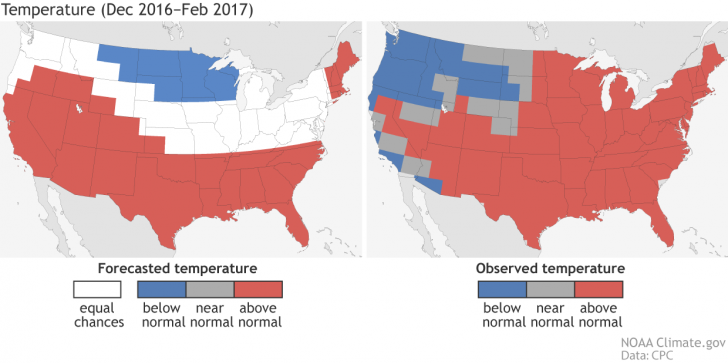
Temperature: Forecast vs Actual, 2016-17
Credit: NOAA

NOAA’s Climate Prediction Center recently published a review of its forecast for the 2016-17 winter.  As you know from horse racing, the stock market and Las Vegas, predictions often do not reflect realities.  The question really is how close to reality the predictions are.

In October, 2016, the Winter Weather prediction was focused on factoring in a weak La Nina pattern in the Pacific.  La Nina and sibling El Nino, as you may be aware, are warm or cool water conditions roughly in the latitude of Peru in the eastern ocean.  These conditions impact the air masses above them and, subsequently, the jet stream which steers weather patterns in the atmosphere.

Climate Prediction Center thought a La Nina (cooler water) would bring generally warmer temps across the lower US and cooler in the Pacific Northwest, Upper Midwest and Ontario. For precipitation, the prediction was below normal precip across the southern US, continuing the drought situation there, and above average precip in the upper band across the US-Canada border.

In reality, the La Nina was weaker and faded away earlier than predicted. That factor plus multiple “Atmospheric River Events” off the California coast, narrow regions of heavy moisture transported from the tropics, and general randomness brought different outcomes.

Temperatures across the US in the 2016-17 winter were the warmest ever recorded. That was in line with the prediction for warmer temps across the whole country. But it was colder than average in the Pacific North West rather than the Northern Plains.  And, while precipitation for wetter than average in the Northern Tier was spot on, the forecast for drier than average only worked out for Florida, where drought conditions persist.

As we know, it was wetter than average in California with ongoing storms racing up from the Pacific. Not predicted.

In general, Climate Prediction Center’s own objective evaluation of its predictions show it was much more accurate for the temperatures this year than precipitation.

We will be bring you predictions for the 2017-18 Winter when they emerge.

Precipitation: Forecast vs Actual 2016-17
Credit: NOAA