If you’re new to the sport, you’re going to find people using terms that may be a little confusing at first. Here’s an explanation of most of the jargon you’re likely to meet.
Nordic skiing is the catch-all term that includes classic technique, skating, ski touring, telemarking, even jumping and biathlon… In all these cases, your boot’s toe is fixed to the binding and your heel is free to lift up, as opposed to the fixed heel in downhill (or alpine) skiing. Nordic skiing is about a jillion years old; downhill is a relative newcomer.
Grooming lets you glide on top of a solid, consistent base that’s been prepared by snowcats or snowmobiles pulling special attachments. Groomed trails are used by both classic skiers and skaters.
Cross-country refers to skiing on machine-groomed surfaces – track for classic skiers and compacted snow for skaters
Classic technique (also called diagonal stride). You’re moving straight ahead instead of skating.
Skating is a relatively new technique (was introduced to racing in the early 1980s) involving an ice-skating like motion of arms and legs, thrusting out to the side. It’s dynamic and relatively exhausting.
Ski touring means skiing on ungroomed snow, whether it’s playing in your backyard or day-long treks in the mountains.
Track skiing (for classic skiers) means skiing in precise machine-compressed grooves, with snow compacted on both sides of the track for planting your poles.
Telemarking is an elegant and practical descent and turning technique.
Ski joring means being pulled, usually by a dog, though I’ve also been pulled by a horse, reindeer, and VW bug.
Biathlon refers to skiing and target shooting, usually with a rifle.
Kilometers are how cross-country ski trail lengths are measured. A km is a little over 1/6th of a mile. Skiers get more of a kick out of saying, “Hey, I skied 10 km today!” than “Well, I skied about 6 miles.”
Nordic Combined naturally enough refers to the blending of ski jumping and cross-country skiing.
The Venerable Inn Has Historic Roots In Ski History.
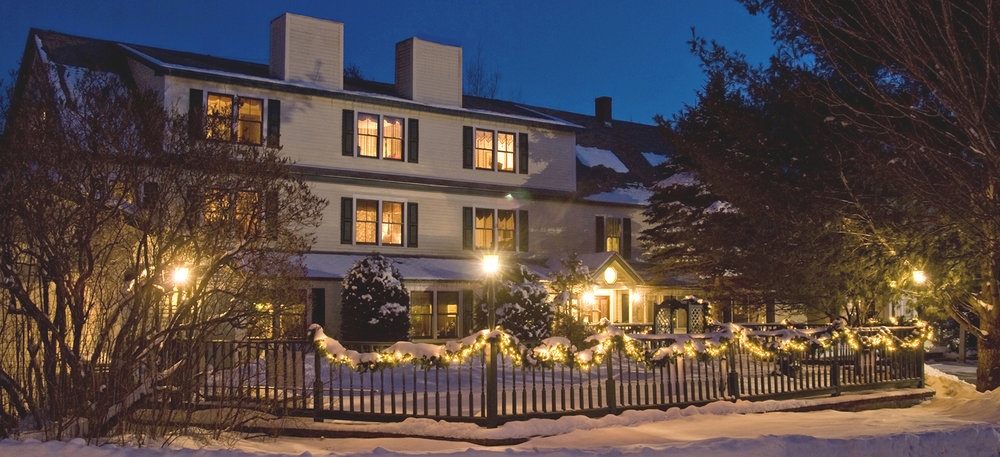
The Woodstock Inn & Resortis one of Vermont’s true gems for travelers. It offers warm New England hospitality amidst an atmosphere of country elegance and year round recreation. Resort facilities include the new 10,000 square-foot Spa, the Resort’s Nordic Center, Suicide Six alpine ski area, the Resort’s Golf Club, and a 41,000 square foot Racquet & Fitness Club. However, it’s the lavish details of the wood-burning fireplaces in guest rooms, luxurious terrycloth bathrobes, and locally-made furnishings, that defines the country sophistication and completes the picture of charm and comfort at the Woodstock Inn & Resort, which rises above expectations.
The Woodstock Inn & Resort is a 142-room, AAA Four Diamond Resort and a member of Preferred Hotels & Resorts. The village of Woodstock is located in Vermont’s Green Mountains with antique shops, art galleries, boutiques, restaurants, and specialty food markets in the downtown area…but if you also want recreation the Woodstock Inn & Resort delivers.
In the winter months, the inn’s Racquet & Fitness Club is situated close to the inn hosting the Woodstock Nordic Center. There are partnerships between the inn and both Fischer Nordic Skis and Tubbs Snowshoes. The Nordic Center maintains some 60 kilometers of trails in the area – half of which are part of the nearby Marsh-Billings-Rockefeller National Historical Park. Professional instruction, ski storage, equipment sales and rental equipment are available at the ski shop, as well as a full line of clothing and accessories for cross country skiing and snowshoeing.
The Tubbs Snowshoes Adventure Center features guided tours, group teambuilding exercises, and family-friendly scavenger hunts. Beginners and experts alike will find the 30 kilometers of trails against the backdrop of the Resort’s expansive grounds, with flat tracks along the babbling Kedron Brook on the golf course and more challenging uphills and downhills on the adjacent Mt. Peg property. Winter adventure-themed vacation packages are built around the Tubbs Snowshoes Adventure Center. From romantic to adventurous, there are value-packed getaways with the adventure centers designed for guests to enjoy an exhilarating way to experience the peace and tranquility of Woodstock in winter.
My wife and I enjoyed part of the Romance Excursion Package including accommodations for two nights, welcome gift basket, breakfast and a four-course dinner for two at the Red Rooster Restaurant, and a guided snowshoe trek to a four-course chef’s dinner at the Mt. Tom Cabin in the national park. We also went cross country skiing on groomed ski tracks accessed from the Racquet & Fitness Club on a sunny morning followed by wonderful massages in the Spa. On the second morning, I went snowboarding at the nearby Suicide Six ski area while my wife took a yoga class at the club. Overall, we were impressed with the inn and its staff, each and every one of them. In all of our interactions, the Woodstock Inn & Resort staff was especially attentive to us, often without the need of having to ask.
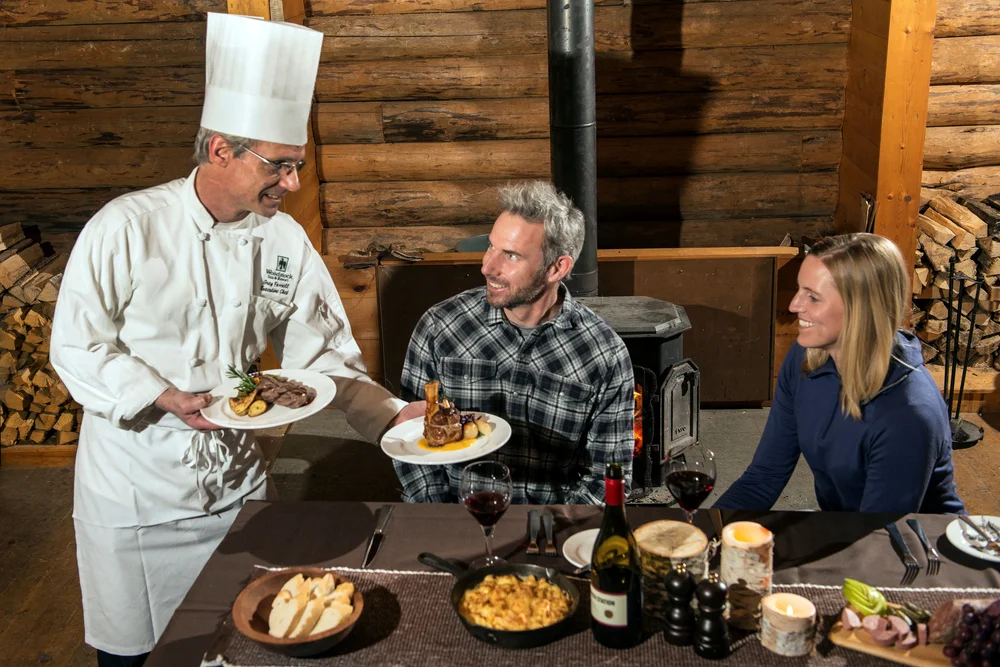
On Saturday evening, we reached the Mt. Tom Cabin after crunching up about one and a half miles on snowshoes up a hardpacked snowy trail under a clear and cold starry night. The meal was prepared on a wood-burning cookstove by the Woodstock Inn’s chef in a candlelight cozy setting. The evening’s guide associated with the national park was a naturalist that imparted some of his knowledge about winter nature and history of the park, which is the only national park dedicated to conservation stewardship. The park’s 550-acre forest is one of the oldest professionally managed forests in the USA with 400-year old hemlocks and Norway Spruce.
The inn’s Main Lobby is comfortably furnished and features a 10-foot fieldstone fireplace at its center. Don’t miss the newly opened Game Room, which is a hoot for the kid in all of us. It has a mix of games including a 4-foot scrabble board on the wall played with magnetic tiles, three real pinball machines, billiards, foosball, six TVs, video games, and more.
The new 10,000 square-foot spa has 10 treatment rooms, luxurious suite, tranquil men’s and women’s lounges, a light-filled Great Room, enclosed outdoor courtyard featuring a meditation tree and a wood sauna and a hot soaking pool. Guests can choose from a wide selection of treatments performed by licensed therapists.
The Woodstock Inn & Resort’s own Suicide Six Ski Area opened in 1937, just a few years after the first ski tow in the United States was rigged up just over the ridge at Gilbert’s Hill. Suicide Six has since evolved into a friendly and personal ski area that caters to families and local skiers. On Sunday morning when I visited, the slopes were covered with young local ski racers learning the ins and outs of skiing gates.
The Woodstock area offers other activities including day trips to nearby points of interest such as Simon Pearce Glass, Shackleton Furniture, or the Quechee Gorge. The Marsh-Billings-Rockefeller National Historical Park, is Vermont’s first national park and it operates in partnership with the Woodstock Foundation, Inc, and the Billings Farm & Museum – a working dairy farm and agricultural museum that mirrors rural life in Vermont in the late 1800s.
Editor Note: This article was originally published in XCSkiResorts.com.
The Hub Of The New England Nordic World Is In New Hampshire.
We excitedly planned a weekend trip to Jackson, N.H., because it is a true Mecca for Nordic skiers. This is the quintessential New England Nordic (XC) skiing experience with the covered bridge, white steepled church, brookside trails, and the accompanying village with all of the trappings.
Many of the trails lead right to the door of local inns, shops, and restaurants. It’s no wonder that Jackson Ski Touring Foundation has been rated the top cross country ski area in the United States by the website, America’s Best Online.
The Foundation is a non-profit organization chartered to maintain XC ski trails in and about the village of Jackson. There are about 75 landowners that allow trails to cross their property. Country inns are spaced throughout the region and the base lodge is a golf country club located on the village loop. The Cocoa Cabin is a warming hut serving hot cocoa on the weekend, located 3 km from the center on the gentle Ellis River Trail. Snowshoers can take a rustic narrow marked snowshoe trail from the center to reach the Cocoa Cabin.
We stopped at nearby Bretton Woods Nordic Center on the way to Jackson to ski in a snow storm for about 10 km on beautiful trails behind the Omni Mt. Washington Hotel. The grand hotel is at the southern base of the mighty Mt. Washington with 1,700 acres of spectacular scenery. This full service ski center has its own parking area and houses the ski school, rental equipment, and a retail shop with XC ski clothing and accessories. The center has a fireplace with couches and food service with tables and seating.
It was a problematic tour for my wife Kimberly, who had snow sticking to the base of her waxless skis. I tried applying a lubricant called Swix Easyglide a few times but it didn’t work for more than 50 feet before the snow stuck to the skis again. In a husband-oriented display of gallantry, I switched skis with her but I couldn’t get them to glide very well either.
We arrived at the Inn at Ellis River in Jackson after leaving Bretton Woods and were showed to our room-with-a-view by new innkeepers John and Mary Kendzierski. The next morning we awoke to the aroma of bacon, which while incredible, does not do justice to how good the maple bacon tastes when accompanying a choice of two hot entree specialties such as cinnamon crepe stuffed with apple filling and topped with creme fraiche or pecan praline French toast. There’s also fruit, yogurt, granola, and freshly baked breads, muffins, and other breakfast treats. The breakfast tables were covered antique metal sewing treadle tables. Looking out the windows from the dining room adorned with snowman figurines, we saw frolicking squirrels hopping from tree branch to tree branch.
Behind the inn and across the Ellis River is the Ellis River Trail, one of the most popular trails from the center lodge for XC skiers and snowshoers. We first stopped by the Jackson Ski Touring Center and got my wife’s skis hot waxed as we waited. The wax job worked like a charm as we left the center for a short tour through the covered bridge, ending up at the Cocoa Cabin. The skiers along the Jackson trails are mostly experienced and courteous meaning they give the right of way to downhill skiers and get out of the groomed ski tracks when appropriate. Most say hello as they pass.
We lunched on scrumptious sandwiches at the J-Town Deli & Country Store, a warm and enticing old-fashioned country store that has a bakery, beer, wine, sweets and treats. Then, we headed to our appointment for a “couples” massages at Moondance Massage. Beside massages, Moondance offers energy work, facials, and yoga classes. By the end of the massages, we were both amazed at how our respective soreness was alleviated. We noticed three more couples coming in the door at Moondance, so this apparently is a popular venture for Jackson visitors.
The “Foundation” maintains 150 km of varied and breathtaking XC ski and snowshoe trails 2 hours north of Boston. Foundation trails connect with A.M.C. trails in Pinkham Notch and White Mountain National Forest backcountry adventure trails.
Our après ski time led us to the Wildcat Inn Tavern in downtown Jackson for some live music and libations. The tavern walls display classic ski posters and some antique gear such as snowshoes and a pair of red Jarvinen XC skis. The seats in one of the rooms were built to look like double chairlifts and there were soccer jerseys from around the world pinned to the ceiling. Afterward, we dined at the nearby Christmas Farm Inn for a great dinner and dessert.
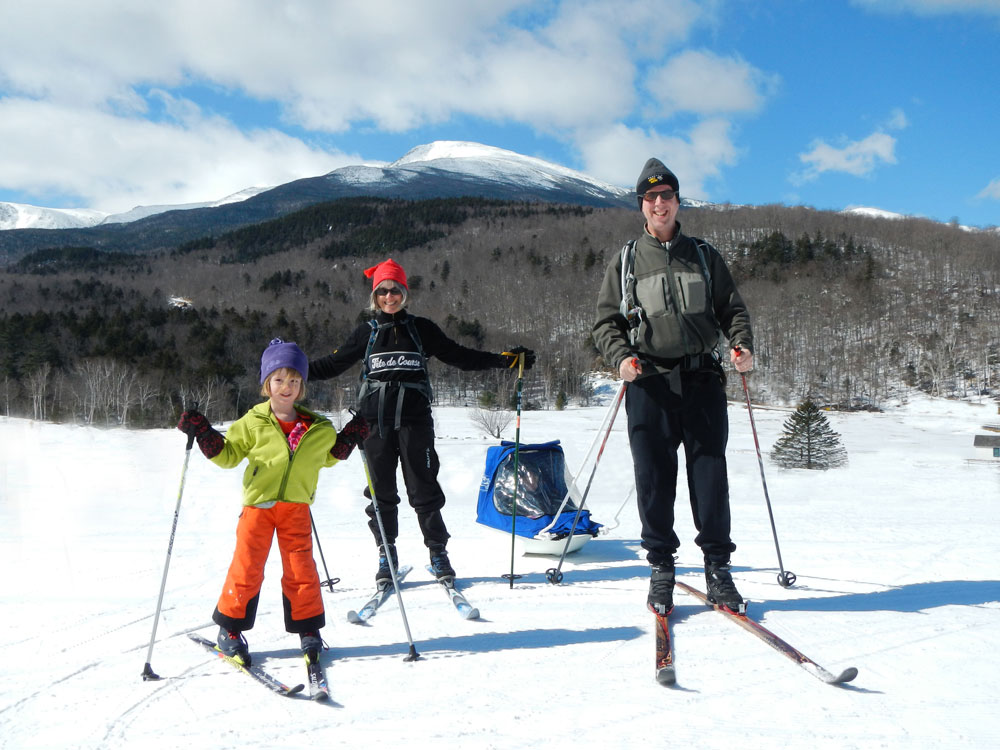
Our getaway day included a stop and tour at Great Glen Trails Outdoor Center, about ten miles outside of Jackson up the Pinkham Notch toward Gorham. The panorama view from the center of the Presidential Range and Mt. Washington is unparalleled. We skied a few cold and windy kilometers on wide whimsically-named trails such as the Great Grump Grade and Hairball Passage toward the Great Angel Warming Cabin. The trails were impeccably groomed and on our way back to the lodge we stopped by the new Glen House Hotel for a drink and lunch. The hotel has 68 rooms and is one of the most sustainable operations in the business. We also checked out the Mt. Washington SnowCoach to head up to treeline on the nearby Toll Road, which is an experience not to be missed.
The White Mountains and Jackson met our expectations delivering great snow, excellent trails, and a superb weekend at a destination worthy of being named a Mecca of Nordic skiing.
Editor Note: This article was originally published in XCSkiResorts.com.
https://seniorsskiing.com/wp-content/uploads/2020/08/Screen-Shot-2020-08-17-at-10.52.05-AM-e1597675963799.png488728Roger Lohr/wp-content/uploads/2014/04/Seniors-Skiing-since2013-Logo@2x-300x68.pngRoger Lohr2020-07-04 10:54:232020-08-19 11:30:01Resort Review: Jackson, NH and The White Mountains
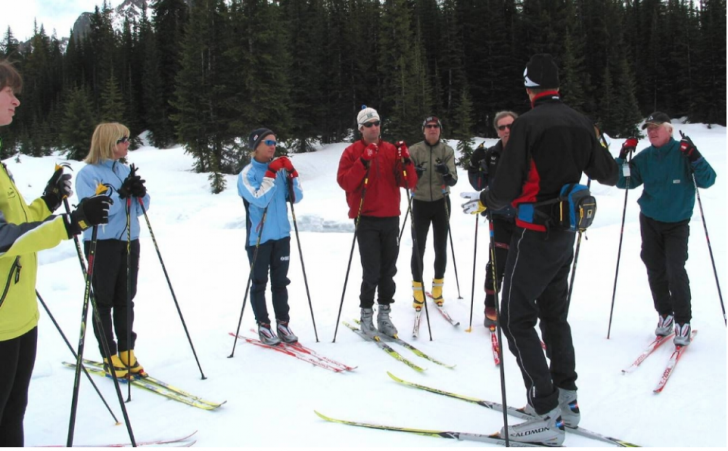
The vast majority of cross country (XC) skiers do not take XC ski lessons, but rather they start with friends or family, who are usually not trained to teach XC skiing. So, who needs XC ski lessons? Most of us do!
Starting with the basics, a XC ski instructor can help a skier choose clothing and equipment that is appropriate for weather and his or her skiing goals and abilities. Equipment selection including the ski flex, length of poles, ski boot type and fit can make a huge difference in a skier’s experience.
A ski instructor can gently guide any XC skier to better skills and match a skier’s pace to his or her level of fitness and interest, keeping the skier from working too hard…and let’s face it, most people who do not XC ski perceive the sport as too much work. The idea of sliding on snow can be a challenge for some people. An instructor can show the proper way to balance, transfer weight from one ski to another, and how to use the poles. Learning to keep the body forward with appropriate ankle and knee bend can start a new skier with confidence. Maintaining control down hills is also key to enjoying XC skiing.
The first time a new skier approaches a hill, whether going up or down, can be a make-or-break experience. A lesson can help one learn simple techniques to travel up a hill with confidence. Going down a hill on XC ski equipment can be frightful to new and experienced skiers alike. Narrow trails, difficult snow conditions, rocks and trees are challenging to even an experienced XC skier. An instructor can make sure the initial down hill experience is a safe and comfortable one by starting on the right terrain and practicing skills and techniques. Such a lesson will prepare a new skier and build their confidence.
Can a Lesson Help Seasoned Alpine Skiers?
Alpine (downhill) skiers who are trying XC skiing for the first time will also greatly benefit by getting some XC ski instruction because the equipment and techniques varies between the two sports. Skiing uphill is a totally new experience for the alpine skier and going down hills on XC ski equipment, which is lightweight and has a free heel…and no big plastic ski boot, can be more than thrilling.
An experienced XC skier, who may need to improve on some aspects of their technique can also benefit from a ski lesson. Most XC ski control and efficiency problems involve incorrect body movements or timing issues and these problems will waste energy. Even constantly looking down at the skis will distort good body position while XC skiing.
Years of incorrect technique can instill the wrong muscle memory and this really requires a certified and experienced instructor to rectify. Video analysis can be a great benefit to seasoned XC skiers. A good ski instructor will not be critical but will direct the lesson to the skier’s goals such as improve glide, control, and feeling more confident on skis.
So many XC skiers use outdated equipment and instructors can be helpful to discuss newer or more appropriate products with them. There are so many derivations of XC skiing, that it is imperative to get informed advice to match what someone wants to get out of XC skiing, be it gliding on a groomed trail or mastering the glades in untracked powder or other ski conditions.
Finding a Qualified XC Ski Instructor
To find a qualified XC ski instructor visit or call a XC ski area. Discuss skiing goals with the instructor and find out if they have been certified by the Professional Ski Instructors organization. Certification involves training and passing a test to teach XC skiing. The instructor should be a “people person” easy to talk to, and offer positive feedback on a skier’s strong points and encouragement on how they can get even better skills. With enhanced skills and techniques, XC skiers can experience the fun aspect as well as enjoy the outdoors and fitness associated with the sport.
Thank you to Brad Noren, of www.NordicFusion.ski who is a PSIA certified level 3 Alpine and Level 2 Nordic ski instructor for information in this article based on his experience teaching since 1972 in northern Michigan.
Editor Note: This article was originally published in XCSkiResorts.com.
Many XC ski areas conduct demo days to give skiers an opportunity to test drive the newest XC ski equipment. It’s a day when product suppliers’ branded tents and flags are flapping in the wind and company reps stand guard armed with knowledge of their wares.
You might participate in a demo because you have outdated gear (national statistics say that XC skis are 17 years old on average) and want to test new and different equipment to replace your old clunkers. Or you might just want to experience the advantages of the new gear. There are many reasonably priced skis but a pair of XC skis can be as high as $500 for premium models, so it makes great sense to try some different skis, ski categories, and brands to find something that best fits you.
Depending on how organized the demo is, you might need a credit card and/or identification for security but remember to also bring an open mind. The rep will ask you about your skiing ability and interests. If you’re an intermediate skier who gets out on the trails four times a winter it is very different from a skier who hits the trails every weekend and can fly on skate skis. Give the rep an accurate description of your skiing prowess and interests so he or she can make a recommendation for you.
If you need a new set up and want to use a product demo to help make the decision about what to buy, do some homework before going to the demo. Talk with a knowledgeable ski shop employee who XC skis. Be wary of the alpine ski shop that limits its XC ski products to a dark or dusty back corner of the store. Find a reputable XC ski shop that sells multiple models among a few different brands of XC skis. Check out some company brand websites or other general XC ski-oriented websites.
When at the demo, get the right size skis for your weight and ski on them for about 15 minutes. Find some uphill and downhill trails to see how the skis perform. Do the skis hold going uphill or do you have to fight to prevent backsliding? Are some skis easier to turn than others? Does the glide seem to extend or do the skis slow down quickly? If you don’t know what to look for while testing, ask the rep for some tips.
It is recommended to stay in the same category of skis when testing, so if you’re trying a recreational waxless ski from one brand, test a similar ski and price point from a different brand before switching to a different kind of skis. Skis perform differently depending on flex, width, and construction – some skis glide better and some are more stable, turn easier, and are slower.
Of course, there are two different XC ski boot/bindings available and if you don’t use the same system on the different skis that you’re testing, you’ll have to change boots to ski the other boot/binding system.
Rossignol rep Will Masson commented about the advantage of demoing with the NIS binding, “The NIS system allows you to move the binding on the ski to 7 different positions so you can fine tune your grip and glide position on the skis. The binding starts out at the balance point position and moves forward 1.5 cm and back 1.5 cm to customize your weight distribution on a particular ski. This can only be achieved when using the NIS system.
There is a graph that shows the benefits of moving the binding forward and back on the plate for skating and classic. A customer might be right between a 176 cm and a 186 cm ski on the recommended weight chart. That customer can be put on the longer ski to enhance the glide, and then the binding would be moved forward to maximize their grip on that longer ski. Advantages are like fine tuning a driver in golf, or a handlebar stem height on a bike, or strings in a tennis racquet. With other Nordic binding systems once you mount the binding you are stuck in that position!”
XC ski boots are a very important aspect of XC skiing comfort and it makes great sense to ski on some different brands. Do you want your boots to feel like a comfortable sneaker or do you desire the substantial support of a stiff sole? Is the toe box area of the boot creasing in a comfortable spot when you’re skiing? Do your heels rise when you lift your foot? Is the boot too tight or too loose? Should you get custom insoles for your boots to make your feet feel more comfortable?
Have you tried XC ski poles recently? Ski poles have different grip straps that are easier to use and you may find that they are more comfortable and effective than traditional ski pole straps. Sunglasses are a great item to test. Do they fog up when you get sweaty? Do they feel so tight that you might get a headache? Are interchangeable lenses available for times of low light or bright sun?
Dedicate part of your ski day to the demo and try more than a few skis, poles, and boots. It should be fun and then you can make informed decisions when you purchase your next set of XC ski equipment and you’ll feel great that you bought the perfect gear. To find a demo day contact a XC ski area or Nordic ski retailer near you to see when they will conduct their next demo day. SIA Photo of SIA Nordic Demo at Devil’s Thumb Ranch Resort & Spa.
Editor Note: This article was originally published in XCSkiResorts.com.
https://seniorsskiing.com/wp-content/uploads/2020/08/Screen-Shot-2020-08-17-at-10.14.05-AM.png422636Roger Lohr/wp-content/uploads/2014/04/Seniors-Skiing-since2013-Logo@2x-300x68.pngRoger Lohr2020-07-04 10:13:572020-08-19 11:32:35Take Advantage Of An XC Demo Day
The cross country ski waxless “skin” bases, use inserted mohair strips on the ski bottom, which are extremely effective for all temperatures and snow conditions. It is high performance waxless base technology for the classic skier, who prefers to use a waxless ski. The ski strips are like small climbing skins and they are resistant to icing because they have a Teflon-like coating. There are conditions where a de-icer should be applied to the skins. There are anti-icing solvents that do not degrade the glue (which holds the skin to the ski) but it is best to get an anti-icer made by a ski manufacturer to avoid damage to the skin and the glue.
Specific cross country ski models that have a flex that are created in conjunction with the skin material, which rides above the snow in the glide phase, are easy to press down for excellent grip during the kick phase.
At Fischer, there are skin skis up and down the product line. The Twin Skin skis have two separate skin strips arranged in offset positions and with variable base-depth integration result in smooth and balanced gliding. These mohair skins ensure you can rely on the kick action, especially in hard or icy conditions and thanks to the unique Teflon coating of the skins, moisture absorption and subsequent icing is completely minimized.
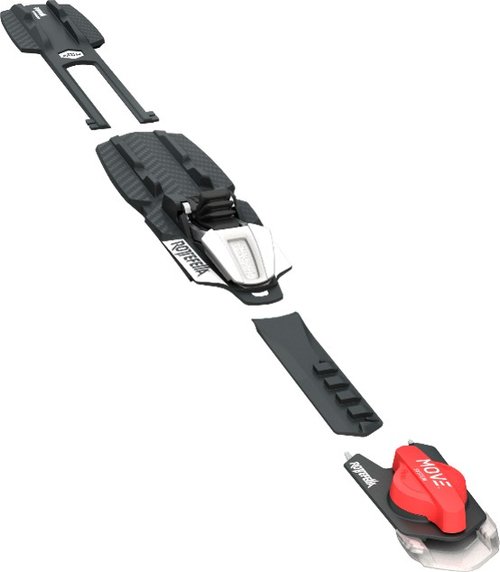
Rottefella Move binding allows easy adjustment on the trail
Technique, temperature and snow composition all have an influence on ski performance but with all TURNAMIC® binding models, which provides tool free adjustment skiers can better match their individual needs. Sliding the system forward provides more grip, while sliding it back will noticeably improve glide. With the optimized setup of the boot-binding-plate-ski components, TURNAMIC® gives you dynamic skiing performance like never before. FLOWFLEX® technology enables the ski to flex freely. I own a pair of Twin Skin skis and I’ve found that these skis glide better than other skis that I’ve owned in the past. At the same time, the skis have not lost the ability to climb up hills.
The TURNAMIC® binding has a user-friendly entry mechanism providing individual adjustment possible in seconds and tool-free. The bindings quickly slide onto the plate without the use of tools. When it’s time to ski, the Turn Lock mechanism can be operated even with a gloved hand, making entry and exit easier than ever before. The Rottefella Move binding when it arrives in the USA, will provide even easier dial-oriented adjustments.The Fischer Twin Skin Superlite EF provides a lightweight all-around ski featuring Efficient Forward, which gives the skier an easier, more forgiving kick action and smooth gliding. The lightweight fitness sport skis come in traditional length to glide easily on the trail.
Rossignol R-Skin Ultra
The Rossignol R-Skin Ultra features a replaceable mohair insert, and the waxless R-SKIN base structures offer an easy, consistent kick and maximum glide with no additional prep work necessary. The Rossignol ski is built with a Nomex Honeycomb construction for an accessible mohair skin classic ski for fitness-oriented skiers. The R-Skin Ultra not only offers a bit more width than a traditional race-oriented classic ski giving a more stable platform, but it also has the same high quality base as Rossignol’s top end race skis, and a great new graphic. Compatible with the Turnamic® binding system, the new Integrated Fixation Plate (IFP) allows the most natural ski flex for unparalleled snow feel, precision, and glide. Replaceable mohair inserts reportedly provide 100-150 days on the snow before they might be replaced.
With the Atomic Pro C2 Skintec, prepping and handling couldn’t be easier thanks to its Skintec technology. There’s no need for kick-waxing – instead mohair grip zones produce excellent kick and glide in all snow conditions and temperatures. And you can replace the grip zone after heavy wear. Atomic has added a high-quality base, race grinding, a sportive sidecut and a flexible tip for an easy slide-in and glide. This year they’ve also given the series a facelift with a cool new design for the track.
A suggestion is to find a cross country ski area or ski retailer that has a demo fleet of skin type skis from any product company and give them a try. Play with the binding settings on the ski binding to see the effect from adjustments on grip and glide. Expect the ski to perform better than you have ever experienced.
Editor Note: This article first appeared in XCSkiResorts.com
https://seniorsskiing.com/wp-content/uploads/2020/08/Screen-Shot-2020-08-17-at-10.06.17-AM.png471468Roger Lohr/wp-content/uploads/2014/04/Seniors-Skiing-since2013-Logo@2x-300x68.pngRoger Lohr2020-07-04 10:08:392020-08-19 11:33:21New Gear For XC: Skin Skis