Tag Archive for: Snow Sport Leaders

Snow Sport Leaders: Herman Dupre, An Original Maker Of Snow

Son Of Immigrant Parents, Herman Dupre Found A Way To Give The Sport Snow.

Innovator, pioneer, snowmaker, Herman Dupre is a legend in snowsports.

Aside from building the Seven Springs ski area in western Pennsylvania into a major mountain resort, Herman Dupre’s claim to fame is that he is a pioneer in snowmaking.  He always tinkered with how to utilize high pressure air and water to help Mother Nature spread some snow on our local area which is hampered by cyclical warm weather/cold weather events.  When you ski in the mid-Atlantic, you need some help to keep the slopes open.  Snowmaking was the answer, and Herman was at the forefront.

Dupre holds 34 U.S. patents for the HKD snowmaking system. He is the chief engineer for Snow Economics, Inc. and his system is now sold worldwide. His new Backyard Blizzard home system based on the HKD concept became available in the winter of 2000. Without the benefit of his work, many winter resorts throughout the world would not have the snowmaking capability they utilize today.

In 1973, he applied for and received his first of many patents, and in 1990, he introduced the standard tower snow gun that was the first of many low energy products that he and his son in law, Charles Santry and his daughter Anni would bring to the ski area management market.

If you look at their website, you will find all the technical detail of their tower guns, and their new fan jet technology with their recent acquisition of a Canadian company which has increased their R&D capabilities as well as their engineering expertise.

Click on the video below to hear Herman tell his story.

Snow Sport Leaders: Dave Scott

“I Don’t Believe In Slowing Down.”

[Editor Note: Dave Scott spent most of his adult life working in multiple facets of the ski and sport industry both in the United States and in Europe. In 2009, David Scott was honored as a Sport Builder by the Colorado Ski and Snowboard Hall of Fame. Beginning his ski-racing career in Pennsylvania, David first came to Colorado to ski for the University of Colorado. During the 1960’s David served on numerous race committees on the East Coast including Junior Alpine Committee, USSA National Alpine Committee and the USSA Coaches Association. In 1971, David returned to Colorado as the Director of Racing for AMF/HEAD in Boulder. This marked a different direction for David’s involvement in skiing working on the import and retail side of the industry. Importing European brands like Blizzard Skis, Koflach Boots, and LaCroix Skis, David introduced many of these companies to American audiences.]

Dave Scott, racer, entrepreneur, ski industry builder.

When did you start, where, why.  How did you get into ski racing?

I started skiing in Pennsylvania in 1948 at age six.  My first experience was at Split Rock Lodge and soon followed by skiing at Big Boulder.  My father and I started skiing at the same time.  We both found the challenge of skiing something that was very addictive.  Our first trip skiing outside Pennsylvania was in 1952 to North Conway, NH and two weeks later we followed that with a trip to Stowe.  After that we were really hooked.  My father was a competitive person and when I expressed an interest in ski racing, he supported me.  I think that my first competition was in 1953 and I had modest success locally.  In 1955, I went to Proctor Academy, NH, because of their reputation for having a good ski team.  After that I competed throughout New England and in Colorado.  I was a good racer, but not good enough to be completive for the US Ski Team.

Why has skiing/outdoor winter sports kept your interest over the years? 

It is a great family sport that can be done together by many different generations.  I regularly ski with my grandchildren and my daughters.  When you are skiing, all of your worries and concerns go away.  Skiing requires all of your physical skills as well as concentration.  There is no time to be concerned about you daily problems.  I enjoy being outdoors in the fresh air.  I like the feeling of the wind in my face and I enjoy the challenge of trying to make better carved turns on each run.

What concerns do you have about skis and related equipment these days? 

There certainly have been a lot of changes with the equipment.  When I started there were non-release bindings and skis without steel edges.  Of course the boots were leather and much softer than what we use today.  The new wider skis with much more side-cut have made skiing easier to learn and enjoy deep powder skiing.  That’s good for the sport, but it means that good powder days don’t last very long.  All of the new equipment, skis, boots and bindings create a lot of new leverage on the body.  We certainly have more knee injuries than 40 years go, but the ankle injuries and broken ankles are almost nonexistent.

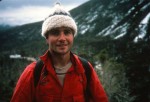
Dave has the same smile!

What advice do you have for seniors who are  thinking about “slowing down” their skiing experience? 

I do not believe in slowing down.   Stay in the best shape you can and continue to challenge yourself.  Prior to last year I had not skied more than five days in any of the previous five years.  I was skiing slower and becoming concerned about being hit.  Last year with the help of some friends I stepped it up.  I skied 20 plus days.  I felt stronger and I started skiing faster again.  I went from being concerned about being hit by skiers and snowboarders to taking charge.  My fear of being hit was reduced to almost nothing.  I rediscovered the love of the challenge of trying to make better and better turns on steep hills.  I continue to challenge my grandchildren and we have a lot of fun together on the slopes.  I don’t have any alternatives.  You either continue skiing and trying to improve or perhaps it is time to stop!

What changes have you seen in the Ski Hall of Fame over the years?  What are you most proud of in being involved with that organization? 

The various ski hall of fames help tell the story of skiing.  It is an important way to honor the competitors and the sport builders.  I was always someone that believed that the HOF was for the very top racers, but I have come to realize that without the sport builders we would not have what we have today.  I feel that it is important to help newer skiers understand what it took to make all the equipment and great resorts possible.  I would not have happened without the determination and risk taking that the pioneers brought to the sport.

Snow Sports Leaders: Bernie Weichsel, BEWI Ski And Snowboard Expos

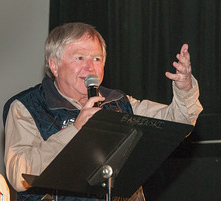
"Bernie Weichsel speaks at the Jerry Awards at the Ishpeming 100 Film Festival during Skiing History Week in Steamboat Springs."

Bernie has been in the ski biz for over 45 years.

Bernie Weichsel is the country’s major producer of ski shows and expos. He founded BEWI Productions, Inc. in 1979 and has successfully marketed snow sports to audiences in the US and internationally. He assists with fundraising for the U.S. Ski Team and other non-profit organizations. Bernie also is a valued member of the SeniorsSkiing.com Advisory Council.

How did you start skiing and become a major player in ski promotion?

Skiing is my first love. I was lucky, my parents, both refugees from Germany, passed on their love of skiing and the Mountains  at any early age. We lived in Manhattan, and I got started at Belleayre Mountain, in the Catskills, when I was four. Due to my mom I got introduced to Trailside Ski Camp, at Killington, during High School – Brooklyn Technical, where I had organized the school’s first Ski Club – where I washed dishes in exchange for lodging and transportation from N.Y.C. Around the same time, I took on the duties of promoting the New York Ski Show that the owner of Trailside – Mike Cohen – had committed to do (in exchange for Trailside’s booth). That action, in turn, led me to get to know Harry Leonard, the creator of ski shows. Harry loved the “stunts” we did to promote his how – like the time I got a group of friends to stencil “Go Go Ski Show” on Manhattan sidewalks. Wasn’t popular with the police, but Harry loved it!

I ended up working for Harry for six years. The shows were in the Fall. It gave me time to “ski bum” – pursuing each winter a different “vocation” (ski guide, rep, etc.), which I did with enthusiasm from Aspen to Innsbruck.

In 1974 I got involved with the International Freestyle Skiers Association (IFSA) tour which was sponsored by Chevrolet & Skiing Magazine. It was the first organized professional Freestyle Skiing competitive circuit with events at five resorts nationwide. Huge crowds would show up to watch the stars of “Hot Dog” Skiing – like Wayne Wong and John Clendenin compete in mogul skiing and aerial acrobatics on skis. It really was the beginning of Freestyle, which is now a major Olympic event.

My ski expo experience led me to create and produce other large scale gatherings promoting sports and travel and music. The longest lasting was the New York City Winter Festival, held annual – weather permitting – in Central Park, from 1979 thru 1996!

I founded BEWI Productions, Inc. in 1979 and soon after purchased the Boston Ski Show from Harry. Audiences had declined, but we figured out how to bring them back.

The number of skiers in the US has been stagnant for 20 years. Why?

The good news is that it hasn’t really changed much. Estimates of how many people ski or snowboard vary between 8 and 22 million; the number is probably around 12 million. As to why it hasn’t grown, there are several reasons, I believe.

Snow sports are not really a sport with teams like baseball. It’s recreation, and it’s a physical activity. That makes it intimidating to many people.

I also believe our society’s perception of winter, and cold weather,— always loudly promoted negatively—pushes people away. It’s a fact of life today but most people just don’t like winter and cold weather. We’re actually taught to “beware it’s going to be cold and snowy,” starting with our parents and the news media, especially television weathermen. It’s something the industry doesn’t talk enough about, but I think it’s a big reason people don’t engage in snow sports.

Then you throw in the economy, having to travel on winter roads to resorts, the perception that skiing is an elitist sport and add in competing family activities, you find the number of people willing to commit to snow sports is small. But, once you get started, chances are you’re going to stick with it.

What role do older skiers have in sustaining the ski industry?

Seniors have a huge role. Chances are they bring their families into the sport. They are more social, skiing in groups and, most important for ski resorts, skiing mid-week. They dine at mountain resorts with friends and family. And manufacturers are making more products for seniors. In a way, they keep the whole industry going. With cheap season passes for seniors, it’s easy to remain active. On the other hand, I notice that when one spouse or another decides to quit, they other one will, too. So, the challenge is to keep them going.

Why do you think older skiers don’t get more attention from the ski industry?

It’s really a strategic business decision to focus on the younger market and youth culture. The industry is over-focused on flashy, free-style, extreme-skiing videos and the like. Maybe it’s because most marketers are young. Frankly, I don’t think marketers know how to approach the senior market. After all, seniors can be counted on to buy season passes, so that segment is almost a “given”.

You were involved with Y.E.S. to get inner city kids on the slopes, and the New England Ski Museum honored you with its “Spirit of Skiing Award.” What are your proudest accomplishments in the world of skiing?

Couple of things. I try to ski my age every year. I’ve done that most years. I slipped a little last year, only 57 days and I’m 68, but I’m going to be trying for 70 days when I’m 70. I’m proud of being able to do that.

I am proud of starting Ski USA, an overseas marketing venture. When I started promoting skiing in Europe in 1981, only a small number of people were coming here to ski in North America. Now, 10-20% of Vail’s business comes from international skiers, and Nationwide the figure is close to 10%. And on a personal level Ski USA opened up doors around the world to friends in so many countries!

I am also proud of the BEWI shows, especially our expos in Boston and Denver, and being able to run them successfully for so many years. And the US Ski & Snowboard Ski Hall of Fame, where I served as chairman for six years. So many things.

What else would you like to add?

I feel very lucky to be involved with snow sports, a healthy, fun-filled activity that I can do with my friends. It’s a life-long sport, and I’ve formed life-long friendships because of it.

One big worry of mine, though, is climate change. That’s something the industry has to be thinking very seriously about right now. After all, it’s happening now.