


Winter Driving: Where’s Your Car’s TC Button?
An Eye-Opening Lesson From Team O’Neil Rally School About Spinning Tires And Traction Control In Snow.

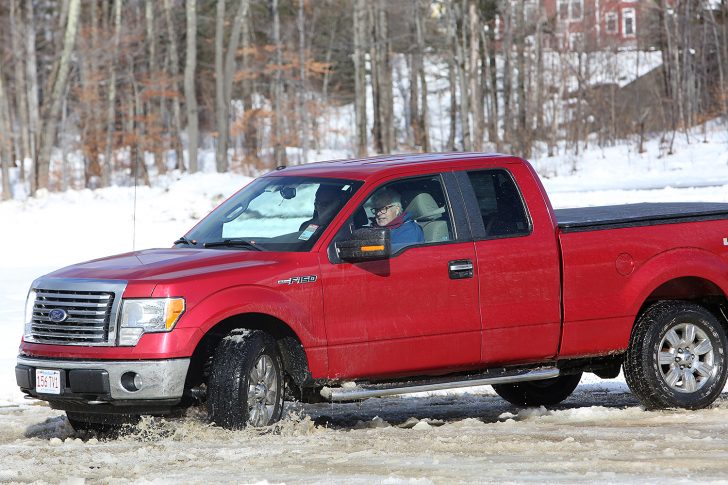
Turning off traction control to see how the Big Red Truck behaves. Credit: Martin Griff
At this past week’s Northeast Winter Weather Summit held at Stratton Mountain, VT., we had a chance to do some driving, spinning, skidding, and generally driving like a cowboy home from the range on a controlled, enclosed test area with mixed conditions: gravel, ice, snow, and mud. We learned something about our Big Red Ford 150 truck that we never knew. There is a button dedicated to tire spinning.

Driving School owner Tim O’Neil says know how your vehicle reacts in different conditions. Credit: Martin Griff
Here’s the concept, according to Tim O’Neil, owner of the Team O’Neil Rally School, Dalton, NH, which has been in business for over 20 years. Usually your vehicle is operating in traction control mode. That is, there is a mechanism that is usually on that prevents your wheels from spinning, preventing certain skids and spin-outs. Tim said, “In deep snow, you may want to turn off that traction control so you get some helpful spinning from the tires. If you don’t, your tires might want to spin, but the traction control makes the engine cut out. That’s the way the system works.”
Where’s that button? The traction control button (aka AdvanceTrac (R) on a Ford truck) was in plain sight right in the middle of our dash. When pressed, traction control is off, you can do all kinds of interesting spins and skids on that gravelly roadway. When turned back on, the truck noticeably behaved itself in the turns. However, if the snow was deeper, and/or you were going up a snow-filled or deep sand road on a hill, we would have turned the AdvanceTrac (R) off, and the spin would have actually helped us by allowing the engine to keep delivering power and not cutting out.

Ford calls this the AdvanceTrac (R) system. Turning it off allows the wheels to spin in deep snow.
Of course, when we turned on the four-wheel drive, the truck handled our outrageous turns and braking like a mountain goat. But not everyone has four-wheel drive.
In some cars, traction control is tied in with what’s called the Dynamic Control System or DCS which ties in the anti-locking brakes (ABS) along with the engine.
The bottom line is that you need to find that button, check your vehicle’s manual to understand how to use it, when it is appropriate to turn it off, and experiment in an empty parking lot on a snowy day.
From Tim’s perspective, newer cars have so many features that owners often overlook some important controls. “The more you know about your car and how it behaves in the snow, the better and more confident you’ll drive. Learn when about to brake hard, and when to brake gently. Brake in the middle of a turn in snowy conditions and see what happens. Or brake early in a turn. Basically, know how your car reacts and use that in different conditions.
“When driving in the winter, it really makes sense to prepare: know how to control your car, get the right tires, shovels, new wipers, an emergency kit, and start earlier than you think. Don’t let a snowfall cancel your trip to the mountains,” Tim concluded.

SnoCountry’s Martha Wilson slides thru a turn under Tim O’Neil guidance.
Credit: Martin Griff