Tag Archive for: winter driving

This Week In SeniorsSkiing.com (Dec. 7)

Weather Factoids, Driving School, PA Trail Names, Utah Poet, Special Birthday For Klaus.

Sno Country’s Martha Wilson slides thru a turn under Tim O’Neil guidance.
Credit: Martin Griff

Busy week here at SeniorsSkiing.com.  We attended the Northeast Winter Weather Summit at Stratton Mountain, VT, and met with meteorologists, ski resort operators, and lots of journalists to discuss matters of mutual interest.  And we picked up some amazing fun facts from hanging around with some weather people:

  • Add this to climate change anxiety. A veteran weather man said the number of sun spots is on the increase. More spots means the sun is burning less hot than the past. The meteorologists call this the “solar minimum”, where sun spot activity causes the upper atmosphere to cool down.  Apparently, it’s a cycle, and we are in the coolest part.  Expect: Bitter cold winters, cool summers, perhaps a new Ice Age. (Not kidding, watch the news.)
  • For every 1,000 feet of altitude you ascend in going from a low lying area to a ski resort in the mountains, there is a drop of 3.7 degrees F. So, if it is 32 degrees in Boston, when you travel up 1,900 feet to the base lodge of Cannon Mountain, the temp will be roughly 24 degrees.
  • The record wind speed at the top of Mount Washington was 231 mph in 1934. Since then, the record has passed on to Australia where a speed of 253 mph was recorded during Cyclone Olivia in 1996.
  • The crew at the top of Mount Washington has to de-ice their manual wind anemometers and other instruments by hand, climbing a ladder to the top of the station and banging off the ice with a hammer, regardless of the weather. That happens as much as every 15-20 minutes, if a storm keeps building up the ice rime. Note: during storms on Mount Washington, the wind can be up to 140-170 mph. Here’s a 38 second video of a guy outside the MWO when the winds are only 109 mph. Click on the image to play.

Winter Driving Tips

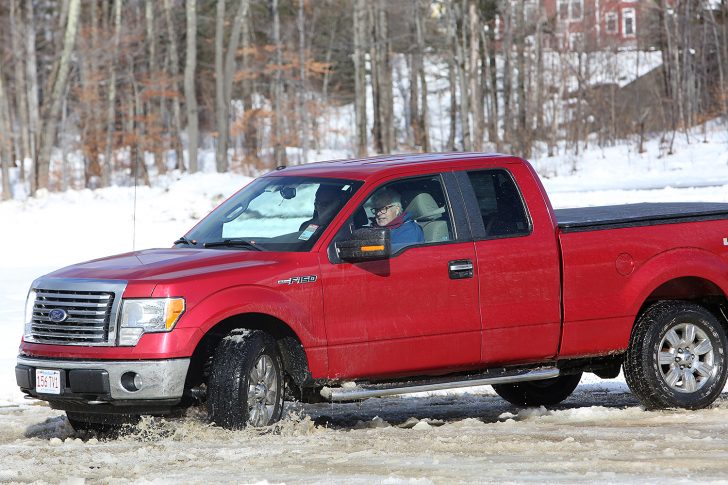
My Big Red Truck sliding thru a turn, under the guidance of the Team O’Neil Rally School. Credit: Martin Griff

We also had a lesson in how to drive in winter conditions from the Team O’Neil Rally School in Dalton, NH. In a separate story, we’ll show you the one extremely important driving control button on our Ford truck we never knew existed and what happened when we pushed it. This was a counter-intuitive eye-opener, and we want to make sure you know about what your special button does in your car because it is imperative you understand how to use it in certain conditions. In addition, we learned about lower tire pressure for deep snow (up to a point), and the importance of being prepared for the mountains.  You can watch lots of different videos on driving techniques from Team O’Neil by clicking here.

Click here for our story on “the button”.  Incidentally, if you have a teenage grandchild, the driving school might be an excellent holiday gift.

This Week

Correspondent Don Burch’s series on ski trail names continues east to Pennsylvania. Writer and cartoonist Mike Roth offers a whimsical take on trail names, too. Jan Brunvand brings us a poem from a Utah poet with advice for a new skier. Our Mystery Glimpse presents a new challenge with two photos of a legend who was gone before his time and the answer to last week’s puzzle.  Someone actually got the right answers, others were pretty close.

Finally, we honor Klaus Obermeyer, the venerable ski fashion icon, who is 99 this week.

Please remember us to your friends. There are more of us every day and we aren’t going away.


The Box In The Back

When You Need “The Box” For Survival, You Really Need It.

This can happen. If it does, you’ll be glad you have the “Box.”

Most people think driving to a ski area is a routine trip. Before they leave, they check and recheck what they think are the most important items—ski equipment. That’s not the only “equipment” you should bring.

Back in the good old days when the back seats of our all wheel drive van or SUV had two kids, ski gear and luggage went in first. Followed by what my daughter dubbed at age eight—“The Box.”

Mandated clothing for everyone was jeans, boots, long sleeve shirt or turtleneck, and, if they wanted, a sweater. In our ski jackets that were always an easy reach in case we had to leave the car in a hurry, we stuffed our gloves in one sleeve and a ski hat in the other. The boots stayed on at all times.

Why? “Because”… It’s a good parental answer because in this case, just “because” is true.

Anytime you head off to the mountains, you need to think about survival. Black ice, mechanical failure, an accident up ahead that halts traffic for hours, or worse, you get into an accident can turn a pleasure trip into a nightmare. BS, you think, I’m one of those who think the glass is always half empt

Au contraire. Enter “The Box” in the back. Actually, it wasn’t a box. It was and still is a medium size tool box. It contains a hatchet, survival knife, a multi-tool,  small bricks of fire starter, matches in a sturdy waterproof container, six thermal blankets,  a hundred feet of rope, a first aid kit complete with ace bandages to make a splint, tweezers, a scalpel with the blades still in the sterile packages,  hydrogen peroxide and isopropyl alcohol in sturdy plastic bottles. And, when they became available, eight MREs (Meals Ready To Eat).  Lashed to “The Box” by four bungee cords were two lightweight shelter halves. Also in the back were two gallons of water either in twenty ounce bottles or large jugs. All this is wedged in the back so if we got into an accident, it wouldn’t fly around. Under the luggage, I carried a snow shovel!

You’re thinking, this guy is nuts! Well, have you ever driven the road between Mojave and Lone Pine, CA? If you haven’t, you’re on the western edge of the Mojave Desert and not much of anything else. I-40 between Amarillo to Albuquerque is arid, and there isn’t a soul for miles. I-91 through Vermont or I-93 through New Hampshire can get really lonely at 11 at night with a broken car in the middle of a snowstorm. On any one of these roads (and many others), you can slide off into the gullies and not be seen from the road.

It can get lonely out there, worse if you’re not prepared.

Don’t think your car will be your lifeboat. If you’re in an accident, the engine may not run or worse. Sitting in an idling car puts you at risk of dying from carbon monoxide. The car is designed to dissipate heat, not retain it!

If you are stuck a long way from the nearest gas station, and do not know how long you are going to be stuck, stay with the car.  Don’t use it for a source of heat unless it is well vented. Heat rises so it goes out the windows very quickly.  If you are on a road, get something or someone on the road to stop whatever traffic comes by. Don’t set off for help unless the weather is clear, and then take your survival stuff with you.  In today’s world, a working fulling charged mobile phone is your best friend.  Small, solar-powered rechargers might be wise to carry in your glove box.

My point in all this is every year, people get stuck alongside the road and the news stories all involve hunger, exposure, frostbite, hospitalization, etc. Don’t be one. Create and carry your own box and be prepared. It’s insurance and you never know when you’ll need it. Not having it could ruin your day.