



2016-17 Winter Forecast Outcome
How Close Were NOAA Predictions? The Surprise Was California.
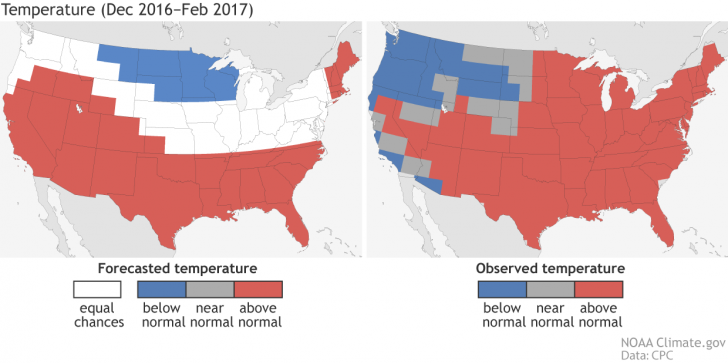
Temperature: Forecast vs Actual, 2016-17
Credit: NOAA
NOAA’s Climate Prediction Center recently published a review of its forecast for the 2016-17 winter. As you know from horse racing, the stock market and Las Vegas, predictions often do not reflect realities. The question really is how close to reality the predictions are.
In October, 2016, the Winter Weather prediction was focused on factoring in a weak La Nina pattern in the Pacific. La Nina and sibling El Nino, as you may be aware, are warm or cool water conditions roughly in the latitude of Peru in the eastern ocean. These conditions impact the air masses above them and, subsequently, the jet stream which steers weather patterns in the atmosphere.
Climate Prediction Center thought a La Nina (cooler water) would bring generally warmer temps across the lower US and cooler in the Pacific Northwest, Upper Midwest and Ontario. For precipitation, the prediction was below normal precip across the southern US, continuing the drought situation there, and above average precip in the upper band across the US-Canada border.
In reality, the La Nina was weaker and faded away earlier than predicted. That factor plus multiple “Atmospheric River Events” off the California coast, narrow regions of heavy moisture transported from the tropics, and general randomness brought different outcomes.
Temperatures across the US in the 2016-17 winter were the warmest ever recorded. That was in line with the prediction for warmer temps across the whole country. But it was colder than average in the Pacific North West rather than the Northern Plains. And, while precipitation for wetter than average in the Northern Tier was spot on, the forecast for drier than average only worked out for Florida, where drought conditions persist.
As we know, it was wetter than average in California with ongoing storms racing up from the Pacific. Not predicted.
In general, Climate Prediction Center’s own objective evaluation of its predictions show it was much more accurate for the temperatures this year than precipitation.
We will be bring you predictions for the 2017-18 Winter when they emerge.
Precipitation: Forecast vs Actual 2016-17
Credit: NOAA