

Three Inches Lower
So, I was riding the chairlift with my pal Angelo Ross at Laurel Mountain, Pa. and we discussed some things about ski technique. Angelo is the Education Development Manager for the Professional Ski Instructors of America (PSIA) and an examiner with the organization. I like to listen to what he has to say and also to ski with him.
I asked him for a tip or two, and he said, ”ski three inches lower.” He explained that most of us ski with too tall a stance and really don’t utilize the ankle and knee joints as we should. My curiosity was piqued, as I always thought I was skiing a little tall being a relatively lanky guy with long legs. Angelo said, try it, and I went on to work on it while he conducted his clinic that day.
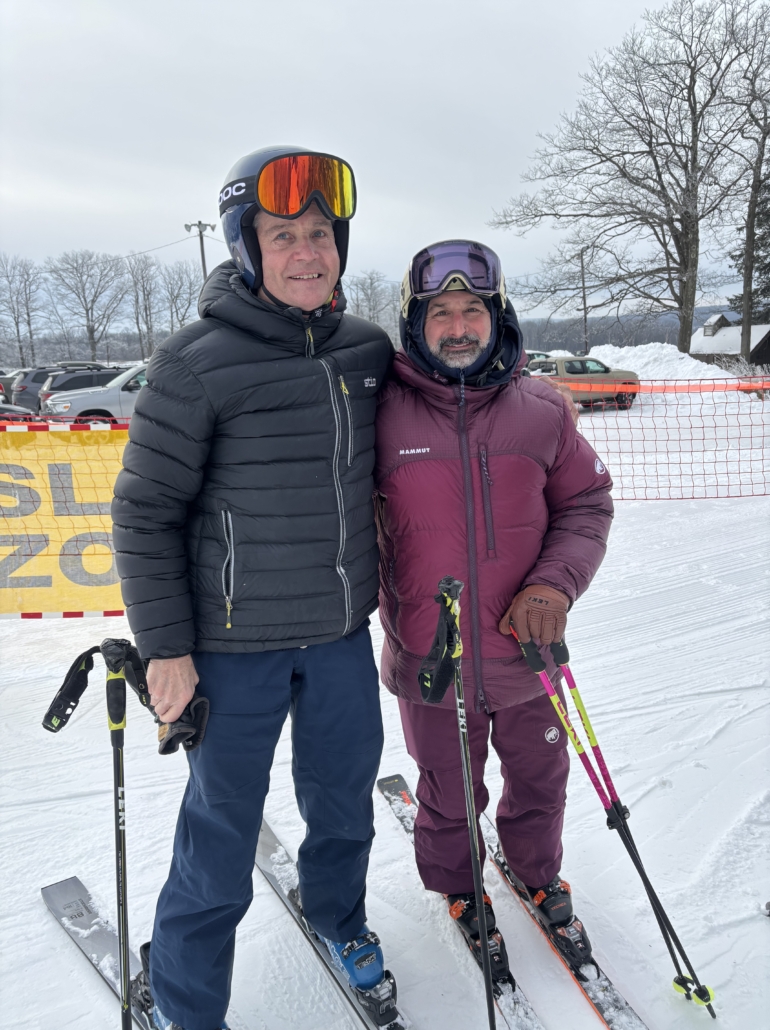
Angelo Ross and me at Laurel Mountain
I also thought about how I had shortened my ski poles to accommodate a lower stance and how I usually just touch the pole at the beginning of a turn to get the process going. But Angelo discussed how skiing and a lower athletic stance is key in many sports.
Think about receiving a serve in tennis. If your ankles are flexed and your knees are flexed and you are in a lower position, you can move quickly laterally to handle the serve. Too upright and you don’t have the quickness to react.
He showed me his stiff arm on the chairlift and asked me to think of it like his leg. If it is stiff, you can’t really move the wrist too much but if you flex your arm, all the joints are more supple. Try it. Then think of your stiff, tall, legs in skiing and then think of how much better they work in a lower flexed position. Try getting three inches lower in your stance with flexed ankles and knees and see what happens. For me, it enables me to use the inside edge more efficiently and also flex my downhill leg and my inside leg for more efficient turns.
We also discussed the need for a lower position and flexed, athletic stance in basketball. Guarding someone, if you are too tall in your stance, you have again, like tennis, no lateral quickness. But if you have a lower, flexed, athletic stance, you can react more quickly and guard your opponent more efficiently. The same thing applies in football. You see them flexed with their hands out in front, ready to attack the opposing running back. Too tall and too stiff, the linebacker is past you in a flash. But if you are ready with your hands out front, like skiing, and your joints flexed, everything moves much more efficiently, and you make those needed tackles.
In short, a flexed, athletic stance in a lower position is helpful in many sports. Try skiing sometime with no poles and get as low as you can and see if you can grab a handful of snow with your inside hand without leaning back. A good exercise to get lower. Try skiing holding your poles halfway down the shaft and see if that helps you to get lower. You will be amazed how much more agile and efficient your turns are and how you can utilize both skis in a turn.
For those of you who do not ski, think about the sports that you may participate in and see the benefits of flexed joints and a lower stance. I am always trying to improve.
Angelo also noted that when we ride mountain bikes together, we are flexed over the handlebars and pedals going downhill to allow more efficient descending. If you are too stiff, you are over the bars and into the woods. Again, I always am trying to learn and see how good positioning is key in a lot of sports, even those that I participate in outside of skiing.
They say you can’t teach an old dog new tricks, but I am a testimony to the false nature of that statement. I am never too old or proud to take a tip from a guy like Angelo, and for all of us seniors, keep learning. Keep trying new things, trying new equipment, and never get complacent. For us skiers, get three inches lower. You will be amazed at how that tip helps.
Follow my blog on http://www.chroniclesofmccloskey.com.

- Three Inches Lower - October 22, 2026
- Preparation - November 20, 2025
- New Boards - September 2, 2025


Yep. When my friends ask for tips, I take some pics and videos of their skiing stance to show them how they aren’t flexing enough. They always think they’re getting lower than they actually are. Seeing is believing.
There’s lots of ways to think about it. I don’t like to tell them to pressure the fronts of their boots or skis as they tend to just lean forward. I tell them to feel like they are sinking into their boots.
It’s never too late to improve your skiing and having something to concentrate on is helpful. As a bonus, the better you are as a skier the more fun you’ll have.
Patrick is so knowledgable and writes many articles regarding skiing and biking , especially but not limited to seniors. Loved this article and hope you feature more! Shred it baby! We seniors need to keep on truckin…..
Hi, I’m from Pittsburgh and occasionally go to Laurel Mountain. I love the old school vibe and have yet to conquer Lower Wildcat. I’m 67 and still learning. I enjoyed this artical and the Pittsburgh connection!
That tall stand most likely leaves the skier in the back seat… Often I see beginner skiers bending more at the waist rather than flexing knees and ankles. This is when it is important to ‘trust’ and take advantage of the support the ski boots are designed to give. Getting into that 3″ lower position, standing on the whole foot, feeling the tongue of the boot against the shin, helps to transfer ‘pressure’ to the ball of your foot and the ‘sweet spot’ of the ski for more effortless skiing…