

Tuning Skis (Part 2)
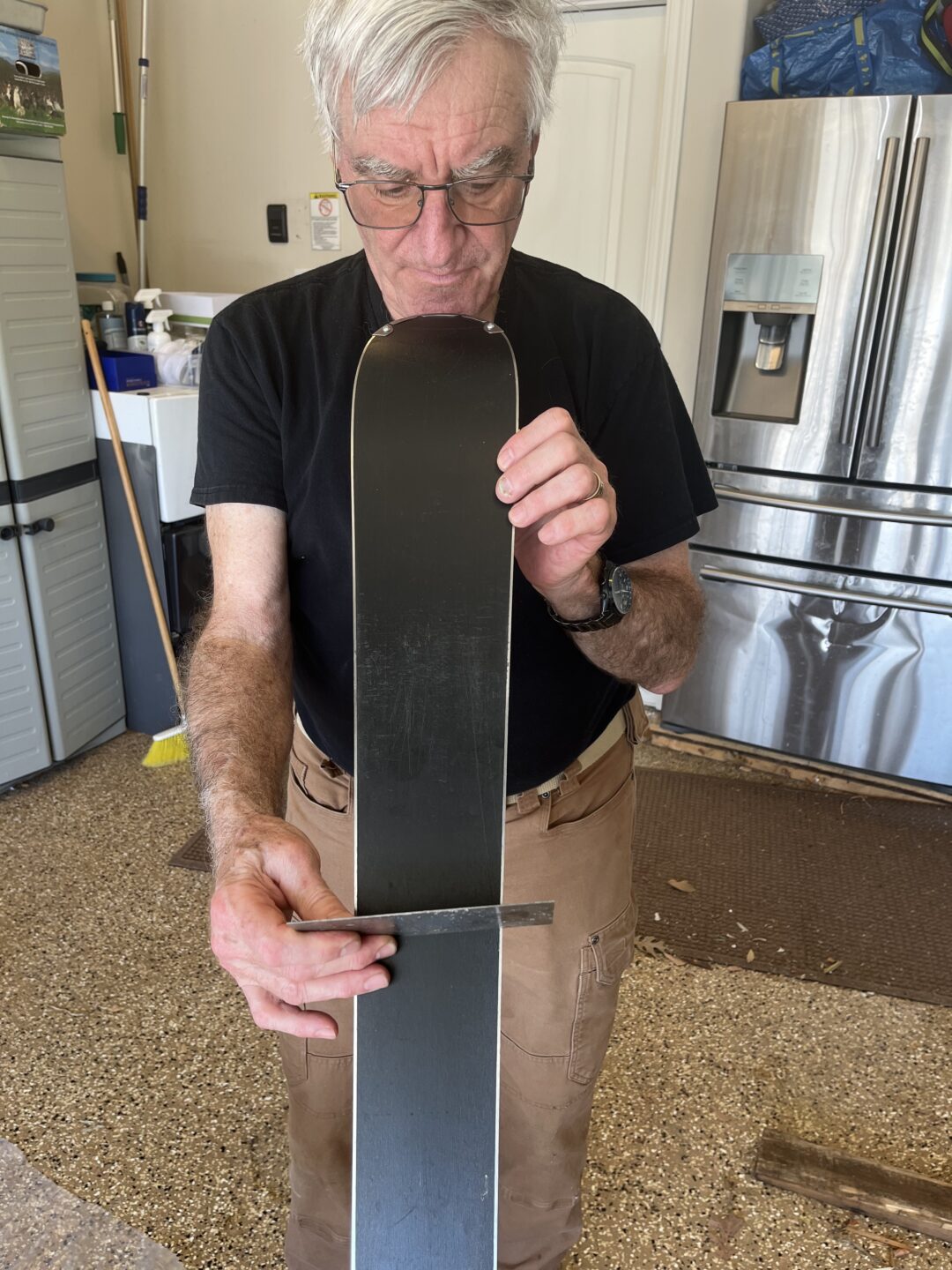
Photo 1: Checking the square of the scraper
As a young ski racer, I learned the importance of properly tune skis. Now as an old a recreational skier, I can assure you skiing “tuned” skis makes the sport more enjoyable.
Tuning a pair of skis answers three questions. One, do the bindings work as advertised? Two, are the bottoms flat, not convex or concave? And three, are the edges are sharp from tip to tail.
The bindings are the easiest to check. Simply twist the toe piece left and right. It should turn smoothly. If you feel a grinding feeling, there may be crud inside that has to be flushed out. FYI, if you carry your “naked,” i.e. not in a bag or container, a ski rack on the top of the car, you will have dirt and grit in your bindings.
Photo 2: Looking for concavity-convexness.
Open and close the heel piece. Again, it should move smoothly. If it doesn’t, use a hose to clean both t
he toe and heel pieces. Do not use soap or a degreaser which will clean out the dirt as well as all the lubricants.
And last, know your ski binding DIN number. The industry went to great lengths in the 1970s and early 80s to standardize boot sole shapes and the boot binding interface. Out of that came a chart that considers, your age, ability, and weight to create a binding setting number. You should know it and check and see if it moved.
In an earlier piece about waxing skis, I mentioned a scraper. Photo one shows me checking to make sure that it is square. Why? The scraper is the perfect tool to check to see if you have a concave or convex bottom.

Photo 3: Using the file
To determine if you have a convex bottom, (Photo 2) as you slide the scraper down the ski, you can see daylight along the edges, and the scraper will rock on the P-Tex. In other words, the bottom is higher than the edges. If it is, the ski will swim, even dart to one side when you try to ski with them flat.
If the bottom is concave, with the scraper resting on the edges, you can see a gap between the scraper and the P-Tex. A concave bottom is another bad condition which causes the ski to be hooky when on edge and often hard to turn.
Neither condition is good. To fix either, take your skis to a ski shop that has a bottom grinder that will true up the bottoms. Note, that grinding the bottoms will take off both P-Tex and the steel edges and must be done very carefully. BTW, another reason to wax skis frequently is that it reduces P-Tex wear.

Photo 4: Edge sharpness
Most ski bottoms, even after several seasons are neither concave nor convex, but their edges are dull. First, when you look at the edges, they should be 900 where the edge meets the snow. Often, you will, as you run your fingers gently down the edges, feel burrs or imperfections caused by hitting rocks, bare spots, pieces of wood, etc. Both edges need to be smooth and “sharp.”
Most ski shops have files designed specifically for this task. You simply run them down the ski, from tip to tail to smooth out the edges. (Photo 3). When you are finished, use the back of your thumbnail, and gently draw it across the edge at a 900 angle (Photo 4). The edge should scrape off some nail. Once you are finished filing the edges, wipe them down with a damp cloth to clean off any reside and you are done.
Trust me, if your skis are tuned properly, you’ll notice the difference.

- Musings from Whistler - March 19, 2026
- Northstar – a Gem Discovered - February 19, 2026
- Notes From a Few Days at Palisades - February 19, 2026


Great article. One note that seems important to mention is the concept of edge bevel. Specifically that the edge angle is frequently tuned to be less than 90 degrees to provide a ‘sharper’ edge. Perhaps this is a commonly understood ski tuning concept, or perhaps it’s a bit more advanced, but certainly it’s important for at-home tuners to understand.
High performance race or hard snow skis are usually tuned to a two or three degree side edge bevel. If you go to ninety degree you will be decreasing your edge grip on hard surfaces. Also, it is a major task to reset bevel angle and one that requires experience. The best tool to remove burrs is a medium diamond stone followed by ceramic stone to smooth out the roughness. When the metal edge hits a rock it generates heat which case hardens the edge. A file won’t cut a case hardened edge and the file will be dulled or ruined.
Some very good points raised by author and the comments. Base and side bevelling is a vexed question. Each manufacturer has their own views. And there is a confusing number of ways of expressing the tune. In my case after years of fiddling about I found my preference whether carving or drifting to be what most people happen to like.And the default tune of many ski shops for Australian conditions (aka your East Coast). Shorthand is 1 degree base and 2 degrees side, expressed as an edge angle of 89 degrees. Call me Mr Average. Many higher level skiers swear by 88 degrees. But I think 89 is a good choice this nearly 80 year old (a senior-senior surely!) looking for a tune with a reasonable sweet spot, yet still holds on for those days when the taps are more than a little opened.
Great article and replies. This week I experimented with changing a base bevel by one half of a degree from the factory recommendation of 1 degree. At 1.5 degree the ski was not as stable when it was running flat. I could not tell any difference when the ski was carving. So in order to restore the ski’s flat running performance, I am changing the base bevel back to 1 degree. The factory recommends a 2 degree side bevel. I haven’t experimented with side bevel on this ski.
To restore the 1.5-degree base edge bevel back to 1.0-degree you will have to first get a new base-grind to flatten & remove a level of base material. The base P-Tex surface is the reference your file guide uses to set the base edge offset bevel. If you set your base file guide to 1-degree (without the base-grind) your file won’t touch any of the base edge (or you may apply so much pressure to make contact that you will actually start removing P-Tex along the edge or distorting the file beyond it’s intended offset angle). Have the shop reset the edge angles when you get the base-grind. You may also have a slightly convex base surface if it ran a little squirrely when running flat.