

If It Doesn’t Hurt, You’re Not Doing It Right!
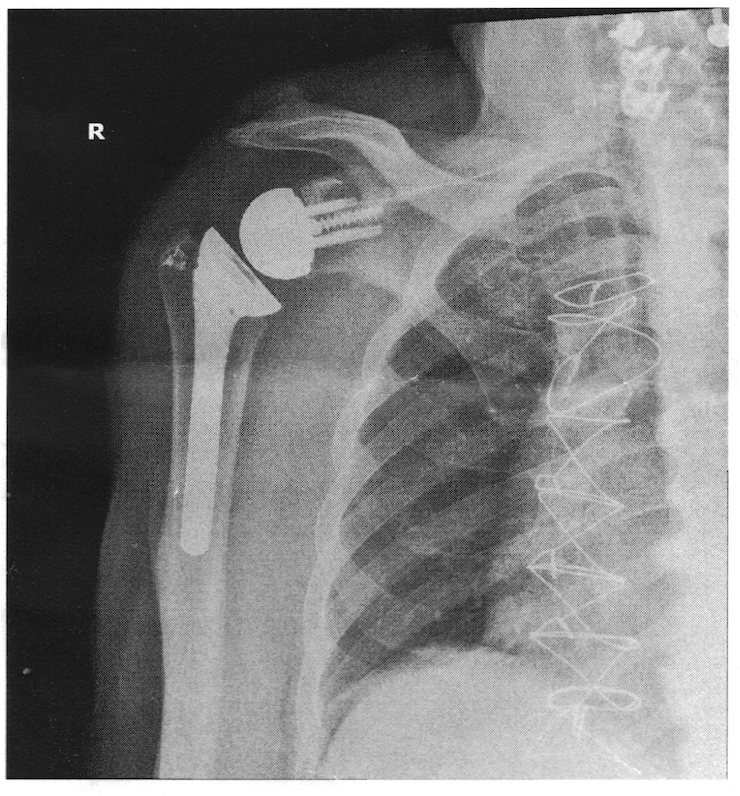
For the last two ski seasons my right shoulder has been giving me increased trouble when poling, especially in the flats. I visited my orthopedist, and x-rays revealed my shoulder had inoperable bone spurs. I needed a total shoulder joint replacement. This would be my 11th surgery in 20 years. Mentally, I wasn’t ready for another surgical procedure and stint at rehab. I inquired what my options were short of surgery. For the next two years I received quarterly cortisone shots in the shoulder. While effective over that period, last season the shots were no longer providing much pain relief, as predicted by my physician. It was time for the replacement surgery.
When I told my surgeon I was ready for the surgery at last, he asked me when I wanted it. I told him July. Knowing I’m an avid skier he laughed and said, “David, nobody on Cape Cod wants surgery in July except you. Pick any date you want.” Of course, I backed into a date I thought would provide plenty of time to be strong on-snow in December. On July 14th I had my right shoulder joint totally replaced.
Frankly, the actual procedure was an ordeal to be endured. The first three-or-four-weeks post-op were almost as tough as my triple by-pass several years ago. It was mostly a pattern of cold therapy, pain pills and sleep during the day. Even though I was fortunate to have an adjustable bed; the most difficult aspect of sleeping at night was always being on my back. You’re strapped into a harness, that’s part sling and part waist band, designed to ensure minimal movement. It’s a lot like how sleeping in a strait jacket must be. Regarding cold therapy, here’s a tip: If you ever have major joint surgery consider buying or renting a Breg Polar Care Wave. The device pumps cold water into a shoulder or knee pad at a rate and temperature that doesn’t harm your skin or other tissue. No twenty minutes on per hour. I had days when I wore it for six or more hours at a time. It provided extended pain relief, which allowed me to take fewer pain meds, and reduced swelling faster which accelerated healing. Depending upon where you live you can buy the unit for $300 or rent it for $100 a week. It’s well worth it.
The new reverse joint replacement
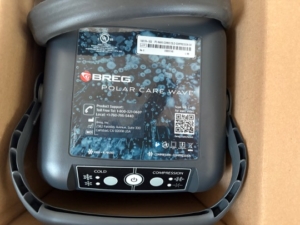
This Berg Polar Care Wave made the healing a little bit easier.
Make no mistake. The most important aspect of recovering from major joint replacement surgery is the post-op physical therapy. I’ve had the good fortune to find a talented physical therapist named Arron. Over the course of about two decades, he has gotten me through two hip replacement surgeries, three shoulder surgeries, a knee surgery, and a lumbar surgery. The regimen generally consists of an hour or so of light weight training and a lot of stretching two times a week. The fact that I’m still making turns at all is a testament to his work. I titled this article “If it Doesn’t Hurt, You’re Not Doing It Right!” because that’s pretty much Arron’s therapy philosophy. He says the #1 reason many patients don’t do well in post-op PT is they don’t (and in some cases can’t) work through the pain. I can certainly testify that while our sessions often push my pain tolerance to the limit at the time, the result is less pain and more range of motion immediately after each workout. During the course of a few weeks, I went from not being able to lift my arm to my chest to becoming able to scratch my nose and the top of my head. That may not sound like much but it’s huge progress when you can’t even cut your own meat or hold a glass of water due to the pain.
Heaven forbid you should ever need joint replacement surgery but if you do, find a physical therapist that will invest in your recovery. If you indicate you’re serious about doing the work it takes to make a full recovery (and getting back on the hill) they’ll respond and push you to heal, recover, and reach your goals.
Flats ahead? Who cares!
- Recycled Water, Real Snow: Big Sky’s Path to a Greener Ski Season - March 19, 2026
- The Rise of Private Ski Resorts for the Very Wealthy - February 5, 2026
- If It Doesn’t Hurt, You’re Not Doing It Right! - January 8, 2026


HI I have 2 knee replacements, I found the way for an easier and faster PT is to keep your muscle strength up before surgery. In PT after my last knee, I was kicked out, after 5 weeks, because we were doing advanced exercises over the last 2 weeks. Also between surgery and PT wiggle, flex and massage the tissue as much as you can, so they don’t become attached to each other from lack of movement. PT has to separates the attachments which is what causes the pain. My first surgery I had 8 pins in my hand. It was totally immobile. PT was very painful, so I learned how to make it less painful. GOD Bless
I have had both shoulders and both knees replaced. There are two key points. One you are correct about the right PT. The second is your commitment to PT and what you need to do. You cannot be a wimp. You need to attack PT and go beyond the number of sets and reps. There is a difference between injury pain and workout pain.
I ski 35 days each year with no pain. My PT and approach worked for me and I smile every ski day. My granddaughters make it even better.
David, I’m sorry you once again needed surgery. I wish you a speedy recovery and return to the slopes. I fear the thought of being confronted by a guy (I know. Sexist comment. Could well be a woman who I would equally fear) but that’s because I’m a physician and I’ve seen so much.
Thank you for your well-wishes Richard. You’ll be pleased to know I was skiing at Okemo, VT last week with the 70+ Ski Club and never even gave my shoulder a thought! I consider that success. As far as your fear of being “confronted” I understand. It can sure take the fun out of your runs. However, you can greatly reduce the likelihood by skiing mid-week, skiing the sides of the trail (you’re at greater risk when traversing) or do what my friend Mike does. He has Ski Guardian flags on his poles and is very pleased with the “buffer” they provide.
Ay yay yay. Shoulders are the worst. Pain all the way, before and after for a test of mettle. My husband had a second shoulder surgery (the other arm from the first) involving four screws tying down tendons frayed from 65 years of surfing and paddling (42 yr Ocean Lifeguard). His rehab (in his late 60s) was a full year of struggle with workout pain and gradual increase in range of motion. But now back at 78 to longboard surfing. Sometimes a full replacement such as yours, is less lengthy although more dramatic due to the bone replacement. But bones heal faster!! So glad for your great outcome and grit.
I want to second (third? fourth?) the recommendation to find a good PT and do all the exercises faithfully. So far, PT has kept me from having shoulder surgery and I hope that continues.
Thanks for sharing your experience.
David, I am happy to hear you are well along in your recovery. I know a number of skiers who have had total knee and shoulder replacement surgeries. They say the hardest is shoulder replacement. You stated: “our comment: “I had days when I wore it for six or more hours at a time,” requires education and a caution. Instead of me posting my opinion, I offer this: https://orthobracing.com/blogs/resources/how-long-to-use-cold-therapy-after-surgery?srsltid=AfmBOoouGYDTVU1pvdX8CRNPSf0dp5flafwCsV4yj1rJsyLgK2dGdQd8
Thanks for the link Dr Steinberg. It certainly is helpful. I feel fortunate to have the ice machine and a little lucky that I didn’t have any ill effects from its use. I skied for the first time last week and my shoulder condition never even crossed my mind.
I had my left shoulder replaced in May 2023 (reverse, same as yours), but it became infected, and after six months I had to have it removed, causing me to miss the 23/24 season. I now only have what my surgeon calls a spacer – it looks like a golf ball on the x-ray – but the range of movement isn’t significantly worse than the replacement. The strength is also a little reduced, but it hasn’t affected my skiing greatly. I had 3 weeks at Panorama in January 25, and will be back there again in another week.
Hello John, So sorry to hear you had double trouble with that infected shoulder replacement. It’s tough enough when it goes well. On the other hand John, you’re skiing in Panorama and in two weeks I’ll be skiing in Big Sky. How lucky are we?
Thanks for the article Dave – hope the new shoulder lets you finish up your Top 50 Resort quest. Since you stress the importance of a good physical therapist, it would be interesting in reading what criteria you followed in selecting Arron. Was it based on research you performed, recommendation from friends, a shot in the dark, …? Also, did you schedule Arron before surgery so that you could begin PT immediately? Thanks for the follow up. Alan
Hi Alan, At first it was dumb luck. After my first hip replacement my surgeon set me up for PT within a few weeks of the procedure. Arron could tell I was serious about skiing again. A couple of things solidified the relationship. He pushed me at every session but even more importantly he constructed a PT routine that not only addressed the current need (hip, shoulder, knee, hip again, etc.) he included exercises design to make me stronger on the hill. I was getting PT and conditioning at the same time! It made all the difference. Since then, I travel 30 minutes just to get to Arron for all of the reasons above and more.
Thanks for the follow up Dave.
What David had is as I understand it, a “Reversal”. The original configuration had a ball on the end of the humerus and a socket at the end of the shoulder. A “Reversal” attaches a ball to the scapula and a socket to the end of the humerus as is shown in the x-ray. Due to a December fall on ice in my driveway I damaged my shoulder. I skied somewhat impaired through that ski season and consulted two orthopedics. The first wanted to do a simple cleanout and reattach the bicep. The second wanted to do a complete rebuild repairing a life of deteriorating shoulder joint. His schedule would have got me in the following December or January (I saw him in May) which conflicted with the following ski season. I opted for the first and simpler surgery and was ready with some impairment for that ski season. I was also told keeping the original configuration (replacement) was not as robust (as in falling on the shoulder) as having the reversal. The reversal surgery seems to have become the popular surgery in the past few years due to more positive results. And yes the recovery from a shoulder surgery is the worst of the joints. I am 5/6’s of a “Sun Valley Six-pack” that being replaced knees, replaced hips, and one shoulder surgery. I skied 92 days last season. I am wondering what the wires are near David’s spine unless they are around the sternum due to his heart surgery. I have had that too.
Hello Chris, firstly, you’re right about the wires around the sternum. I had a triple bypass four years ago. They’re a souvenir. I see you’re a warrior too Chris. I love the “Sun Valley Six-Pack”. I guess I’m working on my “New England 12-pack! I can tell you I was skiing for the first time this season last week and the shoulder never even crossed my mind. Yea!
I just finished having both shoulders reverse total arthroplasty replacements. The left April 2025,
right November 2025. Not much pain, far less than the bone on bone that I had and cortisone was not the answer.
PT is not to be taken lightly. I would recommend it. At 86, see you on the slopes.
Truly inspiring story David! Thanks for taking the time to share it with the rest of us die hard skiers. I’ve had a knee and hip replacement so far and while the hip was a cake walk, the knee is still very painful [after 3 years of rehab and skiing is tough. Im limited to mostly blue groomers and smooth powder and can only get abour 20K vert in a day…My advise is stay away from replacement as long as you can but when you must do it, make rehab your full time job!
Good advice, Robbin. Never rush a surgery but never put it off either. Chances are your body will let you know when it’s time for action. Blue groomers rule! I can’t ski as quickly, or as fast, or as long as I used to but I still manage to pack a dozen runs or so into a few hours.