

My Biggest Fear on the Slopes

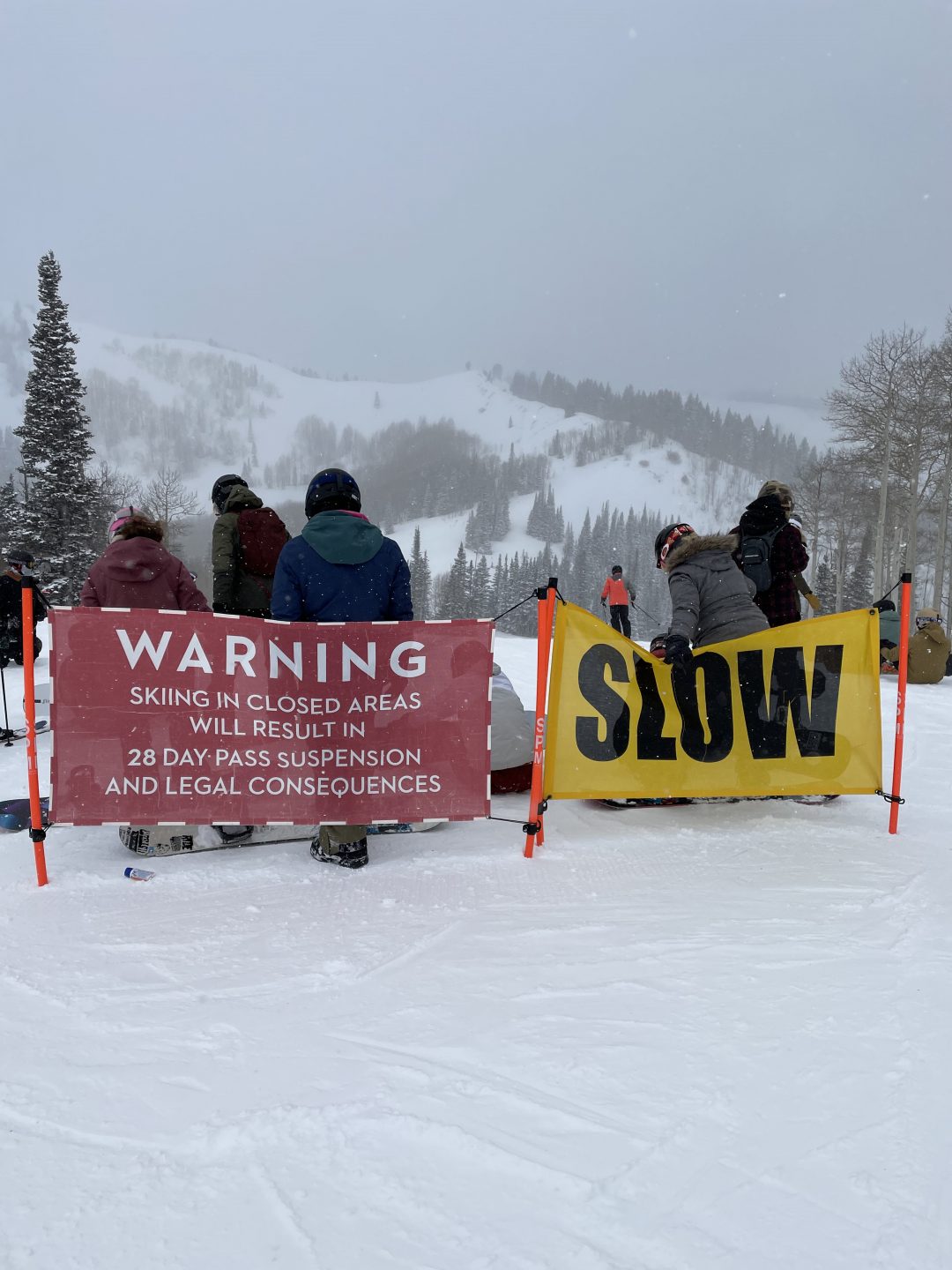
On trail signage at Park City Mountain Resort Photo: Jon Weisberg
Several years ago, SeniorsSkiing surveyed its readers about their biggest fear on the slopes. The overwhelming answer was being hit by an out-of-control skier. It is my greatest fear as well.
Whether he/she may be drunk, stoned or skiing too fast for the conditions, or on a run well above his/her ability, or whatever the cause doesn’t matter. It is reckless and doing puts everyone on the trail in danger.
Think about it. A 150 lbs. person traveling at 20 miles an hour packs a wallop. The force of impact is equal to the object’s kinetic energy divided by the distance. Kinetic energy is the object’s mass (150 lb. person) times the speed (20 mph) squared divided by two, or in this case 30,000 Joules or roughly 22,133 lbs. of force.
The unknown is how far the person has traveled at this speed because he/she is traveling downhill and possibly accelerating. Even if the out-of-control person has only traveled a few feet, getting hit by another person with 22,133 lbs. of oomph may cause serious injuries.
Unfortunately, ski areas do not adequately police their slopes for out-of-control skiers. Their view is that when you step into your bindings, you assume the risk of injury to yourself and to others.
Most of what ski areas do to counter reckless skiers do is reactionary and defensive in the form of snow fences and warning signs. Stationing employees around the mountain who have the authority to take a lift ticket or season pass is something ski areas are loathe to do.
To further protect is ski areas against lawsuits, Colorado passed a law several years ago that made it much harder to sue a ski area if you are injured. And, if you are injured by someone who slams into you, you must sue the individual who hurt you. The ski area defense is “We weren’t involved.”
So, what does a senior skier do? Here’s my list of eight:
1. Ski with your head on a swivel.
2. When you stop, either stop on the side or by a ski slow or trails merge sign.
3. Wait until groups pass and there’s a gap.
4. Ski midweek and avoid weekends and holiday.
5. Don’t ski at the most popular areas. There are many ski areas where a long lift line are the two people who just arrived at the bottom of the lift a few seconds before you did.
6. Pick trails that aren’t crowded.
7. Ski along the edges. All those who ski in New England a lot will tell you that’s where the best snow is!
8. Get to know the mountain before you put on your skis, i.e., study the trail map to know where you want to ski BEFORE you step into your bindings.

- Musings from Whistler - March 19, 2026
- Northstar – a Gem Discovered - February 19, 2026
- Notes From a Few Days at Palisades - February 19, 2026

We are currently skiing in Covara, Dolomiti ski circus, perhaps the most picturesque area on the planet,
The number of skiers of moderate to excellent ability wizzing down and overtaking at high speed is off-putting.
I can certainly look uphill before getting underway, but once on the slope, I can only look forward; the advice of “head on a swivel,” seems impractical.
I haven’t skied in Europe in awhile, but I suspect the problems are the same. BTW, if you like Covara, go ski in Madonna di Compliglio.
Sorry, but head on a swivel means you keep looking around as much as you can.
So you know, Marc L is 100% correct!!
As a ski instructor, I hear that reminder constantly before going out on slopes with guests each day
Suggestion: It IS difficult to look behind you when you’re facing downhill, so please try this:
…as you’re skiing down, just prior to turning – assuming you’re on a traverse, glance over your left or right shoulder & you’ll get a quick picture of what’s coming up behind you. And if you vary the frequency of those glances based on how busy the slope is, I think you’ll find it’s very helpful in staying super aware of skier traffic
I was recently skiing at Park City Mountain when a child about 70 pounds skied right across my path and collided with me and took me down. I am a small woman only about 100 pounds myself. I was with my instructor who went over to the child asked her name and was she with someone else. The child motioned to a middle-aged man downhill from us and said that was her father. My Instructor went over to the father and asked his name and very politely instructed him to teach his daughter to watch where she was going. The gentleman became very defensive and said his name was John Jacob jingle Heimer. My instructor continue to discuss with the father who had quite an attitude about safety on the mountain. Unable to obtain his name, she returned to me who was unhurt. She asked me if I thought she should have taken his picture and my answer was no, nowadays people are so rude. He might’ve punched you in the face. The incident with this gentleman really colored my entire vacation as I’ve been skiing in Park City for 50 years and have never encountered really any rudeness from anyone.
Skiing by the side of the trail does not prevent you from being taken out by snowboarders. OnBoth times I have been hit by borderers I was at the edge of the trail.
Look at it this way. Standing by the side of the trail limits the direction from which one can be hit. Its not perfect, but it is just one of the tools in the avoid being hit toolbox.
A lot of good points…but one thing I always do is leave room for the bombers, the out of control straightliners by leaving a passing lane on either side of the run so they won’t have to choose me vs the trees. The problem is that now grooming is so perfect anyone can straightline. A girl in a wide stance crouch passed me last year along one side, and I watched her disappear into the distance withouth turning or changing position. The other thing is to watch for people like the guy last year using the entire run at a low speed, back and forth…I followed him until he turned left and I went straight…when he came back I was passed him..when we arrived at the base I apologized but he answered with insults…”you have no skills…none!”…any of you who know me might not agree, but I just shrugged and went to the restroom…One more thing…if you are passing a snowboarder try to go by on his front (toe) side so he can see you better. Good luck out there, and stay aware. So far so good here.
Barbara is correct! My wife and I have both been hit by snowboarders at the side or bottom of slopes in what should be safe locations. Because of their sideways orientation the snow boarders are often not aware of skier’s or boarders downhill of their position. We have to stay alert at all times and cannot assume that all skier’s and boarders know and abide by the rules of the slopes. I would agree with Marc, sticking to sides does cut down on the odds.
Yes Barbara, I agree! It seems that’s exactly where the boarders are!
Good points all. Would like to share a couple more ideas learned over the years:
When stopping on a trails’ edge, slow down gradually. it is like brake lights on a car.
If it does not impede traffic , stop below a ski slow / trails merge sign. Best not to be a target.
Ski predictably when you are on a trail with others, stay within a corridor if possible.
Marc,
Excellent and important article! Thank you. I agree with all the points you make. I do think one reason areas don’t police reckless skiing is they don’t want to alienate customers and of course thanks to changes in the law it’s very hard to sue them. I do have a suggestion for where to safely stop on the hill – directly below a large fixed object: eg lift tower, snow making apparatus, tree. This ensures that the unguided human missile makes impact with something other than you.
All the best,
Dick
Being hit by drunk, high, or out-of-control skiers is exactly why we developed Ski Guardian®. This simple device easily attaches to your poles and features flags to help keep snowboarders and skiers at a safe distance. It’s also great for helping your family and friends easily spot you on the mountain. If you need to stop or are injured, Ski Guardian® helps protect you from skiers and snowboarders who may not see you.
For more information, visit SkiGuardian.com.
Stay safe out there!
Good article, and being hit is my biggest fear! I would just add 3 thoughts:
• one, don’t stop after a rise, because you’ll be in a blindspot.
• two, if you ski the edges, like I like to do, you will often encounter people stopped, so just be aware, and give plenty of room.
• three, I like to wear a skier’s backpack, because it usually has a well-padded backpad. I don’t know if it actually helps in a collision, but it might, and it does give me more confidence that if someone were to hit me from behind, I’d have some padding back there to blunt the initial blow.
Like KenC I always wear a backpack. It saved my bacon more than once when hit from behind. The other risk which seems to be increasing in recent years is the skier/boarder speeding on a low traverse.
All good suggestions: defensive skiing is crucial. And the dangers are compounding. Nowadays with legalized marijuana and illegal drugs so readily available to everybody being on the slopes has become more dangerous than ever.
Skiing the edges in New England? One mistake and you’re into the trees, and that is where the two ski deaths have occurred this year. And right now there is no natural snow so there is a hard edge and nothing to cushion you if you go over. Also, you are harder to spot in the shadows. Thus, absent real evidence I would not recommend routinely skiing the edges.
All of the above… head on a swivel, short turns along the sides, waiting for speedsters to pass before moving on… rarely do people get hit on black runs or in the moguls… it is usually on blue and green where the ‘straightliners’ really can “show off” and get into overdrive… does not matter what you say or do when hit; the ‘hitman’ will always chew you out and tell you to f**k off… After being the ‘target’ quite a few times I now always wear a POC back/spine protector…
Reference number 5 from Marc’s list of 8, “Don’t ski at the most popular areas”. For senior skiers who like to ski great uncrowded runs the best area in North America is Aspen Highlands. It is perceived as an extreme skiing mountain and about 70% of it is. But the other 30% is very lightly skied and has many long intermediate groomed runs. It has no green runs so beginners never ski there and it has no terrain parks so very few snowboarders go there either. The majority of the skiers at Aspen Highlands ski the legendary steep terrain of Temerity, Steeplechase and Highland Bowl. That leaves the intermediate terrain practically unused. I have skied runs like Exhibition, Red Onion, Riverside Drive, Apple Strudel, Kandahar and Meadows many times and never encountered another skier. Now that is fun relaxed skiing. Even though Thunder Bowl is classified as expert terrain it is long, wide open and easy to ski and you seldom encounter more than 4 or 5 other skiers.
I will be on the Snowmass trip in March so if any of you would like to explore the wonders of Aspen Highlands I would certainly be happy to show you the secrets of that great mountain.
Avoid places w high speed 6 and 8 packs. The trails become over crowded. Mad River Glen with its slow single chair means the offload is reasonable and you’ve got the slopes to you and your family. Great safe place for young and old.
A couple of other things you can do to be safe:
First, reserve all of your black ski pants and jackets for trips to the mall. Wear bright colors like yellow and green. Dressed in black, you can’t be seen in the shadows or against the backdrop of the trees at the edge of the run.
Secondly, get new wider vision goggles. We switched from Zionor to Anon, and we were surprised at how much the field of view on our side vision opened up. (Especially helpful when skiing with your head on a swivel.)
Finally, we’re convinced skiing in the bumps is the relatively safest place to be on the mountain. Almost no one “out of control” or straight lining makes it past their first turn. That’s where we spend most of our time here at Copper. It’s easy to learn and easy on the joints if you’re doing it efficiently. We picked it up after age 70; you can too.
We feel fortunate to ski at Mad River Glen, a place where snowboarders are not allowed. The presence of our historic single chairlift helps keep our trails uncrowded. Our regular community of skiers will confront an out-of-control skier, as safe skiing is a local norm. That said, falling down at my age is my biggest fear; a collision would make me a nonskier.
Very good point about crowded slopes. Everyone wants to ski the biggest and most famous ski areas. Fortunately, I have skied most of them when I was younger, and the slopes were somewhat less crowded.
These days, I don’t ski at “Resorts” any more. I only ski at “Ski areas” and “ski hills”. They are much less crowded, often with no lift lines at all, No tourists, just locals. And lift tickets only around $20 – $75, instead of $269 or even $325 at the mega resorts. Oh, and the cafeteria prices are correspondingly lower too. So, why pay 5 – 10 times more for the privilege of skiing at an overcrowded place?