Tag Archive for: Big White

The Archetype Senior Skier? This Guy Sure Looks The Part

74 Year Old Long Time Ski Host Books 120 Ski Days A Year At Big White. Jealous?

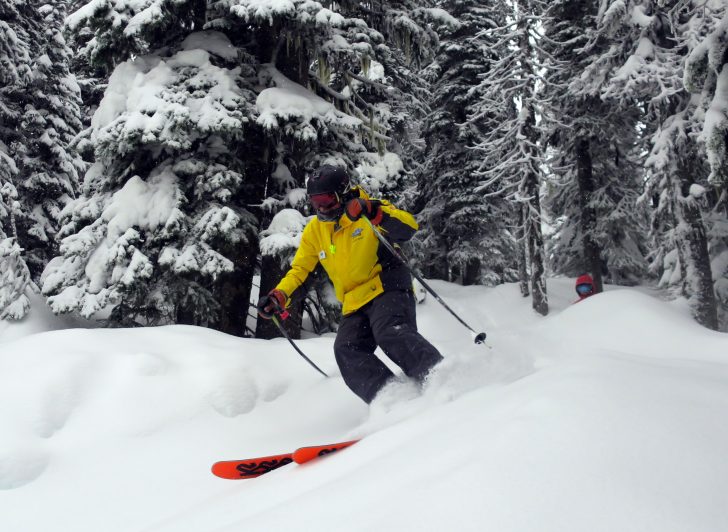
Ski Host Carlan Silha is fit and fortunate to ski so many days at 74.
Credit: John Nelson

It might seem strange that an American from the Spokane area knows this sprawling British Columbia ski resort better than just about anyone.

Carlan Silha has been serving as a snow host at Big White for 20 years, longer than anyone at the resort. The lanky 74-year-old still skis like a 24-year-old, kicking his heels when he takes a jump and issuing a frequent “Woo-hoo!” as he turns in powder.

The story of how Silha got to Big White starts in 1992, when he was a Boeing executive working in Europe. He and his wife Lin were looking for a condo at a ski resort, and a friend suggested Big White.

“We ended up buying because it was a great price,” Silha said. “Then we got here, and realized we really liked it.”

Silha eventually retired, moved from Seattle to the Spokane area, and then began spending every winter at Big White, where he became a snow host, showing visitors the ropes. Now he logs 120 ski days a year and relishes every minute.

“Let’s ski the Rat Trees,” Silha said as he showed around another visitor recently. The trees are so named because regulars have been hanging toy rats from a particular tree deep in the forest near Big White’s Powder Chair.

If you were Carlan, you’d have a big grin, too.
Credit: John Nelson

Silha then shot off, cranking precise turns through the trees in four inches of new snow. “Woo-hoo!” he shouted for perhaps the millionth time of doing this.

“Being outdoors keeps you young,” he said.

During summers, the Silhas spend their time fishing and camping, using Spokane as home base. They like to travel around the West, and Silha keeps fit by hiking and biking.

In winter, they hang out with ski friends who own condos at Big White, a large collection that includes Australians, Brits, Kiwis and, of course, Canadians. The snow host job—showing visitors around Big White’s 7,355 acres—keeps him busy and provides its own rewards.

“The main attraction is meeting people from all over the world,” he said. “And it makes you feel good to show people this mountain.”

Master’s Week At Big White: The Social Side For Seniors

There’s More Than Ski Clinics For Seniors That Make Big White’s Master’s Week Unique.

Sleigh ride at Big White Ski Resort. One of many non ski winter activities.
Credit: Big White Ski Resort

[Editor Note: Correspondent Yvette Cardozo also reported on Big White’s Master’s Week focusing on the ski instruction elements.  Here, she shows us the social side which really looks like a lot of fun.]

The social part of the Big White Ski Resort Masters Week is what made the experience different.

Those of a certain age who skied in the ‘70s and ‘80s will remember the original ski weeks. Some were run like summer camp and at least one (Gray Rocks in Quebec) came off like a cruise ship.

Jolly time at Masters Week apres ski party at Big White Ski Resort. The Masters program is aimed at skiers of all levels over the age of 50.
Credit: Yvette Cardozo

You skied together, you ate together, you made long term friends.

And now, the old fashioned ski week is back and aimed squarely at the folks who made it a success decades ago—the Boomers.

Okay, the ski weeks I remember from yesterday had us on the slope ALL day with a brief break for lunch. My knees are long past that.

 Instead, the Big White Ski Resort (Kelowna, BC) Master’s Week has on-slope work in the morning, then social stuff in the afternoons or evenings. There is also a Masters Monday, aimed more at locals but also including folks who don’t want to commit for an entire week.

And this certainly has hit a chord with people

The first day of my week, when we were joined by the Monday only groups, the resort was expecting perhaps 130 for lunch. Nearly 200 came (many signing up just that morning). There was quite a scramble for food, but nobody went hungry.

Dizzy of Dizzy’s boot fitting shop at Big White ski resort shows off an early 1970s ski boot that boasted fantastic ski technology that, sadly, was ahead of the boot’s ability to support it. The boots famously would come apart during skiing.
Credit: Yvette Cardozo

This reflected what has been happening with the five-day ski weeks, which grew from 23 people a few years ago to 229 last year spread across two sessions before adding a third session at the end of the season.

Each day after class, there was something—a clinic, apres ski, a sleigh ride.

One night, we met for beer and pizza at Dizzy’s Ski & Board Shop where Lindsay Bennett (aka Dizzy) talked about ski gear.

Along shelves in the shop sat hundreds of old boots, some from the 1940s, each representing a tech breakthrough. His fav is an early 1970s orange Scott boot that was truly revolutionary … and fell apart when the plastic couldn’t keep up with tech.

 Boots are, Dizzy said, the single most important piece of equipment you can own. A decent boot will last for 200 days of skiing. And custom foot beds are perhaps the most important thing you can have in a boot, he added.

No one knows that better than me. Slower than most to catch on, I spent a decade trying to figure out how to turn at all. Then someone noticed my board flat feet. I splurged on custom footbeds, headed for a lift and in the space of 30 seconds went from struggling novice to solid intermediate. I had been making the right moves all along but my feet weren’t connecting with the boots.

 A few tips—get ski socks. They’re a blend that keeps you warm without being too bulky. Don’t pull the liner out of your boot each night. Electric boot dryers will do a better job. And park your boots up high for the night (where air in your room is warmer).

 I went into the shop the next day and an added thin innersole and heel lifts helped my aging boots fit snug again with the added benefit of tipping me forward just a bit more.

The next night, my friend Kay and I went on the dinner sleigh ride, riding in a large sled pulled by two beautiful Clydesdale horses through a magic scene of snowy trees and swirling flakes. Dinner was both gourmet and rustic—chicken cassoulet and bison ribs. We bonded with our seat mates, who produced bottles of good red wine and topped it all off with mini cheesecakes.

 Our final gathering was apres ski at an Irish pub with good munchies, great beer and wonderful memories.

Information

Big White Ski Resort’s Masters Week is actually five days, Monday through Friday. There are on-slope lessons each morning, then social activities in afternoon or evenings.

For 2018, Big White is planning at least two Masters ski week programs, Jan. 29 – Feb. 2 and Feb. 26 – Mar. 2, plus possibly a third at the end of the season.

Price for the week (lessons, clinics and most social activities) will be $278 Canadian. Canadian dollars have run about .75 per US dollar for a few years meaning $278 Cdn works out to about $208 US.

There are also Masters Monday classes, held each Monday morning, for people who don’t want to commit to an entire week.

Big White ski resort base village.
Credit: Big White Ski Resort


SeniorsSkiing Guide: Big White, Big Senior-Friendly

Big Choice Of Intermediate Runs, “Master” Lessons, Bring Seniors Back Each Year.

The Alpine T-Bar serves low-angle intermediate terrain near the 7,606-foot summit of Big White. Credit: John Nelson

It’s hard to find a resort better suited to older skiers than the popular British Columbia destination of Big White.

Located in Okanagan region of B.C. near the bustling, fast-growing city of Kelowna, Big White is indeed big, with a sprawling village that boasts the most ski-in, ski-out lodging in Canada.

A skier turns amid the snow ghosts near the top of the Alpine T-Bar at Big White.
Credit: John Nelson

The resort’s rolling terrain of predominantly intermediate runs is especially popular with older skiers. In its lesson programs, Big White offers discounted “Masters Mondays” classes, and two popular “Masters’ Weeks” designed to teach older skiers how to keep shredding.

“Our retention rate is over 60 percent,” says Ollie McEvoy, one of the masters instructors. “If they take a lesson from us, they’ll come back.” The many skiers who take part in the masters’ week programs return every year after making personal connections, McEvoy says.

“They end up making friends for life,” he says.

For U.S. residents, Canadian resorts are particularly attractive this year, with a favorable exchange rate of more than 30 percent. Add to that a discount on senior tickets at more than 16 percent and U.S. skiers make out very well at one of Western Canada’s favorite resorts.

Ski instructor Ollie McEvoy helps run the masters programs at Big White. Credit: Big White Ski Resort

Snow, Terrain and More

  • Location: Big White is about 33 miles southeast of Kelowna, a city of more than 100,000 in the Okanagan Valley of British Columbia. Kelowna has an international airport with daily flights from Seattle, as well as major cities in Canada.
  • Snowfall: “It’s the snow” is the marketing slogan for Big White. Located far inland from Canada’s west coast, Big White’s snow is colder and drier than rival Whistler-Blackcomb, and it receives about 300 inches a year.
  • Terrain, lifts: Intermediate skiers love the rolling terrain of Big White, where all 15 lifts have a green run down. About 72 percent of the terrain is rated easy or intermediate; 28 percent is rated expert and extreme. Five of the chairlifts are high-speed on more than 2,700 acres of skiable terrain.
  • Vertical: 2,656 feet from Big White summit (7,606 feet) to the base of the Gem Lake Express lift (4,950 feet).

Lot To Lift Access

  • Parking: Day-trippers can park at the Gem Lake base or at the Happy Valley Lodge. This is one resort where you should consider staying on mountain because of the vibrant and affordable ski-in, ski-out village scene.
  • Public transportation: Big White offers a shuttle service from the airport to the mountain village, so skiers flying into Kelowna do not need to book a rental car if they are staying on the mountain. In addition, an inter-resort shuttle operates between Whistler, Big White and Sun Peaks for skiers who want to try three of Canada’s biggest resorts.
  • Accommodations: Big White is built for skiers who want to stay on the mountain. Thousands of ski-in rooms are available in all price ranges, with many package deals that include lift tickets and meals.

Culture

  • The vibe: Friendly, with a pronounced Aussie accent. The resort, owned by an Australian family, attracts a large number of Aussie workers and vacationers, giving it a “no-worries, mate” feel.
  • Dining: The resort has 18 on-mountain restaurants in various price ranges. Among the very best is the Kettle Valley Steakhouse and Wine Bar at the Happy Valley base area, serving excellent upscale entrees with a long list of tasty, British Columbia wines.
  • Mountain life: Beyond the lift-skiing, Big White offers many other activities, including Nordic skiing, outdoor ice skating, tubing, snowshoeing and sleigh rides.

Bottom line

  • Big White is a major resort that does very well by older skiers, with vast intermediate terrain and popular masters instructional programs.
  • The strong U.S. dollar makes this Canadian resort particularly attractive for deal-hunters.
  • Excellent snow quality keeps the lifts spinning well into April.

Trail Map Click Here

http://www.bigwhite.com/explore-big-white/mountain-info/maps-brochures

Webcam Click Here

_____

John Nelson is a freelance outdoors writer based in Seattle. Follow his blog at skizer.org.

Big White’s vibrant village has the most ski-in, ski-out lodging in Canada. Credit: Big White Ski Resort