Tag Archive for: blind skier

Short Swings!

Last week’s column highlighted responses to a question posed to several friends: How much vertical footage is needed to have a satisfying day on the hill? For this week’s column, I posed the same question to all readers. Your input over the past several days says a lot about your passion for the sport. Not enough room to include all responses, but here’s a selection:

Fellow ski journalist, Dave Irons, 82, reports, “…all I need is a morning that includes 5-10 runs.” He and his 60-year old daughter ski Shawnee Peak (ME). “The 1200 feet of vertical is plenty. She’s…in great shape, which is why she is good for a few more runs after the old man is ready for a beer.”

John Emery, 67, and his wife ski Bogus Basin (ID). “I still track and log my vert, not for bragging purposes but to keep myself honest.” 

Rick Hovey is 66 and a resident of Park City (UT) since the mid-70s. Typically, he skis one million vertical and 80 days a season. Poor guy, last season he clocked 58 days and 900K vert. He writes, “I expect to meet my goals this year but will try to be satisfied with what I get.”

Rich Spritz writes, “My goal is to ski my age, though this year I may miss 70.” His family has a rule: “three runs counts as a day.” To anyone challenging the rule he suggests skiing three at “Breckenfridge” when it’s 7°F with wind howling, “then come meet inside by the fire and tell me that doesn’t count as a ski day!”

Susan Shaffer, Chapel Hill, NC, has skied one million vertical for several seasons. Last March, when areas closed, she was three days short of skiing her age. 

Tony’s local area is Cannonsburg (MI) with 250’ vertical. The area is a few miles from where he and his wife are on patrol (99 years of patrolling between them). For Tony, a light day is 100 runs or about 25,000 feet. “It’s a lot cheaper than the gym and lots of fresh air.”

At 74, Kevin Toolan’s perfect day is about 4 hours with his 6 and 10-year old grandsons at Okemo (VT) followed by lunch, a glass of wine and a nap. 

Peter Hogan skis Copper Mountain with his step-son. They enjoy lunch at a sheltered woodsy spot with a view, then ski the bowls and take a long “butt-kicking” mogul run before a few beers.

Connie Grodensky writes, “Skiing local is what skiing is about this year.” She takes 10-run days at Mt. Bachelor (OR) and is happy to leave before the crowds arrive. 

Ed Schultz, 76, skis 15 runs at Brantling (NY), with 250’ vertical. It’s small but in region that receives lots of snow.

Bob Ohrt, provides these words of wisdom: “Have been skiing local for many years. Depending on the year, ‘local’ might be a 300′ valley or a 3,000′ resort. It really doesn’t matter. Skiing is the experience and the sensation. Every ‘where’ can offer different joys. Ski what you have got.”

Many thanks to everyone who took the time to share their thoughts.

Skier’s Six-Word Challenge

Here’s the challenge: summarize your thoughts about the season in 6 words. Several have been received. If you want to enter SeniorsSkiing.com’s Six Word Challenge, you may win a Booster ski boot horn, a great gift for any older skier. 

Here’s a selection from the past week.

Louis Vigorita, Ventura, CA, commented on escaping Covid isolation: 

Out of the bubble, into the snow.

Susan Zangrilli, Sandy, Utah, expressed one of this season’s dilemmas: 

Mask, balaclava, gaiter, helmet, goggles. Breathe? 

Her husband, David, laments not being able to boot-up in the Alta locker-room: 

Boots on. Boots off. Sans bench.

Bob Ohrt puts this optimisitc spin on the season:

It’s the smiles not the miles.

And Jan Brunvand, Salt Lake City, who’s already skied seven days, sent this about his season’s goals: 

Fifty days? Good luck with that!

Enter SeniorsSkiing.com’s Six Word Challenge. Summarize how you feel about this season in six words. Winners will receive a Bootster ski boot shoe hornSend entries to jon@seniorsskiing.com.

Passes Surpassed Lift Tickets Last Season

National Ski Areas Association reports that last season, skier/boarder visits using season passes were greater than visits using single and multi-day lift tickets…a first for the industry.

May Be Best Lift Deal in the US

Colorado Ski Country USA’s $35 Gems Card provides two 2-for-1 adult lift tickets or two 30-percent (30%) off adult lift tickets at each of these Colorado resorts: Arapahoe Basin, Cooper, Echo Mountain, Eldora, Granby Ranch, Hesperus, Kendall Mountain, Loveland, Monarch, Powderhorn and Sunlight. For more information: www.ColoradoSki.com/Gems.

Better Mapping

You may have noticed a new look in the trail maps at places like Vail, Sun Valley, Squaw and Alpine Meadows, Stowe, Mt Snow, and Killington. They are among the areas utilizing  the services of VistaMap, a company providing a comprehensive system for creating and maintaining trail and guest maps. Like any good map, these are easy to read and understand. The technology utilized let’s them be updated easily. Click here to visit Vistamap‘s website.

Liftopia’s Assets Acquired

Remember Liftopia, the online ticket seller, which advertised extensively over the past few seasons? The company went under earlier this year after several resorts were not paid for the tickets Liftopia sold. The company’s liquidated assets were acquired by Skitude, a European ski-oriented tech.

Two Interesting Short Ski Films

Abandoned (24 minutes) tells the stories of several defunct Colorado areas.

Made Back East (21 minutes) follows a group of ski friends as they ski backcountry in New York and Vermont.

One Wonderful Ski Video

Twelve year old, Jacob Smith was diagnosed with a brain tumor at age 8. After years of surgery, he is well  but legally blind. This 7 minute video tells Jacob’s story, including his descent on skis of Big Sky’s Big Couloir. Need a pickmeup? Don’t miss this one!
Ski For Light: A Blind Skier’s Experience

Part 1: The Skier

[Editor Note: We met Chris Leghorn in a local North Shore community acoustic music jam. She sang and played her Martin HD 28 with both gusto and gentleness, depending on the song. In talking with her, we learned she had taken part in 19 Ski For Light events since 2001 as a cross country skier.  She started going to Ski For Light just as she was starting to experience adult onset blindness. Her story is inspirational and certainly worth hearing. In Part 1, we will tell Chris’ story; in Part 2, we will hear from a volunteer guide. We interviewed Chris after she returned from the Ski For Light 2019 gathering which took place this year in Granby, CO.]

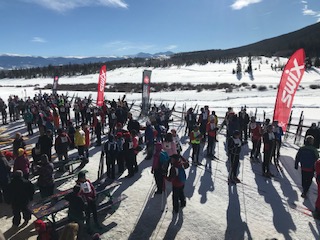
Ski For Light is an all-volunteer, non-profit organization founded in the US in 1975 and modeled after the Norwegian Ridderrenn, a program that teaches blind, visually-, and mobility impaired people to cross-country ski. Each year, the US-based organization holds a week-long cross-country event at a different host resort. About 240-280 people attend, 100 or so blind or visually-impaired, another 12-15 mobility impaired, and the rest volunteer guides and organizers, some of whom travel from Norway, the UK, China, and even Barbados for the event. Many of the attendees return to SFL year after year. Aside from coming to learn or just enjoy cross-country skiing and to grow in independence, the SFL gives blind or mobility-challenged attendees a chance to not think much about being disabled for the week. They are just another participant at the event. The motto of SFL is “If I can do this, I can do anything” describes the attitude that drives the organization’s mission.

Chris with her guide at Ski For Light. Credit: Pam Owen

SeniorsSkiing.com: Chris, how did you get involved with Ski For Light?

Chris: I had heard of Ski For Light in 2001 when my eyesight was getting worse. I read some inspiring articles about the event that motivated me to try it out.  I knew I needed to find a way to do things I loved with assistance.  So, I went to my first SFL that year when I still had some vision.

SeniorsSkiing.com: What attracted you to SFL?

Chris: To my knowledge, SFL is the only event of its kind in the US. Many Alpine ski resorts have programs for blind skiers, but SFL is unique in what it offers.  The program was imported to the US from Norway where the Ridderrenn provided an opportunity for blind people to enjoy the winter. [Note: The Ridderrenn or “Knight’s Race” was started in 1964 by Erling Stordahl, who is blind, when he found he could ski with confidence in the tracks of army trucks without being afraid of bumping into anything. That basic idea formed a framework for Ski For Light.]

I had skied in my college years and had lived on a farm where there was a lot of opportunity to be on skis and outdoors in the winter.  But, before SFL, I hadn’t skied in 25 years. I was always athletic and loved the outdoors, and I needed to find a way to do activities in a different way. I still am very active, despite my blindness. I also do long-distance cycling, hiking, and kayaking.  I have completed three Blackburn Challenges in my double sea kayak. I am always looking for people to participate in these activities with me. [Note: The Blackburn Challenge is a 20-plus mile, arduous ocean rowing race around Cape Ann, MA.]

SeniorsSkiing.com: What is it like to ski with a guide?

Chris and Guide placed in end-of-week race. Credit: Pam Owen

Chris: It is awesome. We are paired with a guide for the whole week. New guides are given some training before the event. Everyone learns a common language to use like “half-track right”, “tips left”, and things like that. But we also talk about how we like certain directions. For example, if we are turning, does the skier prefer degrees or hands of a clock for reference.  Or does the skier want constant feedback or just some communication before a big turn or terrain change. I like to rank hills according to steepness from 1-5 and also length from short to long, i.e., a “long three”.  This communication helps me accurately determine what’s ahead.

The skier and the guide ski side-by-side in parallel tracks about four to six feet apart. Some skiers, however. prefer the guide to be ahead of them, others behind.  Again, it’s a preference you have to work out together. Once you work out the communications, it’s a matter of just heading out and doing it.

Every year, I try to express the depth of my gratitude to my guides for giving so much of themselves so that I can have a beautiful week of feeling free on the snow. Their response to my gratitude is always, “We are the winners here.”

Skiers and Guide ski in parallel tracks. Credit: Pam Owen

SeniorsSkiing.com: What have you learned about yourself through SFL?

Chris: I’ve learned that I take my attitude about my blindness too seriously, or rather my fear of how I am being judged about my blindness. There are many amazing sight-impaired people at SFL, and, in their presence, I have learned to be more relaxed about who I am as a person with failing eye sight. There is an incredible spirit of positivity that words can’t explain at Ski For Light.

When I am cross-country skiing beside my guide, I feel so free because I am not attached to my [guide] dog or holding onto someone’s arm. It’s a freedom I don’t feel much anymore, and it’s very special.


For more information about Ski For Light, donating, volunteering, or becoming a guide, click here for the SFL website.


Fast Freddie

Blind Skier Inspired All Who Knew Him.

Fast Fred Siget on the left with Pat McCloskey, center, and friend at a long ago National Blind Skiing Championships.


The first time I skied with Fred Siget was in Snowshoe, WV, with Larry Walsh of the Pittsburgh Post Gazette. This was my maiden voyage guiding a visually impaired skier. I had Fred, the first blind skier in our area, in front of me. Right turn, left turn, right turn, stay, stay. All of a sudden the only tree around popped up right in front of us as I yelled “Crash,” and Fred sat down as he ran into it.  I felt so bad, but Fred dusted himself off with a smile and said, “Pat, don’t worry about it at all. This will be one of many.” And we continued down the slope. This began a 40-year friendship with the one and only Fast Freddie Siget.

Fred lost his vision as a result of an accident with a high pressure hose when he was a volunteer fireman. As devastating as this injury was, he was undaunted. He became the first visually impaired computer programmer for Koppers Corporation. He continued dancing, and he learned to ski with guys like Larry Walsh, Jim Conley, Lynne (Kravetz) Hartnett, Shorty Leco and Micky Hutchko.

Fred always had ideas on how to make things easier for blind skiers and how to improve guiding techniques. He had a transmitter rig where the guide used a microphone and Freddie had an ear piece which made calling out commands easier and more understandable.

Once I used the transmitter while standing on top of a slope, calling commands to Fred as he skied by himself down to the chairlift. With his “Blind Skier” jacket on, people were shocked viewing his run. In the bar afterwards, we had some fun with Herman Dupre the owner of Seven Springs Mountain Resort. I put the microphone on and guided Fred over in front of Herman and told him to tell Herman how much he admired his red flannel shirt. Herman was stunned and later remarked to me laughing that he was starting to “get hot thinking about all the free passes I gave to Fred and now he is telling me how much he likes my shirt!” Hilarious.

Fred was always anxious to help new guides. He put himself at risk during the training but always felt that it was worth it not only to train guides that could assist him, but to help the other visually impaired skiers who were beginning to show up at BOLD (Blind Outdoor Leisure Development) outings at Seven Springs.

Perhaps the most compelling thing about Fred was his kindness and appreciation for his fellow skiers and guides. He always remembered your birthday and when he called me, he sang, “Happy Birthday to you, Happy Birthday to you, get plastered, you bastard, Happy Birthday to you.”

He was popular for his skiing for sure, but as a person, you could not get a better guy who was always interested in others and never talked much about himself.

We lost Fred this fall at 94 years of age. He had an amazing life, and we will miss him. Fred never let his accident slow him down. He always said that he did more as a visually impaired individual than he ever did before losing his sight. He took a perceived bad thing and turned it into opportunity. Shouldn’t we all learn from that lesson?