Tag Archive for: Colorado Snowsports Museum

Mystery Glimpse: Young Racer

Who Is This Racer?

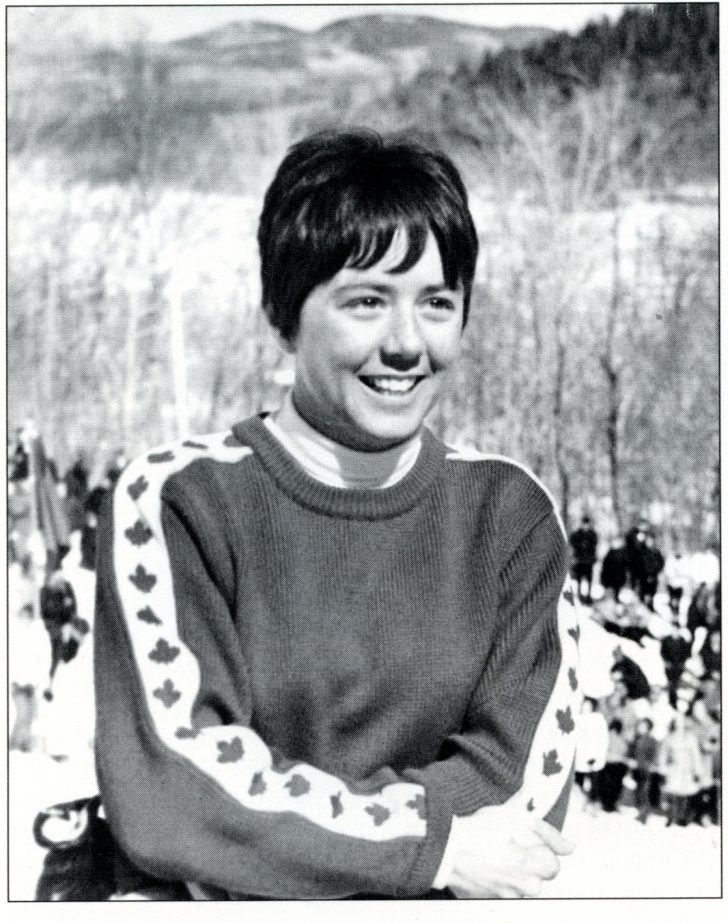
Major hint: O, Canada! This one should be easy. This week, we all need an easy one. Can you tell us about her history? Her extraordinary career? Thanks to the New England Ski Museum for this picture.

Credit: Dorothy Crossley, New England Ski Museum

Last Week

This photo was taken at Crested Butte Mountain Resort in 1963, showing off the installation of their new Carlevaro-Savio, Silver Queen Gondola.

Crested Butte Mountain Resort opened in 1960 when two men—Fred Rice and Dick Eflin—purchased a ranch on Mt. Crested Butte. An operating permit enabling the resort to be built was approved by the United States Forest Service the following year.

In 1963, Crested Butte constructed a top-to-bottom gondola from the base area to near where the bottom of the High Lift is today. The resort was the second resort to open a gondola in Colorado, after Vail Ski Resort opened theirs in 1962. Constructed by Carlevaro-Savio, the three-person Silver Queen Gondola was notorious for being cramped, and the cabins were known to have frequent collisions. The gondola lasted until 1972, when a bubble double chairlift replaced it.

Special thanks—again—to Dana Mathios, curator and Director of Collections, at the Colorado Snowsports Museum, located in Vail, CO.

Mystery Glimpse: Fast Lady

[Editor Note: SeniorsSkiing.com is asking our readers to contribute to support our online magazine. Yes, we have grown in the number of subscribers and advertisers. But our expenses have also grown. You can help us defray some of these expenses by helping us out with a donation.]

Support SeniorsSkiing.com by clicking here.

______________________________________________________

Nice Sweater, But Who Is She?

Looks like a balmy day on the snow with this speeding skier, sans cap and a big sweater.  And hmmm, that flag.  This week’s pic comes from Jamie Storrs at Peak Resorts who has opened their archives for SeniorsSkiing.com.

Credit: Thad Quimby, Peak Resorts

Last Week

Thanks again to Dana Mathios, Curator and Director of Collections, Colorado Snowsports Museum, for the description. This photo shows the 1972 U.S. Alpine Ski Team. Colorado heroes include Hank Kashiwa, Rick Chaffee, and Whit Sterling.

Hank Kashiwa was a member of the U.S. National Team from 1967 to 1972. He won the 1969 US National Championships and competed in the 1970 World Championships in Val Gardena, Italy. After racing in the 1972 Olympics in Japan, he starred in the Pro Circuit from 1972 to 1981 and won the World Pro title in 1975. He later served as President of the Volant Ski Corporation, a Boulder-based ski manufacturer. Hank was inducted into the Colorado Snowsports Hall of Fame in 1994.

Other 1972 US Alpine Ski Team members included Bob Cochran, David Currier, Terry Palmer, Tyler Palmer, Karen Budge, Marilyn Cochran, Susan Corrock (placed third in Downhill), Barbara Cochran (who won the Slalom), Sandy Poulsen , and Patty Boydstun.

Mystery Glimpse: Name That Team

Here’s A Ski Team From The Past.

Can you name when? Who’s who? Thanks to the Colorado Snowsports Museum for this one.

Last Week

Well, last week’s photo was a challenge.  Not one guess. Thanks again to Dana Mathios of the Colorado Snowsports Museum for this description.

This photo was taken at The Hotel Jerome in Aspen. The photo is believed to have been taken in 1948, but some indications from the scrapbook this photo came from indicate a date as early as New Years 1939. The Jerome was built in 1889 and is often described as one of the city’s major landmarks. In 1986 it was listed on the National Register of Historic Places. During Prohibition a celebrated spiked drink, the Aspen Crud, was invented at “J-Bar”. Later, the drink and the bar became popular with members of the 10th Mountain Division while they trained in the area. After the war, Aspen and its new ski resort became a popular destination. Celebrities vacationed in Aspen like Gary Cooper, John Wayne, and Hunter S. Thompson.

The Hotel Jerome: If the walls could talk…Credit: Amuse


Mystery Glimpse: Two Racers

One Very Young, The Other A Successful Competitor.

Many thanks to the Tread Of Pioneers Museum, Steamboat Springs, for this photo. Visit their online collection by clicking here.

Last Week

This is George Lundeen’s bronze statue, The End of An Era,  circa 1960. Why is it significant? Here’s what Dana Mathios, Curator and Director of Collections, Colorado Snowsports Museum, has to say:

This sculpture depicts a sport poised at a turning point on the edge of change. Soon, metal and synthetics would become standard in ski construction in place of wood that had been in use for more than 4,000 years. Pioneering skiers used a single wooden pole. By the early 1900s, two poles were in fashion. The shafts were often made from bamboo until superior poles of a light metal alloy were developed. Higher, plastic ski boots featuring buckles marked the passing of lace-up leather boots.

Also depicted in the sculpture is an early version of a safety binding designed to release the toe of the boot in a fall. A leather thong anchored the heel to the ski. More advanced safety bindings that released both the toe and the heel of the boot followed.

Early in the development of Colorado’s ski industry, the Pikes Peak region offered a number of small ski areas. Nearby slopes at The Broadmoor Hotel and others on Pikes Peak at Glen Cove, Elk Park, and Holiday Hills were popular. The region also included Tenderfoot Hill at Cripple Creek and the Edlowe ski jumping hill at Divide. In time, large corporate-managed ski areas further to the West replaced the small, locally owned ski facilities in the region.

Many thanks to  curator Dana Mathios and the Colorado Snowsports Museum for their many contributions to SeniorsSkiing.com’s Mystery Glimpse feature. Visit the museum’s website to browse its collection and do consider making an audition.

Mystery Glimpse: Flying Racer

Who Is The Airborne Skier? What’s His Story? Do You Know His Hometown?

This week, we made the Mystery Glimpse a little more challenging.  Name this high flyer.  Tell us about him and (hint) how he met his unfortunate and untimely end.

Okay that’s hard. Here’s another one of this celebrated personage.

These photos come from the collection of the Tread Of Pioneers Museum, Steamboat Springs, CO. The museum is a not-for-profit historical institution that promotes an understanding and appreciation of the history of the Steamboat Springs area by collecting, preserving, exhibiting, interpreting, and sharing that history and heritage with audiences of all ages and interests. Check out its collection of historic skiing photos.

Last Week

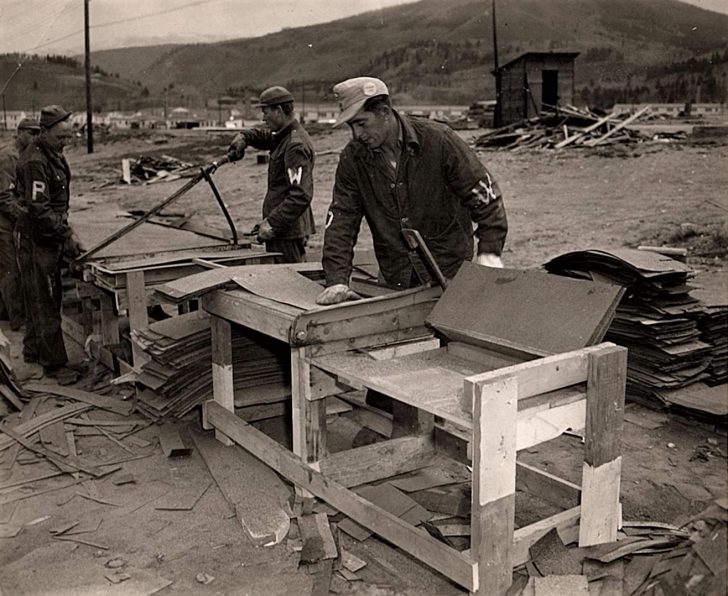
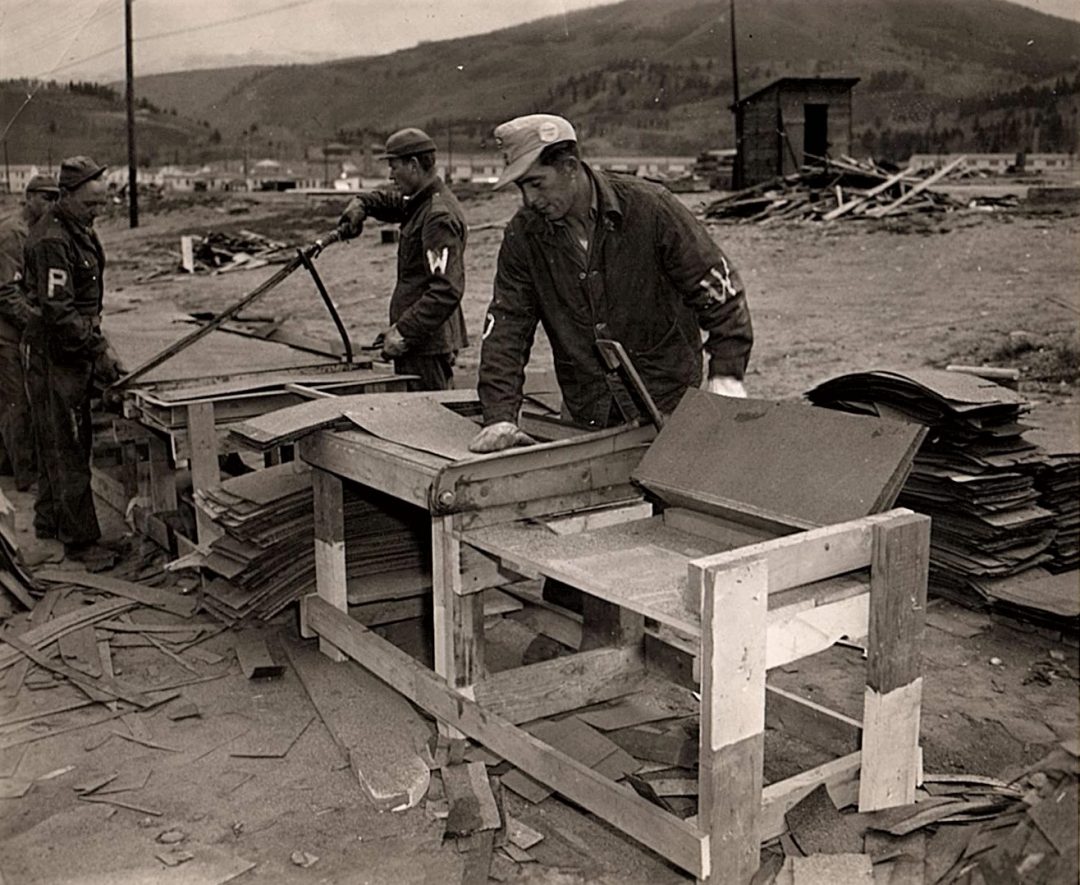
German POWs making shingles at Camp Hale, CO, circa 1943-46. Credit: Colorado SnowSports

We had at least one correct comment on who these soldiers were, as well as some very close guesses.

Those hard-working chaps were German POWs held at Camp Hale, CO. Did you know that from 1943 through 1946, Colorado had 48 Prisoner of War Camps? Out of the many camps, the Army placed several hundred German prisoners of war at Camp Hale, the 10th Mountain Division training facility. Though communication between prisoners and soldiers was officially forbidden, the German prisoners regularly talked with the German sympathizers in the 620th Engineer General Service Company, which arrived at the camp on December 5, 1943. The 200 soldiers who made up this unit were not actually engineers. Like several other army units, the 620th was made up of suspected Nazi sympathizers (mostly Germans) and other opponents of the war.  They got along quite well with the POWs, exchanging greetings and illegal gifts. The images show POWs making shingles and stacking lumber at Camp Hale.

Thanks again to the Colorado Snowsports Museum, Vail, CO, for contributing the photograph from its archives.  You can virtually visit the museum by clicking here. 

Mystery Glimpse: Who’s Diligently At Work?

They’re Lucky To Be In The Mountains And Not Where They Were.

This should be relatively easy.  Who are these chaps? What are they doing? Where are they doing it? When? Look closely. There are clues you can see.

Thanks, again, to the Colorado Snowsports Museum and Hall of Fame for contributing this picture. The museum’s website has some well-researched articles on the history of snow sports of all kinds in the Rocky Mountains and Colorado. Click here for more. SeniorsSkiing.com thanks Dana Mathios, Director of Collections, for working with us on this series.

Last Week

We thought this would be more difficult. Clearly, there are some fans of Queen Maud of Norway out there. The photo is the young Queen, right, skiing with her sister, Princess Victoria, in 1907. The Vesterheim Norwegian-American Museum contributed this photo. Apparently, this pose was an attempt by English-born Maud to look more “Norwegian”.

Queen Maud was daughter of Britain’s Edward VII, was raised in England, and married a Danish prince. Clearly, inter-marriage of royals was a way to ensure longevity for blue bloods. During her first years in Norway, she and her spouse were photographed in Norwegian folk costumes, and enjoying winter sports such as skiing, to give them a Norwegian appearance in the eyes of the public. Hence, this picture.

In 1877, Norwegian Americans began collecting and preserving objects at Luther College in Decorah, Iowa, documenting their chapter of the immigrant story, making them pioneers in the preservation of cultural diversity in America. That early collection

Maud of Wales in 1906

has grown into one of the most comprehensive museums in the United States dedicated to a single immigrant group—Vesterheim Norwegian-American Museum, now an independent not-for-profit organization accredited by the American Alliance of Museums (AAM).


Mystery Glimpse: Two Stars On The Snow

Who Are These Folks?

Hint: It’s New England. Another Hint: You’ve undoubtedly seen one of these folks in action.

This week’s Mystery Glimpse photo comes from the archives of the New England Ski Museum with headquarters in Franconia, NH, and a new branch location in North Conway, NH.

The New England Ski Museum collects, conserves, and exhibits elements of ski history for research, education and inspiration. They have have operated the Museum at Franconia Notch State Park since December, 1982, and welcome thousands of visitors each year. You can access detailed descriptions of the museum’s permanent and annual exhibits by clicking here.

Last Week’s Mystery Glimpse

Who, What, Where, When?

Only one guess on this one. That’s surprising because the story behind this picture is embedded in Vail lore.

On April 1, 1964, when Vail was still brand new, a 14-year-old boy named Marty Koether got lost on the slopes—and ended up becoming a permanent part of Vail history.

Koether, who accidentally skied into a yet-to-be developed Game Creek Bowl, spent a long, cold night in a tree well near the bottom of the present-day location of the Game Creek lift before climbing out the next morning and being discovered by ski patrol.

The incident was chronicled in Skiing Magazine and became part of the mountain’s folklore. The winding, green trail in Game Creek Bowl “Lost Boy” is named after Koether and his disappearance.

A salute to the  Colorado Snowsports Museum and Hall of Fame.    A special thanks to museum curator Dana Mathias who provided this story.

Do you remember this incident?