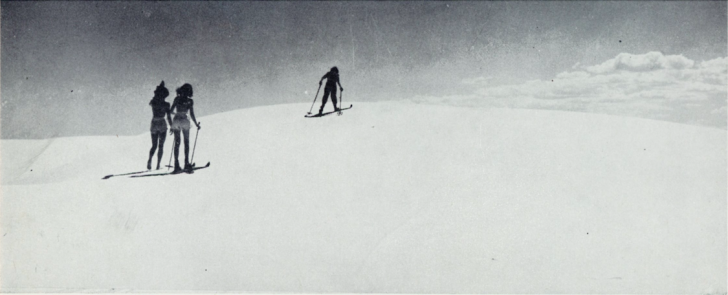
Test Your Skiing Knowledge

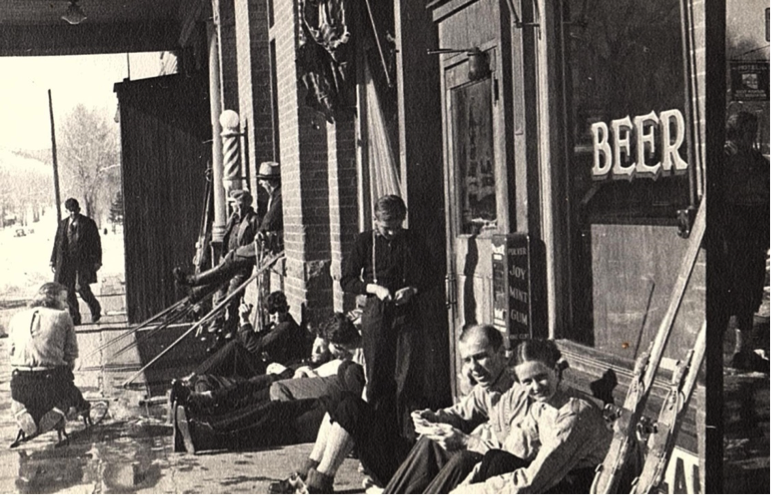
Where are these skiers? Source: New Mexicao Ski Museum

Each issue of SeniorsSkiing.com has a picture to help test your skiing knowledge. The pictures are from collections in a variety of participating ski museums, which we encourage you to visit and to support.

This image was submitted by New Mexico Ski Hall of Fame and New Mexico Ski Museum, located outside Albuquerque, at the base of the Sandia Peak Aerial Tramway. The museum collects, preserves and displays items connected with and/or celebrating the history of snow skiing in New Mexico. The Ski Hall of Fame celebrates individuals who have contributed substantially to the development of skiing and snowboarding in the state.

It is open daily year-round, and admission is free.

Where in New Mexico are the skiers in this picture? The first person to identify the correct location (email  jon@seniorsskiing.com) will receive a copy of Arcadia Publishing’s book, Skiing in New Mexico.

The correct answer and the name of the winner will appear in the next issue of SeniorsSkiing.com.

The winner of the last Test Your Skiing Knowledge (a few others had the correct answer, but were not the first to submit it) is George Treisbach of Harrisburg, Pa and Copper Mt, Co. He identified author Arthur Conan Doyle, creator of Sherlock Holmes. Congratulation for this mystery well-solved, George. Enjoy the  membership we purchased for you to The New England Ski Museum.

mystery picture

Test Your Skiing Knowledge

mystery picture

Each issue of SeniorsSkiing.com will have a picture to help you test your skiing knowledge. The pictures are from collections in a variety of participating ski museums, which we encourage you to visit and to support. 

This image was submitted by The New England Ski Museum, a non-profit based in New Hampshire with locations at the base of the Cannon Mountain Tramway and in downtown North Conway. In addition to an extensive collection of objects, the museum issues a substantial publication with articles on ski history and content from museum exhibits. More about the museum and its most wonderful shop at www.newenglandskimuseum.org,

The man in the picture is known to each of us but not in the context of skiing. If you can identify him, send me a note (jon@seniorsskiing.com). For the person sending the first correct answer, we’ll purchase a membership in The New England Ski Museum. The correct answer and the name of the winner will appear in the next issue of SeniorsSkiing.com.

Mystery Glimpse: Multiverse of Santas

Santa Santa Santa

Where are we? What’s special about what’s going on?

Last Week

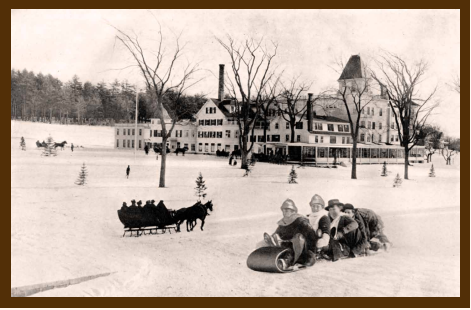
Clearly, there are some fantastic ski history buffs in among our readership. We had some spot-on descriptions of this old hotel last week.

This is the Poland Springs House in Poland Springs, ME. Here’s a bit of this famous landmark’s story from Glenn Parkinson, the historian at the Ski Museum of Maine. He writes:

Hiram Ricker expanded his family’s inn at Poland Spring in 1876 by building a hotel with 350 guest rooms. The resort was marketed as a “country getaway with recreational activities and having water with health benefits,” according to the official history. The hotel became popular for the country’s social elite and the basic design was used to develop other resorts such as the Samoset and the Mt Kineo House.

“Recreational activities included one of the first golf courses in the state and of course a variety of winter activities. In some ways the Poland Spring resort was Maine’s first winter resort. Activities such as horse drawn sleigh rides, snowshoeing and skiing were popular. A toboggan slide ran all the way down to the lake. There was even winter harness racing on the ice of the lake. Photos of the time show lots of people wearing big fur coats watching a few people on skis or snowshoes. Into the 1920’s skiing was so new to most people that it was more of a spectator event than an activity.

“Well into the 1920s the Poland Spring Resort was one of Maine’s most popular places for winter sport and recreation.”

There are some fascinating photos of ski history in Maine at the museum site.  Thanks to the Ski Museum of Maine for allowing us to use this picture.

mystery glimpse

Mystery Glimpse: The Old Hotel

Where? When? What?

This week’s Mystery Glimpse is a challenge. Major hint: The identity of the magnificent hotel can be found on the website of the Maine Ski and Snowboard Museum. Spend some time there browsing around and consider supporting the Museum and its mission. If you know where, when and what this is a picture of—or when you find the answer—comment below in Leave A Reply.

Last Week

Some astute SeniorsSkiing.com readers really know their skiing history.  There were many correct comments.
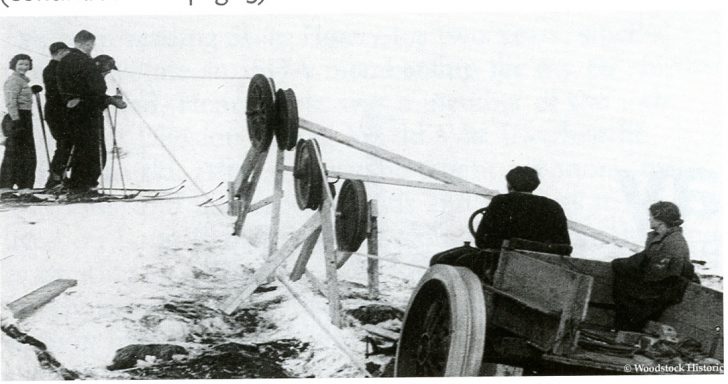
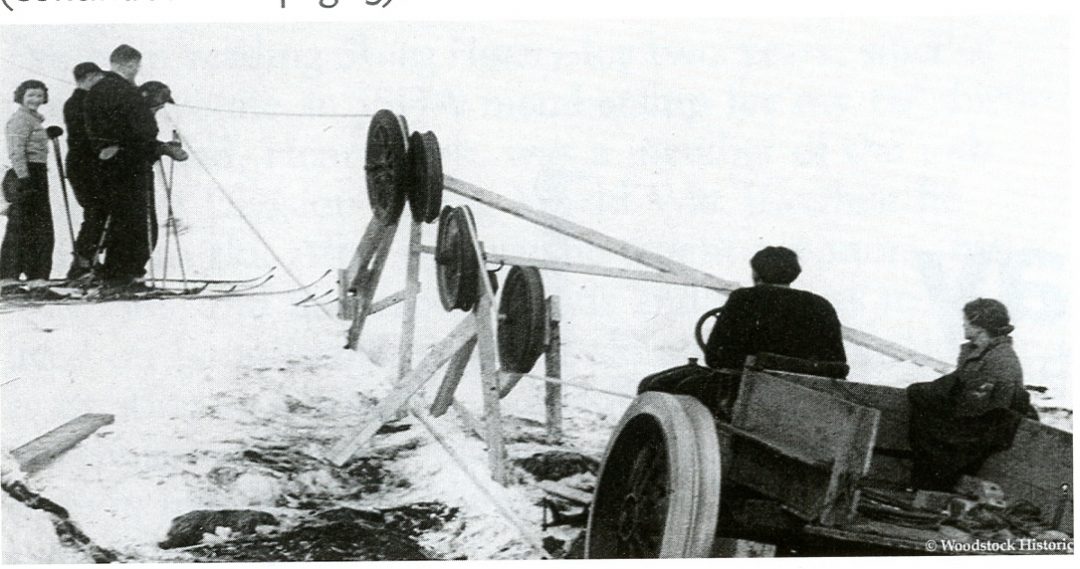
This is indeed, the famous first rope tow in the US erected in 1934 on the Gilbert dairy farm in Woodstock, VT. That’s a Model T Ford providing the uphill energy. The 900-foot tow was copied from the rope tow erected a year earlier in Quebec. The Model T had enough power to haul five skiers at a time.  The rope tow was a feature of the White Cupboard Inn for guests and locals.  Eventually the tow became the Woodstock Ski Tow and charged $1 a day for tickets. It closed in 1952, operating for 18 winters.

Two land trusts were collaborating with new landowners to maintain an easement to the historic ski hill and re-establish part of the old ski run, renovate the still standing warming hut, and cut hiking trails linking to the Appalachian Trail. Ski people love nostalgia.

We’d like to thank Skiing History Magazine and the International Ski History Association for allowing us to use these photos. 

The old Model T can be seen at the head of the lift line. Credit: Ski History.


Mystery Glimpse: Where And When?

This Is An Oldie.

Can you identify where this rope tow was and when? If you can, write your comment in Leave A Reply below.

Many thanks to Ski History magazine for this picture. Ski History magazine is the publication of the International Ski History Association. Find out more about ISHA by clicking here.

Last Week

Bjorn before the start of an American Birkebeiner, 2009. Credit: FastSkier.com

In keeping with last week’s Make More Tracks theme, we posted a picture of the GOAT of Nordic racing.

And he is Bjorn Daehlie, the Norwegian Nordic skier who has won more total Olympic and gold medals than any other cross-country skier, making him the greatest Nordic competitor of all time. 

Bjorn is reported to have one of the highest VO2 max scores for endurance athletes in all sports. The maximum rate of Oxygen (O2) consumption by the body during exercise is the criterion measure of aerobic endurance fitness. Dahlie’s VO2 max has been recorded as high 96 ml/kg/min in the 1990s.  That’s more than twice the VO2 max for his most likely competitors, 20-29 year old males in excellent condition. 

A back injury forced Dahlie into retirement in 2001.  Since then, he has become a successful businessman in real estate and fashion. Dæhlie also invented the Salomon Nordic System Pilot Bindings.  His ski clothing is offered in a variety of outlets. Click here for the Bjorn Dahlie line at REI.

What’s curious is Bjorn is a national hero in Norway, an astronomic legend in cross-country circles, yet virtually unknown to North American skiers. 

Bjorn Dahlie showing his stride.

Mystery Glimpse: XC Dominator

Perhaps The Greatest XC Competitor Of All Time?

This week’s challenge might be very difficult for some, easy for others.  Why? Because not as many people follow the fortunes of cross-country competitors compared to their Alpine counterparts. Everyone knows Karli Schranz, Jean-Claude Killy, Bode Miller, and the rest.  But how about Sverre Stenersen, who consistently won medals in the Olympics and World Championships through the 50s? Remember what Jessica Diggins and Kikkan Randall did just a few years ago in the team sprint at the PyeongChang Olympics? Curious? Check it out here. 

This week we are presenting a photo of an xc racer who some have called the very best.  If you know who he is, comment in Leave A Reply below.

Okay, that’s a nice pic, but hard to identify the person.  How about this one?

Last Week

This is ski jumper Anders Haugen wearing his 1924 Chamonix Olympics coat. Norwegian-born Haugen came to the States in 1909 and started ski jumping with his brothers in the Milwaukee area. Between 1910 and 1920, Anders and his brothers won the US Championship 11 times. As captain of the US team at the inaugural Winter Games, Haugen wound up placing fourth behind three Norwegians.
However, in 1974, a sports statistician noticed that Haugen’s score was incorrectly calculated. After verification by the International Olympic Committee, Anders Haugen, at 85 years old, was awarded a bronze medal. Thus, he became the first American Winter Olympics medalist and the only US athlete to win an Olympic medal in ski jumping.

As for this fantastic coat, it was created for the US team by the Hudson Bay Co. of Canada and is called a Capote.

The 1924 Olympic capote is made of felted, twill-weave wool. It is white or natural color with printed bold stripes in black, yellow, red and green-blue. There is fringe along the top of the shoulders and sleeves and along the top front opening of the coat made of the same wool fabric, along with a tall, pointed hood.

Anders Haugen’s “Capote” from 1924 Olympics. Credit: Colorado Snowsports Museum


Mystery Glimpse: Flashy Coat

What The Heck Is He Wearing?

Who is this person? There must be a story behind that coat. Something to do with the Olympics?  This might be a tough one. Please reply in Leave A Comment below.

Thanks to the Colorado SnowSports Museum for contributing this picture.  Did you realize there snow sports museums all across North America? Many are small, locally-funded non-profits. Consider visiting and supporting them as each serves a vital role in preserving the history of all snow sports.

Last Week.

Yes, that’s Doug Pfieffer, long-time ski celebrity, innovative ski instructor, and journalist. Ty Rice, one of our observant readers, noticed this comma position is actually the same picture, flopped over.

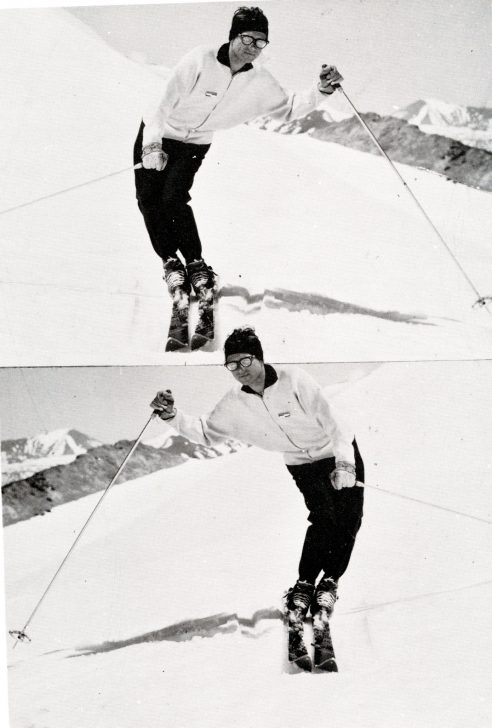
This photo was taken from my personal, autographed copy of the 1958 Skiing With Pfeiffer. Doug inscribed, “A collector’s item for Mike Maginn.” Well, it is now.

Doug is one of the founders of the Professional Ski Instructors of America (PSIA), long-time editor of SKIING magazine, promoter of skiing in film and television, and, along the way, invented freestyle skiing.  He was inducted into the US Ski and Snowboard Hall of Fame in 1987.  You can read more about his career by clicking here. 

Doug was my boss at SKIING back in the early 70s.  It was terrific to work with him in so many ways, especially since we shared the same birthday.  Happy Birthday, Doug! Here’s both of us at the 2017 Hall of Fame Induction Ceremony.

And here’s the cover of Skiing With Pfeiffer, a book which helped start the careers of many a ski instructor.

Mystery Glimpse: Instructor Comma

Famous Instructor And Ski Celebrity.

Here’s a picture of one of skiing’s most famous instructors, demonstrating the equally famous comma position.  This might be an easy one for many readers who have been around skiing for a while, like since the early 60s. Heavy hint: He just had a birthday.

Last Week

Yes, it’s the famous Air Car, a sui generis tram that operated at Mt. Snow, VT, from around the mid-60s to the mid-70s. It “flew” directly over Fountain Mountain, connecting the Snow Lake Lodge to the ski area. Legend has it that Mt. Snow developer Walt Schoenknecht had back problems and didn’t like taking off his skis.  So the Air Car, along with the Bubble Chairlift, accommodated him and, we bet, lots of other skiers.  Skis-on “gondolas” were an innovation, and Walt was a leader in coming up with ideas like the Air Car and Bubble Chair that made Mt. Snow unique.

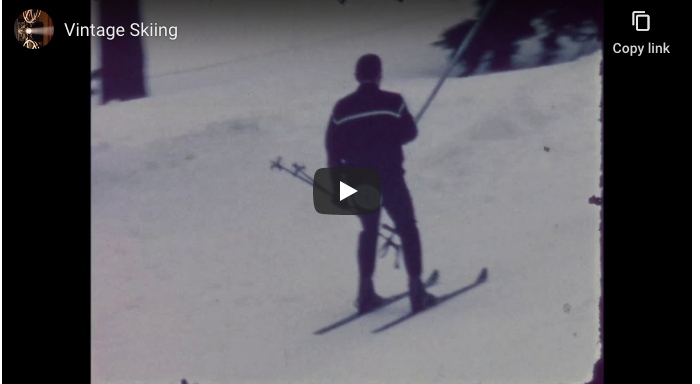
Here’s another view of the Air Car in operation. Do any readers remembers taking the Car? What was it like?

Mystery Glimpse: Air Ride

Not A Flying Saucer.

Close, though. It certainly looks like it might be from…um…elsewhere. And that’s a giveaway to what was going on in that particular era. Is it an amusement park ride? Prop from a space movie? No, but at what stylish resort did this car-ish “gondola” appear? How about when? Does anyone know the history? We thank Jamie Storrs of Vail Resorts for opening his archive of historical photos for us.


Last Week

We have few answers as to the details of the video of vintage home movies curated by correspondent Don Burch. Clearly, some 50s and 60s footage. Don reports the first segment is from the Ostego Ski Club skiing at Hidden Valley, PA. The second is labelled 1961, and no data for the last segment. Fun, though, to see that world again.

Here it is in case you missed it last week.


Mystery Glimpse: Home Movies

Vintage Scenes Of Skiing.

Here’s a different Mystery Glimpse challenge.  Correspondent Don Burch has uncovered some old home movies from an online video archive.  Can you spot where this footage might have been taken? Are there clues in these different videos that might reveal when these were taken? Even if you can’t identify the locations, check out that equipment and the bota bag. Just click on the image below. Does anyone use a bota bag these days? Anyway, have fun with these memories. 

Last Week

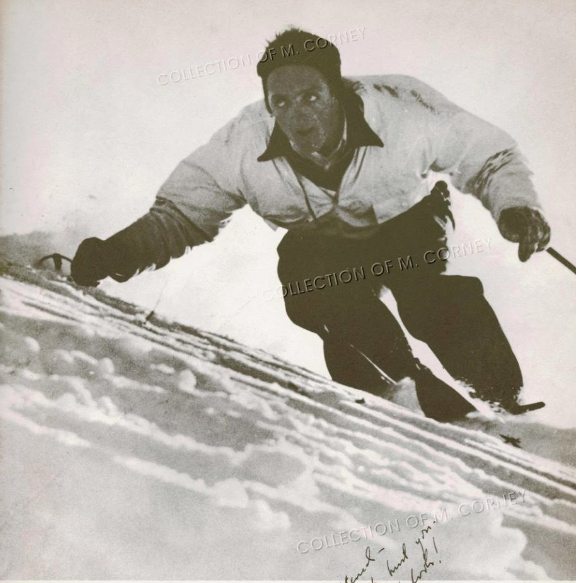
Here’s the photo with Durrance’s autograph. Credit: Ski History

This photo of Dartmouth’s Dick Durrance with an intense “look” comes from a book published by Friedl Pfeiffer in 1939.  The Sun Valley Ski Book was a pictorial ski instruction book, containing action shots of celebrity skiers of the day.  We discovered this photo in an article in Ski History Magazine, the publication of the International Ski History Association. The specific book this was taken from was discovered in bookstore by long-time skier Marc Corney. Not only does it contain a collection of spectacular photos, each photo has an autograph of the subject.  There’s also four pages of autographs from various people who apparently were invited to sign the book which most like belonged to none other than the author Friedl Pfieffer.  You can read the whole fascinating story by clicking here. There are lots more pictures, too. And please consider supporting the International Ski History Association while you are at it.

Autograph: “Don’t be frightened. He’s too small to hurt you even with that look!” Credit: Ski History


Mystery Glimpse: Those Eyes

The Face Of Intensity.

Here’s the first of our Mystery Glimpse feature for this new season. We post a picture from snowsport’s past and you guess who the person, place, or thing is. Write your response in the Leave A Reply box below.  If you know any details about the photo or the situation, let us know.

Here’s a racer whose name you should be familiar.

Credit: Ski History Magazine


Mystery Glimpse: Yes, It Was Buddy

Buddy Werner, Movie Star

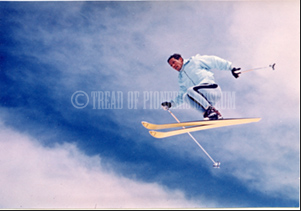
Many readers identified this Bogner-clad high-flyer as Buddy Werner, the celebrated ski racer. And yes, there is a strong resemblance to Jean-Claude Killy in this pic. Many thanks to Steamboat’s Tread Of Pioneers Museum for contributing this photo.

Just three weeks after the 1964 Innsbruck Olympics, Buddy Werner was in Switzerland to film a movie produced by Willy Bogner. According to Wikipedia, Werner and German racer (and Olympic medalist) Barbi Henneberger, age 23, were caught in an avalanche on the Trais Fleur slope, near St. Moritz. Both skied out of the first avalanche, but were caught up in another; their bodies were found hours later.

Bogner, 22, and Henneberger were to be engaged that summer;  he was tried by a Swiss court for homicide by negligence. He was initially acquitted, but the prosecution later won a conviction on appeal, of manslaughter by negligence, and Bogner received a two-month suspended sentence.

After a memorial service in Denver, Werner’s funeral in Steamboat Springs overflowed the United Methodist Church,and he was buried at the city cemetery at the base of Howelson Hill. Coach Bob Beattie and teammates from the U.S. Ski Team were pallbearers. 

Kudos to reader Bruce Boeder for following the hints and connecting the dots. In case you missed it, here’s his entry: “Went to the Internet Movie Database and find that Buddy Werner did appear in a movie called SkiFascination made by Willy Bogner (Werner and Bogner’s fiancée were killed in an avalanche while making the movie—but people subscribed to this website well remember Buddy Werner). Accordingly, piecing together the clues—photo from the Steamboat museum, Head Comps with long thongs, and Scott poles— it may be Buddy dressed in the Bogner finest?!” Elementary, my dear Bruce.

Here’s a preview of SkiFaszination, released in 1966. Bogner skiwear galore.

Thanks To The Ski Museums Who Contributed To This Series

Our Mystery Glimpse series would not be possible for the many ski museums who allowed us to use photographs and artwork from their archives and collections.

These museums are scattered across the country, all mostly staffed by dedicated volunteers and a few paid employees. If you’ve never visited a ski museum, you have a treat ahead. Please consider a visit—virtually, or in person (when the virus lifts), stop at the museum’s gift shop, make a donation, and marvel at the care taken to curate the history of snow sports.

The ski museums which have contributed paintings and artwork this year:

And many thanks to our insightful readers for their many guesses, comments, memories, and contributions to our trip through snow sports nostalgia.


Mystery Glimpse: Movie Star

Who’s This?

This is a still from a movie this celebrity ski racer was in. Many thanks to the Tread Of Pioneers Museum in Steamboat Springs, CO, for this photo.

Last Week

Credit: Journal New England Ski Museum

From the Journal Of The New England Ski Museum:

“Pete Seibert worked as a ski patroller in Aspen just after the war, then in 1950 attended L’Ecole Hoteliere de Lausanne in Switzerland, learning the art of hotel management on the G.I. Bill. Returning to Colorado, he became manager of Loveland Pass ski area, then moved to Aspen Highlands in 1957.  By then, Earl Eaton had taken Seibert on a March climb up the mountain just west of Vail Pass that Seibert decided he would spend his life developing.”

The video below tells the story of that seminal hike into the hinterlands which would become the Vail resort.


https://www.youtube.com/watch?v=zP4vzekpwjg

Mystery Glimpse: Cool Sun Glasses

A Founder

Another easy one.  Let’s hear from you. Do you have any stories about this person?

Credit: Journal New England Ski Museum

Last Week

Credit: Dorothy Crossley, New England Ski Museum

Nancy Greene-Raine, skiing’s girl next door. Not only was she a successful ski racer for Canada, she became a senator for British Columbia in 2009 until her mandatory retirement in 2018. She has a long list of ski industry related accomplishments, including racing, ski area development, fundraising, as well as awards.  She is a recipient of the Order of Canada, the country’s highest civilian honor. She was instrumental in developing Sun Peaks in BC where she regularly skis with visitors.

Here’s a comment from Steve Threndyle, a reader who recently skied with Nancy.

“That’s Nancy Greene-Raine (note ‘e’ in Greene and hyphenated last name). Canada’s Female Athlete of the Half Century (wasn’t even close). Two time overall World Cup winner. Canada’s Sweetheart (well, more like, “Tiger”, her nickname). Gold and Silver Olympic Medalist, in 1968 Grenoble. Served in the Canadian Senate until mandatory retirement at age 75 three years ago. Authored legislation to ban sugary/unhealthy food and instituted Canadian Fitness Day each June.

Skied with her for a couple of hours two weeks ago. She and Al are wonderful people. Sun Peaks is a fantastic place!”

Here’s a picture Steve provided with a smiling Nancy.

Nancy still skiing at Sun Peaks. Credit: Steve Threndyle

Here’s a short video of Nancy speaking about her 1968 Grenoble Olympics gold medal win.

Mystery Glimpse: Young Racer

Who Is This Racer?

Major hint: O, Canada! This one should be easy. This week, we all need an easy one. Can you tell us about her history? Her extraordinary career? Thanks to the New England Ski Museum for this picture.

Credit: Dorothy Crossley, New England Ski Museum

Last Week

This photo was taken at Crested Butte Mountain Resort in 1963, showing off the installation of their new Carlevaro-Savio, Silver Queen Gondola.
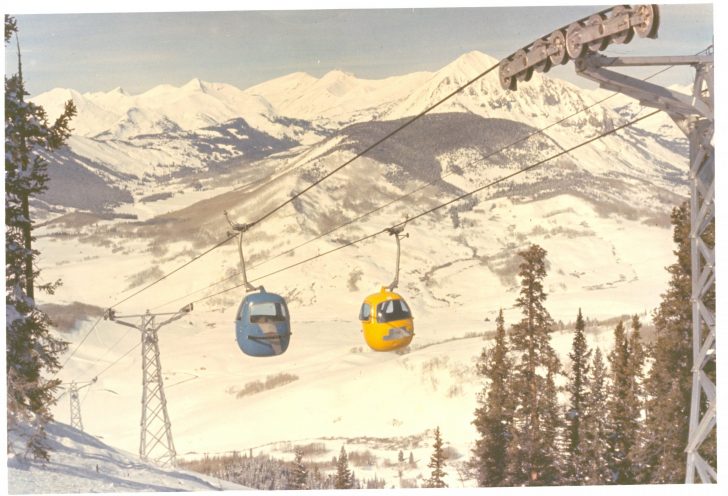
Crested Butte Mountain Resort opened in 1960 when two men—Fred Rice and Dick Eflin—purchased a ranch on Mt. Crested Butte. An operating permit enabling the resort to be built was approved by the United States Forest Service the following year.

In 1963, Crested Butte constructed a top-to-bottom gondola from the base area to near where the bottom of the High Lift is today. The resort was the second resort to open a gondola in Colorado, after Vail Ski Resort opened theirs in 1962. Constructed by Carlevaro-Savio, the three-person Silver Queen Gondola was notorious for being cramped, and the cabins were known to have frequent collisions. The gondola lasted until 1972, when a bubble double chairlift replaced it.

Special thanks—again—to Dana Mathios, curator and Director of Collections, at the Colorado Snowsports Museum, located in Vail, CO.

Mystery Glimpse: Bumpin’ Gonds

What Ski Area Is This?

And what’s the story behind these yellow and blue gondolas?

Special thanks to Dana Mathios, curator of the Colorado Snowsports Museum, for providing this week’s photo.

Last Week

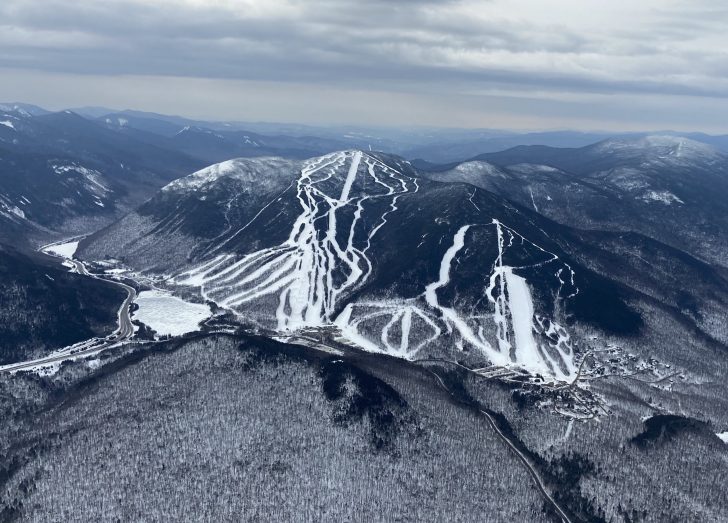
This is a photo of Cannon Mountain, Franconia, NH, home of America’s first aerial tramway which began operation in 1938 and was renovated in the 80s. Taken from the air by a passing friendly aviator, the resort has a reputation as one comment pointed out for being “too cold and too fast”.  Regardless, one feature of Cannon that endears the state-owned resort to SeniorsSkiing.com is that seniors 65-plus ski for free. That is, if you are a New Hampshire resident.  Still, that’s a gift.

That wide swath you see on the right side of the mountain is the training hill for myriad ski teams. At the very base is the Mittersill Alpine Resort.  A reader reports the training hill was closed for 40 years, but it’s clearly back in operation, accessible from the base by a t-bar.  Quaint, no?

Here’s a short video showing the ride up the tram.


Mystery Glimpse: From The Air

What Are We Looking At?

Thanks to a friendly aviator, we have this magnificent, recent (last week) view of a most formidable mountain resort.  How’s your pattern recognition?  Can tell us where it is? Major hint: That wide trail to the right is used for racing team practice.

Last Week

Yes, Lucille Ball visiting the Mittersill Alpine Resort in Franconia, NH, probably in the early-mid 60s. The man on the left is Gary Morton, her second husband, not her “I Love Lucy” husband-partner Desi Arnaz.

She and Desi can be credited with creating the sitcom format. Among her many other achievements was becoming the first female head of a major television-film production company, Desilu Productions. Her biography doesn’t reveal her attraction to snow country, however.

We can only guess she was a guest of Baron Hubert von Pantz, Mittersill’s founder and aristocratic host.

Desi, Jr., down in front looks like he could use a hot chocolate.

This photo is currently on display in the lobby of the Mittersill Alpine Resort along with other momentos of the hotel’s history.  Among those is a page from the hotel registry featuring the signature of Princess Elizabeth, soon to be Queen, on a stop over trip during her tour of Canada.


Mystery Glimpse: Celeb In NH

[Editor Note: SeniorsSkiing.com is asking our readers to contribute to support our online magazine. Yes, we have grown in the number of subscribers and advertisers. But our expenses have also grown. You can help us defray some of these expenses by helping us out with a donation.]

Support SeniorsSkiing.com by clicking here.

______________________________________________________

All The Way From Television Land.

Was she a skier?

Here’s a famous television celebrity you should know if you grew up in the 50s. We took this from a picture displayed in the lobby of the venerable Mittersill Alpine Resort, Franconia, NH. We think the famous person was visiting the Baron von Pantz and his family, who built the resort in the mid-40s, modeled after his “castle” in Austria.  Enough clues.

Last Week

This is iconic Tuckerman Ravine, located across from Wildcat Ski Area in NH. There were many interesting guesses as to the artist.  We can see a little Wyeth in there.  However, this watercolor is by G. Lewis Hodgkins (1906-1972), an architect who lived in nearby North Conway. Hodgkins eventually became keeper of Ye Coach and Four Inn on Oak Street. He gave daily painting lessons that were quite popular.
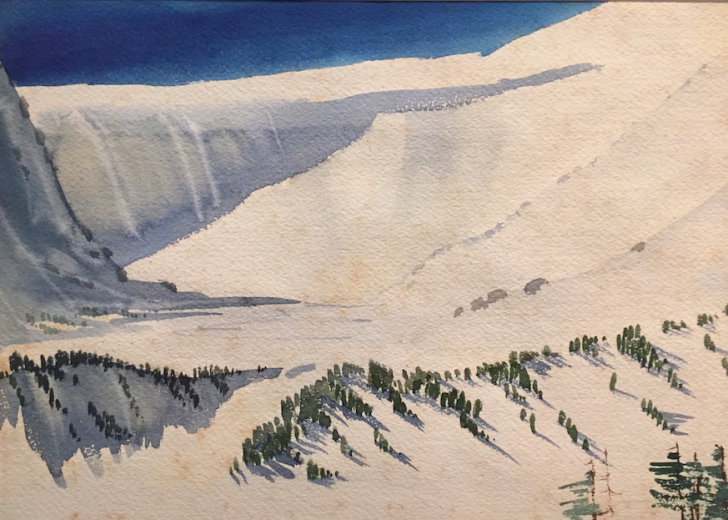
He is known for his bold strokes and his ability to interpret his subjects simply and impressionistically. This water color was most like done en plein air. 

Curiously, as an architect, Hodgkins designed homes and buildings in and around the area, including the North Conway Community Center which eventually became the North Conway branch of the New England Ski Museum where this work is currently displayed.

Many thanks to the New England Ski Museum for permission to use this photo.


Mystery Glimpse: Water Color With Snow

[Editor Note: SeniorsSkiing.com is asking our readers to contribute to support our online magazine. Yes, we have grown in the number of subscribers and advertisers. But our expenses have also grown. You can help us defray some of these expenses by helping us out with a donation.]

Support SeniorsSkiing.com by clicking here.

______________________________________________________

You Can Probably Guess Where, But Who’s The Artist?

Many thanks to the New England Ski Museum, North Conway Branch, and Executive Director Jeff Leich for letting SeniorsSkiing.com use this beautiful water color.

Last Week

Credit: Thad Quimby, Peak Resorts

Yes, Suzy “Chapstick” Chaffee.  And the location is Fountain Mountain, Mt. Snow, VT., probably during a photo shoot.

A major skiing celebrity,  Suzy is a former Olympic alpine ski racer and actress. Following her racing career, she modeled in New York with Ford Models and then became the pre-eminent freestyle ballet skier of the early 1970s. She is perhaps best known by the nickname, Suzy Chapstick, from the 1970s, when she was a spokesperson for ChapStick lip balm.

She was inducted into the National Ski Hall of Fame in 1988.

As a social activist, Chaffee championed Title IX legislation (equal opportunity for women in school sports). She was the first woman to serve on the board of the U.S. Olympic Committee, and has been a member of the President’s Council on Physical Fitness under four U.S. presidents. She was a co-founder in 1996 of the Native Voices Foundation, an organization that seeks to develop Olympians from among Native American tribe.

Suzy combined two great skills: Ballet and Skiing,  becoming a key player in the free-style movement back in the 1970s. She also was a pioneer in the fitness craze, writing a book about fitness, and remaining committed to athletics and exercise long into her career.

Suzy embraced skiing and ballet to provide a foundation for freestyle.


Mystery Glimpse: Fast Lady

[Editor Note: SeniorsSkiing.com is asking our readers to contribute to support our online magazine. Yes, we have grown in the number of subscribers and advertisers. But our expenses have also grown. You can help us defray some of these expenses by helping us out with a donation.]

Support SeniorsSkiing.com by clicking here.

______________________________________________________

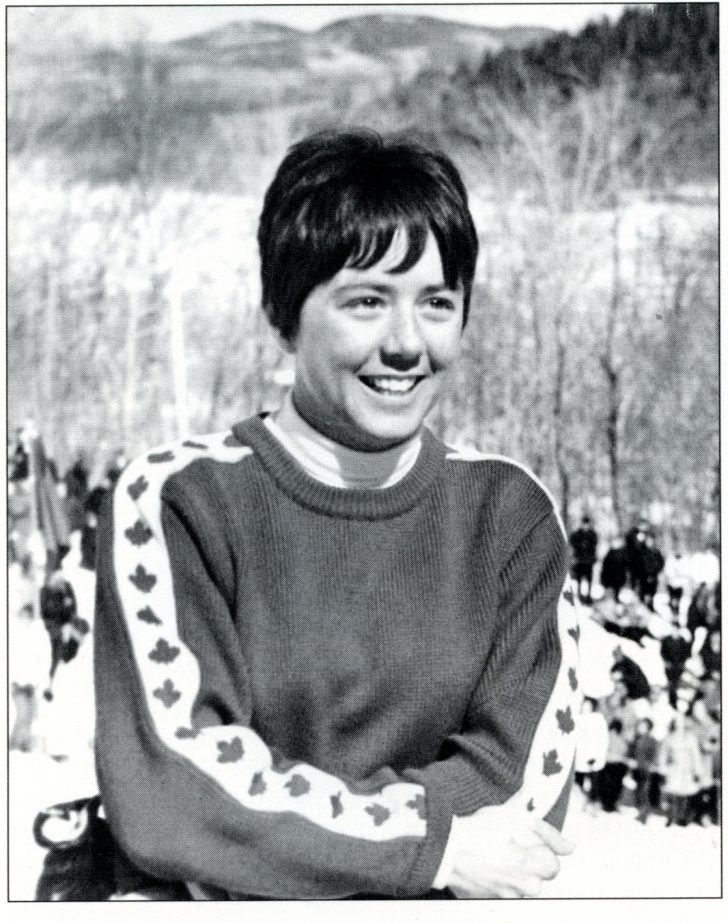
Nice Sweater, But Who Is She?

Looks like a balmy day on the snow with this speeding skier, sans cap and a big sweater.  And hmmm, that flag.  This week’s pic comes from Jamie Storrs at Peak Resorts who has opened their archives for SeniorsSkiing.com.

Credit: Thad Quimby, Peak Resorts

Last Week

Thanks again to Dana Mathios, Curator and Director of Collections, Colorado Snowsports Museum, for the description. This photo shows the 1972 U.S. Alpine Ski Team. Colorado heroes include Hank Kashiwa, Rick Chaffee, and Whit Sterling.

Hank Kashiwa was a member of the U.S. National Team from 1967 to 1972. He won the 1969 US National Championships and competed in the 1970 World Championships in Val Gardena, Italy. After racing in the 1972 Olympics in Japan, he starred in the Pro Circuit from 1972 to 1981 and won the World Pro title in 1975. He later served as President of the Volant Ski Corporation, a Boulder-based ski manufacturer. Hank was inducted into the Colorado Snowsports Hall of Fame in 1994.

Other 1972 US Alpine Ski Team members included Bob Cochran, David Currier, Terry Palmer, Tyler Palmer, Karen Budge, Marilyn Cochran, Susan Corrock (placed third in Downhill), Barbara Cochran (who won the Slalom), Sandy Poulsen , and Patty Boydstun.

Mystery Glimpse: Name That Team

Here’s A Ski Team From The Past.

Can you name when? Who’s who? Thanks to the Colorado Snowsports Museum for this one.

Last Week

Well, last week’s photo was a challenge.  Not one guess. Thanks again to Dana Mathios of the Colorado Snowsports Museum for this description.

This photo was taken at The Hotel Jerome in Aspen. The photo is believed to have been taken in 1948, but some indications from the scrapbook this photo came from indicate a date as early as New Years 1939. The Jerome was built in 1889 and is often described as one of the city’s major landmarks. In 1986 it was listed on the National Register of Historic Places. During Prohibition a celebrated spiked drink, the Aspen Crud, was invented at “J-Bar”. Later, the drink and the bar became popular with members of the 10th Mountain Division while they trained in the area. After the war, Aspen and its new ski resort became a popular destination. Celebrities vacationed in Aspen like Gary Cooper, John Wayne, and Hunter S. Thompson.

The Hotel Jerome: If the walls could talk…Credit: Amuse


Mystery Glimpse: Crash Pad

CORRECTION!

Linda Meyers, not Barb Ferries.

We received several comments and emails about the identification of the woman in this recent Mystery Glimpse. The photo was provided by the Tread of Pioneers Museum, Steamboat Springs, was mis-labelled as Barb Ferries. Our observant readers saw the error and correctly identified her as Linda Meyers who also skied with Buddy Werner on the 1964 US Ski Team.  One of those who corrected us was none other than Chuck Ferries, Barb’s brother.  We notified the curator at the Tread of Pioneers Museum which is taking corrective action. Thanks readers.


Where Is This Hotel?

Thanks to the Colorado Snowsports Museum for this picture.

Last Week

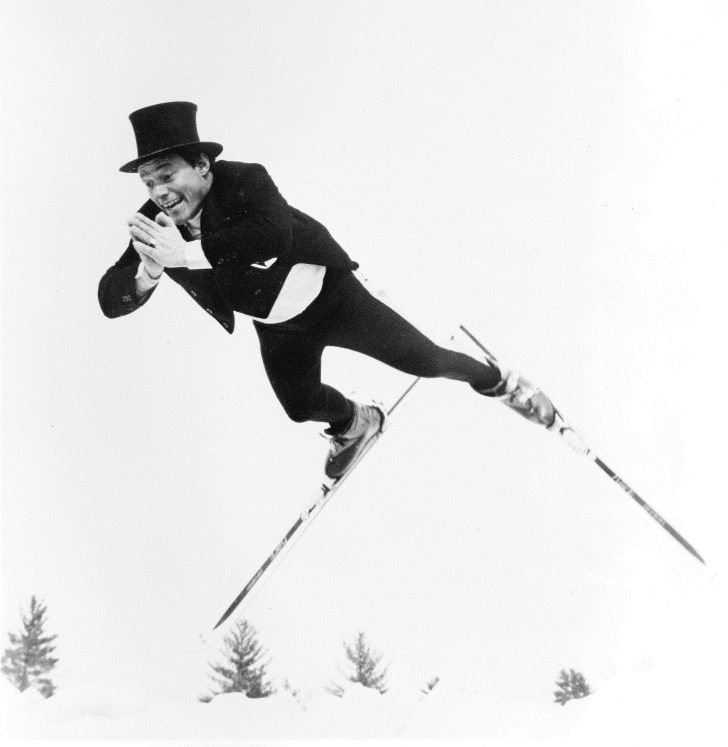
Rudi Wyrsch was the self proclaimed Pied Piper of skiing and taught children not only how to ski but how to have fun on and off the snow.  From Piperville, his name for the Mt. Snow pee-wee  playground/ski school,  to his 12 foot stilts, Rudi was a master at engaging children with entertainment.  Once a member of the Swiss national team and coach of the British, Australian, and New Zealand ski teams, Rudi worked at Mount Snow in the 60’s – 70’s. After wowing the kiddies on the hill, Rudi entertained adults back in the lodge with joke-telling, magic tricks, and juggling.  

Rudi’s approach to teaching kids at Piperville revolved around three principles: 1) Balance, 2) How to turn, and 3) Self-confidence. 

Rudi conducted trick skiing stunts across New England.  Here he is performing at Pleasant Mountain, ME, home of a nascent freestyle program under Rudi. He later open a restaurant at Taos, NM. We have heard, but could not confirm, that he was killed in a “ski accident” in Switzerland.  If anyone knows that part of the story, please share it with us.

Thanks to Mt. Snow and Peak Resorts for the pic of Rudi  flipping in the top hat and to the New England Ski Museum for the photo below.


Mystery Glimpse: Top Hat

Flippin’ Clown.

This should be easy for some old timers.  Who is this guy? What’s his back story?

Thanks to the amazing historic ski photo archive at Peak Resorts for this pic.

Last Week

This is Linda Meyers and Buddy Werner in April, 1963.  Linda competed at the 1960 and 1964 Winter Olympics. In 1960 she tumbled in the downhill event, but completed the descent and placed 33rd; she failed to finish the giant slalom. In 1964 she placed 12th in the slalom and 30th in the giant slalom.

Meyers grew up in Bishop, California, near Mammoth Mountain, and took up skiing following Jill Kinmont Boothe. Besides Olympics she competed at the 1958 and 1962 World Championships and finished fifth in the combined event in 1962. After retiring from competitions she coached skiers in Colorado.

Buddy Werner was a top US ski racer, retiring from racing after the 1964 games. He was killed in an avalanche while filming a ski movie in the Swiss Alps later that year.

[Note: This Mystery Glimpse was updated, correcting the identity of the woman skier.]


Mystery Glimpse: Two Racers

One Very Young, The Other A Successful Competitor.

Many thanks to the Tread Of Pioneers Museum, Steamboat Springs, for this photo. Visit their online collection by clicking here.

Last Week

This is George Lundeen’s bronze statue, The End of An Era,  circa 1960. Why is it significant? Here’s what Dana Mathios, Curator and Director of Collections, Colorado Snowsports Museum, has to say:

This sculpture depicts a sport poised at a turning point on the edge of change. Soon, metal and synthetics would become standard in ski construction in place of wood that had been in use for more than 4,000 years. Pioneering skiers used a single wooden pole. By the early 1900s, two poles were in fashion. The shafts were often made from bamboo until superior poles of a light metal alloy were developed. Higher, plastic ski boots featuring buckles marked the passing of lace-up leather boots.
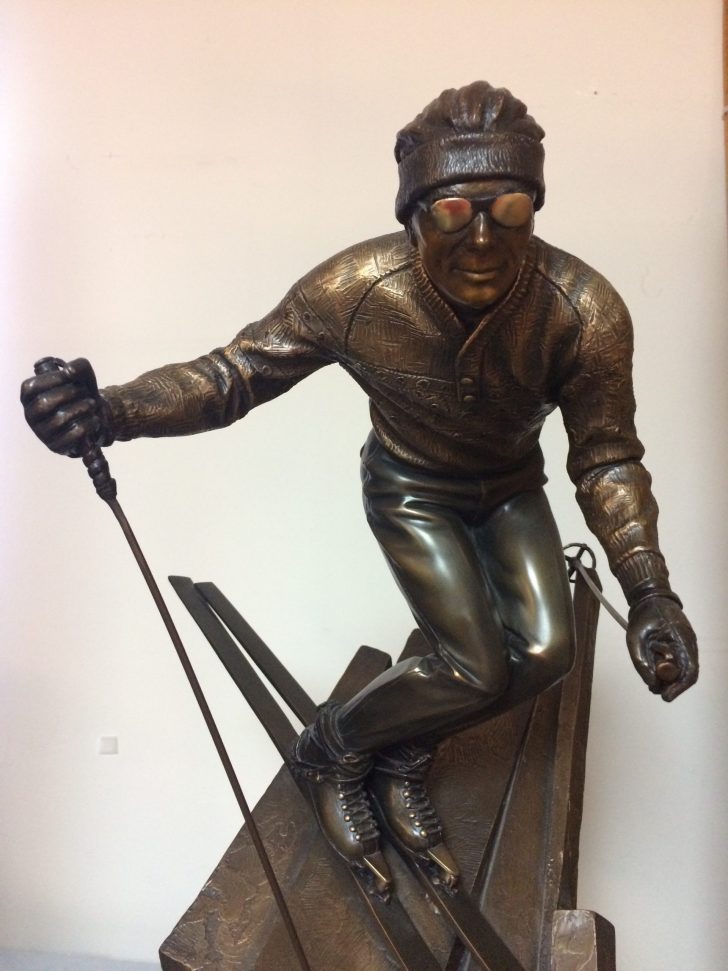
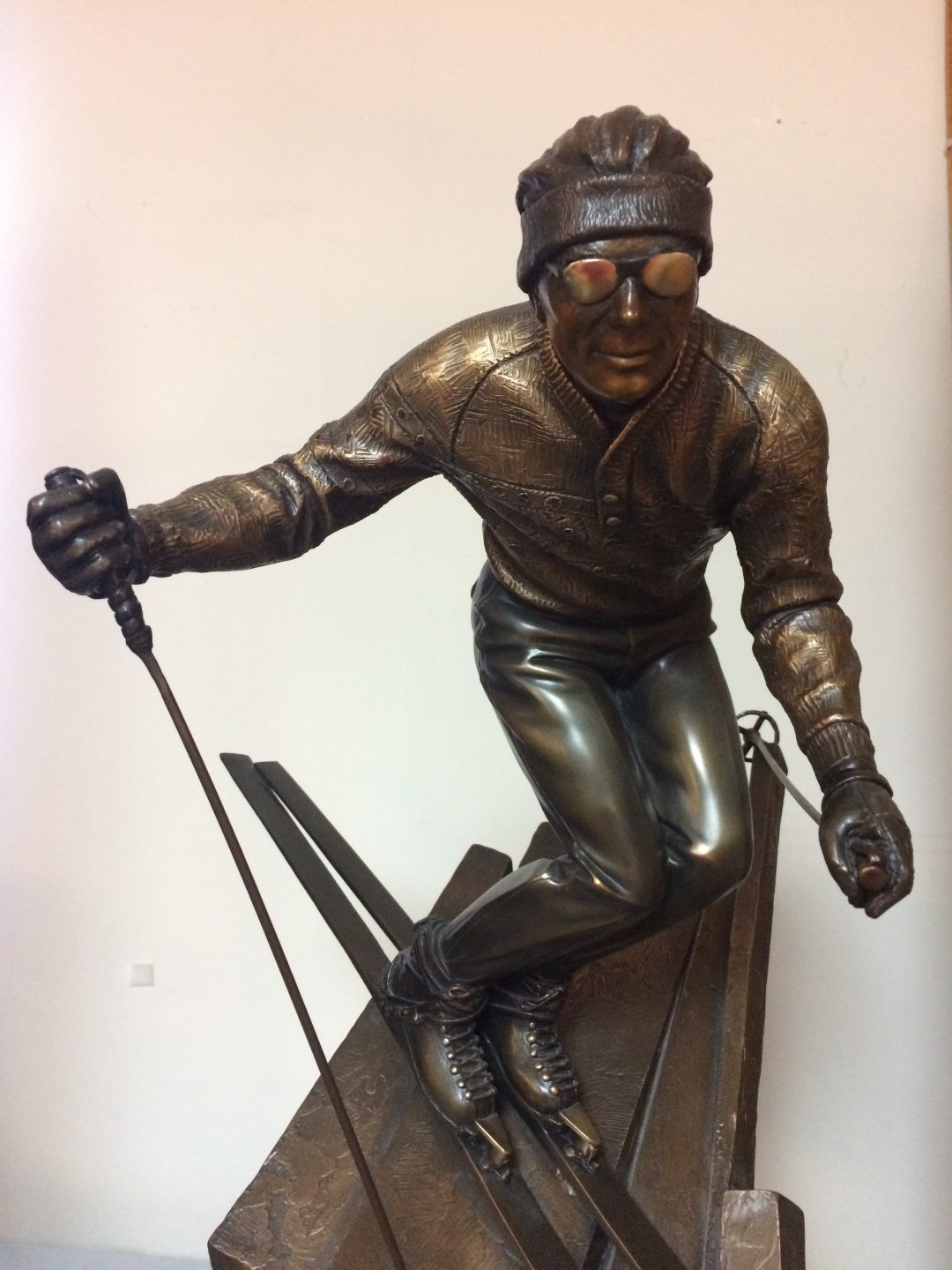
Also depicted in the sculpture is an early version of a safety binding designed to release the toe of the boot in a fall. A leather thong anchored the heel to the ski. More advanced safety bindings that released both the toe and the heel of the boot followed.

Early in the development of Colorado’s ski industry, the Pikes Peak region offered a number of small ski areas. Nearby slopes at The Broadmoor Hotel and others on Pikes Peak at Glen Cove, Elk Park, and Holiday Hills were popular. The region also included Tenderfoot Hill at Cripple Creek and the Edlowe ski jumping hill at Divide. In time, large corporate-managed ski areas further to the West replaced the small, locally owned ski facilities in the region.

Many thanks to  curator Dana Mathios and the Colorado Snowsports Museum for their many contributions to SeniorsSkiing.com’s Mystery Glimpse feature. Visit the museum’s website to browse its collection and do consider making an audition.

statue

Mystery Glimpse: Turning Point

What’s The Story Behind This Statue?

Why is it so important to the Colorado Snowsports Museum?  Who is the artist?

Last Week

The Fountain Mountain at Mt. Snow, VT was the subject of last week’s mystery. According to Mt. Snow’s Jamie Storrs, the Fountain was switched on for the first time on January 18, 1965

When Mount Snow’s founder, Walt Schoenknecht, saw something he simply must have, he built it. In this case, it was the fountain that shoots out of Lake Geneva in Switzerland. From that seed, Fountain Mountain is born.

Fountain Mountain, a 350-foot geyser out of Snow Lake, is powered by twin Westinghouse 600-horsepower pumps that shoot 3,000 gallons of water per minute straight up through three Worthington centrifugal pumps.  It was said to be the largest man-made geyser ever built.  Back in the day, Governor Phil Hoff was on hand to launch Fountain Mountain.

During the winter, Fountain Mountain erupts 24/7 and as the water freezes, a giant ski hill is formed. The hill is large enough to hold races; a rope tow transports skiers to the top. Fountain Mountain lasts into the summer months and, since 1969,  is the site for summer race camps in June.

Alas, the Fountain Mountain was shut down when the energy crisis of the early 70s drove the costs of running it out of sight.

Swimming at the foot of Fountain Mountain, circa 1964. Credit: Mt. Snow