Tag Archive for: conditioning for seniors

Shape Up 2: Up A Notch

Revving Up Intensity For Our Five Basic Exercises.

[Editor Note: Last month, we reprised a set of baseline exercises focusing on legs and hips as part of a get-ready strategy for this season’s snow sports activities that was originally published in 2016.  This week, our exercise guide, physical therapist, certified strength and conditioning specialist and teleskier Rick Silverman, shows us how to up these exercises to the next level. As with any exercise plan, make sure you don’t overdo it; recognize your limits. If you have any issues or complications, please check with your medical advisor. In a couple of weeks, we will show you the highest intensity level for these activities.]

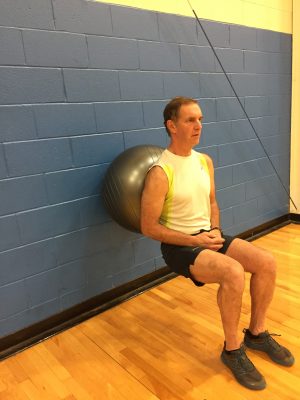
Static Quad Wall Sit

We used to do this in our college freshman dorm as a macho challenge. Sit against the wall, legs at 90 degrees.  You can use a ball, as Rick does here, or just lean against the wall.  Start with a relatively comfortable time, say, 20 seconds. Work your way up to 60 seconds. And don’t overdo this one!

quadwall_static_1


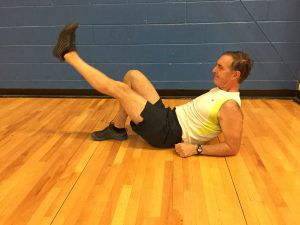
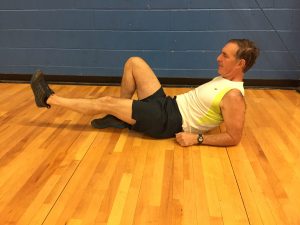
Sit Up Leg Raises

Bring your upper body up, support yourself on your elbows.  The key here is keeping your leg straight and toes up.  Don’t rest your heel on the ground on the downbeat. A variation is to point your toes to the right on the up and to the left on the down and vice versa.

legraise_sit_1

legraise_sit_2


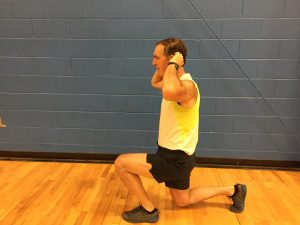
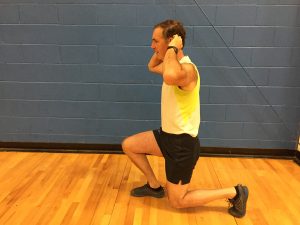
Alternating Lunges

Bend knee to 90 degrees and no more. Alternate right and left if you want or do eight reps on the right, eight on the left and repeat.

lunge_alt1

lunge_alt2


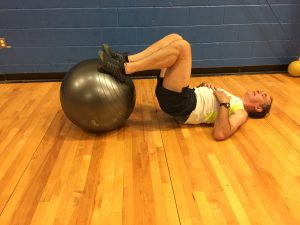
Hamstring Bridge

You can use an exercise ball for this or a chair with rollers.

hamstring_bridge_1


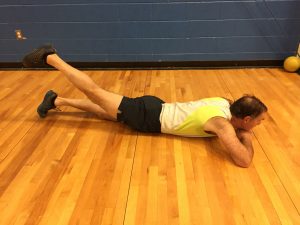
Glute Leg Raise

Add this hip area exercise to the Outer Hip Abductors we showed you last time.  Remember, hip strength plays a big role in all snow sports moves. You will feel this in your butt, for sure.  Don’t raise your leg too high. Again, work your way up to 16 reps x 2 sets.

hipflexor_glute


The most important take-away from all this is to do something to get into shape for the snow sports season.  Cycling, hiking and all those other summer sports are terrific conditioners.  If you’ve been active all summer, try some of these as a test of sorts to see where you stand, conditioning-wise.  If you’ve not been as active, please take time to run through some of exercises. If you do these every other day, you will start seeing results in a couple of weeks.

Can You Ski Yourself Into Shape?

There Are Other, Fun Ways To Get Ready Besides Hitting The Gym.

Sure, you can do the gym thing. It’s not too late to hit the trails, too.

One of the myths I hear from people at the beginning of the ski season is that they can “ski themselves into shape.”  They have not really done any preparation for the ski season and feel that they just have to start skiing, and their ski legs will eventually come back.  If I ever heard fake news, this is it.  Skiing is a dynamic sport and in order to effectively execute a turn, your legs need to be in good shape before the first turn of the season.  I can’t tell you how many times I have see folks whose “legs are killing them” after the first and second day of a ski trip.  They ski defensively, because they are not in good shape and all the money that they have spent on a ski trip is for naught. That’s because they failed to get in shape before they got on that airplane.  The same is true for local skiers who make their way to their local ski area and have the same experience.

So why not start thinking about this now if you have not done so?  There are a lot of articles popping up in the ski periodicals and web sites about exercises that you can do in the gym.  But how many of us really want to spend time in the gym day in and day out to prepare for ski season?  How many times can we pretend to sit in an invisible chair with our backs to the wall to strengthen our legs?  On the other hand, there are outdoor activities that can be engaged to get the legs in shape but are also fun and allow us to be in the outdoors which is where we all want to be in the first place.

With the flaming leaves coming in to view, the trails in our mountains and parks are available for mountain biking, hiking, and trail running.  Hiking and trail running uphill prepare the legs for sure as well as providing an excellent outdoor fresh air activity.  Mountain biking ramps that up a bit by strengthening the legs on climbs, as well as simulating skiing skills like looking ahead and picking a path through varied terrain.

Lots of folks mountain bike, hike, and run during the summer season when the weather is cooperative, but when the time change looms—Nov. 4 this year, by the way—and the days get shorter, the motivation for these activities starts to wane.  If you want to be prepared for ski season, I would strongly suggest that you continue these activities as long as you can during the fall and into the winter if conditions allow.

A good friend of mine says there is no such thing as bad weather, just bad clothing choices. So why not buy a good Gore-Tex suit for running or hiking and also one to ride in the winter if you can do it.  Night riding is a favorite of mine, and there are a lot of options for rechargeable light and battery systems. I have used a lot of expensive lighting  options in the past but with the advance of lighting technology, you can now purchase systems for a fraction of the cost of the traditional main stream lighting systems.  Cree Mountain Bike Lights found on Amazon are an excellent choice for around $32.00 and provide three mode LED lighting with a rechargeable battery that can provide up to two hours of excellent light on high mode.  I use these lights on my handlebar with another one on my helmet.  I store the battery for the helmet light in my hydration pack and also the battery for the handlebar light can be attached to the top tube of the mountain bike.  I also purchase spare batteries and store them in my pack in the event that there are any issues with the primary battery.

It is not too late to get back on that bike, lace up the trail running shoes or hiking boots, and get moving.  Your legs will appreciate your diligence now in the early fall season, and you will enjoy your turns and ski outings much better if you take the time to be in shape when the first flakes start to fly in the mountains.

High tech bike lights allow you to ride into the evening hours when the clock changes back to Standard Time. Credit: MountainRides.com


My Fitness Journey Continues: Part Five

From High-Tech to Low-Tech, Great Gear For Getting Fit

The best fitness gear you can get requires no expense! It’s at the end of your legs: your own two feet. Walking (or jogging or running) as much as you can in any given week will burn calories and keep you cardiovascularly fit. Being on the move is considered one of the key factors in staying healthy and living longer (as well as enhancing one’s stability, litheness, and mind function).

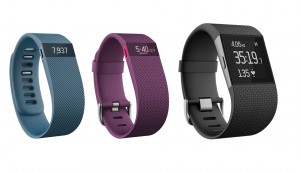
The pioneering body device is Fitbit. Other devices have grown up around it. Credit: Fitbit

The pioneering body device is Fitbit. Other devices have grown up around it.
Credit: Fitbit

But in the digital, tech-centric world we all live in today, even our simple walking regimens can be enhanced by a bit of 21st-century gear, the most popular being Fitbit. The dandy little waterproof device straps on your wrist and keeps track of exactly how much you’re actually walking any given day. The basic device ($80 on Amazon) monitors the number of steps you take and lets you set personal goals you can track. It also monitors your sleep so you know how long and even how peacefully you’ve slept. For a bit more moolah, there are more sophisticated trackers available, like the Apple Watch,  that do such amazing things as alert you when you’ve been idle for a certain length of time, and track your heart rate, skin temperature, and blood oxygenation.


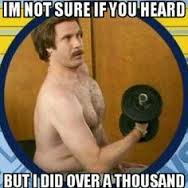
Can you do that? Weights are critical to seniors' fitness. Credit: GymRat

Can you do that? Weights are critical to seniors’ fitness.
Credit: GymRat

The most essential low-tech fitness gear for seniors? Without question, weights. Every official health organization recommends that seniors, whatever their age, incorporate regular strength training into their weekly regimen. In Part Two of this series, the UCSF medical director I was interviewing recommended I get a bone scan since I hadn’t had one since my 50s. The new scan showed that I had osteopenia, meaning lower-than-normal bone mass, now widely considered to be a natural aging process, and one that, in many instances, can be dealt with naturally without drugs. I was told to make sure I was getting enough calcium and to do regular weight-bearing activities. In addition to my weekly half-hour weight class, I now do a half-hour of weights two more times a week. Start out with a weight that’s comfortable (but not too!), then once your round of reps becomes too comfortable, go up a weight. I’m currently using three-pound weights, but I’m about to switch to my five-pound weights. You can find many different weight exercises for seniors online, so it’s easy to create your own program; just be sure you’re getting all the muscle groups.

An update on my own personal fitness journey: I continue to make slow yet steady progress to decrease my weight and measurements and increase my core strength, balance, cardiovascular capability, and stamina. I rarely miss any of my four weekly exercise classes (aerobics, stretching, and weights), which I’ve become a little addicted to. I see a marked improvement in my balance (I can grab an ankle and bring it up behind me for a quad stretch without teetering at all, but I still can’t do burpees, which the 78-year-old woman next to me does without batting an eyelash!). I’ve quit Weight Watcher’s, but I continue to keep a food diary and I’ve cut out some bad eating habits that I miss not at all (such as potato chips with sandwiches). I make it a point to say no to myself dietarily several times a day. When I started this fitness series on May 1st, I weighed 166 pounds; today I weighed in at 156 pounds. At this rate, it would take me another year to reach my target weight of 130 pounds, so I plan on making some major changes in my diet regimen in the coming three months. Stay tuned!

A Dietary P.S.—

How sweet it isn’t! I religiously check the nutrition facts on labels for the daily value percentages, but I didn’t even notice all these years that there is NO percentage listed for sugar until my daughter watched the excellent documentary, Fed Up, and informed me of this fact (thanks, sugar lobby!). I discovered that one Margarita accounts for my entire daily allowance! So if you’re interested in keeping track yourself, know that the American Heart Association recommends 37.5 grams of sugar per day for men and 25 grams per day for women (keep in mind that many unprocessed foods contain sugar naturally); also, before you sugar up, consider the harm sugar can do to aging teeth.

Check out this site if you’d like to know more about sugar and how much is good for you.

Editor Note:  We congratulate Rose Marie for her perseverance.  She has made progress and shared her lessons along the way.  Thank you, Rose Marie, we are all impressed by your commitment to self-improvement. Also note that mention of products was not paid for or supported in any way.

My Fitness Journey Begins: Part One

My six-month plan to go from being a couch potato to a mogul masher.

I had a revelation and a wake-up call on the slopes of Heavenly Mountain Resort this winter while skiing a few runs with the resort’s director of skier services. I had not taken my own advice regarding pre-skiing conditioning or done anything to lose the pounds that have piled on in the last decade or so. And even though I had been able to squeeze into my ski pants and didn’t seem to be affected by the 7,000-foot mid-mountain elevation, I felt like a lumbering whale as I went down the slopes. When I got into gunk, I really had to struggle to work my way out of it. I just didn’t have any strength.

Correspondent Rose Marie Cleese BEFORE she started her fitness program. Credit: Rose Marie Cleese

Correspondent Rose Marie Cleese BEFORE she started her fitness program.
Credit: Rose Marie Cleese

But having my ski gene reactivated and sitting amid all that alpine splendor at lunch, I realized how much I love this invigorating sport and all that comes with it. I decided then and there that one of the things on my bucket list (which I still haven’t put together) is going to be skiing down a slope somewhere at age 90!

So I’m going public with my fitness plan; if that doesn’t keep me on track, I don’t know what will! Plus I’m hoping that my personal journey to fitness will encourage other seniors to make the effort to get in the shape they need to be in to return to the slopes and be able to ski safely and with great satisfaction. And I hope that we’ll learn from each other as I share my progress over the next six or seven months. Comments and suggestions are encouraged! My monthly progress reports will be interspersed with bold-faced suggestions to help readers take action.

So, first things first. Before folks at our age jump into a fitness and diet regimen, it’s vital to have the blessing of one’s doctor. I had a complete physical a few months ago, and my doctor was encouraging me to move more, eat less and more healthy. I’m planning to include a few comments from her in a future progress report. Check with your doctor before you begin any fitness and/or diet program.

Since I can’t afford a personal trainer and have a big DIY streak in me, I’m planning to do a mix of things that I think I can stick with, keeping in mind the elements of fitness and health in general and for skiers and boarders specifically. Ignoring any one of these will not get me where I need to be next November. But at its simplest, it all gets down to exercise and diet.

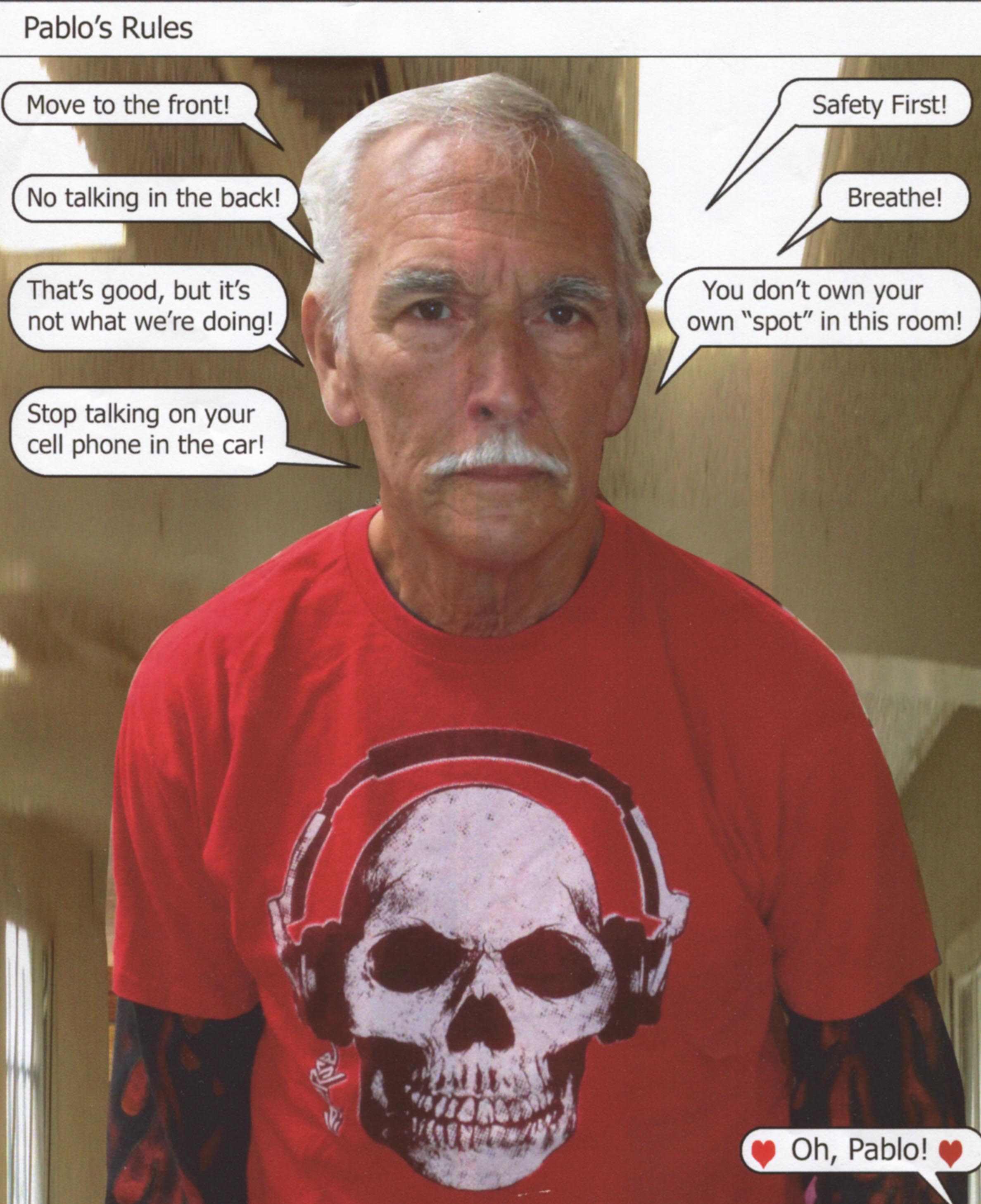
No nonsense aerobics instructor Pablo Molina keeps his classes hopping. He'll be 73 in June, just a few months older than Rose Marie

No-nonsense aerobics instructor Pablo Molina keeps his classes hopping. He’ll be 73 in June, just a few months older than Rose Marie. Credit: San Francisco Recreation and Parks Department

First, I plan to move a lot more. In March, I started several once-a-week classes at the local San Francisco Park and Rec Senior Center located in Golden Gate Park two blocks from my flat: a low-impact and a medium-impact aerobics class, a stretching and strengthening class, and a weights class. And they’re all free. Look for free fitness classes or programs for seniors; they’re more common than you’d think. These classes have shown me in no uncertain terms what I have to work on most: building up my core strength and regaining my balance!

Cardiovascular-wise, I’m finding that, after just six weeks, I’m hardly out of breath now when I walk up the hill to my flat after class. My exercise goal is this: by the end of the summer, to be able to do all the floor core-building exercises and the aerobics exercises that involve balance without batting an eyelash. It’s a pretty pathetic sight to see right now!

My other big move toward fitness and good health was joining Weight Watchers. I’ve known many people over the years who have sworn by it and were also able to maintain a healthy weight once they quit. Choose a dietary program that you can stick to. I signed up for Weight Watchers’ online program in mid-April for three months and after figuring out how to navigate around the website, I’m finding that I’ve become a lot more conscious of my food consumption. Since Weight Watchers’ integrates activity into the point system, I’m also seeing quantitatively the connection between exercise and what and how much one eats. When I started, I weighed 170 pounds and today my weight is 166 pounds. My goal is to reach 140 pounds by the end of my three months with Weight Watchers’, next maintain that weight for a couple of months, and then get down to 130 pounds before the flakes fly.

And finally, I want to concentrate on getting adequate sleep. I’m still working on that one, inveterate night owl and all-nighter puller that I am. I am, however, making sure I get a good night’s sleep when I have an exercise class the next morning. It’s a start!

One more caveat before I sign off: set realistic goals. I expect that I will hone this fitness plan in the coming months, possibly adding some yoga classes, hiking the trails in the wealth of parklands that surround me, and adding more fruits and vegetables to my larder. All I have to do, whenever I waver, is picture being at the top of some fabulous snow-covered mountain, and everything seems possible. Wish me luck!

[Editor’s Note: SeniorsSkiing.com salutes Rose Marie for publicly chronicling her personal journey back to fitness  She is an inspiration to us and we hope to those seniors in our readership or friends of our readership who would benefit from getting back into shape.  Please support her with advice and comments as she travels down that challenging road.]