Tag Archive for: Dolomites

Historic5

Short Swings!

[Editor Note: SeniorsSkiing.com is asking our readers to contribute to support our online magazine. Yes, we have grown in the number of subscribers and advertisers. But our expenses have also grown. You can help us defray some of these expenses by helping us out with a donation.]

Support SeniorsSkiing.com by clicking here.

______________________________________________________

How many of you have taken a skiing road trip recently? Over the past few seasons, I’ve ridden lifts with numerous retired couples skiing their way across the continent; getting the best value from their Epic, IKON and Mountain Collective passes.

Using cars and RVs, they traverse from one resort to another, taking occasional non-ski breaks. It’s a return to the collective skiing fantasy promoted by ski magazines and filmmakers for as long as I can remember.

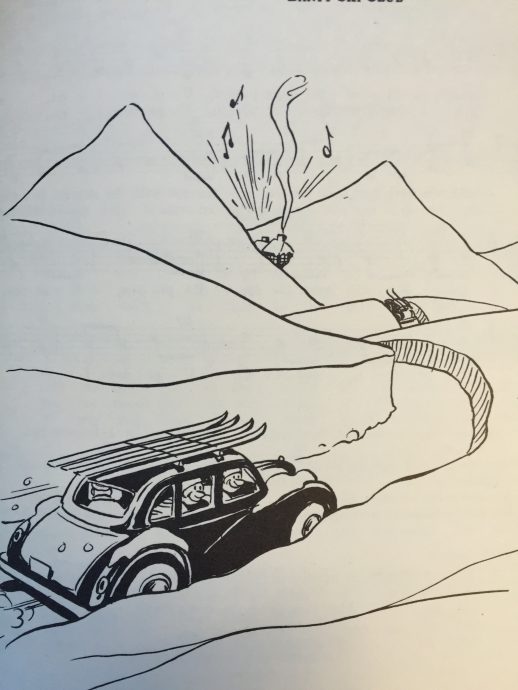
As romantic as the skiing road trip seems, moving from one place to another can be a pain. There’s packing and unpacking. Moving stuff in and out of hotel rooms and friends’ homes. Waking up in unfamiliar places, etc. etc. It gets old, especially as we get older. 

There are exceptions. Last season, we toured the Dolomites on a guided ski safari. That week skiing from mountain inn to mountain inn, enjoying great food, beautiful scenery and our small group’s camaraderie made it one of our all time best skiing experiences.

But I’ve reached a point where I no longer want the hassle of moving around. I thought that renting a place in Salt Lake City for the season would do it. But that, too, requires a drive to one of the nearby areas. Because the place has become so overpopulated, Ski Utah and Ski City USA, two of the local ski promotion entities, encourage people to use public transportation to get to the resorts. At this age, I prefer to drive.

The solution, which many of you long ago discovered, is in the form of staying on or very close to the hill. 

Our Vail friends have the good fortune of walking to the end of their driveway and stepping into a private community van for a short ride to the lift.

And our Deer Valley friend simply walks down his heated driveway and up his community’s heated road to reach the slope.

Talk about skiing luxury!

For those of us without homes on or near the hill, there are the hotels, lodges and inns that are. They can be pricey at big name resorts. But some digging can produce surprising bargains.

For example, from March 6-15, Chalets Montmorency at Mont Sainte Anne in Quebec has a five-night deal for $175 (Canadian) per person, double occupancy. 

Generally, exchange rates make skiing in Canada a good deal.

And, as I’ve explained in past columns, Europe has many great bargains. Click on the adjacent Inspired Italy or Alpskitour ads to get a few ideas.

Ski club trips also can be economical. 70+ Ski Club consistently offers well-priced trips with slopeside lodging. Click on its ad to learn more.

It turns out that for this aging couple, the season has had a few too many moves. And the way things are scheduled, there will be more. 

I’m not sure where we’ll ski next year, but wherever we go, except for when we’re on the hill, we won’t be moving around.

RIP: Mammoth Mountain Founder, Dave McCoy, 

Dave McCoy, who started and developed Mammoth Mountain in California, died February 8. He was 104. McCoy started Mammoth in 1942 and operated the resort for 68 years. When he was 22, he was the California State Skiing Champion. He skied until he was 92. Watch the video about Dave and Mammoth, produced when he was 98.

OOPS!

Last week’s appreciation of Alta neglected to make reference to the Wild Old Bunch, the group of older skiers who gather daily for lunch at the large round table in Alf’s Lodge and Wednesdays for dinner at 5:30PM at the Chuck-o-Rama in South Salt Lake’s Fashion Place Mall.


Avalanche At Alta

This week’s issue has a not-to-be-missed letter from Harriet Wallis advising her nephew to exercise more caution in the backcountry. Last week, avalanche danger and control closed Alta, Snowbird and Little Cottonwood Canyon for two days. During the shutdown, Mac Charval was able to video a slide as it tumbled across the road heading for the Alta Peruvian Lodge. My understanding is that there was no damage.

https://twitter.com/SeanDNeves/status/1226174442637672448?s=03)

Apple iWatch DOES Like Skiing, After All

Thanks for reader Steve for advising that iWatch users look under “D” for Downhill Skiing  in the device’s “Workouts” function.

Bootster Booster

Jim Cobb, who invented and manufactures The Bootster ski boot shoe horn regularly receives fan mail for this clever compact device. He sent in this comment from a senior skier: Thank YOU for creating and providing the Bootster so that all of us “old and stiff” skiers (and our old and stiff boots too!) can keep getting on the snow even as time marches on.  The Bootster is essential for any skier grappling with the ordeal of getting boots on. Click on the adjacent ad to learn more.

Prevent Cold Temp Phone Failure

Typically, even when my phone is in an inside pocket, it loses juice on cold days. Yesterday, at Alta, it was 21F, time to try a product I picked up at the Snow Show in Denver. It’s an air-activated warmer, similar to a disposable glove warmer. But this one has a peel-off layer that exposes a tacky surface to affix the warmer to the back of a cell phone. I stuck it onto the back of the phone’s protective case. I checked several hours later and the phone was warm and almost fully charged. It’s made by Ignik Outdoors.  A 10-pack costs $19.95; 30-pack, $29.99. (Use discount code WarmSenior15 for a 15% discount exclusive to SeniorsSkiing.com readers through March.) The company also makes hand warmers. All of its disposable warmers come in resealable pouches, which, when used correctly, extend the life of each warmer.

Please Help

February is when we pass the SeniorsSkiing.com collection plate. Donation messages are posted throughout the site. When we started this labor of love six years ago, we decided to make it weekly and free. Since then it has grown substantially, forming a global community of older skiers. By the end of this season, there should be 20,000 subscribers. As we grow so do our expenses. Advertising and your donations help cover some costs. Mike and I cover the rest. For those of you who have donated, we appreciate your support. If you enjoy SeniorsSkiing.com, please click here to help.

Short Swings!

There’s a difference between skiing and a skiing experience

Confused? Let me explain.

With just a few exceptions most of my 65-seasons have been spent skiing. I can’t remember every day or every run, but riding up and skiing down so many places and in so many conditions has been wonderful. Small areas, enormous areas:  in retrospect they were variations on a similar theme. Travel to resort. Lift up. Ski down. Repeat. After a while, memories blend.

1930’s Italian trade card for broth company

Over the years, I’ve had some standout skiing experiences. Some, in resorts; others, far from lifts. All were memorable. 

One week with an instructor and a group of Aussies at Jackson Hole, we skied deep powder, jumped into Corbett’s, drank gallons of beer, and shared a lot of laughs. 

Another time with a guide and three other skiers, we took off in a fixed wing ski plane from a slope in Verbier, landed on a glacier near the Italian border, and spent the rest of the day skiing snow-covered pastures, though tiny summer villages, and down into a valley, where we had lunch and hopped on a train to return to Verbier. Memorable!

The week many years ago with Great Northern Snowcat Skiing in Canada’s Selkirk range was another hard-to-forget skiing experience. The snow was so deep that only the tops of 20’ trees were showing. I often think of how wonderful that week was and wonder if I’m past the shelf life to try a week of hell-skiing.

In many ways, memories of skiing are like memories of raising a family. There’s the quotidian background noise of events punctuated from time to time by the more memorable skyrockets. I always told my kids stories when they were going to sleep but I don’t remember every night or every tale. I do, however, remember some of the big events. It’s how we’re wired. Common memories are like snapshots; uncommon ones are like videos; more detail, more recall.

Skiing has its similarities. With some exceptions, the daytrips and the regular ski holidays tend to blend. But the more unusual skiing experiences stand out. 

Pam and I will never forget being on ski safari in the Dolomites with Inspired Italy or ski exploring the world-class resorts in the Aosta Valley with Alpskitour.

She, who delights in reminding me, after every day of skiing, that she’d be happy never to ski again, is now asking when we’ll be able to return to the Italian Alps for another great skiing experience.

1930’s Italian trade card for broth company

###

Lake Tahoe: More to Go

Lake Tahoe snowpack is currently at 245% of average with more is forecast. More good skier news: temps are cold, so conditions are expected to hold.

###

Brighton: Right On!

Brighton Ski Resort, at the end of Utah’s Big Cottonwood Canyon, is a major snow magnet. Many storms favor it over Alta, a short distance away at the end of adjacent Little Cottonwood Canyon. As I write this, Brighton is reporting yet another 24″ dump, reporting 10″ in the past 24 hours, 15″ in the past 48 hours, and 54″ in the past seven days! To date this season, Brighton has received 634″!!!! If past is prologue, Brighton will continue to be catching flakes well beyond its April 21 close.

###

Snowbird Closing Date?

The resort has 650″+ and a 176″ base. It announced it will continue daily operations through May 12, then stay open Fridays through Sundays “for as long as we can.”

###

Rick Kahl Receives Major Ski Journalism Award

Rick Kahl

Rick Kahl, editor of industry trade publication, Ski Area Management Magazine, was namesd recipient of The Carson White Snowsports Achievement Award. The Award, presented annually by the North American Snowsports Journalists Association, honors extraordinary achievement, influence and innovation in the advancement of North American skiing, snowboarding and all snow-related sports. Congratulations, Rick!


###

NoSweat Helmet Liners

NoSweat is a brand of self-stick, disposable liners for use with hats, visors, and helmets. I intended to use NoSweat this spring on warm ski days but never got around to it. The product is well designed and relatively inexpensive. It keeps perspiration from cascading into and stinging your eyes. Google “No Sweat Helmet Liners” for many purchasing options or visit the company’s site.

###

Earth Day

Monday, April 22 is Earth Day. Visit the official Earth Day site to see how you might support the organization’s many efforts to improve the environment. Then, put on your sneakers or boots and give our collective Mother a visit. She’s been taking a beating for a long time and needs to know we still love her. In other words, dear readers, time to Take a Hike!

Ötzi the Ice Man: Three Millennia Older Than Mel Brooks


Reconstruction: Alfons & Adrie Kennis © South Tyrol Museum Archaeology/Ochsenreiter

He may not be the world’s oldest skier, but at more than 5000 years, he is the world’s oldest and best-preserved wet mummy. Given his advancing years, Ötzi is in particularly good shape. 

Named for where he was found in 1991 by two hikers on the Italian-Austrian border, Ötzi now resides in the South Tyrol Museum of Archaeology in the lovely small Northern Italian city of Bolzano. If you find yourself in the general vicinity, I strongly recommend paying him a visit.

© South Tyrol Museum of Archaeology

One of the many effects of global warming is the discovery of ancient things thawing their way out of the ice: thousand year old skis in Oppland County, Norway; a 500-year-old girl with perfectly preserved hands found in the Andes; an almost intact wooly mammoth found in Russia’s Arctic Lyakhovsky Islands. To learn more watch this brief “Secrets of the Ice” video.

But Ötzi stands apart, for his age, his superb condition, and the extensive science applied to understanding who he was. His genome has been mapped, his stomach contents carefully analyzed, and his belongings extensively interpreted. 

He is thought to have been a traveling shaman dispensing medical treatments. Evidence for that is in the form of fungi with antibiotic properties found in a sack. He also had dots and lines tattooed on either side of his lower spine at known acupuncture pain relief sites. Interestingly, even today, similarly located tattoos are found on people from primitive cultures.

Ötzi also had no hand callouses and underdeveloped upper body musculature, suggesting he was not engaged in agriculture or other physically demanding activities. Indeed, his animal skin clothing was finely put together and his axe decorative and showing little wear, possible signs of status and respect.

But respected or not, Ötzi was murdered. A 21st Century police detective examining the evidence concluded he was murdered a day or two following a violent fight. A cut on one of his hands suggests he had defended himself during the recent altercation. An arrowhead found in his body had severed an artery and caused his death. Detective work showed it was shot from a distance of about 100’. Because he was found with all his belongings, the possibility of theft has been ruled out.

© South Tyrol Museum of Archaeology/Ochsenreitr

Visitors to the museum view Ötzi’s gnarled flesh and twisted frame through a window in the freezer room where he’s on display. 

A reconstruction based on everything known about him stands in an adjacent gallery, created with the help of police forensics. 

Some of you may remember that long before Ötzi came out of the ice, Mel Brooks was considered to be the world’s oldest man. He and Carl Reiner drew upon his longevity in their classic comedy routine.

The South Tyrol Museum isn’t large, but it is one of the most fascinating places I’ve seen. If you’re planning a trip to the Dolomites, it’s a place you’ll want to visit along the way.

SeniorsSkiing Guide: Italy’s Dolomiti Superski

­Winter wonderland in one of the largest ski areas in the world.

Although I was born and raised in Italy, I did not do much skiing until I moved to Colorado for college. So I jumped at the occasion to join some old friends for a week of skiing in the Dolomites—a portion of the Italian Alps characterized by their stunning rocky outcrops, sufficiently beautiful to be listed as a UNESCO World Heritage site.

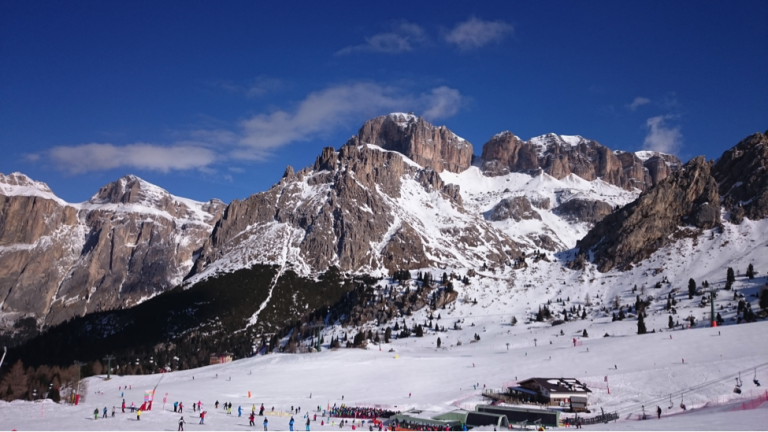
A view of Sella Massif from the south. Credit: Paola Gaudiano

A view of Sella Massif from the south.
Credit: Paolo Gaudiano


Dolomiti Superski
is a resort encompassing some 12 connected ski areas totaling 1,200 Km (750 miles) of trails served by 460 lifts. While a few of the areas require a bus for the connection, you can literally ski all day without ever doing the same trail twice, while experiencing a wide variety of terrains and stunning views.

Terrain

The area is accessible to all levels, but in general is aimed toward families, and as such there is a preponderance of easy and medium slopes. I was pleasantly surprised by the large number of older skiers—for once, I did not feel like a rarity because of my gray hair.

As with most European areas, the vast majority of the terrain is groomed, and if you like moguls or off-piste this place is not ideal. On the flip side, when the snow is abundant (which this year it was not), if you find places to go off-trail safely, you will likely find lots of untouched powder even a few days after the last snow.

The main attraction of this area is Sella Ronda, a 40 Km loop around the Sella massif, spanning four valleys and offering a variety of stunning views. The loop is great for intermediate skiers, and it’s possible to head off for side detours for more advanced skiing.

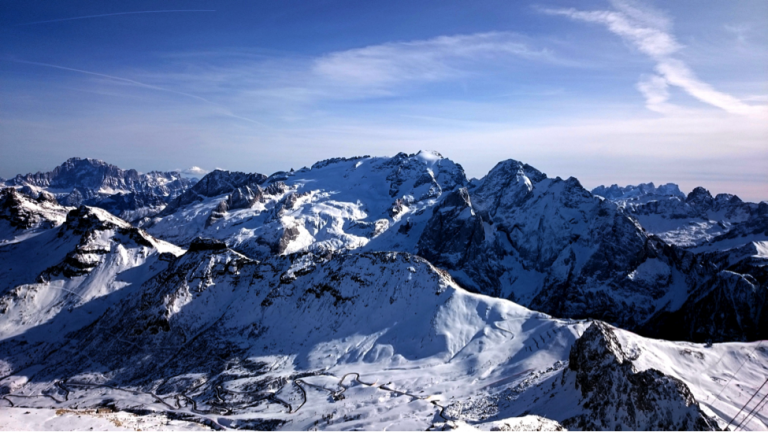
Marmolada and its glaciers. Credit: Paolo Gaudiano

Marmolada and its glaciers.
Credit: Paolo Gaudiano

Getting there

I flew into Munich, which gave me the best combination of price and relative convenience. Depending on which town you choose, it is somewhere between three and four hours from Munich, about two-three hours from Innsbruck, two-three hours from Verona and three-four hours from Milan. You can also take a train and bus combination if you want to avoid driving, but travel times will be longer.

Lodging

The entire area is dotted with small towns and hundreds of hotels. Most of them offer mezza pensione, which includes breakfast and dinner. Our group was based at Hotel Alpi, a three-star hotel in Campitello Di Fassa that cost €85/night for a single, or €130/night for two. The food, service and amenities were excellent. There are many stores nearby and a Ski Bus that connects all the towns, making it really easy to get around.

Food and Culture

As with most of Italy, part of the experience is the food. One of my favorite things about skiing in Italy is that there are lots of restaurants on the slopes that serve great food and are relatively inexpensive. On the downside, most of these places do not allow bringing and eating your own food. I brought sandwiches every day, and sometimes I just had to find a bench somewhere to eat.

Bottom Line

Skiing in Italy is much cheaper than most of the US. I paid €240 for a 5-day pass giving access to all the areas. Coupled with the inexpensive food and lodging, you’ll pay the same if not less than flying to Utah from the East coast.

Discounts are offered for skiers over 65 (roughly 10 percent off).

Trail Map Click Here

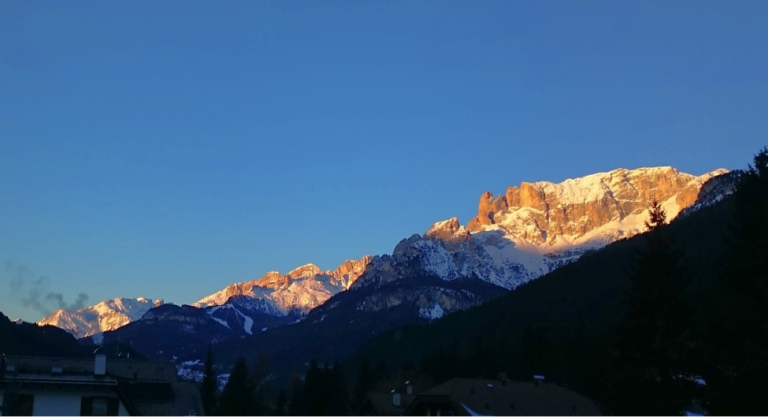
A view from Paolo's hotel room, showing the dolomite rock the region is named for. Credit: Paolo Gaudiano

A view from Paolo’s hotel room, showing the dolomite rock the region is named for.
Credit: Paolo Gaudiano