Tag Archive for: El Nino

Dreaming of Skiing the Alps? Follow Warren Miller’s Advice: Don’t Delay.

Warren Miller has been gone for less than a year, and his wisdom about not postponing your next ski adventure has been on my mind.

There’s one experience in particular that beckons. It is based in the beautiful ancient village of Saint Vincent in the Aosta Valley in the western Alps, close to Mont Blanc, Zermatt, and Monte Rosa.

Organized by Alpskitour, clients stay in their choice of five- and three-star hotels. The village serves as hub, and every day, they join their guide and a few other people to explore trails and slopes on the highest peaks in the Alps, crisscrossing between Italy, France and Switzerland.

The groups are mostly European-based intermediate and advanced skiers, with the occasional American, Canadian, New Zealander, or Australian. The guide and group ski together for five days, always riding different lifts and exploring new terrain.

They stop at quaint mountain refugios for lunch. Forget burgers and fries. This is on-mountain dining in beautiful settings.

The landscape is incredible. Dramatic peaks. Trails snaking through magnificent rock formations. Slopes that descend through scenic hamlets.

The dreamlike experience is what I remember from the Warren Miller films of my youth and from ski trips to the Alps in the 60s and 70s.

Then, wrapped up in family and career, I skied closer to home, exploring Colorado, Utah, New Mexico, Wyoming, Idaho, Montana, and British Columbia.

The skiing has been great, but the dream of the Alps was always there.  My wife and I booked with Alpskitour for mid-March, 2019. We’re looking forward to returning to the roots of modern skiing, enjoying its history and culture; its  exceptional beauty, and hospitality.

Alpskitour has been advertising with SeniorsSkiing.com since last season. Their website explains the group’s unique concept and is filled with wonderful images of what to expect. I’ve been emailing with Gerry Walsh, a Brit who has booked with Alpskitour for several family ski holidays. He wrote glowingly about the guides, the hotels, the scenery, and the outstanding hospitality.

I know that the exchange rate isn’t optimal. We could wait until it is. And the flight to Milan will be a few hours longer than if I were traveling in the U.S. And committing this early has some risk regarding snow levels.

But forecasters tell us this will be an El Nino year with higher moisture and warmer temperatures and southerly snowfall.  And wherever you go, lodging and skiing tend to add up.

I’ll ski a few weeks in the West this season. Might even catch some warm corn days in New England. But come March, we’ll be in the Aosta Valley with Alpskitour.

Warren Miller had it right. Don’t put it off. If you love skiing, try something different. This will be my 65th consecutive ski season. We’ll be celebrating in the Alps.

This Week In SeniorsSkiing.com (June 22)

Southern Hemisphere Special, Safe and Sane Cycling For Seniors, Zany Videos, El Nino Coming.

Yes folks, it’s the start of the ski season in far away places below the Equator. Here’s a picture of downtown Santiago, Chile, which received a highly unusual coating of snow for the first time in years.

If there’s snow in the city, there’s more in the mountains. Credit: anis_velasco/instagram

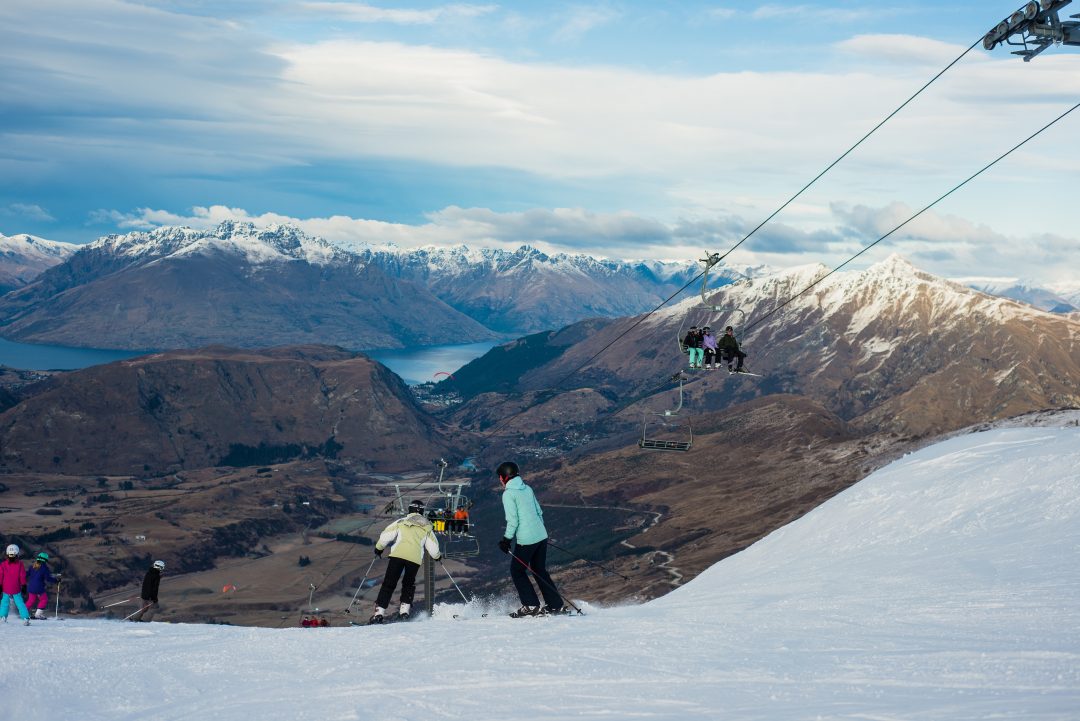
And in New Zealand, The Remarkables, those beautiful, mystic mountains from Lord of the Rings fame near Queenstown, are open for the season.  Check out the video of opening day at the bottom of this article. Nearby Coronet Peak has been open for a couple of weeks.  Here’s what the early season skiing looks like down there.

First turns of the season at Coronet Peak, Queenstown, New Zealand.

Skiing Chile

If you’ve ever wondered what it might be like to follow the snow during the summer and weren’t quite sure how to do it, we have a new series that might get you started.

Portillo Plateau, Chile. Amazing skiing starting now. Credit: Casey Earle

In celebration of the beginning of the snow season in the Southern Hemisphere, we have an orientation to skiing in Chile by a new SeniorsSkiing.com correspondent Casey Earle, an American ex-pat who lives and skis down there.  His first article describes the different resorts what line the magnificent Andes mountains. You will hear more about skiing in Chile in the coming months.

Biking With Young Hammerheads

Veteran cyclist, skier, and SeniorsSkiing.com correspondent Pat McCloskey offers some advice for seniors who ride with a gang of younger riders.  He has strategies for going around the loop safely and saving face at the same time. It pays to recognized the limitations that senior status brings, especially on a mountain bike.

Have You Seen These Videos?

Here’s Opening Day at The Remarkables, Queenstown, New Zealand. Click below for the festivities.

And, Check Out What Happens To A Show Off When His Ski Flipping Trick Doesn’t Work. Click the picture below.

Finally, mountain biking down Corbet’s Couloir? First time ever, but you can be sure it isn’t the last.  Thanks Teton Gravity Research. Click on picture to view.

And Looking Ahead. El Nino Is Knocking.

Weather worriers are looking at an emerging El Nino pattern forming in the eastern Pacific. El Nino comes around when the surface water temperature increases ever so slightly in the ocean west of the Peru and Ecuador. Since everything in the weather world is connected, that water temperature change impacts the atmospheric wind patterns which impacts the everyone’s weather.  From the Weather Channel Explainer:

“If El Niño conditions are present during the winter, the jet stream pattern over the U.S. shifts and can result in a wetter-than-average winter across the southern tier of the U.S., including portions of California.

“During an El Niño winter temperatures are also typically cooler-than-average from the southern Plains into the Southeast and warmer-than-average from eastern Alaska into western and central Canada and into the Pacific Northwest, northern Plains and Midwest.

“The strength of the El Niño plays an important role in impacts across the U.S., including in the tropical Atlantic. At this point, it is too early to know when an El Niño pattern may develop and how strong it might be.”

Happy First Day Of Summer.

Onwards.  Have you bought your season ticket yet? Time to pay attention to whatever deals are left.

And tell your snow loving buddies about SeniorsSkiing.com.  Remember, there are more of us everyday, and we aren’t going away.


2016-17 Winter Forecast Outcome

How Close Were NOAA Predictions? The Surprise Was California.

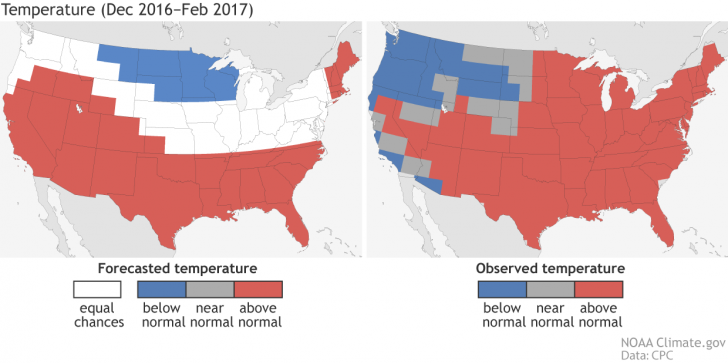
Temperature: Forecast vs Actual, 2016-17
Credit: NOAA

NOAA’s Climate Prediction Center recently published a review of its forecast for the 2016-17 winter.  As you know from horse racing, the stock market and Las Vegas, predictions often do not reflect realities.  The question really is how close to reality the predictions are.

In October, 2016, the Winter Weather prediction was focused on factoring in a weak La Nina pattern in the Pacific.  La Nina and sibling El Nino, as you may be aware, are warm or cool water conditions roughly in the latitude of Peru in the eastern ocean.  These conditions impact the air masses above them and, subsequently, the jet stream which steers weather patterns in the atmosphere.

Climate Prediction Center thought a La Nina (cooler water) would bring generally warmer temps across the lower US and cooler in the Pacific Northwest, Upper Midwest and Ontario. For precipitation, the prediction was below normal precip across the southern US, continuing the drought situation there, and above average precip in the upper band across the US-Canada border.

In reality, the La Nina was weaker and faded away earlier than predicted. That factor plus multiple “Atmospheric River Events” off the California coast, narrow regions of heavy moisture transported from the tropics, and general randomness brought different outcomes.

Temperatures across the US in the 2016-17 winter were the warmest ever recorded. That was in line with the prediction for warmer temps across the whole country. But it was colder than average in the Pacific North West rather than the Northern Plains.  And, while precipitation for wetter than average in the Northern Tier was spot on, the forecast for drier than average only worked out for Florida, where drought conditions persist.

As we know, it was wetter than average in California with ongoing storms racing up from the Pacific. Not predicted.

In general, Climate Prediction Center’s own objective evaluation of its predictions show it was much more accurate for the temperatures this year than precipitation.

We will be bring you predictions for the 2017-18 Winter when they emerge.

Precipitation: Forecast vs Actual 2016-17
Credit: NOAA


Adios, El Nino, Hola, La Nina

Big Changes Are Coming Again To Next Season’s Weather.

View post on imgur.com

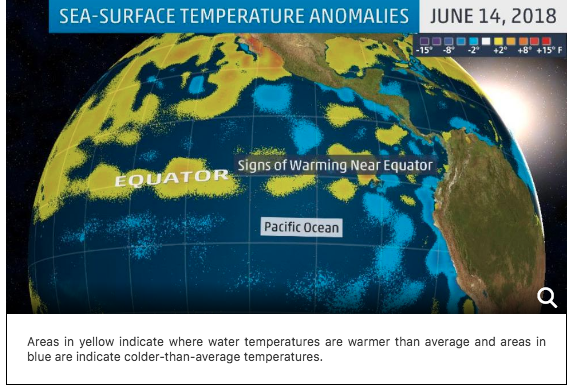
The image above shows how the sea surface temperature is changing from warm to cooler, signaling the advent of a La Nina event.

Weather scientists are predicting that the sea surface temperatures in the Eastern Pacific will continue to drop, ending the extraordinary, record-breaking El Nino conditions that drove so much of last winter’s weather. When the sea surface water temps drop below .5 degrees C off the coast of Peru, the new La Nina will be in the wings, bringing yet another set of changes to next ski season’s weather. Some reports predict this La Nina can be as dramatically cold as the fading El Nino was warm.

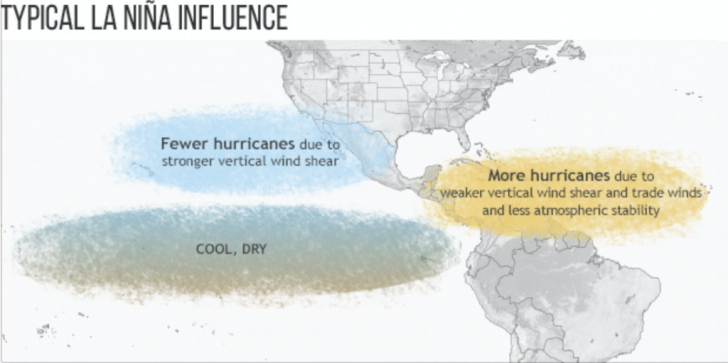
During the summer coming up, the first impact you’ll see will be more hurricanes in the Atlantic. The hurricane season in the Atlantic starts on June 1 and goes to November 30. The prediction is for more storms because of weaker upper level winds.

For the winter months, a typical La Nina pattern will be cool weather in the Northwest, warm and dry across the southern border, and a wet East.  Click here for an interesting discussion from the Weather Network. 

Fun Fact: La Ninas last longer than El Ninos.  The La Nina event that followed the the 1997/98 El Nino lasted 33 months!

Here’s a more technical discussion from NOAA. 

Stay tuned for more updates as we watch how La Nina takes shape and how it will impact next winter’s weather.

The first La Nina impact could be more frequent Atlantic hurricanes. This year's La Nina is predicted to be as cool as last year's record-breaker El Nino was warm. Credit: NOAA

The first La Nina impact could be more frequent Atlantic hurricanes. This year’s La Nina is predicted to be as cool as last year’s record-breaker El Nino was warm.
Credit: NOAA


Early 2015-16 Winter Forecast: El Nino Cometh

A Strong El Nino Is Not Too Cool News For Skiers.

ElNino2


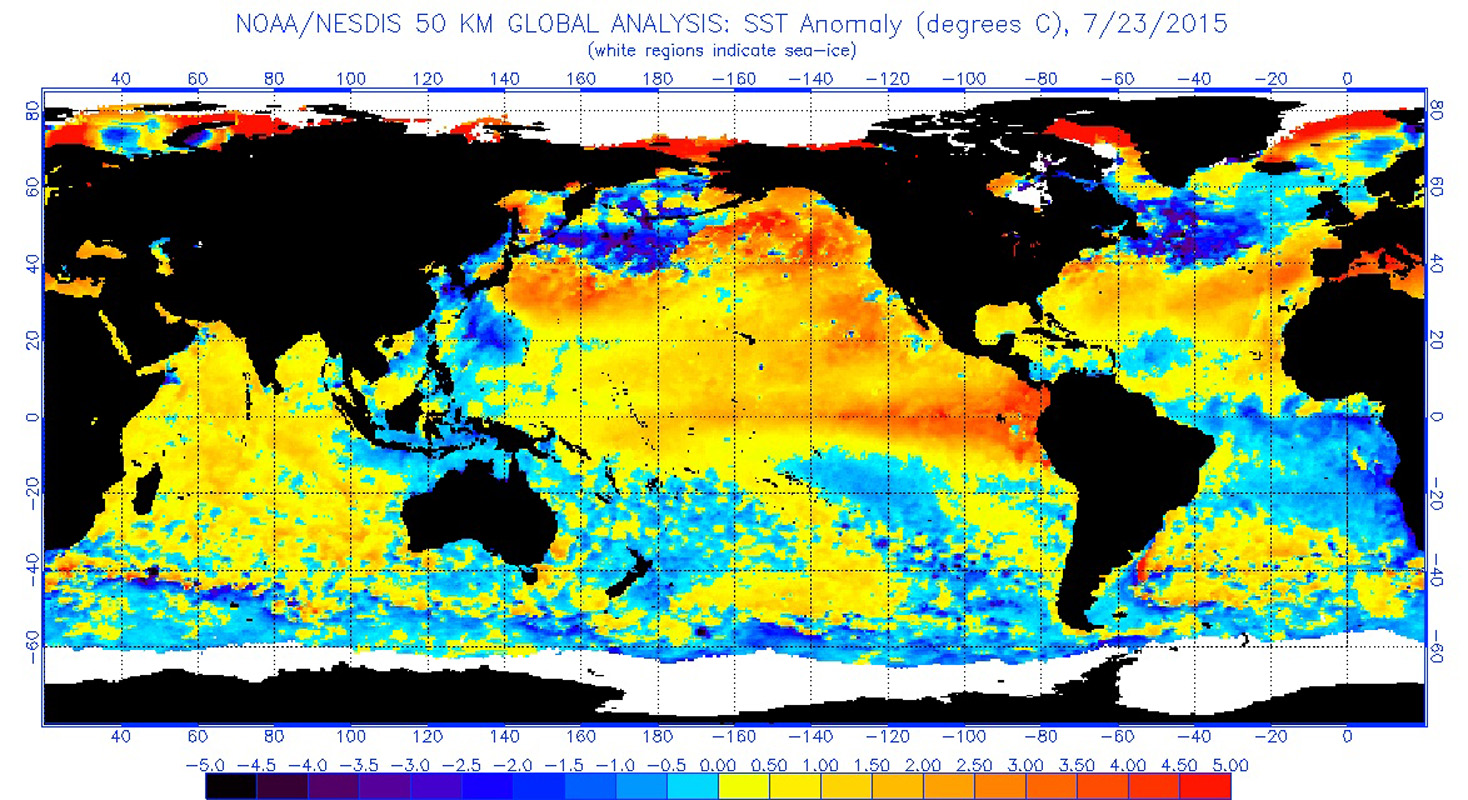
The latest (July 15th) word from NOAA (National Oceanic and Atmospheric Administration) and other weather watchers is that the El Nino currently growing off the west coast of South America is gaining intensity.  El Nino is the weather phenomenon that occurs when Eastern Pacific waters are warmed through a combination of factors, starting with increased cyclones in the Indonesian archipelago, the reversal of the trade winds from easterly to westerly off South America, and the resulting flood of warm Western Pacific waters eastward.  This has an direct impact on our weather and, in fact, weather around the global.

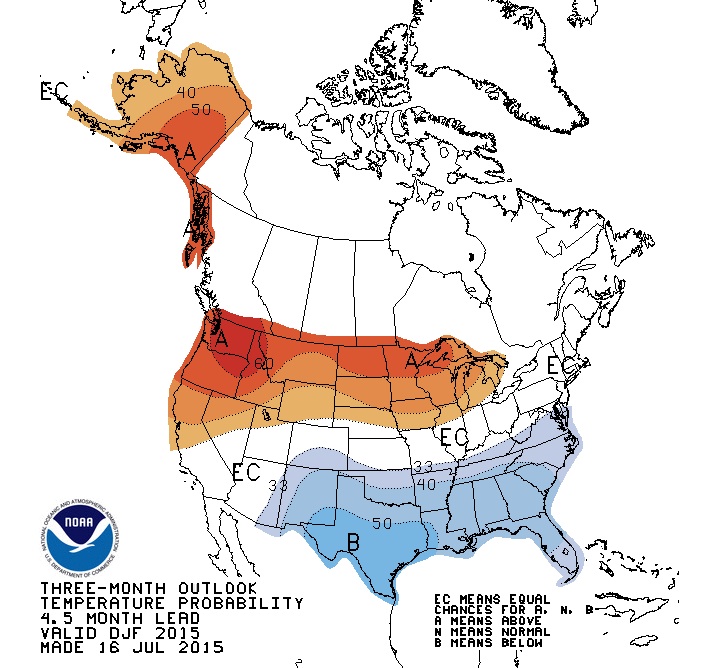
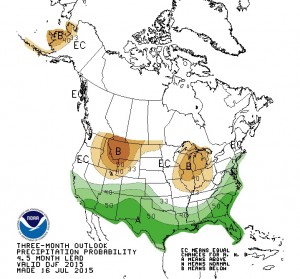
Dec-Jan-Feb Prediction Charts for Precipitation and Temperature reflect impact of El Nino. Credit: NOAA

Dec-Jan-Feb Prediction Charts for Precipitation and Temperature reflect impact of El Nino.
Credit: NOAA

TPrecipPredictionWhen an El Nino comes in, intensity clearly matters.  As of July, this year’s El Nino has a running start, driving the Sea Surface Temperatures (SST) off South America up +1.5 degrees above normal.  Some models have that going up even further later in the year.

According to NOAA, this year’s El Nino has a 90% chance of lasting through February 2016 and an 80% chance of lasting through April next year.  The last strong El Nino in 1997-98 brought major flooding to the West, especially California where storms caused half a billion dollars in damage and loss of life.  This winter, this El Nino’s level of intensity is predicted to have the following effects on our weather:

  • There will be a milder hurricane season this summer and fall in the Atlantic, a busier one in the Eastern Pacific. The National Hurricane Center has predicted below-normal storm activity for the Atlantic Hurricane Season which started June 1 and an above-normal season for the Eastern Pacific, thanks to El Nino.
  • It will be wetter this winter in the southern US from around Interstate 80 to the Mexican border.
  • It will be drier in the Northern Rockies, Ohio Valley, Great Lakes and Northeast.
  • It will be cooler in the southern band from Southern California to the Gulf states to the Carolinas.
  • It will be warmer in the Pacific Northwest to the Great Lakes and the Northeast.

Forecasting weather six months out is obviously an exercise in probability.  What’s interesting this year is that the variables are not wishy-washy; the SST is demonstrable, leading one to think that the chance for coming close to prediction is better than not.

SeniorsSkiing.com will keep you posted as the weather predictors weigh in.