[Editor Note: As the new year begins, SeniorsSkiing.com is again asking our readers to contribute to support our online magazine. Yes, we have grown in the number of subscribers and advertisers. But our expenses have also grown. You can help us defray some of these expenses by helping us out with a donation. This year, we have a mix of premiums for different level of donations, including stickers, sew-on patches, our new SeniorsSkiing.com ball cap. All donors will be entered into a drawing for a pair of bamboo Polar Poles to be drawn in late March. You can donate by clicking here.]
Ski In It If You Must. If You Must, Here’s Some Advice.

Go slow and watch the snow. Credit: MechanicsOfSport
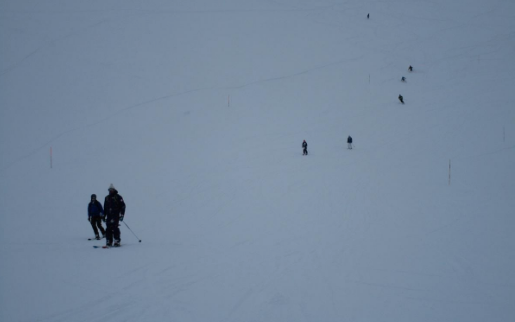
If you’re like me, skiing in flat light isn’t fun, but it beats not skiing. It is as if one is skiing inside of a milk bottle. Like different types of snow conditions, we’ve all had to deal with it.
For the record, flat light occurs when there’s no contrast, and one can’t see shadow and/or gradients of light that define shadows. On a mountain, flat light occurs when it is snowing, or under a thick overcast or when you are skiing in the clouds and sunlight can’t reach the trail on which you are skiing. In other words, there’s little or no contrast, and you’re eyes can’t see the “texture” of the snow surface.
Flat light affects everyone differently and us older folks are more affected than young whipper-snappers. You can’t change the weather that leaves three choices: Ski only when the sun is out; ski wearing goggles that improve contrast; and/or alter the way you ski.
Not skiing is, at least to me, not an option so let’s move to goggle technology. The buzzword is visible light transmission or VLT. Lighter tints of amber, yellow, rose, green, gold colored lenses transmit more light than the same level greens, copper, browns and gray tints. Flat light varies from on one slope from another and day to day. Sp, if you need goggles to manage flat light, wait until you get to the ski area and step outside to see what shade lens works best.
To see “better” in flat light, years ago, I tried yellow and other colored lenses which helped but….still not great. Frustrated, I tried a pair of yellow Ray-Ban shooting glasses that were better than goggles with yellow lenses. On my last trip, I wore polarized sunglasses with the brown Serengeti tint. They were better than yellow lenses, but not practical when it was snowing.
Goggle makers such as Oakley, Smith, Scott, Giro all have products they claim help you see better in flat light. Be prepared to spend big bucks, i.e. $200+ for a pair. How well they work depends on the ambient/flat light, lens color, tint of your glasses or contacts, the health of your eyes, and other variables.
There is something that works and doesn’t cost a dime. It is how you ski the mountain. Here are four tips that will improve your flat light ski experience.
- Tip 1: Ski near the trees, snowmaking guns and lift towers along the side of the trail. They provide contrast, faint shadows, and reference points.
- Tip 2: Avoid skiing bowls, wide-open areas, and trails because in flat light, the subtle differences in “height” needed to create shadows doesn’t exist.
- Tip 3: Slow down, give yourself more time to react to moguls, surprises in the terrain, and avoid obstacles.
- Tip 4: Wear bright or ‘dayglo’ colors. You want other skiers to see you.
Best advice for flat light is be careful and ski within your limits so you can enjoy the skiing. If you’re uncomfortable or tense, find a trail that works for you and stick with it.
Decide for yourself if this is for you. Credit: MechanicsOfSport