Professor Combines Passions and Art; Students Publish Textbook on the Subject
Editor Note: The author is this article is Peter Mark, a professor of Art History at Wesleyan University. He is author of five books about pre-colonial Africa, has taught in France, Germany, and Portugal. He lives in Connecticut and Strasbourg, France. He hikes, cross-country skis in the Catskills, the Vosges, and the Black Forest. He now climbs in the Italian Alps every summer where he reports “the food is better”. We hope to publish the essays his students produce in his course, The Mountains and the History of Art, in the future.

Mountain Landscape With Lake. JMW Turner, circa 1842.
In 2013, I decided to join three lifelong passions—hiking, climbing, and skiing—to my career as an art historian at Wesleyan University, by introducing a course on the mountains and the history of art. If you want to learn a new subject, teach that subject.
Two central themes have emerged: mountain passes are highways for movement of artistic styles, and the mountains are the embodiment of “the Sublime.” I expected also to teach my students basic hiking craft, replacing GPS with map and compass. But several of them are more experienced than me. One had climbed Mt McKinley, another was a mountain guide on Central American volcanoes. I benefit from my students’ enthusiasm and their insights..
Since Moses climbed Mt. Sinai, peaks have symbolized the Transcendent or the Holy. And since the first-century Romans constructed their Via Claudia Augusta across the Italian Alps, mountain passes have funneled the movement of people and culture. But interest in the peaks themselves dates only to the Enlightenment—the first climb of Mt Blanc was in 1786.
The mountains truly became a symbol of the Sublime, the Transcendent, in the 19th century. Wesleyan students study the Romantic era: the poetry of Wordsworth, Turner’s magnificent mountain landscapes of chaotic storms, and Ruskin’s philosophical writings about the natural world, all of which present mountains as a manifestation of the Sublime. In early 19th Century America, “mountains” meant the Catskills. The crags and summits painted by Thomas Cole became a symbol of American identity—the wilderness, untrammeled and majestic. But true Transcendence was still to be found in Europe, in the Alps. Some of the finest travel writing of the late 1800s comes from Mark Twain’s account of the Alps.
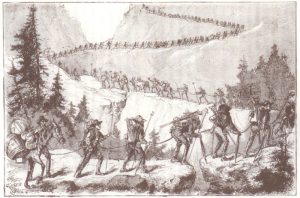
Mark Twain’s “Climbing The Riffelberg” appears in Tramp Abroad, an account of his journey through the Alps.
We look at mountains as subjects for landscape painters, for poets, and for philosophical essays from Emerson to Twain. But we mix in a healthy dose of the history of mountaineering. Twain was one of the first authors to write on this subject! We spend a week studying the British 1920s Everest expeditions. And we cover the history of skiing both in Austria and in New England—some SeniorsSkiing.com readers will recall the ski school at Cranmore Mountain, where Hannes Schneider brought modern technique from the Vorarlberg to New Hampshire. Schneider’s career, from ski instructor to film star in 1920s Austria, to refugee from Hitler, fills one lecture.
Were I to teach “The Mountains and the History of Art” in German, there would be a wealth of literature, in English, less so. But my students have produced some wonderful essays for this course. At their suggestion, we decided to bring together a collection of the best essays. “Next fall our book, “The Mountains and the History of Art” will be available both online via the Wesleyan University website and in a print version, published by Wesleyan University Press.
Stay tuned for more insights about how mountains have made an impact on art.
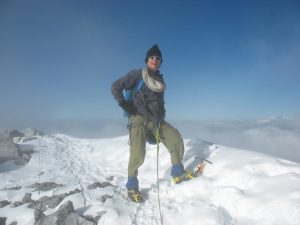
Professor Peter Mark summits somewhere in the Alps.
Credit: Peter Mark




