


Tag Archive for: Ski Weather predictions

Skiing Weatherman: West Still Strong, East Hanging In

Some Powder. Trail Counts Good.

The weather pattern that dominated the month of March in the eastern half of the country has continued right into April…unfortunately.  I communicated with a resort manager in Vermont last week and found out that the mountain, which has a high base elevation…had received exactly one inch of snow last month.  One %#$$@*& inch!  A good number of areas pulled the plug after offering skiing during the Easter weekend as the lack of snow and late month rain beat down the base depths to the point where skiing and riding couldn’t be extended any further.

Going forward, I wish I could tell you that some late snow was on the way to sustain the sliding for several more weeks, but that is simply not the case.  The strong ridge at the jet stream level that took shape a couple of weeks ago over northeastern Canada is still there, and a piece of that ridge has extended into the northeastern U.S. the past week, leading to temperatures that continued the shrinking of the snow supply.  While it will be turning cooler in the East relative to normal for the last two weeks of this month, it looks like “too little, too late.” Lastly, base depths never got overly deep during the heart of winter, then the snow drought hit in March, and right now, we are left with a dwindling supply on the slopes.  So, in the East, get it while you can.  Grab the rock skis, bring the sunscreen and the tailgate gear and have a go at it.  This weekend there will be about 20 resorts to choose from in the East and trail counts are still pretty healthy.

In the West, the spring skiing season is also underway with the resorts sitting on much more in the way of “money in the bank.”  That is, ample snowfall through the season has built up the base depths to an extent that skiing and riding can easily continue for several more weeks.  Keep in mind that a good number of resorts will be closing, or have already closed, because their deals with the National Forest Service say they must, regardless of how much snow is still on the hill.  But overall, the season still has plenty of legs throughout the West.  In this region, there is actually hope for a little more in the way of snow.  Here’s a map of the snowfall for the next couple of weeks.

It’s not a ton of snow, but if you time it right you might be able to squeeze in a few more powder turns before calling it quits for the season.  British Columbia has been the big winner in terms of snowfall this season, which is to be expected during a La Nina winter, and they are in line for a dump or two, or more, in the coming weeks.  Unfortunately, a Covid resurgence has caused many of the resorts in that province to close for the season.

The turns are out there if you really want them, but you might have to work a little harder to make them.

REGIONAL HIGHLIGHTS:

Pac NW/B.C.:

Late week snow will set up one more weekend of winter surfaces.

Central and southern Sierra:

Perfect spring skiing weather coming up for the next week.  Sunny, mild days and overnight lows below freezing to preserve and set up the snow.

Rockies:

Mild days, chilly nights, and any precip in the next week will be light.

Midwest:

Lutsen, Minnesota appears to be the only resort still operating.  Light rain and snow most days next week.

Northeast:

Warm pattern turns cooler late next week and beyond.  Better hustle to get those turns in.

Mid-Atlantic/Southeast:

The party is over.


seniorski5

Skiing Weatherman: Pattern Is Relatively Quiet

Fresh Snow in Cali. Mild Temps Next Week.

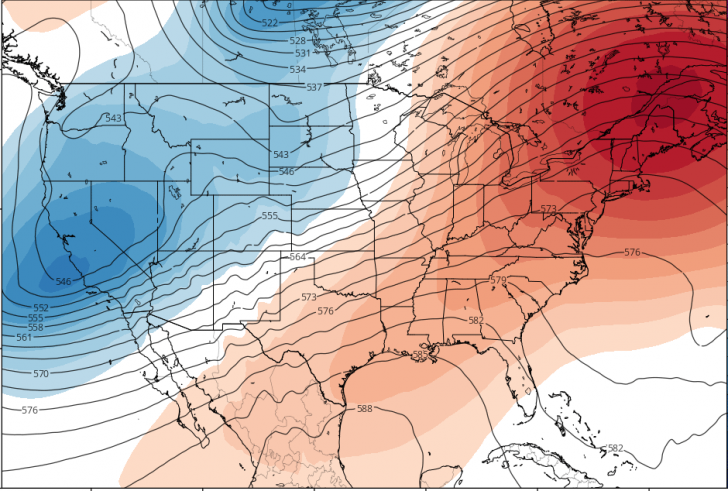
Last week’s installment touched upon the fight we usually see in March between lingering cold to the north and advancing spring warmth from the south.  The fight usually takes the form of storminess, where it only a matter of whether there is enough cold air in the mix to produce snow instead of that other stuff.  And yet here we are in the first week of March with something resembling a mini snow drought over the eastern half of the country.  There hasn’t been a significant widespread snowfall in a couple of weeks and aside from northern New York and northern New England, where there have been one or two light snowfalls across in recent days, surfaces have morphed into “machine groomed” or, when temps rise above freezing, “loose granular.”  Fear not, though.  I hoped that a storm late this week would turn the corner and hit the Northeast, but a cold northwesterly flow has suppressed that idea well to the south.  By no means has the East seen its last snowfall, but the next sizable one will come after a turn to milder weather during the week of the 8th.  Here is a forecast for the jet stream level on the 11th that illustrates the cause of the warm-up.

If you follow the lines around the burnt orange center in a clockwise fashion, you can see that the air mass that flows into locations east of the Mississippi originates over the Southwest, where temperatures are running above normal.  At the same time stamp, the following surface map shows a high pressure center off the coast of New England.

Following the lines clockwise around the blue “H” indicates a broad, low level mild southwesterly flow reaching the Great Lakes to New England.  So, look for a shift to softer, spring-like surfaces in these areas next week.

The flip side of these ridges at the surface and aloft are the upper troughs and surface low centers that will be moving through the West next week.  The air flow is around troughs is counter clockwise, and if you look at the first map and picture the western trough sliding down the coast from Washington to southern California, you can see that a broad onshore flow of moisture will immediately precede the arrival of the center of circulation, which is a great recipe for fresh snow in the Cascades and Sierra ranges.  The highest totals will come from central and southern Sierra resorts, where the core of the trough will pass overhead midweek. Farther north it will be offshore.  Later next week, the weakening trough will swing through the southern Rockies, where lighter snow will fall but refresh surfaces.

Back to the East.  The pattern is progressive, so the warming will be transient.  Here is a jet stream forecast for the 15th that shows a cold trough returning to the Midwest and East.

That setup will help preserve snow and produce fresh snow at times and there are signs that the colder pattern will dominate the second half of the month.  More on that next week.

REGIONAL HIGHLIGHTS:

Pac NW/B.C.:

After a heavy late week dump in B.C., lighter snows fall this weekend in the Cascades.  Periodic light snows during the week of the 8th.

Central and southern Sierra:

Fresh snow as well as wind this weekend for Tahoe.  Snowy much of the week of the 8th for all Cali resorts.

Rockies:

Turning colder next week with light to moderate snows across the north.  Weakening upper trough brings light midweek snows in southern Rockies.

Midwest:

Seasonably cold weekend and milder next week.  Best shot at snow later next week across far northern Minnesota and Michigan.

Northeast:

Cold weekend with temps moderating by midweek.  Transition back to colder pattern gets underway next weekend with potential messy storm.

Mid-Atlantic/Southeast:

Midwinter temps this weekend; spring skiing develops next week.  Colder air returns week of the 15th.


The Skiing Weatherman: Haves And Have Nots

The Difference Between East and West Is Remarkable.

Over the past few weeks, I have shared with you some of my winter forecasting tricks of the trade but now it is time to get down to business and do some actual forecasting. 

The pattern change that was foretold a couple of weeks ago by the re-curvature of a typhoon east of Japan is well underway (The “Typhoon Rule”). By this weekend an unseasonably cold upper trough will cover the eastern half of the country.  The air that the trough delivers will be of arctic origin, and, although it travels over ground that is not yet covered with snow, it will still be cold enough for some productive snowmaking in the taller mountains of the Northeast and as far south as resorts in the central Appalachians. 

Better yet, the cold air will rush in on the heels of a low pressure system that will generate a swath of snow from the Great Lakes eastward to the interior Northeast.  Lake effect snow will kick in downwind of Erie and Ontario for a short time, but because the system will be progressive, that backside snow won’t last very long.  This looks like a three- to six- inch event from the Adirondacks eastward through the Greens and Whites and on into the mountains of Maine.  That may not seem like much, but that first inch of machine made snow is laid down a lot faster when it lands on crystals and not leaves and dirt.  The cold temps this weekend will help to chill the soil, too.

On a broader scale, the developing pattern will be one of the “haves” and the “have nots” with respect to cold weather and prospects for snow.  Here is what the jet stream pattern is likely to resemble late next week

The deep trough will cover much of the eastern half of the country, with a strong ridge covering the waters of the eastern Pacific.  Clockwise flow around the ridge will combine with counterclockwise flow around the trough to tap into air masses from far to the north. This setup is ideal for the delivery of cold to the Midwest and East.  This next map shows the expected temperature anomalies at the five thousand foot level in a week from now. That altitude level is a proxy for forecasting surface temps.

The purple shading tells me that the air will be plenty cold for snowmaking and natural snow opportunities from the upper Midwest through the Northeast.  That takes us to the middle of the month, but my sense is that the same general pattern will persist until after the 20th or so, and perhaps close to Thanksgiving.  From time to time, smaller scale disturbances embedded in the flow around the trough will spin through the Lakes and into the East, and those systems will represent the best shots at natural snow over the next couple of weeks.

That is the good news.  While eastern North America will be unseasonably cold for the foreseeable future, thanks to the trough, the not-so-good news is that the ridge over the Pacific will keep temps above normal for the most part from the Continental Divide westward, as the temperature anomaly map suggests. 

Some snowmaking will be possible at times in the higher elevations of the West, but natural snow will be hard to come by in this pattern.  In the heart of winter, there is enough cold air around for both the West and the East to be cold simultaneously, but we are still six weeks away from the START of winter, so we are playing the game of “haves” and “have nots”.  For now, it is “advantage Midwest and East”.