Tag Archive for: Snow In Literature

Snow In Literature: Cross Country Snow

By Ernest Hemingway

(This is an excerpt from the short story which appeared in the collection In Our Time (1927). To read the complete story, click here.)

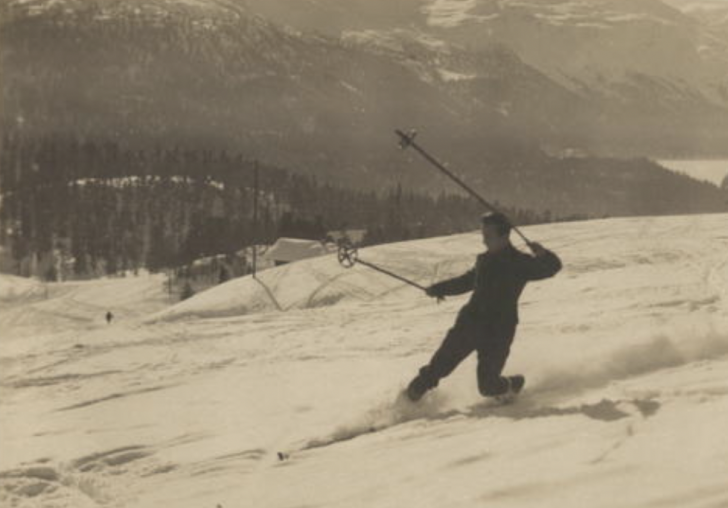
The funicular car bucked once more and then stopped.  It could not go farther, the snow drifted solidly across the track. The gale scouring the exposed surface of the mountain had swept the snow surface into a wind-board crust. Nick, waxing his skis in the baggage car, pushed his boots into the toe irons and shut the clamp tight. He jumped from the car sideways onto the hard wind-board, made a jump turn and crouching and trailing his sticks slipped in a rush down the slope.

On the white below George dipped and rose and dipped out of sight. The rush and sudden swoop as he dropped down a steep undulation in the mountain side plucked Nick’s mind out and lift him only with the wonderful flying, dropping sensation in his body. He rose to a slight up-run and then the down, faster and faster in a rush down the last, long steep slope.  Crouching so he was almost sitting back on his skis, trying to keep the center of gravity low, the snow driving like a sand-storm, he knew the pace was too much. But he held it. He would not let go and spill. Then a patch of soft snow, left in a hollow by the wind, spilled him and he went over and over in a clashing of skis, feeling like a shot rabbit, then stuck, his legs crossed, his skis sticking straight up and his nose and ears jammed with snow.

George stood a little farther down the slope, knocking the snow from his wind jacket with big slaps.

“You took a beauty, Mike,” he called to Nick. “That’s lousy soft snow. It bagged me the same way.”

“What’s it like over the khud?” Nick kicked his skis around as he lay on his back and stood up.

“You’ve got to keep to your left. It’s a good fast drop with a Christy at the bottom on account of a fence.”

“Wait a sec and we’ll take it together.”

“No, you come on and go first. I like to see you take the khuds.”

Nick Adams came up past George, big back and blond head still faintly snowy, then his skis started slipping at the end and he swooped down, hissing in the crystalline powder snow and seeming to float up and drop down as he went up and down the billowing khuds. He held to his left and at the end, as he rushed toward the fence, keeping his knees locked tight together and turning his body like tightening a screw brought his skis sharply around to the right in a smother of snow and slowed into a loss of speed parallel to the hillside and the wire fence.

[Editor Note: On April 5, PBS stations will be airing a new, three part series by Ken Burns and Lynn Novick on Hemingway, who was an enthusiastic skier in Europe in the 20s. SeniorsSkiing.com previously published an excerpt from The Snows of Kilimanjaro, describing skiing in the Voralberg.]  


Snow In Literature: On A Tree Fallen Across The Road

[Please consider supporting SeniorsSkiing.com with a donation. We appreciate your help. Click here.]

(To hear us talk)

By Robert Frost

The tree the tempest with a crash of wood
Throws down in front of us is not bar
Our passage to our journey’s end for good,
But just to ask us who we think we are

Insisting always on our own way so.
She likes to halt us in our runner tracks,
And make us get down in a foot of snow
Debating what to do without an ax.

And yet she knows obstruction is in vain:
We will not be put off the final goal
We have it hidden in us to attain,
Not though we have to seize earth by the pole

And, tired of aimless circling in one place,
Steer straight off after something into space.


Snow In Literature: Fwooosh

Fwoosh! By Matthew Haddad (Age 12)

[Editor Note: This poem was written when Matthew was 11 for his grandfather SeniorsSkiing.com reader Doug Haddad. Proud grand dad submitted it on his behalf.]

Past snowy hills

On a 100 degree down

Intricate snowflakes

Frozen hearted yet making a winter wonderland 

Where skiing takes place

Over thousands of moguls

Making the snow a light wave

Directed down a thin river

When at a halt below, at the base all seems your fault

For the fun has stopped

Yet you may go up for another round

Lifted up by chairlifts

To another zoom down the mounting

Snow In Literature: Brown’s Descent

Or the Willy-Nilly Slide

Credit: M. Maginn

By Robert Frost (1916)

Brown lived at such a lofty farm
That everyone for miles could see
His lantern when he did his chores
In winter after half-past three.
And many must have seen him make
His wild descent from there one night,
’Cross lots, ’cross walls, ’cross everything,
Describing rings of lantern light.
Between the house and barn the gale
Got him by something he had on
And blew him out on the icy crust
That cased the world, and he was gone!
Walls were all buried, trees were few:
He saw no stay unless he stove
A hole in somewhere with his heel.
But though repeatedly he strove
And stamped and said things to himself,
And sometimes something seemed to yield,
He gained no foothold, but pursued
His journey down from field to field.
Sometimes he came with arms outspread
Like wings, revolving in the scene
Upon his longer axis, and
With no small dignity of mien.
Faster or slower as he chanced,
Sitting or standing as he chose,
According as he feared to risk
His neck, or thought to spare his clothes,
He never let the lantern drop.
And some exclaimed who saw afar
The figures he described with it,
”I wonder what those signals are
Brown makes at such an hour of night!
He’s celebrating something strange.
I wonder if he’s sold his farm,
Or been made Master of the Grange.”
He reeled, he lurched, he bobbed, he checked;
He fell and made the lantern rattle
(But saved the light from going out.)
So half-way down he fought the battle
Incredulous of his own bad luck.
And then becoming reconciled
To everything, he gave it up
And came down like a coasting child.
“Well—I—be—” that was all he said,
As standing in the river road,
He looked back up the slippery slope
(Two miles it was) to his abode.
Sometimes as an authority
On motor-cars, I’m asked if I
Should say our stock was petered out,
And this is my sincere reply:
Yankees are what they always were.
Don’t think Brown ever gave up hope
Of getting home again because
He couldn’t climb that slippery slope;
Or even thought of standing there
Until the January thaw
Should take the polish off the crust.
He bowed with grace to natural law,
And then went round it on his feet,
After the manner of our stock;
Not much concerned for those to whom,
At that particular time o’clock,
It must have looked as if the course
He steered was really straight away
From that which he was headed for—
Not much concerned for them, I say:
No more so than became a man—
And politician at odd seasons.
I’ve kept Brown standing in the cold
While I invested him with reasons;
But now he snapped his eyes three times;
Then shook his lantern, saying, “Ile’s
’Bout out!” and took the long way home
By road, a matter of several miles.

Snow In Literature: Interlude

By Linda Pastan

Credit: MD Maginn

We are waiting for snow
the way we might wait for a train
to arrive with its cold cargo—
it is late already, but surely
it will come.
We are waiting for snow
the way we might wait
for permission
to breathe again.

For only the snow
will release us, only the snow
will be a letting go, a blind falling
towards the body of earth
and towards each other.

And while we wait at this window
whose sheer transparency
is clouded already
with our mutual breath,

it is as if our whole lives depended
on the freezing color
of the sky, on the white
soon to be fractured

Excerpted from Queen of a Rainy Country by Linda Pastan. Copyright © by Linda Pastan. Used with permission of the publisher, W. W. Norton & Company, Inc. All rights reserved. Buy Now.


Snow In Literature: Dust of Snow

By Robert Frost

Credit:Creasy Mahan Nature Preserve

 
The way a crow
Shook down on me
The dust of snow
From a hemlock tree
 
Has given my heart
A change of mood
And saved some part
Of a day I had rued.
 

Snow In Literature: Two Tramps In Mud Time (Excerpt)

[Editor Note: This time of the year, we like to re-publish this verse from Frost’s Two Tramps In Mud Time. We also note that we’ve published a number of Frost’s poems in our Snow In Literature this publishing year. Unintended.  But his words reflect the world of people who know winter and all it brings. You can listen to Frost himself reading the whole poem by clicking on the YouTube link at the bottom.]

By Robert Frost

The sun was warm but the wind was chill.
You know how it is with an April day
When the sun is out and the wind is still,
You’re one month on in the middle of May.
But if you so much as dare to speak,
A cloud comes over the sunlit arch,
A wind comes off a frozen peak,
And you’re two months back in the middle of March.


Snow In Literature: The Wood-pile

By Robert Frost

Out walking in the frozen swamp one gray day,
I paused and said, ‘I will turn back from here.
No, I will go on farther—and we shall see.’
The hard snow held me, save where now and then
One foot went through. The view was all in lines
Straight up and down of tall slim trees
Too much alike to mark or name a place by
So as to say for certain I was here
Or somewhere else: I was just far from home.
A small bird flew before me. He was careful
To put a tree between us when he lighted,
And say no word to tell me who he was
Who was so foolish as to think what he thought.
He thought that I was after him for a feather—
The white one in his tail; like one who takes
Everything said as personal to himself.
One flight out sideways would have undeceived him.
And then there was a pile of wood for which
I forgot him and let his little fear
Carry him off the way I might have gone,
Without so much as wishing him good-night.
He went behind it to make his last stand.
It was a cord of maple, cut and split
And piled—and measured, four by four by eight.
And not another like it could I see.
No runner tracks in this year’s snow looped near it.
And it was older sure than this year’s cutting,
Or even last year’s or the year’s before.
The wood was gray and the bark warping off it
And the pile somewhat sunken. Clematis
Had wound strings round and round it like a bundle.
What held it though on one side was a tree
Still growing, and on one a stake and prop,
These latter about to fall. I thought that only
Someone who lived in turning to fresh tasks
Could so forget his handiwork on which
He spent himself, the labor of his ax,
And leave it there far from a useful fireplace
To warm the frozen swamp as best it could
With the slow smokeless burning of decay.

Snow In Literature: Stopping By Woods On A Snowy Evening

By Robert Frost

Whose woods these are I think I know.
His house is in the village though;
He will not see me stopping here
To watch his woods fill up with snow.

My little horse must think it queer
To stop without a farmhouse near
Between the woods and frozen lake
The darkest evening of the year.

He gives his harness bells a shake
To ask if there is some mistake.
The only other sound’s the sweep
Of easy wind and downy flake.

The woods are lovely, dark and deep.
But I have promises to keep,
And miles to go before I sleep,
And miles to go before I sleep.\\

Snow In Literature: A Contemporary

By W.S. Merwin (1927-2019)

What if I came down now out of these
solid dark clouds that build up against the mountain
day after day with no rain in them
and lived as one blade of grass
in a garden in the south when the clouds part in winter
from the beginning I would be older than all the animals
and to the last I would be simpler
frost would design me and dew would disappear on me
sun would shine through me
I would be green with white roots
feel worms touch my feet as a bounty
have no name and no fear
turn naturally to the light
know how to spend the day and night
climbing out of myself
all my life

Snow In Literature: The Winter’s Spring

By John Clare (1793-1864)

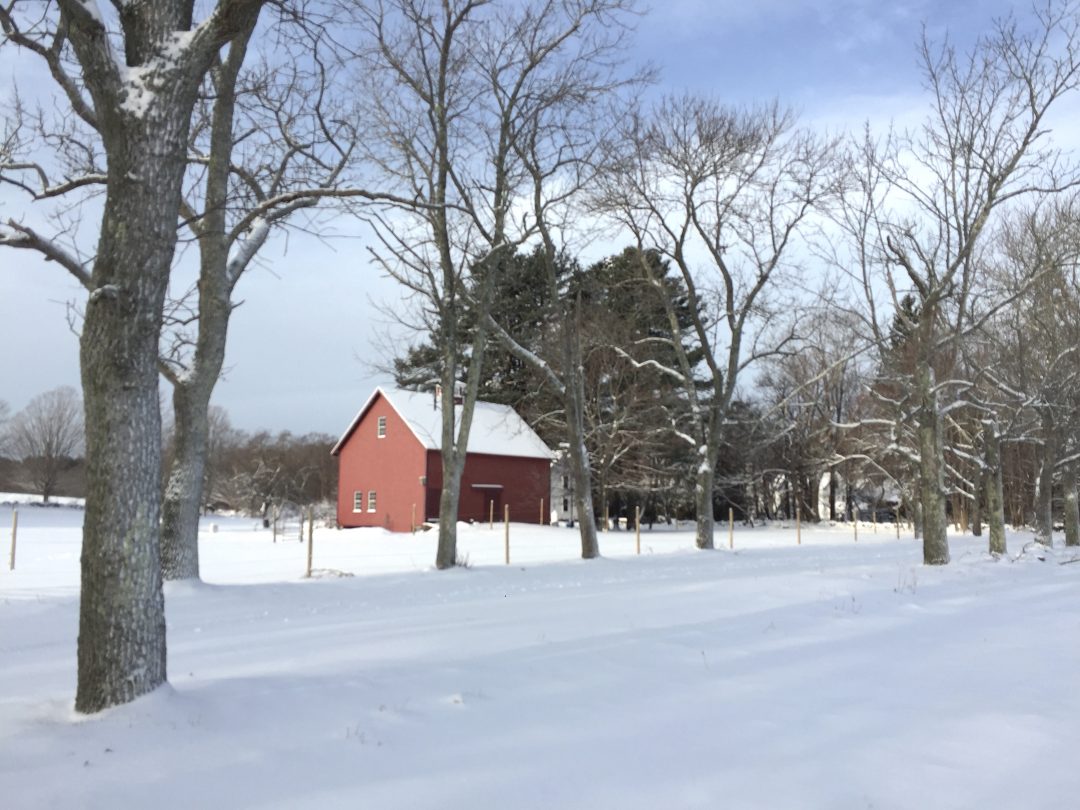
Appleton Farms, Ipswich/Hamilton, MA. Credit: Mike Maginn

The winter comes; I walk alone,

I want no bird to sing;

Tho those who keep their hearts their own

The winter is the spring.

No flowers to please—no bees to hum—

The coming spring’s already come.


I never want the Christmas rose

To come before its time;

The season, each as God bestows,

Are simple and sublime.

I love to see the snowstorm hing’

‘Tis but the winter garb of spring,


I never want the grass to bloom:

The snowstorms’ best in white.

I love to see the tempest come

And love its piercing light.

The dazzled eyes that love to cling

O’er snow-white meadows sees this spring.


I love the snow, the crumpling snow

That hands on everything,

It covers everything below

Like white dove’s drooding wind,

A landscape to the aching sight,

A vast expanse of dazzling light.


It is the foliage of the woods

That winters bring—the dress,

White Easter of the year in bud,

That makes the winter Spring.

The frost and snow his posies bring,

Nature’s white spurts of the spring.

Appleton Farms, Ipswich/Hamilton, MA. Credit: Mike Maginn

Snow In Literature: My November Guest

November Is A Forerunner.

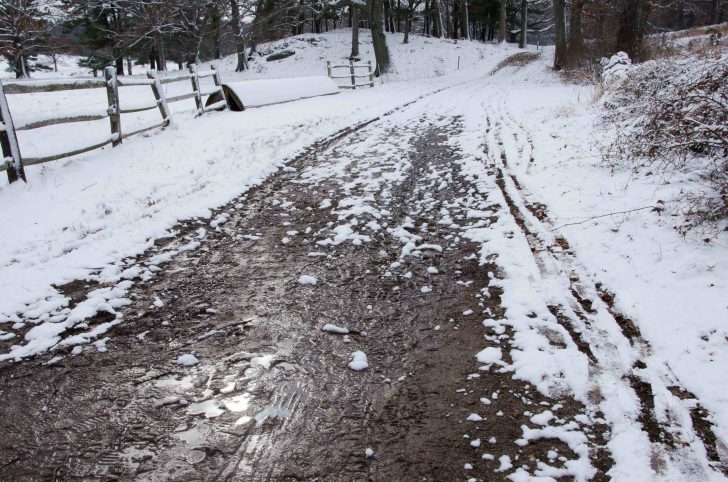
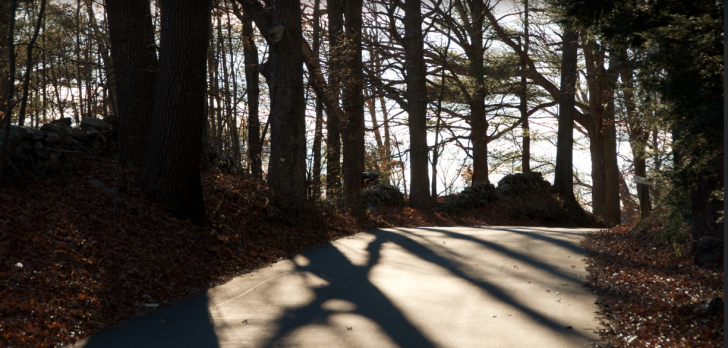
November Road, Credit: M.Maginn

My November Guest

By Robert Frost (1913)

My sorrow, when she’s here with me,
Thinks these dark days of autumn rain
Are beautiful as days can be;
She loves the bare, the withered tree;
She walks the sodden pasture lane.

Her pleasure will not let me stay.
She talks and I am fain to list:
She’s glad the birds are gone away,
She’s glad her simple worsted grey
Is silver now with clinging mist.

The desolate, deserted trees,
The faded earth, the heavy sky,
The beauties she so truly sees,
She thinks I have no eye for these,
And vexes me for reason why.

Not yesterday I learned to know
The love of bare November days
Before the coming of the snow,
But it were vain to tell her so,
And they are better for her praise.