
Tag Archive for: snowshoes

Snowshoe hiking

Learning To Love Snowshoes

Not XC’s Poor Cousin Anymore.

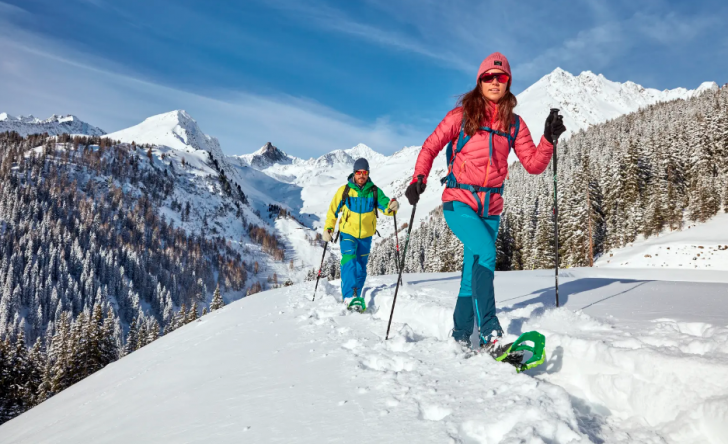
Snowshoe hiking gets you out on the snow and sunshine.

Back in 1971, when I transferred winter affections from downhill to Nordic skiing (due to a spectacular fall in Austria, that racked up one knee and stripped off my nifty French-made Fusalp ski suit– but that’s another story), I tried snowshoeing too. After all, cross-country skis and snowshoes were both made of wood and quite beautiful; they’re both ways to travel over snow rather than wade through it; they’re both very low-impact sports…

But cross-country evolved into my lifelong true love, while snowshoeing became merely the affably boring cousin you contact every few years. Too much work; bindings were crappy (now you’re in, now you’re not – and your fingers are gonna freeze putting the damn things back on); ‘shoes didn’t slide like skis, except sideways downhill on crust; wood frames cracked; rodents enjoyed chewing the rawhide webbing in summer storage…

Modern snowshoes confirm the theory of evolution. They’re clearly descendants of the woodies but fill new niches in design, materials, flotation, fun…

We moved ‘way beyond Sergeant Preston and his gigantic snowshoes.

I found this out one January about a dozen years ago, designing XC trails near Big Sky resort in Montana. (Sadly, I hadn’t visited that cousin in almost 30 years.) The snow was too deep, buried underbrush and deadfall too catchy, to use Nordic skis; so since slogging through waist-deep powder on foot was out of the question, what to do? Happily, intuition had suggested bringing my new aluminum snowshoes along, to test the frozen waters; and they behaved magnificently, though I dumped a couple of times trying to back up, sinking the tails of the ‘shoes. (My style of absorbing knowledge always seems to be “education through error.”)

So what’s new about this next generation – or two – of snowshoes? It may seem minor at first, but bindings have improved incredibly – they’re easy to use, stay on, sturdy, and they don’t stretch so they slide off your boots. The ‘shoes themselves are durable and have no food value, since they’re generally made with aluminum frames and synthetic decking that’s durable and gives great flotation – that combination also allows light weight, so less effort. The addition of bottom metal cleats gives you much better grip on crust and even side-hills (though it’s still smart to avoid those when possible).

Let’s, what else? Modern models definitely aren’t as pretty, but it’s a trade of aesthetics for dependability, longevity, convenience, and ease of movement.

Snowshoes are usually not as pricey as Alpine (or even Nordic) gear, but it’s still smart to rent before you buy to see if you like the sport. You can use hiking or snow boots with today’s adjustable bindings, or even sneakers with neoprene booties. A pair of gaiters will help keep out the snow and make sure your feet stay warm and dry.

There’s a new kind of ‘shoe that came on the market recently from a Colorado company (www.crescentmoonsnowshoes.com). They’re made of foam (foam!), but from my destructive testing are not just light but also sturdy, incredibly maneuverable (I backed up in them, did a 180 degree jump-turn for no good reason – no falls!), have great bindings, and are setting the snowshoe industry on its butt.

There are a thousand more subtleties to fun snowshoeing – using poles, running vs. walking, clothing, etiquette, blah blah. They’re relatively unimportant. Snowshoeing has become easy, and easy on your bones and joints. And even if you don’t glide, just repeat too yourself, “600+ calories per hour!” enjoy the burn, and head for the dessert tray after your outing.

Lovin’ Snowshoes

‘Shoes Have Come A Long Way.  Have You Looked Lately?

Old: Good for decorating rustic cabins.

Back in 1971, when I transferred winter affections from downhill to Nordic skiing (due to a spectacular fall in Austria that racked up one knee and stripped off my ski suit—but that’s another story), I also tried snowshoeing. After all, cross-country skis and snowshoes were both made of wood and quite beautiful; they’re both ways to travel over snow rather than wade through it; they’re both very low-impact sports.

But cross-country evolved into my lifelong true love, while snowshoeing became merely the affably boring cousin you contact every few years. Too much work; bindings were crappy (now you’re in, now you’re not—and your fingers are gonna freeze putting the damn things back on); ‘shoes didn’t slide like skis, except sideways downhill on crust; wood frames cracked; rodents enjoyed chewing the rawhide webbing in summer storage.

Modern snowshoes confirm the theory of evolution. They’re clearly descendants of the woodies but virtually a new species in design, materials, flotation, and fun.

I found this out one January about a dozen years ago, laying out ski trails at a resort in Montana. (Sadly, I hadn’t visited that cousin in almost 30 years.) The snow was too deep, buried underbrush and deadfall too catchy to use Nordic skis. So since slogging through waist-deep powder on foot was out of the question, what to do? Happily, intuition had suggested bring my new aluminum snowshoes along to test the frozen waters. They behaved magnificently, though I dumped a couple of times trying to back up, sinking the tails of the ‘shoes. (My style of absorbing knowledge always seems to be “education through error.”)

Modern: Light, durable, inexpensive. Credit: Tubbs

So what’s new about this next generation (or two – more on that shortly) of snowshoes? It may seem minor at first, but bindings have improved incredibly; they’re easy to use, they stay on, and they don’t stretch. The ‘shoes themselves are durable and have no food value to rodents, since they’re generally made with aluminum frames and synthetic decking that’s durable and gives great flotation.  That combination is light weight, so there’s less effort. The addition of bottom cleats gives you much better grip on crust and even side-hills, though it’s still smart to avoid those when possible.

What else? Modern models definitely aren’t as pretty, but it’s a trade off of aesthetics for dependability, longevity, and convenience.

Snowshoes are nowhere near as pricey as Alpine or even Nordic gear, but it’s still smart to rent before you buy to see if you like the sport. You can use hiking or snow boots with today’s adjustable bindings, or even sneakers with neoprene booties.

There’s a new kind of ‘shoe that came on the market this fall ago from Crescent Moon Snowshoes, a Colorado company. They’re made of foam (!) but from my destructive testing are not just light but also sturdy, incredibly maneuverable.  I backed up in them, did a 180 degree jump-turn for no good reason.  They have great binding and are setting the snowshoe industry on its butt.

There are a thousand more subtleties to fun snowshoeing—using poles, running vs. walking, clothing, etiquette, and the like. They’re mostly unimportant. Snowshoeing has become easy, and easy on your bones and joints. And even if you don’t glide, just repeat too yourself, “600+ calories per hour!”, enjoy the burn, and head for the dessert tray.

Most Modern: Foam ‘shoes from Crescent Moon.

Women-Only Snowshoes: Vive La Difference!

Special Thanks to Roger Lohr, Editor and Publisher of XCSkiResorts.com for allowing us to post this article which first appeared on that site.

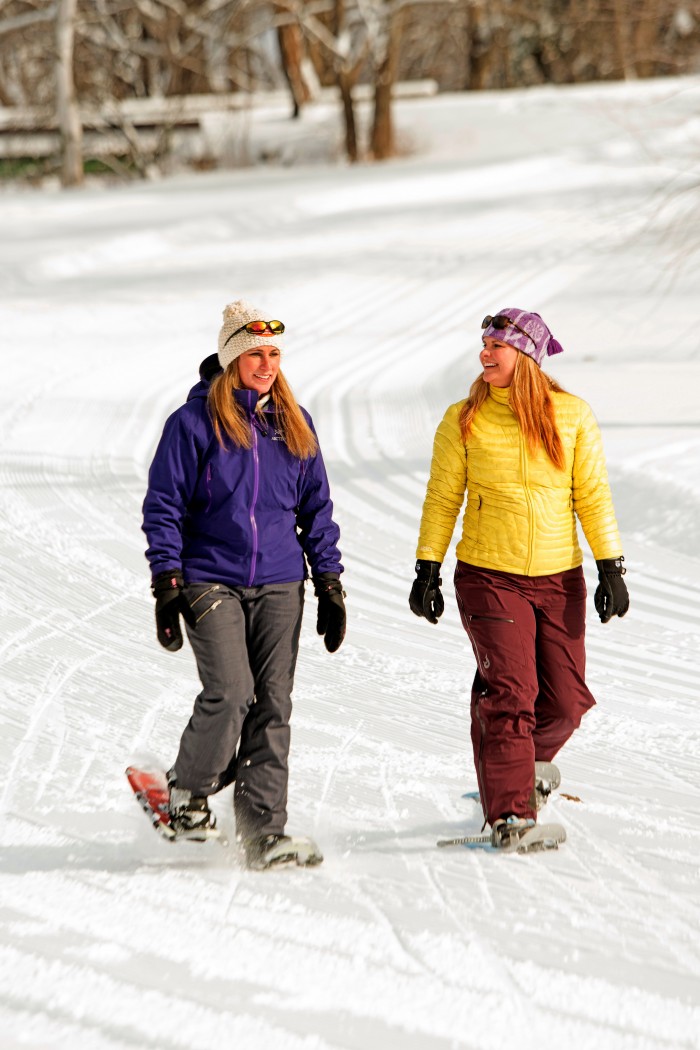
About half of all snowshoers are women, who snowshoe to experience nature, to exercise with friends and family, for backcountry access, and to have outdoor fun throughout the winter. The various snowshoe companies have been catering to this market by offering a broad selection of women’s-specific snowshoe technologies recreation and fitness, but do the women’s snowshoes go beyond just a change in cosmetics?

Woodstock Inn attracts women snowshoers who can step along in women-only gear. Credit: Woodstock Inn

Woodstock Inn attracts women snowshoers who can step along in women-only gear.
Credit: Woodstock Inn

Tubbs Snowshoes pioneered the development of women’s-specific snowshoes by offering patented binding technologies that custom fit women’s boot sizes and by ergonomically engineering frames that are tapered at the tip and tail to accommodate women’s shorter strides. The result was lightweight, comfortable, high-performance snowshoes and many of the other brands have followed suit.

There are a few differences between Tubbs’ men’s and women’s snowshoes. On average, women have a narrower stance and shorter gait, so women’s snowshoes are narrower in width. Women’s average weight range is both more light weight and a smaller range than men’s, so they provide snowshoes in a shorter size for women, longer for men. The Tubbs men’s and women’s bindings differ, providing the optimal fit for the average women’s boot size and volume range, versus a larger average men’s boot size and volume range. Foot size also affects the optimal position for the heel lift, so the placement of the heel lift on men’s snowshoes varies from the placement on women’s snowshoes.

The Atlas Snowshoes Company conducted gait studies and biomechanics research to create snowshoes that enable women to hike and run with the most natural stride possible, while making the snowshoes both comfortable and lightweight. The research revealed that women have a greater Q-angle (at the knee where the thigh bone angles in from a woman’s wider hips) and abducted gait that create specific issues when snowshoeing. Women also tend to pronate (collapsing arches) pointing to the need for bindings to support the arch of the foot.

MSR snowshoes for women balance a naturally narrower gait and the need to “float” on the snow. Credit: MSR

According to the people at MSR, the studies conducted by Tubbs clearly showed male/female anatomical differences. However, when these differences are translated into physical products the design changes are not as noticeable. For example, women generally walk with a narrower gait than men. Therefore, a very narrow snowshoe would suit women better, but the snowshoe width has a direct impact on flotation so the final design can’t be too narrow. The ideal width snowshoe for women is a balance between very narrow to accommodate gait and wider for adequate flotation.

MSR believes that it is important to look beyond the measurements and understand how the snowshoes feel. Thousands of hours of field testing showed that subtle differences are noticeable. The major male/female differences with men’s and women’s versions of MSR are with decks and bindings. The women’s deck shape is optimized for snowshoe performance (traction & flotation) and a female gait. The bindings are sized to meet the proportions of a women’s footwear. There is also specific MSR technology such as Axis™ Gait Technology (Women’s Lightning Ascent Snowshoes), which allows women to compensate for varying degrees of toe-out or toe-in. This technology provides laterally adjusting the bindings independently of the frame, ensuring efficient, parallel-tracking snowshoes regardless of a women’s natural toe-out or toe-in stance. This means that the binding itself can swivel on the snowshoe to adjust for varying degrees of natural toe direction allowing binding alignment with your natural stance rather than forcing you to point your feet directly ahead.

Yukon Charlies Snowshoes has the YC Pro II Series women’s snowshoes, which are designed with features specific to the needs of the female snowshoe enthusiast. The rockered V shape tail enhances performance and allows for a more natural stride. These snowshoes are lighter, stronger and more reactive than any of the company’s other women’s snowshoes.

Yukon Charlies’s Advanced Series for women is a feature-packed “go anywhere” snowshoe is designed by women, for women. The rocker V tail allows for a natural stride from a walk to an aerobic sprint, while the integrated heel lift and the axle system makes Yukon Charlie tout them as their best women’s snowshoe ever.

Redfeather Snowshoes has three styles of Hike snowshoes with the SV2 pull handle binding. There’s also a choice to get the snowshoes in a kit with poles and a bag. The Redfeather Hike has sizes of 22, 25, 30 (inches) for women up to 150, 175, and 200 lbs.

Tubbs Snowshoes and Atlas Snowshoes have shown the greatest commitment to women’s snowshoe products and they are probably the largest snowshoeing product brands. Tubbs Snowshoes has 11 models for women (in seemingly every snowshoe category) including Flex ESC, Flex TRK, Flex ALP, Flex RDG, Flex Vrt, Wilderness, Mountaineer, Frontier, XPlore, and Xpedition.

Atlas Snowshoes has six options for women including the Electra 8 and 9, Endeavor, Fitness, Race, and Run.

Few of the snowshoe companies invest in marketing directly to women but the Tubbs Snowshoe event “Romp to Stomp Out Breast Cancer” Series, is very popular focused on women. This year’s event at Frisco Nordic Center in Colorado was attended by more than a thousand people! The series, which has been hosted at sites across North America has raised funds and awareness since 2003 bringing in more than $2.8 million for the fight for a cancer cure.

Whether the trail conditions are light fresh snow, crust, slush or ice, women want to trust their snowshoes for all-condition durability, excellent traction, flex for control, and comfort. Women are coming to expect that their snowshoes are specific to their needs and built to withstand frequent use offering many seasons of recreation, fitness and adventure.