

Tag Archive for: winter snow prediction

Snowy Winter Ahead? Ask A Wooly Bear

Some Say It’s Folklore. Some Say It’s Real.

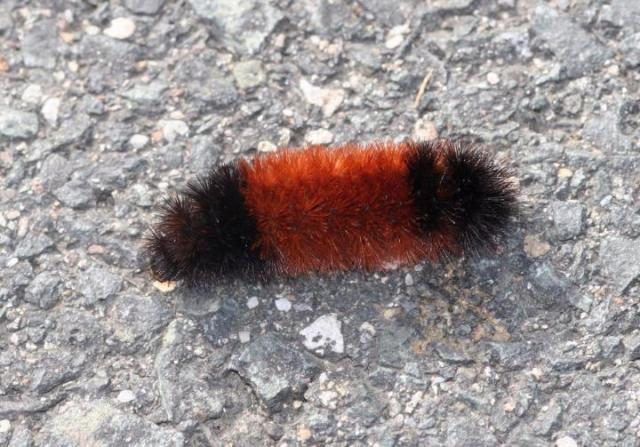
Wooly Bear caterpillar may predict snow. Then again, they may not. Credit: Harriet Wallis

Wooly Bear caterpillar may predict snow. How do they do that?
Credit: Harriet Wallis

Wooly Bear caterpillars are cool dudes. Their fuzzy bodies are black at both ends and orangish in the middle.

Winter enthusiasts examine that orangish band to learn what the coming winter will bring. A narrow band predicts a cold winter with precipitation. A broad band foretells a warm winter.

The bug’s celebrity status began in 1948 when Dr. C. H. Curran, a curator of insects at the American Museum of Natural History in New York City, gathered the critters and took measurements trying to correlate the width of the band to the weather.

He did this for eight years. Perhaps Wooly Bears were a good excuse to get out of the city in the name of science.

Wooly Bears are found throughout the country, but they’re more prevalent in the eastern states.
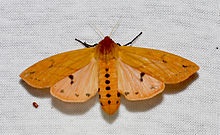
Wooly Bear produces Tiger Moth which predicts weather, maybe. Credit: Harriet Wallis

Winter forecaster Wooly Bear produces a Tiger Moth. Credit: Harriet Wallis

The caterpillar is the larval from of the rather bland Tiger Moth (Pyrrharctia Isabella).

I know old time Vermonters who use a different method to predict the winter. They sit on the porch and count how many loads of firewood go by.

There are other folklore methods. If the weeds grew extra tall in summer, it means a snowy winter. And ample acorns and apples with thick skins predict a cold, snowy winter.

Please excuse me now. I’m going to look for some Wooly Bears and bite into an apple.

Read more about skiing and from Harriet Wallis at www.skiutah.com

Winter 2015 Forecast: Maybe Snow, Maybe Not

Handicapping 2014-2015 winter can lead to confident-sounding but wrong predictions.

By now, you’ve noticed that the weather in the past few years has become a series of conversation-starting, concern-causing, head-scratching, question-asking phenomena.  Last winter was—as they say down east— a “hoser”.  In the Northeast, we had the most persistent, bitterly cold winter in memory.  According to the National Weather Service, New England temperatures frequently and persistently ranged at or below normal low ranges from January to the end of March.  Even the Mid-Atlantic States had a cold and snowy season.  Early snow and a lot of it created deep powder conditions in the Alps, especially Italy.  Meanwhile, the Polar Vortex brought a cold and snowy season to the Northern Rockies and Midwest while California was unseasonably dry and warm.

What’s in store for 2014-15?  Joel Gratz of OpenSnow, an interesting online forecasting site we recommend to our readers, is

OpenSnow Compared US and International Models Credit: OpenSnow

OpenSnow Compared US and International Models
Credit: OpenSnow

not enthusiastic about long-range forecasts in general.  Nevertheless, he compared a number of US and European forecasts for the upcoming 2014-15 season and found some consensus:  Dry in the Northwest, Snowy in the Far West and uncertain from the Rockies eastward to New England.  Just to test the reliability of long-range predictions like this, he compared the accuracy of several forecast models from the prior 2013-14 season with actual results.  Those predictions were “far from perfect”.

So, he concludes, “Can we trust seasonal forecasts from these models? Based on last year (predictions), definitely not.”  He suggests we treat all of this as entertainment.  On the other hand, this year’s El Nino might actually “force the weather to behave in more predictable ways.” At the end of the day, who knows?

Besides, the Boston Globe reported this June that long-range climate is warming fastest in the Northeastern states, led by Maine and Vermont and in the South West.  Conclusion:  Ski when and where you can.