This Week In SeniorsSkiing.com (May 18)

Survey Results: Summer Activities, Summer Trail Prep, Sacropenia Defense.

We are in high spring, as it were, as of this writing, and yet they are still squeezing out runs in Killington, VT, and will be until the end of May. Here’s a pic from last weekend from Aspen East Ski Shop’s Facebook page.

Still turning at Killington with one week to go. Credit: Aspen East Ski Shop

And also at Killington, Scott Howard, (65) a senior skier (!), has managed to break the unofficial record for the total number of vertical feet skied in a

Vertical record holder (unofficial) Scott Howard. Credit: Scott Howard.

season.  According to Trace, his iPhone app, Scott has racked up over six MILLION vertical feet by skiing 60 runs a day, seven days a week. Just so you know, six million vertical feet is equal to 1136 miles. That’s a little short of the distance from Vermont to Colorado.

Couple more runs, Scott, and you can head to the hot tub.

For more about this achievement, click here to read story from our friends at Snowbrains. 

Meanwhile, most of us have put up out skis and are into our non-snow activities. In case you are wondering, what do senior skiers do in the off season.  Let’s look at the results from our recent survey.

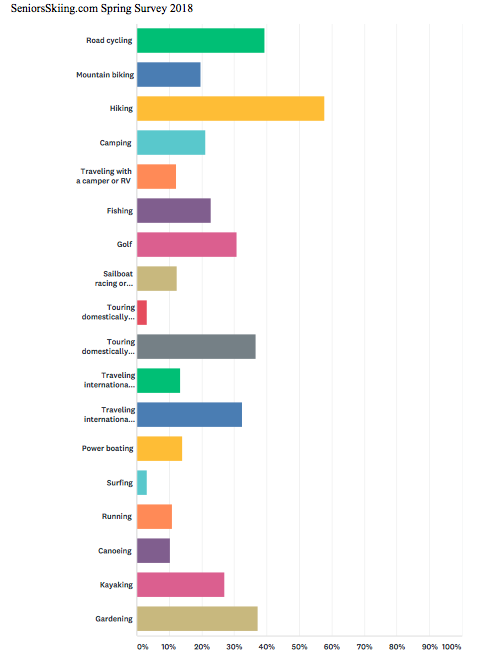
Non-Snow Activities From SeniorsSkiing.com Spring Survey 2018

We asked our readers what activities they participated in after the snow melts. Here’s the top ten.

  1. 57.83% Hiking
  2. 39.32% Road Cycling
  3. 37.31% Gardening
  4. 36.54% Touring independently domestically
  5. 32.44% Touring independently internationally
  6. 30.78% Golf
  7. 26.93% Kayaking
  8. 22.78% Fishing
  9. 21.18% Camping
  10. 19.69% Mountain Biking

The most interesting write-in comment was Dragon Boat Paddling. We also noted many write-ins for Tennis, Swimming, and Hunting. We should have made these choices in this survey and will include them next time. Your comments? Reactions?
This Week

Correspondent Yvette Cardozo takes us up to Sun Peaks Resort in British Columbia where we learn how trails are prepped for summer.  Check out those cows! And we hear from Arthur Razee, a new contributor, who explains how do deal with sacropenia, the condition that causes muscle loss in older folks. It happens to us all, but we can manage to deal with through diet and a specific exercise.

Also, we say goodbye to our old friend and mentor, venerable and veteran ski journalist John Henry Auran. You can read a tribute here.

Meanwhile, stick with us through the summer.  We have some interesting stories lined up and we do want to hear from you. Please, please tell your friends about us.  Remember, there are more of us every day and we aren’t going away.

Meanwhile, here’s a shot of a May snowstorm in Charlotte Pass, New South Wales, Australia, where the season is just getting under way.  It’s snowing somewhere in the world every day!


Short Swings!

Are older skiers the Rodney Dangerfields of the slopes? Sometimes it feels like ski resorts show us no respect.

Consider that there are no Epic or Ikon senior discounts, and, in the case of some Ikon resorts, there no longer are local season passes and the senior discounts associated with them.

Some of the big players are doing very well. Vail Resorts, which owns Epic, reported a 58% increase in second quarter net revenue over second quarter 2017. Part of the increase was a one-time bonus from the new tax law; part of it was from increases in lift ticket and season pass products.

Like any other business, the ski industry follows the money. Which brings me to one of the key findings from our most recent reader survey. Fifty-six percent of all respondents spent $1000 to $5000 per person on skiing and related activities last season. More than 10% spent $5000 or more per person.

The same can’t be said for Millennials and Gen-Xers, the industry’s primary target markets.

One in five U.S. skiers and boarders are 52 or older. Our survey, which had more respondents than any of our previous reader surveys, showed an average of 15 days on the hill. More than one-third skied 23 days or more.

For those bottom line oriented ski executives who may be reading this: We use your facilities more and spend more than the youngsters. Think twice before removing senior discounts.


New Canadian Resort to Have Longest Vertical in North America

Valemount Glacier Destination is being developed in the Cariboo Mountain Range in British Columbia. When completed, it will have the longest vertical drop in North America (6726′) and the third longest in the world. Developers expect it to become a year-round skiing and sightseeing destination. Near Jasper National Park, the area already has substantial infrastructure. When completed, there will be skiing on several mountains, the largest of which is Mt XXXX, which summits at XXXXX ‘. The resort is a 75 minute drive from Jasper. It is located on the trans-Canada rail line and has a local airport within walking distance of the resort base. Larger airports are several hours away.

According to Tomas Oberti, project manager, the first phase is expected to open for day skiing in December. Full build-out of the project will occur over 20 years.

More on Valemount Glacier Destination at http://valemountglaciers.com.

Seven Skiers Die in Alps Storm

Seven skiers on the Haute Route in Switzerland died in a sudden storm in early May. They were part of a guided group forced to overnight in freezing temperatures. Adding to the tragedy: they were just a few hundred meters from an alpine hut. Elsewhere in the Alps, the storm claimed the lives of another seven climbers and tourists. It was the most loss of lives in Switzerland since 1999, when 12 died in an avalanche in the Valais.


The Daily Senior Skier Skinning Session at Arapahoe Basin

Doris Spencer is 72; Kent Willoughby, 79. They have been skinning up A-basin for nearly 18 years. This short documentary inspired me. I expect it will do the same for you.


Snowbird’s One Star Season

The Bird just issued this one-minute video summary of the season. The resort characterizes 2017-18 as a “one star” season, but you’d never know it from the skiing and boarding in the video.


Baltimore Ski Club Celebrates Member’s 90th Birthday

Dave Karczmarek, BSC Director of Ski Trips, recognizing John Wotell on his 90th.

John Wotell turned 90 in February, and the Baltimore Ski Club recently turned out in force to celebrate. A long time skier, he and his wife, Ann, were active members of the Ski Club of Maryland since the 1960s. For years, he was president of the group and made “President for Life” when he stepped down. He celebrated his 90th at Big Sky. Happy Birthday, John!


Skiing Grandparents Play Major Role Introducing Grandkids to Winter Sports

Courtesy: Daily Mail

Grandparents who ski or board play a major role introducing their grandchildren to the sport. This is one of several significant findings from the April reader survey.

It was the fifth SeniorsSkiing.com reader survey, and it produced the largest reader response to date.

Fifty-eight percent of respondents identified as grandparents. The introduced more than 68% of their grandchildren to the sport. Importantly, 94.5% of the kids continue to participate. Each responding grandparent or grandparent set has an average of 3.7 grandkids.

These “gateway grandparents” may instruct the kids, pay for lessons, or encourage their adult children to do the same. Even if the grandparents don’t live nearby, readers report that they purchase equipment and clothes as gifts, and often host family ski vacations.

The average survey respondent is 68 and skied or boarded an average of 15 days last season. More than one-third skied 23 days or more.

“As this survey shows, grandparents play a major role introducing younger people to skiing and boarding,” observes Mary Jo Tarallo, Executive Director of Learn To Ski and Snowboard, the national initiative dedicated to spreading the joy of skiing, snowboarding and winter sports.”At a time, when the ski industry is seeking ways to attract more participants, the SeniorsSkiing.com survey results shed light on grandparents as a reliable but overlooked source of new skiers and boarders.”
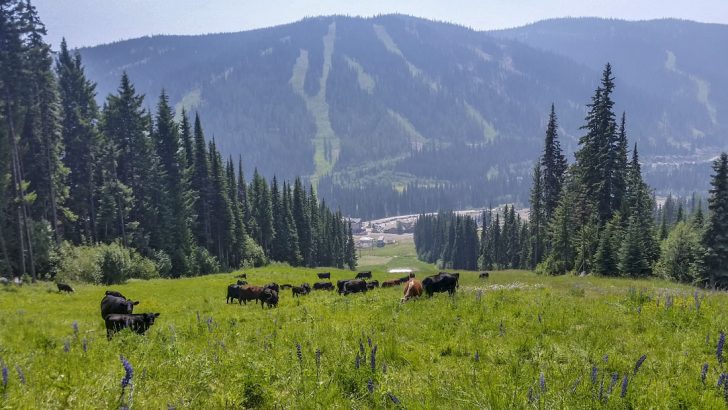
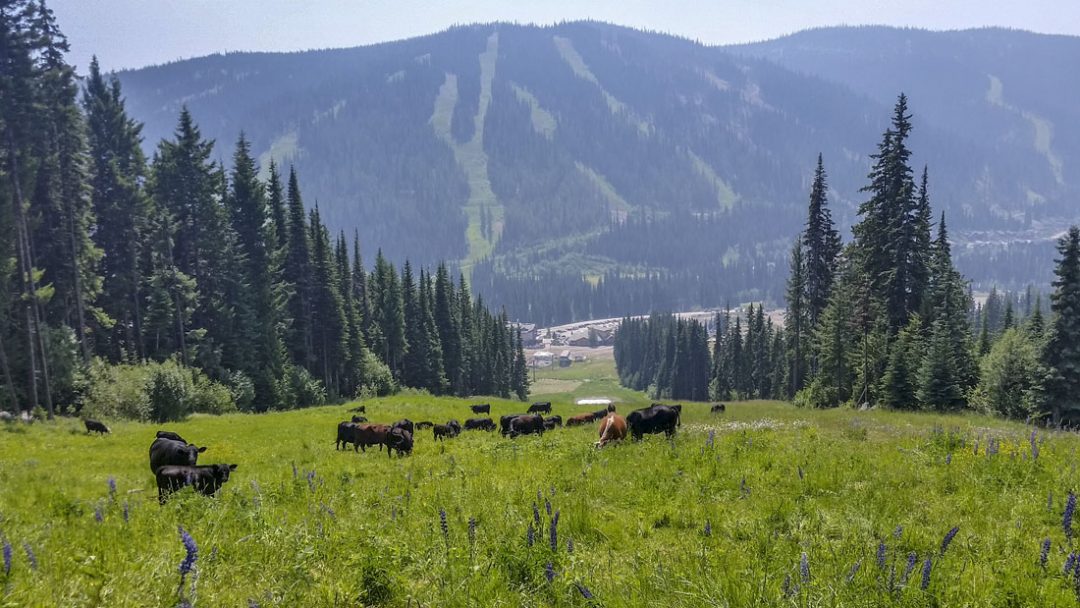
Grazing cows

Summer Trail Prep: How It’s Done

What Happens When the Snow Disappears Along With The Crowds?

Grazing cows in summer help cut grass on ski runs. Part of summer prep. Credit: Sun Peaks Resort.

Bet you’ve never thought about how your favorite ski runs get cared for when there’s no snow on the ground.

Yes, they have to be prepped each summer.

Seth Worthen, slopes manager at Sun Peaks Resort in British Columbia, Canada, explained how his 11 person trail crew works. And it’s a seven-day-a-week job.

Willow and alder trees, for instance, can grow four to six feet over the summer—the height of an average person. You might think of willows as bushes, but if left alone, they can become 20-foot trees, fast.

“We use a flail mower,” said Worthen. “It practically makes the willow into chips. Even the larger ones can be laid down flat.”

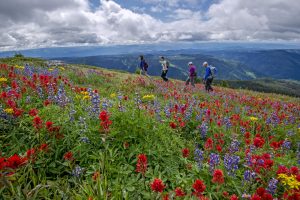
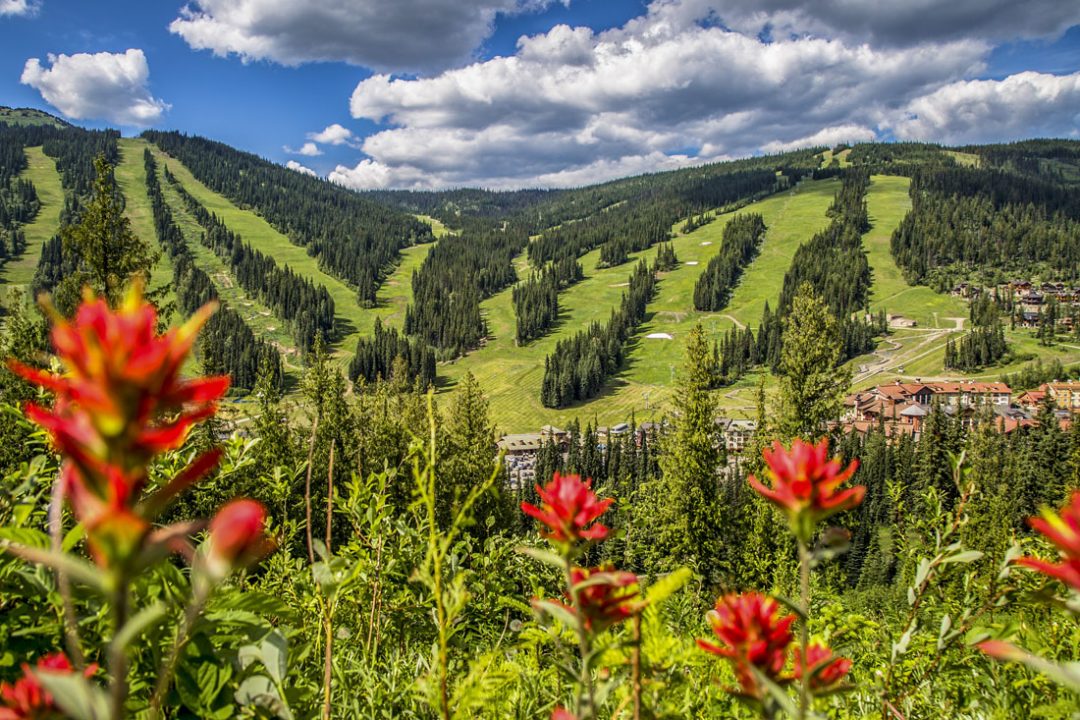
Summer flowers and hiking at Sun Peaks Resort. Summer prep of ski runs will include cutting the grass after the flower bloom. Credit: Sun Peaks Resort.

The crew starts low on the ski mountain in May as soon as the snow clears. But they often can’t get to the tops of runs until July because of lingering snow.

Early grooming years at Sun Peaks Resort were spent removing stumps and rocks. So now, most runs are just grass.

“We mow ‘em with an off road mowing machine, making stripes up and down. Sundance almost looks like a golf course. When you mow two or three feet of grass growth, it lies down and insulates the ground so we need only 25 – 30 cm (about a foot) of snow to open.”

And then, there are the cattle.

Four farms in the area have grazing rights on Crown recreation land. That means the nice, smooth, grassy ski slopes get help with grass cutting from the bovines. Some years, it’s only a few hundred cattle, but it theoretically could be thousands.

So another job here is setting up electric fences to keep the cattle out of the core village. There are gates so people can access hiking trails.

Among the other jobs, there’s cutting some trees along the edges of existing trails each summer to widen them a bit. Also choosing and marking winch cat trees. These are the trees the grooming cats attach cables to so they can manicure steep ski runs in winter.

“We bore into the trees to make sure there’s no decay,” said Worthen.

That’s a smart move when you are expecting to have a cable on a tree keep an eight ton snow cat from sliding uncontrollably down the mountain.

Summer prep is not exactly a hazard free job. One recent summer, one worker was herding a bull (yes, there are bulls among the grazing cattle) when she stepped wrong off a log and broke her ankle. We know she healed just fine because this winter, she was helping run dogsled tours.

At least a third of the runs are prepped each summer, though there are north facing runs on Mt. Morrisey that get more water so the willows grow faster and have to be dealt with yearly.

Thanks to the fact most runs are now just grassy trails that are skiable with a fairly thin layer of snow and are helped by snow making on major green runs, the resort is usually ready to open for skiing each year by the second week of November.

https://www.sunpeaksresort.com/

Summer flowers and hiking at Sun Peaks Resort. Summer prep of ski runs will include cutting the grass after the flower bloom. Credit: Sun Peaks Resort.

Sarcopenia: Insidious Muscle Loss Can Be Managed.

It Can Happen, But Don’t Despair.  Read On.

A fitness program that includes resistance training can forestall muscle loss.

Sarcopenia or muscle wasting is a condition which affects almost everyone starting about 50 years of age.  Do you have it?  Look in the mirror: Your once proud biceps and pectorals have sagged, your pants are falling down, no more butt, your legs look skinny. What looks like loose skin is really the loss of muscle. You find yourself skiing on easier slopes, minding how you climb stairs, playing less aggressive tennis, and basically losing muscle tone.

Is all lost? No, indeed.  A prominent medical school subjected a group of older folks who used walkers to a resistance training program.  In 90 days, they were able to ditch the walkers!

Apparently, the secret is a resistance training routine with some dietary changes.  A structured program in resistance, i.e., weight lifting, similar to a body builder’s program is the key.

In addition, older folk do not process proteins well. When it’s snack time, we go for crackers or other carbohydrates. This subdues your appetite but contributes nothing to your protein intake and robs your body of the space that could be utilized for protein.  Find a protein source for your snacks.  I am fond of beef jerky. Or try Greek yogurt, trail mix, almonds, peanut butter and celery, and others. Check here for ideas. Protein drinks are okay, but don’t use them as a meal replacement.

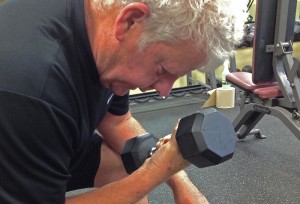
Light weights are good for bone density and muscle mass preservation.
Credit: SeniorsSkiing.com

Resistance training for seniors is a case of make haste slowly. There is potential for injury and an untrained individual needs to be careful. Proper form is absolutely critical for injury prevention and instruction by a professional is required, either at certified trainer at a gym or a physical therapist.

Medicare covers about 20 physical therapy visits a year. Get a referral from your primary care provider. Medicare with a United Healthcare supplement (AARP) has the Silver Sneakers Program which allows you unlimited visits to a gym on the program.

If you do have some resistance training experience but have been lax for a while, start off slow.  Start with a lower body workout—squats, lunges—that use your body weight only for four weeks.  Then add light dumbbells. A weight which allows you to complete three sets of 10 reps without undue exertion is the signal to increase the load, never more than about 10 percent.

Don’t forget your upper body. Most gyms have an array of weight machines which reduce balance issues.  Once again, find a personal trainer for a couple of visits to learn the form and reduce the chance of injury.

Follow your program three times a week.  You will feel stronger in a month, see results in two months and by the third month you will have developed a life-long habit.

As with all exercise programs, seek the advice of your medical professional and get expert help in starting out.