Marker Recalls Some 2017/18 Touring Bindings

Possible steel pin breakage in Marker’s Kingpin models 10 and 13 may lead to lower release forces and result in falls, according to the manufacturer.

Marker is recalling its 2017-18 Kingpin toe binding

The ski touring binding is targeted at the backcountry market. Marker is replacing the binding toes at no cost. If you have the binding contact your local Marker Authorized Retailer or visit https://www.marker.net/en-us/support/recall/ for assistance.

This Week In SeniorsSkiing.com (July 20)

More On Skiing Chile, Fat Bikes For Seniors, Mammoth Invests In Summer, Lost Baby Robin, Alone In The Woods.

Casey grabs some pow at La Parva, Chile. Credit: Casey Earle

Summer is in full glory as we write this. So far, in New England, we’ve had a massive, long-lasting heat wave, heavy rains, clear skies, and classic summer days.  We’ve been hiking, riding our bike in prep for a charity ride in a couple of months, sailing, and generally enjoying the outdoors.  And that is probably not unlike what you, dear reader, are doing this summer.

In our recent survey, we asked what kinds of summer activities you were involved in.  The collective responses revealed a demographic of active, fitness-oriented seniors who have a vast array of different activities off the snow. In a way, you inspire us to get going when we’d rather be lazy.  We have readers who are volunteers restoring historic vessels, one Master of Foxhounds(!), lots of gardeners, car show exhibitors, swimmers, tennis and polo players, weight lifters, dog trainers, yoga practitioners, and community service activists.  Well done, SeniorsSkiing.com readers! In fact, you’ve shown us another side of you, an interesting you that we’d like to know more about.  So, we’re going to follow up with a new feature next winter profiling some of our readers who have unusual and noteworthy past-times.  Stay tuned.

This Week

Our focus on the Southern Hemisphere continues with another look at skiing in Chile.  This time, SeniorsSkiing.com correspondent Casey Earle tells us what to expect when you ski in Chile; be advised, it’s really different from your local area.

Long-time correspondent Pat McCloskey tells us about the emergence of the “Fat Bike”, a mountain bike with tires on steroids.  Turns out, fat bikes are boon to seniors who love to ride the gnarly.  If you’re looking for a new way to ride, check out what might be a serious game changer for our many readers who cycle.

Utah-based correspondent Harriet Wallis has time on her hands as she recovers from a wrist injury.  She recounts a charming tale of rescuing a baby robin. Who hasn’t had an encounter with a baby bird outside the nest?

Washington state-based Yvette Cardozo has taken a trip down to Mammoth Mountain to report on the investments in summer activities funded by the Alterra Mountain Co., Mammoth’s new owners.  It’s amazing what $10 million will do when poured into developing non-snow activities.  How about a Mega-Zip line from 11,000 feet down to the base lodge?  Whee!

Finally, we are publishing “Alone In The Woods, A Lost Hunter’s Guide,” a document we discovered a few years ago from the State of Maine. It is filled with advice and guidance on surviving in the woods if you are lost, injured, or just unlucky.  Despite the folksy presentation and cartoon illustrations, the content is invaluable.  We’re offering it as a free download to all readers. Tell us what you think.

El Nino Cometh

We’ve been called a bit nerdy for watching the El Nino conditions in the Eastern Pacific.  Nevertheless, the La Nina-El Nino natural oscillation has shown to be predictive of the weather not only in North America but around the world.  The latest report from the National Weather Service Climate Prediction Service says the probability for having an El Nino are literally warming up.  Here is what a classic El Nino winter looks like:  Remember, this is a prediction of the future in a chaotic weather system.  Learn, but don’t place any bets.

A typical El Nino winter may be in store for 2018-19. Credit: Climate Prediction Center.


Thanks for reading SeniorsSkiing.com.  Tell your friends about us.  Remember, there are more of us every day and we aren’t going away!


Short Swings

Short Swings!

An old story tells of a teacher who before summer break would always advise his students to do three things: Take one long walk. Read one good book. Make one new friend.

It’s advice I try to follow.


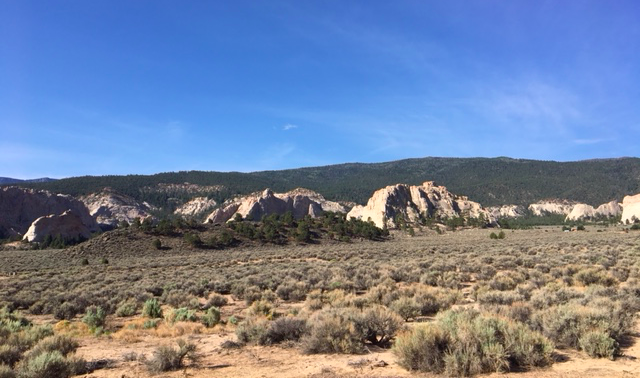
Every day, before the heat sets in, I walk to the end of our road. It traverses a magnificent high desert landscape with tall cliffs and a verdant mountain slope. Some days I continue another 30 minutes across the desert, into a slot canyon and up to a waterfall. The temperature in this lush narrow space can be 20 degrees lower than the desert. It’s wonderfully refreshing.

I’ve read several books over the past few months. One of them is Beneath A Scarlet Sky by Mark Sullivan. Set in Milan and the Dolomites during the Nazi occupation of Italy, it’s based on the true story of Pino Lella, a teen-ager who uses his climbing and skiing skills to help Italian Jews escape to Switzerland. Pino becomes the driver/interpreter for a Nazi general, has a love affair, and experiences numerous nail-biting adventures. Following the war he moves to America and teaches skiing at Mammoth. Dave McCoy, Mammoth’s founder, is quoted saying seeing Pino in deep powder was “like watching a dream.” I found the book so absorbing that its 500+ pages went by in a weekend.

I thought that approaching 75, as I am, making new friends wouldn’t be so easy. But I was wrong. Just last week, I attended a workshop on conflict resolution taught by a Zen Buddhist monk and an Aikido master. I was the oldest person in the room. Many were half my age. But we were there to learn, to interact and to share stories. It’s nice to be in a group for several days learning new things and making new friends.

SeniorsSkiing.com Trail Masters

Next month we’ll announce the 2017-18 Trail Masters. 106 of you skied or exceeded your age last season. The ten oldest in the group range from 76 to 79. Each will receive our new Trail Master patch.

Indoor Ski Area To Open (FINALLY) in NJ Meadowlands

Year-round skiing and boarding will be available at Big SNOW America, a 12-story, 180,000 square foot indoor ski area in New Jersey’s Meadowlands. the area will be part of a shopping mall with 450+ stores and restaurants. Development of the indoor area started in 2003 and had numerous stops and changes in ownership. Once completed, it’s proximity to New York and it’s airports is expected to turn it into a major destination.

Mount Snow’s Carinthia Lodge is Gone

Built in 1960, it is being replaced by a $22 million structure that will carry the same name. The 38,000 square foot building is expected to open for next season.

SeniorsSkiing.com Fifth Anniversary Gathering

We’re planning a mid- October party to celebrate five years of publication. It will be held in a private room in a pub on Manhattan’s Upper West Side. Advertisers and ski resorts are contributing SWAG. More details starting in September.


Summer Adventures At Mammoth Mountain

Non-Snow Activities Make Mammoth A Family Summer Vacation Stop.

Climbing the Via Ferrata at Mammoth Mountain Ski Area.Credit: Peter Morning, Mammoth Mountain Ski Area.

Ok, picture yourself, flat on your belly in “Superman” position, hurtling in the air down a mountain at 60 mph.

No wonder Mammoth Mountain Ski Resort calls this the Mega-Zip. It’s billed as the “most vertical in the USA” (some 2,100 feet from the top of the ski resort at 11,053 feet) to the bottom.

Definitely not for the faint of heart. Adrenalin junkies, line up here.

The mountain is aiming to open the zipline by late summer, before all these non-snow goodies have to close for the winter season (and skiing!). And it’s got three more adventures, one in the works and two others already operating. The “taste of climbing” wall called Via Feratta is being built. The ropes course for kids 12 and under (gotta grab ‘em early) is already open, as is the Woolly’s Mining Co, a gem mining adventure for kids.

The zipline starts at Mammoth’s top, 11,053 feet and plunges over what some locals call “Oh S*%t Cliffs,” heading down at speeds billed at “over 55mph.” The run is more than a mile long from top of mountain to the base, and you will be able to descend side by side with other folks on parallel cables.

The whole ride is actually in two stages, starting from the very top and going on a somewhat sideways path to the mountain’s Chair One, where people exit and get on a second line all the way to the bottom.

Mammoth hopes to open it by early September, which would give about a month before winter snows start.

The Via Ferrata, which translates to “Iron Path” is a mid mountain mostly horizontal traverse along a cliff face. Rebar is being secured into the cliff face and the adventure will include ladders, suspended bridges and iron rungs, among other things. There will be six different routes that progress in difficulty.

“We think of it as an intro to climbing,” said Justin Romero of the mountain’s marketing department. “The idea is to give people who have never thought of climbing an idea of what it’s like.”

You go with a guide, he added, you are clipped in at all times and the total vertical is about 180 feet as you follow a set trail for 300 feet more or less horizontally across the rock.

The website says “perfect for families, groups or individuals. No previous climbing experience required.”

Photos of what it might look like show folks in full climbing gear … helmet, harness and the rest.

Kids’ Ropes Course at Mammoth Mountain Ski Area. Credit: Peter Morning, Mammoth Mountain Ski Area.

Then, for those kids you found climbing the kitchen cabinets while still in diapers, there’s the kids ropes course for children 12 and under. The site says, “Climb, stretch, balance and crawl your way through 10 different elements that include a climbing net, log walk, planks, swings and more before you rappel back to the ground to finish.”

But for the parents, it’s nice to see all this isn’t THAT high off the ground, and the final rappel drops a fairly tame 15 feet.

A lot of these improvements come courtesy of Alterra Mountain Co., which now has interest in a dozen ski destinations, including CMH (heli skiing). The company, which recently merged with Intrawest, pumped serious money into Mammoth. Some $10 million is being used this summer on the zipline, the cliff climb and both children’s adventures along with improvements to Canyon Lodge.

Besides the zip and climbing route, folks in summer can mountain bike, hike, just ride the gondola for the view and in the greater Mammoth Lakes area, fish, kayak and more.

Summer season is usually early June through end of September when the snows arrive.

For more information: https://www.mammothmountain.com/

People enjoy and photograph the view of lakes from the top of the gondola at Mammoth Mountain Ski Area. This viewpoint is a short hike from the gondola top. Credit: Yvette Cardozo


Tale Of A Baby Robin

You Can Find Adventure In Your Own Back Yard. This Adventure Began In A Window Well.

Found: Baby Robin in distress. Credit: Harriet Wallis

[Author’s note: I’m stuck at home with an arm in a cast. Can’t drive. Can’t hike. Can’t, can’t, can’t. The baby robin tale is a good reminder that adventure and joy can be right at home.]

Laurie called to me: “A baby bird has fallen down into the window well.”

A little robin sat as still as a stone. His little beak pressing against the glass, and his eyes looking in. He couldn’t fly out with his stubby little wings, and his mom couldn’t get down into the narrow space to feed him. There was no other choice. The little fledgling had to be rescued.

Laurie climbed into the window well, put the little fluff into a bucket, and lifted him out. But then what? He was limp and weak. His one foot curled uselessly under him. How long was he in the window well? How long since he’d been fed? Instinctively he opened his mouth wide.

When I was a child, I raised a baby robin by feeding it worms. My dad and I would go into the back yard after dark and get onto our hands and knees. We’d shine a flashlight onto the grass and spot the night crawlers coming up out of the soil. We’d catch them as food for my little robin.

Worms. Robins eat worms. We have a box of fishing worms stored in the refrigerator. Laurie put a fat worm onto a paper plate and cut it into bite size pieces with an old knife.

The little mouth opened wide and she dropped a piece in. Gulp. Down it went. Then his little mouth opened wide again. Repeat. Repeat. He consumed the whole worm.

We got on the internet and read up on what to do with a fledgling bird. We were relieved to find that birds have a poor sense of smell, and handling the baby would not cause his mother to abandon him. And we learned what to do.

The next step: Build a temporary nest for him from a little box and shredded paper towels. We put the worm-fed baby robin into the temporary nest, and put the nest on a stool beneath the tree where he was born. We hoped his mom would find him.

The passive, weak little robin came to life. Did the good meal revive him? He jumped from his cushy nest onto the edge of the box and called loudly: Mom! Mom! Mom!

Adult robins flew in with bugs in their beaks to feed their fledglings on the ground. But they ignored him. He wasn’t one of their own. He called and called— but he was all alone.

Daylight was fading, but we saw him jump off the edge of the box and stumble over some long blades of grass. Then he disappeared.

To read more from Harriet click here for her stories on SkiUtah.

Free: Baby Robin, well-fed and alert, about to head out to the world. Credit: Harriet Wallis

Fat Bikes Are A Boon For Senior Cyclists

New Technology In Mountain Bikes Can Keep Seniors On The Trails.

Here’s a Fat Tire bike; carbon frame has room for wider tires. Credit: Pat McCloskey

Remember when you first bought your first pair of “shaped” skis?  I do.  I jumped on them to take advantage of an easier turn and less work.  Fast forward, I have a nice quiver of skis now with some 107s under foot for powder, loose snow, and crud.  Just point and shoot with total confidence.  Equipment keeps senior skiers in the game.

Same thing with mountain biking.  For several years now, the rage has been “fat” bikes and plus size tires with lower pressures for traction and control. Recently, while watching some friends maneuver very easily over tombstone like rocks and greasy roots here in the East, I marveled at the control that the plus tires and full suspension give the rider.

For those of you who are not familiar with the plus tire revolution, the description of plus refers to any tire width that is basically 2.6 inches and wider in diameter.  Most mountain bike tires have traditionally been in the 1.95-2.3 inch diameter range.  But in recent years, the technological advances in mountain biking have developed carbon frames which are compatible with wider .35 mm rims that accept a wider width tire.  With lower tire pressures around the 12-psi to 15-psi range, the plus technology allows the rider to have a more plush ride with suspension that grips gnarly terrain like glue. For the senior rider who wants a challenge but wants to maneuver safely through rocky, rooty, terrain, the plus bikes are just like our wider width skis—just point and shoot.

Knobby Fatties grip any kind of trail and make the going smoother. Credit: Pat McCloskey.

While riding behind one of the best riders I know who happens to be in his late sixties, I noticed that he didn’t even pick his lines anymore on a technical trail.  He just points the 3-inch tire and rolls over everything.  So, I recently purchased a 29er plus, full suspension bike from Salsa and VOILA, I do the same.  I feel much more confident with the plus technology.  A definite “plus” for a senior rider who still wants the challenge.

Many of the current generation of the plus bikes now (either 27.5 or 29ers) come equipped with the SRAAM Eagle components.  Simply put, they have a wide range of gearing with a 50 tooth cog in the back that allows for easy climbing of virtually anything that is thrown at you on the trails.  Even though the plus 29ers, for instance, are a little heavier than the standard carbon full suspension bikes, the Eagle gearing makes it easier for a senior rider to maneuver the plus bikes up a steep, rock strewn trail.  Personally, I love the “old man” gear and even though my local bike shop employees say I don’t need it, I definitely want it, and I use it.  I will take every advantage I can—on the slopes or on the trails.

So, take a look at plus technology.  Those 3-inch width tires may be a little excessive for your local trails and you may want to scale back to 2.67 or 2.8, but the lower pressures, enabled by wider profile rims, make life a lot easier and more enjoyable on the trails for a senior rider.  Modern equipment keeps you in the game, folks.  Take advantage of it.

Here’s the big 50-tooth inside “old man” gear that provides mega leverage. Credit: Pat McCloskey


More Ski Chile: What To Expect From A Chilean Ski Trip

Some Adjustments Necessary To Ski The Legendary Mountains Of Chile.

For many, a typical Chilean ski trip will seem a bit like traveling back in time to the USA 30 or 40 years ago. Some of the lifts date back even further than that! While the ski areas around Santiago are progressively upgrading their infrastructure, snow making, grooming, and security, the ones further south remain, in a word, funky.

Most Chileans do not speak English, but those in ski schools, tourism, and management positions generally do. If you have no Spanish, you should still get by just fine, as people are mostly helpful and warm. The Chilean peso converts at 630 to the dollar.

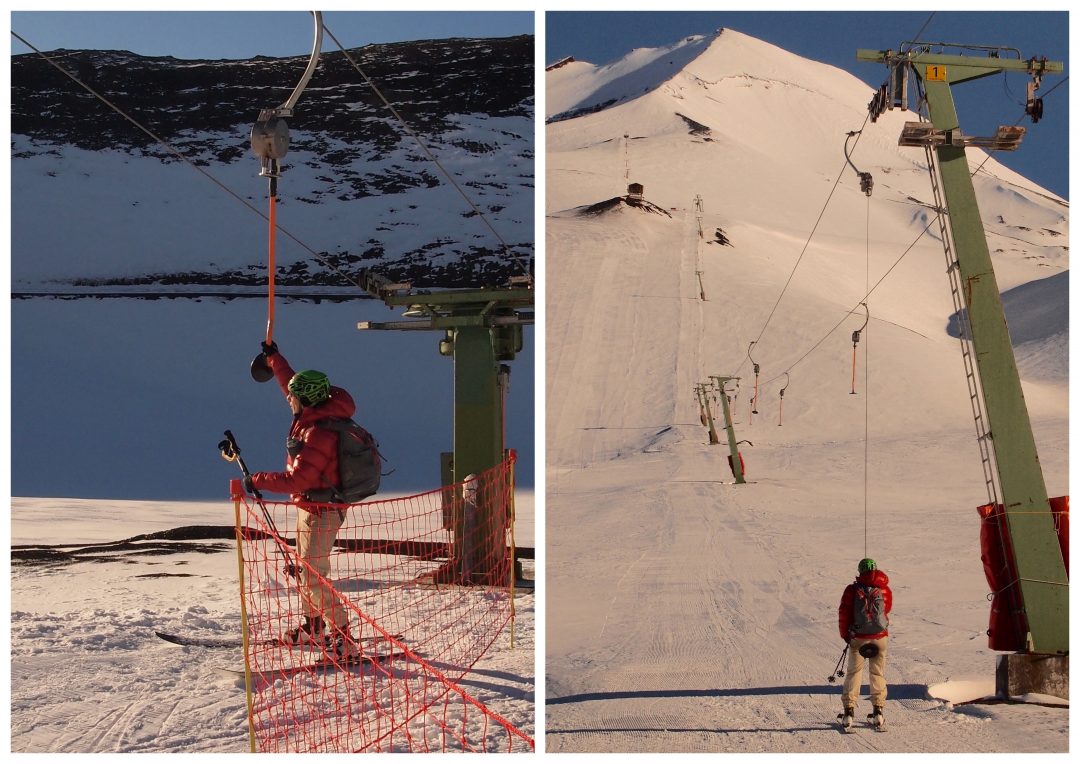
Expect a lot of surface lifts, mainly t-bars and platters, but also the infamous “va et vient” lifts at Portillo (more on that later). On the plus side, these lifts are usually fast, run in windy weather (which is frequent), and you can bail out easily enough if they stop for whatever reason. Some of the chairlifts are second hand from Europe or the USA, and only one high speed quad exists, in Valle Nevado. Lifts open at 9:00 and close at 17:00, with most skiers coming out at around 11:00. Lunch runs from 12:00 to 15:00.

A lonely ride at Corralco. Remember those Poma lifts? Credit: Casey Earle

Don´t expect to get good snow conditions information from the ski area websites, often it is outdated, wrong, or simply non-existent. Portillo is very reliable, but for other ski areas you may have to resort to analyzing webcams or scouring their Facebook pages.

The weather and snow conditions in the Central zone are generally very good. With few but furious snow storms, and occasional extremely light, dry snowfalls, most days will be sunny, fine-packed powder skiing. Off-piste is often limitless, with the southern exposures accumulating triple the amount of the northern ones. With both the sun beating down, and the storm winds roaring in from the north, only in exceptional years can the true north faces be skied, and thus almost all runs are south facing. The season normally runs from mid-June to the end of September.

Casey grabs some pow at La Parva. Credit: Casey Earle

You have to go at least 400 km south from Santiago to the next ski area, Nevados de Chillan, the beginning of the southern climate zone. Here the storms are more frequent and wetter, and the mountains are lower, with skiing starting near or at the tree line. Most people consider skiing in this area more towards spring, when the weather improves. Packed base data is often referred to in meters, reaching up to 5 meters in places. The season in the south often starts late June, and extends into October, with backcountry excursions (on the volcanoes) going into November.

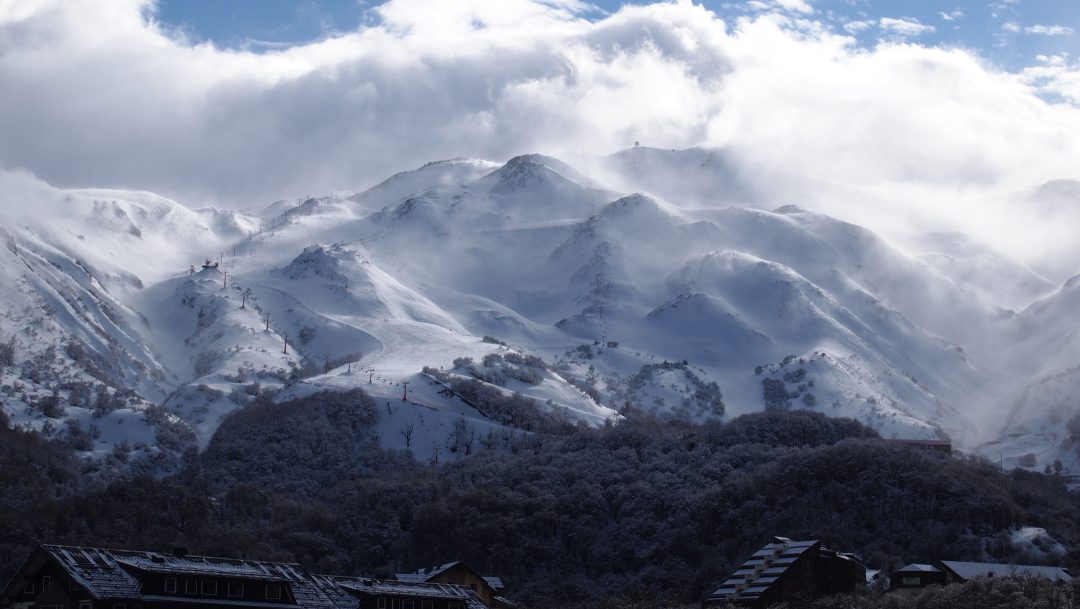
Nevados de Chillan on a windy day. Credit: Casey Earle.

Large hotels are few, at best one per area. La Parva has no hotels, large or small. Aside from Portillo, most people go for the day, or lodge in cabins, small hotels, hostels, or property rentals near the ski areas. Airbnb, Booking.com and other websites have a wide variety of lodging available. In general, what you see is what you get. Chilean food is quite palatable for American tastes, with lots of familiar (and some very unfamiliar) dishes, all accompanied by great local wine and beer.

Lift ticket pricing is based on high and low season, and age group. Avoid the two middle weeks of July, which is the kids winter holiday, as it is quite expensive and crowded. “High season” prices go from July to early/mid August in general, then just weekends, except for Sept 17-19 (National Independence holidays). Seniors start at 65, with about a 20-30% discount on normal adult prices, which run around US$70 in high season and $50 in low. La Parva has a class of seniors from 60-65, and then “super-seniors” as 66+, which only pays US$18 anytime!

Next up is a review of Portillo!