Letter to the Editor: Ageism in the Ski Pass Industry

To whom it may concern,

As I get older, each year I have to reassess the value of purchasing an annual ski pass. And each year Alterra continues to practice ageism in its pass pricing structure!

You offer NO SPECIAL PRICING for forgotten senior skiers and riders (many of whom are on a fixed income) over 70 years of age who may only ski a few times per year compared to other pass holders. You offer discounts to college, military, nurses, young adult, child, 4 and under but nothing to those of us who have been your loyal bread and butter customers for years. Those of us who have brought up the next generation or two of new skiers and riders of whom you now benefit.

I have noted this discrimination to your company before but my concerns were met with indifference. Apparently corporate greed is more important than fairness in rewarding older skiers who have steadfastly supported the ski industry through thick and thin for decades.

You’re probably thinking why should Ikon offer a senior discount when Epic doesn’t? That’s bad business thinking. Why not be the leader in offering seniors a proper deal like many of the smaller resorts like Loveland do? Not to mention that Snowy Range who offers free lift tickets to the over 70 crowd! Not only would you attract more older skiers and riders but also their children and grandchildren.

Offering discounts to nurses, military members, young adults, etc. demonstrates respect for them and what they do for our society. Seniors have contributed and continue to contribute a great deal to our lives, yet all too often, they receive less respect and are kicked to the curb. Refusing to include seniors with nurses, military, and young adults is a slap in the face and denies them the respect they deserve. Most of the seniors who ski have done so for a large part of their lives and want to affordably continue. They are not the (discount treated) hotdoggers who often endanger the lives of other skiers and riders.

I know that your company doesn’t really care but I felt the need to give my opinion. Maybe by the time I’m 80 your company will give my generation a little respect by offering us the discounted ski passes we deserve.

Avid skier since 1960,
G.S. Wood

ICYMI for May

Evelyn Kanter at Snowbasin 2023

Even though this amazing snow season is winding down, there’s still some important news for skiers and riders.

Here is our monthly ICYMI – in case you missed it – tidbits of this and that, including extended operating days at resorts in the US and Canada.

Utah

The state has received a record amount of what it markets as The Greatest Snow on Earth, including some 700 inches at Brighton and Alta.

Ski Utah reports these new closing dates for resorts still operating – if your favorite destination is not on the list, it has already closed for the season –

  • Alta – April 23, 2023
  • Brian Head – April 30, 2023
  • Brighton – May 29, 2023
  • Deer Valley Resort – April 23, 2023 (extended beyond original date!)
  • Park City Mountain – May 1, 2023 – (extended beyond original date!)
  • Snowbasin – April 23, 2023 – (extended beyond original date!)
  • Snowbird – Open daily through May 14. Then open Friday–Sundays and holidays through Memorial Day. With no closing date in sight, Snowbird will continually assess operations past Memorial Day based on conditions.
  • Solitude – May 21, 2023 – Open daily until May 21. More info here.
  • Woodward Park City – to be announced for chair closure but the jib park is open until the snow melts!

Montana –

Big Sky is offering a selection of resort-specific passes for next season, including $60/day Twin Tips deal. Purchase before April 27 to get the low price. Big Sky is also an Ikon Pass member.

Alaska –

Alyeska Resort will join the Ikon Pass community for winter 23/24 with no blackout dates.  Ikon Base Pass holders will have access to five days, with select blackout dates. Alyeska Resort is also available on the Ikon Session Pass.

The addition of Alyeska Resort brings the list of Ikon Pass resorts 56 mountain destinations across 11 countries and 16 states.

Alyeska Resort is a playground for all levels of skiers and riders, located just 40 miles south of Anchorage, Alaska, in Chugach State Park, offering glacier-filled vistas and Northern Lights sightings. The mountain is home to a 60-passenger aerial scenic tram with panoramic views, 1,610 acres of varied terrain, 76 trails and over 669 inches of snow annually, plus seven dining experiences, including Seven Glaciers, a AAA Four Diamond Award restaurant with unparalleled views overlooking seven hanging glaciers.

Visit in March as I did a few years ago, and enjoy the start of the famous Iditarod Race in downtown Anchorage.  It’s a fun day with parades and other events.

Canada –

Whistler Blackcomb has closed the Peak 2 Peak Gondola and the Whistler Village Gondola for the season.

But spring skiing is still accessible on Blackcomb Mountain on weekends until May 22, via the Blackcomb Gondola.

Elsewhere –

The winter ski/snowboard season is just beginning in Chile and New Zealand(Click here for details on the 70+ Ski Club New Zealand Trip this August.)

Season Passes –

Have you bought yours yet for next season?  Epic, Ikon, Mountain Collective, Indy. All offer great deals for multiple destinations.  But don’t delay – early-purchase deals have expiration dates, and some passes have capped numbers, so when they’re gone, they’re gone.

See you next month!

Giving Back

Photo by Joel Muniz on Unsplash

The definition of a “cohort” is a collection of people who share characteristics or experiences over time. It’s one of many descriptions of us skiers and riders. We seek and revel in the mountain life and its experiences and invite others to share in our reverie. Our life view is expansive, embracing all.

Giving back to others is deeply embedded in the psyche of skiers and riders, and an active part of our mountain ethos. Sometimes all it takes is someone or a group of skiers and riders gathering to have an impact.

In February 2023, residents and businesses in Tamarack and Boise did just that, by honoring a beloved cohort with a huge and fund-raising effort to help feed the less privileged in Idaho.

The Idaho Foodbank reports that nearly nine percent of the state’s population, including more than 46,000 children, face food insecurity. Nearly 7,000 Idaho seniors are at risk of not getting enough to eat, which leads to exacerbating health issues.

In 2022, The Idaho Foodbank provided 27.2 million pounds of food, enough for 22.6 million meals, enough for about 184,000 people per month.  Managers say they can provide four meals for every dollar donated. It takes the combined efforts of farmers, food product manufacturers, distributors, community organizations, government, and individual citizens to make this happen.

The food bank fundraiser was to honor the memory of Larry Gebert.  It was the idea of Dan and Kathy Boespflug, Tamarack locals.  Dan and Larry grew up together in Montana.  They were neighbors and attended kindergarten thru college together and stayed friends – cohorts – their entire lives.

Larry died of a massive heart attack April 1, 2022.  He was actively involved in more than 40 charities in Idaho.  One of his favorites was The Idaho Foodbank.  So, Dan and I decided to give to the Foodbank in Larry’s name,” wrote Kathy.

She turned to a local rider, homeowner, and realtor, Trisha Sears, to create and sponsor an “Ending Hunger Spring Challenge” event here at the Tamarack  Resort. Kathy and her husband Dan pledged to match donations to The Idaho Foodbank up to $25,000.

A group of about 50 skiers, mostly seniors and those approaching senior status, convened on a Friday evening in February to take up the challenge. What’s the best way to incentivize skiers and riders? With  food and wine, of course.

A builder family, Delain and Dana Kemper, who live here at Tamarack hosted the gathering in a recently completed home for sale (yes, we were all careful about spilling wine or dropping food on the floor). Holesinsky Vineyard and Winery, 2022 Idaho Winery of the Year, donated the wine. Brian Auger, Ken Callan and Jeff Hemmes brought their Oonis to make pizza. Salads and hors d’oeuvres were also donated.

How did we do? We raised more than $17,000, which Dan and Kathy Boespflug matched. But, we were not done.

Rex and Mary Beth Chandler, owners of the top-rated Chandlers Steak House in Boise, donated a special luncheon for 35 people to add to the match. The luncheon was oversubscribed. Boise Channel 7 showed up for the luncheon and ran reports on the Idaho Today Show and also the evening news in Larry’s honor.

https://www.ktvb.com/article/news/local/idaho-today/idaho-today-spring-challenge-with-idaho-foodbank/277-6237dd1b-552a-4127-9e03-633f463e2341

https://www.ktvb.com/video/life/boise-couple-idaho-foodbank-donations-honor-larry-gebert/277-7a9cd676-d429-404e-afc7-7a675eb73b61

With these events, Dan and Kathy Boespflug and their skiing and riding cohorts raised $65,500. Not too shabby!  It’s a heart-warming example of how skiers and riders, thinking locally, drinking locally, giving locally.

What are you doing at your local ski area to give back locally?

Powder in the Glades

Glade skiing is not about speed and power, but about grace under pressure. It is dancing a ballet on snow crystals where a mistake can really hurt.  It is that fine line where fantasy and reality meet, especially when you are knee-deep in a fresh blanket of powder that rests lightly between the trees.

When you find that rhythm where decisions become subconscious rather than worrisome; when you get to that skill point where you can relax and the whole run slows down in your brain, then trees don’t go whipping by, they ghost on past you.

You no longer see tree trunks or boulders, but only the white avenues between them.

There is an intimate relationship between powder snow and me. Neither of us actually speak, but I sometimes feel a door opening, a finger beckoning, the seductive music welling up from underneath, and the flashing danger of boulders and trees that go rocketing by.

Antoine de Saint-Exupery, most famous for writing The Little Prince, once said that, “A goal without a plan is just a wish.” However, you can’t plan a descent down through a mountainside of trees and boulders. So, I guess it follows, then, that a drop down into a tree-covered vertical snow field is simply a wish that has come true.

For some of us, the ultimate thrill is to go where there is no path and leave a trail.  I want to go farther. I want to go where no one has gone before, where the wind and snow cover my run so no one will ever know I have been there.

Carve your own patterns.  Be a performance snow artist. Look back up the mountain and marvel at your own creative genius.

Grooming a trail is like putting a goopy gel in your hair to make it behave. Powder, on the other hand, is like the long flowing tresses of Mother Nature that move gently in the wind, enfolding you in their thick lovely strands.

I pitched down into the sea of green-spotted white, my skis floating on an uncertain medium. The wide powder skis disappeared into the fluff and all I could see, if I looked down, was a vee of snow peeling away from the top of my boots.  But in powder skiing you don’t have time to look down.

What you are forced to look for is the white openings. If you concentrate on the trees or boulders you are in trouble. There has to be an internal calmness that realizes every turn is a leap of faith; that you know there will be a way out even when you can’t immediately see it.

I know I am there only at the pleasure of the snow Gods. The deep crystals invite me in close and protect me, allowing me to penetrate and then let me float through the cold smoke as if there is no yesterday and no tomorrow but only the here and now.

I never assume that I am in control because I know there is always the danger of a stump just under the surface of the snow, put there to remind me of my limitations.

Unlike groomed runs where you power up the downhill ski, here you get both skis equally involved in floating just underneath the surface of the snow.

Gentle pressure, forward movement, never looking down. Find the snow, find that small chute that gives you the lane down the mountain. When you put your skis together, all you need is enough space to get the core of your body through. Sometimes the opening is so narrow you have to turn your shoulders to fit.

Think of a narrow doorway in your house. If you can find an open lane about that size you can move on down. The trick is to seek out a series of doorways as you drop down the mountain. Every turn requires that you know in your heart that another opening will revealed when you round this boulder or that tree.

That doesn’t mean you can’t stop and enjoy the moment, but what it does mean is that you are in the woods where all you will hear is the occasional locational shout from companions who have joined you in this roller coaster of joy.

What fascinates me about glade skiing is that you have to make a series of choices, sometimes in a nanosecond, to avoid hitting something very hard. You turn when Mother Nature demands, not when you happen to want to, as on an open groomer or even a mogul run.

You don’t control the course, only your reaction to it. This is not a hostile environment until you introduce speed and movement. Speed is what brings the challenge, and it is in that process of control that I find the most solace.

No one is in control of my movement. No one else says turn right or left. No one else says go fast here or slow there. It is my challenge, and I control the pace of my movement.

At first, I struggled a bit, trying too hard to be analytical. Conscious choices, which take time to process, gave way to simple reaction. A really great Robert Johnson blues song started to work its way up from the recesses of my mind, and my body started to simply react.

Soon, I became a tiny figure on the surface of a huge mountain, dropping down its uncaring sides, finding spaces where there were none, turning and dropping ever downward. At first, there was a heartbeat and air rushing into demanding lungs, then there was music to replace it, and then even that fell away as I simply disappeared.

Add This Great Book About Skiing History to Your Bookshelf

To Heaven’s Heights: An Anthology of Skiing in Literature It’s an eclectic mix of stories celebrating skiing as sport, transportation and more.  It’s for anybody who loves skiing – even reading about skiing.

Many of the selections are nostalgic accounts of learning to ski, or descriptions of ski treks of long ago and far away. Others are exciting accounts of accidents, avalanches, competitions, skis in warfare, and daring ski chases from spy thrillers by writers like Ian Fleming and Brad Thor.

About half the selections are originally in English, and others are translated from the foreign languages, including some  translated by Christophersen herself, who was born in Norway. The rest is a scattering of French, Russian, German and Italian writings and even a little “skiers and hunters ditty” from Mongolia.

Altogether, this hefty book is a wonderful collection of interesting readings about our favorite sport.

Christophersen arranged her selections in twenty-three chapters, but there is overlap among headings like “Humour,” “Romance,” and “Poems.” The chapter titles “Miscellaneous” and “Just Skiing” reflect how difficult it is to sort such material into discrete categories.

No matter.  This is a book for pleasurable browsing that inspires the reader to explore further in the works excerpted.

The first book I looked up was Peter Kray’s 2014 novel,  The God of Skiing, which I am enjoying now. Another revelation was the work of French author Henri Troyat, whose 1957 novel Tender and Violent Elizabeth should be great, if the excerpt here is a fair sample.

The fiercely independent and feisty heroine is not  only a terrific skier but also a striking young lady with problems to solve concerning her repressive parents and two aspiring lovers. I ordered a British edition because it has a ski resort scene on the cover instead of the bodice-ripper illustration of other editions. I can’t wait to see how Elizabeth works things out.

Sometimes only sketchy or slightly incorrect information is given, making it a bit tough to track down originals.

For instance, the American writer Swain Wolfe (1939-2021) is introduced in the present tense with a paragraph quoted from an out-dated website. His first name is misspelled as “Swaine” and the title of his book from which the selection comes is The Boy Who Invented Skiing: A Memoir (2006) not simply “I Invent Skiing” as the excerpt is titled.

My personal favorite in the book is the last piece, John Updike’s story “Man and Daughter in the Cold” from The New Yorker, 1968. The skiing experience in blizzard conditions is perfectly rendered, while the exploration of relationships between the title characters raises the story to the level of true literature.

With so much to praise about Ingrid Christophersen’s award-winning book, I feel almost ungrateful suggesting a few more things that might have been included. On the other hand, second-guessing an author is part of the enjoyment of an anthology.

So I wonder—with all the wonderful pieces from Norwegian works that few of us would ever be able to read in the originals—why not include something from Stein Eriksen’s Come Ski With Me (1966)?

Also, alongside vignettes of skiing as a way of life among Norwegians, it would be appropriate to include selections from English writers who travelled to Norway and emulated the native love of the sport. Good examples are found in such books as Mrs. Alec Tweedie’s A Winter Jaunt to Norway (1894) and J. H. W. Fulton’s With Ski in Norway & Lapland (1912).

Probably every reader will think of other works that could be mined for skiing in literature.  Maybe there’s enough for a sequel.

Although we are all adults here, I feel warnings should be sounded about two items in the book that may put off some readers.

The piece titled “The Seducer” by a contemporary Norwegian writer includes a long and rather graphic sex scene. And there’s a selection by the German film director “Leni” Riefenstahl who produced propaganda films for the Nazis.  While describing Berlin in 1932, before she made an “escape to the mountains” of Switzerland, the Nazi sympathizer recounts receiving a leather-bound copy of Hitler’s Mein Kampf from Joseph Goebbels as a Christmas present. Ugh! Who needs this?

Ingrid Christophersen’s book was published in London by the Unicorn Publishing Group ( unicornpublishing.org ), 2021. 336 pages, hardbound. Available from online booksellers, including as a Kindle edition.

Proceeds from sales will go to Snow Camp, the UK’s National Snowsports charity, www.snow-camp.org.uk which gives young inner-city children the opportunity to experience the mountains and in many cases turn their lives around.

So it’s a good read for a good cause. 

Vail Resorts Introduces Season-Long Rental Program

Photo by Jack Finnigan on Unsplash

It’s called “My Epic Gear”, and it allows skiers and riders to reserve the same boots, skis or snowboard for an entire season at participating Vail Resorts destinations.

Skis and boards are top models from top manufacturers. Boots are fitted with customized insoles and boot fit scanning technology.  Everything offers free slopeside pickup and drop off, and there’s a new app to guide you to choose the ideal gear.

The My Epic Gear program launches in the 2023/24 season as a pilot program to Epic Pass holders, at Vail, Beaver Creek, Breckenridge and Keystone.

The following season – 2024/25 – Vail Resorts plans to expand the program to Whistler Blackcomb, Park City Mountain, Crested Butte, Heavenly, Northstar, Stowe, Okemo and Mount Snow, with further expansions planned for future seasons.

Of course, it all depends on the success of the pilot program next season.

How it Works

Choose a model of ski or snowboard at the beginning of a season, and be guaranteed that model will be available any day of the season, fully tuned.

Try a different model of ski or snowboard any day, such as powder skis, based on availability.

Select from the most popular and latest skis, snowboards and boots.

Choose from name brand, high-quality ski and snowboard boots with customized insoles and boot fitting process.  Or, opt out of the boot offer and use your own.

The plan includes free slope side pickup and drop off every day, at every participating mountain resort.

The new My Epic app will manage the entire experience, from gear selection to boot fitting to delivery.

What it Costs

A full season membership for adults will cost $50, plus a $50 per day rental fee.

My Epic Gear also promises to keep your reserved skis or board properly tuned and waxed.

Depending on how often you ski or ride, that’s less than the average daily cost per season for owning gear, including paying airline baggage fees or shipping costs, and waxing and tuning during the season.

And, the $50 daily fee is about half the daily demo price premium equipment just about anywhere in snow country.

By my limited math skills, it sounds like the gear program will pay back in one week of skiing or riding – just like the Epic Pass and/or IKON Pass.

Child pricing will be introduced as part of the full launch of the program for the 2024/2025 season.

Choose Your Gear

At the beginning of the season, members can select a favorite model of ski or snowboard, and that gear will be tuned and available to them every day, at any participating resort, guaranteed.

There are 15 different leading brands and more than 50 of the most popular and latest ski and snowboard models available, including personalized recommendations to help guests determine the right gear for their needs.

Customized boot fittings leverage scanning technology, and members will have access to name brand, high-quality boots with insoles for a customized fit. Members can also opt out of choosing boots, if they prefer to use their own.

In addition to choosing favorite gear for the season, members can sample other brands and models of skis and snowboards for all terrains, weather conditions and skill levels, subject to availability.

My Epic Gear will collect guest feedback throughout the season and will recommend the best option for a guest based upon their experience level, conditions, and the latest equipment choices, as well as reviews from members in the program.

SeniorsSkiing Feedback

We welcome your comments, too. Do you think this is a good deal? Why? Why not?

Utah’s Best Kept Secret Slopes

Powder Mtn

We all know there are many options to ski Utah – Snowbird, Alta, Brighton, Solitude, Park City, Snowbasin, Deer Valley.  But none can hold a candle to Powder Mountain.  Why is this, you might ask?

Powder mountain boasts the largest ski/snowboard area in North America, with 8,464 acres of groomed trails and un-groomed of pure skiing pleasure.

You are at an elevation of 7,500 feet to almost 9,000 feet at the top, and because of the high elevation the mountain produces over 500 inches of light fluffy powder annually. They do boast the greatest snow on earth with no snowmaking.

It’s easy to lose track of what you’re skiing since the area is so vast.

I was amazed that we had skied most of the day and noticed we had only skied 15 runs. Even though there are – literally – miles of downhill options, there are a few  lifts.  Most are older fixed grip chairs. The vertical ranges from a short 582 feet vertical at the Village lift to 1,609 vertical at Paradise lift, and an impressive 1,268 for the high-speed.

All the lifts service some very good long runs from beginner to expert (they are also open till 9pm on one lift, for night skiing on the Sundown chair).

On one day, I decided to ski only the Hidden Valley hi-speed lift.  From 9am to 3pm, I skied 25 runs and 29,000 vertical feet. That was a max for me, and I wasn’t tired from it because I found the “zone”.

Limiting Guests

Something important to mention is that Powder Mountain limits the number of skiers to 1,500 season pass holders plus day-trippers. So, even on a busy weekend you can expect about 2,200 to 2,500 skiers on 8,500 acres.  That’s 3.5 acres plus or minus for each skier.

It’s also important to note that Powder Mountain offers FREE skiing to anybody 75+, which makes it a popular destination for senior skiers and riders – and there are lots of us.  The 70+ Ski Club includes a day at Powder Mountain in its annual Utah trip.

There is a reservation system, so if you don’t want to be blocked out and you are purchasing a daily ticket, do it ahead of time online. Also for 75+ senior skiers, who need to reserve online, not at the ticket window.

The limits on daily skiers and riders meant that it was few and far between that I was passed by another downhiller.  As you look up a slope from any chair you might see a dozen people on any given slope.

So, safety wise, it was a delight. As a matter of fact, at least eight of about 50 who passed me on the entire week of skiing made announcements of “on your left” or “on your right”.  When was the last time you heard that on a crowded slope?  Utah, or anywhere else?

Powder Mountain is a throwback to skiing in the 60’s and 70’s, with a basic and unpretentious lodge, compared to some other resorts in the west.

Many of the skiers/riders here are diehards, with about 45% locals and the rest of 55% from out of town.

For the adventurous, there is also the opportunity to go Cat Skiing on a per ride basis. Next season – 2023/34 – Powder Mountain plans to provide full day cat skiing with the strong possibility of having an additional 20,000 acres beyond what they already have.

As the area expands, they are trying very hard to keep the current “down to earth” feel of the area.  Everyone from lift attendants to mountain hosts, to all the staff, are very friendly and cheerful.

And chairlift conversations were equally friendly and cheerful, including tips on where to stay nearby, since there is no base area lodging. On one lift ride I was offered a prayer session!


Season Passes and Other Tips

Powder Mountain season passes are hard to come by. There’s a waiting list of about 6,000 people and currently 3,000 pass holders, do don’t hold your breath. I maintain mine, which I received five years ago, so I don’t have to worry about getting a reservation.

If you are going for a longer period, buy a five-pack early in the season, which can be used on a choice of days during the season.

The area’s goal is to provide the best snow conditions to serious skiers and riders, which it is able to do by limiting the number of downhillers on any day.

You will never see a long lift line here,  as you might find at other areas on weekends, especially on a powder day.  The longest lift line I encountered in a week here was just three minutes long on a weekend day when they had reached the max number of skiers for the day.  Mostly, I just skied right up to the lift with just a one or two chair wait for the few people in front of me.

What a delight it is to ski Powder Mountain.  I’m already planning my trip for next year………

Thoughts on Aging and Ageism

“You haven’t aged a bit.” “You can’t teach an old dog new tricks.” “Young at heart.” “So when are you going to retire?” “Still skiing at your age?”

We’ve all heard, read or experienced comments like that, because American culture is grotesquely youth-centric.  The notion is that it is sad to be old, that wrinkles are embarrassing and so on.

There is ageism in the workplace, in the doctor’s office, and in the bedroom, all reinforced by pervasive myths developed throughout our lifetime.

Even The Beatles questioned aging when they sang, “Will you still need me, will you still feed me when I’m 64.”  That was in the 60s, when they – and we – were in our 20s and 30s, suggesting perhaps that there is a question about love and relationships for older people.

The well-regarded Pew Center found recently that accepted “hallmarks of aging” include obvious perceptions about gray hair, having grandchildren and being retired.  More importantly, perhaps, the research revealed a common view about us older people that includes forgetfulness, problems with bladder control and decreased sexual activity.

Before you start claiming that this “ism” is just more “woke,” the stereotype of ageism lies in the assumption that all members of the older people (elders) group are the same – too old for a certain type of car, specific haircut, type of clothing, how to speak, etc.  Not to mention too old to ski, snowboard or X-C.

Despite seeing more grey-haired and otherwise older models in commercials, there is an overwhelming and incessant daily barrage of messages of socially sanctioned prejudice.  That message is – simply – that people who are no longer fashionably young and fashionably slim  find themselves exiled to the margins of society.

Aging is perceived with weakness, forgetfulness and decline. We are afraid of aging, are in denial about aging, and many societal norms keep us blind to the many benefits of aging (and this is not referring to senior discounts offered at the movie theater or on the ski slopes).

There is research that shows that on average, those with positive perceptions about aging live eight years longer than those with negative beliefs about ageing. This is due in part to their motivation to take better care of themselves and/or their engagement with meaningful activities.  Like skiing/riding.

Negative stereotypical beliefs can impact health through psychological and behavioral pathways. They operate unconsciously and increase in power as they become more self-relevant and these beliefs are internalized within American society from childhood throughout a person’s lifespan.

Negative beliefs such as “having a senior moment” have pseudo-scientific legitimacy. Age related frailty and similar age-oriented miss-attributions can influence how we even think about ourselves and if not counteracted by positive beliefs these thoughts can impact how we feel and act.
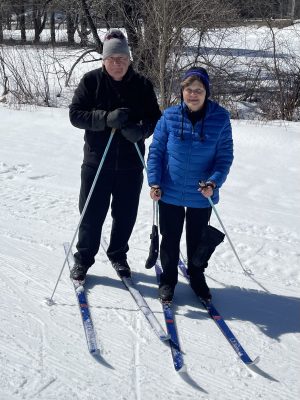
There are no biological markers for reaching “old age”, despite the prevalence of social security, senior discounts, and retirement age.

“Elderspeak” which is using simplified language, sing-song cadence, and a louder than normal voice is not acceptable as a method for communicating with all older people. Serious mental decline is NOT a normal or inevitable part of ageing.

Aging and memory have much to do with environmental factors and how we approach and think about aging, and the way we tell ourselves how to grow old. The accepted stereotype that the brain inevitably deteriorates as we get older is false.

If you relate to statistics here are a few:

  • 75% of those over 85 years old perform everyday activities (i.e., dressing, cooking, relieving themselves) without personal assistance;
  • 90% of older folk who are not in nursing homes can think (finding their slippers, making their way) just fine;
  • Only 3% of Americans older than 65 are in nursing homes and that rate is down from 5% in the last decade while 9% of those older than 85 are in nursing homes;
  • 3.6% of those aged 65-75 in the US have dementia and those rates have been declining;
  • of 145 medical schools in the US, only five have a geriatric department and all medical schools require pediatric training compared to less than 10% that require geriatric training.

Do you think that elders are bad drivers? Statistics show that as a group we have fewer accidents, we are more likely to use seat belts, follow speed limits, are not intoxicated, don’t text while driving, and drive much less at night. Hmmm.  Sounds like seniors are smarter behind the wheel than their kids or grandkids.

If you want to know more about the slow and subtle shift away from labeling us 50+ folk as doddering idiots, check out these two books –

“Breaking the Age Code” by Dr. Becca Levy (Vermilion, 2022),  and “This Chair Rocks, A Manifesto Against Ageism” by Ashton Applewhite (Celadon Books, 2016).

They cover a litany of age-related topics ranging from sex, workplace issues, legislation to address discrimination, the longevity economy, caregiving, independence and self-reliance, retirement living, loneliness, the value of intergenerational relationships, and so much more.

Just in case you don’t already know the answer to the question of whether you’ll still need me and feed me when I’m 64 – ask me on the chairlift.

Tips for Elder Cross Country Skiers

Herman Smith Johannsen also known as Jackrabbit Johannsen was known for cross country (XC) skiing at 102 years old. He was a man who popularized XC skiing in Quebec and later in America. He lived until he was 111 and was always inquisitive about what was on the other side of the hill. The Jackrabbit kids’ ski program in Canada was named for him and there was also a Jackrabbit ski wax. I don’t know if there is a direct correlation for Johannsen proving that XC skiing helps you live longer, but it is a nice theory.

Among the 4-5 million American XC skiers, about 11.2% are aged 55 or older while 30% of the general population falls into that age group. For those elder individuals who live in or near snow country, they might want to consider the benefits of XC skiing to help them live healthier and longer lives like Johannsen.

As a recreational activity, XC skiing is one of the most acknowledged forms of aerobic exercise and there is scientific evidence that the sport’s characteristics are excellent for mental well-being, too. Recommendations are for older people to undertake vigorous physical intensity (exercise) for 75 minutes per week or moderate intensity for 150 minutes each week. XC skiing is a sport that even when done at a slow pace can raise the heart rate for fitness. The well-being associated with XC skiing is derived not only from the physical exercise involving all the body muscle groups, but it is an outdoor activity that takes place in nature in the winter. This “forest bathing” or immersion in nature has been explained in the book “The Nature Fix” and according to scientific evidence besides the fitness biological benefits, there are very positive psychological and medicinal impacts derived from the activity. The sensory experience of getting outdoors is a kind of eco therapy and a prescription for lowering stress, restoring attention, and boasting mental health and cognitive clarity.

Many XC ski areas offer programs catering to elders from weekly meet-up group outings to special lesson programs and of course, discounted rates for those aged 65 and older. The social aspect of XC skiing occurs when meeting others on the trail junctions or in the lodge and evidence shows that interacting with friends and family is significant factor for living a long and healthy life.

Ski lessons (or a refresher clinic) are recommended to make the sport easier and more satisfying. Ask for an instructor who specializes in teaching older skiers.

Some recommendations for older XC skiers include talking to the doctor if uncertain about strenuous exercise (and remember that you are able to take it easy and ski at a slow pace). There are tips for first timer XC skiers at https://www.xcskiresorts.com/resort-features/2022/1/7/best-secrets-about-cross-country-skiing which suggest to stay within your limits and not to ski too long or too far. Going to a XC ski area is a great idea because the trails are groomed and tracked which makes the sport easier. Additionally, the ski area will have patrollers, rental equipment and ski instructors to provide technique pointers if needed. The new XC ski gear for skiing on a groomed trail is light and lively. The bindings are adjustable to give the skis more glide (go faster and glide further) or more grip (go slower) and this adjustability can also help address how the ski performs in different snow conditions. If a trail is too steep another option is available as it is not a crime to remove the skis and walk down the difficult section (or side step on the skis to avoid speeding out of control).

Another good idea is to know where you are going and where you are on the trail network. Many trail configurations can be confusing and you don’t want to get lost particularly if you are tired. Check the trail signs along the trails and carry a trail map if one is available – and check the map to know where you are in the trail network.

Dressing for cross country skiing is about layering (see What to Wear article at https://www.xcskiresorts.com/new-blog/2016/7/21/cross-country-skiing-apparel) with a light  base layer, a shirt and a light jacket. Only use heavier layers when it is very cold because overdressing can be a problem as you create heat when XC skiing. Keep in mind that you can remove layers if you become overheated. Socks, gloves and a hat are important components of your outfit and each plays a key role in keeping you comfortable. 

Socks should be comfortable and keep your feet warm and dry. There are many brands of ski socks that are produced to perform. XC ski gloves are available in various thicknesses and if you have problems with the cold, get a heavier XC ski glove or mitten but avoid alpine ski gloves because they are too heavy and are not made for the movement with XC ski poles. Hats could include a lightweight knitted cap or a headband. If your jacket has a hood, that works perfectly on a very cold day.

Sunglasses can minimize the glare off the snow but they also keep the wind out of your eyes. Another job for sunglasses may include improving flat light on the trails, but for the most part this is less important because XC skiing is not too fast so you can handle terrain without worrying about the visibility due to flat light.

Injuries are minimal with XC skiing but be aware of issues such as falling, exhaustion, dehydration (always bring water and take gulps a few times on your outing), and frostbite (if it is very cold). If you are not a regular XC skier, expect to be sore in some muscles (such as back, neck, arms or legs) on the day following your outing and Advil should successfully address such soreness.

When done regularly XC skiing is soft on the body and delivers a general well-being that it can bring you. Hopefully these tips will help you to enjoy the winter outdoors on XC skis!