Best Deals For Seniors at 124 North American Ski Areas (2026)

SeniorsSkiing.com wholeheartedly agrees with 106 year old ski industry legend Klaus Obermeyer when he says “The longer you ski, the longer you live.”  With that philosophy in mind we are pleased to provide subscribers with our annual listing of North American ski areas who let older skiers continue their passion without breaking the bank.

Our general criteria for “deeply discounted” were passes available for under $50.  

While not intentional, this list may contain incorrect or out of date information.  As ski season gets into full swing, some of these passes may no longer be available at super low prices or not available to purchase again until the spring.

State/Province Area Age to Qualify
Alaska Eaglecrest 75
Alaska Moose Mountain 80
Arizona Arizona Snowbowl 75
Arizona Ski Valley 70
Arizona Sunrise Park 75
California Palisades Tahoe 80
California Dodge Ridge 75
California Mammoth Mt 80
California June 80
California Big Bear 80
California Snow Summit 80
California Mt High 75
California China Peak 75
California Snow Valley 80
Colorado Hesperus 75
Colorado Granby Ranch 76
Colorado Monarch Mountain 69
Colorado Powderhorn 75
Colorado Purgatory 75
Colorado Ski Cooper 75
Colorado Sunlight Mtn Resort 80
Colorado Wolf Creek 80
Idaho Lookout Pass 80
Idaho Schweitzer Mt Rst 80
Maine Big Rock 75
Maine Black Mt of Maine 75
Maine Hermon Mountain 70
Maine Mt Abram 80
Maine Saddleback Mt 80
Maine Pleasant Mtn 80
Maine Sugarloaf 80
Maine Sunday River 80
Maryland Wisp 75
Massachusetts Bousquet 80
Massachusetts Berkshire East 80
Massachusetts Otis Ridge 70
Michigan Big Powderhorn 75
Michigan Boyne Mt, 80
Michigan The Highlands 80
Michigan Crystal Mt 80
Michigan Mt Holiday 70
Michigan Nubs Nob 70
Michigan Shanty Creek 70
Michigan Snowriver Mtn 80
Michigan Snow Snake 70
Michigan Treetops Resorts 70
Montana Bridger Bowl 80
Nevada Diamond Peak 80
New Hampshire Crotched Mt 80
New Hampshire Attitash 80
New Hampshire Wildcat 80
New Hampshire Bretton Woods Ski 80
New Hampshire Cannon Mountain 65 *
New Hampshire Cranmore 80
New Hampshire Dartmouth Skiway 80
New Hampshire Gunstock 70
New Hampshire King Pine Ski Area 80
New Hampshire Loon Mt 80
New Hampshire Mt Sunapee 80
New Hampshire McIntyre Ski Area 65
New Hampshire Ragged Mountain 80
New Hampshire Waterville Valley 80
New Jersey Mountain Creek 80
New Mexico Angel Fire 75
New Mexico Parajito Mtn 75
New Mexico Red River Area 70
New Mexico Sandia Peak 75
New Mexico Sipapu 75
New Mexico Taos 80
New York Catamount 80
New York Hunter Mt 80
New York Maple Ski Ridge 70
New York McCauley Mt. 70
New York Mt. Peter Ski Area 70
New York Swain Resort 75
North Carolina Catalooche 70
North Carolina Sugar Mtn Resort 75
North Carolina Hatley Point 70
Oregon Hoodoo Ski Bowl 75
Oregon Mt Ashland 70
Oregon Mt Hood Meadows 75
Oregon Ski Anthony Lakes 70
Oregon Willamette Pass 75
Pennsylvania Big Boulder 80
Pennsylvania Jack Frost 80
Pennsylvania Liberty Mtn 80
Pennsylvania Ski Roundtop 80
Pennsylvania Whitetail 80
Pennsylvania Hidden Valley 80
Pennsylvania Seven Springs 80
Pennsylvania Laurel Mtn 80
Pennsylvania Shawnee 70
Pennsylvania Ski Sawmill 70
Pennsylvania Spring Mountain 70
Pennsylvania Bear Creek 70
South Dakota Terry Peak Ski 80
Tennesse Ober Mountain 70
Utah Alta 80
Utah Brian Head Resort 75
Utah Nordic Valley 75
Vermont Okemo 80
Vermont Stowe 80
Vermont Mount Snow 80
Vermont Burke Mt 80
Vermont Killington / Pico 80
Vermont Smugglers Notch 80
Virginia Wintergreen Rsrt 75
Washington 49o North 80
Washington Crystal Mountain 80
Washington Mt Spokane 80
Washington Bluewood 70
Washington Summit at Snoqualmie 80
Washington White Pass 73
West Virginia Canaan Valley 70
Wyoming Snowy Range 70
Alberta Castle Mtn 75
Alberta Lake Louise 80
Alberta Marmot Basin 80
Alberta Mt. Norquay 80
British Columbia Mt Washington 75
British Columbia Red Mt Resort 75
British Columbia Panorama 80
Ontario Mt Pakenham 70
Ontario Ski Chicopee 80

*NH residents

We encourage readers to email corrections subscriptions@seniorsskiingmedia.com.

Ski Trip Planning – It’s That Time of the Year

Photo by Lala Azizli on Unsplash

Thanksgiving 2025 is in the rearview mirror. For many of us who don’t live in a ski town or close to one, it is time to start serious planning for this season’s skiing. If you’re like me, ski trips start with either a really long, as in 11 – 12-hour drive, or a flight. What follows are the six questions I ask.

Question #1 – where do we want to ski this season? Every year, I try to ski somewhere new. Two years ago, it was Santa Fe Ski Basin. Last year it was supposed to be Sipapu in New Mexico, but lack of snow ended that trip. Entering into our decision is resort an Epic or IKON area, or as someone who is 80+, can I ski for free?

Question #2 – Next is the fun part of guessing whether the area will have snow. FYI, there are 13 different weather forecasting models, and you can drive yourself crazy studying them. Remember, Mother Nature gets the majority vote, and she can be fickle.

I’ve found that one of the better predictors is the answer to the question, Will it be La Nina or El Niño year? Describing how water temperatures in the Pacific Ocean affect our weather is well beyond the scope of this post. However, weather history tells us that in an El Niño year, the ski areas in the Southern Rockies and New England will usually get more precipitation because the jet stream whistles across Southern and Central California and the Southwest before zipping up the Appalachians into New England.

When winter weather is driven by La Nina, there will be more snow in the Northern Rockies, colder in New England, and warmer in the Southern Rockies, where it will also be drier. 

Clouding the picture is that there are some smaller climatological zones where this doesn’t apply directly, i.e., Whistler and to some degree, Mammoth, around Lake Tahoe, or the areas south of Lake Ontario. Also, drier doesn’t mean no snow; it implies that the snowfall will be average or less than average. Note, this year La Nina is in charge and take it for what it is worth.

Question #3 – when? Holiday weeks and weekends – Christmas/New Year, MLK, and Presidents Day – are out. That drives dates.

From dates, question #4 is who is going? That impacts dates but also housing, i.e. condo, house or hotel room. 

Question #5 – is the how do we get there? If we are flying, we want to make sure the flights coincide with check-in and check-out times/dates. 

Question #6 – do we need a rental vehicle? If we do, it means reserving a spot at an offsite airport parking facility that takes us to and from the airport so we don’t have to remember where I parked the car!

So that’s the process. Six questions to answer, and happy skiing.

Boot Sliders: A Shoehorn for Ski Boots

Do you have difficulty getting into your ski boots? Not anymore! Seniorsskiing.com wants to introduce you to Boot Sliders. After much research and product development this ski boot shoehorn delivers on its claim to make getting into your boots easy. Here’s their story as told by the owner, David Sears.

I started thinking about this in early 2021 at Okemo Mountain on my first ski outing since COVID.  I have high arches and boots have always been a bit of an effort to get into. With COVID restrictions I had to put on my boots leaning on a car in a rainy and icy parking lot – it was a real struggle and I honestly wasn’t sure I’d be able to get them on.  I did get them on and the day turned out to be quite nice and a welcome break from COVID, but I started thinking seriously about shoehorns for ski boots since I didn’t want to go through that experience again.

I was working full-time as a lab administrator at MIT but started researching what was available already. What I found was OK but seemed to ignore the source of my difficulty: the friction along to bottom of the boot where the ball of my foot pressed against the insole.  It seemed to me that as I was trying to get my heel to move down into the boot, I was just putting more pressure on the ball of my foot, increasing the friction and resistance there.

I started experimenting with different materials with the goal of finding something flexible and slippery that could go under the foot to test my hypothesis that relieving that sticking point would help me to get into my ski boots.  I settled pretty quickly on PTFE, a really slippery plastic, and created prototypes of varying thickness, shape, and length.

Easing my way into semi-retirement in 2024 gave me more time to devote to this, and I worked with various vendors and partners on design, materials, and more testing to come up with final specs and design to move forward with production for the 2024-2025 season. 

While this didn’t allow time for marketing, we did get set up for sales with Amazon and on our own site and put a couple of videos up on YouTube.  Somehow people started finding us, and then there was a good bit of word of mouth and we had a good year. 

Our first bit of customer feedback made me feel our testing had paid off: “Just tried you boot slider. Amazing. I’ve been skiing for 55 years. Where have these been? Great idea and product.”  (All of this was in the subject of the email. My adult children tell me this is typical of both me and my target market’s age group.)

Our goal has been to develop a product to make getting into ski boots a bit easier so people can start their ski days raring to go instead of needing a break and judging by reviews and messages we’ve received from users; we’re meeting that goal. Check out our website – Click Here

More Fun, or More Fear? How Kids Improve

Photo by Kajetan Sumila on Unsplash

I know, you’re going to think it’s BORING going out on the hill with the grandkids.  But the truth I’ve witnessed is that it all depends on YOU.  

Even though it’s probably more fun for you to head down fast on your favorite blue or black trails, it’s much more fun for the little ones, when they’re getting started, to go down what they know.  And that’s the green and blue trails they’ve probably taken more than a couple group lessons on…private lessons if they’re super lucky.

Why?  In a word…confidence.  Confidence fights fear, and when confidence wins, heads spin with fun, excitement and happiness.  And the happier the kids feel, the easier it’s going to be to get them to try to ski “up a level” from what they know:  going from walking around on skis to greens, from greens to blues, and from blues to blacks, it’s all about that visible progress that helps the little ones realize they’re actually improving, they’re feeling more comfortable on their skis with less fear/anxiety, and then they will test themselves, and ski a bit faster, not much, just a little. Some may also brag a little when they’ve gone up a level AND had fun.  That’s confidence at work, it’s their friend, and it should always be your goal when skiing with the kids.  Why?

Because now, not only are they having more fun, they see their own improvement, bit by little bit: smoother turns, maybe sometimes the uphill ski slides down next to the downhill ski (WOW!).  All of these little improvements give them the confidence, so when you suggest trying a “Blue” run, and tell them they’re ready, now they might believe you, and might also WANT to try the more challenging run.  So choose WISELY!  don’t select the toughest “blue run”, purposely choose an easy blue.  Blue is blue, it’s more challenging than the greens.

When you get to top of your first blue run, ski over to the side somewhere it’s out of the way of “skier traffic”, and make the boy or girl stop.  Take your time!!  This is probably exciting for whomever you’re with, who’s trying their first blue.  The slower you take this run, the more fun your little one will have, since she knows it’s a fearsome “blue”, and she’s on it!  Take it pretty slow the whole way down the first time, speeding up maybe when you see the bottom in sight, and particularly if she wants to speed up.

At the end, ask her what she thought…did you like that?  Was it fun?  If you get a positive response, don’t be too pushy, but ask what she’d like to do next.  If she wants to do the same blue or another blue, congrats you hit a home run mom/dad!  If she wants to go back to green, no problem, go back to green!  She’s still got the memory of going down her first blue, and no doubt she’ll want to try it again before long.

Avoid as much as possible pushing your kids out of their comfort zone too quickly.  Remember, skiing is supposed to be tons of fun, and if it just always feels scary to your little one, you’re on a wrong-way street, where the sign at the far end might as well say: Goodbye skiing!  Instead, let your kids build their confidence at their own pace, and before you know it, you’re the one who will be having trouble keeping up with the kids.  What a wonderful and bittersweet day that is, because I know, I was there a long time ago with my own kids.

Bumps for Boomers

Moguls at Aspen

Bumps for Boomers offers adult skiers a smart, sustainable way to keep skiing fun, challenging, and enjoyable for years to come. Designed specifically for skiers ages 40 to 70 and beyond, the program reflects the realities of adult learning, pacing, and safety while still delivering meaningful progress and excitement on the mountain. Created in 2001 with a “Think Different” approach to instruction for older adults, Bumps for Boomers is now in its 24th season, drawing on more than two decades of experience and thousands of successful participants.

The program is ideal for intermediate and above skiers who are comfortable on blue trails but may feel intimidated by moguls, powder, or off-piste terrain. Many participants want better control, smoother skiing, and greater confidence, along with the ability to explore more of the mountain. Above all, they are looking to elevate their skills in a way that supports long-term, comfortable skiing and minimizes unnecessary impact on the body.

Bumps for Boomers focuses on smart, sustainable technique. Participants learn low-impact, efficient methods that emphasize soft-edge engagement, controlled turn shape, and intelligent use of terrain. Instruction centers on improving balance, control, and decision-making, helping skiers move with confidence through more varied and challenging conditions.

Coaches are from the Aspen Ski School

The program is delivered through a four-day small-group mogul and powder clinic that provides a safe, confidence-building pathway into bumps, powder, and off-piste skiing. Clinics run full days and are intentionally kept small to ensure personalized attention, targeted feedback, and a supportive learning environment. Returning participants can continue their progression through the Master of Bumps Academy (MBA).

All coaches are PSIA-certified, highly experienced instructors who are hand-picked from the Aspen Ski School. Advance reservations are recommended.

For more information, visit www.bumpsforboomers.com or call 970-989-2529.

Three Holiday Gifts Senior Skiers Wish For

Publishers Note: It is with great sadness that we learned of the recent passing of one of our most popular contributors, Harriet Wallis. This is one of her many wonderful articles we are republishing this season.

When It Comes To Holiday Gifts, Sometimes Our Adult Children Don’t Have A Clue What We Would Like To Have. Here Are Some Hints To Pass Along. Or, Just Send A Link To This Story!

A surprise awaits and it’s not fruitcake. Credit: Harriet Wallis

Idea #1. A private lesson: A gift of confidence and fun.

You know you’d love to have the undivided, one-on-one attention of a skilled instructor to refresh your skills or move the needle a little bit further on your skiing. Ask for a private coaching session.

“Private lessons help build confidence,” said Leslie Blank, snowsports school director at Brighton. “Private lessons will let you move at your own pace. Or, you can get a little out of the comfort zone and try something new.”

Even good skiers get stuck in ruts, said Tim Wolfgram, director of Snowsports Services at Solitude. A private lesson can help you try new movements so you can have more fun.

Idea #2. A professional photo: Ski action or family portrait.

Ask your adult kids to put down their selfie sticks. Instead, ask for a professional photo of you skiing. Or, get the whole clan together for an on-slope family portrait.

Let a pro capture the photo memory.
Credit: Dobber Price, Peak Photo at Alta

Many resorts have on-mountain photographers who will take great photos of you with no fee and no obligation. But it’s a good idea to call ahead and coordinate the location and time with the photographer.

Here’s a tip. “Wear bright colors. It’s better than dark colors,” said Dobber Price, owner of Peak Photo at Alta, which is now in its 28th year of ski photography. And ski action photos, whether on a gentle slope or steep terrain, will capture your inner pro.

Idea #3. Ski tuning: So you can slide and turn more easily.

Ask to have your skis tuned. Many shops will inspect your skis and give a no-cost assessment of what needs to be done. Often, they just need to be waxed. Sometimes, if they haven’t been tuned or waxed for a long time, they might need more work. “It’s all about safety and the quality of turns,” said Brett Pergrossi, rental manager at Snowbird.

Tuned and waxed skis will slide and turn more easily. “You might slide right past your buddies on the flats,” said Brayden Morgan, head of rentals at Alta Ski Shop. “And, you won’t be as tired because you won’t use as much energy,” he said.

Many resorts offer gift certificates. But tell your kids to be sure the certificate can be used for the service they choose for you. They can buy it, wrap it, and give it. The holiday is solved. And you’ll have a treat coming.

P.S. Now aren’t these gifts better than fruitcake?

Drowsy Driving

Photo by Krzysztof Hepner on Unsplash

Christmas Day: it had been a great day on the hill skiing with my son, then a young teenager: good sunlight, crisp temperatures, plenty of snow on the trails, and modest holiday lift lines that meant lots of vertical.

It was late afternoon, time to hit the road and go home for the holiday dinner. The drive was a familiar one, about an hour;  mostly on a clear, four lane divided highway.  My son was asleep in the passenger seat by the time we cleared the parking lot. I turned up the thermostat to summer temps and cranked up the sound to blast level on my favorite CD.

Halfway home the trip the trip ended suddenly, up against a guardrail, the left front of the station wagon ripped away by the collision. The cause  of the accident wasn’t nature. The weather that afternoon was perfect. It wasn’t behavior. The trip from last run to the parking lot had no detours. I had slept well the night before, Despite all that, I fell asleep at the wheel.

Fortunately no one was hurt in the crash and no other vehicle was involved.  Still it was a stunning first person  introduction to –Drowsy Driving.

The National Highway Traffic Safety Administration reports an estimated 100,000 car crashes each year are caused primarily by drowsy driving resulting in more than 71,000 injuries and 6,400 deaths.  Common causes for drowsy driving are fatigue due to insufficient sleep or dehydration, or the effects of medication. Middle of the night is the most treacherous common timeframe.

Late afternoon too.

We skiers face special risks,  especially as we get older. .

Think about your own experience. You get in your car after spending much of the day out in the cold. You have had a good workout on the hill.  You turn up the car thermostat right away to take away the chill.  Chances are it is late afternoon. Even if there is no setting sun, the daylight is dimming.  especially early in the ski season – December and January. On top of all this, there is the body’s natural tendency to lose energy late in the day.

All of this is no surprise. At least not until the effects of drowsy driving hit you.

Drowsy Driving is not just ski related. But ever since my accident – which remains vivid in my mind even through it was years ago – I am conscious of the risk every time I plan a day on the hill.

My thoughts include:

#1 Try to avoid solo travel. I always try to team up with a companion for the trip.

#2 Always bring along a container of liquid for the trip. I want something in the car.- coffee or water or a soft drink – to sip along the way. The new, popular 30 oz insulated containers work very well for this. Apres ski beverages can wait until I’ve reached my final destination.

#3  Always have sound on during the trip. Whether it is music, or news, or even a book narration, I want some noise in the car.

#4 This is the most important thing to me. I make at least one stop on the route, no matter how long the trip. I do not wait to feel tired. I plan ahead; a stop at least once every 30-45 minutes, to get out of the car, walk around, and refill whatever I’m drinking if possible. You may not feel the need to stop. But it is better to do it sooner than necessary and feel refreshed when getting back underway.

Drowsy driving is a serious matter. It sure can spoil a road trip. You don’t want to learn about it from experience if a few simple steps can keep it from happening in the first place.

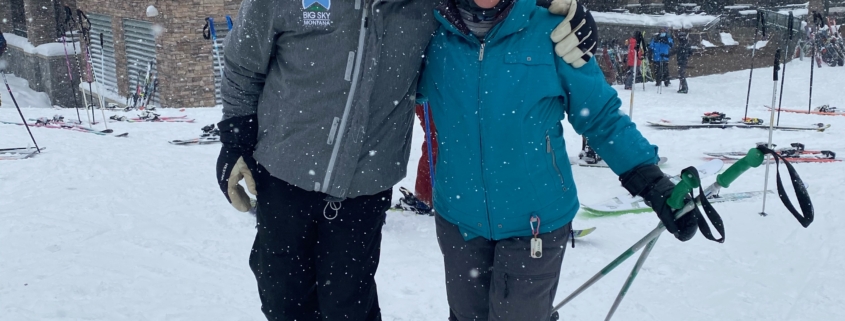
Dan Egan and Evelyn Kanter at Big Sky, Montana

Skiing the Snowfields and Couloirs of Turkiye with Dan Egan

He’s one of the most famous extreme skiers of all time, a super-nice guy, and a talented filmmaker whose latest, ‘Return to the Silk Road’, takes us skiing with him and his nephew through the mountains of Turkiye, formerly known as Turkey.  I’m referring, of course, to Dan Egan, who also coaches backcountry skiing around the world in his sell- out clinics, from Les 3 Vallees, France to Big Sky, Montana, where this photo of the two of us was taken.

Egan screened the 20-minute film to attendees at the SnowBound ski show in Boston in November, where I was part of the audience oohing and aahing at spectacular scenes of daredevil skiing and equally memorable scenes of you-have-to-see-this-at-least-once-in-your-lifetime destinations like Cappodocia.

You are probably familiar with photos of hot air balloons floating over the otherworldly area of hundreds of small sandstone peaks, carved out for ancient dwellings.  Egan takes you here when it’s all snow covered and even more magical.  Here, kabobs replace schnitzel, sweet tea replaces gluhwein, and haggling over pennies for a souvenir or valuable hand-made Turkish carpet from a vendor in an old-fashioned souk replaces a pre-printed (and overpriced) pricetag elsewhere.

The film in part recreates Dan’s and his brother John’s roles in the groundbreaking 1991 Warren Miller  ‘Steeper and Deeper’. There are plenty of clips from that film, along with behind-the-scenes stories from Egan and his longtime cameraman, Tom Grisson, who also shot the earlier film.

There are glorious long drone and bodycam shots of Dan and nephew Jonny pushing boundaries – both geographical and skiing – doing perfect s-turns down what looks like miles of fresh powder snowfields and narrow couloirs. Some of them, apparently, were first descents.  And there are shorter ones of them skinning up to what the older Egan describes as a “whole other world”.

Some of his narration is philosophical, about how skiing and snowboarding connect generations, and how gratifying it was to recreate this trip with his brother’s son.  Simply, “I love skiing with him,” Egan says about Jonny.  It’s something we all can relate to when skiing or boarding with family, especially the next generation.

One segment that made me laugh is the crew discovering a time warp ski shop – filled with neon-colored one-piece ski suits like those worn in the 1991 film.

Since then, the resorts where they skied then – Cappodocia and the sides of the volcano of Mount Erciyes – have grown into  world-class destinations from a single t-bar or single chair.  And I do mean single chair, as in one-person chair.

These days, Erciyes has nearly 100 miles of marked trails, from beginner and intermediate cruisers to the expert terrain skiers named Egan eat for breakfast.  And it’s an Indy Pass member.

It’s a delightful film for anybody who likes great snow, great views, great storytelling, and discovering new ski destinations to add to your  bucket list.

Best of all, it’s free to watch on YouTube.  Thanks, Dan Egan and your DeganMedia.

http://youtube.com/v/8Ui68wycz7k

www.dan-egan.com

www.skiclinics.com

See you on the slopes -maybe even the slopes of Cappodocia or Ercicyes in Turkiye.

My Favorite Place to Ski at Big Sky

Photo by Andrew Meehan on Unsplash

My favorite run at Big Sky just happens to be my mother’s name, Lizette.  It is the kind of run you find out about from a local or a regular who knows where to find the best powder stashes. Or, you discover it by accident, as I did.  Either way, it’s the kind of run that quickly becomes your top choice among a mountain of choices.

Lizette is a delicious glade, with myriad gentle bumps polka dotting wide-spaced evergreens and aspens. It’s tucked in between two of the perfect turn wide groomers on the Southern Comfort side of the mountain, thankfully missed or ignored by those zooming past the small sign turn-off.  Often, I’ve been alone for the entire run, stopping not to catch my breath but to inhale the solitude.

Every time I ski Lizette, I know she is watching over me, making sure I have a great time.  She even watches over folks I’ve introduced to the trail, such as Tom Alexander, a fellow skier from the 70+ Ski Club. He had never skied bumps or a glade before. I convinced him he could handle these powder puffs, promising that my mother would watch over him, too. 

She did, of course.  He did fine, and bragged about the experience over dinner that evening.  

I learned to love mountains from the woman who grew up in a small town in Bavaria long before high-speed four-, six- and even eight-seater lifts, computers, digital remotes, live streaming, men walking on the moon or cars with automatic transmissions and lane departure monitoring. 

She was sent to America alone in her early 20s just after WWI, to work and send money home to support her family struggling in an economic crisis not of their doing – like millions of immigrants before her and since.  I cannot imagine her fear of heading to a land where she did not speak the language and knew nobody except the name on the piece of paper of a woman from her hometown who promised her a job when she got to NYC.

I grew up with stories of her childhood hikes in the nearby Alpine mountains, walking to the local tavern to fill her Poppa’s beer stein for dinner before the days of refrigeration at home, and bedtime readings of Heidi, who also loved the mountains.  Okay – they were the Swiss Alps, not the Bavarian Alps, but why quibble.

Even though she never skied, she would get that wistful faraway look when somebody is calling up a memory whenever I described the crisp, clear air and spectacular picture postcard view from the top of some mountain I had skied.  And she shook her head laughing in pleasure whenever my two then-young children told her about their yard sales and lost mittens at the mountains where they learned to ski.

My mother Lizette passed away in 2005 at the impressive age of 103.  It was before I had discovered “her” run, so I could not tell her about it, and enjoy her shaking her head and laughing in disbelief that there was a ski trail somewhere with her name on it.

But I do that now always on my first excursion of the day on the gladed trail named Lizette, looking up briefly and saying “Hi, Mom” – and on every lap that follows.

I always head to Southern Comfort in the morning, when it’s in full sun. It’s also when Big Sky’s powder hounds are headed elsewhere, so the lift line here tends to be short, and generally stays that way for the rest of the ski day.  Also because this is an older, slower fixed grip triple, not one of the super-modern ones with heated seats and a bubble cover to further protect against the weather, like Big Sky’s Ramcharger, Swift Current and Powder Seeker lifts.

There’s also the opportunity to ski from Southern Comfort to the super-luxury Montage Resort hotel, where the lobby bathrooms have super-luxury heated seats.  I cannot imagine what a woman who survived two World Wars and the Depression would think of those.  My turn to shake my head and laugh.

There’s another bubble-chair here to a couple of groomers and one treacherous bump run, and no lift line any time I’ve ventured here.

Lizette is enough of a favorite that I did seven laps in a row one day last season – more or less, since I had stopped counting after four or five.

She was watching over me each time, and if you ski Lizette with me, she’ll watch over you, too.

A few spots are open for SeniorsSkiing.com subscribers to join the 70+ Ski Club trip to Big Sky Jan 31-Feb 7, 2026.  Please email us for details.  click here

64 Years of Skiing & the Consequences

I first skied when I was six, and loved it from the first day.  It was a rope tow at North Creek, NY, near my mom’s hometown.  By the second day I was taking the rope-tow and couldn’t understand why sometimes the rope felt SOOOO light in my hands, and other times it was almost too heavy to hold on.  But most important…every time I let go the rope at the “get-off” spot, I was on the way to FUN!   It’s been 64 years of fun, enjoyment, camaraderie, a bit of racing, good anxiety, wet, cold, enormous powder dumps, sleet. You know what I’m talking about, it’s the wonder of skiing and always having fun on the hills.

Except that the past season of 2024 wasn’t  great at all. It started out with the rainiest day I’ve ever skied in January.  I was in Vermont with old friends, and said I’d take their granddaughter up on the hill.  She had a great time, I taught her a basic wedge/snowplow, and we had fun all day long.  The only problem was the dull ache in my left hip.  It had been bothering me more often  during the previous twelve months.  In 2021, I’d seen an orthopedic specialist, who said, “Well, you don’t need surgery now, and maybe you never will, but there’s some erosion of cartilage in your left hip joint.”

The discomfort in my hip got a bit worse each of the past three years.  I tried PT but it didn’t work for this (the cartilage was going, going…and then pretty much gone by winter 2024).  By March 2024, with one decent hip and one goner hip, my annual spring trip to Snowbird & Alta was bittersweet.  Always love being out there, but I was skiing (in my mind) like an old guy, and I didn’t like it, cause I still didn’t feel “old”!  But I could only manage a decent turn to the left, and that just doesn’t cut it in the Wasatch!  In my mind I knew my future. So I did what I had to do. I got in touch with my “bone doctor”, or orthopedist.

Now, three years after first meeting my doctor, I understood why he’d originally said, “well, you may never need a hip replacement  at all”.  Everyone’s body works differently, and so whereas my cartilage was now gone (and to quote the goodfellas in Goodfellas: “and there wasn’t nothing we could do about it”), plenty of other guys and gals in my situation, with a similar period of “time passage”, might have more cartilage working for them in the joint, thereby lessening pain and immediate need for surgery.

My pain was constant, so I asked my doctor for some names of top surgeons. The first guy had done the surgery to replace a very good friend’s hip nine years ago, but now he wasn’t doing as many surgeries, being older.  So I called the next surgeon on my list.  There was something in his manner that exuded a quiet confidence in his surgical abilities (he specializes in hip and knee replacements).  I was already feeling really good about him, when he said, ”so you’re a skier”.  I told him I was, and had just returned from a Utah trip, but that my home mountain was Stratton in VT.  “That’s where I ski with my family every year”, he said.

Well, you guessed it.  I chose him.  It was important to me that he was an athlete, a regular skier, and we both loved the same mountain in Vermont.

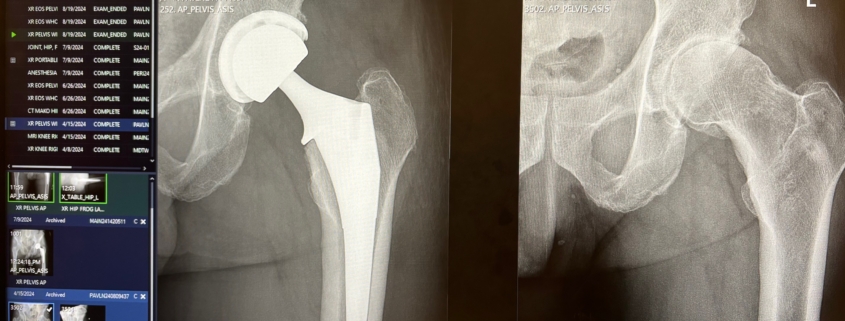
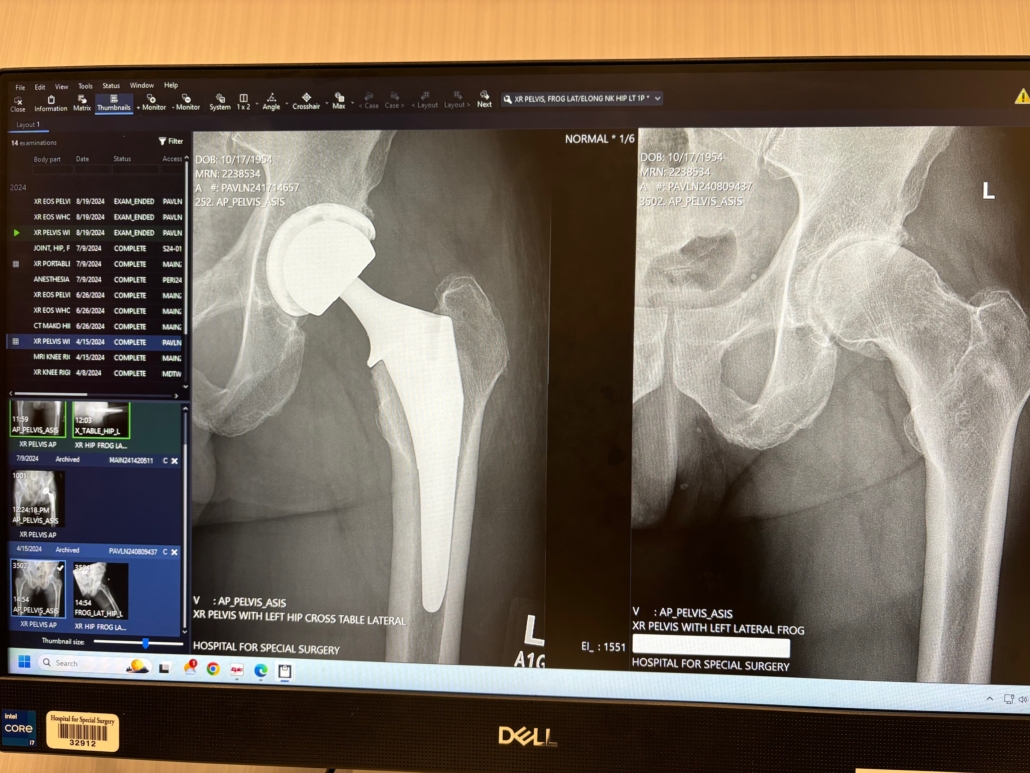
X-Ray of John Gleb’s Hip

Three months later, in early July, I had the surgical procedure done in New York City.

My hip feels great, zero soreness from area of incision.  Walking average of 1.5 miles per day.  And because the cartilage had all but disappeared in my left hip joint, it had the result of shortening my left leg perhaps an 1/8 of an inch, which contributed to my irregular walking gait.  Now both legs are the same length again, (another beautiful consequence of the surgical procedure), and walking feels totally normal.  Am I happy?  You better believe it.  Did I wait too long?  No, I actually think I waited the right amount of time.

Moral of the story for me: Pain is a signal that something’s wrong, especially when it doesn’t go away, and acting on that signal has been such a great thing for me. Got questions?  Happy to reply.  I’m just a regular guy, not a doctor.  But pleased to be helpful in any non-medical way, personal perspective, etc.

Very thankful I did this.

The Top Resorts in Europe – World Famous and Not

Lots of snow and sunshine days, gorgeous views, varied terrain, modern lifts and multiple choices for dinner, nightlife and shopping.  All are the hallmarks of what makes a winter resort great anywhere in the world, including in Europe. These are the top-rated resorts in France, Italy, Switzerland elsewhere in Europe are based on a mix of all those things, plus transfer time from and back to the nearest airport.  Plus the low cost of weekly ski passes – as low as $50/day – adds to the appeal.

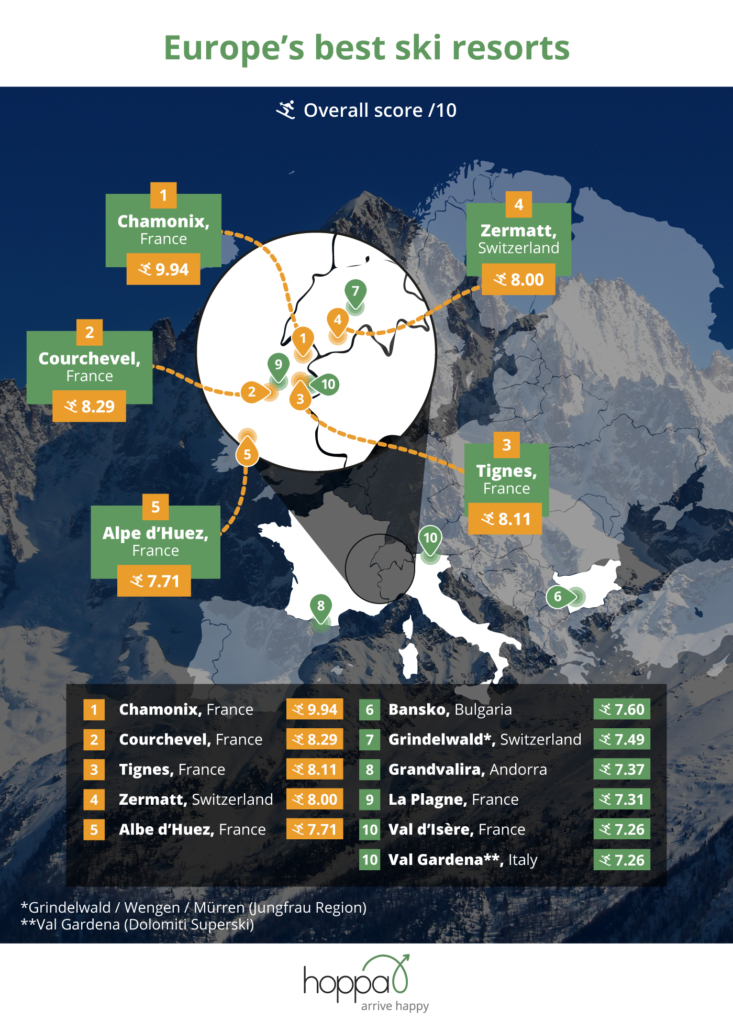
Research by the Europe-based air transfer company hoppa rates Chamonix, Courchevel and Tignes the top three, and includes lesser known Bansko, in Bulgaria, and Grandvalira, in Andorra, as up-and-coming super-affordable hidden gems less crowded than the larger and more famous destinations on the list.

So here are some factoids to help you decide where to go next –

Chamonix  – Nestled at the foot of Mont Blanc in the French Alps, Chamonix tops the ranking with an overall score of 9.94. Famous as the birthplace of modern alpine skiing and host of the first-ever Winter Olympics, it remains one of the world’s most iconic resorts.

Ski passes average $85/day for a weekly pass, annual snowfall reaches 470cm, and no other resort in the list offers as many restaurants or nightlife options.

Courchevel – Contributing to Courchevel’s high score is its average annual snowfall of 399cm, its high number of nightlife listings and restaurants and its high number of Google searches. Courchevel is a great place for a luxury stay. Along with stunning scenery and desirable hotels, and more than a dozen Michelin-starred restaurants in the area, including Le Sarkara, Le 1947 à Cheval Blanc, and Baumaniere 1850.

Ski passes also average $85/day for a weekly pass.

Tignes – This resort completes an all-French top three with a score of 8.29 out of 10. Contributing to its high score is its high snowfall of almost 700cm per year, an affordable ski pass of just around $50/day for a weekly pass, and its high number of nightlife listings.

Due to Tignes’ high average snowfall – around 669cm a season – it is considered a safe resort to book. That means you don’t have to worry about whether or not it will have snow.

Val Gardena (Dolomiti Superski) in Italy and Val d’Isere, also in France, are also on the top ten list – and both are destinations this season for the 70+ Ski Club.

Bansko ski passes are the least expensive on the list – around $50/day  – which is one third of the price of Zermatt in Switzerland, the most expensive ski resort in in Europe, and also on this top ten list. Bansko has a ten-mile cruiser known as the “Ski Road”.  Closest airport is Sophia.

Grandvalira is the largest ski resort the Pyrenees, with more than 150 miles of trails, 70 lifts and six base areas. Is part of the group that also includes Pal Arinsal and Ordino Arcalis. You can ski all three on one pass for around $75 for a weekly pass.

Other resorts on this top ten list include Grindelwald/Wengen/Murren in Switzerland’s Jungfrau Region and two more areas in France, both smaller and lesser known than their big sisters, La Plagne and Alpe d’Huez.

Surpisingly, no resorts in Austria or Germany made this list.

Not world-class Innsbruck, with its world-famous Hahmenkamm run, or even Gurgl, where I learned to ski after college in the 60s, trading English lessons for ski lessons, and site of the recent World Cup races in which Mikaela Shiffrin cemented her winning legacy as G.O.A.T.  Not Garmish-Partenkirchen in Germany’s highest mountain range, site of the1936 Winter Olympics, where some inns on the main street have been serving guests since the 1600s.  So it goes.

You can read the full research here: https://www.hoppa.com/en/discover/infographics/european-ski-index

What is your favorite ski resort in Europe? Where do you want to go next?

See you on the slopes.

It’s Everywhere!

If you have been shopping for cold weather gear lately, PrimaLoft is hard to miss. This ubiquitous synthetic insulation marked by a triangular red shield is now featured in more than 1,000 cold weather brands that cater to the winter wear market. Very likely it is an important part of your winter wardrobe now.
What is PrimaLoft? And where did it come from?

As the popularity of skiing grew in the 1960s and 70s, so did the need for clothing to stay warm on the slopes. Goose down insulation was the answer.  A down parka was the epitome of popular fashion and practical comfort. But it turned out there was a problem. Once that down insulation got wet, its ability to hold heat went away. So long outdoor comfort!

In 1983, the US Army research lab in Natick Ma. asked  the Albany International Corp., a pioneer in advanced textile and material processing, to develop a water resistant alternative to goose down for military issue clothing. The goal was 97 percent of the warmth, weight and compressibility of down, whether wet, or dry.

The result:  PrimaLoft, a synthetic down, that was patented in 1984 and established for commercialization as a subsidiary of Albany International in 1989. . A year later, the first commercially available PrimaLoft insulated garment was manufactured and marketed by L.L.Bean. PrimaLoft Inc became a privately owned independent company in 2012 with headquarters in Latham NY, outside Albany. Today, one form or another of the insulation is used in jackets,, pants, gloves, shoes, sleeping bags and just about anything insulated offered by companies that sell outdoor products.

PrimaLoft products are mainly a polyester microfiber, often made from reclaimed plastics like water bottles that have been through a clean, shred, and melt process and designed to be biodegradable. There are also versions that are blended with merino wool.

Currently,  in addition to the headquarters in upstate New York where product research and development activities are based, the company has representatives in Europe and an office in Asia. The emphasis is creating insulation featuring recycled content using advanced manufacturing technology and renewable energy that significantly reduces carbon emissions in production. The trademark you see for this is PrimaLoft P.U.R.E. A serial innovator, this fall (fall of 2025) the company introduced six new products that enhance and  fine tune commercial applications of the insulation fibers.

Originally conceived for all-weather use by the military, PrimaLoft has emerged over the past 40 years as a mainstay in the recreational clothing industry and regular feature in the wardrobe of skiers everywhere.

Skiing Les 3 Vallees, World’s Largest Connected Area

My favorite ski trip last season was with the 70+ Ski Club to Meribel, in the heart of Les 3 Vallees, the world’s largest ski/snowboard resort, in the French Alps.

There are more than 375 miles of groomed trails and many more miles of ungroomed that the Europeans call, simply, “off piste”.  In six days, I hardly ever skied the same run or took the same lift more than once – easy to do with nearly 200 trams, gondolas and chairlifts. 

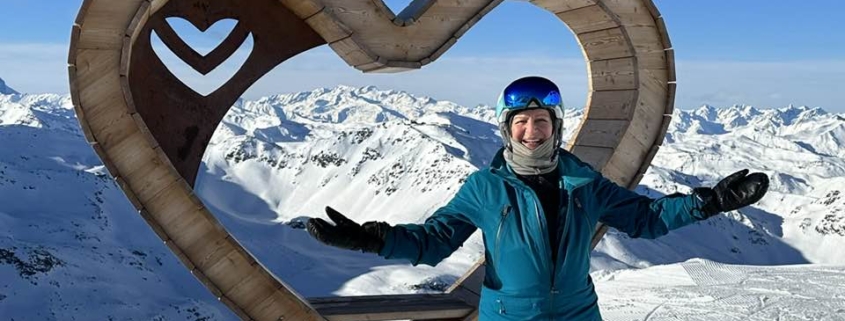
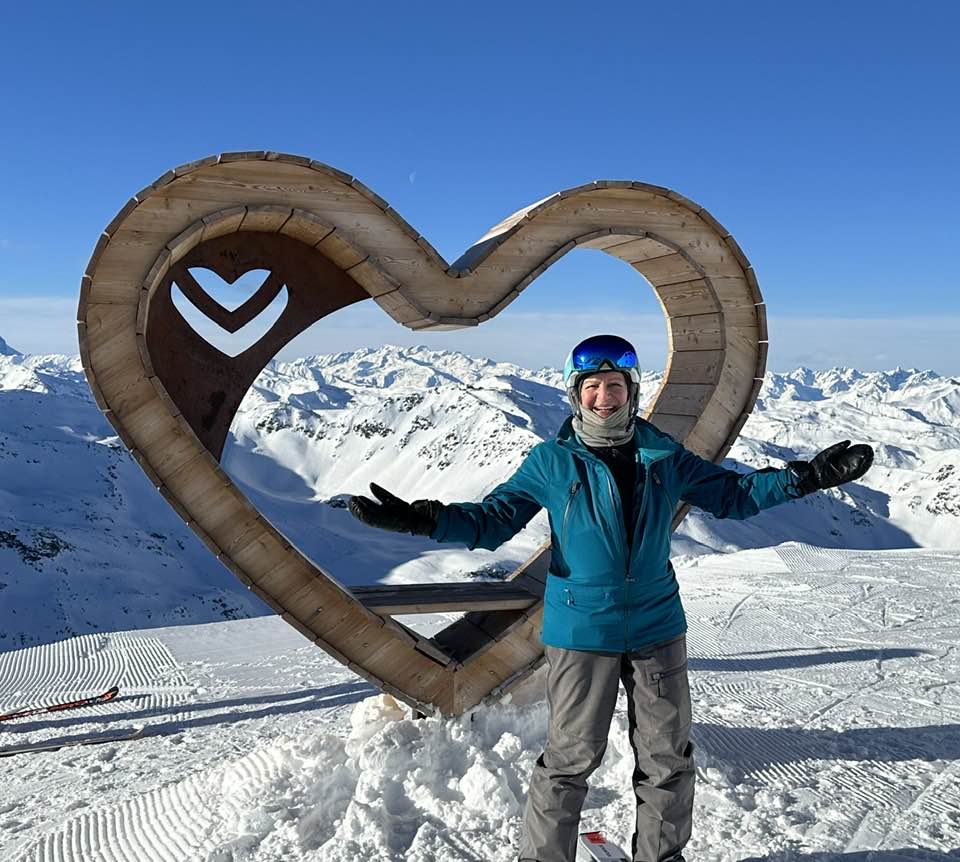
Meribel bills itself as the “heart” of Les 3 Vallees, since it is in the center valley, making it easy to ski over to Courchevel on one side or Val Thorens on the other.  Heart-shaped wooden sculptures polka-dot Meribel’s many trails, all of them – of course – placed at a picture postcard view for selfies, including with Mont Blanc in the distance.

Each valley is large enough to have several villages, and it’s important to remember the name of yours so you can ski back to the right one at the end of the ski day.  Otherwise, it’s a long and expensive taxi ride, as much as 90 minutes and a matching number of Euros. 

One of the perks of skiing in Europe is that rentals or passes cost the same for a full week as for one single day back home, which balances out the higher cost of your airline ticket.  A weeklong pass for a zillion acres and non-stop scenery was around $150 for those over 70 ($450 if you are under 70), including insurance for the French version of ski patrol.

The main run in Meribel is Mont Vallon, with long – and I mean LONG – wide cruisers on either side of the lift.  Everything here is supersized – one day I skied 23 miles with my guide, and that’s with stopping repeatedly for photos or to catch my breath and the hour-plus mid-day meals which are an integral part of the experience in the Alps.

The French take lunch seriously and just don’t understand the American style of grab-and-go.  Maybe it’s because – unlike back home –  there are dozens of mid-mountain restaurants serving gourmet fare.  So I indulged – including a local beer brewed in a land better known for its wines.

Courchevel is the most famous of the three valleys, with villages named for their location in meters – 1350, 1550, 1850 – plus a couple of others with actual names.  The higher you go, the more expensive the hotels get, including a Vuitton hotel and one owned and operated by the Rossignol family. 

Courchevel also is where the best nightlife is. But those who know me know that I’ve been saying for at least the last 30 years that when I ski all day, my idea of nightlife is a pillow at 10pm.  Maybe 9pm, now that I’m 70+. So, you’ll have to ask somebody else about nightlife in Courchevel.  Or shopping.

I loved discovering trails in 1550 named for Native American tribes, along with a teepee with Native American artifacts inside – a slopeside example of Europe’s ongoing love affair with the Wild West. 

Val Thorens is the highest of the three valleys, so the season usually starts earlier and finishes later then elsewhere.  My favorite run here was another goes-on-forever cruiser, off the Ponte de la Masse lift to the village of Les Meniures, below the village of Val Thorens.

Val Thorens, perched at an altitude of 2,300 meters, has just been crowned “Best Ski Resort in France and the World 2025” for the tenth time in 12 years by the World Ski Awards.

There’s also a backside bowl, Orelle, that would be rated black and double-black in the USA.

Evelyn Kanter at Meribel Les 3 Vallees

Trail ratings are similar to the USA – green for beginner, red (not blue) for intermediate, and black for expert.  Unlike the USA, trail markings are minimal – just poles with the color designation and a sign at an intersection with the names and direction of connecting trails.

So it’s up to you – or your guide – to know where you are, where you are going, and how to get back to your hotel later. Maybe that’s why there are more than 1,400 uniformed instructor/guides in Les 3 Vallees.  Mine was originally from Scotland, who visited during college eons ago and never left. 

The nearest airport is Geneva, then a 90-minute drive to your destination in one of the three valleys.  I added a few days after skiing to visit Lausanne and Montreux, both hugging the shores of Lake Geneva. Several others in the 70+ Ski Club group added on Geneva, Paris or London, depending on their airline connections, before or after.

I’m ready to return, since there are still several hundred of the 375 miles of trails and 200 lifts and dozens of mid-mountain restaurants that I need to check out.

A bientot – which is French for see you soon, hopefully on the slopes.

It’s All Waiting for You in Idaho!

While still relatively unknown for its’ amazing skiing, Idaho has a long and storied ski past with 2026 being their 102nd anniversary of ski operations. 102 years ago, Idaho’s first ski area took shape as Blackwell’s Jump. According to “Ski the Great Potato: Idaho”* it was created for the inaugural McCall Winter Carnival, Jan. 24, 1924, and was maintained and operated through 1937. This marked the start of a skiing revolution that transformed small-town hills into world-class destinations. You may ask, “Why Idaho?”. Here’s why:
Idaho is uncrowded – Even on holidays and weekends lift lines with more than a 10 min wait are rare. Idaho offers a range of reasons to ski there. There are 19 Ski Areas with epic terrain. You’ll find a total of 29,000 vertical feet on over 22,000 skiable acres. From smaller, very affordable “breeder and feeder” ski areas to larger areas offering on mountain lodging; you’ll find a range of additional activities including cross country skiing, night skiing, award-winning restaurants, sledding, horse-drawn sleigh rides, indoor water parks, spas, skating, guided snowshoeing tours and more.

Resorts offering on mountain lodging include Schweitzer, Silver, Tamarack, Sun Valley and Grand Targhee. Many others have lodging (and relationships) with lodging partners in nearby towns including Lookout, Brundage, Bogus, Soldier, Pebble Creek and Kelly Canyon.

Beginners will find amazing programs and lesson packages at Rotarun, Bald Mountain, Pomerelle, Cottonwood Butte, Snowhaven and Little Ski Hill. Over half offering an extremely affordable daily lift ticket under $70. Please check out the comparison page at https://skiidaho.us/compare

There’s natural beauty with epic views all around. Schweitzer offers views of three states plus Canada. Grand Targhee offers spectacular views of the Grand Tetons (I know because I’ve been there). Silver has the longest gondola in North America with epic views of the Silver Valley. Sun Valley, perhaps Idaho’s best known resort, has 250 sunny days a year. Brundage boasts stunning views of nearby mountain ranges and Payette Lake. Tamarack offers similar views of Cascade Lake.

Bringing the kids along? Fifth graders can ride 18 mountains, three times each for only $29, sixth graders can ride two times each with the purchase of a 5th /6th grade Peak Season Passport.

Idaho enjoys high snowfall averages at all of its major resorts. And you can visit many of them in one trip. Idaho has six regions with two or more ski areas within easy distance of one another.

Idaho is served by two major airports: Spokane WA (GEG) and Boise (BOI). Additionally, we have four regional airports in Idaho Falls (IDA); Sun Valley (SUN), Pocatello (PIH) and Magic Valley (TWF). Please check out the Ski Idaho travel page at https://skiidaho.us/traveling-to-idaho for more detail or click on the Idaho banner ad and be sure to Visit Idaho.

*“Ski Areas Past and Present” by Margaret Fuller, Doug Fuller, and Jerry Painter.

Amtrak Ski Train Returns for 2025/26 Season With Expanded Service

All aboard! Take the train between Denver and Winter Park and avoid both traffic jams on I-70 and base area parking problems.  This season, Amtrak has expanded its service to add both Thursdays and nearby historic Fraser, Colorado to the schedule.

The 2025/26 Amtrak Winter Park Express operates Friday-Sunday between December 19 and January 4.  Expanded service is Thursday-Sunday, starting January 8, through March 29.

One-way fares start at just $9 and $4.50 for kids, with no baggage fees for your gear.  Now that’s a deal!  Especially since close-in parking at Winter Park this season is a whopping $50 on weekends and $40 on weekdays.

Amtrak Benefits on All Ski Trains

Unlike airline checked baggage or car rental agency add-ons for a luggage rack, you can bring your gear on board for free, and there are special ski storage racks on most trains. Plus, Amtrak offers discounts to passengers 65+, to members of the military and to disabled passengers. Families can save money, too, as children (and grandchildren) aged two to 12 are eligible for 50 percent off tickets.

Choose a one-day round-trip, or split your outgoing and return to spend an entire weekend, a full week or longer. Each way takes about three hours.

The Amtrak Winter Park Express leaves Denver at 7:00 am and leaves Winter Park Resort at 4:35 pm local time. While onboard, you’ll enjoy a trip in Coach class, featuring wide, reclining seats, big picture windows, ample legroom and no middle seat. And free wi-fi.

Be sure to visit the bi-level Sightseer Lounge for panoramic views of the Rocky Mountains and Moffat Tunnel from upstairs and café service with snacks and drinks for sale downstairs.

If you stay on to the additional stop in Fraser, you can learn about the town’s frontier history at the Cozens Ranch Museum, or zip down the Frazer Tubing Hill, or both.

Amtrak Guest Rewards members earn 2 points per dollar spent on the Winter Park Express.

Amtrak Trains to Other Resorts

Glide into some of the Northeast’s top ski destinations aboard Amtrak’s Vermonter, between St. Albans – Essex Junction (Burlington) – Springfield – New York – Washington, DC, while you pass quaint New England villages and towns tucked beneath the beautiful backdrop of the snowcapped Green Mountains.

Resorts accessible on the Vermonter include Stowe Mountain Resort, Jay Peak Resort, Bolton Valley Resort and Okemo Ski Resort.

  • Vermont Ski Resort
  • Berkshire East Mountain Resort

The Ethan Allen Express operates daily between NYC, Albany, Rutland and Burlington, including a scenic stretch along the Hudson River through the Hudson Valley.

Killington is accessible from either Rutland or Burlington, via regularly scheduled public bus service on Vermont Translines.

California Zephyr

Th classic and scenic California Zephyr travels year-round between Chicago and the snow-capped Sierras beyond San Francisco, through some of the most beautiful scenery in the USA.  Although you might not want to make the full 51-hour trip in winter, it’s each to choose in-between destinations such as Denver and Salt Lake City, or via connections to Emeryville.

Ski/snowboard resorts accessible from the California Zephyr include Palisades Tahoe and Diamond Peak in California;  Alta, Deer Valley and Park City in Utah; Keystone, Breckenridge, Vail and Arapahoe Basin in Colorado.

See you on board.

The Comeback XC Skier

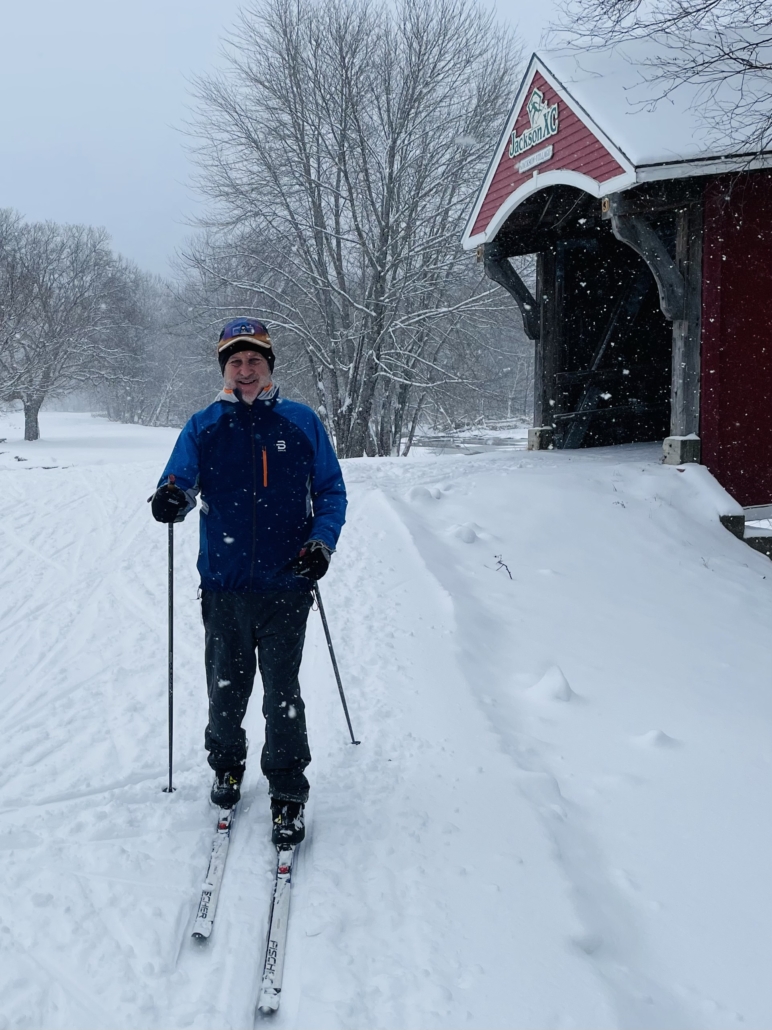
RBL at Jackson XC

There is a ski industry statistic that cross country (XC) skiers have owned their skis for an average of 17 years. I don’t remember the source of the information and it is probably outdated, but I’ve quoted it for more than three decades and after attending an excessive number of ski swaps, reused ski equipment sales, and local yard sales, I can attest that indeed there are a lot of really old XC skis out there. Every now and then I buy an old pair of wooden XC skis that are in pristine shape so I can use my pine tar stuff to recondition the ski bases and use them once a year.

This talk about old XC ski gear got me to thinking about the “comeback skier.” You know, the people who tried XC skiing in the past, and then put the gear in their garage and took a rest- of-their-life hiatus. In general, many of these folks tried XC skiing and felt it was too much work particularly when comparing it to alpine skiing where they could ride a ski lift up a mountain followed by skiing back downhill. A ski industry term for these people is “lapsed skiers” but recently the skier participation statistics are showing a resurgence in XC skiing which may be a resurrection or revival and is likely connected to the aging baby boomers and a new group of younger people interested in winter recreation, wellness, and getting outdoors.

This potential returning lapsed XC skier may have originally thought that the sport was not their cup of tea, but Father Time and Mother Nature may have conspired to change the outlook on XC skiing for older and younger people, respectively.

There are reasons that one might consider coming back to XC skiing. The sport is soft on the body and you can do it at your own pace. You can ski on the flat terrain which is relatively easy rather than climbing uphill on trails that will require returning on high speed adventures that could cause concern. You could XC ski for a short time such as a half hour, which would cover a short distance. I go XC skiing for about 4-5 kilometers (2-3 miles) on flat terrain and it takes about 45 minutes, but that distance may require a bit more time for the comeback XC skier.

TIPS FOR THE COMEBACK

For the first few days of the comeback, keep it on a manageable level of time and effort while you become accustomed to it. Like anything, if you do it regularly you will improve in every aspect XC skiing. You probably have light layers of clothes (base layer, outer layer, good noncotton socks, light gloves and a hat) that can be used for XC skiing.

Perhaps you would consider going out with a ski instructor to get tips that will make the sport easier and give you some goals to achieve. In fact, it is highly recommended that returning XC skiers rent XC ski equipment and take a ski lesson to see if it is something that might be pursued further. The newer XC ski gear (skis, boots, poles) may surprise the comeback skier because the gear makes the sport much easier than decades ago. Waxless skis give better grip and glide than ever before, XC ski boots are both supportive and comfortable, bindings can be adjusted out on the trail, and even the new pole straps are helpful.

Ellen Chandler, executive director at Jackson XC and board member at Ski NH commented “Sometimes these former skiers bring their old gear which has not benefited from sitting around for the past 20 years.  We do get some rescue calls when old boots “blow out” on the trail.  Boots are the weak link. Also, some things have improved with the passage of time, so a person who can reenter the sport with new, responsive boots (plastics have improved over the years) attached to skis with bindings that have benefited from improved engineering, and a ski with a more subtle but effective pattern base, or a “skin base,” is setting themselves up for success.”

XC skiing still does not cost an arm and a leg to either acquire equipment or visit a commercial XC ski area like Jackson XC, where a trail fee is paid to access groomed trails and maybe they’ll even use snowmaking. At the ski area you can get rental gear, a trail pass, and take a lesson for a package price. Jackson XC 2025 Day rate – $25 for adults; Rental day rate – $25; Group lesson Super Saver package – $89 and it is lower for kids and seniors.

In the Rocky Mountains, the folks at Breckenridge Nordic Center will give a 20% discount if you register on the Internet for a group lesson. They specialize in working with people who have never been on snow and share the joy of the XC skiing by helping skiers learn efficiency and control. Josh Dayton, who runs the operation has produced a 9-minute video that can be accessed with a QR code by skiers to watch in advance of their experience on the snow which covers the touch points about controlling the skis and maintaining balance. It’s great for first timers or folks who want a refresher in the basics! All staff at the resort are ambassadors who offer ski tips to anyone. As soon as the skier steps out the door there is a staff person there who helps skiers put the equipment on, review the trail map, talk about body balance, and so on. When people come to Breckenridge Nordic with old equipment, they get offered a free upgrade to see the difference that new gear can make in the skiing enjoyment. Here’s the video https://www.youtube.com/watch?v=_i6978nfvEw

After XC skiing, expect a little soreness if you have not used the specific muscles associated with XC skiing recently, but typical over-the-counter medicines, rub-on creme, or pads should take care of any of those problems. If you go XC skiing at a groomed ski area a few times, you will quickly get the feel of gliding along the snow in the tracks or on packed trails; you’ll be traveling at a slow speed that provides immersion in the outdoors and nature; you’ll be enjoying one of the best forms of exercise and with a regular schedule of XC skiing, wellness (physical and mental) will be yours to experience in very little time.