

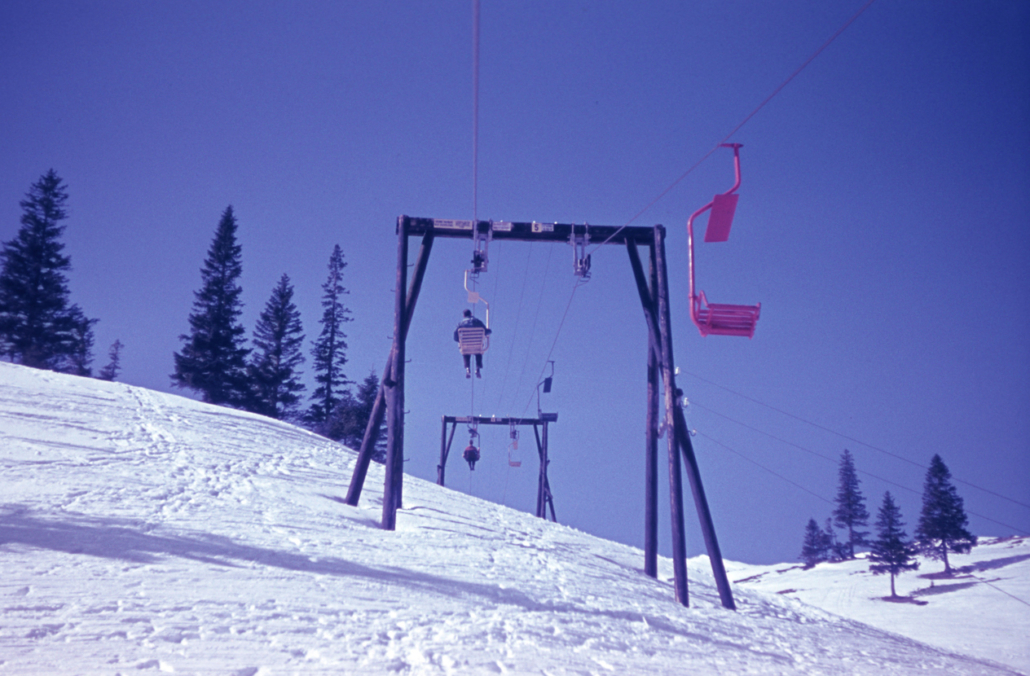
Is the “Golden Age” of Skiing Coming to an End?
Credit:Dirk von Mallinckrodt
When I look back to my early days skiing in Connecticut in 1962, I’m amazed at how the sport has progressed. Back then there was little to no snowmaking, no grooming, and no high-speed lifts (and certainly no on mountain WiFi!) These innovations have profoundly changed the quality of the skiing experience overall. But where is the sport going? Today skiing faces the prospect of more monumental changes in its future in the form of climate, operational, and demographic changes. Recently, the sport has suffered a substantial decline in participation, accessibility, and profitability.
As anyone who skis in the east knows, and in Europe for that matter, climate change is real. It’s perhaps the single greatest challenge facing the sport. There’s no denying the season is getting shorter on both ends and rain (childishly called “wet precipitation” by some snow reporters) is a threat at any time during the season. The more frequently occurring freeze-thaw cycle is making it more and more difficult for resorts to provide a quality surface consistently. While many resorts have spent fortunes on snowmaking systems, it comes with environmental and economic costs. It requires vast amounts of water and is energy intensive, raising sustainability concerns.
Climate scientists warn that ski resorts, particularly those at lower elevations, will see a steady decline in natural snowfall. Smaller resorts that lack the financial resources to invest in snowmaking are already struggling to remain operational. While large, well-funded ski resorts have managed to survive through investment and diversification, smaller ski areas are struggling. Many local ski hills have closed in recent decades due to financial difficulties, lack of consistent snowfall, and declining visitor numbers. These smaller ski areas often serve as entry points or “feeder mountains” for new skiers, meaning their disappearance could further accelerate the sport’s decline.
Without affordable, accessible ski areas, fewer young people are introduced to skiing, leading to a shrinking base of future skiers. This creates a cycle where only large, expensive resorts remain, reinforcing the perception that skiing is an exclusive and costly activity.
The rising costs of skiing continue to support that belief. The cost of lift tickets, equipment, accommodation, and travel have risen sharply over the past few decades. The heavy commercialization of major destination resorts has led to significant cost hikes. We’ve all heard the stories about lift tickets exceeding $200 a day. The result is the pricing-out of middle-class families and younger generations. In addition to the cost of lift tickets skiers also find themselves dealing with the cost of equipment rentals or purchase, ski lessons, and winter gear further increasing their financial burden. Travel costs, particularly for those who do not live near ski resorts, add another barrier. The high cost of skiing has led many to seek alternative winter activities that are more affordable, such as snowshoeing, winter hiking, and even indoor skiing experiences.
Changing demographics and lifestyle preferences are also critical factors in skiing’s decline. Baby boomers played a key role in skiing’s popularity from the 1960s to the 1990s. The generation is now aging out of the sport. Younger generations, particularly millennials and Gen Z, still engage in outdoor activities, but their interests are more diverse and often lean towards experiences that are less structured and expensive. Skiing has also struggled for decades to attract diverse participants, again reinforcing the position that skiing is for wealthier, predominantly white demographics. Efforts to make skiing more inclusive have been slow, and many potential newcomers feel unwelcome or excluded from the skiing community.
Despite all the challenges facing skiing, the sport is not doomed to disappear. The decline of skiing is a complex issue driven by environmental, economic, and cultural changes. While skiing faces significant challenges, there are opportunities for adaptation and reinvention.
If the industry embraces sustainability, affordability, and inclusivity, skiing can remain a viable and enjoyable winter sport for future generations. The future of skiing depends on whether it can evolve to meet the demands of a changing world while preserving the essence of the sport that has captivated people for generations.
- Recycled Water, Real Snow: Big Sky’s Path to a Greener Ski Season - March 19, 2026
- The Rise of Private Ski Resorts for the Very Wealthy - February 5, 2026
- If It Doesn’t Hurt, You’re Not Doing It Right! - January 8, 2026


It’s not just up to industry, current skiers have to talk up skiing too. On chairlifts I always say “I’m Paul. You come far? Skiing with friends? Like the day? Have neighbors that ski? Yes, I get a lot of sideway glances but this is taciturn New England and it takes awhile to get people out of the freezer even even when we’re skiing in it.
Hello Paul, I always enjoy and encourage a good conversation on the lift. Whether the talk is about equipment, the conditions, sharing ski knowledge, or just idle chatter, the social element is a valuable part of the sport. My worst rides up are with closed mouthed riders who remain silent for whatever reason. It makes for a long ride.
My first skiing experience was also in Connecticut at a now closed area called Ski Rattlesnake in Somers/Stafford Springs. Back in the 60’s 3 rope tows lace boots and just fun
Thanks David, your summary is clear and present, and unfortunately unsettling. Many of the sports we grew up around, (I am 70) i.e. football, basketball, baseball, were affordable to the extent that schools most often supplied equipment, and there were no entrance fees. Skiing was also affordable, what with less than 2 bucks for a lift ticket and easily attainable equipment from the local hardware store, or even borrowing from your neighbor… if not accepting their hand-me-downs. In my neighborhood, the hand-me-downs were a multi-family resource. My grandson secretly pouted with his mother when I brough him used equipment… really good stuff at a fraction. Motivating a kid these days takes too much buff and shine. Children don’t build forts anymore… metaphorically. It didn’t take long for him get along with it all, no one made fun of his equipment on social media. Another factor are the passes. The industry folks are hip to this. Net-net, it’s always about money. Good news is that skiing technology across the board is fabulous. Buy used, buy a pass, ski less hours per day, and more days per season. GEO
In my day I skied over 30 Western and Canadian ski mountains and many midwestern ski hills. Arthritis forced me to give up skiing at 85, I am now 93. It is obvious to me that the high cost of skiing has driven much of the middle class away from skiing.
Interesting article. Ski prices over the past decade have risen dramatically over the past decade. I am not a fan of these huge mountain pass collectives (Epic, Ikon, etc) because I think they have hurt the spontaneity of the sport. My friends and I use to decide to go skiing on a whim, but now you have to plan your ski days like a military campaign to get a decent price. However , the US Ski industry have had their best 4 out of 5 seasons this decade. Last season’s total visits were the 3rd highest on record. I’m not sure about Climate change because we may be having shorter seasons but better (check New England + Canadian Rockies ski areas, US Northern Rockies). I think the biggest problem is the high cost to start in the sport (clothes, equipment, cost of a 1-day ticket).
Vic, I share your nostalgic comment about “…deciding to go skiing on a whim…”. I and my friends used to check the weather each morning and see where the best snow was. Armed with that info, we would decide where to ski that day, jump in the car and make tracks to the mountain of our choice. When we got there we bought a day ticket that, while not cheap, was at least affordable. The excitement of that spontaneity is gone. Resorts are purposely killing the day ticket, and therefore the day skier, to drive customers to a pass. Vail recently announced It’s peak day ticket will be $356 this season? Who is stupid enough to pay that? Only the very rich, who don’t care. Sane people realize three days of that will buy a season pass. That’s exactly what the resorts want.
Much has been said of the challenges the industry faces. Notwithstanding, getting a younger asset involved seems to be a key factor for sustainability. Simply put it’s too expensive for a family of four to ski – whatever the venue may be. Somehow the cost has to be reduced. For example, some ski areas provide a mid-week (usually like a Wednesday) for a significantly reduced first day on skies package – and give them a full day/night experience with some limited all mountain access, not just the bunny slope, – which could be easily controlled with RFID tickets. Such an incentive does provide at least an economic reason to try the sport for a day. Yet, these types of programs are not widely advertised! Why do the ski areas, who claim to want to encourage participation, not advertise their reduced cost programs? And really reduce the cost not a cursory fly-buy, or some ginger-bread like a free soft drink or a not-so-tasty hot chocolate, or a worn out billboard on the interstate! Yes, advertising is expensive, however without it who really knows what is available. Perhaps resort areas might consider specific targeting of population areas that have greatest potential for revenue return with a younger target audience in mind. In addition, make the advertising culturally appealing since there seems to be a demographic slant to skiing participation.
At 76 I’ve 75 years and coached junior ski racers for decades. Skiing has always been an expensive sport and lifts, snow making and grooming ain’t cheap. Today no one would be happy with the bare spots, rocks and ice we skied back then. Most skiers want groomed highways and wouldn’t ski without them. I live near Syracuse N.Y. and there are three areas within an hours drive – two in half an hour or under. A season pass and locker are very affordable – less than three days of sticker shuck at Mt Fancy. The usable vertical is how much you descend before stopping. For most this is less than the 600 vert at the local hills so the 2900 vert of the Snowbird Tram line is well beyond their reach and the 5,500 at Revelstoke and others more so. As a codger I ski weekdays only arriving when the area opens and ski non stoppers for two to three hours when my legs say stop and I enjoy my pp and j in my warm car watching the parade of descending skiers. Small ski areas near population centers are the backbone of the sport and deserve much credit.
It’s a competition to see which will kill skiing the fastest: Climate change or the ski industry itself.
TJ
I’m not much concerned with the way it used to be, but the last paragraph about skiing becoming more sustainable, affordable, and inclusive is right on. The issue is how much will it cost ski companies (product suppliers and ski areas) to move in that direction; Can they continue finding cheap labor with J1 visas; Find housing for employees; Continue finding discounted energy; Find source materials; Address waste; Take advantage of smart promotional strategies; Devise ways for prices to be reduced, etc…all while continuing to maintain a reasonable profit.
This article raises some very salient points on why skiing is in decline as a winter sport but I would like to suggest that there is another problem that make people hesitant to take up skiing. Skiing has always had a fast fashion aspect where most ski equipment/clothing winds up in landfills because there is no real second hand market for any of it and most of it is unable to be recycled, particularly skis, binds and boots. For anyone who is only able to get skiing 2 or 3 weekends a year or maybe only able to get away for a week long ski holiday at some resort, this does not make skiing a very attractive sport to consider when you also add in the cost lift tickets and lodging. Skiing will survive but unless the sport can address its enviromental impacts and increasing cost of entry the number of skiers will continue to decline.
Not enough people are skiing -wha????? Vic and David clearly showed that skiing on a whim is truly dead, unfortunately. I can only assume that all the new requirements , i.e. reservations for parking, nearly mandatory multi-day ticket purchases, etc. were set up to handle the crowds waiting with bated breath to spend inordinate amounts of money doing their favorite sport. No??? Then why?
Patti, your assumptions are largely correct. A all those measures are simply meant to control the absurd amount of skiers that can show up on any given day. We’ve all seen the pics of epic lift lines. When those long lines appeared it lead to the creation of the reservation system. Resorts are learning how to adapt to the situation they created as they go. Corporate passes are a great value but the unintended consequences you mention, among others skiers have to deal with, are a result of resorts realizing they could boost their preseason cash flow with passes priced to steer customers away from the day pass since they believe day pass traffic is too unpredictable for crowd management.
To: Dirk , I enjoyed your article especially Mohawk Mt. where I first started skiing in the late 50’s. I recognized the photo of the open trees near the top like it was just yesterday, thanks. At age I8, I started teaching at Mt. Snow where in the late spring towards the last few days of operation I rode up the chair with Walt Schoenknecht, owner. We skied a couple of runs on the North face which was the only reaming skiing left. He told me about how many years he scouted out a location with more than normal snow located close to New York city to attract a high population for a successful enterprise. A very cordial and laid back personality, all I can say, he was a very genuine person. As I was typing this comment, I looked his name up on the computer and to my surprise he also developed a ski area in Gatlinburg, Tennessee. My wife and owned a few rental cabins about 10 years ago in Gatlinburg and skied there a few time not knowing he did it! Our eyes lit up when we read the article and the photo of him looked just like I remember him. Thanks again Dirk for bringing me down memory lane. Don
What do you mean by the future if the spurt is deowndant in ‘inclusivity’? I understand how price and climate and/or snow affect the sport of wealthier white peopke, but how will ‘ inclusivity’,
( definition ?) affects the future viability of the sport.
Hello Steve,
I think your question is, “How will inclusivity affect the viability of the sport”.
For decades now, in an effort to get them to ski, the ski industry has practiced inclusivity by actively promoting to minorities . What I meant was, with the decline of the Boomers, skiing will need to replace them. For several decades now the skier universe has stayed around 12 million. Where will new skiers come from?